Drift vs Intercom for B2B Conversational Marketing: An Honest 2026 Comparison
Turn this article into takeaways for your work.


Each assistant summarizes the article only for you and suggests best practices for your work.
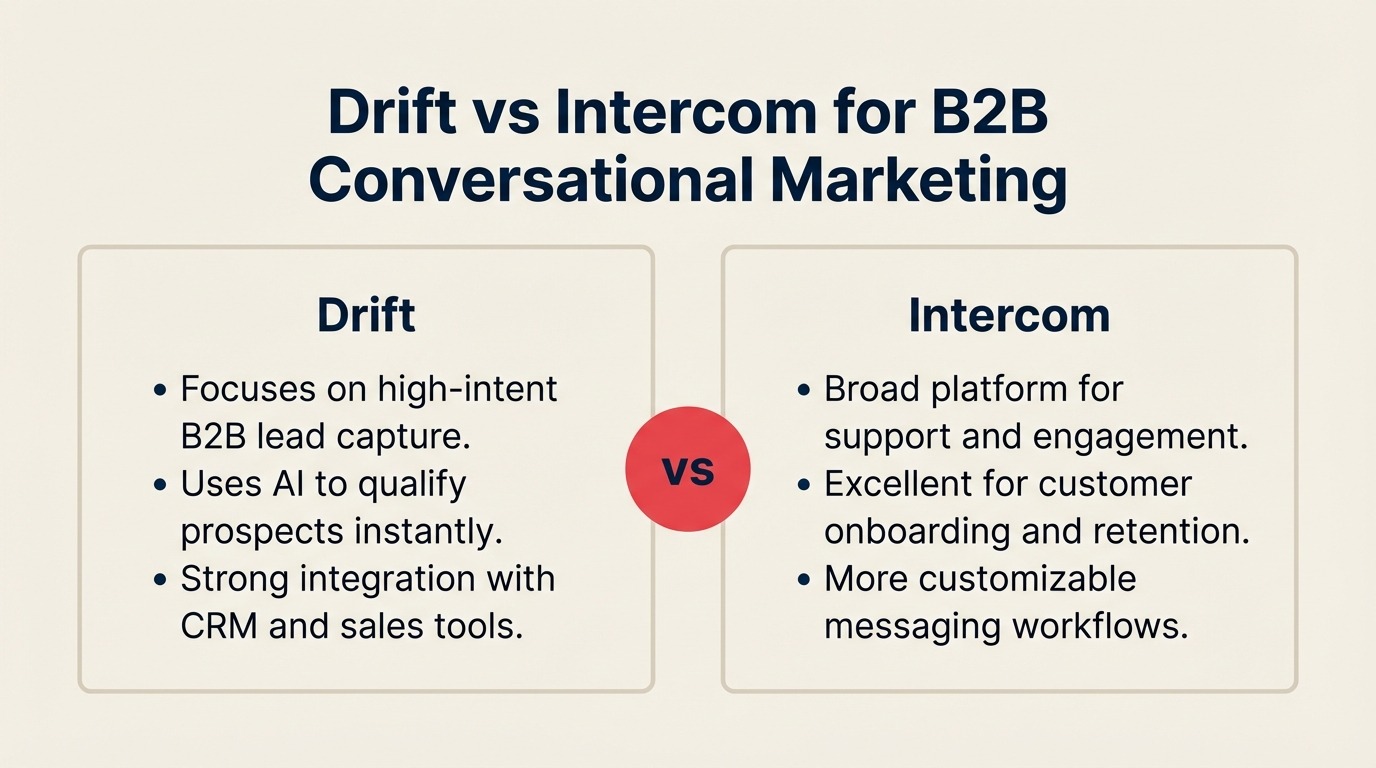
There's a question that keeps coming up in demand gen and marketing ops circles: do we go with Drift or Intercom? Both are expensive. Both are well-known. And they've both been recommended in the same breath for years, even though they've been drifting apart (pun intentional) in terms of what they actually do.
In 2026, this comparison is more complicated than it was two years ago. Drift was acquired by Salesloft. Intercom went all-in on AI-driven customer support. If you're evaluating these tools today, you need to understand where each product is heading, not just where it sits right now.
This article gives you the honest breakdown, including where each tool genuinely wins, where each falls short, and what to look at if neither is the right fit for your team.
What Each Tool Actually Is in 2026
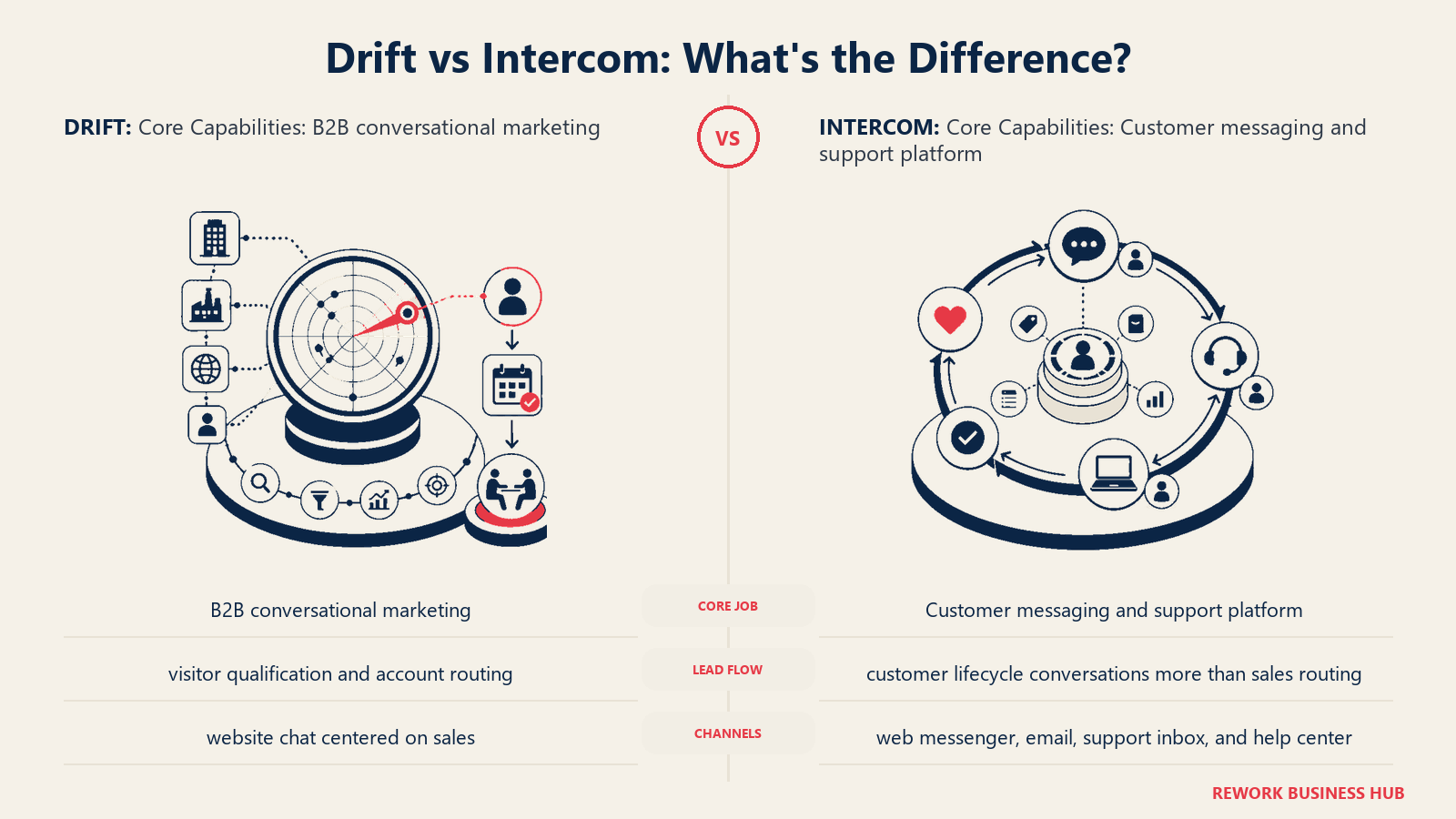
Drift started as a conversational marketing platform. The core idea was website chat that qualifies visitors and routes them to sales reps, without forms. Over time it evolved to include AI chatbots, ABM intent signals (via the Drift Engage and Lift AI integrations), email, and more. In 2024, Salesloft acquired Drift and folded it into the Salesloft platform as the "Conversational Marketing" component. If you're a Salesloft shop, Drift is now a natural extension of your outbound motion. If you're not, Drift is still available as a standalone product, but its roadmap is increasingly tied to the Salesloft ecosystem.
Intercom is a customer messaging platform that has covered support, onboarding, and marketing from a single inbox for years. In 2024 and 2025, Intercom went all-in on AI. Its Fin AI Agent product handles tier-1 support queries at scale. But Intercom still has live chat, proactive messaging, product tours, email campaigns, and a help desk. It's one of the few platforms that tries to cover the entire customer lifecycle, from first website visit to long-term account expansion.
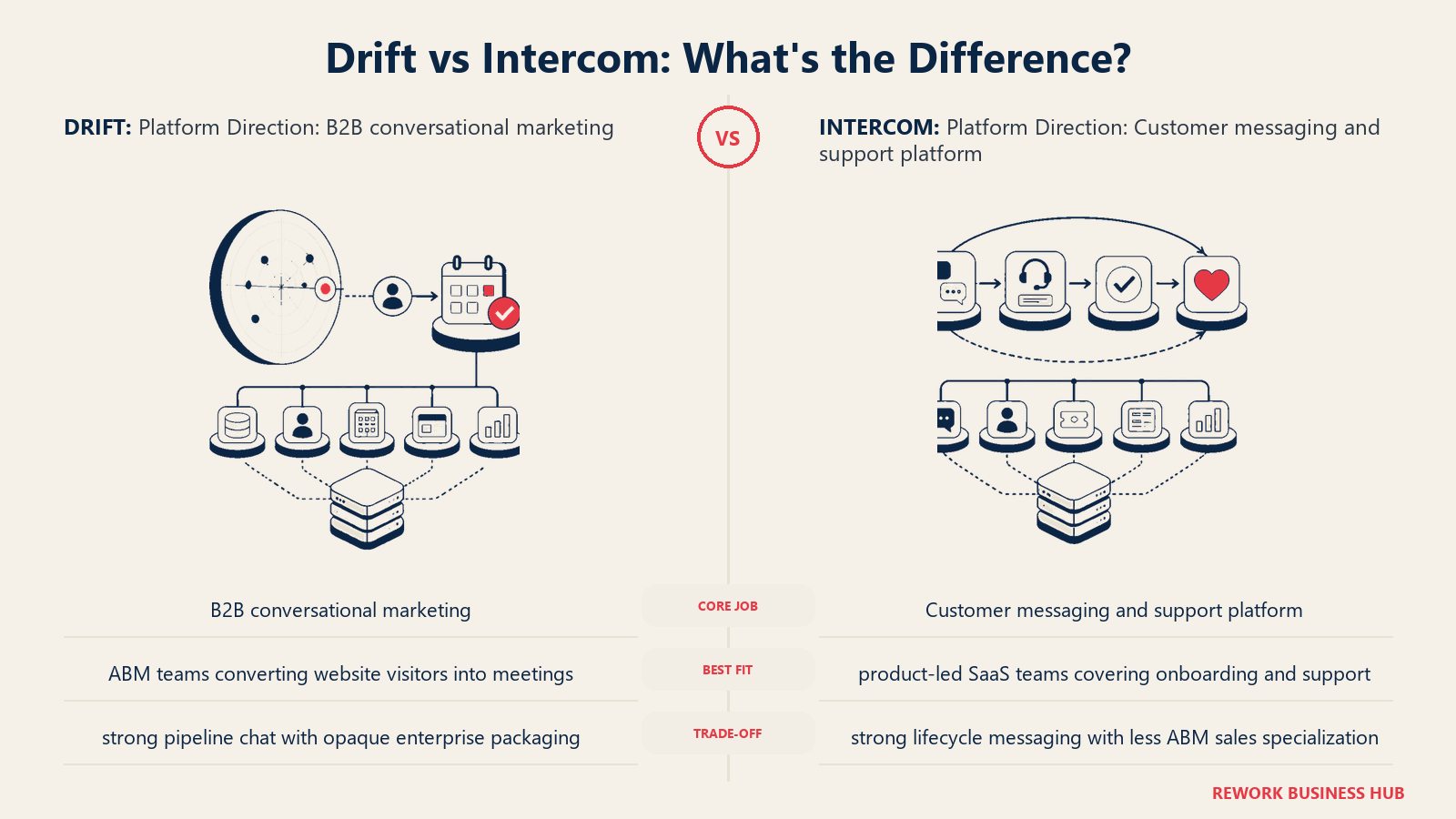
These two products serve different primary use cases. Drift is pipeline-generation-first. Intercom is customer-lifecycle-first. That framing is the clearest way to think about this decision.
The Head-to-Head at a Glance
| Drift | Intercom | |
|---|---|---|
| Primary use case | Pipeline generation, ABM website engagement | Customer lifecycle (support + onboarding + marketing) |
| Entry pricing | Custom / contact sales | Starter from ~$74/seat/month; Essential from ~$87/seat/month |
| Live chat | Yes | Yes |
| AI chatbot / agent | Yes (Drift AI) | Yes (Fin AI, strong) |
| Email campaigns | Basic | Yes, full email sequences |
| Help desk / ticketing | No | Yes, full help desk with ticketing |
| Product tours | No | Yes |
| ABM / intent signals | Yes (Drift Engage + partner integrations) | Limited |
| In-app messaging | No | Yes |
| HubSpot integration | Yes | Yes |
| Salesforce integration | Yes (deep, especially in Salesloft ecosystem) | Yes |
| Pricing model | Seat-based + platform fee | Seat-based + resolution-based (AI) |
| Best-fit team | ABM-heavy enterprise, Salesloft shops, pipeline-focused sales | SaaS, PLG, customer success + marketing combined |
Pricing Deep Dive
Be warned: this section will frustrate you, especially on the Drift side.
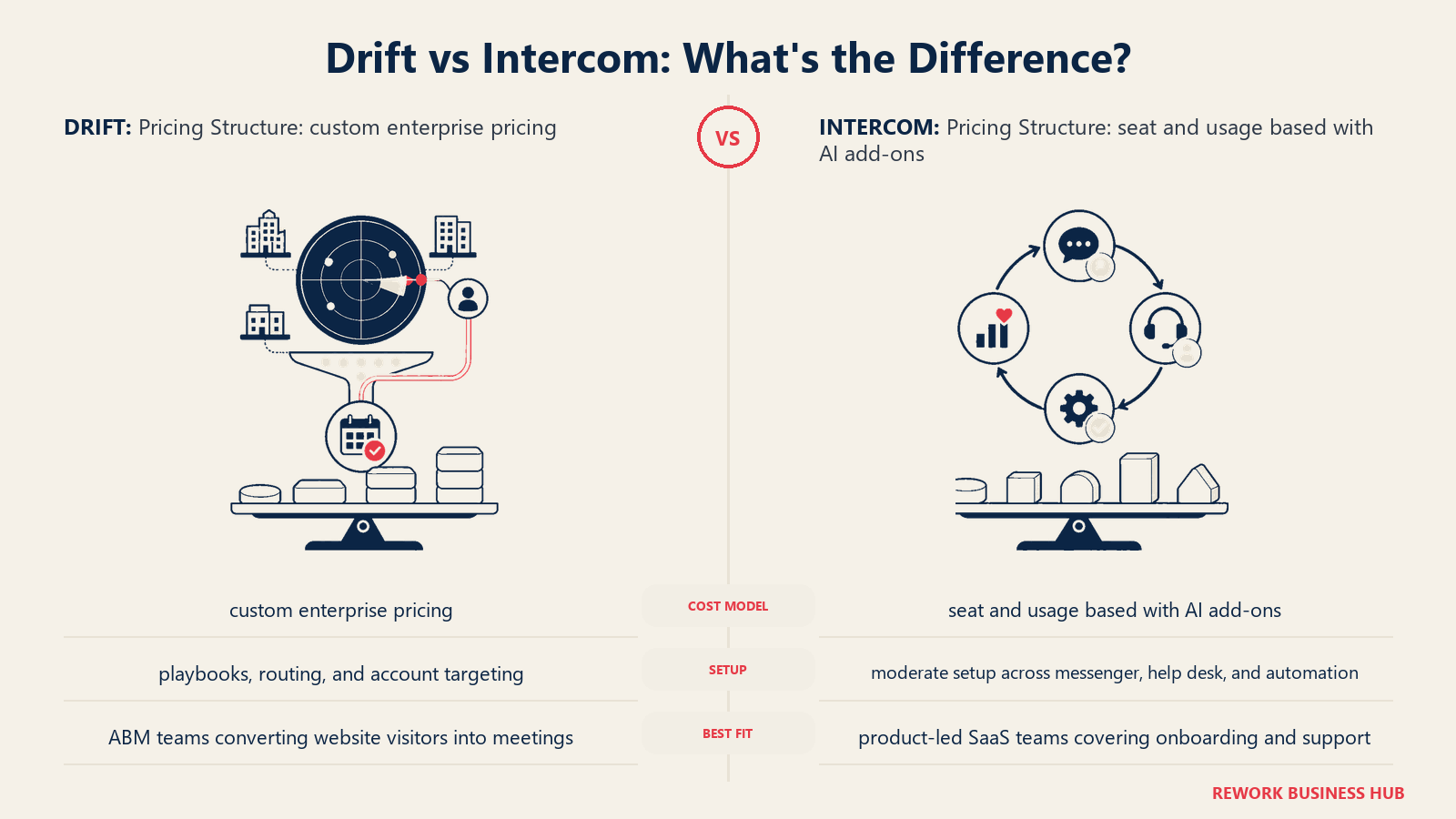
Drift pricing in 2026 is opaque. Drift moved to custom enterprise pricing a while back, and the Salesloft acquisition didn't make it more transparent. You won't find a public pricing page with clean tier breakdowns: Drift's pricing page redirects to a "contact sales" form. Conversations typically start in the $2,000–$3,000/month range for a small team. For mid-market teams with ABM use cases and multiple users, expect $5,000–$15,000/month once you add Drift Engage (their ABM layer) and more seats.
The opacity is a legitimate concern. It makes budgeting harder, it gives Drift more leverage at renewal, and it's a frustrating experience when you're trying to run a fair vendor comparison. That's not a knock on the product itself, but it's real information you need going into conversations with their team.
Intercom pricing is more transparent, though still complex because of how they layer seat-based and resolution-based costs for the AI tier. Intercom's pricing page publishes the full tier breakdown.
- Starter: ~$74/seat/month (billed annually). Limited features, small teams.
- Essential: ~$87/seat/month. Live chat, basic automation, help desk, email.
- Advanced: ~$153/seat/month. Workflows, custom reports, multilingual support.
- Expert: ~$216/seat/month. Workload management, SSO, compliance features.
- Fin AI Agent: Priced per resolution (~$0.99 per successful AI-resolved conversation). This can get expensive fast for high-volume support teams.
For a B2B team of 5 people focused on conversational marketing (not support), you might run $400–$800/month on Intercom's lower tiers. If you add AI resolution and have any meaningful support volume, costs escalate quickly.
Compared to both of these, alternatives like Crisp ($25–95/month), Tidio ($29–$59/month), and Chatwoot (open-source, self-hostable) look very different. Worth knowing before you sign anything. If the broader question of software sprawl and what enterprise tooling really costs is relevant to your budget conversation, that piece is worth a read before committing to any annual contract.
Feature-by-Feature
Website Chat and Routing
Drift excels here for B2B. Its routing logic for website visitors is sophisticated: identify a visitor as part of a target ABM account, serve a custom playbook, route directly to the account executive. For companies running named-account programs, this is a real differentiator. See also how lead routing in chat works at the operational level before you configure your playbooks.
Intercom has solid website chat with good routing rules, but routing to specific reps based on account-level intent isn't its strength. It's better at routing based on user properties (known customers vs. anonymous visitors) than on outbound ABM account lists.
AI Chatbots and AI Agents
Intercom's Fin AI Agent is genuinely strong, particularly for customer support. It handles tier-1 queries well, escalates gracefully to human agents, and has solid citation/sourcing from your knowledge base. Intercom's own 2025 Customer Service Trends Report found that 67% of support leaders expect AI agents to handle the majority of tier-1 queries within two years, context worth having when evaluating Fin's roadmap. If support deflection is part of your use case, Fin is worth evaluating seriously. Intercom's Fin funding round and its implications for demand gen leaders gives useful context on where the product is headed.
Drift's AI is more focused on qualification and meeting booking: identifying intent, asking qualifying questions, booking calendar slots. It's less focused on support deflection and more focused on converting anonymous traffic into pipeline. Both are solid. Different jobs.
Email Campaigns and Sequences
Intercom has a full email product: sequences, triggered campaigns, behavioral emails. You can run nurture campaigns, onboarding sequences, and product announcements from the same platform. This is a meaningful advantage if you want to reduce the number of tools your team manages.
Drift has email, but it's not a first-class feature. Drift was built for synchronous conversation, not email nurture. If sequences are central to your workflow, it'll probably frustrate you.
Help Desk and Ticketing
Intercom has a full help desk. Tickets, SLAs, assignment rules, a customer portal. This is a core part of the product and genuinely good.
Drift does not have a help desk. If you need unified support and marketing in one platform, Drift requires you to pair it with a separate support tool.
ABM Targeting and Intent Signals
Drift wins clearly on ABM. Drift Engage lets you layer in firmographic and intent data to serve different chat experiences to target accounts. You can show one chat playbook to a $200M target account and a different one to anonymous SMB traffic. Gartner's Magic Quadrant for Conversational Marketing consistently recognizes intent-based chat personalization as a key differentiator for enterprise B2B buyers. For account-based programs, this is hard to replicate in Intercom.
Intercom has some targeting by user segment, but it's not built for outbound ABM logic the way Drift is. You'd typically pair Intercom with a dedicated ABM platform (Demandbase, 6sense) rather than using Intercom for the targeting itself.
Product Tours and In-App Messaging
Intercom has these as first-class features. If you're a SaaS company onboarding users inside a product, Intercom's product tours, checklists, and in-app messages are genuinely useful. It's one of the clearest differentiators.
Drift is not an in-product tool. It's a website and outbound-engagement tool. If in-product messaging matters to your use case, Drift isn't part of the conversation.
Reporting and Pipeline Attribution
Drift gives you pipeline influence reporting: conversations started, meetings booked, influenced pipeline. For a CMO who needs to show chat's contribution to revenue, this is important. Drift's own State of Conversational Marketing report documents how B2B companies are measuring chat's pipeline impact, useful benchmarks before you build your internal attribution model. If the broader question of proving conversational ROI beyond last-touch attribution is something your team is wrestling with, that's worth reading alongside this comparison.
Intercom reports on customer experience metrics: CSAT, resolution time, conversation volume, AI deflection rates. Less focused on pipeline attribution by default, though integrations with Salesforce and HubSpot can fill that gap.
The Salesloft Factor
This deserves its own section because it's material to the 2026 decision.
When Salesloft acquired Drift, two things happened: Drift got tighter integration with the Salesloft stack (cadences, dialer, revenue intelligence), and Drift's standalone product roadmap became harder to predict.
If your team runs Salesloft for outbound sequencing, the acquisition is arguably a net positive: you get chat-to-sequence workflows, unified reporting, and one vendor conversation. The ABM + outbound combination is a real use case.
If your team doesn't use Salesloft and isn't considering it, the acquisition introduces risk. You're depending on Drift's roadmap staying relevant to your non-Salesloft workflow, and on Salesloft's pricing team not bundling Drift in ways that raise your costs. Neither is guaranteed. For teams making a 2–3 year platform commitment, it's worth asking Drift's sales team directly: what does the roadmap look like for standalone customers? The CMO guide to vendor stability after the Drift-Salesloft deal covers what questions to put in front of their sales team.
Who Gets Left Out by Both
Let's be honest. A lot of B2B teams don't need enterprise chat software. They need simple live chat, basic bot qualification, and email notification when a visitor has a question. For those teams:
- Crisp ($25–$95/month): Clean team inbox, WhatsApp and Messenger support, basic bot builder. Good for startups and small teams.
- Tidio ($29–$59/month): Live chat + basic chatbot, AI features added recently, much cheaper entry point.
- Chatwoot (open-source): Self-hostable, free at the base level, solid shared inbox. Requires technical setup.
- Freshchat (Freshworks): Part of the Freshworks suite, competitive pricing, good for teams already using Freshdesk.
If your budget is under $500/month and you don't need ABM intent signals or deep product-tour workflows, Drift and Intercom are both more tool than you need. See Respond.io vs ManyChat for B2B sales teams for options in that range.
Integrations
Both tools have solid integration ecosystems.
| Integration | Drift | Intercom |
|---|---|---|
| HubSpot | Native (two-way) | Native (two-way) |
| Salesforce | Native (deep in Salesloft ecosystem) | Native |
| Marketo | Yes | Yes |
| 6sense / Demandbase | Yes (Drift Engage partners) | Limited |
| Slack | Yes | Yes |
| Rework CRM | Via API/Zapier | Via API/Zapier |
For teams running ABM with 6sense or Demandbase, Drift's partner integrations give you account-level intent data flowing directly into chat targeting. Intercom doesn't have equivalent native partnerships here.
Who Should Pick Drift
- You run a named-account ABM program and need chat experiences tailored to specific target accounts
- Your team is already on Salesloft and wants unified outbound + inbound conversation management
- Pipeline attribution from chat to revenue is a board-level metric for your team
- You're enterprise B2B, $5K+/month budget isn't the blocker, and you want best-in-class ABM chat
- You need sophisticated intent-based routing that sends known ICP visitors directly to their account exec
Who Should Pick Intercom
- You're a SaaS company and customer lifecycle coverage (onboarding + support + marketing) matters
- Your team needs a proper help desk alongside marketing chat, and you don't want two separate tools
- In-product messaging and product tours are part of your onboarding or adoption strategy
- You want AI support deflection at scale (Fin AI is worth taking seriously here)
- You prefer more transparent pricing and don't want "contact sales" as the starting point
- You're product-led growth: self-serve onboarding where in-app messaging is as important as website chat
Who Should Look Elsewhere
- Your budget is under $500/month: look at Crisp, Tidio, or Freshchat
- You primarily need WhatsApp-first B2B sales workflows: look at Respond.io
- You want CRM-first conversation management where deals are the primary object: look at Intercom vs Rework: the conversational CRM angle
- You need simple lead capture from Meta ads: look at ManyChat
- You want to self-host: look at Chatwoot
- You're leaning toward Drift alternatives because the Salesloft acquisition creates uncertainty: Best Drift alternatives for mid-market sales covers those options
Decision Framework: Pipeline-Generation-First vs. Customer-Lifecycle-First
Here's how to run this decision cleanly:
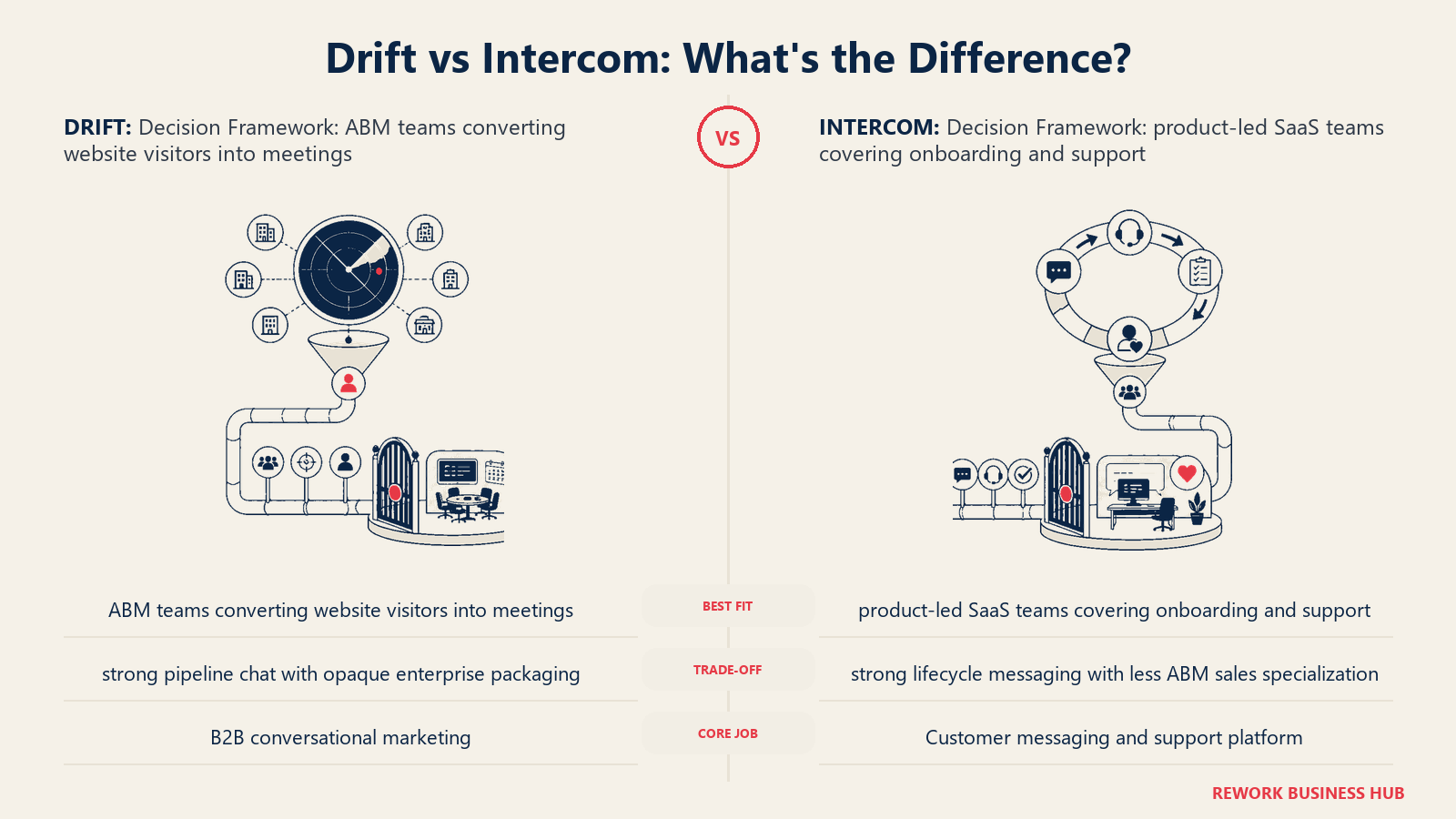
If your primary job is converting unknown website visitors into booked meetings, and your team cares deeply about account-level targeting, intent signals, and pipeline attribution, Drift is the better tool. It was built for this. The Salesloft integration strengthens it if you're in that ecosystem.
If your primary job is managing the full customer conversation from first touch through onboarding and retention, and you want one platform instead of three stitched together, Intercom is the better tool. Its breadth is a real advantage when customer success and marketing are both involved.
Teams that get burned are usually trying to use Drift as a support platform (it's not one) or Intercom as an ABM targeting engine (also not what it does best).
And one more thing worth saying: both tools have gotten more expensive over the past few years while alternatives have gotten better. If you're making this decision in 2026, running a 30-day trial of a simpler alternative alongside your Drift or Intercom evaluation isn't wasted time. The gap between enterprise and mid-market chat tools is smaller than it used to be.
What to Do Next
- Define primary use case first: Pipeline generation from anonymous traffic, or lifecycle management of known customers? This single question narrows the decision significantly.
- Run a Salesloft audit: If you're considering Drift, find out whether your team is likely to adopt Salesloft. If yes, the bundled value is real. If no, evaluate Drift as a standalone product and ask about roadmap explicitly.
- Request transparent pricing from both: Intercom will give you numbers. Drift will ask for a discovery call. That's useful signal about what the vendor relationship will look like.
- Trial Intercom at the Essential tier: It covers the core features well enough to evaluate before committing to Advanced or Expert tiers.
- Evaluate at least one alternative: Try Crisp or Tidio for two weeks. If either of them can cover 80% of what you need at 20% of the cost, that's worth knowing before you sign an annual contract.
Related Resources:

Senior Implementation Consultant
On this page
- What Each Tool Actually Is in 2026
- The Head-to-Head at a Glance
- Pricing Deep Dive
- Feature-by-Feature
- Website Chat and Routing
- AI Chatbots and AI Agents
- Email Campaigns and Sequences
- Help Desk and Ticketing
- ABM Targeting and Intent Signals
- Product Tours and In-App Messaging
- Reporting and Pipeline Attribution
- The Salesloft Factor
- Who Gets Left Out by Both
- Integrations
- Who Should Pick Drift
- Who Should Pick Intercom
- Who Should Look Elsewhere
- Decision Framework: Pipeline-Generation-First vs. Customer-Lifecycle-First
- What to Do Next