More in
Conversational Growth Insights
When WhatsApp Belongs in Your B2B Sales Motion (and When It Doesn't)
Mar 27, 2026
The Death of the Contact Form — What's Replacing It and Why
Mar 19, 2026 · Currently reading
Conversational ROI: Measuring Beyond First-Touch Attribution
Feb 24, 2026
Ad-to-Chat Funnels: A CRO's Evaluation Framework
Jan 16, 2026
The CMO's Case for Owning the Chat Layer (vs. Delegating to Support)
Jan 15, 2026
The Death of the Contact Form: What's Replacing It and Why
Turn this article into takeaways for your work.


Each assistant summarizes the article only for you and suggests best practices for your work.
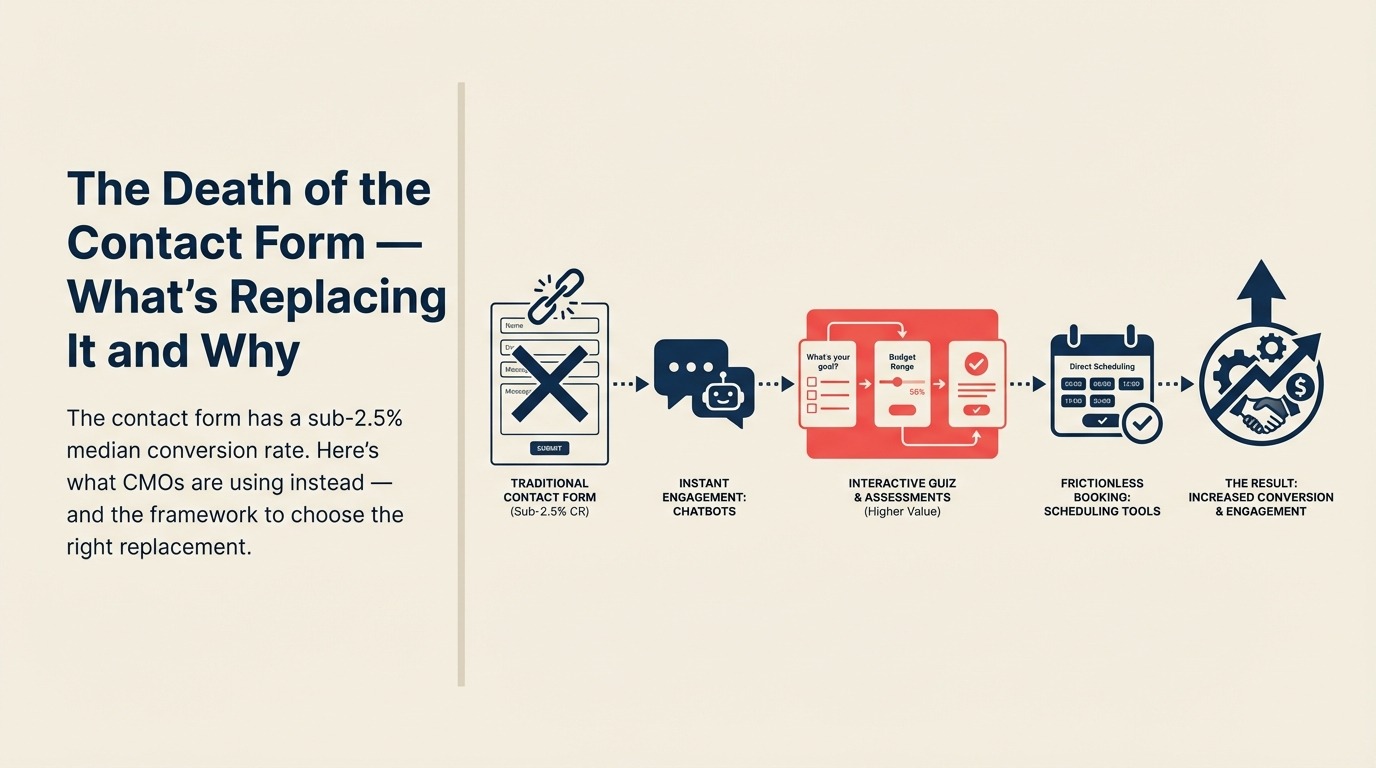
The contact form has been the default B2B lead capture mechanism for two decades. It also has a median conversion rate under 2.5%. That's not a design problem. It's a structural one.
When a buyer lands on your pricing page at 10pm and fills out a form, what actually happens? In most companies, a webhook fires into HubSpot or Salesforce, the lead sits in a queue, and an SDR reaches them sometime the next business day. Or the one after that. By then the buyer has already talked to two competitors who had a Tidio or Intercom widget in the bottom right corner and responded within three minutes.
The companies seeing 3–5x lift on inbound aren't running better forms. They've stopped using the form as the primary capture mechanism and replaced it with something that meets buyers where intent is highest: a conversation.
Why the Form Fails
The form's failure mode isn't obvious until you map what happens on both sides of the submission.
On the buyer's side: they have a question, or they're mid-evaluation, or they just want to talk to someone. The form asks them to describe their need in a text box, hand over their contact information, and wait. That's a high-friction request at a high-intent moment. The median B2B buyer has already done 60–70% of their research before contacting a vendor. They're not in discovery mode. They want a conversation.
On the seller's side: the form creates a follow-up delay problem that the industry has studied extensively. InsideSales research put the conversion rate difference between responding within five minutes versus 30 minutes at 21x. The mechanics behind that gap are documented in detail in lead response time research for B2B teams. Most sales teams, optimizing for efficiency over speed, batch their lead follow-up. The gap between submission and first contact averages 42 hours in B2B. By then the intent signal is cold.
The deeper problem is the intent-friction mismatch. Forms are a low-intent, high-friction capture mechanism. They made sense when B2B buyers expected multi-day delays and had fewer options. Neither of those conditions holds anymore.
That said: forms aren't dead. They work fine for gated content, event registrations, and long-cycle enterprise deals where the buyer expects a formal RFP-style follow-up. The mistake is using them as the default when other channels would convert better.
Three Replacement Patterns
There's no single replacement for the contact form. The channel that outperforms it depends on your sales motion. Three patterns are emerging across B2B.
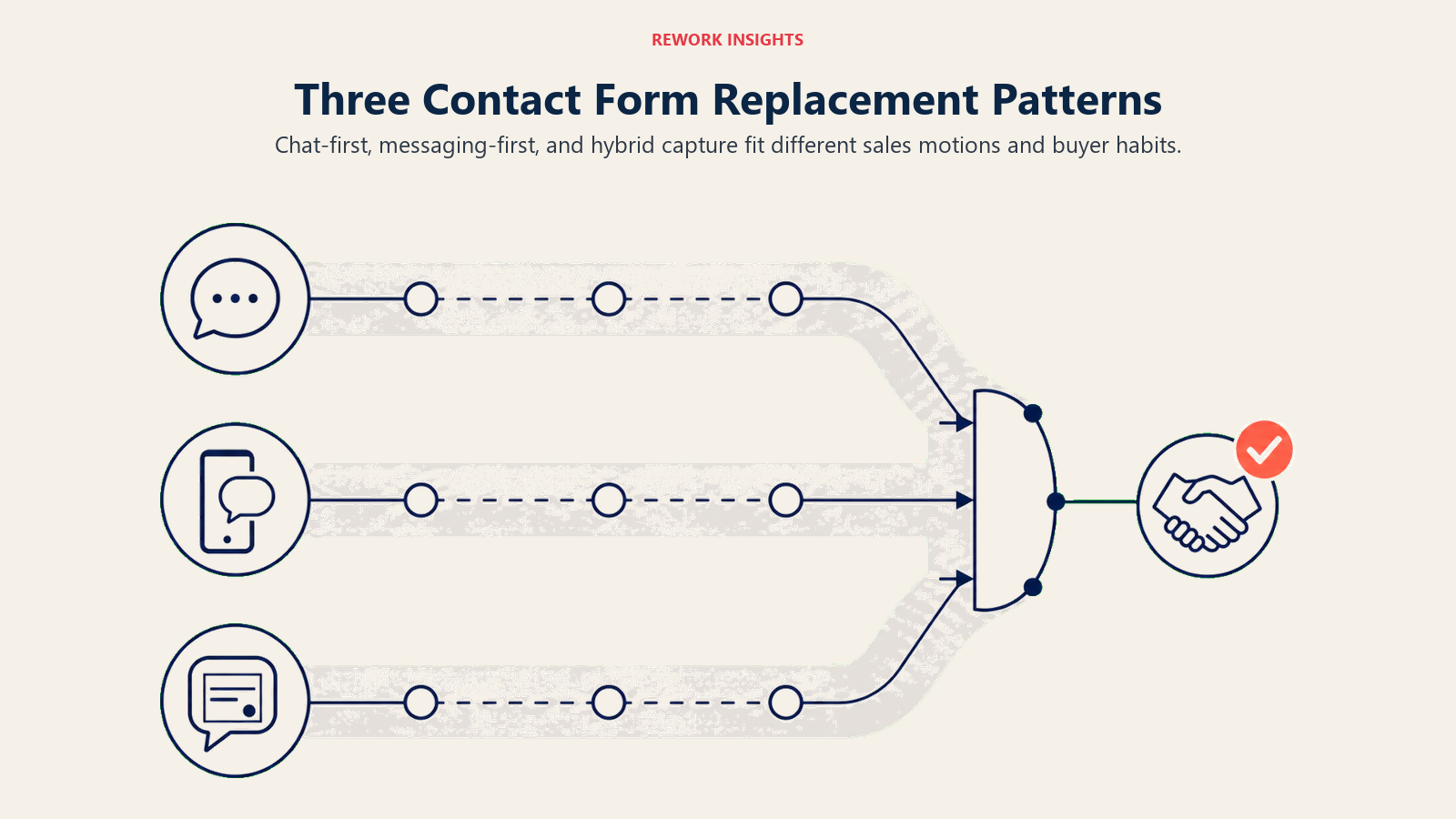
Pattern 1: Chat-first capture. Tools like Intercom, Drift, and Tidio place a proactive widget in the buying journey: pricing pages, feature pages, high-intent blog posts. According to Intercom's Customer Service Trends report, businesses that engage site visitors within the first 30 seconds see significantly higher qualification rates than those relying on passive form capture. Instead of a form, the visitor gets a prompt: "What are you trying to figure out?" or a qualifying question sequence that routes them to the right response.
This pattern works best for SaaS with self-serve or sales-assist motions, where the buyer is already on your site and has some intent. The conversion lift comes from reducing time-to-first-response to minutes or seconds and from qualifying the conversation before handing to sales. A well-configured Intercom bot can do in 90 seconds what an SDR qualification call takes 15 minutes to do.
Pattern 2: Messaging-first capture. In markets where WhatsApp, Messenger, or Line are primary business communication channels, the form is being replaced by click-to-message ad formats and direct WhatsApp Business entry points. Respond.io and ManyChat sit as orchestration layers here, routing incoming conversations, automating initial qualification, and syncing contact data to CRM. If you're evaluating which platform to use, Respond.io vs. ManyChat for B2B sales teams breaks down where each fits.
This pattern works best in Southeast Asia, Latin America, the Middle East, and parts of Europe where messaging apps are how business gets done. It also works for SMB buyers who prefer asynchronous, casual communication over scheduled calls. The interaction feels less transactional and more like talking to a colleague.
Pattern 3: Hybrid capture with CRM routing. Some companies are building form-adjacent experiences where the form is still technically present but is wrapped in a chat interaction. The visitor fills out a short form inside a chat widget, which then routes them to a live agent or sequences them into the appropriate nurture flow, all without leaving the conversation context.
This pattern suits companies with complex routing requirements: multiple product lines, different customer segments handled by different teams, or markets with different response requirements. Platforms like Respond.io support this natively, letting teams build routing rules that assign conversations based on form data, channel origin, or behavioral signals. The technical side of building that routing is covered in the lead routing from chat to CRM guide. And the visitor never has to leave the conversation context.
How Buying Motion Determines the Right Replacement
The biggest mistake CMOs make when evaluating these patterns is choosing on tooling rather than on motion fit.
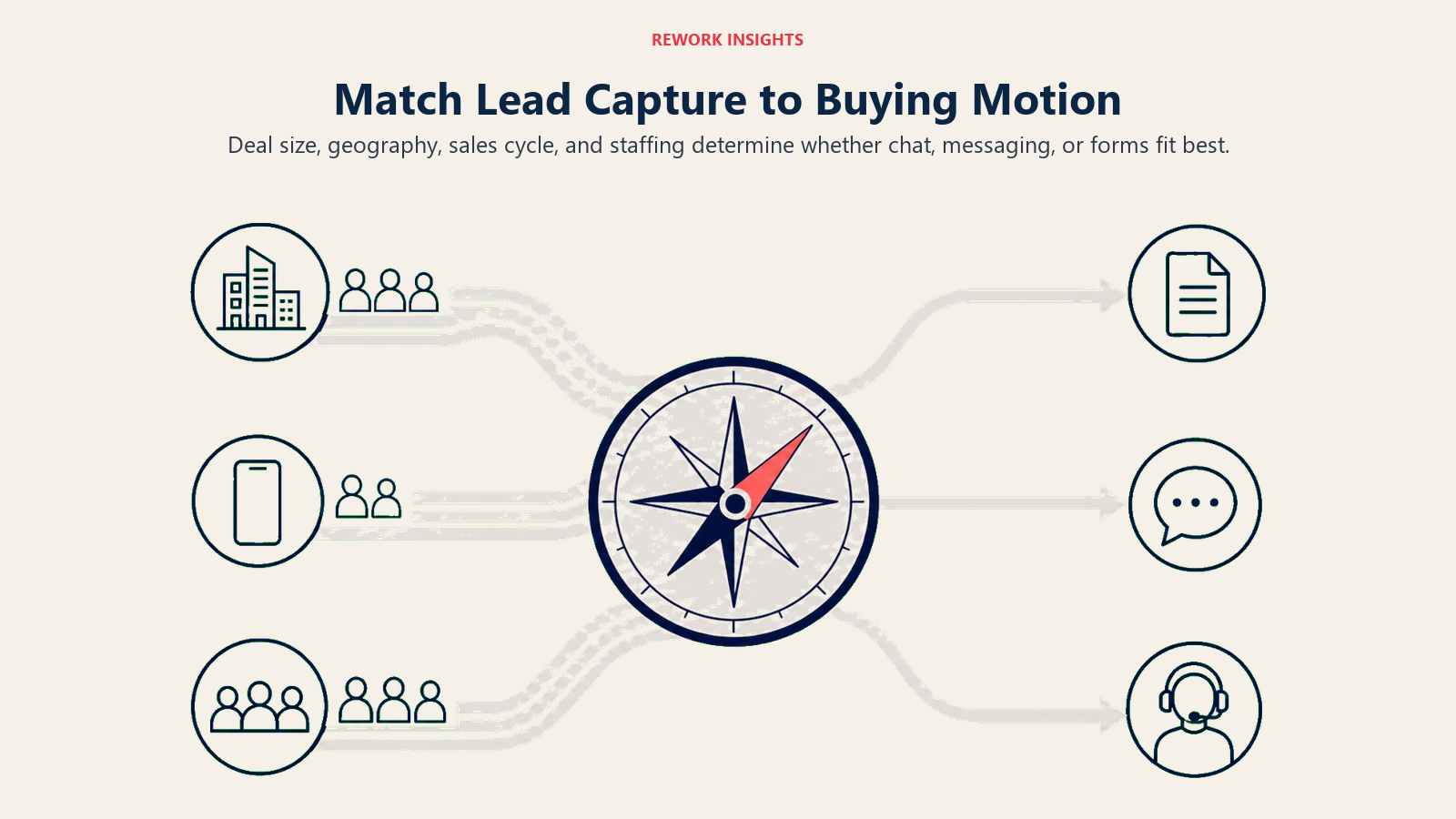
A high-ACV enterprise deal with six-to-twelve-month cycles and a five-to-seven person buying committee doesn't benefit from WhatsApp. Enterprise buyers expect formal, documented communication. Introducing an informal channel early in the process signals misalignment. For enterprise, the right replacement is proactive chat on the highest-intent pages, staffed by SDRs or solutions consultants during business hours, with thoughtful AI coverage outside those hours.
An SMB SaaS product targeting markets where WhatsApp usage is dominant (Brazil, Indonesia, the Philippines, Mexico) is almost certainly leaving pipeline on the table by relying on form fills and email sequences. The buyer checks WhatsApp ten times before they check email once. Responding there in under a minute, with a human or a well-trained AI agent, is a structural conversion advantage.
Mid-market SaaS with 30-90 day cycles typically benefits most from chat-first capture. The buyer is actively evaluating, wants information quickly, and will respond to proactive engagement. But they also expect some level of process. A hybrid model, chat widget with smart routing that can escalate to a sales rep, tends to work better than fully automated messaging.
The Lead Capture Channel Matrix
When evaluating which channel to prioritize, score your options across four dimensions:
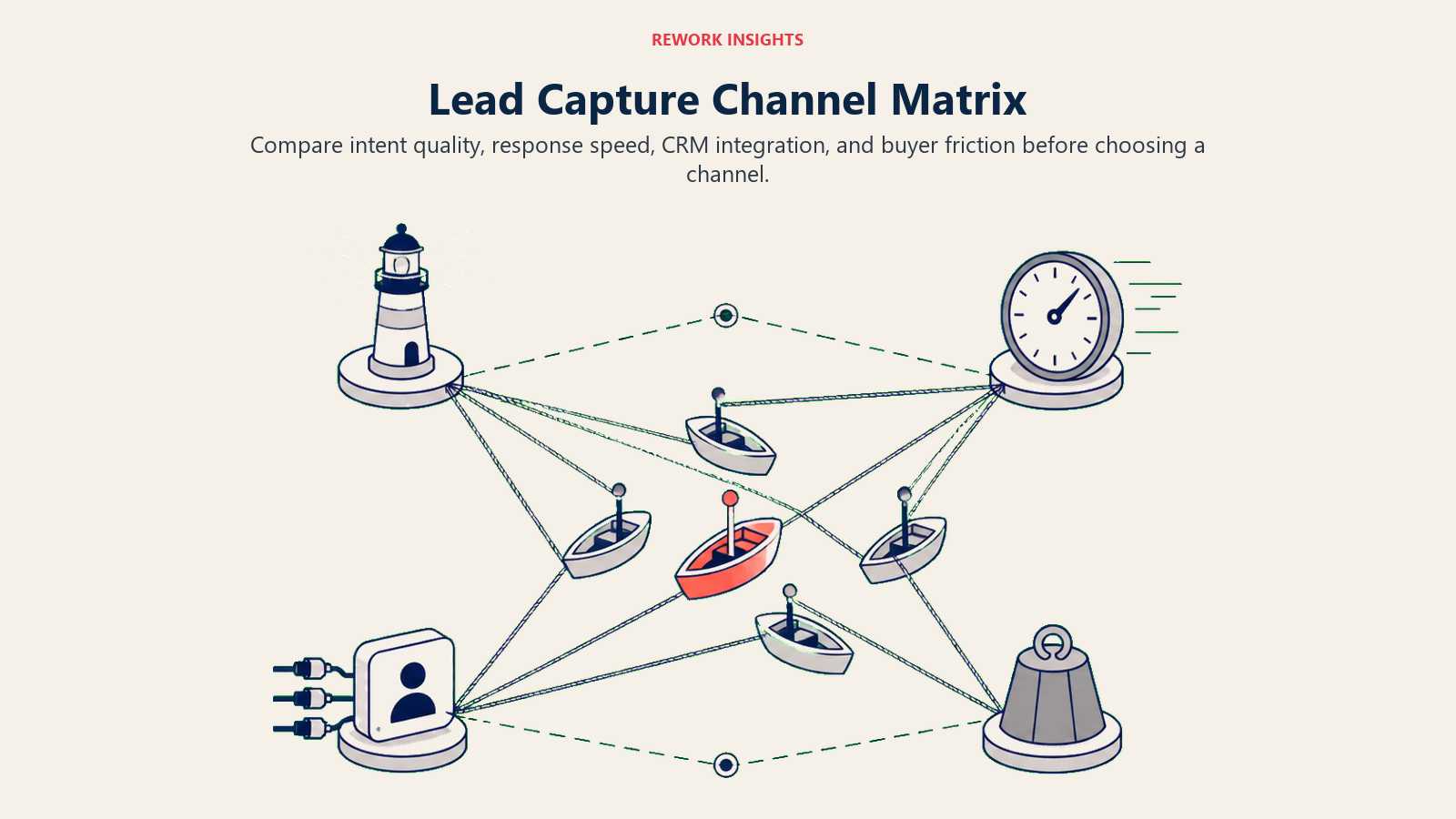
Intent signal quality. How well does this channel capture and preserve the buyer's intent? Live chat scores high because the conversation itself is the signal. Forms score low: they produce a record but lose all the context. WhatsApp-based funnels score medium: the conversation is rich but the channel creates attribution challenges.
Follow-up speed. How fast can you respond? Chat enables real-time response. WhatsApp with automation enables sub-minute response at scale. Forms are structurally delayed. If speed-to-response is a conversion driver in your market, this dimension should be weighted heavily.
CRM integration ease. How reliably does capture data flow into your revenue systems? Intercom and Drift have mature HubSpot and Salesforce integrations. ManyChat's CRM sync has historically required custom setup. Respond.io has built solid integration layers with both platforms, the Respond.io to HubSpot setup guide walks through the integration steps. Forms, ironically, score highest here because the submission event is easy to track.
Buyer friction. What does the buyer have to do? Live chat requires nothing except starting a conversation. WhatsApp requires opening an app they already have open. Forms require submitting data and waiting. Lower friction at the point of highest intent is almost always worth optimizing for.
| Channel | Intent Signal | Follow-up Speed | CRM Integration | Buyer Friction |
|---|---|---|---|---|
| Contact form | Low | Low | High | Medium |
| Live chat (Intercom, Tidio) | High | High | High | Low |
| WhatsApp via Respond.io | High | High | Medium-High | Low |
| ManyChat automation | Medium | High | Medium | Low |
| Drift (enterprise) | High | High | High | Low |
No channel wins on all dimensions. The matrix tells you where you'll make tradeoffs, not which channel to pick. Use your motion type and buyer geography to weight the dimensions appropriately.
The CMO Ownership Question
Here's the organizational problem that most discussions about contact form replacement miss: in most companies, chat sits under Support or Product, not Marketing. That made sense when chat was a support function. It doesn't make sense when chat is a pipeline function.
When Support owns chat, the primary metrics are resolution time, deflection rate, and CSAT. Those are the right metrics for a support tool. But they're the wrong metrics for a demand gen tool, where the right question is: how many qualified pipeline conversations did chat generate this quarter?
A CMO who wants to use chat as a pipeline channel but doesn't own the tooling, the routing rules, or the AI configuration of that chat will be consistently blocked by support-oriented optimization. The widget will be set up to answer questions, not capture intent. The routing will send high-intent visitors to a queue, not a rep.
The pipeline cost of this misalignment is real. Buyers who arrive with purchase intent and get routed to a support flow will either disengage or find the forms themselves, and then hit the same 42-hour follow-up delay.
The fix is organizational, not technical. CMOs who have taken ownership of the pre-sale conversational layer and handed post-sale to Support have seen meaningful pipeline impact. Not because they bought new tools, but because they changed the optimization target. The article The CMO's Case for Owning the Chat Layer maps out what that transition looks like organizationally.
A Decision Tree for CMOs
Before committing to a form replacement strategy, walk through these questions:
What is your deal size? Under $10K ACV: messaging-first and chat-first both work. Over $50K ACV: chat-first with human coverage on high-intent pages, forms for formal RFP flows.
What are your primary markets? If more than 30% of your pipeline comes from regions where WhatsApp is dominant: start there. If North America-only: live chat on your highest-converting pages will deliver faster lift.
What is your average sales cycle? Under 30 days: optimize ruthlessly for speed-to-first-conversation. Over 90 days: focus on intent signal quality and CRM routing over response speed.
Who owns your chat today? If Support: the first move is the organizational one, not the tool one. If Marketing: focus on the channel architecture question.
Can you staff real conversations? If not reliably: invest in AI agent configuration before adding more channels. The chatbot-to-rep handoff guide covers how to structure AI coverage so no conversation goes cold outside business hours. An understaffed chat widget that goes unanswered is worse than a form because it creates an explicit broken promise.
The companies that are making this shift aren't replacing forms everywhere. They're replacing them at the moments where form friction costs them the most: pricing pages, demo request pages, and high-intent bottom-of-funnel content. That's where buyers are ready to talk, and where the gap between "fill out this form" and "start a conversation" has the biggest impact on revenue.
According to Drift's State of Conversational Marketing, companies that replaced forms with chat on their pricing pages reported median response-time improvements from hours to under two minutes. For the measurement side of this shift, Conversational ROI: Measuring Beyond First-Touch Attribution covers how to build a reporting model that captures chat's pipeline contribution when standard CRM attribution falls short.
Learn More
