More in
AI Jobs & Skills News
Finance Keeps Shedding Jobs as the Economy Hires: The White-Collar Warning
Jun 6, 2026
AI Skills Just Became the Hardest Hire in the World. You Won't Recruit Your Way Out
Jun 6, 2026 · Currently reading
Is AI Actually Killing Jobs? May's Hiring Numbers Say Not So Fast
Jun 5, 2026
You Put Your AI Agents on the Org Chart. Accountability Quietly Dropped
Jun 5, 2026
Everyone Blames AI for the Gen Z Job Crisis. The Fed Points at Remote Work
Jun 5, 2026
AI's Net Job Drag Fell to 11,000 a Month. Construction Is Hiding the Truth
Jun 4, 2026
AI Blamed for a Record 40% of May's US Layoffs, the Third Month Running
Jun 4, 2026
Four Futures for Jobs by 2030: The Mid-2026 Checkpoint for CEOs
Jun 3, 2026
Can Federal AI Apprenticeships Fix Your Skills Gap Cheaper Than Hiring?
Jun 3, 2026
AI Engineer Pay Split Into Two Markets. Only the Top Is a Bubble
Jun 3, 2026
AI Skills Just Became the Hardest Hire in the World. You Won't Recruit Your Way Out
Turn this article into takeaways for your work.


Each assistant summarizes the article only for you and suggests best practices for your work.
Something just flipped in the global talent market, and if you're running a business right now, it changes the math on almost every hiring decision you'll make this year.
According to ManpowerGroup's 2026 Global Talent Shortage Survey, which covers 39,063 employers across 41 countries, AI skills have become the hardest skills to find on the planet for the first time in the survey's history. Not software engineering. Not cybersecurity. Not traditional IT. AI skills. That's a meaningful break from every prior year, and it lands at exactly the moment when a lot of owners are deciding whether to hire AI talent or build it internally.
The short answer is that you probably can't hire your way out of this. But you can build your way out. Here's why, and what that actually looks like in practice.
What the Data Actually Says
ManpowerGroup surveyed tens of thousands of employers globally and found that AI Model and Application Development is the single hardest skill to source anywhere in the world today, cited as a top gap by 20% of employers. AI Literacy sits right behind it at 19%. Traditional IT and data skills, which topped these rankings in prior years, fell all the way to 7th place.
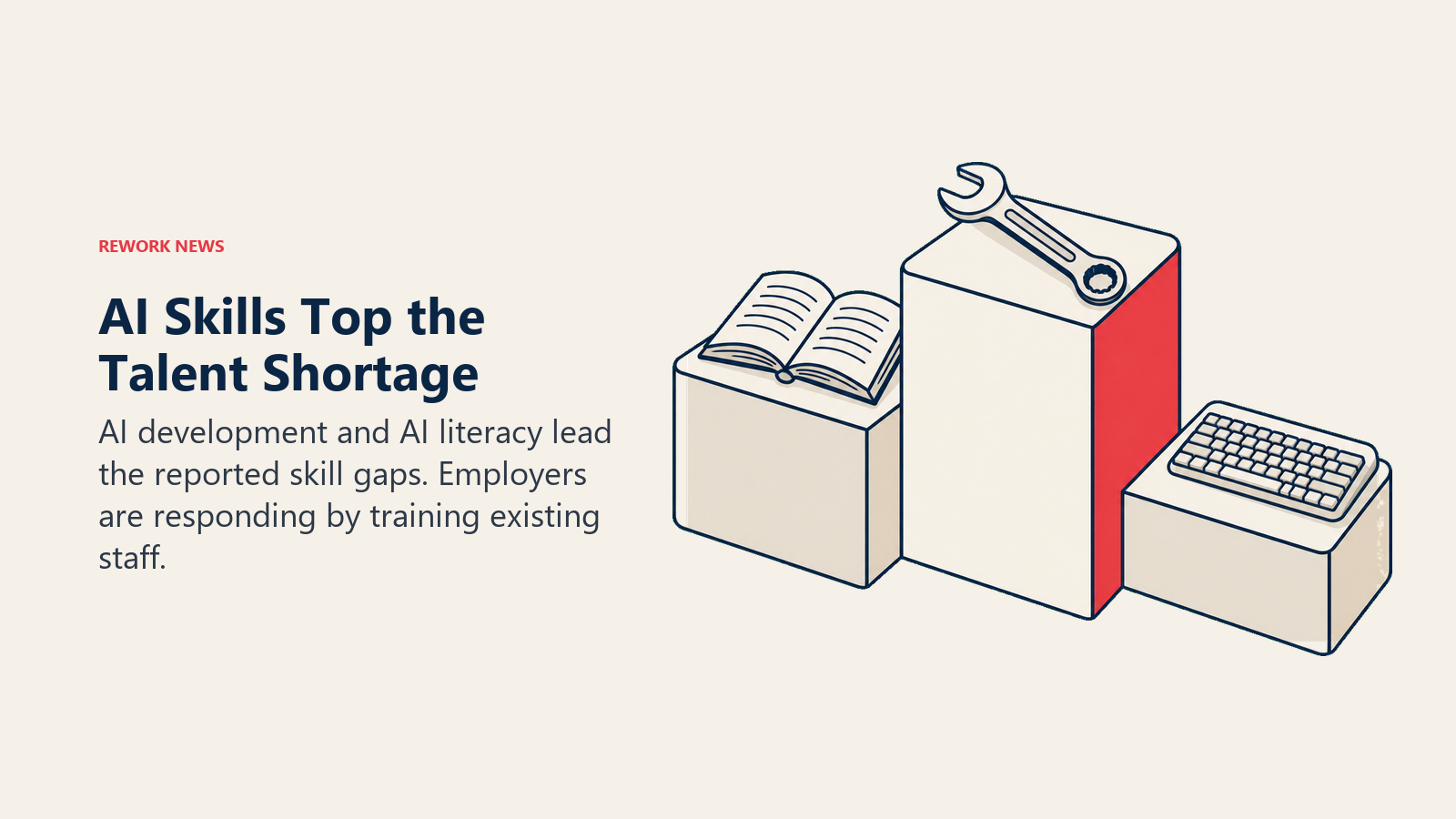
Overall, 72% of employers report difficulty filling roles. That's a broad talent squeeze, but the AI slice of it is the sharpest.
The survey also asked employers what they're doing about it. The most common response, chosen by 27% of employers, is upskilling and reskilling existing staff. That's ahead of schedule flexibility (20%) and location flexibility (18%). In other words, the employers who are actually solving this problem are mostly not recruiting their way to a solution. They're looking inward.
Key Facts
- AI Model and Application Development is the #1 hardest-to-find skill globally, cited by 20% of employers (ManpowerGroup, 2026 Global Talent Shortage Survey)
- 72% of employers globally report difficulty filling roles (ManpowerGroup, 2026)
- Upskilling and reskilling existing staff is the #1 employer response to the talent shortage, chosen by 27% of employers (ManpowerGroup, 2026)
One more data point worth sitting with: the human attributes employers are actually hunting for haven't changed much. Communication and collaboration (39%), professionalism and work ethic (36%), and adaptability and willingness to learn (34%) are the top three. The AI tools are new. The people traits that make AI tools useful are old, and your existing team probably has most of them.
The Build-vs-Buy Framework for AI Talent
Here's the core strategic decision every owner is navigating right now, and the ManpowerGroup data gives you a clear way to frame it.
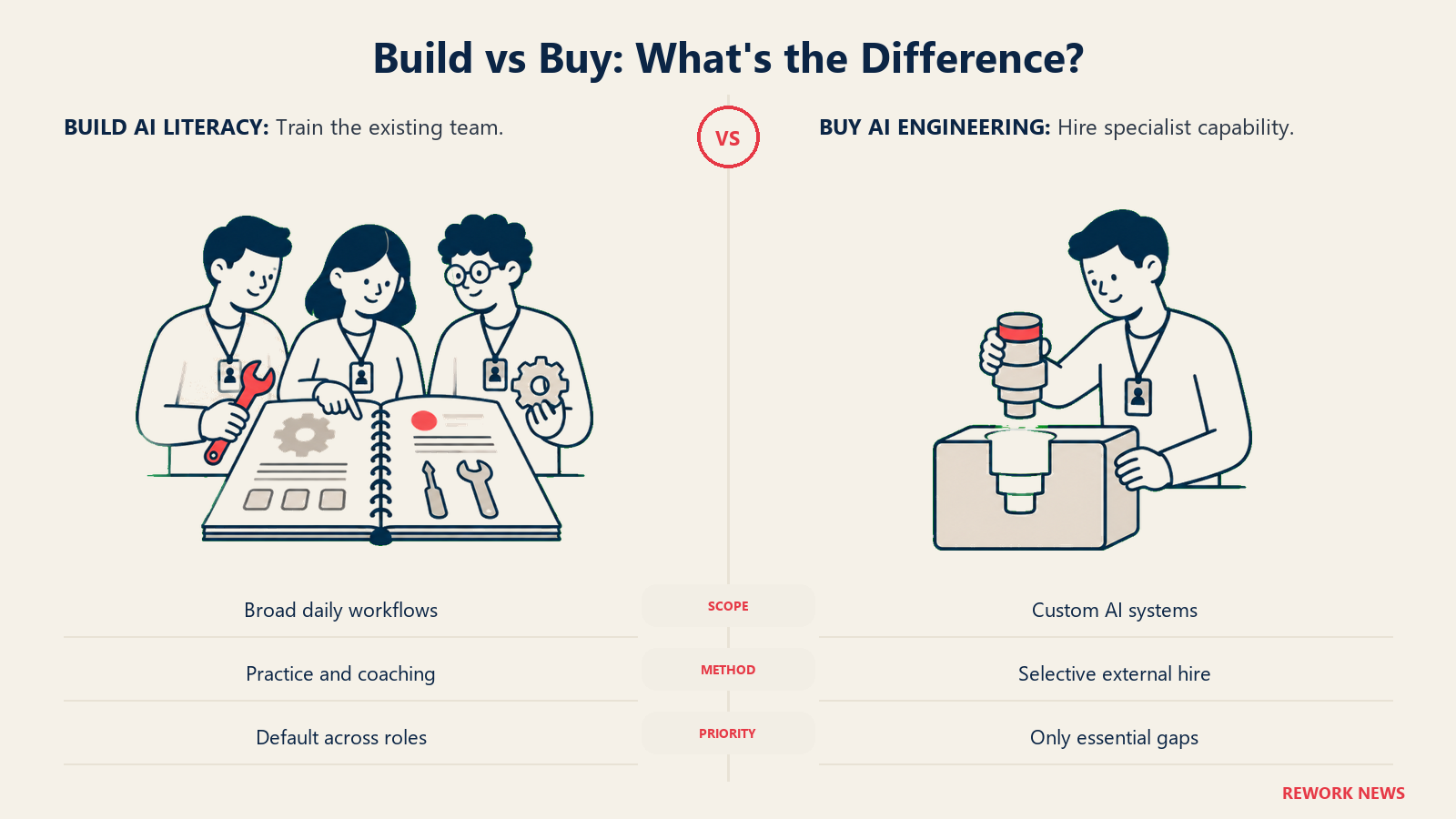
Not all AI skills are the same. You need to separate two categories before you decide what to hire and what to train.
AI Literacy is the ability to work effectively with AI tools: prompt effectively, evaluate AI output critically, integrate AI into daily workflows, and catch the mistakes that AI confidently makes. This is teachable. It's teachable to almost anyone on your team with solid judgment. Training programs exist at every price point, from free OpenAI courses to structured corporate learning platforms. The marginal cost per employee of getting someone from zero to functional AI literacy is low, and the return is high because the skill compounds across every role it touches.
AI Engineering (model development, fine-tuning, building AI applications from scratch) is genuinely scarce and genuinely hard. This is the 20% gap in the ManpowerGroup data. These engineers are rare, they know it, and they command compensation to match.
PwC's AI Jobs Barometer found the AI wage premium has been roughly doubling year over year, approaching 56% above market rates for equivalent non-AI roles. If you're a small or mid-size business, competing for that talent against large technology companies and well-funded startups is a losing bid most of the time. You will spend enormous time and money trying to attract someone who has a dozen offers and is choosing based on brand name, equity, and compensation you can't match.
The practical move: buy selectively on AI engineering (for the one or two roles where it's genuinely non-negotiable), and build aggressively on AI literacy (across your whole team, cheaply, starting now).
ManpowerGroup's own tagline for their 2026 VivaTech Startup Challenge captures this well: "Human First, Digital Always." The finalists pitch in Paris on June 17, and the challenge is explicitly looking for companies that lead with human capability rather than technology for its own sake. The employers winning on AI talent right now are the ones investing in the people they already have.
Why This Hits Owners Harder Than Anyone Else
Large enterprises have structural advantages in this environment. They can pay the 56% wage premium and still call it within budget. They have L&D departments, learning management systems, and the headcount to run cohort-based training programs. They can absorb a slow reskilling cycle because they have enough bench depth to keep running while people are in training.
You probably don't have most of that. And that's exactly why the build-first strategy matters more for owners than it does for Fortune 500 companies.
When the AI engineer candidate is choosing between your offer and three others, the large company wins. But when you look at what an AI literacy program actually costs per employee versus the fully-loaded cost of a mis-hire in a scarce market, the build side of the ledger looks a lot better. A single failed AI engineering hire, including recruiting fees, salary, severance, and the time your team lost while you tried to make it work, can easily run six figures. A structured AI literacy track for your whole team can be a fraction of that.
The honest cost of AI transformation usually surprises owners in the opposite direction: the skills layer is more affordable than expected, but the external talent layer is far more expensive. Getting clear on which is which before you start spending is the move.
A 3-Step Build-First Talent Plan
This isn't a complex strategy. But it does require being deliberate, because reskilling doesn't happen by accident.
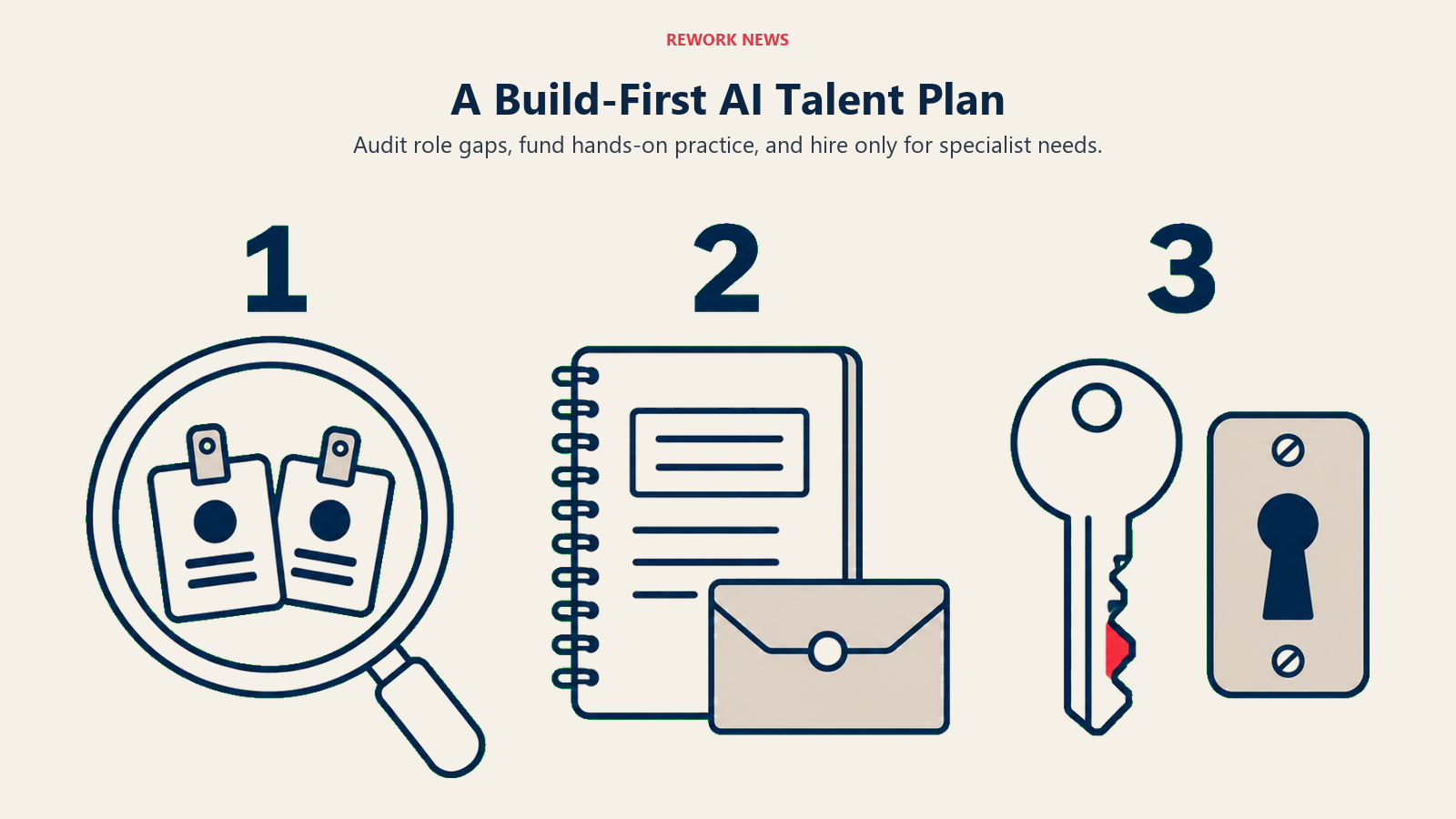
Step 1: Audit your current roles for AI-literacy gaps.
Go role by role and ask two questions: which parts of this job could be done faster, cheaper, or better with AI tools? And does the person in this role currently know how to use those tools? The gap between those two answers is your reskilling surface area. For most businesses, it's larger than expected, and most of it is addressable without hiring anyone new. A skills-based talent strategy starts here, with honest mapping before any spend.
Step 2: Fund a small reskilling budget per head.
You don't need a large program to start. A few hundred dollars per employee per year, spent on structured courses, hands-on AI tool access, and designated practice time, moves people meaningfully along the literacy curve. The goal isn't to turn your finance manager into an AI engineer. It's to make sure they can use AI to produce a first-draft analysis, check their own work, and flag when the output doesn't look right. That's achievable fast, and it compounds. Corporate AI reskilling budgets in 2026 show what peer companies are actually spending, and it's typically less than owners expect.
Step 3: Reserve external AI hires for the one or two genuinely specialist roles.
Be specific about what you actually need an AI engineer for. If you're building proprietary AI models or deeply custom AI applications, that's a real engineering need and you should hire for it. But if you need someone to help your team work with existing AI tools more effectively, you can probably build that from within. The DOL's AI apprenticeship framework is worth watching here: government-backed pathways are starting to create a new pipeline of trained workers that won't cost you a 56% premium to access.
The Counterpoint (and Why Hybrid Is Realistic)
Reskilling has real limits. Not every employee can make the full transition to AI-forward work, and not every role's AI component is teachable in a short timeframe. Some gaps genuinely require someone who already has deep AI engineering skills, and pretending otherwise leads to strategic drift.
The realistic outcome for most businesses is a hybrid: a strong internal AI literacy program for the majority of roles, supplemented by a small number of strategic external hires for the capabilities you can't build fast enough. The ManpowerGroup data shows this is already how most employers are responding. Reskilling first doesn't mean reskilling only.
What it does mean is that you don't default to "let's hire" before you've checked whether you can build. In a market where AI skills carry a doubling wage premium and qualified candidates are picking offers, the default should flip. Build first. Buy selectively. And take the reskilling budget seriously before the next hiring round, not after.
The AI role evolution happening across industries is happening whether you hire or not. The difference is whether your existing team is equipped to participate in it.
Frequently Asked Questions
Why did AI skills overtake engineering as the hardest skill to hire in 2026?
The ManpowerGroup 2026 Global Talent Shortage Survey, covering 39,063 employers across 41 countries, found AI Model and Application Development at #1 (20% of employers) and AI Literacy at #2 (19%). This is the first time AI skills have topped the ranking, reflecting how fast employer demand has accelerated relative to the supply of trained workers. Engineering and traditional IT both fell as AI-specific skills pulled ahead in employer priority.
What's the difference between AI literacy and AI engineering for hiring purposes?
AI literacy is the ability to use, evaluate, and integrate existing AI tools effectively. It's broadly teachable to most employees at low cost and delivers high returns across every role it touches. AI engineering covers model development, fine-tuning, and building AI applications from scratch. That's the genuinely scarce category, with a wage premium that has been roughly doubling year over year (PwC AI Jobs Barometer). Most businesses need a lot of the first and a little of the second.
How should a small business respond to the AI skills shortage if it can't compete on salary?
Start with an AI literacy audit: map which roles have the biggest gap between AI capability available and current employee skill. Fund a reskilling budget per employee, even a modest one, and give people dedicated practice time. Reserve external AI hiring for the one or two roles where deep engineering skill is genuinely required and can't be built fast enough. The ManpowerGroup data shows that the most common employer response globally is already upskilling and reskilling, not just recruiting.
Learn More
- AI Literacy: The New Workplace Skill
- AI Role Evolution: What Changes for Whom
- Skills-Based Talent Strategy
- Leading AI Transformation
- Digital Fluency
- AI Fluency and the 2026 Salary Premium
- LinkedIn AI Skills Demand Surge, 2026
Source: ManpowerGroup 2026 Global Talent Shortage Survey | PwC AI Jobs Barometer (AI wage premium data)
