Skills-Based Talent Strategy: Organizational Capability Framework

Turn this article into takeaways for your work.


Each assistant summarizes the article only for you and suggests best practices for your work.
What You'll Get From This Guide
- 5-Level Maturity Model: Progressive organizational skills-based talent capabilities from basic skills tracking to enterprise skills ecosystem leadership
- Implementation Roadmap: Clear step-by-step progression through skills maturity levels with timelines and investment benchmarks
- Competitive Edge: Organizations with mature skills-based strategies are 85% more likely to successfully redeploy talent and 57% more likely to anticipate workforce needs
- Tools and Resources: Comprehensive skills taxonomy frameworks, assessment tools, and benchmarking resources for organizational development
A skills-based talent strategy is an organizational approach that identifies, assesses, develops, and deploys people based on verified skills and competencies rather than degrees or tenure. It uses a skills taxonomy, skills assessments, and an internal talent marketplace to match talent to work. Mature programs invest 4 to 6 percent of payroll and are 107 percent more likely to place talent effectively.
Strategic Imperative for Organizational Excellence
The shift from credentials to skills represents one of the most significant changes in talent management this decade. LinkedIn's 2025 Global Talent Trends report shows that 85% of employers now use skills-based approaches in hiring decisions, up from 56% in 2022. This isn't a passing trend. It's a fundamental restructuring of how organizations identify, develop, and deploy human capital.
The business case is strong. Deloitte research indicates that skills-based organizations are 107% more likely to place talent effectively, 98% more likely to retain high performers, and 52% more likely to innovate. Meanwhile, organizations clinging to traditional credential-based approaches struggle with talent shortages, skill gaps, and reduced workforce agility.
IBM's Institute for Business Value found that the average half-life of skills has dropped to just four years, down from ten years in 2000. Technical skills depreciate even faster, with some becoming obsolete within 18 months. This accelerating skills decay makes traditional approaches to talent management less and less effective. Organizations can't wait for employees to complete multi-year degree programs when the skills they need are evolving in real-time.
Skills-Based Talent Strategy as an organizational capability encompasses the enterprise's systematic ability to identify required skills, assess current capabilities, close skill gaps through hiring and development, and match talent to opportunities based on verified competencies rather than credentials or tenure.
The Competitive Advantage Metrics for Skills-Based Talent Strategy
Organizations with mature skills-based talent capabilities demonstrate:
- Talent Acquisition Efficiency: 70% reduction in time-to-hire through skills-focused job descriptions and assessments
- Workforce Agility: 85% higher success rate in internal talent redeployment during market shifts
- Employee Retention: 41% lower turnover among employees with clear skills-based career paths
- Skills Gap Closure: 2.5x faster skill development through targeted learning aligned to verified gaps
- Diversity Improvement: 36% increase in candidate diversity when removing credential requirements
- Innovation Capacity: 52% higher innovation metrics through skills-based team composition
- Cost Reduction: 50% lower external hiring costs through improved internal mobility programs
The 5 Levels of Organizational Skills-Based Talent Maturity
Skills-based maturity expands from scattered records to predictive talent intelligence and an open skills ecosystem.
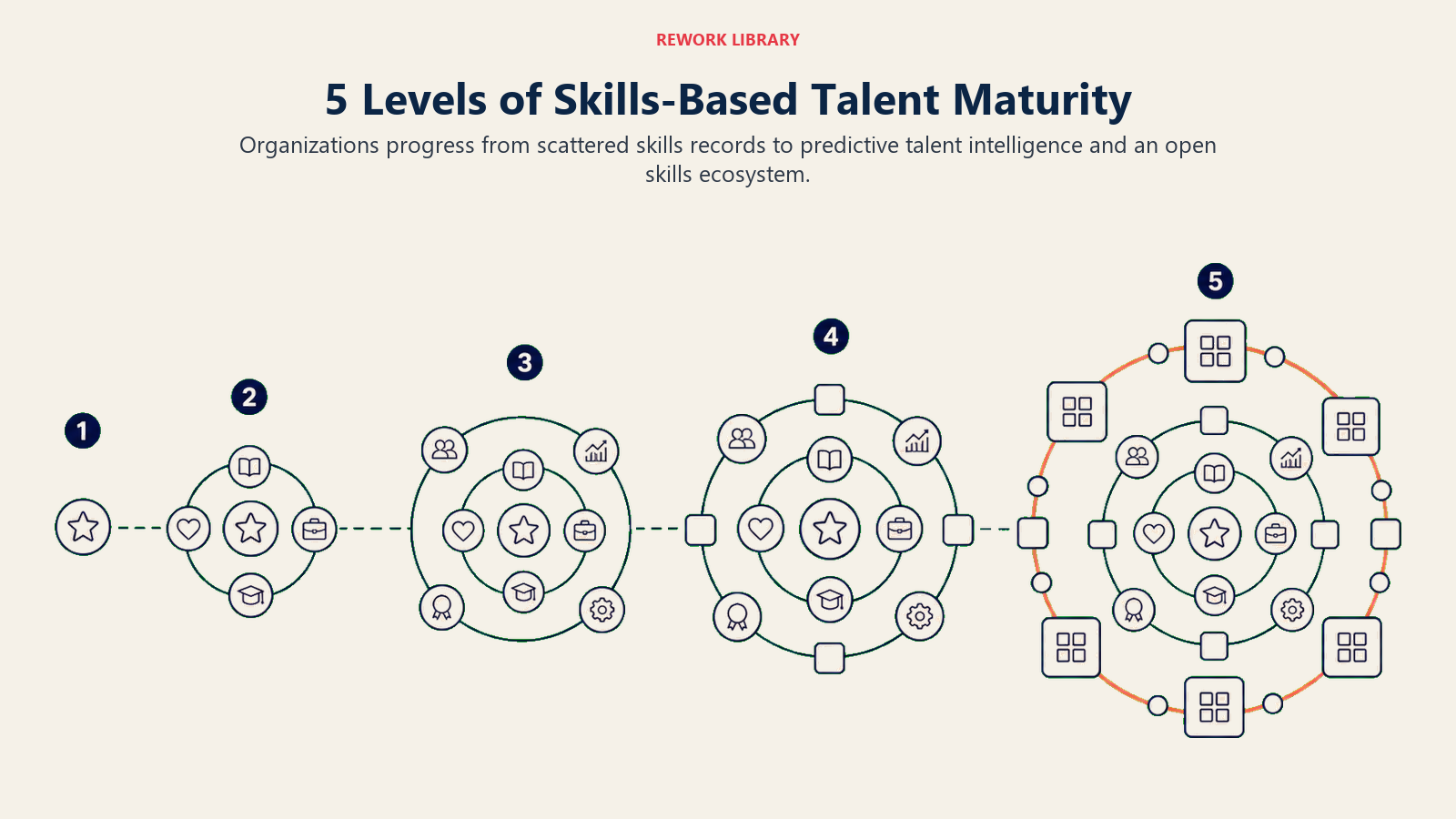
Level 1: Reactive - Ad Hoc Skills Recognition (Bottom 25% of Organizations)
Organizational Characteristics:
- Skills are mentioned in job descriptions but not systematically defined or assessed
- Hiring decisions rely primarily on degrees, certifications, and years of experience
- No centralized skills inventory exists across the organization
- Managers make talent decisions based on personal relationships and intuition
- Training investments are disconnected from strategic skill requirements
Capability Indicators:
- No standardized skills taxonomy or competency framework exists
- Employee skills data is scattered across disconnected systems or not captured at all
- Internal mobility happens through informal networking rather than skills matching
- Succession planning relies on tenure and manager recommendations, not on skill assessments
Business Impact & Costs:
- Hiring cycles average 45-60 days with 40% first-year turnover due to poor skills matching
- Critical skill gaps go unnoticed until project failures occur
- Training budgets waste 30-40% on programs that don't match actual skill needs
- Internal talent pools stay invisible, forcing expensive external recruiting
Real-World Examples:
- Traditional Manufacturing Firms: Many still require four-year degrees for roles where specific technical skills matter more than academic credentials
- Legacy Financial Institutions: Credential-heavy hiring practices exclude qualified candidates while failing to assess the analytical and digital skills that actually matter
Investment vs. Return:
- Minimal investment in skills infrastructure (less than 0.5% of payroll)
- Return deficit of -25% to -40% compared to skills-based benchmark organizations
Benchmark: Bottom 25th percentile - Organizations experience chronic skill shortages and talent mismatches
Level 2: Structured - Formal Skills Framework Implementation (25th-50th Percentile)
Organizational Characteristics:
- Standardized skills taxonomy established for key roles and functions
- Skills-based job descriptions replace credential-heavy requirements for select positions
- Basic skills assessments integrated into hiring processes
- Employee skills data collected in centralized HR systems
- Training programs mapped to defined skill categories
Capability Indicators:
- Skills taxonomy covers 40-60% of organizational roles with defined proficiency levels
- Skills assessments used in 50-70% of hiring decisions with validated instruments
- Learning management system tracks skill development activities and completions
- Basic skills gap analysis conducted during annual workforce planning cycles
Business Impact & Costs:
- Hiring cycle time reduces by 25-30% through skills-focused screening
- First-year turnover decreases by 15-20% through improved candidate-role matching
- Training effectiveness improves by 35% through skills-aligned program design
- Internal mobility increases by 20% through basic skills visibility tools
Real-World Examples:
- Unilever (2018-2022): Implemented skills-based hiring across graduate programs, removing degree requirements and using AI-powered skills assessments, resulting in 16% increase in hiring diversity and 35% reduction in cost-per-hire
- Bank of America (2020-2024): Built competency frameworks for customer-facing roles, improving performance prediction accuracy by 40%
Investment vs. Return:
- Investment of 1-2% of payroll in skills infrastructure and assessment tools
- Return of 30-50% improvement in hiring quality and retention metrics
Benchmark: 25th-50th percentile - Organizations adopt foundational skills practices but lack enterprise-wide integration
Level 3: Proactive - Integrated Skills Ecosystem Culture (50th-75th Percentile)
Organizational Characteristics:
- Comprehensive skills taxonomy covers all roles with validated proficiency definitions
- Skills-based hiring is the default approach across all functions and levels
- Internal talent marketplace enables employees to find opportunities matching their skills
- Continuous skills assessment replaces periodic reviews with real-time capability visibility
- Coaching and mentoring programs connect skill development to career progression
Capability Indicators:
- Skills taxonomy achieves 90%+ role coverage with regular validation and updates
- AI-powered skills inference identifies capabilities from work outputs and project contributions
- Internal mobility rate exceeds 25% annually through proactive skills matching
- Predictive analytics spot emerging skill gaps 12-18 months before they become problems
Business Impact & Costs:
- Hiring cycle time reduces by 50% through efficient skills-based candidate screening
- Training ROI improves by 60% through personalized skill development paths
- Employee engagement scores increase by 25% through skills-based career visibility
- External hiring costs decrease by 40% through improved internal talent utilization
Real-World Examples:
- IBM (2017-2024): Transformed talent practices with AI-powered skills frameworks, identifying 3,000+ unique skills across the organization and enabling 40% of roles to be filled internally. The "New Collar" initiative eliminated degree requirements for 50% of U.S. jobs
- Google (2019-2025): Built skills-based career pathways that allow engineers to move between product areas based on transferable capabilities, reducing unwanted attrition by 15%
Investment vs. Return:
- Investment of 2-4% of payroll in advanced skills technology and talent mobility infrastructure
- Return of 70-100% improvement in workforce agility and talent utilization
Benchmark: 50th-75th percentile - Organizations demonstrate systematic skills integration across talent processes
Level 4: Anticipatory - Skills Intelligence Leadership (75th-95th Percentile)
Organizational Characteristics:
- Skills intelligence platforms provide real-time visibility into organizational capabilities
- External skills market data informs compensation, development, and acquisition strategies
- Workforce planning integrates skills forecasting with business strategy development
- Skills-based organization design replaces traditional job-based structures
- Cross-industry skills partnerships accelerate capability development
Capability Indicators:
- Dynamic skills ontology updates automatically based on market trends and internal data
- Skills supply and demand modeling drives strategic planning and investment decisions
- Gig and project-based work allocation optimizes skills utilization across boundaries
- Skills credentials are portable and industry-recognized through blockchain verification
Business Impact & Costs:
- Workforce planning accuracy improves by 80% through skills-based forecasting models
- Time to productivity for new skills decreases by 60% through targeted development
- Innovation metrics improve by 75% through optimal skills-based team composition
- Revenue per employee increases by 25% through improved skills-to-work matching
Real-World Examples:
- Microsoft (2020-2025): Implemented skills graph technology connecting 200,000+ employees to internal opportunities, achieving 30% internal mobility rate and 50% reduction in critical role time-to-fill
- Novartis (2021-2025): Built skills-based talent marketplace serving 100,000 employees, enabling project-based work allocation that improved R&D productivity by 20%
Investment vs. Return:
- Investment of 4-6% of payroll in advanced skills intelligence and workforce planning systems
- Return of 200-350% improvement in talent optimization and strategic workforce outcomes
Benchmark: 75th-95th percentile - Organizations leverage skills intelligence for competitive workforce advantage
Level 5: Transformational - Global Skills Ecosystem Leadership (Top 5% of Organizations)
Organizational Characteristics:
- Organization shapes industry skills standards and certification frameworks
- Skills-based operating model enables continuous organizational adaptation
- External skills ecosystem extends talent capabilities beyond organizational boundaries
- Thought leadership influences global workforce policy and education systems
- Skills marketplace creates value for customers, partners, and communities
Capability Indicators:
- Real-time skills pricing and allocation optimize value creation across ecosystems
- Skills development produces monetizable expertise and consulting revenue
- Industry coalitions advance shared skills standards and credential portability
- Academic and government partnerships reshape education for skills-based economies
Business Impact & Costs:
- Workforce transformation costs decrease by 70% through systematic skills transition
- Market leadership positions secured through superior talent agility
- New revenue streams emerge from skills development intellectual property
- Employer brand strength attracts top talent seeking skills-based careers
Real-World Examples:
- Amazon (2019-2025): Invested $1.2 billion in upskilling programs, creating industry-standard certifications in cloud computing and machine learning that benefit the broader technology ecosystem
- AT&T (2013-2025): Reskilled 140,000 employees through Future Ready initiative, becoming a model for large-scale workforce transformation that influenced industry practices
Investment vs. Return:
- Investment of 6-10% of payroll in transformational skills infrastructure and ecosystem development
- Return of 500-800% premium in workforce adaptability and market positioning
Benchmark: Top 5th percentile - Organizations define global skills standards and shape workforce evolution
Your Roadmap: How to Advance Through Each Level
Current State Pain Points: Most organizations struggle with persistent talent shortages despite rising unemployment, skill gaps that slow digital transformation, high turnover among employees who can't see a career path, and inefficient internal mobility that forces expensive external hiring. Traditional credential requirements exclude qualified candidates while failing to predict job performance.
Target Outcomes: Advanced skills-based talent capabilities enable organizations to identify and develop critical skills faster, redeploy talent efficiently during market shifts, build diverse and high-performing teams through objective skills assessment, and create employee experiences that improve retention through career growth visibility.
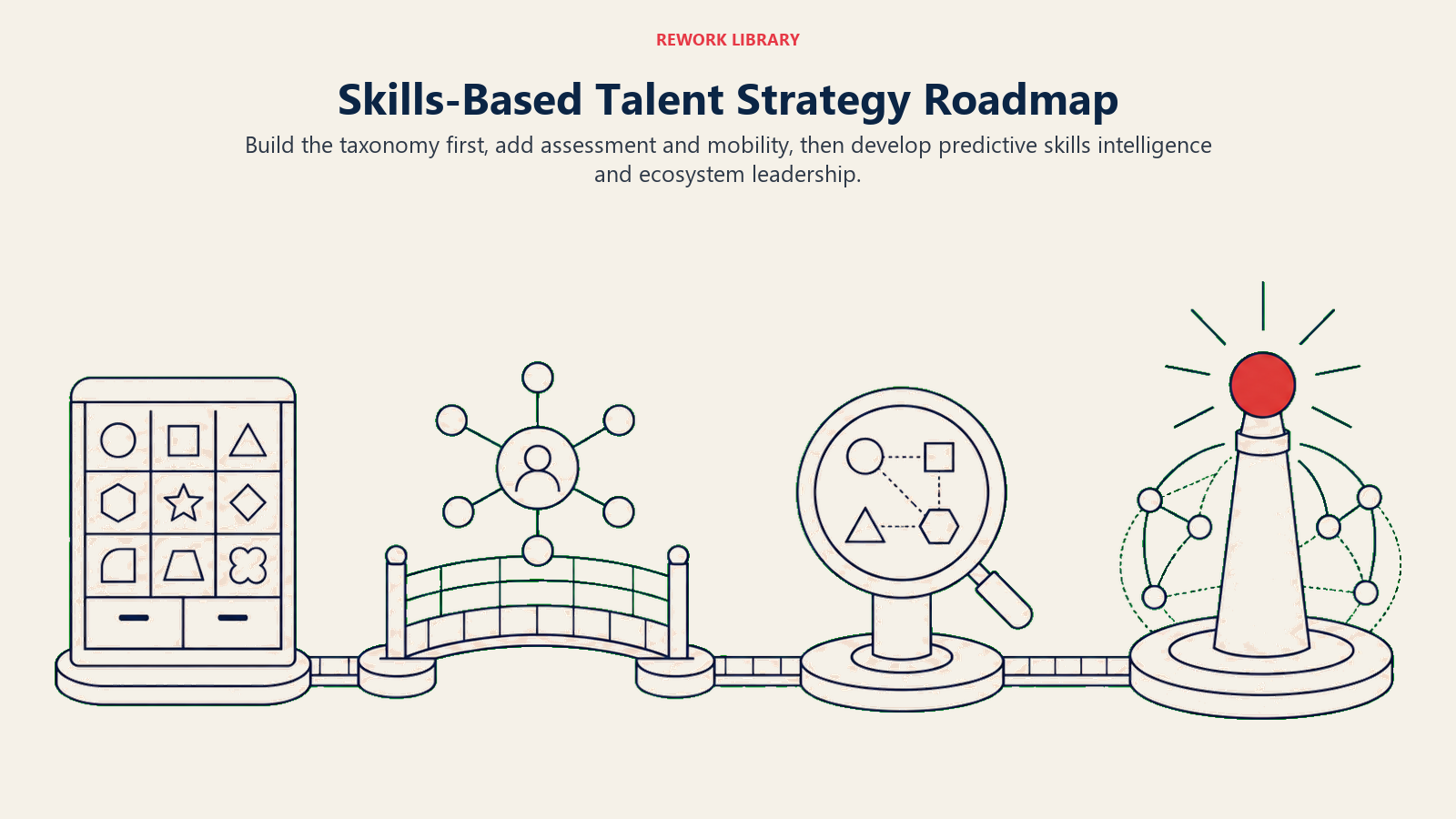
Level 1 to Level 2: Building Skills Foundation (6-12 months)
Step 1: Skills Taxonomy Development (4 months) - Create a standardized skills framework covering priority roles and functions. Map existing competency models to the skills taxonomy. Define proficiency levels and assessment criteria for each skill. Budget $150K-400K for taxonomy development and validation.
Step 2: Skills Assessment Integration (4 months) - Add validated skills assessments to your hiring processes for high-volume and critical roles. Train hiring managers on skills-based interviewing techniques. Build scoring rubrics that emphasize demonstrated capabilities over credentials. Budget $200K-500K for assessment tools and manager training.
Step 3: Skills Data Infrastructure (4 months) - Deploy HR technology that captures and centralizes employee skills data. Create skills profiles for all employees through self-assessment and manager validation. Establish data governance to keep skills information accurate. Budget $250K-600K for technology and data management.
Level 2 to Level 3: Skills Culture Integration (12-18 months)
Step 1: Internal Talent Marketplace (8 months) - Set up a technology platform that helps employees discover opportunities matching their skills. Create policies supporting internal mobility, including manager release requirements and transition support. Track internal movement metrics. Budget $500K-1.5M for marketplace technology and change management.
Step 2: Continuous Skills Assessment (6 months) - Replace periodic reviews with ongoing skills validation through project feedback, peer assessment, and work output analysis. Use AI-powered skills inference that identifies capabilities from actual work. Budget $400K-1M for assessment technology and process redesign.
Step 3: Skills-Based Career Paths (6 months) - Define career progressions based on skill acquisition rather than tenure or credential accumulation. Map lateral movement opportunities across functions. Connect learning investments to career advancement. Investment of $300K-800K for career framework development and communication.
Level 3 to Level 4: Skills Intelligence Development (18-24 months)
Step 1: Predictive Skills Analytics (10 months) - Build capabilities to forecast future skill needs based on business strategy, technology trends, and market analysis. Create skills supply and demand models for resource management planning. Budget $1M-2.5M for analytics infrastructure and data science resources.
Step 2: External Skills Intelligence (8 months) - Pull in external labor market data for skills pricing, availability, and trend analysis. Benchmark your organization's skills capabilities against competitors and industry standards. Budget $600K-1.5M for market intelligence subscriptions and integration.
Step 3: Skills-Based Organization Design (8 months) - Restructure work around skills clusters rather than traditional job families. Enable flexible team composition based on project skill requirements. Create governance for skills-based resource allocation. Budget $800K-2M for organization design consulting and change management.
Level 4 to Level 5: Skills Ecosystem Leadership (24-36 months)
Step 1: Industry Skills Standards (15 months) - Lead industry coalitions developing shared skills frameworks and portable credentials. Influence education providers to align curricula with industry skill needs. Budget $2M-5M for standards development and partnership management.
Step 2: Skills Ecosystem Extension (12 months) - Extend skills marketplace to include contractors, partners, and alumni. Create skills development programs that benefit broader communities. Budget $3M-8M for ecosystem platform development and partnership investments.
Step 3: Skills Monetization (12 months) - Develop revenue streams from skills development intellectual property, certification programs, and consulting services. Position your organization as a skills transformation leader. Budget $5M-15M for product development and market launch.
Quick Assessment: What Level Are You?
Level 1 Indicators:
- Job descriptions emphasize degrees and years of experience over specific capabilities
- No standardized skills taxonomy or competency framework exists organization-wide
- Employee skills data isn't systematically captured or centrally accessible
- Internal mobility depends on who you know, not what you can do
- Training investments aren't connected to identified skill gaps
Level 2 Indicators:
- Standardized skills framework covers key roles with defined proficiency levels
- Skills assessments used in majority of hiring decisions with validated instruments
- Centralized HR system captures employee skills through self-assessment
- Basic internal job posting shows required skills for open positions
- Training programs mapped to skills taxonomy categories
Level 3 Indicators:
- Internal talent marketplace enables skills-based opportunity discovery
- AI-powered tools infer skills from work outputs and project contributions
- Internal mobility rate exceeds 20% annually through proactive matching
- Skills gap analysis informs workforce planning and development investments
- Career paths defined by skill acquisition, not just tenure progression
Level 4 Indicators:
- Predictive analytics forecast skill needs 12-18 months in advance
- External labor market data informs skills strategy and compensation
- Work organized around skills clusters rather than traditional job families
- Skills credentials verified and portable through industry standards
- Real-time skills supply and demand modeling drives resource allocation
Level 5 Indicators:
- Organization leads industry skills standards and certification development
- Skills marketplace extends to contractors, partners, and ecosystem participants
- Skills development programs generate revenue and industry recognition
- Academic and policy partnerships reshape education for skills-based economy
- Employer brand attracts talent specifically seeking skills-based careers
Building Your Skills Taxonomy
A skills taxonomy provides the foundation for all skills-based talent practices. Without a well-designed taxonomy, organizations can't consistently assess capabilities, spot gaps, or match talent to opportunities.
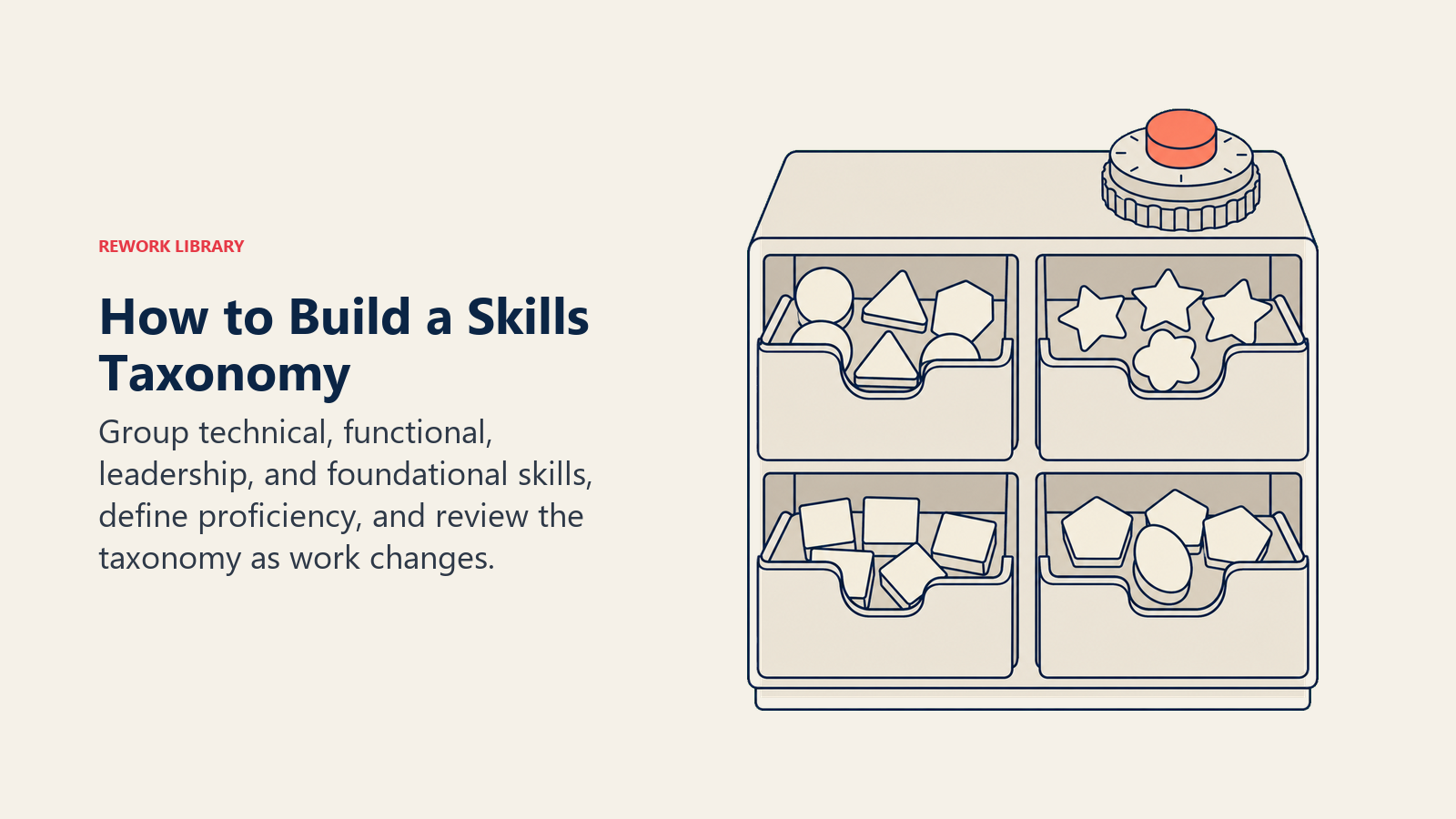
Skills Taxonomy Architecture
Skills Categories:
- Technical Skills: Job-specific capabilities required to perform work (e.g., Python programming, financial modeling, regulatory compliance)
- Functional Skills: Domain expertise applicable across roles (e.g., project management, data analysis, customer relationship management)
- Leadership Skills: People and organizational capabilities (e.g., team development, strategic communication, change leadership)
- Foundational Skills: Universal capabilities supporting performance (e.g., critical thinking, collaboration, adaptability)
Proficiency Levels:
- Novice: Basic understanding, requires supervision and guidance
- Competent: Can apply skill independently in routine situations
- Proficient: Handles complex applications, coaches others
- Expert: Recognized authority, shapes organizational practices
- Master: Industry thought leader, advances the discipline
Taxonomy Maintenance: Skills taxonomies need ongoing attention to stay relevant. Set up quarterly review cycles to add emerging skills, retire obsolete ones, and update proficiency definitions based on market changes. Assign taxonomy ownership to ensure someone is accountable for keeping it current and accurate.
Skills Assessment Methods
Self-Assessment: Employees rate their own proficiency. Useful for building an initial inventory, but you'll need validation since people tend to over- or under-estimate their abilities.
Manager Assessment: Direct supervisors validate employee skills based on observed performance. This provides valuable perspective, but results can be inconsistent across managers.
Skill Testing: Validated instruments measure actual capability through simulations, projects, or standardized assessments. This is the most objective approach, but it's expensive to develop and maintain.
Work Output Analysis: AI tools infer skills from completed projects, code commits, documents, and other work products. It's scalable, but you need sophisticated technology to make it work.
Peer Assessment: Colleagues rate skills based on collaboration experience. Valuable for interpersonal capabilities, but watch out for relationship bias.
Skills-Based Hiring and Assessment
Skills-based hiring removes unnecessary credential barriers while improving prediction of job performance.
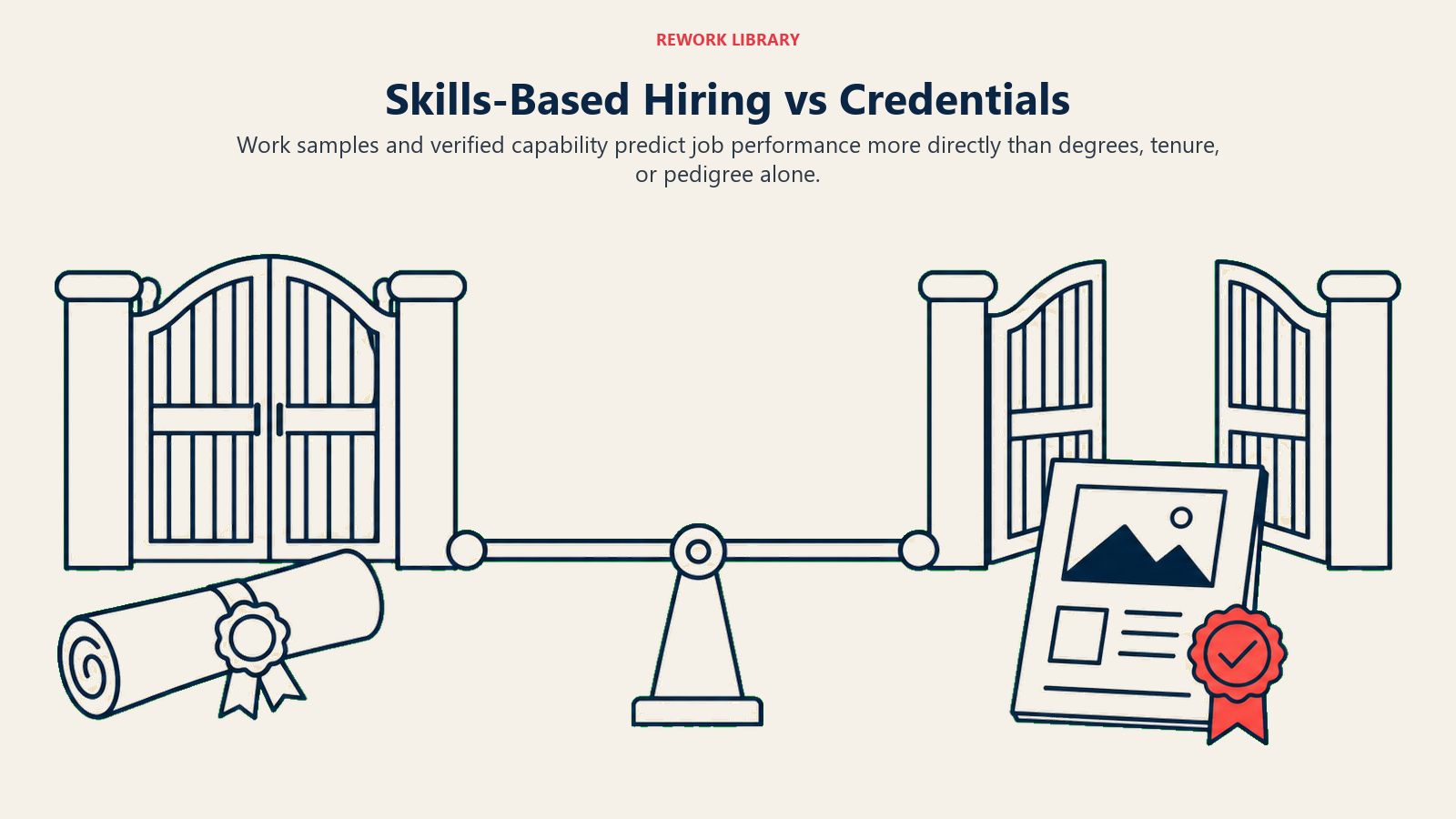
Implementing Skills-Based Job Descriptions
Traditional Approach: "Requirements: Bachelor's degree in Computer Science, 5+ years of experience, MBA preferred"
Skills-Based Approach: "Required Skills: Python (Proficient), Machine Learning Model Development (Competent), Data Pipeline Design (Competent), Cross-functional Collaboration (Competent)"
Research from Harvard Business School shows that 67% of job postings require degrees even when current workers in those same roles don't have them. Removing these requirements expands candidate pools by 20-30% while improving diversity.
Assessment Best Practices
Work Sample Tests: Have candidates complete actual job tasks. Google found work sample tests predict performance 2x better than interviews.
Structured Skills Interviews: Use standardized questions targeting specific skills with consistent scoring rubrics. Train all interviewers on evaluation criteria.
Skills Portfolios: Allow candidates to demonstrate capabilities through project examples, certifications, and documented achievements.
Trial Projects: Paid trial periods let both sides assess fit based on demonstrated performance rather than interview impressions.
Internal Talent Mobility and Skills Matching
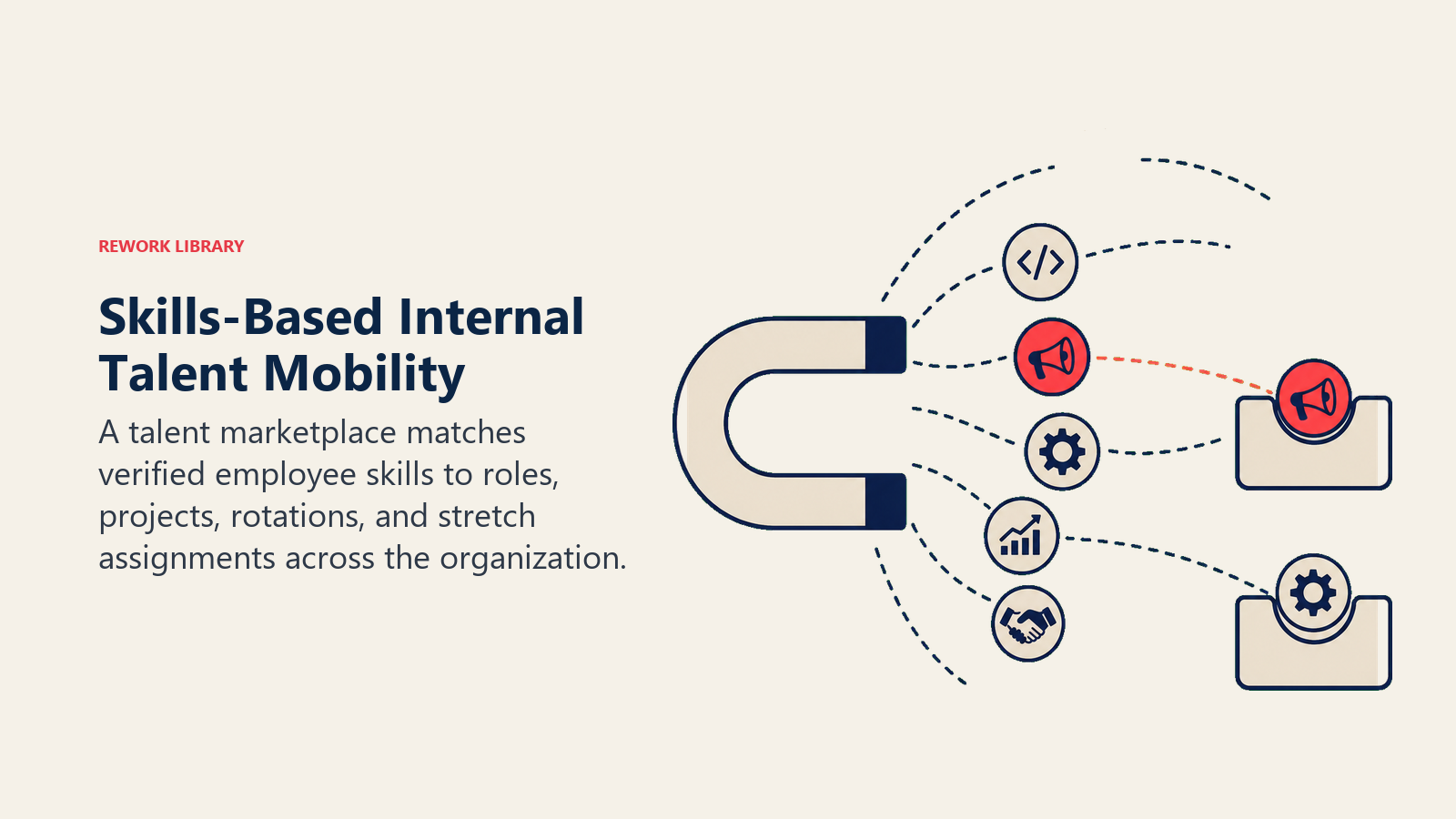
Internal mobility programs deliver significant value when powered by skills data.
Talent Marketplace Design
Core Features:
- Skills-based opportunity matching connecting employees to projects, roles, and learning
- Transparent internal postings with clear skill requirements and development potential
- Manager release policies ensuring employees can pursue internal opportunities
- Skills gap analysis showing what development enables desired career moves
Success Metrics:
- Internal fill rate for open positions (target: 30-40%)
- Time to fill internal transfers (target: 30-40% faster than external)
- Employee participation in marketplace (target: 50%+ monthly active)
- Career move satisfaction scores (target: 4.0+ on 5-point scale)
Enabling Skills-Based Mobility
Gig and Project Work: Let employees contribute their skills to short-term projects outside their home teams. This builds cross-functional experience and surfaces hidden capabilities.
Rotation Programs: Structured moves between functions develop broader skills while identifying talent for leadership tracks.
Stretch Assignments: Targeted challenges develop specific skills through application rather than classroom training.
Mentoring Connections: Match employees with mentors who possess skills they're developing. Skills-based pairing improves mentoring outcomes by 35%.
Skills Development and Upskilling Programs
Targeted development closes skill gaps faster and delivers better ROI than generic training programs.
Skills Gap Analysis
Current State Inventory: Aggregate employee skills data to understand organizational capabilities.
Future State Requirements: Project skill needs based on strategy, technology roadmap, and market trends.
Gap Identification: Compare current state to future requirements to identify priority development areas.
Investment Prioritization: Rank skill gaps by strategic importance, development difficulty, and buy-vs-build economics.
Development Program Design
Personalized Learning Paths: Connect individual skill gaps to relevant learning resources, projects, and experiences. Generic training catalogs are a waste of time and money.
Blended Approaches: Combine formal learning (10%), social learning (20%), and on-the-job experience (70%) for optimal skill development. Classroom training alone rarely builds real capability on its own.
Manager Enablement: Train managers to support employee skill development through coaching, feedback, and opportunity creation. Managers who actively develop their teams see 15% higher retention.
Skills Verification: Require people to demonstrate learned skills through projects, assessments, or certifications. Course completion doesn't mean someone actually acquired the capability.
Measuring Skills ROI
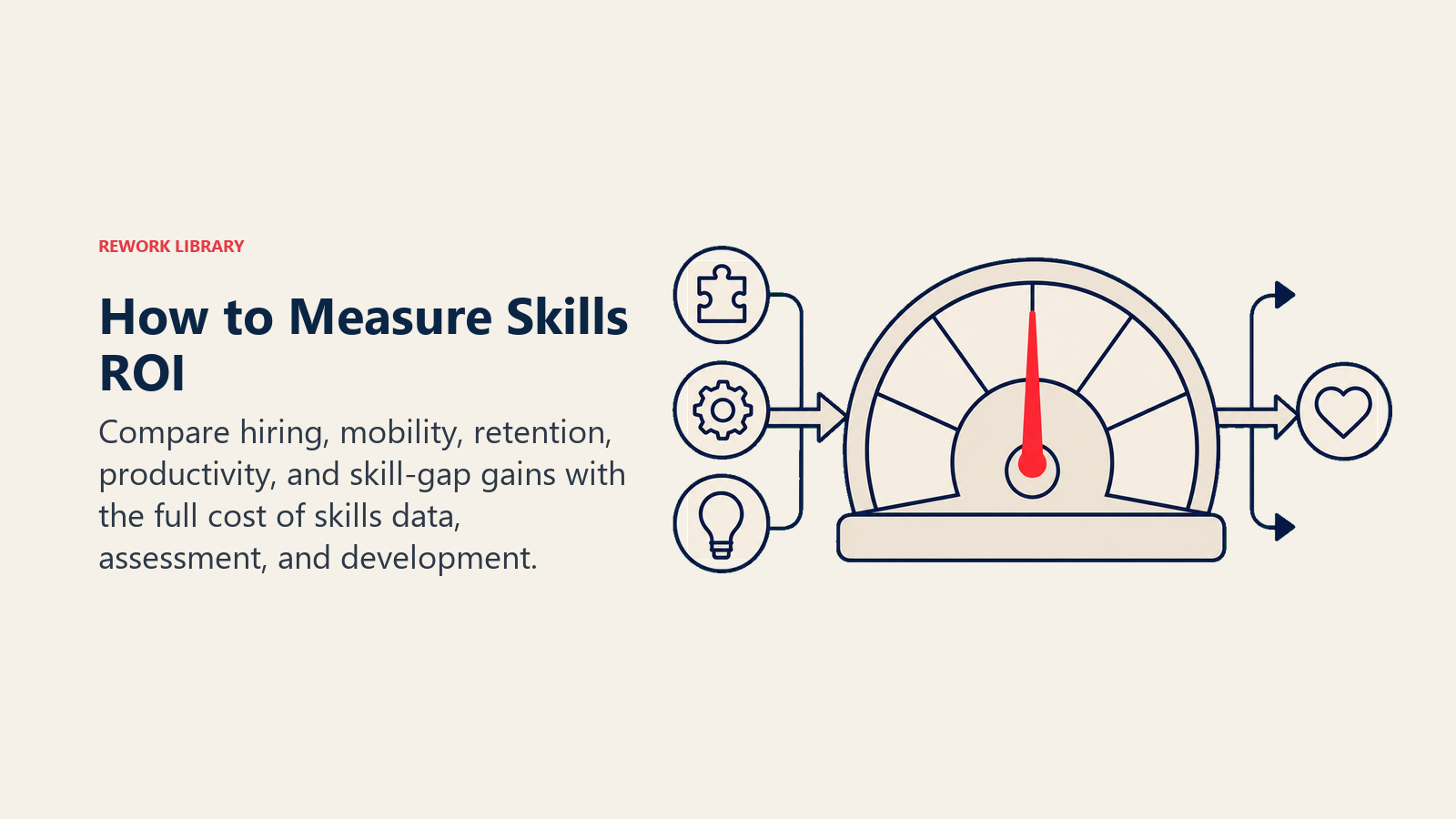
Showing return on skills investments builds support for continued capability building.
Skills Investment Metrics
Leading Indicators:
- Skills inventory coverage (% of roles with defined skills)
- Employee skills profile completion rate
- Internal mobility application rate
- Skills development activity participation
Lagging Indicators:
- Critical skill gap closure rate
- Internal fill rate for open positions
- Time to productivity for role transitions
- Employee retention by skills development access
- Revenue per employee trends
ROI Calculation: Skills ROI = (Value of improved outcomes - Skills investment costs) / Skills investment costs
Include in value calculation: reduced external hiring costs, faster time-to-fill, lower turnover, improved productivity, and enhanced innovation metrics.
Benchmark Targets
| Metric | Level 2 | Level 3 | Level 4 |
|---|---|---|---|
| Skills taxonomy coverage | 50% | 90% | 100% |
| Internal fill rate | 15% | 30% | 45% |
| Time-to-fill reduction | 20% | 40% | 60% |
| First-year turnover reduction | 10% | 25% | 40% |
| Training ROI improvement | 25% | 50% | 80% |
Industry Benchmarks and Best Practices
Technology Sector Benchmarks
- Skills Taxonomy Maturity: 75-90% of organizations at Level 3+
- Internal Mobility Rate: 25-35% annual internal movement
- Investment Level: 3-5% of payroll in skills infrastructure
- Leading Organizations: Microsoft, Google, IBM (Level 4-5 capabilities)
Financial Services Benchmarks
- Skills Taxonomy Maturity: 50-70% of organizations at Level 2-3
- Internal Mobility Rate: 15-25% annual internal movement
- Investment Level: 2-4% of payroll in skills infrastructure
- Leading Organizations: JPMorgan Chase, Capital One, USAA (Level 3-4 capabilities)
Healthcare Benchmarks
- Skills Taxonomy Maturity: 40-60% of organizations at Level 2-3
- Internal Mobility Rate: 12-20% annual internal movement
- Investment Level: 2-3% of payroll in skills infrastructure
- Leading Organizations: Cleveland Clinic, Kaiser Permanente (Level 3 capabilities)
Manufacturing Benchmarks
- Skills Taxonomy Maturity: 35-55% of organizations at Level 2-3
- Internal Mobility Rate: 10-18% annual internal movement
- Investment Level: 1.5-3% of payroll in skills infrastructure
- Leading Organizations: Siemens, Boeing, Toyota (Level 3-4 capabilities)
Resources for Organizational Development
Current Frameworks and Methodologies
- Skills-Based Organization Framework: Deloitte methodology for skills-first talent transformation
- Competency Modeling: SHRM and OPM frameworks for systematic capability definition
- Skills Taxonomy Standards: ESCO (European) and O*NET (U.S.) classification systems
- Learning Experience Design: Modern approaches to skills-aligned development programs
Technology Platforms
- Talent Marketplaces: Gloat, Fuel50, Eightfold, Workday Skills Cloud
- Skills Assessment: SHL, Criteria, TestGorilla, Codility
- Learning Platforms: Degreed, LinkedIn Learning, Coursera for Business
- Workforce Planning: Visier, Anaplan, Workday Adaptive Planning
Educational Resources
- Professional Certifications: SHRM Skills-Based Talent Management, ATD Talent Development
- Academic Programs: MIT Sloan Future of Work, Wharton People Analytics
- Industry Associations: SHRM, ATD, i4cp, The Conference Board
Strategic Considerations for Leadership
How should the board evaluate the organization's skills-based talent maturity and prioritize investments?
Boards should assess skills capability through metrics including skills taxonomy coverage, internal mobility rates, time-to-fill for critical roles, and workforce agility indicators. Request quarterly reporting on skill gap closure rates, hiring quality improvements, and training ROI. Compare your metrics against industry benchmarks and competitors. Make sure there's adequate investment (2-5% of payroll) in skills infrastructure. Skills capabilities compound over time, and early investment creates sustainable competitive advantage.
What organizational structure changes are required to advance from credential-based to skills-based talent practices?
Advancing skills maturity requires dedicated skills leadership with enterprise-wide authority, typically reporting to the CHRO or CEO. Create cross-functional teams connecting HR, business leaders, and technology to govern skills taxonomy and assessment practices. Redesign recruiting, learning, and mobility functions around skills data and processes. Set up centers of excellence for skills assessment, skills analytics, and internal mobility that serve all business units consistently.
How can we overcome manager resistance to skills-based hiring and internal mobility?
Manager resistance often comes from fear of losing control over team composition and worry about losing top performers to other areas. Address these concerns by involving managers in skills framework development, training them on skills-based hiring benefits, creating policies that balance organizational needs with team stability, and measuring managers on talent development contributions. Share data showing that managers who develop and export talent attract stronger candidates and build reputations as talent leaders.
What role should AI play in skills-based talent practices?
AI accelerates skills-based practices through automated skills inference from work outputs, matching algorithms for internal mobility, personalized learning recommendations, and predictive analytics for workforce planning. But AI should augment human judgment, not replace it. Make sure there's transparency in AI-driven decisions, validate algorithms for bias, keep humans in the loop for major talent decisions, and communicate clearly with employees about how AI uses their skills data.
How do we balance skills-based practices with the need for credentials in regulated industries?
Regulated industries require certain credentials for compliance, but these are the floor, not the ceiling, of talent requirements. Distinguish between regulatory requirements (non-negotiable) and organizational preferences (open to skills-based evaluation). For non-regulated roles, apply full skills-based practices. For regulated roles, ensure credential compliance while using skills assessment to differentiate among qualified candidates and inform development priorities.
What metrics should we track to demonstrate ROI from skills-based talent investments?
Track leading indicators like skills inventory coverage, employee profile completion, marketplace engagement, and skills development participation. Monitor outcome metrics including internal fill rate, time-to-fill reduction, hiring quality (first-year performance and retention), training effectiveness, and workforce agility during organizational changes. Calculate comprehensive ROI by comparing talent outcomes before and after skills-based implementation, including both hard cost savings and productivity improvements.
How should skills-based practices connect to compensation and career advancement?
Skills-based compensation ties pay to demonstrated capabilities rather than tenure or credentials alone. Add skills premiums for high-value competencies, create advancement criteria based on skill acquisition, and ensure pay equity across paths requiring different skills. Be cautious about full skills-based pay transformation without mature skills assessment capabilities. Start by incorporating skills into advancement criteria while maintaining market-based base pay, then evolve as your assessment maturity increases.
What change management approach supports successful skills-based transformation?
Skills-based transformation requires significant behavior change from employees, managers, and HR professionals. Build awareness through clear communication of the "why" behind skills practices. Get employees involved in skills framework development to build ownership. Train managers extensively on new hiring and development approaches. Celebrate early wins and share success stories. Address concerns about assessment fairness openly. Phase implementation to allow for learning and adjustment.
How do we maintain skills taxonomy relevance as the market evolves rapidly?
Set up formal taxonomy governance with quarterly review cycles. Monitor external skills market data for emerging capabilities. Get business leaders and technical experts involved in identifying new skill needs. Use AI-powered tools to track skill trends across job postings and industry content. Create processes for rapid addition of emerging skills while retiring obsolete ones. Balance comprehensiveness with usability since overly complex frameworks hurt adoption.
What are the critical success factors for skills-based talent marketplace implementation?
Successful marketplaces need comprehensive skills data on both opportunities and employees, transparent posting of internal opportunities with clear skill requirements, policies that let employees pursue opportunities across boundaries, manager training on talent sharing benefits, metrics measuring marketplace usage and outcomes, and executive sponsorship showing organizational commitment to internal mobility.
Your First 30 Days: Getting Started
Week 1: Skills Capability Assessment
Do a comprehensive evaluation of your existing skills-based practices using the maturity model framework. Survey HR and business leaders on current talent processes, review hiring practices for credential versus skills emphasis, and benchmark capabilities against industry standards. Document your baseline skills infrastructure, assessment tools, and internal mobility metrics.
Week 2: Stakeholder Alignment
Run sessions with your executive team to build consensus on skills-based talent priorities. Present the business case including talent shortage data, competitor practices, and ROI projections. Address concerns about implementation complexity and change management requirements. Secure leadership commitment for the skills-based transformation investment.
Week 3: Quick Win Implementation
Find 2-3 high-impact opportunities that can show skills-based value within 60-90 days. Consider piloting skills-based hiring for high-volume roles, launching skills self-assessment for targeted functions, or improving internal job postings with skill requirements. Focus on visible wins that build organizational confidence.
Week 4: Roadmap Development
Create a detailed plan for advancing to the next maturity level including timeline, technology requirements, success metrics, and governance structure. Prioritize skills taxonomy development, assessment tool selection, and change management activities. Identify external partners for accelerated capability building and put together your project team.
Conclusion: The Skills-Based Imperative
Skills-Based Talent Strategy is the organizational capability that separates talent leaders from talent laggards in an era of accelerating skill evolution and persistent workforce challenges. Organizations that systematically develop skills-based capabilities don't just fill positions. They build adaptive workforces capable of continuous transformation.
The evidence is clear: organizations with mature skills-based capabilities are 85% more likely to successfully redeploy talent, 57% more likely to anticipate future workforce needs, and 107% more likely to place talent effectively. They achieve 70% faster hiring, 41% better retention, and 36% greater diversity through objective skills assessment.
The path to skills-based excellence requires systematic progression through maturity levels, each building capabilities that enable more sophisticated talent optimization. From basic skills recognition to global ecosystem leadership, each level represents expanded organizational capability for thriving in skills-driven competitive environments.
The investment is significant. Leading organizations invest 4-6% of payroll in skills infrastructure. But the returns are worth it. Skills capabilities become sustainable competitive advantages that compound over time, enabling organizations to adapt faster, develop talent more efficiently, and deploy human capital more effectively than credential-bound competitors.
The question for leadership teams isn't whether to adopt skills-based practices, but how fast to advance through maturity levels before talent shortages and skill gaps constrain strategic execution. In markets where skills availability determines competitive capacity, organizational skills-based talent strategy becomes the ultimate workforce differentiator.
Learn More
Want to learn more about skills-based talent strategy and related organizational capabilities? Check out these guides:
- Coaching and Mentoring - Develop coaching capabilities that accelerate employee skill development
- Resource Management - Optimize talent allocation through skills-based workforce planning
- Strategic Planning - Integrate skills forecasting into organizational strategy development
- Leading Teams - Build the people-leadership skills that managers need to develop their teams
Related Organizational Competencies

On this page
- Strategic Imperative for Organizational Excellence
- The Competitive Advantage Metrics for Skills-Based Talent Strategy
- The 5 Levels of Organizational Skills-Based Talent Maturity
- Level 1: Reactive - Ad Hoc Skills Recognition (Bottom 25% of Organizations)
- Level 2: Structured - Formal Skills Framework Implementation (25th-50th Percentile)
- Level 3: Proactive - Integrated Skills Ecosystem Culture (50th-75th Percentile)
- Level 4: Anticipatory - Skills Intelligence Leadership (75th-95th Percentile)
- Level 5: Transformational - Global Skills Ecosystem Leadership (Top 5% of Organizations)
- Your Roadmap: How to Advance Through Each Level
- Level 1 to Level 2: Building Skills Foundation (6-12 months)
- Level 2 to Level 3: Skills Culture Integration (12-18 months)
- Level 3 to Level 4: Skills Intelligence Development (18-24 months)
- Level 4 to Level 5: Skills Ecosystem Leadership (24-36 months)
- Quick Assessment: What Level Are You?
- Building Your Skills Taxonomy
- Skills Taxonomy Architecture
- Skills Assessment Methods
- Skills-Based Hiring and Assessment
- Implementing Skills-Based Job Descriptions
- Assessment Best Practices
- Internal Talent Mobility and Skills Matching
- Talent Marketplace Design
- Enabling Skills-Based Mobility
- Skills Development and Upskilling Programs
- Skills Gap Analysis
- Development Program Design
- Measuring Skills ROI
- Skills Investment Metrics
- Benchmark Targets
- Industry Benchmarks and Best Practices
- Technology Sector Benchmarks
- Financial Services Benchmarks
- Healthcare Benchmarks
- Manufacturing Benchmarks
- Resources for Organizational Development
- Current Frameworks and Methodologies
- Technology Platforms
- Educational Resources
- Your First 30 Days: Getting Started
- Week 1: Skills Capability Assessment
- Week 2: Stakeholder Alignment
- Week 3: Quick Win Implementation
- Week 4: Roadmap Development
- Conclusion: The Skills-Based Imperative
- Learn More
- Related Organizational Competencies