More in
AI Jobs & Skills News
Finance Keeps Shedding Jobs as the Economy Hires: The White-Collar Warning
Jun 6, 2026
AI Skills Just Became the Hardest Hire in the World. You Won't Recruit Your Way Out
Jun 6, 2026
Is AI Actually Killing Jobs? May's Hiring Numbers Say Not So Fast
Jun 5, 2026
You Put Your AI Agents on the Org Chart. Accountability Quietly Dropped
Jun 5, 2026
Everyone Blames AI for the Gen Z Job Crisis. The Fed Points at Remote Work
Jun 5, 2026
AI's Net Job Drag Fell to 11,000 a Month. Construction Is Hiding the Truth
Jun 4, 2026
AI Blamed for a Record 40% of May's US Layoffs, the Third Month Running
Jun 4, 2026
Four Futures for Jobs by 2030: The Mid-2026 Checkpoint for CEOs
Jun 3, 2026 · Currently reading
Can Federal AI Apprenticeships Fix Your Skills Gap Cheaper Than Hiring?
Jun 3, 2026
AI Engineer Pay Split Into Two Markets. Only the Top Is a Bubble
Jun 3, 2026
Four Futures for Jobs by 2030: The Mid-2026 Checkpoint for CEOs
Turn this article into takeaways for your work.


Each assistant summarizes the article only for you and suggests best practices for your work.
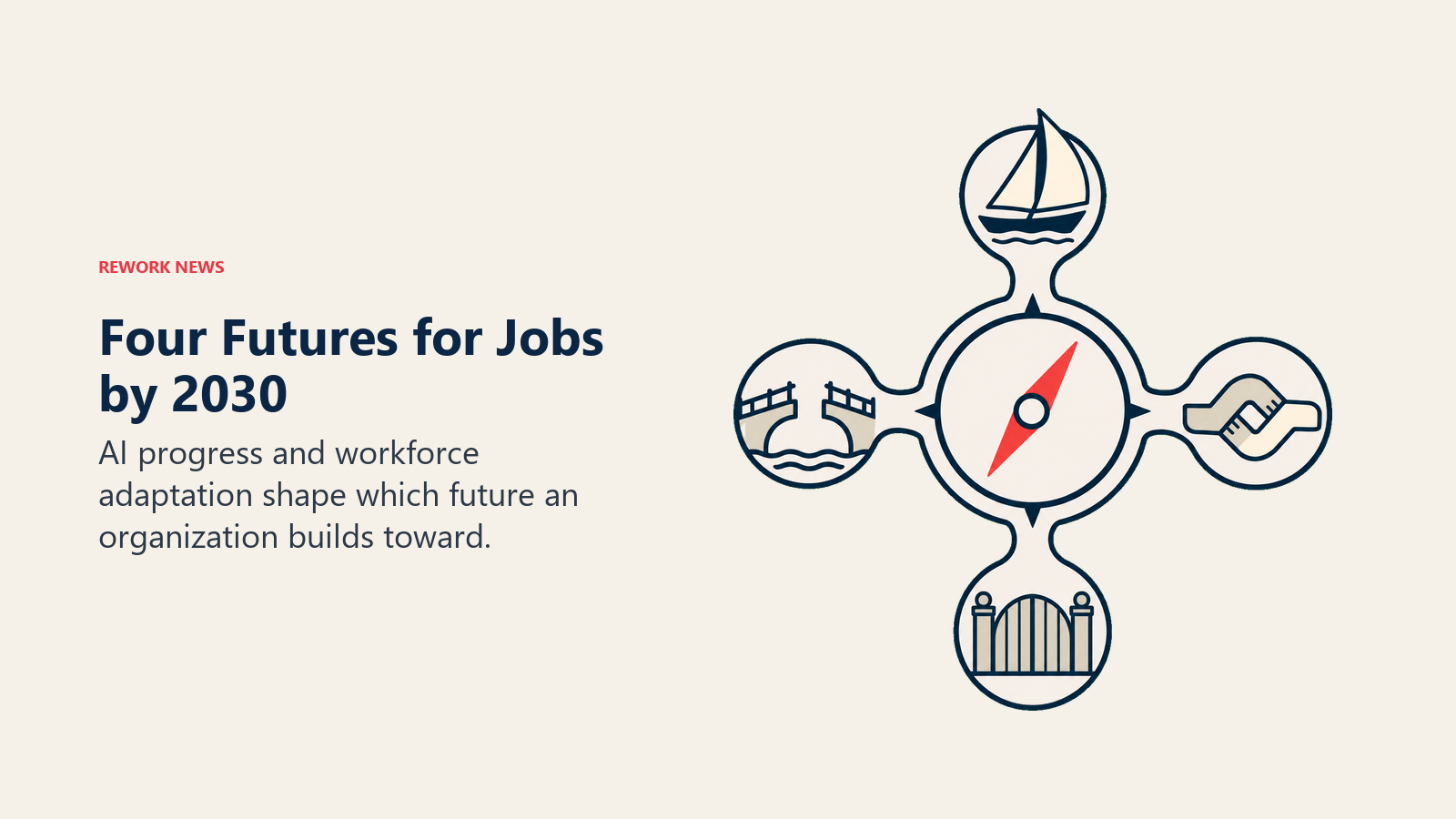
We are roughly halfway between now and 2030. That matters because the World Economic Forum (WEF) set 2030 as the horizon for its landmark analysis, "Four Futures for Jobs in the New Economy." The WEF didn't predict a single outcome. It mapped four distinct paths that companies and economies could travel depending on how fast AI advances and how deliberately organizations invest in human capability.
The midpoint is the right time to check the map. According to the World Economic Forum, roughly 170 million new roles will be created by 2030 while about 92 million are displaced, a net gain of 78 million jobs. But that optimistic net figure hides enormous variance. It holds only if organizations actively redesign roles, retrain people, and adopt AI in a way that augments human work rather than simply eliminating it.
The evidence at mid-2026 suggests many companies are not on that path. Here's how to figure out which future your organization is actually building toward, and what to do about it this quarter.
The Four Scenarios, Translated for CEOs
The scenarios are useful only if CEOs translate them into workforce bets they can start adjusting before 2030 arrives.
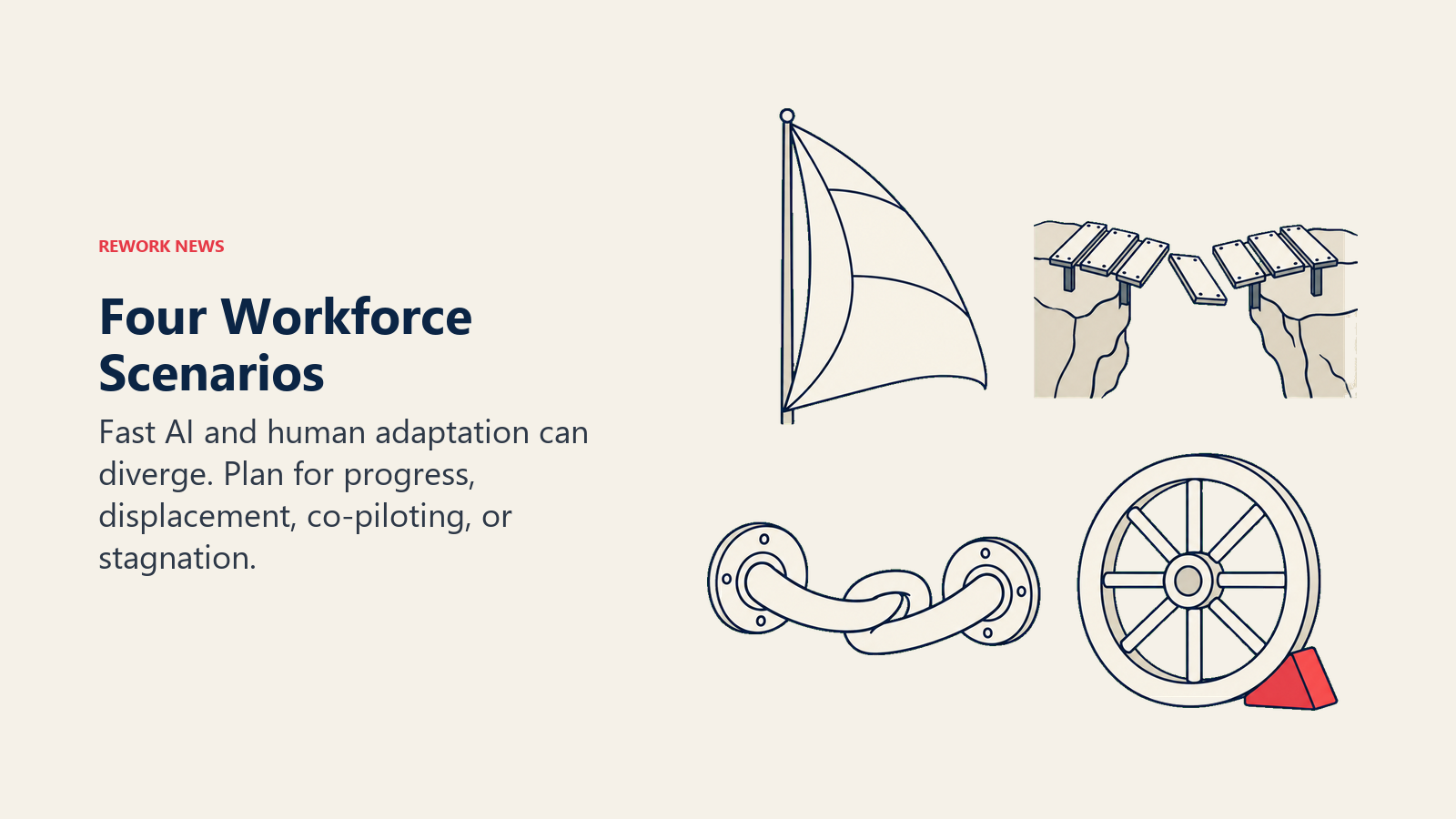
The WEF framework lays out four possible futures, each driven by a different combination of AI capability growth and workforce adaptation speed.
Supercharged Progress describes a world where AI breakthroughs arrive fast and companies capture the productivity gains. Growth is real, but the disruption is severe. Workers without advanced skills fall behind quickly, and the premium for AI fluency widens fast. This is the "high tide lifts some boats, swamps others" scenario.
The Age of Displacement is the scenario most CEOs fear but few explicitly plan to avoid. AI adoption accelerates faster than reskilling. New roles emerge, but the workforce can't fill them quickly enough. Employment polarizes. The social cost rises, and at some point regulatory and reputational pressure arrives at the boardroom door.
The Co-Pilot Economy is the scenario nearly every corporate AI strategy claims to be building toward. Adoption is deliberate and gradual. AI handles repetitive and analytical tasks while humans handle judgment, relationships, and creativity. Productivity rises and so does worker confidence. This is the outcome where the WEF's net +78 million jobs figure actually plays out.
Stalled Progress is the scenario nobody advertises but many organizations are quietly sliding into. Skills gaps, organizational inertia, or limited AI adoption blunt productivity gains. The technology is there; the capability to use it isn't. Growth stays flat while competitors in more adaptive markets pull ahead.
Key Facts
- Approximately 170 million new roles will be created and 92 million displaced by 2030, for a net gain of 78 million jobs (World Economic Forum Future of Jobs Report 2025).
- Employers expect about 39% of workers' core skills to change by 2030, with AI and big data ranked as the fastest-growing skill clusters (WEF).
- Workers with advanced AI skills earn approximately 56% more than peers in the same role (PwC AI Jobs Barometer, cited in WEF).
What Mid-2026 Signals Are Actually Saying
The signals available right now don't point to the Co-Pilot Economy. They point somewhere between Age of Displacement and Stalled Progress.
ManpowerGroup's 2026 Global Talent Barometer found that regular AI use by workers jumped to 45%, a meaningful acceleration. But in the same survey, worker confidence fell for the first time in three years. Forty-three percent of workers now fear automation could replace their job within two years. Sixty-four percent are "job hugging," staying in their current role purely for stability rather than growth. And 56% reported receiving no recent training from their employer. AI adoption is rising while investment in human capability is stalling. That combination is the textbook setup for displacement.
The policy side is more encouraging. The U.S. Department of Labor committed $243 million in April 2026 to integrate AI skills into Registered Apprenticeship programs, which is a direct, structural bet on the Co-Pilot Economy outcome. And AI skills now appear in roughly 1 in 10 U.S. job postings, more than doubling year over year. Demand for human AI fluency is real and growing fast. The gap is on the supply and investment side.
The picture, taken together, is of an economy accelerating toward AI adoption without a matching acceleration in workforce preparation. That's the definition of the Age of Displacement scenario gaining ground.
For more on what the AI skills salary premium looks like in practice, or how companies are benchmarking their reskilling budgets, those data points sharpen the picture.
The Three-Signal CEO Self-Diagnostic
The WEF framework becomes useful only when you apply it to your own organization. Here's a three-question diagnostic that tells you which scenario your company is building toward.
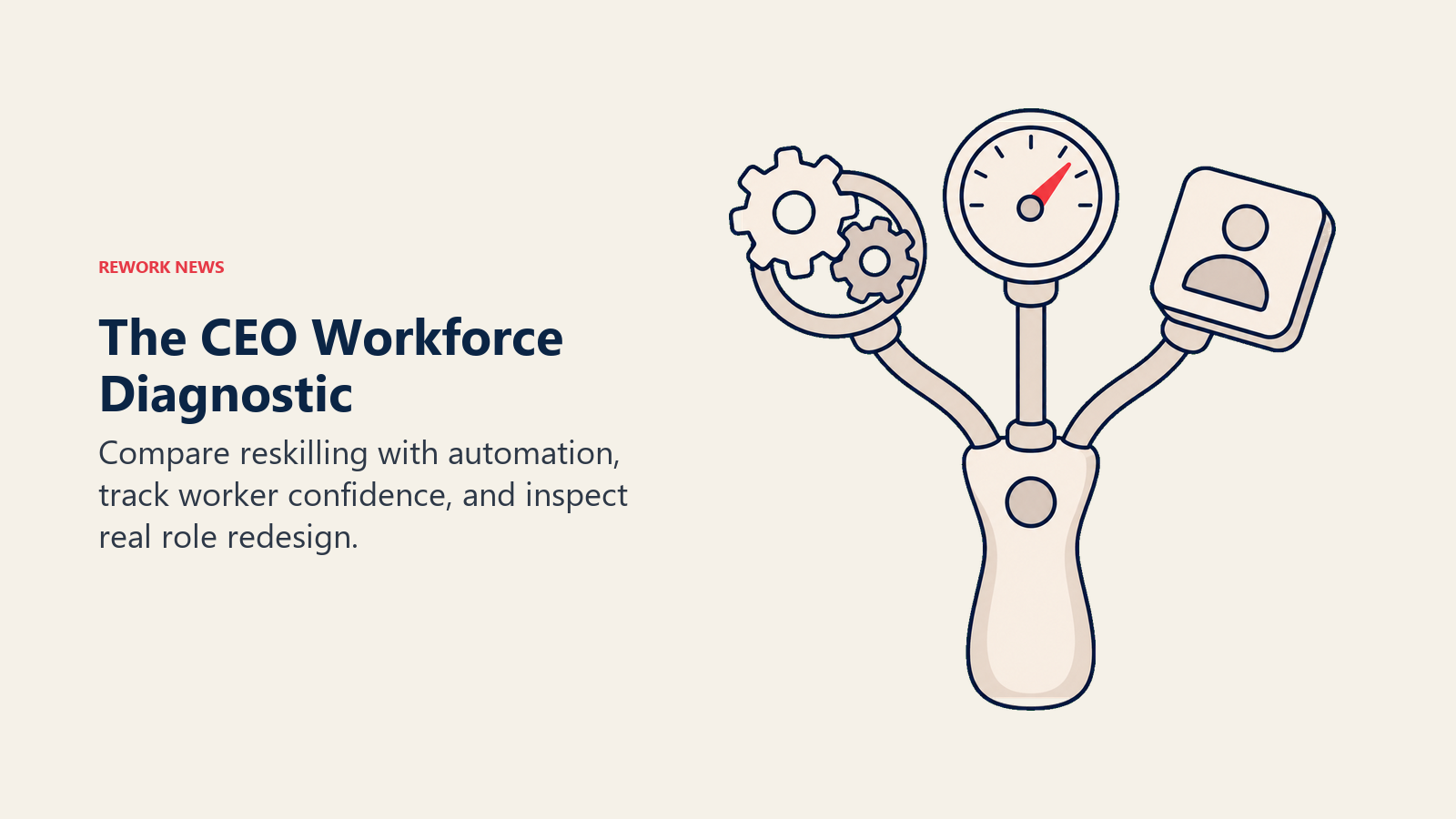
Signal 1: Are you reskilling faster than you're automating?
Count the AI-driven automation projects you've approved in the last 12 months, and count the structured reskilling investments attached to them. If the automation projects outnumber the reskilling investments by more than 2:1, you're on a displacement trajectory regardless of what your people strategy documents say. The AI workforce readiness gap data from CHRO surveys shows most large employers are at 4:1 or worse.
Signal 2: Is internal worker confidence rising or falling?
You don't need a full engagement survey. A pulse question to your managers every quarter works: "Do your team members feel their skills are getting more valuable here, or less?" If confidence is flat or falling while you're increasing AI investment, you are replicating the ManpowerGroup pattern at the company level. Falling confidence predicts job hugging, knowledge hoarding, and quiet resistance to AI adoption, all of which accelerate Stalled Progress or worse.
Signal 3: Are you redesigning roles or just eliminating them?
Cutting a role and calling it "AI efficiency" is not a Co-Pilot Economy move. The Co-Pilot Economy requires deliberate role architecture: breaking jobs into task components, identifying which tasks AI handles, and rebuilding the human portion around judgment, relationship, and creativity. If your workforce reduction announcements don't come with visible role redesign plans, the message your organization receives is displacement, not augmentation. That shapes behavior for years.
The replace-vs-augment debate has real data behind it now. The augmentation path delivers better outcomes on both productivity and retention.
What to Do This Quarter
You can't build a four-year workforce strategy in one quarter. But you can make one directional decision this quarter that shifts your trajectory.
The highest-leverage move: attach a reskilling commitment to every automation project already in flight. Not a training budget line item. A specific, named program that tells workers in affected roles what skill they'll gain and what role that skill unlocks. This closes the confidence gap and creates the accountability structure that Co-Pilot Economy organizations actually have.
A secondary move: measure worker confidence explicitly alongside AI adoption metrics. Most organizations track AI tool deployment and cost reduction. Few track whether the people using those tools feel more capable or less secure because of them. The ManpowerGroup data shows confidence fell even as usage rose. That divergence is the early warning signal for the scenarios you don't want.
The US National AI Talent Initiative and the national AI talent policy developments give companies external frameworks to anchor internal programs to, which is useful for board-level credibility and for recruiting.
By late 2027, the labor market data will start showing which scenario is winning globally. The window to influence where your company lands is now, at the midpoint, before the patterns become structural.
Frequently Asked Questions
What are the WEF's four futures for jobs by 2030?
The World Economic Forum identified four scenarios based on the pace of AI advancement and the speed of workforce adaptation: Supercharged Progress (fast AI, high disruption), Age of Displacement (AI outpaces reskilling), Co-Pilot Economy (deliberate, augmentation-focused adoption), and Stalled Progress (slow adoption and skills gaps blunt gains). Each scenario leads to a fundamentally different labor market outcome by 2030.
Which of the four futures are we currently tracking toward?
Mid-2026 signals are mixed but lean toward the less favorable scenarios. Worker AI use is rising (45% report regular use, per ManpowerGroup 2026), but confidence is falling, 56% of workers report receiving no recent training, and 64% are staying in roles for stability rather than growth. This pattern, high adoption with low investment in human capability, aligns more closely with Age of Displacement than with the Co-Pilot Economy most corporate strategies claim to target.
What's the single most important thing a CEO can do this quarter to shift toward the Co-Pilot Economy?
Attach an explicit reskilling commitment to every automation project currently in flight. Not a budget line, but a named program with a clear skill outcome and a named role that skill unlocks. This closes the gap between automation pace and workforce preparation pace, which is the core structural problem the current signals reveal.
Sources: World Economic Forum, Four Futures for Jobs | WEF Future of Jobs Report 2025 | ManpowerGroup Global Talent Barometer 2026 | U.S. Department of Labor, April 2026
