Leading AI Transformation: Leadership Competency Framework

Turn this article into takeaways for your work.


Each assistant summarizes the article only for you and suggests best practices for your work.
What You'll Get From This Guide
- 5-Level Maturity Model: Progressive leadership capabilities from reactive AI adoption to transformational AI ecosystem leadership
- Strategic Framework: Clear guidance for building AI vision, communicating with stakeholders, and driving organizational change
- Ethical Leadership: Frameworks for balancing AI efficiency with workforce concerns and responsible AI deployment
- Practical Roadmap: Step-by-step progression through AI leadership maturity with timelines and investment guidance
Business competencies are the strategic, interpersonal, and decision-making capabilities a leader uses to run an organization, and AI transformation now sits among the most valuable of them. Leading AI transformation draws on four core business competencies: strategic vision to connect AI to outcomes, change leadership to move the organization, ethical judgment to deploy AI responsibly, and stakeholder communication to keep trust intact. This guide maps those competencies to a 5-level maturity model so you can locate your current level and advance.
Strategic Imperative for Leadership in the AI Era
The emergence of generative AI and machine learning has fundamentally altered what organizations expect from their leaders. According to McKinsey's 2025 State of AI report, companies with AI-ready leadership are 2.8x more likely to capture value from their AI investments. Yet 67% of executives report feeling unprepared to lead their organizations through AI transformation.
This gap represents both a challenge and an opportunity. Leaders who develop AI transformation competencies now will shape how their industries evolve. Those who don't? They risk watching competitors pull ahead while their organizations struggle with failed implementations and workforce uncertainty.
The stakes are real. Boston Consulting Group research shows that AI transformation initiatives led by executives with strong AI literacy achieve 40% higher ROI compared to those led by executives who delegate AI strategy entirely to technical teams. And Gartner predicts that by 2027, 80% of executive roles will require demonstrated AI transformation leadership capabilities.
Leading AI Transformation as a competency encompasses a leader's ability to envision AI's strategic role, guide organizational change, make ethical decisions about AI deployment, and communicate effectively with stakeholders who have varying levels of AI understanding and different concerns about its impact.
The Business Case for AI Leadership Competency
Organizations with mature AI transformation leadership demonstrate:
- Implementation Success: 73% higher success rate for AI initiatives through strategic alignment and change management
- Value Capture: 2.4x faster time-to-value from AI investments through focused prioritization
- Workforce Engagement: 58% higher employee buy-in for AI initiatives when leaders communicate transparently
- Ethical Outcomes: 65% fewer AI-related reputation incidents through proactive governance frameworks
- Competitive Position: 45% higher likelihood of becoming industry AI leaders within 3-year periods
- Talent Attraction: 52% improvement in recruiting AI talent when executive AI vision is clear and compelling
The 5 Levels of AI Transformation Leadership Maturity
AI transformation leadership develops in recognizable stages, from reactive technology decisions to influence over industry standards and global AI policy.
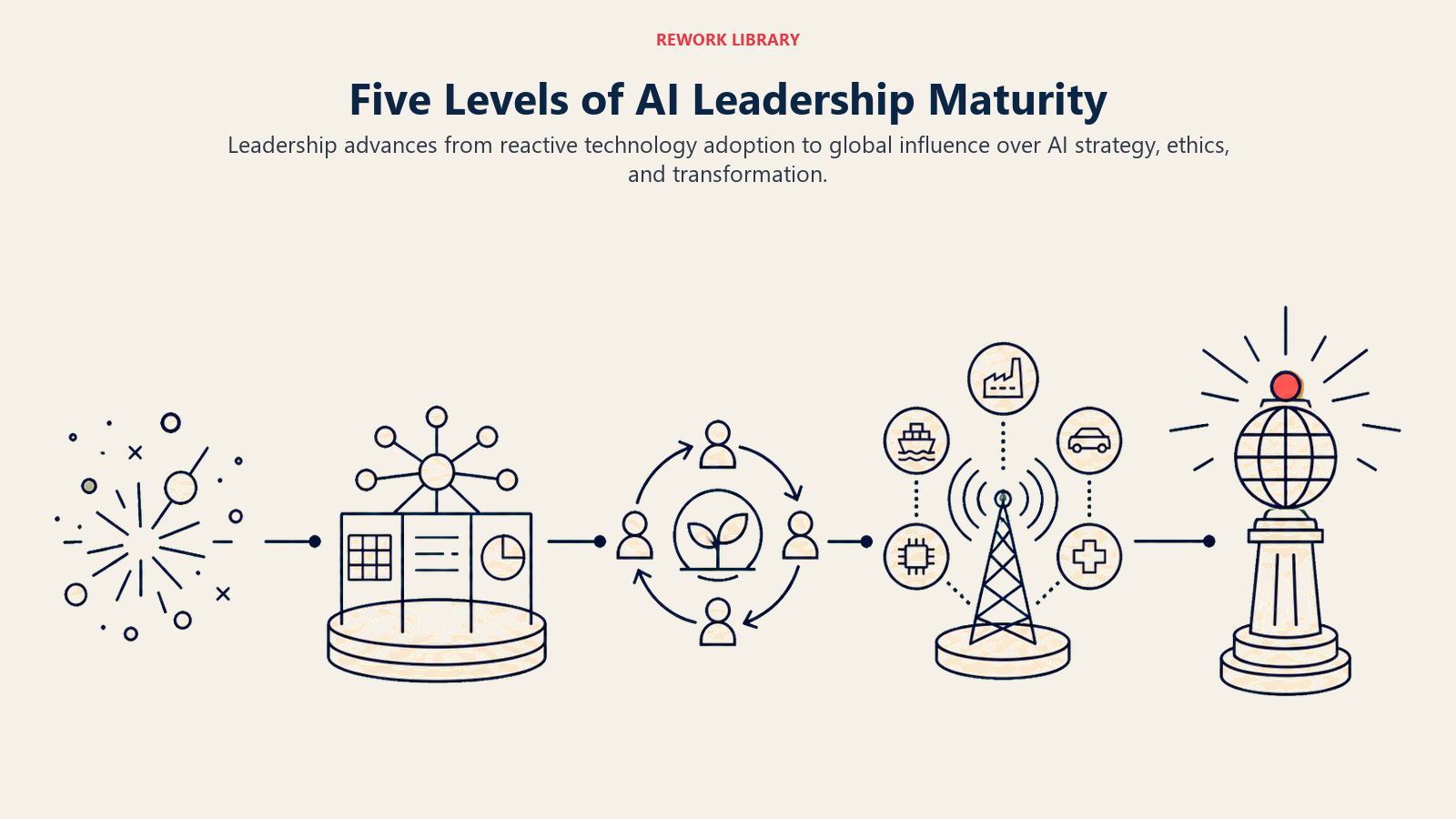
Level 1: Reactive - Technology-Focused Response (Bottom 25% of Leaders)
Leadership Characteristics:
- AI initiatives are driven by technology availability or competitive panic, not strategic vision
- Leader delegates AI decisions entirely to IT or data science teams without executive engagement
- Limited personal understanding of AI capabilities, limitations, and business applications
- Workforce concerns about AI are dismissed or ignored rather than addressed directly
- AI ethics treated as compliance requirement rather than leadership responsibility
Capability Indicators:
- No articulated AI vision or strategy connecting AI investments to business outcomes
- AI initiatives selected based on vendor pitches or competitor announcements, not strategic fit
- Communication about AI is inconsistent, creating confusion and anxiety across the organization
Business Impact:
- AI initiatives fail 60-70% of the time due to poor strategic alignment and change management
- Workforce resistance undermines implementation as employees feel threatened and unheard
- Significant investment wasted on AI projects that don't connect to what the business actually needs
Real-World Example:
- IBM Watson Health (2015-2022): Despite significant investment, Watson Health struggled partly because leadership focused on technology capabilities without adequate attention to healthcare workflow integration, physician adoption, and the complex realities of clinical decision-making.
Benchmark: Bottom 25th percentile - Leaders who treat AI as primarily a technology decision rather than a business transformation
Level 2: Structured - Strategic AI Integration (25th-50th Percentile)
Leadership Characteristics:
- Formal AI strategy developed with clear connection to business objectives and competitive positioning
- Leader actively participates in AI initiative prioritization and resource allocation decisions
- Basic AI literacy enables meaningful conversations with technical teams about feasibility and trade-offs
- Structured communication plan addresses workforce concerns about AI impact on roles
- AI governance framework established with defined accountability and ethical guidelines
Capability Indicators:
- AI strategy document articulates 3-5 year vision with prioritized use cases and success metrics
- Regular executive review of AI portfolio ensures strategic alignment and resource optimization
- Employees receive clear communication about AI plans and how their roles may evolve
Business Impact:
- AI initiative success rate improves to 50-60% through better strategic alignment
- Workforce anxiety decreases as transparent communication builds trust and clarity
- AI investments begin generating measurable business value within 12-18 month timeframes
Real-World Example:
- Delta Air Lines (2019-2024): CEO Ed Bastian's structured approach to AI integration focused on specific operational improvements (baggage tracking, customer service, maintenance prediction) with clear business cases and employee communication, resulting in measurable efficiency gains.
Investment vs. Return:
- Investment of dedicated executive time (10-15 hours monthly) plus AI literacy development
- Return of 35-50% improvement in AI initiative outcomes and workforce engagement
Benchmark: 25th-50th percentile - Leaders who treat AI strategically but haven't yet embedded AI thinking into organizational culture
Level 3: Proactive - Culture-Driven AI Leadership (50th-75th Percentile)
Leadership Characteristics:
- AI transformation treated as business transformation requiring cultural change, not just technology adoption
- Leader models AI adoption personally, using AI tools and discussing AI applications openly
- Deep understanding of AI enables challenging assumptions and pushing for innovative applications
- Workforce development programs build AI capabilities across the organization at all levels
- Leading change principles actively applied to AI transformation initiatives
Capability Indicators:
- AI literacy programs reach all management levels with role-specific capability development
- Cross-functional AI teams empowered to identify and pursue AI opportunities autonomously
- Leader can articulate AI's role in competitive strategy to board, investors, and customers
Business Impact:
- AI initiative success rate reaches 70-80% through organizational alignment and capability building
- Employee engagement with AI increases as teams see opportunities rather than threats
- AI-driven innovations emerge from multiple business units, not just central data science teams
Real-World Example:
- JPMorgan Chase (2017-2025): CEO Jamie Dimon's approach treats AI as core to competitive strategy, with substantial investment in AI talent, infrastructure, and executive education. The bank's AI initiatives span trading, fraud detection, customer service, and internal operations.
Investment vs. Return:
- Investment of organizational AI literacy programs ($500K-2M annually) plus executive capability development
- Return of 60-80% improvement in AI value capture and organizational AI readiness
Benchmark: 50th-75th percentile - Leaders who have built AI-ready cultures and can execute complex AI transformations
Level 4: Anticipatory - Industry AI Leadership (75th-95th Percentile)
Leadership Characteristics:
- Leader shapes industry AI adoption patterns through strategic thinking and public advocacy
- Advanced AI understanding enables identifying emerging AI capabilities before competitors
- AI ethics leadership extends beyond compliance to proactive industry standard-setting
- Workforce transformation programs create new roles and career paths enabled by AI capabilities
- External AI partnerships and ecosystem relationships amplify organizational AI capabilities
Capability Indicators:
- Organization recognized as AI leader by industry analysts, media, and competitors
- AI strategy anticipates market shifts 2-3 years ahead, enabling first-mover advantages
- Leader speaks credibly about AI at industry conferences and in media interviews
Business Impact:
- AI initiatives achieve 85-90% success rate with breakthrough competitive outcomes
- Talent attraction improves as top AI professionals seek to work with recognized leaders
- AI-driven business models create new revenue streams and market opportunities
Real-World Example:
- Satya Nadella at Microsoft (2014-2026): Nadella transformed Microsoft's culture and strategy around AI, from acquiring LinkedIn and GitHub to integrating AI across products. His communication about "AI for good" and responsible AI set industry expectations while positioning Microsoft as an AI leader.
Investment vs. Return:
- Investment of $2-5M annually in AI leadership development, partnerships, and ecosystem participation
- Return of 150-300% improvement in AI competitive position and market valuation premium
Benchmark: 75th-95th percentile - Leaders who shape how their industries think about and adopt AI
Level 5: Transformational - Global AI Thought Leadership (Top 5% of Leaders)
Leadership Characteristics:
- Leader influences global AI policy, ethics standards, and adoption patterns across industries
- AI vision creates new market categories and transforms how industries operate
- Ethical AI leadership establishes frameworks adopted by governments and international bodies
- Workforce transformation creates models replicated by other organizations facing AI disruption
- AI capabilities enable organizational mission previously considered impossible
Capability Indicators:
- Invited to advise governments, international organizations, and academic institutions on AI
- AI transformation methodology studied in business schools and replicated across industries
- Public statements on AI shape media coverage and public understanding of AI implications
Business Impact:
- AI initiatives approach 95% success rate with market-defining transformation outcomes
- Organization commands premium valuations reflecting AI leadership and future potential
- AI capabilities enable addressing previously intractable challenges at global scale
Real-World Example:
- Jensen Huang at NVIDIA (2016-2026): Huang's vision positioned NVIDIA at the center of AI computing, transforming the company from gaming graphics to AI infrastructure. His communication about AI's potential shaped industry investment patterns and public understanding.
Benchmark: Top 5th percentile - Leaders whose AI vision and execution shape global technology and business evolution
Your Roadmap: How to Advance Through Each Level
Current State Pain Points: Most leaders feel pressure to respond to AI without adequate preparation. Common challenges include overwhelming technology options, workforce anxiety, unclear ROI, ethical uncertainty, and difficulty communicating AI strategy to diverse stakeholders. These problems compound because AI capabilities advance faster than organizational learning.
Target Outcomes: Advanced AI transformation leadership enables executives to build compelling AI vision, guide organizations through uncertainty, maintain workforce trust, deploy AI ethically, and capture competitive advantage. The goal is developing leadership capability that remains relevant as AI technology continues evolving.
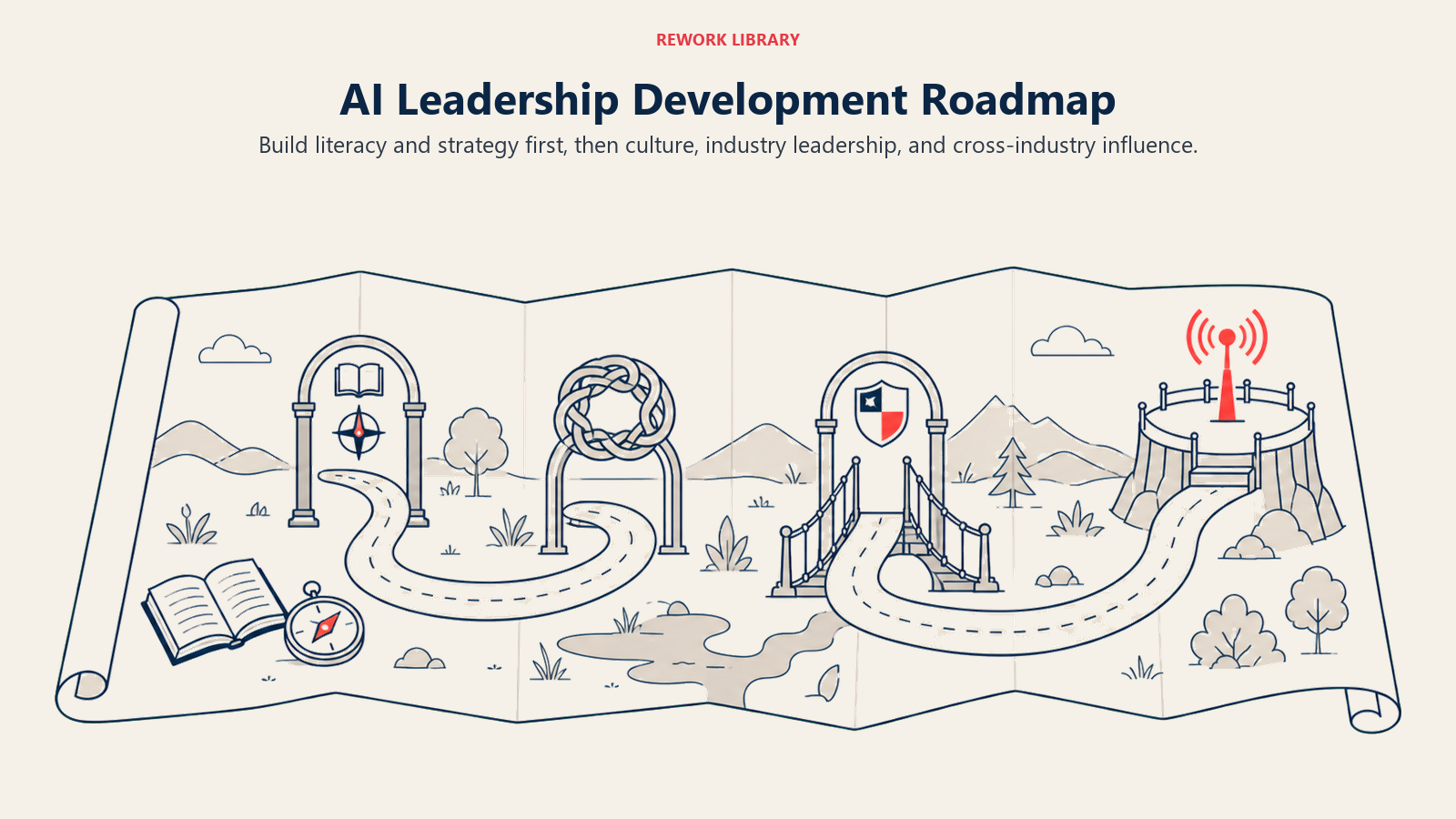
Level 1 to Level 2: Building AI Strategic Foundation (6-12 months)
Step 1: AI Literacy Development (3 months) - Build a foundational understanding of AI capabilities, limitations, and business applications through executive education, hands-on experimentation, and conversations with AI practitioners. Focus on understanding what AI can and can't do rather than technical details.
Step 2: Strategic AI Vision (3 months) - Work with leadership team to articulate AI's role in competitive strategy, identifying 3-5 priority use cases with clear business cases. Connect AI investments to specific business outcomes rather than general "digital transformation."
Step 3: Workforce Communication Framework (2-3 months) - Develop transparent communication plan addressing how AI will affect roles, what support employees will receive, and how the organization will navigate changes. Acknowledge uncertainty while providing clarity on principles.
Level 2 to Level 3: Building AI-Ready Culture (12-18 months)
Step 1: Personal AI Adoption (Ongoing) - Model AI adoption by using AI tools personally, sharing experiences (including failures) with teams, and demonstrating continuous learning. Leaders who visibly engage with AI build credibility for transformation initiatives.
Step 2: Organizational AI Capability (8-12 months) - Implement AI literacy programs across management levels, create cross-functional AI teams, and establish metrics for organizational AI maturity. Build capability broadly instead of concentrating it in technical functions.
Step 3: Change Leadership Integration (6-9 months) - Apply leading teams principles to AI transformation, addressing resistance, building coalition support, and celebrating early wins. Treat AI transformation as organizational change, not technology implementation.
Level 3 to Level 4: Developing Industry AI Leadership (18-30 months)
Step 1: External AI Engagement (12 months) - Participate in industry AI forums, contribute to standards discussions, and build relationships with AI research institutions. Develop executive presence in AI conversations through preparation and authentic engagement.
Step 2: AI Ethics Leadership (9-12 months) - Go beyond compliance to proactively establish ethical AI frameworks, publish principles publicly, and engage with stakeholders on responsible AI deployment. Build reputation for thoughtful AI governance.
Step 3: AI Ecosystem Development (12-18 months) - Build partnerships with AI vendors, startups, and academic institutions that amplify organizational AI capabilities. Create advisory relationships that provide early access to emerging AI capabilities.
Level 4 to Level 5: Achieving Global AI Thought Leadership (24-48 months)
Step 1: Public AI Thought Leadership (18-24 months) - Develop and share original perspectives on AI's implications through speaking, writing, and media engagement. Contribute to global AI policy discussions with substantive expertise.
Step 2: Cross-Industry AI Influence (18-24 months) - Extend AI transformation methodology beyond own organization through consulting relationships, board positions, and advisory roles. Help shape how other industries approach AI transformation.
Step 3: AI Impact at Scale (Ongoing) - Apply AI capabilities to challenges beyond traditional business scope, including social impact, environmental sustainability, and human development. Demonstrate AI's potential for positive transformation at global scale.
Quick Assessment: What Level Are You?
Level 1 Indicators:
- You delegate AI decisions to IT without substantive executive involvement
- AI strategy consists of responding to vendor pitches or competitor announcements
- You avoid discussing AI with employees because you're uncertain what to say
- AI ethics conversations feel like compliance requirements rather than leadership responsibility
- You can't explain how AI investments connect to business strategy
Level 2 Indicators:
- You have documented AI strategy with prioritized use cases and success metrics
- Regular executive reviews ensure AI initiatives align with business objectives
- Communication plan addresses workforce concerns about AI impact on roles
- AI governance framework establishes accountability and ethical guidelines
- You can have substantive conversations with technical teams about AI trade-offs
Level 3 Indicators:
- You use AI tools personally and share your learning experiences with teams
- AI literacy programs reach all management levels with role-specific development
- Cross-functional AI teams identify and pursue AI opportunities autonomously
- You can articulate AI's competitive role to board, investors, and customers
- Employees see AI as opportunity rather than threat due to transparent leadership
Level 4 Indicators:
- Industry recognizes your organization as AI leader based on execution and communication
- AI strategy anticipates market shifts 2-3 years ahead of competitors
- You speak credibly about AI at industry conferences and in media interviews
- Your AI ethics frameworks influence how others think about responsible AI deployment
- Top AI talent seeks to join your organization based on your AI leadership reputation
Level 5 Indicators:
- Governments and international organizations seek your input on AI policy
- Your AI transformation approach is studied in business schools and replicated by others
- Public statements on AI shape media coverage and public understanding
- AI capabilities enable your organization to address previously intractable challenges
- You're helping define what AI leadership means for the next generation of executives
Balancing AI Efficiency with Workforce Concerns
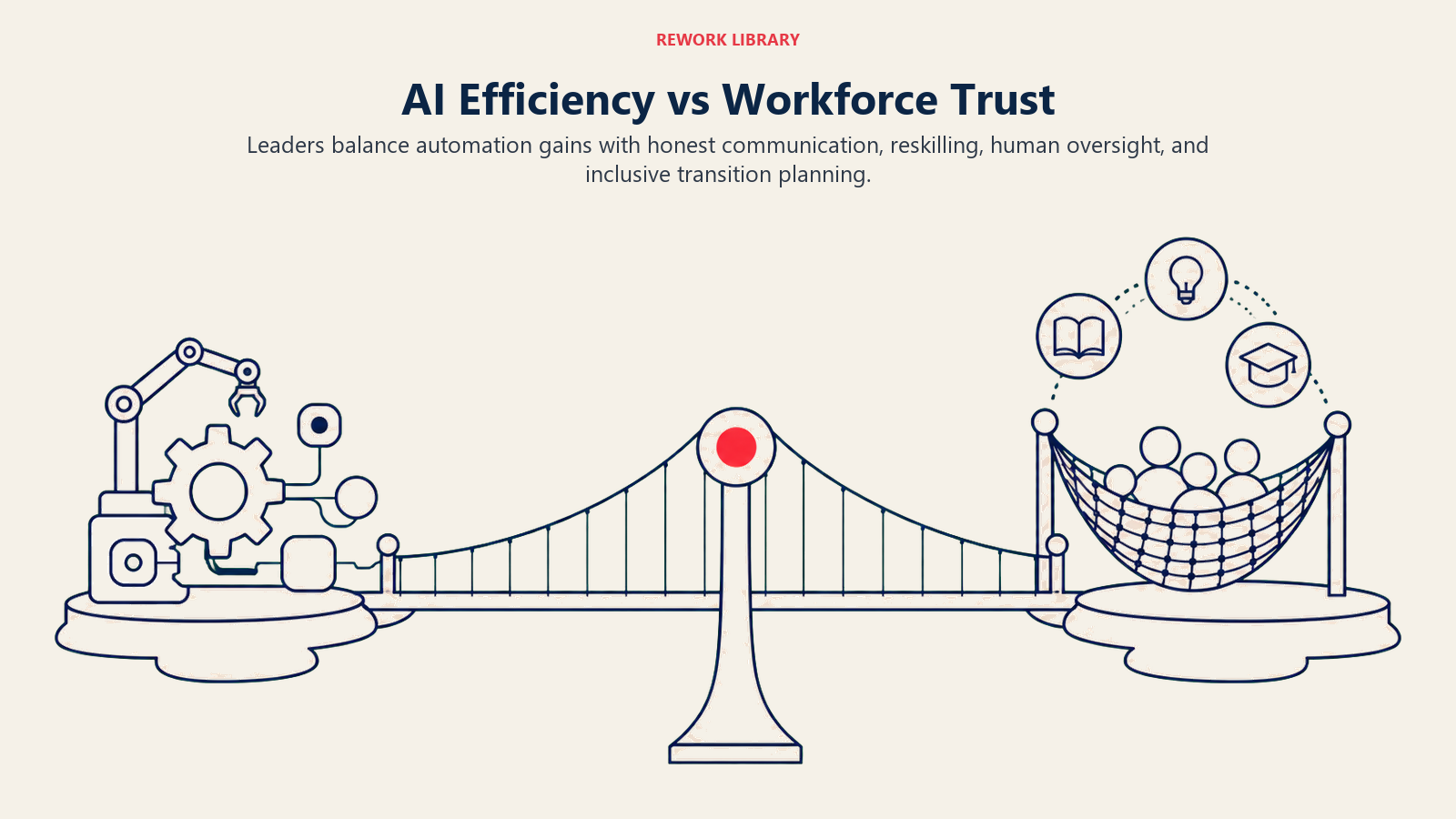
One of the hardest parts of AI transformation leadership is handling the tension between AI's potential for efficiency gains and legitimate workforce concerns about job displacement, skill obsolescence, and changing work.
The Leader's Dilemma
Leaders face genuine tension here. AI can automate tasks, reduce costs, and improve speed. But employees reasonably worry about their futures. Investors expect efficiency gains while customers and employees expect responsible deployment. There's no formula that resolves these competing pressures.
Principles for Navigating This Balance
Transparency Over Reassurance: Employees can tell the difference between genuine communication and corporate talking points. Rather than promising "AI won't replace jobs" (which may not be true), communicate honestly about what's known and unknown, what principles will guide decisions, and what support employees will receive.
Investment in Workforce Development: Organizations that invest significantly in reskilling and role evolution demonstrate commitment beyond words. This investment signals that the organization values its people while building capabilities needed for AI-augmented work.
Human-AI Collaboration Focus: Frame AI strategy around augmentation rather than replacement where that's genuinely possible. Identify roles where AI handles routine tasks while humans focus on judgment, creativity, and relationship building.
Inclusive Transition Planning: Involve employees in identifying AI opportunities and planning transitions. People who participate in change feel far less threatened than those who have change imposed on them.
Honest Timeline Communication: If AI will eventually affect certain roles significantly, communicate early enough for people to prepare rather than surprising them with sudden changes.
What This Looks Like in Practice
AT&T (2013-2020): When facing massive technology change, AT&T launched their "Future Ready" initiative offering all employees access to online degrees and certifications. The program acknowledged that many roles would change significantly while providing substantial support for employees to evolve their capabilities. Over 140,000 employees participated.
Unilever (2019-2024): Rather than using AI to simply reduce their workforce, Unilever applied AI to eliminate mundane tasks while creating new roles focused on creativity, consumer connection, and innovation. The approach required honest communication about which tasks would disappear and genuine investment in new capabilities.
Ethical Leadership in AI Adoption
Beyond Compliance
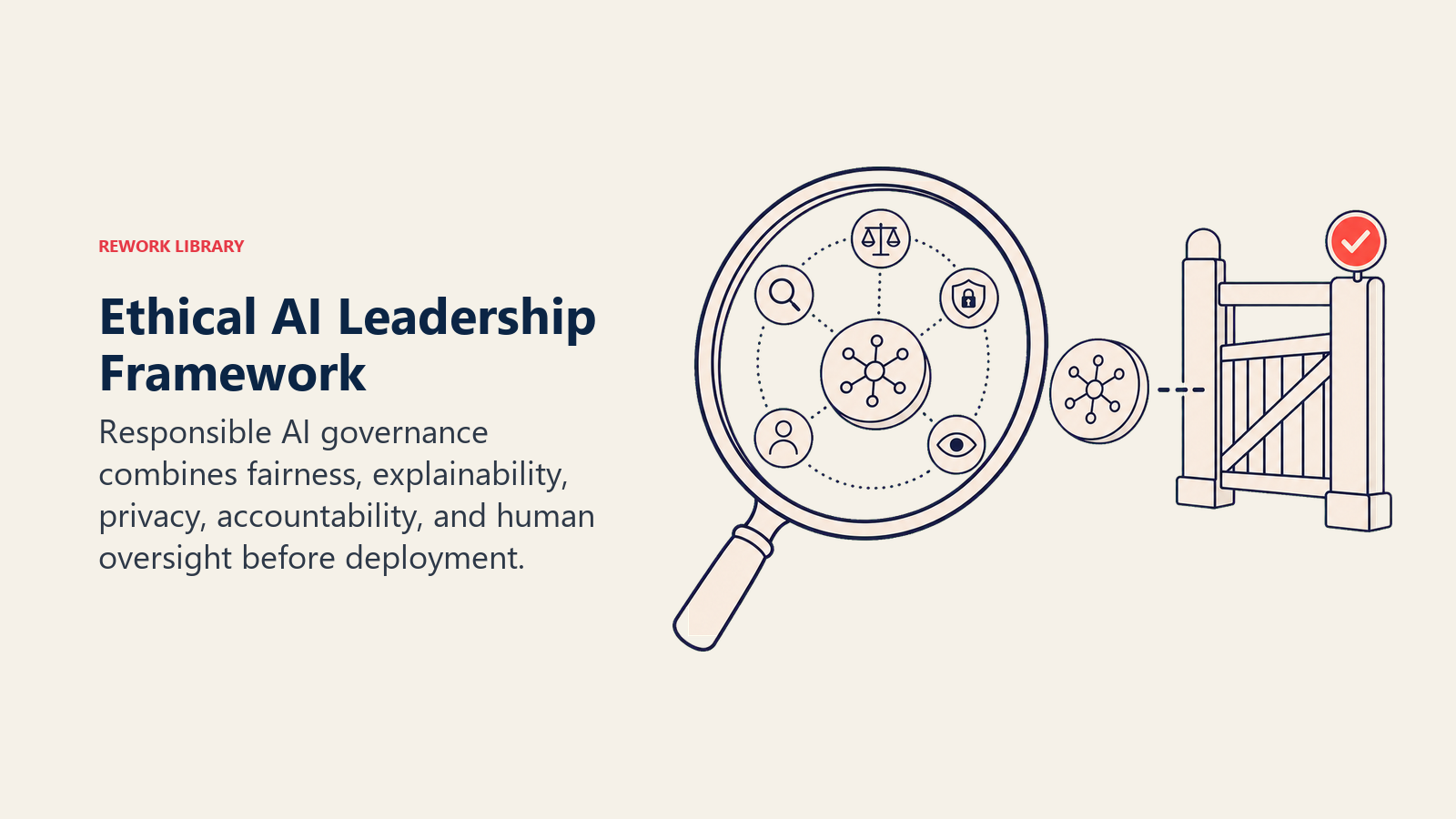
AI ethics isn't just about avoiding legal liability. Leaders who treat ethics as a compliance requirement miss the opportunity to build trust, avoid costly mistakes, and position their organizations for long-term success. Ethical AI leadership requires proactive engagement with difficult questions.
Key Ethical Considerations
Bias and Fairness: AI systems can perpetuate or amplify existing biases. Leaders need to ensure AI applications are tested for bias, monitored over time, and designed with fairness as an explicit objective.
Transparency and Explainability: Stakeholders increasingly expect to understand how AI systems make decisions, especially when those decisions affect them directly. Leaders have to balance proprietary concerns with reasonable transparency.
Privacy and Data Use: AI requires data, but data use raises privacy concerns. Leaders need to establish clear principles about what data is collected, how it's used, and how consent is obtained and respected.
Accountability: When AI systems make mistakes, someone has to be accountable. Leaders need to ensure clear accountability structures exist before AI is deployed, not after problems emerge.
Autonomy and Human Oversight: Determining which decisions can be delegated to AI and which require human judgment is a leadership responsibility. The answer varies by context and will change as AI capabilities evolve.
Building Ethical AI Frameworks
Effective ethical AI frameworks include:
- Principles: Clear statements about values that guide AI development and deployment
- Governance: Processes for reviewing AI applications against ethical principles before deployment
- Monitoring: Ongoing assessment of AI systems for unintended consequences
- Accountability: Clear responsibility for ethical AI outcomes at executive level
- Stakeholder Engagement: Regular input from employees, customers, and communities affected by AI decisions
Real-World Ethical Leadership
Google (2018): When employees protested AI work for military applications, Google's response demonstrated both the importance and difficulty of ethical AI leadership. The company established AI principles and withdrew from Project Maven, though debates continue about how those principles are actually applied.
Salesforce (2018-2024): Salesforce appointed a Chief Ethical and Humane Use Officer and established an Office of Ethical and Humane Use, demonstrating organizational commitment beyond policy documents.
Communicating AI Strategy to Stakeholders
Different stakeholders have different concerns, knowledge levels, and communication needs. Effective AI transformation leadership means adapting your communication for each audience.
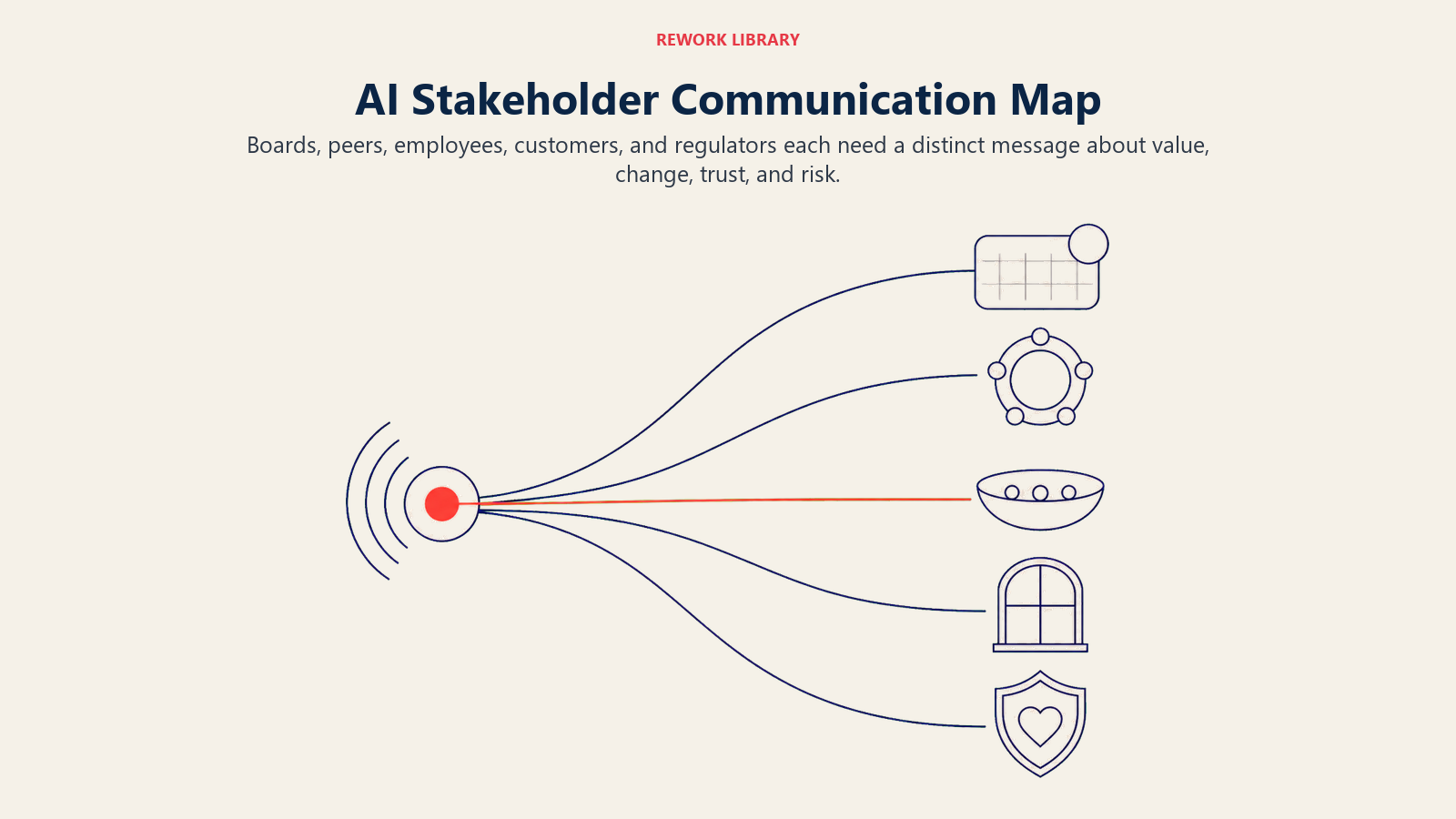
Board and Investors
What They Care About: ROI, competitive position, risk management, timeline to value
Communication Approach: Focus on business outcomes, competitive implications, and risk mitigation. Provide clear metrics and milestones. Acknowledge uncertainty while demonstrating strategic clarity.
Common Mistake: Over-promising on AI capabilities or timelines. This leads to credibility damage when reality proves more complex.
Executive Peers
What They Care About: Impact on their functions, resource requirements, cross-functional coordination
Communication Approach: Engage as partners in transformation, not recipients of edicts. Seek input on priorities and implementation. Acknowledge that AI transformation affects everyone differently.
Common Mistake: Failing to secure genuine buy-in from peer executives. This leads to passive resistance that undermines implementation.
Employees
What They Care About: Job security, skill requirements, daily work impact, support available
Communication Approach: Be honest about what's known and unknown. Provide concrete information about skill development opportunities. Listen to concerns and respond substantively.
Common Mistake: Corporate-speak that employees recognize as inauthentic. This erodes trust precisely when trust is most needed.
Customers
What They Care About: Service quality, privacy, pricing, how AI affects their experience
Communication Approach: Focus on benefits to customers. Be transparent about how AI is used in customer interactions. Provide options for customers who prefer human interaction.
Common Mistake: Deploying AI in customer-facing applications without adequate communication. This leads to negative experiences and trust damage.
Regulators and Public
What They Care About: Compliance, safety, fairness, societal impact
Communication Approach: Proactive engagement demonstrates responsibility. Contribute to policy discussions constructively. Be transparent about AI use and governance.
Common Mistake: Reactive communication that positions the organization as resisting oversight rather than committed to responsible AI deployment.
Industry Benchmarks and Best Practices
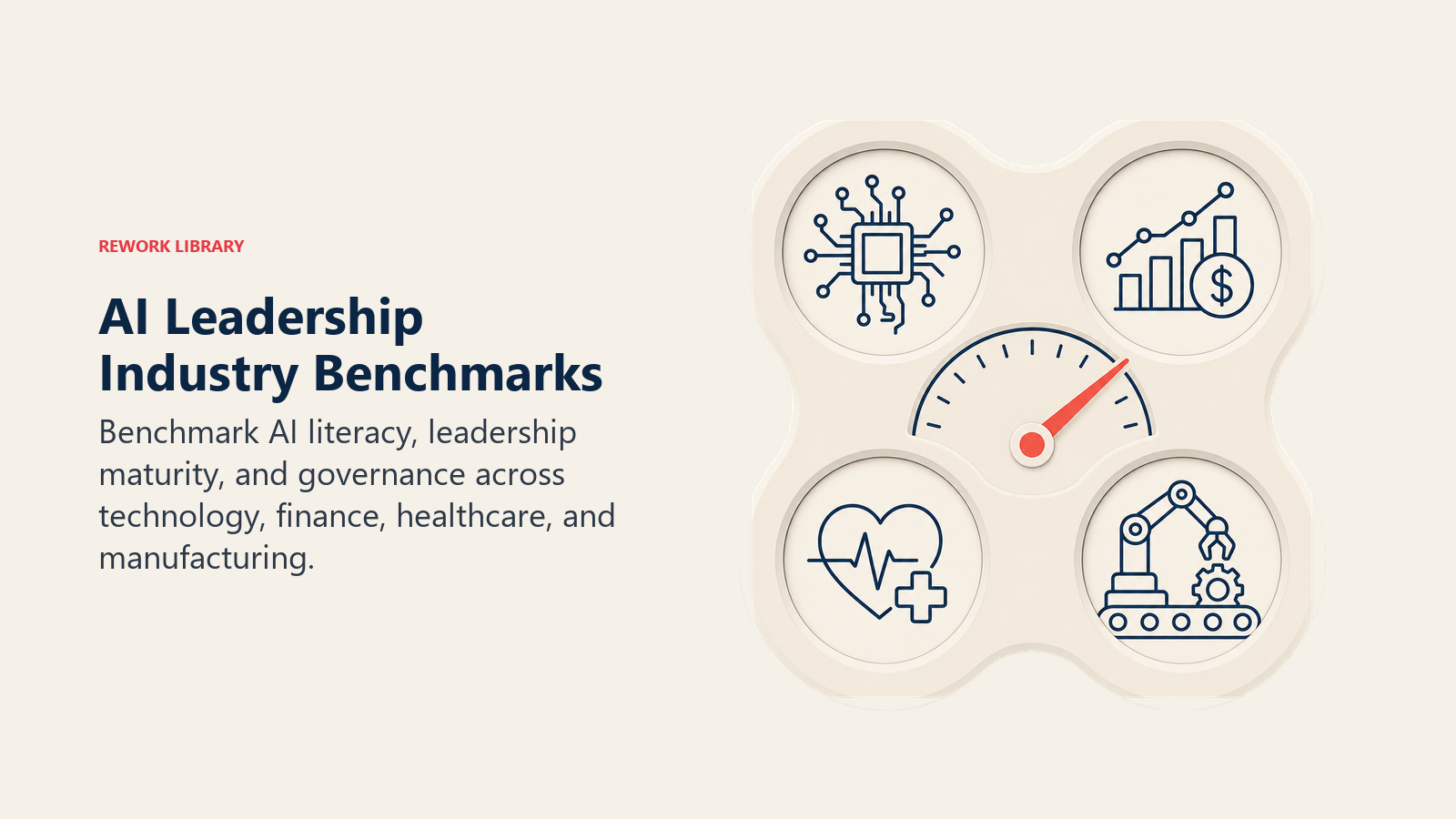
Industry comparisons show where executive AI literacy, leadership maturity, and ethical governance are advancing fastest, and where capability gaps remain.
Technology Sector
- AI Leadership Maturity: 65-80% at Level 3 or above
- Executive AI Literacy: 90%+ have substantive AI understanding
- AI Ethics Frameworks: 75% have published AI principles
- Leading Organizations: Microsoft, Google, NVIDIA (Level 4-5 capabilities)
Financial Services
- AI Leadership Maturity: 50-65% at Level 3 or above
- Executive AI Literacy: 70-80% have foundational AI understanding
- AI Ethics Frameworks: 60% have formal AI governance
- Leading Organizations: JPMorgan Chase, Goldman Sachs, Capital One (Level 3-4 capabilities)
Healthcare
- AI Leadership Maturity: 40-55% at Level 3 or above
- Executive AI Literacy: 55-70% have foundational AI understanding
- AI Ethics Frameworks: 80% have formal AI governance (regulatory driven)
- Leading Organizations: Mayo Clinic, Cleveland Clinic, Kaiser Permanente (Level 3-4 capabilities)
Manufacturing
- AI Leadership Maturity: 35-50% at Level 3 or above
- Executive AI Literacy: 50-65% have foundational AI understanding
- AI Ethics Frameworks: 45% have formal AI governance
- Leading Organizations: Siemens, BMW, Toyota (Level 3-4 capabilities)
Resources for Leadership Development
Executive Education
- MIT Sloan: AI Strategy and Leadership programs for executives
- Stanford HAI: Human-Centered AI executive education
- Harvard Business School: AI for Business Leaders
- INSEAD: AI Transformation Leadership programs
Books and Publications
- "AI Superpowers" by Kai-Fu Lee - Global AI landscape and implications
- "Human + Machine" by Accenture - AI-human collaboration frameworks
- "Prediction Machines" by Ajay Agrawal et al. - Economics of AI for business leaders
- "The AI-First Company" by Ash Fontana - Building AI-centric organizations
Frameworks and Tools
- NIST AI Risk Management Framework - Comprehensive AI governance guidance
- EU AI Act - Regulatory framework influencing global AI governance
- Partnership on AI - Multi-stakeholder AI ethics resources
- World Economic Forum AI Governance - Global AI policy frameworks
Strategic Considerations for AI Transformation Leadership
How should boards evaluate CEO and executive team AI transformation capabilities?
Boards should assess AI leadership through multiple dimensions: strategic AI vision clarity and alignment with business objectives, demonstrated AI literacy that enables substantive technology discussions, track record of AI initiative success and value capture, workforce communication effectiveness during AI transformation, and ethical AI governance frameworks. Request quarterly reporting on AI portfolio performance, workforce AI readiness metrics, and ethical AI incident reviews. Make sure executive compensation includes AI transformation objectives.
What distinguishes successful AI transformation leaders from those who struggle?
Successful AI leaders treat AI transformation as business transformation, not technology implementation. They invest personally in AI literacy, model AI adoption visibly, communicate transparently about AI's implications, and balance efficiency objectives with workforce concerns. They're also comfortable with uncertainty, making decisions with incomplete information while remaining adaptable as AI capabilities evolve. Leaders who struggle typically delegate AI entirely to technical teams, avoid difficult workforce conversations, or pursue AI without strategic clarity.
How can leaders maintain workforce trust during AI transformation when some job impacts are genuinely uncertain?
Authenticity matters more than false reassurance. Acknowledge what you don't know while being clear about the principles that will guide decisions. Commit to specific workforce support investments (reskilling programs, transition assistance, internal mobility) that demonstrate organizational commitment regardless of specific outcomes. Involve employees in identifying AI opportunities and planning transitions. Trust builds through consistent action over time, not single communications.
What role should external AI advisors play in executive AI transformation leadership development?
External advisors can accelerate AI literacy, provide objective assessment of AI opportunities and capabilities, and offer perspective on industry AI trends. But they can't substitute for executive ownership of AI strategy and communication. Effective leaders use advisors to build their own capabilities, not to outsource AI decisions. Be cautious of advisors with vendor relationships that may bias recommendations toward specific technology solutions.
How should leaders prioritize AI investments when resources are limited and opportunities seem overwhelming?
Start with strategic clarity about where AI can create the most significant competitive advantage or operational improvement. Prioritize use cases with clear business cases, available data, and organizational readiness. Resist pressure to pursue AI broadly without focus. Build credibility through successful focused implementations before expanding scope. Accept that you'll have to pass on some AI opportunities to ensure successful execution of priorities.
What governance structures are most effective for overseeing enterprise AI transformation?
Effective governance includes board-level AI oversight (often through the technology or risk committee), an executive AI steering committee for strategic decisions and portfolio management, cross-functional AI ethics review for deployment decisions, and operational AI governance for ongoing monitoring. Governance should enable speed while ensuring alignment, ethics, and risk management. Avoid governance structures that create excessive bureaucracy or slow AI experimentation unnecessarily.
How can leaders develop AI transformation capabilities when their organizations have limited AI maturity?
Personal AI literacy development can proceed independently of organizational AI maturity. Use AI tools personally, engage with AI communities and publications, and build relationships with AI practitioners. Apply strategic thinking frameworks to AI opportunities even before organizational capabilities exist. Often, a leader's AI capability development creates pull for organizational AI investment as they identify concrete opportunities and communicate AI's strategic importance.
What are the biggest mistakes leaders make when communicating AI strategy to employees?
Common mistakes include: over-promising that AI won't affect jobs when the impact is genuinely uncertain, using corporate language that employees recognize as inauthentic, failing to acknowledge legitimate concerns, communicating once rather than continuously, and not providing concrete information about available support. Effective communication requires honesty about uncertainty, specificity about principles and support, and ongoing dialogue rather than announcements.
How should leaders balance AI efficiency objectives with ethical AI deployment?
This balance requires explicit discussion rather than assuming that efficiency and ethics naturally align. Establish clear ethical boundaries that efficiency objectives can't override. Include ethical review in AI deployment decisions, not just after the fact. Recognize that short-term efficiency gains from ethically questionable AI deployment often create long-term costs through reputation damage, regulatory action, or workforce trust erosion. Build ethical considerations into AI business cases.
What succession planning considerations are essential for sustaining AI transformation leadership?
AI transformation capability should be an explicit criterion for leadership succession at all levels. Include AI transformation experience in leadership development paths. Document AI strategy, principles, and lessons learned to enable continuity during transitions. Build AI transformation capability broadly across the leadership team rather than concentrating it in a single executive. Make sure your board has sufficient AI literacy to evaluate AI leadership candidates and maintain AI transformation momentum during leadership transitions.
Your First 30 Days: Getting Started
Week 1: Personal AI Engagement
Start using AI tools directly. Experiment with generative AI for tasks relevant to your role. Document what works, what doesn't, and what questions come up. This hands-on experience builds credibility and understanding that no executive briefing can provide. Share your learning openly with your team.
Week 2: Stakeholder Landscape Assessment
Map key stakeholders and their AI-related concerns. What questions are board members asking? What worries keep employees up at night? What are customers expecting? What are competitors doing? This assessment shapes your communication strategy and identifies urgent priorities that need attention.
Week 3: Strategic AI Clarity
Work with your leadership team to articulate current AI strategy status and gaps. What AI investments exist? What's working? What's struggling? What opportunities remain unexplored? The goal isn't a comprehensive AI strategy in one week. It's an honest assessment of your current state as a foundation for strategic development.
Week 4: Communication Foundation
Develop your initial communication approach for different stakeholder groups. What will you say to employees at the next all-hands meeting? What questions should you be prepared to answer? What commitments can you make with confidence? What uncertainty do you need to acknowledge honestly?
Conclusion: The Leadership Imperative
AI transformation leadership isn't optional for today's executives. The question isn't whether AI will reshape your industry. It's whether you'll lead that reshaping or be reshaped by it.
The evidence is clear: organizations with AI-ready leadership capture significantly more value from AI investments, maintain workforce trust through transformation, and position themselves for long-term competitive advantage. Leaders who develop these capabilities now will shape how their industries evolve.
But this isn't just about competitive advantage. AI transformation leadership is about responsibility. The decisions leaders make about AI deployment will affect employees, customers, communities, and society. Leading AI transformation ethically and effectively is among the most important leadership challenges of our era.
Moving from reactive AI adoption to transformational AI leadership requires sustained effort across multiple dimensions: personal AI literacy, strategic vision, change leadership, ethical frameworks, and stakeholder communication. No leader masters all these overnight. But every leader can start today.
The organizations that will thrive in the AI era won't be those with the most advanced AI technology. They'll be those with leaders who can guide organizations through uncertainty, maintain trust, deploy AI responsibly, and capture AI's potential while handling its challenges.
That leadership capability is built through deliberate development, starting now.
Learn More
Enhance your AI transformation leadership through related competencies:
- Strategic Thinking - Build strategic frameworks for AI opportunity assessment and prioritization
- Leading Change - Master change leadership principles essential for AI transformation
- Leading Teams - Develop team leadership capabilities for AI-enabled organizations
- Executive Presence - Build credibility for AI communication across stakeholder groups
Related Organizational Competencies

On this page
- Strategic Imperative for Leadership in the AI Era
- The Business Case for AI Leadership Competency
- The 5 Levels of AI Transformation Leadership Maturity
- Level 1: Reactive - Technology-Focused Response (Bottom 25% of Leaders)
- Level 2: Structured - Strategic AI Integration (25th-50th Percentile)
- Level 3: Proactive - Culture-Driven AI Leadership (50th-75th Percentile)
- Level 4: Anticipatory - Industry AI Leadership (75th-95th Percentile)
- Level 5: Transformational - Global AI Thought Leadership (Top 5% of Leaders)
- Your Roadmap: How to Advance Through Each Level
- Level 1 to Level 2: Building AI Strategic Foundation (6-12 months)
- Level 2 to Level 3: Building AI-Ready Culture (12-18 months)
- Level 3 to Level 4: Developing Industry AI Leadership (18-30 months)
- Level 4 to Level 5: Achieving Global AI Thought Leadership (24-48 months)
- Quick Assessment: What Level Are You?
- Balancing AI Efficiency with Workforce Concerns
- The Leader's Dilemma
- Principles for Navigating This Balance
- What This Looks Like in Practice
- Ethical Leadership in AI Adoption
- Beyond Compliance
- Key Ethical Considerations
- Building Ethical AI Frameworks
- Real-World Ethical Leadership
- Communicating AI Strategy to Stakeholders
- Board and Investors
- Executive Peers
- Employees
- Customers
- Regulators and Public
- Industry Benchmarks and Best Practices
- Technology Sector
- Financial Services
- Healthcare
- Manufacturing
- Resources for Leadership Development
- Executive Education
- Books and Publications
- Frameworks and Tools
- Your First 30 Days: Getting Started
- Week 1: Personal AI Engagement
- Week 2: Stakeholder Landscape Assessment
- Week 3: Strategic AI Clarity
- Week 4: Communication Foundation
- Conclusion: The Leadership Imperative
- Learn More
- Related Organizational Competencies