More in
AI Jobs & Skills News
Finance Keeps Shedding Jobs as the Economy Hires: The White-Collar Warning
Jun 6, 2026
AI Skills Just Became the Hardest Hire in the World. You Won't Recruit Your Way Out
Jun 6, 2026
Is AI Actually Killing Jobs? May's Hiring Numbers Say Not So Fast
Jun 5, 2026
You Put Your AI Agents on the Org Chart. Accountability Quietly Dropped
Jun 5, 2026 · Currently reading
Everyone Blames AI for the Gen Z Job Crisis. The Fed Points at Remote Work
Jun 5, 2026
AI's Net Job Drag Fell to 11,000 a Month. Construction Is Hiding the Truth
Jun 4, 2026
AI Blamed for a Record 40% of May's US Layoffs, the Third Month Running
Jun 4, 2026
Four Futures for Jobs by 2030: The Mid-2026 Checkpoint for CEOs
Jun 3, 2026
Can Federal AI Apprenticeships Fix Your Skills Gap Cheaper Than Hiring?
Jun 3, 2026
AI Engineer Pay Split Into Two Markets. Only the Top Is a Bubble
Jun 3, 2026
You Put Your AI Agents on the Org Chart. Accountability Quietly Dropped
Turn this article into takeaways for your work.


Each assistant summarizes the article only for you and suggests best practices for your work.
Naming your AI agent and giving it a seat on the team feels like smart change management. It sounds friendly. It sounds like adoption.
New research says it may be doing the opposite of what you want.
According to a study from the Boston Consulting Group's Henderson Institute, published in Harvard Business Review, the way you frame an artificial intelligence (AI) agent to your team changes how your people behave around it. When a manager treats AI as a teammate or an employee, responsibility for mistakes starts to slide off the humans and onto the tool. People catch fewer errors. Trust goes down. And the part that should stop any team leader cold: none of it makes the team any more likely to actually use the AI.
That last point matters most. The whole reason leaders humanize these tools, give them names, put them on the chart, talk about "onboarding" them, is to drive adoption. The data says that trade does not pay off. You get the downside and not the upside.
What the Researchers Actually Found
The team behind the study surveyed and ran experiments with more than 1,200 human resources and finance professionals across the United States, Canada, and the European Union. The pattern was consistent enough to be uncomfortable.
Key Facts
- Nearly one-third of managers framed AI as a teammate or an employee, and more than 20% listed AI agents on their company's org or work charts. (BCG Henderson Institute, Harvard Business Review, May 2026)
- When AI was framed as an employee, people identified fewer errors and shifted blame for mistakes onto the AI rather than themselves. (BCG randomized experiment, 1,200+ HR and finance professionals)
- Humanizing the AI raised fear of being replaced by about 7% and lowered trust in workplace AI by about 10%, without meaningfully increasing intent to adopt it. (BCG / HBR)
Read those together and the story is not subtle. A practice that is supposed to make AI feel safe and collegial instead made people more anxious, less trusting, and less careful, while moving adoption barely at all.
Why Framing an Agent as a Person Lowers the Bar
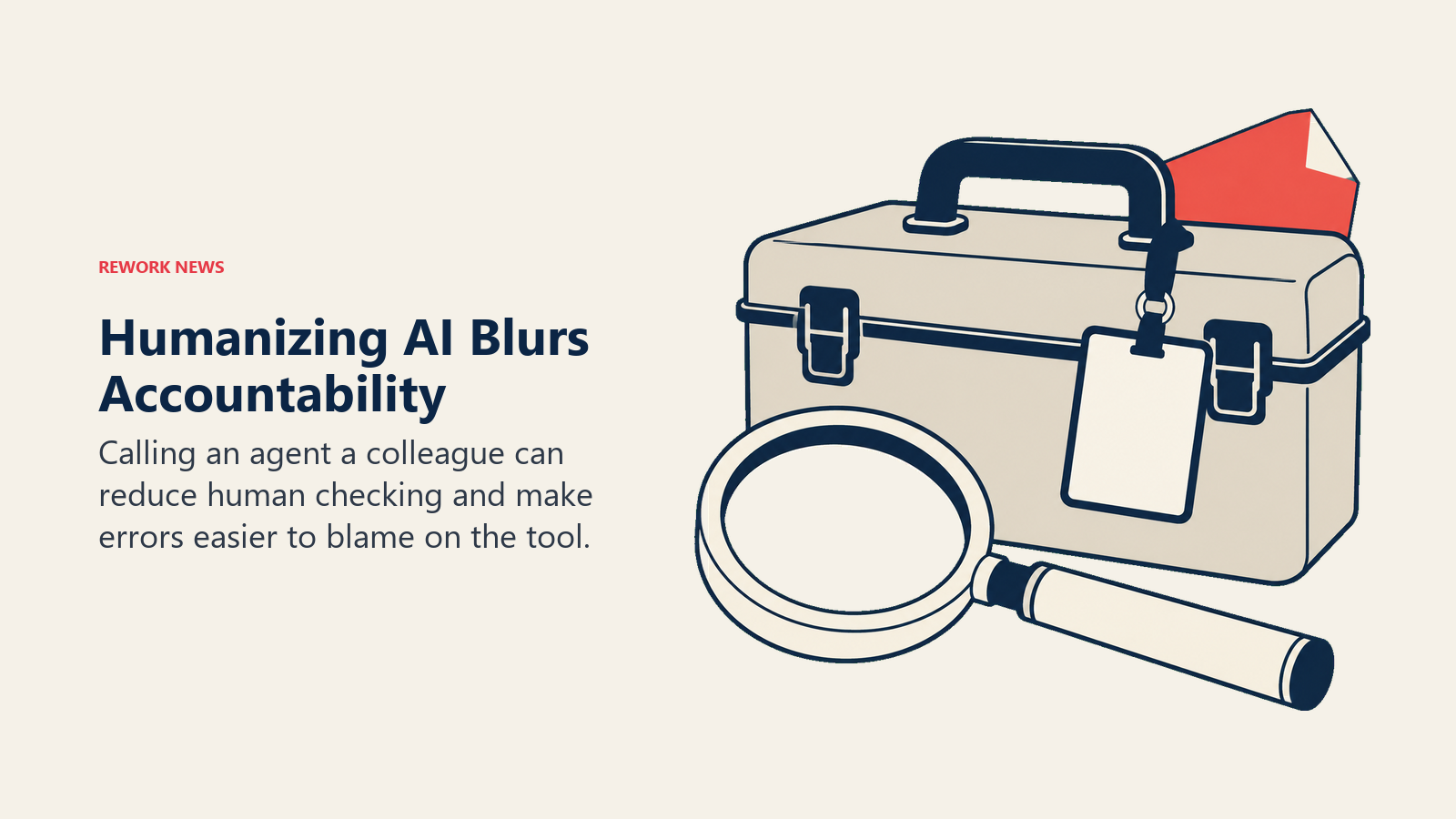
The framing matters because personifying an AI agent can blur accountability exactly where leaders need it to be sharper.
Here is the mechanism, and it is very human.
When you call the agent "Alex" and put it on the team, you create a target for blame. A mistake is no longer something a person made. It is something Alex did. That tiny shift in language gives every human in the loop a quiet permission slip. If the agent is a colleague, then the agent owns its own errors, and I do not have to check its work as closely.
So people check less closely. The study found that participants working with a humanized agent caught fewer mistakes and were quicker to point at the tool when something went wrong. In a process where a human is supposed to be the last line of review, that is exactly the behavior you cannot afford. The agent does not feel embarrassed, does not get coached, and does not improve because you blamed it. The error just ships.
There is a second cost. When an agent gets a name and a seat, real employees start to wonder where they stand. The research tied humanized AI to a measurable jump in worry about being replaced and a drop in trust. A team leader trying to build confidence around new tools ends up doing the reverse, one friendly agent nickname at a time.
The Org-Chart Trap
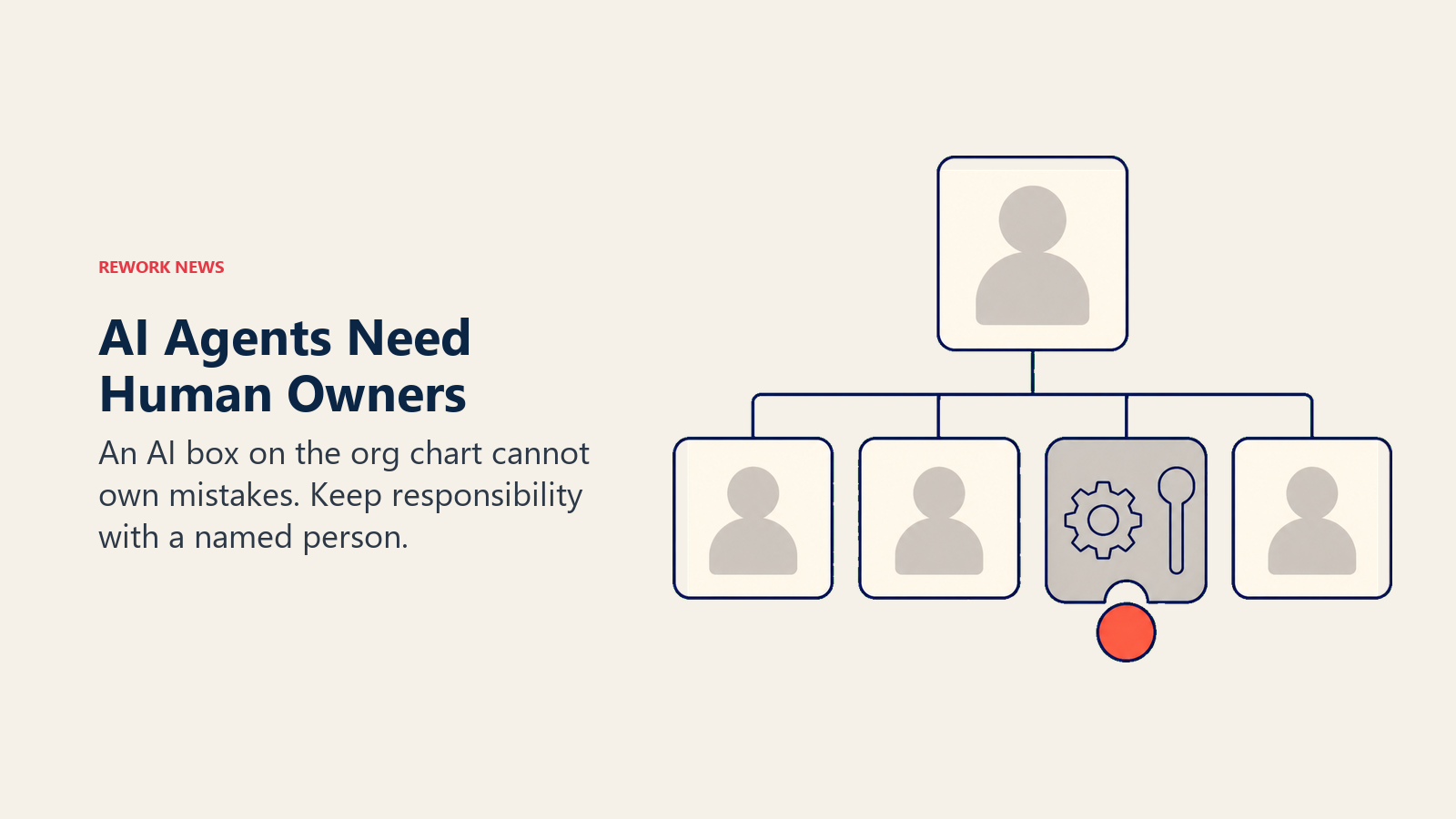
The most striking number in the study is the 20% of managers who have put AI agents onto an actual org or work chart. It is easy to see why. It looks modern. It signals that the company takes AI seriously. It gives the agent a tidy box and a reporting line.
But an org chart is a map of accountability. Every box on it is a place where responsibility is supposed to live. When you add a box that cannot be held responsible, cannot be fired, cannot be coached, and cannot feel the weight of a bad call, you have not added a teammate. You have added a hole that real accountability can drain into.
And the agent gains nothing from the promotion. It works exactly as well whether you call it a coworker or a calculator. The only thing that changed is how the humans around it behave, and the research says they behave worse.
What to Do Instead
You do not have to choose between adoption and accountability. The study suggests the friendly framing was never buying you adoption in the first place. So drop it, and keep the discipline. Four moves for any team leader rolling out agents.
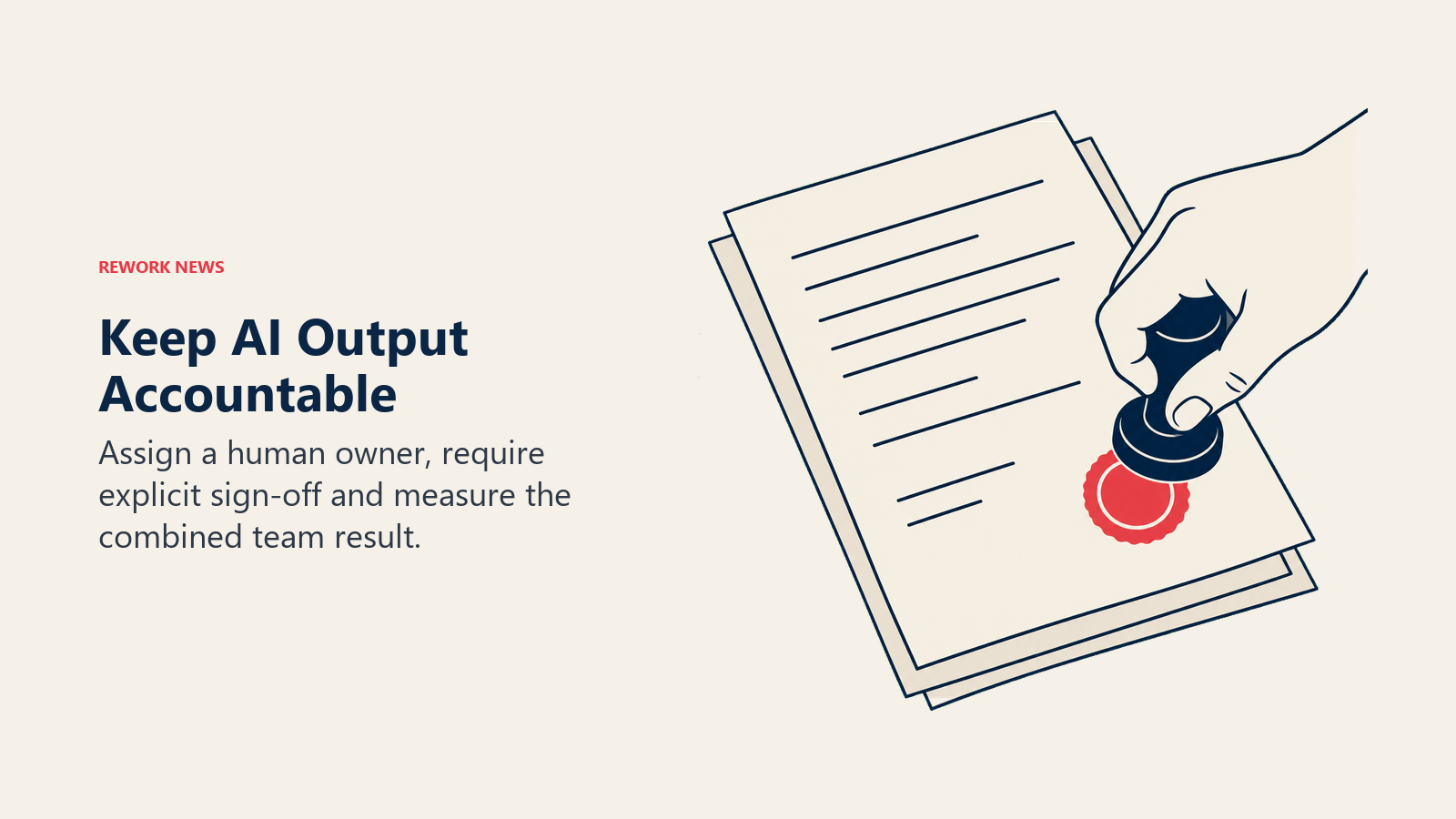
Give every agent a named human owner. The agent is a tool. A specific person owns its output and answers for it the same way they would answer for a spreadsheet they built. Put that person's name next to the agent, not a nickname for the agent itself.
Talk about agents as instruments, not colleagues. Language is the lever here. "The drafting tool" and "the prospecting model" keep responsibility where it belongs. "Alex on the team" moves it. This is free, and it is the single highest-leverage thing you can change this week.
Keep error review human and explicit. Build a step where a person signs off on the agent's work and is on record for it. The moment review becomes "the agent handled it," your last line of defense is gone. This is the same discipline behind keeping a real governance layer around AI at work instead of assuming the tool polices itself.
Measure the human-plus-AI output, not the agent. Performance reviews should still land on people and teams. The agent is part of how the work got done, not a separate worker with its own scorecard. That keeps the incentive to check, improve, and own results pointed at the humans who can actually respond to it, which is the heart of how AI is changing the performance review.
The pull toward treating agents like people is strong, and the tool-to-teammate mindset gets framed as the unlock for AI value. This research is a useful corrective. The mindset that actually captures value treats the agent as a powerful instrument with a human firmly in charge of it. The companies experimenting with AI agents on the org chart of the future should read the BCG numbers before they redraw the boxes, and middle managers, who carry most of the real AI rollout, are the ones who set the tone. Name the human. Keep the accountability. Skip the nickname.
Frequently Asked Questions
Does treating AI like an employee improve adoption?
No. The BCG Henderson Institute research found that humanizing AI did not meaningfully raise people's intent to adopt it. It did lower trust and raise fear of replacement, so the practice carries real costs without the adoption benefit leaders assume it brings.
Why does putting AI on the org chart reduce accountability?
An org chart maps where responsibility lives. Adding an AI agent as its own box creates a target for blame that cannot be coached, corrected, or held responsible. People in the loop then check the agent's work less carefully and attribute mistakes to the tool rather than themselves, so errors slip through.
What should a team leader do instead of naming agents like coworkers?
Treat each agent as an instrument with a named human owner who answers for its output. Use tool language rather than colleague language, keep an explicit human sign-off on the agent's work, and measure the combined human-plus-AI result rather than scoring the agent on its own.
Source: BCG Henderson Institute, 2026 | Harvard Business Review, May 2026 | Fortune, May 28, 2026
