The Evolution of Selling: From Haggling to AI Agents
Turn this article into takeaways for your work.


Each assistant summarizes the article only for you and suggests best practices for your work.
Picture a sales floor in Dayton, Ohio, in the 1880s. A new company has a machine most shopkeepers don't think they need. Its salesmen can't explain why they should. The owner, John H. Patterson, answered by writing the explanation down and making everyone say it the same way. Most of what came after is an argument with that answer.
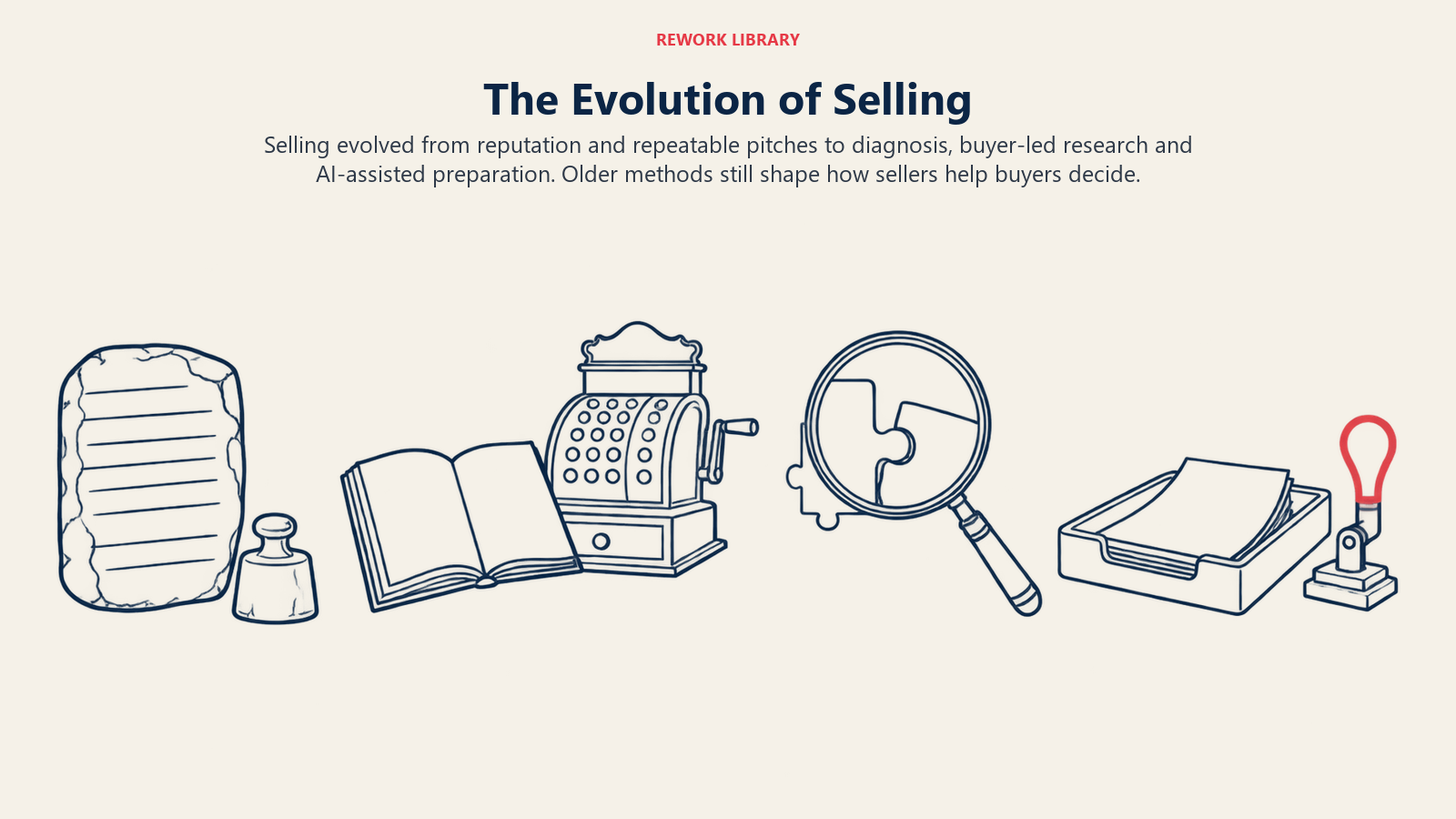
Selling has run on a series of dominant ideas, and each one answered a problem the last one created. Written merchant contracts governed agents in Hammurabi's Babylon. A trained and scripted pitch arrived at National Cash Register after John H. Patterson bought the company in 1884. Questions replaced pitches in the late 1980s. The throughline: every era moved the seller a little further from talking at the buyer and a little closer to helping the buyer decide.
This page tells the story of the ideas. For the dated milestones and the companies, read The History of Sales and the sales timeline. For the credit question, see who invented modern sales.
Timeline at a Glance
| Year | Milestone | Why It Mattered |
|---|---|---|
| Around 1750 BCE | Code of Hammurabi sets rules for merchants and their agents | Trade by agent needed written receipts and penalties. |
| 1884 | Patterson takes control of NCR | The company becomes the model for a trained, scripted sales force. |
| Spring after 1893 | NCR opens its first sales training school in Dayton | Selling is taught as a skill, not assumed as a talent. |
| 1936 | Dale Carnegie's book is first published by Simon & Schuster | Interest in the other person becomes mainstream sales advice. |
| 1970 | Mack Hanan's Consultative Selling is first published | Selling is framed as transferring value, not pushing product. |
| 1988 | Neil Rackham's SPIN Selling is published | Research on real sales calls turns questioning into a method. |
| 2006 | HubSpot is founded around inbound marketing | Buyers who wanted helpful information, not interruption, get a model built for them. |
| November 2011 | The Challenger Sale is published | The debate shifts to whether sellers should teach buyers something new. |
| 2017 | SiriusDecisions buying study of 868 buyers | Evidence that the early seller still shapes the decision. |
| 2025-2026 | Salesforce surveys 4,050 sellers on time and AI agents | Agents become part of how sellers plan their week. |
The Haggling Years (antiquity-1870s)
Reputation carries the deal, and the agent carries the risk
The first selling idea needs no theory. Two people meet, one vouches for the goods, and the price is argued out. What the earliest written records show is not the haggling but the machinery around it. In the Code of Hammurabi, in the King translation, a merchant who sends goods with an agent is protected by a receipt rule: "the agent shall give a receipt for the amount." An agent who took money and could not show a receipt was not allowed to treat it as his own, and one who disputed the merchant's claim could be made to pay three times the sum.
Notice what that law solves. A merchant could not travel everywhere, so a second person sold on his behalf, and the whole arrangement depended on trust that could be checked. The law supplied the check. The dominant idea was the seller's word is the product, and the problem it created was distance: the further the sale, the less the buyer could confirm. Every later era is, in part, a new way to handle that gap.
Keep the precursor apart from the concept. Nobody in Babylon practiced "sales management" as a field. They solved the oldest sales problem, which is how to trust a person you cannot watch. Peddlers, market stalls and fairs ran on the same idea for most of the next three thousand years.
For teams today: if a deal depends on one rep's personal word, you own an unwritten promise. Put what was promised in the record, the modern receipt.
The Pitch Machine (1884-1920s)
Patterson writes the pitch down and the company starts teaching it
The turning point is a failing company in Dayton. When Patterson bought controlling interest in 1884, fewer than 400 cash registers had ever been sold. His early direct mail went out to 5,000 prospects and, in the article's words, "Not one response came in to the NCR." So he turned to the people who did sell.
After touring sales offices in 50 towns and cities, Patterson wrote a primer from the talks of his best salesmen, which Selling Power calls one of the first canned sales presentations. It ran about 400 words, every salesman had to memorize it, and those who would not were fired. Behind it sat a Manual that the same account calls the first systematic approach to handling customer objections. After he found at the 1893 World's Fair that many NCR salesmen did not know their product, a sales training school opened in Dayton the following spring. Patterson also created the protected territory, so reps stopped raiding each other, and the quota, which the article calls the first effort to get measurable results in selling.
The idea of this era was the right words, said the same way, close the sale. It answered the problem of inconsistency: a hundred salespeople, a hundred pitches, a few good ones. Its weakness was equally clear. A script assumes the buyer's situation matches the script. That is why the mechanics lived on in the sales playbook, sales quotas and territory planning, while the pure canned pitch slowly lost ground.
For teams today: keep the primer's discipline, a written, shared way to explain what you sell, and drop the assumption that every buyer needs the same speech.
The Persuasion Craft (1930s-1960s)
Selling becomes a skill of influence, taught to everyone
Once selling could be taught, a market opened for teaching it. The best-known artifact is Dale Carnegie's How to Win Friends and Influence People, first published by Simon & Schuster in 1936. A rare-book dealer's listing records that it had sold more than 15 million copies by 1986. Its advice is not a closing trick. It argues for genuine interest in the other person, which is why it traveled from sales floors into every office.
This era's dominant idea was the seller wins by understanding and moving the person. It built on Patterson's training culture but shifted attention from the script to the buyer's feelings and the seller's presence. The era also produced the hard-sell closer, the door-to-door pitch and the closing-technique folklore, and the problem it left was trust. Buyers learned to recognize techniques, and a technique that works only when the buyer does not notice it has a short life.
You can still see this layer in rapport-building advice and in negotiation tactics for sales. The part that held up is the insistence that the buyer is a person with a point of view. The part that aged badly is the idea that influence is something done to them.
For teams today: teach rapport as listening. If a tactic needs the buyer to miss it, retire it.
The Needs Turn (1970-1990s)
From telling to asking, and from products to problems
By the 1970s, products were getting complicated and deals longer. The pitch could no longer carry a sale that depended on a buyer's operations. Mack Hanan's Consultative Selling was first published in 1970, and a reviewer sums up its premise as "The essence of selling is not pushing products but transferring value to customers." The seller becomes an adviser who understands the customer's business first. Our own pages on consultative selling and value selling descend from that move.
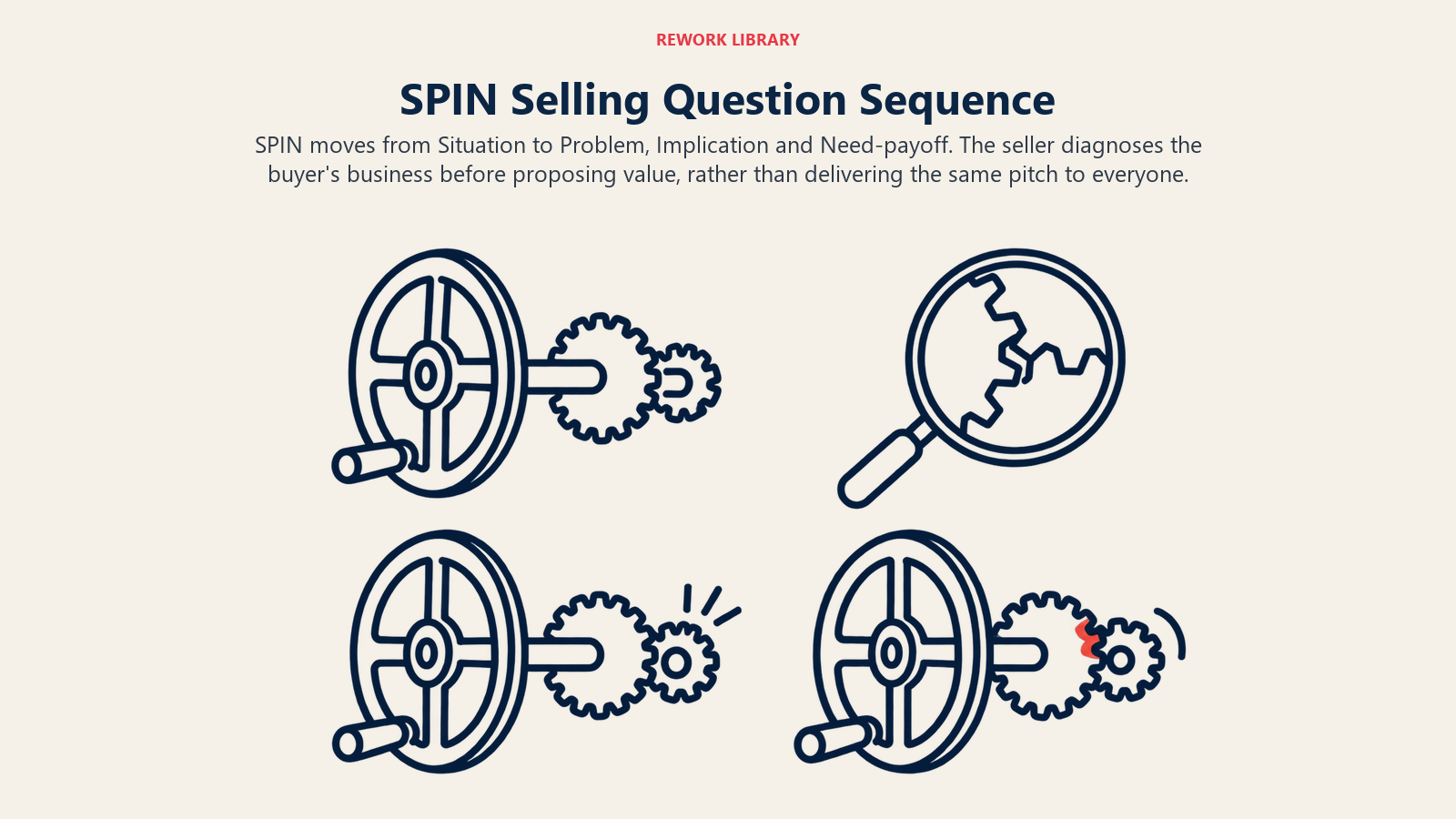
The research arrived in 1988. Neil Rackham's SPIN Selling, published by McGraw-Hill that year, drew on a roughly 12-year Huthwaite study of effective sales performance. Routledge's catalogue describes the underlying data as more than 35,000 sales calls by 10,000 salespeople in 23 countries, and the book's main claim is that many methods built for low-value sales do not work for major ones. The method asks about Situation, Problem, Implication and Need-payoff, in that order. See SPIN selling for the mechanics and solution selling for the closely related school that organized a sale around the customer's problem.
The dominant idea was diagnose before you prescribe. It answered the problem of the mismatched pitch. It created a new one: questions become a script of their own, and a buyer who has already done the diagnosis can find them slow. For the day-to-day version, see sales discovery best practices.
For teams today: pick one questioning method and practice it with recorded calls. Discovery that the buyer experiences as an interrogation is the pitch in disguise.
The Buyer-Led Web (2004-2017)
Buyers research first, and sellers learn to be found
The web reversed who held the information. HubSpot's account is that in 2004 two MIT graduate students noticed a shift in how people shop, and that "Buyers didn't want to be interrupted by ads, they wanted helpful information." They founded HubSpot in 2006 to help companies adapt through inbound marketing. Selling now started before the first call: with a blog post, a comparison page, a review.
The popular claim is that buyers finish most of their research before they speak to a vendor. The 2017 SiriusDecisions study, published through Forrester and based on 868 buyers, is more careful: more than 60 percent of buyers received information from the eventual winning seller's representative in the first, educational phase. The reading that fits both is that buyers research independently and the seller who helps early still shapes the decision. That is the case for inbound lead generation and for mapping the buyer journey honestly.
The idea was be useful where the buyer is already looking. It answered the problem of interruption and gave marketing a seat in the revenue story. The new problem was parity: when every vendor publishes helpful content, helpful stops being a difference.
For teams today: assume the buyer arrived informed. Ask what they already read, and add something they didn't find.
The Insight Push (2011-2017)
The best reps stop waiting to be asked and start teaching
This era overlaps the last, because it answered the same web with the opposite instinct. The Challenger Sale, by Matthew Dixon and Brent Adamson, was published on November 10, 2011. The publisher describes it as based on a study of thousands of reps across industries and geographies, finding that every rep falls into one of five profiles and that only the Challenger profile consistently delivers high performance. Details are in our Challenger Sale article.
A year later, Adamson, Dixon and Nick Toman argued in Harvard Business Review that "customers don't need you the way they used to." Their point was that buyers could now define solutions for themselves, which put pressure on the diagnose-first school: if the customer has already diagnosed, the seller has to bring something the customer did not have.
The dominant idea was add insight, then lead the buyer somewhere new. It answered the parity problem of the buyer-led web. Its risk is a rep who challenges without understanding; the idea works when the insight is real and fails when it is a rehearsed provocation. For a comparison of this and the earlier schools, see sales methodologies compared.
For teams today: build the insight library before you train the behavior. A challenge with nothing behind it is just friction.
The Agent Age (2022-present)
Software drafts, researches and updates, and sellers get time back
The newest idea changes who does the work around the conversation. Salesforce's seventh State of Sales survey, a poll of 4,050 sales professionals in August and September 2025, reports that the average seller spends 40% of their time selling, that 54% had used agents, and that sellers expect agents to cut prospect research time by 34% and email drafting time by 36% once fully implemented. Those are survey results and seller expectations, not measured outcomes.
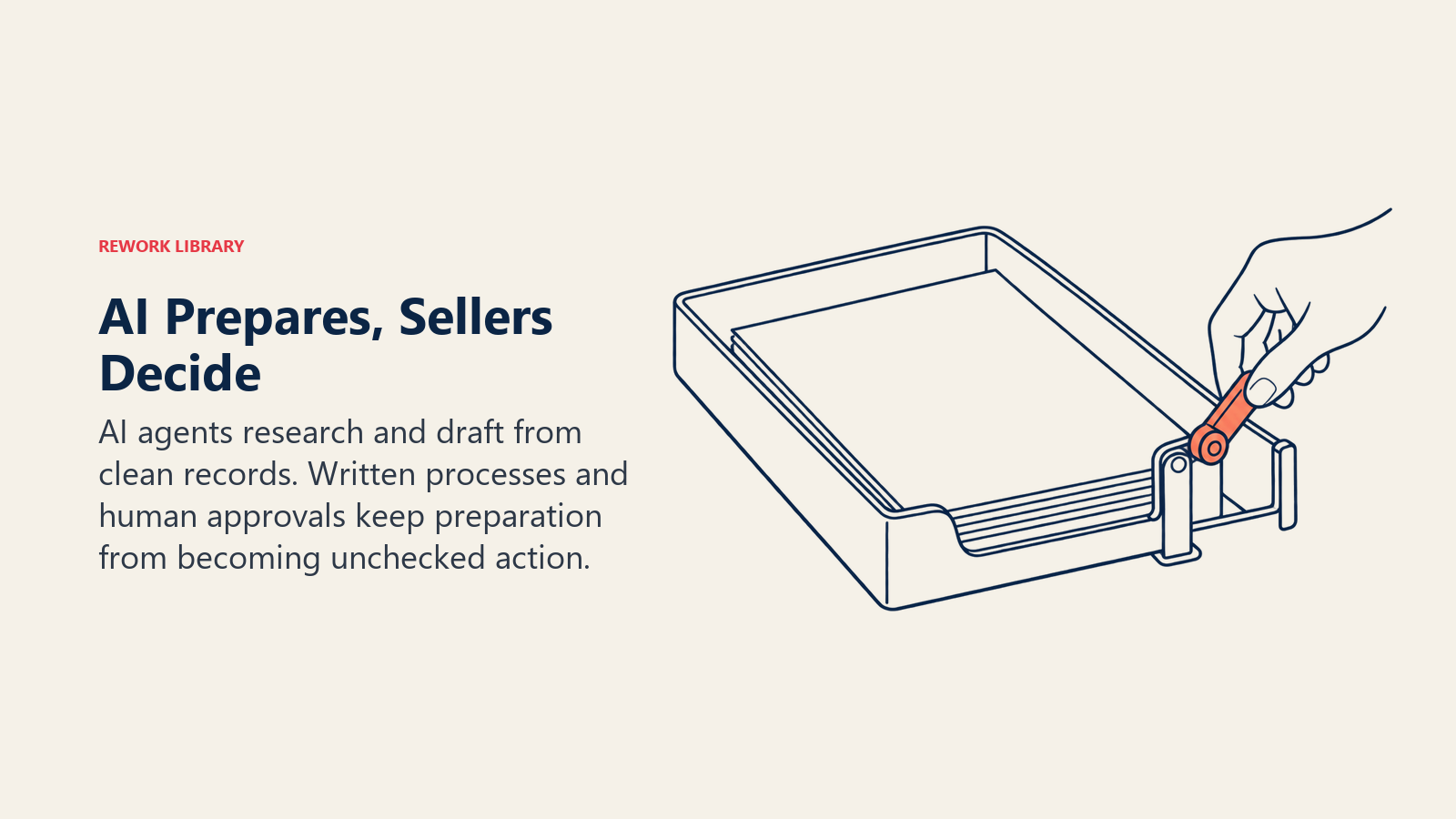
The dominant idea is the machine prepares, the human decides. It answers the oldest tax on selling, which is the administration that crowds out buyer conversations. It raises the stakes on inputs: an agent drafting from a stale record or routing on a vague profile makes the same mistake faster. The prerequisites are the unglamorous ones this history keeps returning to, a written process and a clean record. See revenue operations for how teams organize that foundation.
For teams today: automate the preparation, protect the conversation, and write down which decisions stay with a person.
How the Selling Models Compare
Each model changes what the seller contributes, from a trusted promise to a repeatable pitch, useful questions, new insight or prepared decisions. The older roles remain part of the modern mix.
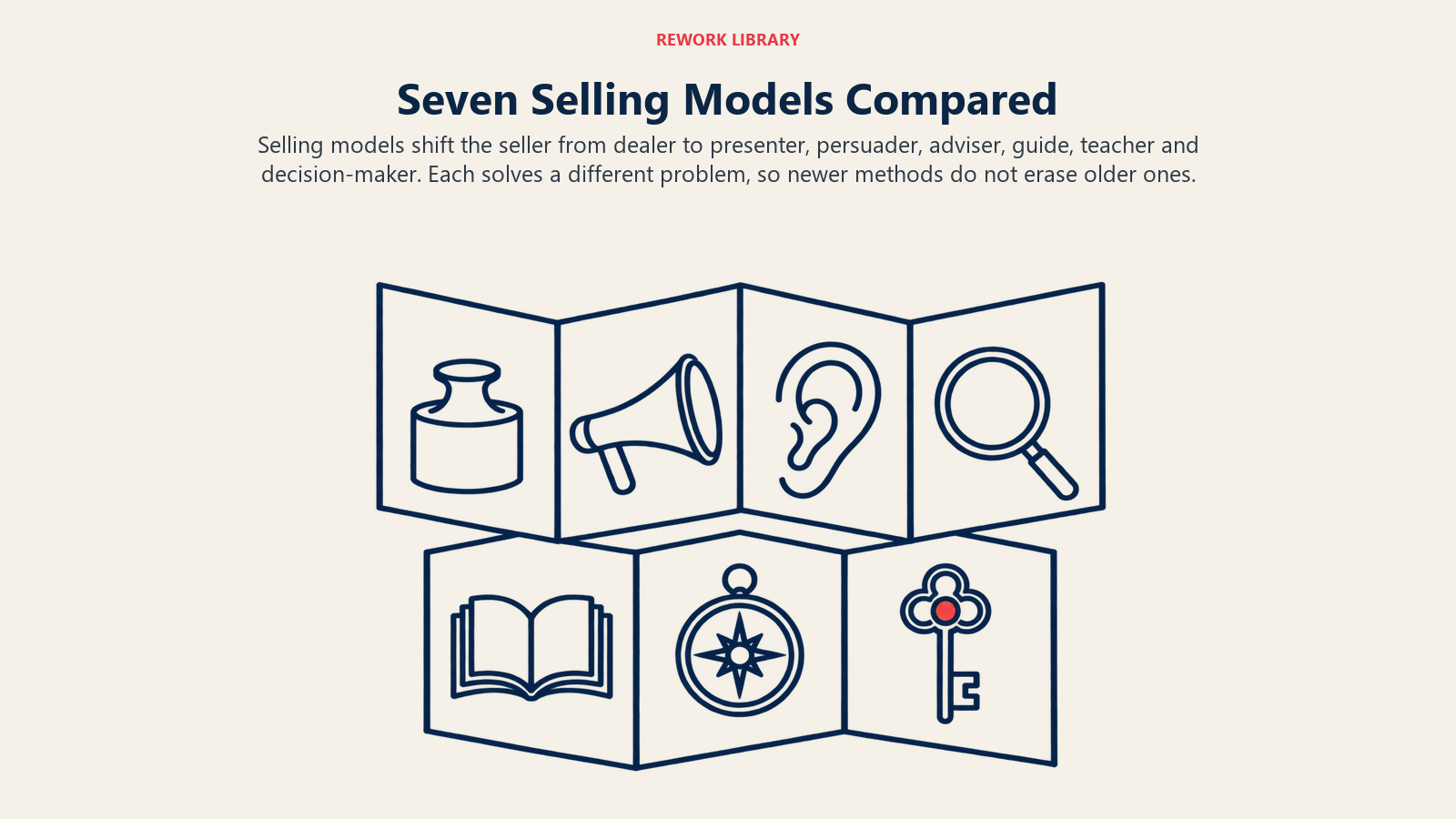
| Era | Core idea | Seller's role | Buyer's role | What broke it |
|---|---|---|---|---|
| Haggling Years | Reputation and negotiation | Trusted dealer or agent | Judge of the person | Distance and scale |
| Pitch Machine | The same tested words every time | Presenter | Audience | Pitches that ignored the buyer's situation |
| Persuasion Craft | Understand and influence the person | Persuader | Person to be won | Buyers learned the techniques |
| Needs Turn | Diagnose before prescribing | Adviser, questioner | Source of the problem | Scripted questions; buyers who had already diagnosed |
| Buyer-Led Web | Be useful where buyers search | Publisher, guide | Independent researcher | Parity of content |
| Insight Push | Teach something new | Teacher, challenger | Learner | Insight without substance |
| Agent Age | Software prepares, human decides | Decision-maker with assistants | Informed, often AI-assisted | Still unfolding |
Key People
| Name | Role | Contribution | Year |
|---|---|---|---|
| John H. Patterson | NCR chief | Written primer, training school, protected territory, quota | 1884 onward |
| Dale Carnegie | Author and trainer | Made interest in the other person mainstream advice | 1936 |
| Mack Hanan | Author | Consultative Selling | 1970 |
| Neil Rackham | Researcher and author | SPIN questions from Huthwaite research | 1988 |
| Matthew Dixon and Brent Adamson | Authors | The Challenger profile | 2011 |
| Brian Halligan and Dharmesh Shah | HubSpot founders | Inbound marketing company | 2006 |
Key Facts
- Fewer than 400 cash registers had ever been sold when Patterson bought NCR in 1884.
- Rackham's research behind SPIN Selling covered more than 35,000 sales calls by 10,000 salespeople in 23 countries.
- The Challenger Sale was published on November 10, 2011.
- In a study of 868 buyers, more than 60 percent received information from the winning seller's rep in the first phase.
- Salesforce's survey found the average seller spends 40% of their time selling.
The Pattern Behind the History
Our synthesis, not published research. Call it the Answer-and-Strain cycle:
- Each idea answers the last idea's failure. Scripts answered inconsistency, questions answered scripts, insight answered diagnosis.
- Each idea works until it becomes a routine. Buyers recognize the pattern, and it stops differentiating.
- The seller's role keeps moving toward the buyer's problem. From dealer to presenter to adviser to teacher.
- Old ideas do not disappear. Reputation, the primer and the question list all remain in a modern sales team.
- Tools change the cost of the work, not the question. Phones, CRM, the web and agents each made something cheap, and the strategic question stayed: what does this buyer need to decide?
What It Teaches Teams Today
- Name the idea your team runs on. Most teams mix a pitch, a question list and a content library without choosing one.
- Know what each idea needs. Scripts need a consistent buyer, questions need trust, insight needs real research, agents need clean data.
- Retire what buyers have learned to spot. If the tactic only works unnoticed, it's finished.
- Keep the oldest layer. Written promises, an honest record, and a person the buyer can trust are the same needs Hammurabi's receipts met.
For the milestones behind these ideas, return to the history of sales, and for the management side of the same story, the history of management.

Co-Founder, Rework.com
On this page
- Timeline at a Glance
- The Haggling Years (antiquity-1870s)
- The Pitch Machine (1884-1920s)
- The Persuasion Craft (1930s-1960s)
- The Needs Turn (1970-1990s)
- The Buyer-Led Web (2004-2017)
- The Insight Push (2011-2017)
- The Agent Age (2022-present)
- How the Selling Models Compare
- Key People
- Key Facts
- The Pattern Behind the History
- What It Teaches Teams Today