Who Invented Modern Sales?
Turn this article into takeaways for your work.


Each assistant summarizes the article only for you and suggests best practices for your work.
Picture the problem John H. Patterson faced in 1884, before he bought into the firm. The product was new. The buyers were skeptical shopkeepers. The people selling it were improvising.
The usual answer to who invented modern sales is Patterson of the National Cash Register Company (NCR). He took control of the firm in 1884 and built a trained, scripted, territory-based, quota-driven sales force. Fewer than 400 cash registers had ever been sold before he bought in. But no single person invented selling. Arthur Sheldon taught it as a science, Dale Carnegie taught it as a human craft, and Thomas Watson carried the NCR system into IBM. The title is contested because "modern sales" can mean four different things, and each claimant is the best answer to a different one.
Most American sellers were in the same position: written sales arguments were rare, so each seller largely worked out the pitch alone. The argument over who "invented" modern sales is really an argument over who first turned that improvisation into something a company could teach, measure and repeat. For the wider arc, see the history of sales.
Timeline at a Glance
For the full chronology, read the sales timeline. This table covers only the dates that bear on the title.
| Year | Milestone | Why It Mattered |
|---|---|---|
| c. 1950-c. 1840 BCE | Assyrian merchants trade tin and textiles at Kanesh and leave more than 23,000 tablets | Long-distance selling run on written letters, agents and records. |
| 1856 | Singer's trade publication floats renting machines and applying the fee to the price | Selling a costly product to ordinary households through credit. |
| 1861 | John Wanamaker opens his first store in Philadelphia | A fixed price and a money-back promise as a selling policy. |
| 1872 | Montgomery Ward issues its first catalog, a single sheet of 163 items | Selling at distance with no salesperson in the room. |
| 1884 | Patterson takes controlling interest in NCR | The start of the system most histories call managed selling. |
| 1887 | The first NCR Primer appears, with a script by Joseph H. Crane | A written sales script that every agent could learn. |
| January 1894 | NCR publishes a Sales Manual combining the Primer with the Book of Arguments | Scripts plus a catalog of answers to objections. |
| 1900 | Each NCR sales district receives a formal quota | A measurable target for every territory. |
| 1902 | Arthur Sheldon opens a mail-based sales school in Chicago | Salesmanship taught as a science to thousands. |
| 1914 | Thomas Watson joins the Computing-Tabulating-Recording Company | NCR-trained selling moves into IBM's ancestor. |
| 1917 | About a quarter of the CEOs of the top 200 industrial firms have spent time in selling | Sales becomes a route to the top of American business. |
| 1925 | Edward Strong credits E. St. Elmo Lewis with the AIDA formula | The attribution that made Lewis famous, and later disputed. |
| 1936 | Dale Carnegie's How to Win Friends and Influence People is first published | Persuasion packaged as a craft for ordinary people. |
| 2023 | Akinori Iwamoto publishes a paper disputing the Lewis story | A reminder that the "who invented it" record keeps changing. |
The Merchant's Ledger (c. 1950 BCE-1840s)
Letters, agents and receipts carry trade across distance
Start in a merchant quarter in central Anatolia. Kanesh, today's Kültepe, was a hub where Assyrian merchants sold tin and textiles and bought copper, silver and gold. Excavations there have produced more than 23,000 clay tablets, most of them from the merchant quarter and dating to roughly 1950-1840 BCE. They are the commercial letters, accounts and disputes of people who sold to buyers they could not supervise from home.
The same problem shows up in law. The Babylonian code of Hammurabi has a run of provisions on merchants and the agents who traded on their behalf. Laws 104 to 107 require receipts when money or goods change hands between them, and punish a merchant or agent who denies a handover with a repayment of three times or six times the sum. Selling at a distance, in other words, needed records and rules from the start.
Keep the precursor apart from the concept. These merchants sold, and some of their methods would look familiar, but nobody trained them to a script, gave them a protected territory or set them a quota. Closer to the modern story, the historian's survey of the American salesman notes that many European nations had traveling peddlers, yet none built organized sales forces to the same degree as the United States by the early 1900s. That gap is the ground on which every modern claimant stands.
For teams today: the oldest sales tools are the written record and the clear rule about who owes what to whom. If your handoffs live in someone's head, you are selling like a village market.
The Mass-Merchant Years (1856-1890s)
Credit, fixed prices and catalogs reach ordinary buyers
Move to the 1850s, when machines and factories began producing goods for people who had never bought them before. In 1856, Singer's trade publication asked why not rent a sewing machine to the housewife and apply the rental fee to the purchase price. The Harvard Business School credit history says the plan, borrowed from piano showrooms, tripled sales in a year, and that by the 1890s Singer agents were known for "dollar down, dollar a week" tactics. Selling a costly product through a payment plan and a door-to-door agent was a real invention in method.
In Philadelphia, John Wanamaker opened his first store in 1861, and a state marker credits him with the fixed one-price system and the money-back guarantee, which he built into a "new kind of store" in 1876. A National Park Service history gives the careful version. It says his Oak Hall store proclaimed Full Guarantee, One Price, Cash Payment and Cash Returned as its four laws, that other merchants had already introduced all four, and that Wanamaker "made the innovations credible." He was, that account says, chiefly a popularizer of other people's ideas.
Then there is selling with no seller at all. Aaron Montgomery Ward issued his first catalog on August 18, 1872: a single sheet listing 163 items. The company's policy of "satisfaction guaranteed or your money back" is described by the museum as an industry first. A catalog is the opposite of a trained sales force, and it is why the claimants' definitions diverge. What these three share is that they solved trust at a distance, with price, credit and a refund, and not by managing people.
For teams today: policies sell. A guarantee, a clear price and a payment plan did work that no pitch could do. Ask which of your terms removes risk for the buyer before a rep says a word.
The Patterson Years (1884-1913)
A cash-register maker turns improvisation into a trained system
The scene is Dayton, Ohio. Patterson, born in 1844, paid $6,500 for control of the failing company in 1884 and renamed it the National Cash Register Company. Over the next years the Dayton Innovation Legacy profile records the pieces falling into place. In 1887 he adopted a standardized "canned" sales talk based on the work of top salesman Joseph H. Crane. By 1900 each sales district received a formal quota. Salesmen got guaranteed territories and earned commission on all sales within them, and meeting a quota earned an invitation to the sales convention.
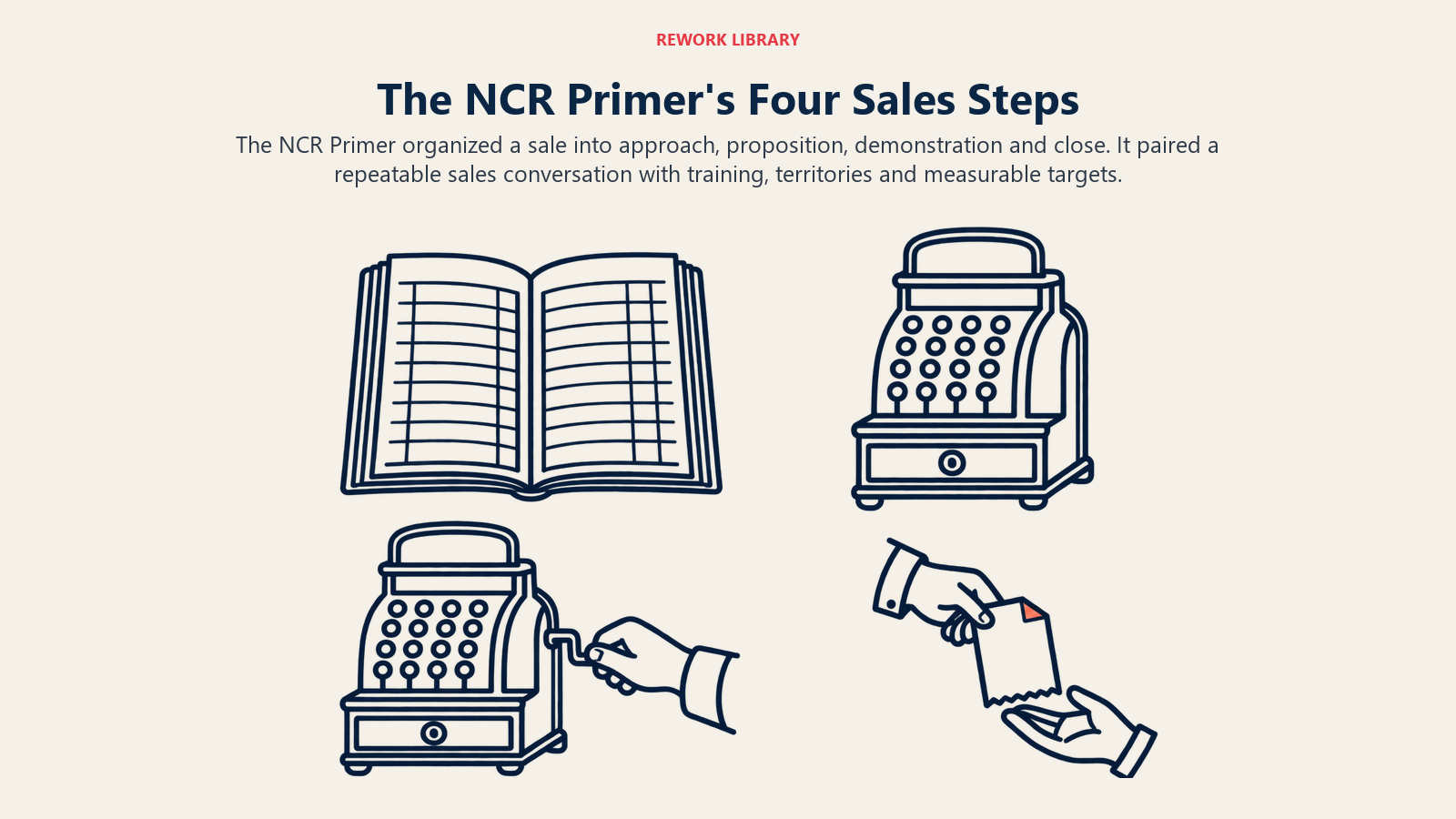
The Harvard Business School's Baker Library gives the documentary trail. The first NCR Primer appeared in 1887, with Crane, Patterson's brother-in-law, writing its first script, "How I Sell National Cash Registers." In January 1894 NCR produced a formal Sales Manual that joined the Primer to the Book of Arguments, a catalog of answers to common objections. The manual reached nearly 200 pages in 1904 and was condensed to a 56-page booklet by 1910. The Primer split every sale into four steps: approach, proposition, demonstration and close. In the approach, the salesman presented himself as a consultant who wanted to help raise the merchant's profit, and did not mention the register. That is an early form of what we now call consultative selling.
Training came with it. After seeing poorly informed salesmen at the 1893 World's Fair in Chicago, Patterson began training in Dayton the following spring, and estimates at the time said it doubled business in the first year. Selling Power also credits him with sales conventions, and quotes his advice to salesmen: "Give everybody a chance to buy."
Here is the catch for anyone declaring Patterson the inventor. The same Baker Library account says written sales arguments were rare but not as new as some of Patterson's biographers claim. It points to Henry B. Hyde's Hints for Agents in 1859 and Bates Harrington's How 'Tis Done in 1879, and suggests Patterson's agents, many of whom had sold for other firms, probably knew of earlier scripts. What was new at NCR was the combination, scripts, manuals, territories, quotas, conventions and a school, run by one company at scale. That is a claim about a system, not about any one ingredient. The same survey says Patterson promoted "scientific" salesmanship, writing scripts, mapping territories, testing pay methods and requiring monthly quotas.
Patterson's methods also fed a talent line. The Dayton profile names Hugh Chalmers, a former NCR vice president who later founded the Chalmers Motor Car Company, and Charles Kettering, the NCR inventor who was hired and fired repeatedly. It also records a magazine claim that between 1910 and 1930 one-sixth of the nation's top executives had been trained and fired by him. For the modern descendants of these tools, read about the sales playbook, territory planning and the sales quota.
For teams today: Patterson's real invention was making selling teachable. If your best rep's pitch and answers to objections are not written down, you haven't built what NCR built in 1887.
The Science of Selling (1898-1920s)
Psychologists and correspondence schools turn the pitch into a theory
Now go to Chicago in 1902. Arthur Frederick Sheldon opened a mail-based sales school built on a strict method that applied to ideas and services as well as goods. The Cook Memorial Public Library history says he combined scientific method with ethics, rejecting the 19th-century "buyer beware" approach, and that by 1904 the school enrolled about 150 new students a month and by 1915 had more than 10,000 students worldwide. He also coined the Rotary motto "He Profits Most Who Serves Best."
This is where the best-known formula in selling enters the story. AIDA, short for attention, interest, desire and action, is usually credited to E. St. Elmo Lewis. Edward K. Strong wrote in 1925 that Lewis formulated the first three words in 1898 and added "get action" later. Akinori Iwamoto's 2023 historical paper in the Conference on Historical Analysis and Research in Marketing proceedings found that Strong gave no citation, that no Lewis writing from around 1898 contains the formula, and that the first studies of AIDA in 1911 did not mention Lewis at all. Iwamoto concludes that Sheldon, not Lewis, can be regarded as the originator, with Frank H. Dukesmith also contributing decisively, and he points to Seth Brown's 1904 article as a likely first orderly statement of the four words. Sheldon himself wrote in 1910 of four mental states in every sale: attention, interest, desire and action.
Lewis's own surviving words are modest. In 1908 he wrote that attracting attention, making it interesting and persuading to action is the same problem. That makes Lewis a real contributor to advertising theory and a weak claimant to the formula. It also shows how a widely repeated "invented by" credit can rest on one uncited sentence.
By the 1910s the habit had spread beyond one company. Harvard's Bureau of Business Research published its first bulletin in 1913 on shoe selling, and by 1917 about a quarter of the chief executives of the top 200 industrial firms had spent part or all of their careers in selling. By the 1920s, the same account says, sales management had arrived as an essential part of corporate strategy.
For teams today: treat a famous model as a hypothesis with a history, not as scripture. AIDA is still a useful checklist for a message. It is a poor reason to stop asking what buyers actually do.
The Carry-Over Years (1914-1936)
NCR alumni and a bestselling author spread the craft
The next turn is how the system traveled. Thomas Watson spent more than a decade at NCR, where IBM's history says he honed his sales skills. Charles Flint recruited him in 1914 to the Computing-Tabulating-Recording Company, which was underperforming. The engineering history of Patterson notes that Watson carried these practices into what became IBM. IBM's own account says that in the 1920s he required new recruits to complete a six-week intensive sales training program before meeting customers, and the company was renamed International Business Machines in 1924. The media called him "The world's greatest salesman." IBM also says he brought the slogan "Think!" with him from NCR, with permission.
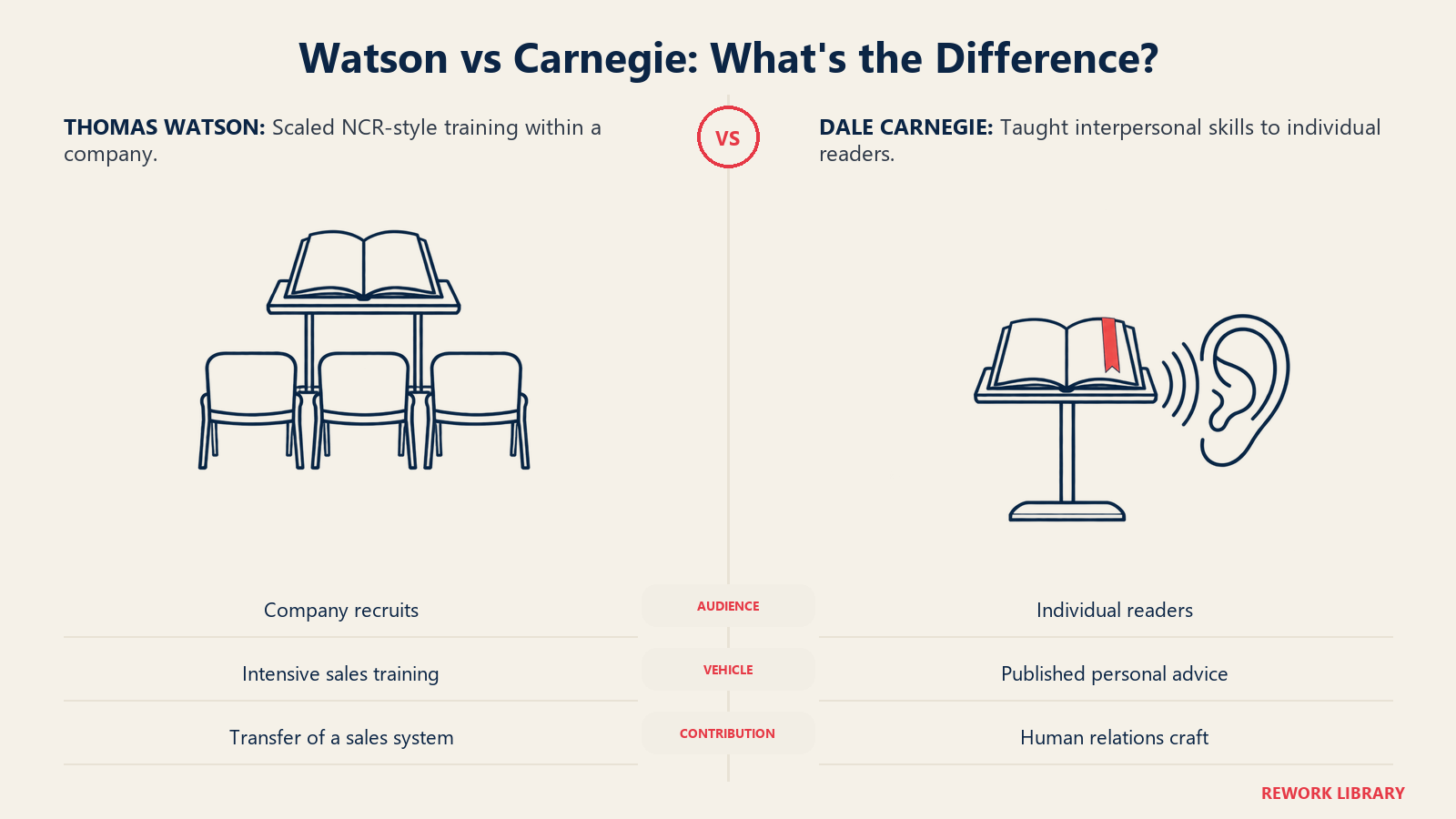
Meanwhile Dale Carnegie moved the craft from the company to the individual. How to Win Friends and Influence People was first published in 1936, and Harvard's survey notes it drew partly on his time as a salesman for Armour. The book's lasting claim, that interest in the other person moves a conversation further than a clever close, sits at the base of every modern relationship-based approach, including consultative selling and later SPIN selling.
The two men show a split that still runs through sales. Watson scaled a method through an organization. Carnegie sold the method to individuals who might never work for a company that had one.
For teams today: a system does not stay in the building. The people you train carry your method to their next employer, so write it down and make it good enough to be worth carrying.
The Contested Crown (1936-present)
Each claimant owns a different half of the job
Today the title sits where popular history put it. Selling Power's profile calls Patterson the father of professional selling. Careful sources are more hedged. The Baker Library says the practice of scripts predates him, the National Park Service says Wanamaker popularized instead of invented, and the AIDA scholarship says the credit for its best-known framework went to the wrong man for a century.

The cleanest way to read the dispute is to ask what "modern sales" means. The table lays it out.
| If by "modern sales" you mean | The name usually given | Evidence | The caveat |
|---|---|---|---|
| A managed, trained, quota-driven sales force | John H. Patterson, NCR | Primer 1887, Sales Manual 1894, district quotas 1900 | Scripts existed before him, and the first Primer script was Crane's |
| The first written sales script | Henry B. Hyde, then Joseph H. Crane | Hints for Agents, 1859; first Primer script, 1887 | Scripts are one ingredient, not a system |
| Honest, fixed-price retail | John Wanamaker | Store opened 1861; four laws of Oak Hall | A National Park Service account calls him a popularizer |
| Selling by mail, with no seller present | Montgomery Ward | First catalog 1872 | Replaces the salesperson instead of training one |
| Selling expensive goods on installment | Singer's agents | Rental-plan proposal 1856 | A credit method, not a selling method |
| Selling as a teachable science | Arthur Sheldon | School opened 1902; four mental states in 1910 | Reached students by mail, and the AIDA record is still being debated |
| The attention-to-action formula | Lewis (traditional), Sheldon (Iwamoto) | Strong, 1925; Iwamoto, 2023 | No Lewis text from 1898 has been found |
| Selling as a human craft | Dale Carnegie | Book first published 1936 | Writes about people, not about sales operations |
| Carrying a system to a new industry | Thomas Watson | CTR in 1914, IBM in 1924 | A transmitter more than an inventor |
If your definition is a company that manages how its people sell, Patterson holds the strongest, best-documented claim. If it is the theory of what goes on in the buyer's head, look to Sheldon and the contested AIDA record. If it is selling as a human skill, it is Carnegie. And if it is the practice of selling at all, the Kanesh tablets are thousands of years older than any of them. For a map of the later methods that grew from these roots, see sales methodologies compared and the challenger sale.
For teams today: when someone declares a single founder of a field, ask which definition is doing the work. The same habit settles most arguments in your own company about who "invented" your process. The sibling story for another discipline, who is the father of modern management, runs on exactly this logic.
Key People
| Name | Role | Contribution | Year |
|---|---|---|---|
| John H. Patterson | NCR owner | Built the Primer, manual, territories, quotas and sales school | 1884 onward |
| Joseph H. Crane | NCR salesman, Patterson's brother-in-law | Wrote the first Primer script, "How I Sell National Cash Registers" | 1887 |
| Henry B. Hyde | Equitable Life | Published scripted arguments for agents in Hints for Agents | 1859 |
| John Wanamaker | Philadelphia merchant | Popularized fixed prices and the money-back guarantee | 1861 |
| Aaron Montgomery Ward | Mail-order merchant | Issued the first catalog, a single sheet of 163 items | 1872 |
| Arthur F. Sheldon | Sales educator | Opened a mail-based sales school and wrote of four mental states in a sale | 1902 |
| E. St. Elmo Lewis | Advertising writer | Traditionally credited with AIDA, a credit now disputed | 1898 (per Strong) |
| Dale Carnegie | Author and trainer | Wrote How to Win Friends and Influence People | 1936 |
| Thomas J. Watson | NCR salesman, then IBM head | Carried NCR-style selling into IBM and required six weeks of training | 1914 onward |
Key Facts
- Before Patterson took control of NCR in 1884, fewer than 400 cash registers had ever been sold.
- NCR's first Primer appeared in 1887, and its Sales Manual reached nearly 200 pages in 1904.
- Each NCR sales district received a formal quota in 1900.
- Sheldon's school had more than 10,000 students worldwide by 1915.
- Strong's 1925 account of Lewis and AIDA had no citation, according to a 2023 historical paper.
- By 1917 about a quarter of the CEOs of the top 200 industrial firms had spent time in selling.
The Pattern Behind the History
Our synthesis, not published research: the title of "inventor of modern sales" follows four habits.
- One title, many questions. Patterson answered how a company sells, Sheldon why a buyer buys, Carnegie how to treat the person, and Watson how a method travels.
- The system gets the credit, not the first ingredient. Scripts predate NCR, as do fixed prices and installment plans, yet the combination at scale is what is remembered.
- Practice comes before the name. Merchants at Kanesh sold by letter and agent thousands of years ago, long before anyone wrote a theory of it.
- Famous formulas outrun their evidence. A model repeated for a century can rest on one uncited line.
What It Teaches Teams Today
- Write the method down. Patterson's lasting contribution is that selling became teachable. A playbook, a manual of answers to objections and a clear territory rule still do most of the work.
- Separate the ingredient from the system. A script alone didn't create NCR's results. Scripts, training, targets and conventions did, working together.
- Treat a famous framework as a hypothesis. Test AIDA, SPIN or any other against what your own buyers do.
- Remember that methods travel. Watson took what he learned at NCR to IBM. Whatever you teach will outlast your team, so make it good.
For the wider story of how selling developed, return to the history of sales. Why the usual story focuses on one company is also part of how selling itself changed.

Co-Founder, Rework.com
On this page
- Timeline at a Glance
- The Merchant's Ledger (c. 1950 BCE-1840s)
- The Mass-Merchant Years (1856-1890s)
- The Patterson Years (1884-1913)
- The Science of Selling (1898-1920s)
- The Carry-Over Years (1914-1936)
- The Contested Crown (1936-present)
- Key People
- Key Facts
- The Pattern Behind the History
- What It Teaches Teams Today