Sales Timeline: Key Milestones in the History of Selling
Turn this article into takeaways for your work.


Each assistant summarizes the article only for you and suggests best practices for your work.
Picture a clerk in a merchant house in central Anatolia, almost four thousand years ago. He presses a receipt for a loan of silver into a small clay tablet. He wraps it in a clay envelope and rolls a seal across it.
Selling is as old as trade, and its best-documented written trail starts with clay tablets from the Old Assyrian trading colony in Anatolia, roughly 2000 to 1800 BCE. The modern, managed version began in 1884, when John H. Patterson took over the National Cash Register company and turned selling into something a company could teach, measure and reward. The throughline of the whole timeline: every new way of reaching buyers (roads, catalogs, phones, email, AI) has forced sellers to add a new way of earning trust and keeping records.
The seal meant that a partner months away by donkey caravan couldn't later claim the deal never happened. That small act contains most of what sales has argued about ever since: who vouches for whom, who keeps the record, and what happens when buyer and seller can't see each other. This page walks the full chronology, then explains each cluster of milestones. For the interpretive overview, start with the history of sales.
Timeline at a Glance
| Year | Milestone | Why It Mattered |
|---|---|---|
| Ca. 2000-1800 BCE | Old Assyrian merchants record a loan in silver on a clay tablet sealed in an envelope | Written, sealed records let trade run between partners who were far apart. |
| Ca. 1750 BCE | Hammurabi's laws, engraved on a basalt stele, cover trade among their 282 judgements | Commerce had written rules about agents, goods and receipts. |
| 130 BCE | The Silk Road is formally established under China's Han dynasty | Long-distance selling got a standing network of routes and middlemen. |
| 1856 | Edward Clark introduces hire purchase for Singer sewing machines | Payment in instalments opened a costly product to ordinary households. |
| 1872 | Aaron Montgomery Ward issues his first mail-order catalog | A single printed sheet reached rural buyers without a seller present. |
| 1884 | John H. Patterson buys controlling interest in NCR | The start of the first widely copied system of managed selling. |
| 1886 | Richard Sears founds the R.W. Sears Watch Company | The mail-order house that later became the largest catalog seller begins. |
| 1914-1915 | Thomas Watson leaves NCR for CTR; the slogan THINK dates to a 1915 meeting | NCR's sales culture moves to the company that became IBM. |
| 1936 | Dale Carnegie publishes How to Win Friends and Influence People | Interpersonal technique became a book ordinary sellers could study. |
| 1988 | Neil Rackham's SPIN Selling is published | Research-backed questioning replaced the pitch in large sales. |
| 1991 | Congress passes the Telephone Consumer Protection Act on December 20 | Telemarketing met its first federal limits. |
| 1999 | Salesforce incorporates on March 8 | CRM became a subscription anyone could buy. |
| 2003 | The National Do Not Call Registry opens on June 27 | Buyers gained a legal way to refuse interruption. |
| 2004 | Salesforce lists on the New York Stock Exchange on June 23 | Hosted CRM was proven as a business model. |
| 2006 | Brian Halligan and Dharmesh Shah found HubSpot | Inbound marketing became a mainstream source of sales conversations. |
| 2011 | Dixon and Adamson preview The Challenger Sale; the book follows on November 10 | The debate moved from rapport to teaching buyers something new. |
| 2017 | SiriusDecisions surveys 868 buyers worldwide | Early seller contact was shown to matter in the first phase of buying. |
| Nov 2022 | ChatGPT launches publicly | Drafting, summarizing and research became cheap to automate. |
| Feb 2026 | Salesforce publishes its State of Sales survey of 4,050 professionals | Agents were reported as a planned part of the sales workflow. |
The Merchant Ages (c. 2000 BCE-1700s)
Reputation, receipts and caravans carry trade across distance
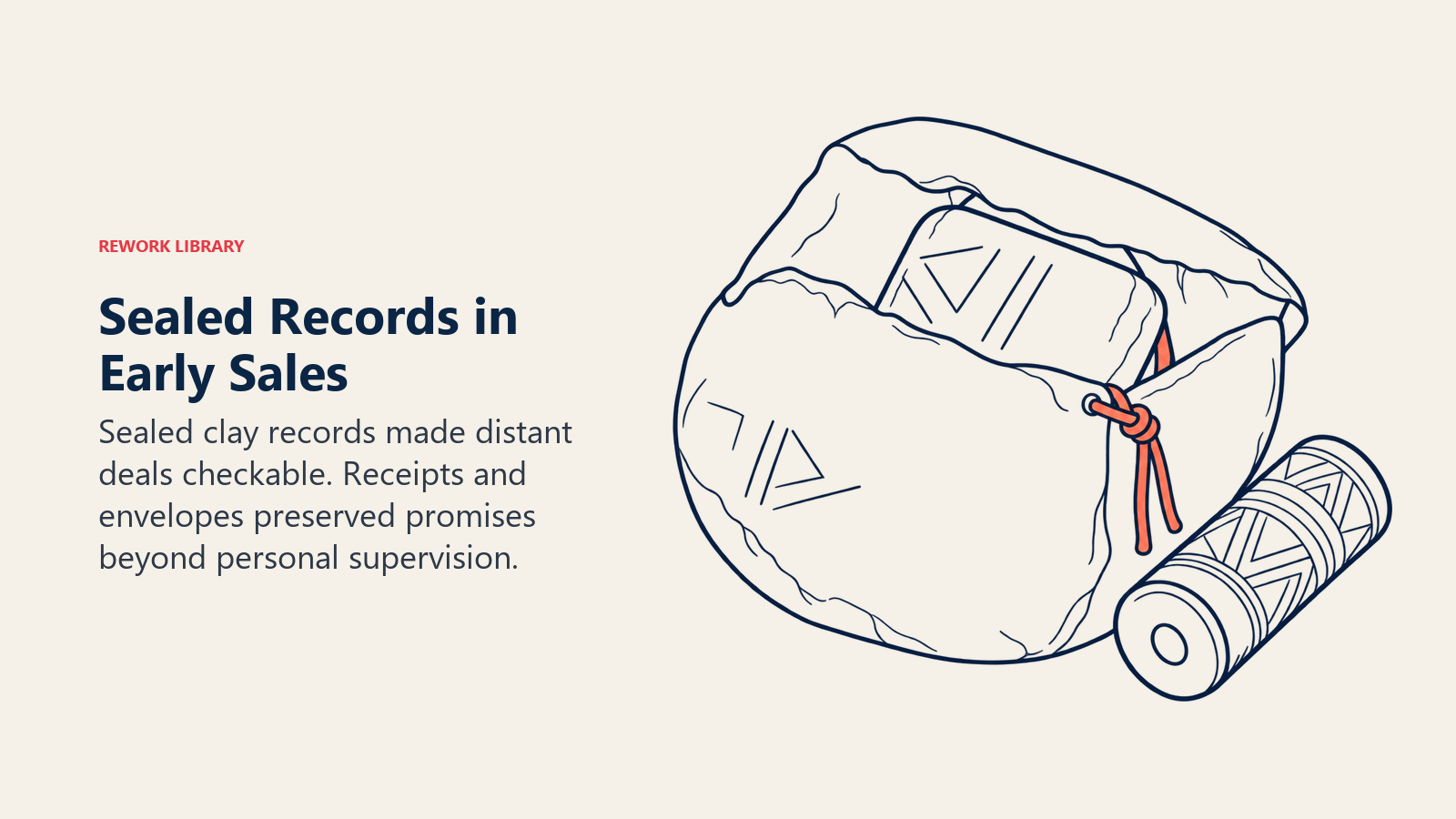
The oldest sales records we can read are business papers. The Metropolitan Museum of Art holds a cuneiform tablet that records the quittance for a loan in silver, made in the Old Assyrian trading colony and dated to about the 20th to 19th century BCE, probably from Kültepe (ancient Kanesh) in Anatolia. The same museum holds the clay envelope stamped with four cylinder seals that enclosed it. The seals were the signature. J. G. Dercksen's chapter on the period frames it as the golden interval of Old Assyrian trade, 2000 to 1700 BC.
Law followed trade. The Louvre dates the stele of Hammurabi, king of Babylon, to around 1750 BC, with 282 judgements arranged in chapters that include trade. In L. W. King's translation on the Yale Avalon Project, the provisions on merchants and agents turn on receipts: an agent who handed over money without taking a receipt could not claim it afterward. The idea is old: if the deal isn't written down, the seller carries the risk.
Then the roads. The World History Encyclopedia describes the Silk Road as a network formally established under the Han dynasty in 130 BCE that linked regions in commerce until 1453 CE. Nobody on those routes called the work sales, and no company trained them. Keep the precursor apart from the concept: these merchants sold, but selling as a managed function did not exist yet. What they left behind is the first pattern in this timeline, that distance forces records and reputation.
For teams today: the tablet is a CRM note with a seal on it. If a promise made to a customer lives only in one rep's head, you have a pre-1800 BCE record system. Start with territory planning and clear account ownership.
The Catalog and Installment Age (1850s-1880s)
Mail and monthly payments reach buyers the seller never meets
Move to the 1850s, to a world with railroads, a postal service and factories that could make far more than local shops could sell. The Victoria and Albert Museum records that Isaac Merrit Singer and Edward Clark set up their sewing machine firm in 1851 and that Clark introduced a hire purchase scheme in 1856, letting buyers pay in several instalments so that people beyond the wealthy could afford a machine. The solution to a pricing problem was a payment plan, and it changed who could buy.
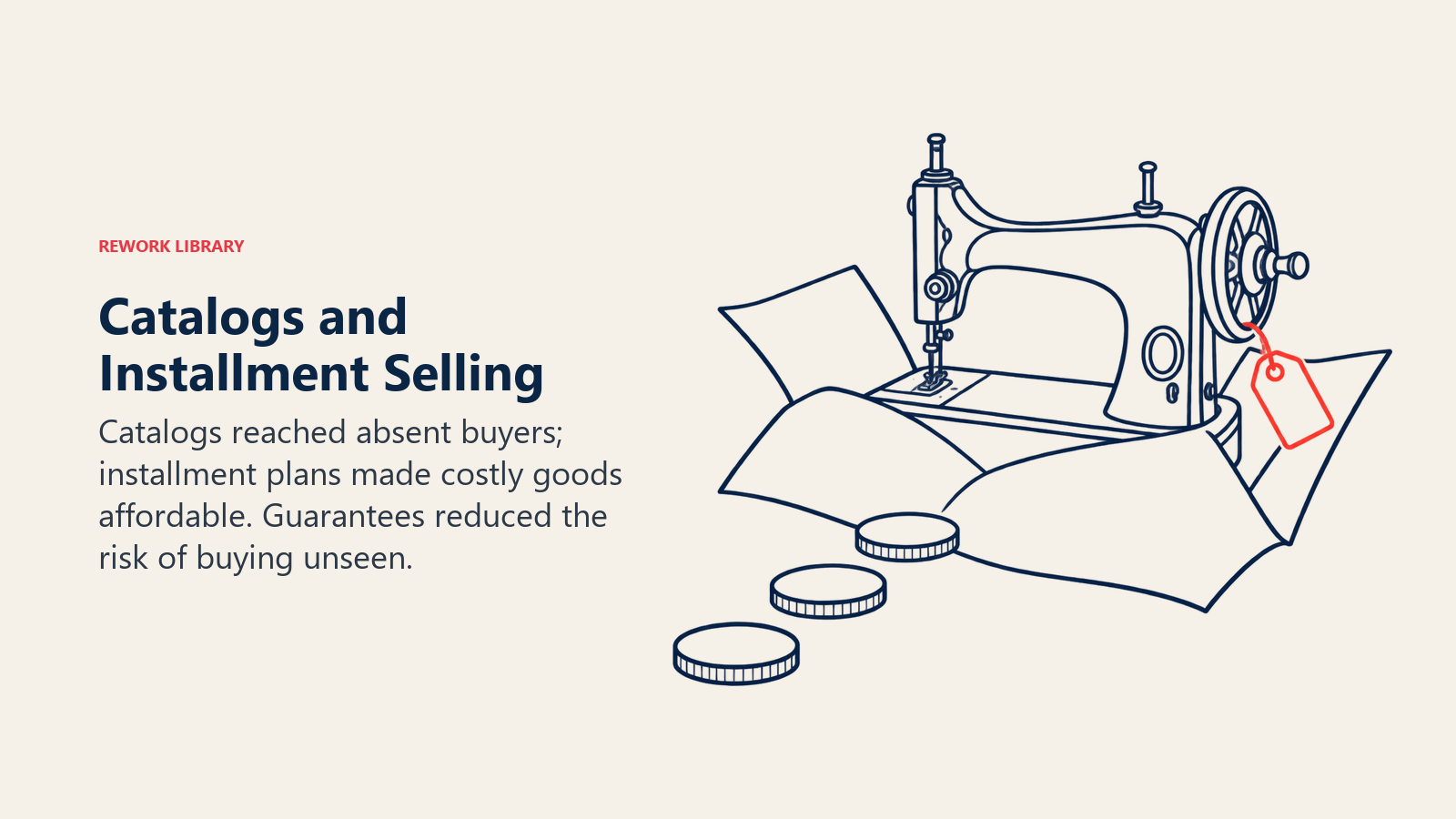
Distance was the next barrier. On August 18, 1872, Aaron Montgomery Ward issued a one-sheet catalog listing 163 items aimed especially at rural and farming customers. The Chicago History Museum credits the firm with an early guarantee, "satisfaction guaranteed or your money back," which it calls an industry first. The Library of Congress dates Richard Sears's start in the same business to 1886, when he founded a watch company that later became Sears, Roebuck & Co.
These sellers solved reach and affordability. They created a new problem: a buyer who could not inspect the goods had to trust a promise in print. Guarantees filled that gap, which is why returns policies still carry weight in a buying decision.
For teams today: every pricing model and payment term is a sales tool, not an afterthought. And if you sell without meeting the buyer, your guarantee does the job a face-to-face handshake used to do.
The NCR Years (1884-1915)
A cash register company writes the first sales system
This era overlaps the last: Patterson took control while the catalog houses were still growing. In 1884 he bought controlling interest in the Dayton, Ohio firm National Cash Register, when fewer than 400 registers had ever been sold, according to Selling Power's history. Selling Power credits him with the NCR Primer, a 400-word presentation that salesmen had to memorize, which grew into a manual for handling customer objections. It also credits him with protected territories for the best salesmen, a quota that it calls the first effort to obtain measurable results in selling, and regular conventions where agents traded ideas and top performers were rewarded.
The mechanics matter more than the myth. Patterson took what worked in the field and wrote it down so that new agents could repeat it. Our article on the sales playbook is the direct descendant. Territories and quotas gave managers something to measure, and they created the tension sales leaders still manage: accountability against the judgment that makes a good seller good. See sales quota for the modern version.
The system also travelled with people. Selling Power notes that Thomas Watson, a former NCR salesman, went on to found IBM. IBM's own account says Charles Flint lured Watson away from NCR in 1914 to the Computing-Tabulating-Recording Company, and traces the one-word slogan THINK to a 1915 meeting of NCR sales and advertising executives in Dayton. The sales culture that NCR built became part of the company that led business computing for decades. For the other side of that story, read the history of computers.
For teams today: if your best rep's pitch isn't written down, you don't have a process yet. And quotas work when they are attainable and tied to pay, which Patterson's agents knew as well as yours do.
The Persuasion Craft (1915-1970s)
Technique is taught, and a book makes it public
By the 1920s selling was a large occupation, and the market for training followed. Dale Carnegie's How to Win Friends and Influence People was published in 1936. Its central claim, that interest in the other person moves a conversation further than a clever line, turned relationship skills into something a seller could practice.
The weakness of the era was that technique spread faster than evidence. Closing lines and scripts passed from one trainer to the next as folklore. A seller could be trained and still not know why a call worked. The correction came in the 1980s. The craft also carried the idea behind consultative selling: diagnose before you prescribe.
For teams today: teach persuasion and negotiation as skills with practice and feedback. If a technique only works when the buyer does not notice it, retire it.
Methods, Records and Rules (1980s-2003)
Questions, CRM and a legal brake on cold calls
Three things changed selling in about fifteen years. First came evidence. SPIN Selling, by Neil Rackham, was published by McGraw-Hill on May 1, 1988, and the publisher describes it as the result of 12 years of research by the Huthwaite corporation into effective sales performance. It put questions about situation, problem, implication and need-payoff at the center of complex selling. SPIN selling is covered in full elsewhere, and sales methodologies compared sets it beside the rest.
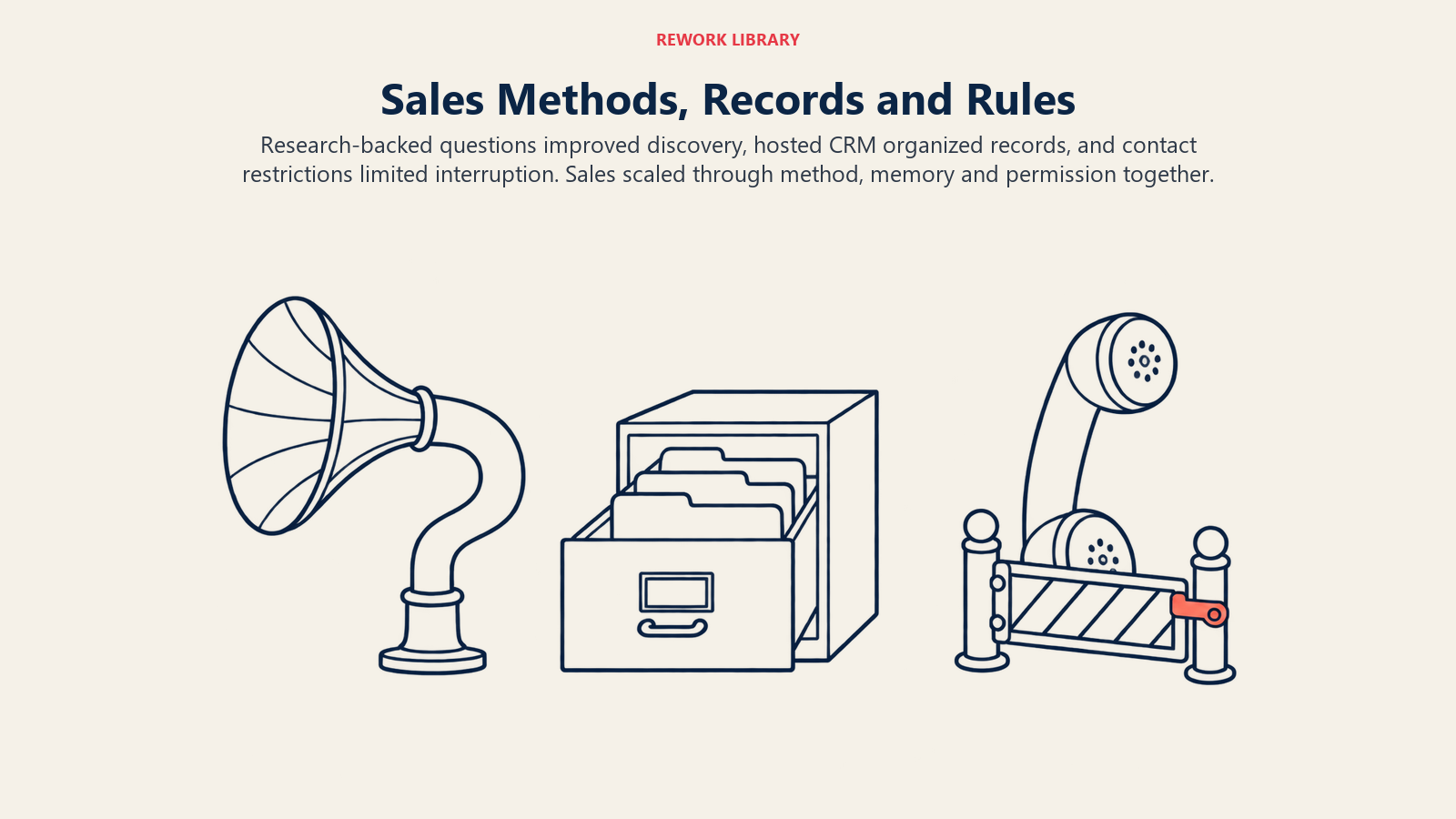
Second came a brake on volume. The phone had made contact so cheap that Congress wrote the numbers into law. In the Telephone Consumer Protection Act of 1991, signed December 20, 1991, Congress found that more than 300,000 solicitors called more than 18,000,000 Americans every day, and that telemarketing sales had reached $435 billion in 1990. It called unrestricted telemarketing an invasion of privacy. The FTC opened the National Do Not Call Registry on June 27, 2003, free and open to consumers by phone or online; enforcement began October 1, 2003.
Third came the record. Salesforce incorporated on March 8, 1999 and went public on the NYSE on June 23, 2004, raising $110 million at $11 a share. Its founders were Marc Benioff, Parker Harris, Frank Dominguez and Dave Moellenhoff. Hosted CRM put accounts, stages and forecasts in front of managers for the first time, and it made data entry a discipline: lead management differs from CRM, but both rely on records people actually keep.
For teams today: pick one method and encode its stages in your CRM. Check the contact rules in every market you call. Outbound still works, but it works through relevance, which is the case for a research-led prospecting strategy.
The Buyer-Led Age (2006-present)
Buyers research first, and software starts doing the preparation
The web reversed the information balance. HubSpot's founders, Brian Halligan and Dharmesh Shah, started the company in 2006 on the observation that buyers did not want to be interrupted by ads and wanted helpful information. That is the logic of inbound lead generation.
Researchers asked what this meant for the seller. Matthew Dixon and Brent Adamson previewed their findings in HBR on September 30, 2011, ahead of the book The Challenger Sale, due on November 10, 2011. Their argument, covered in our Challenger Sale article, was that the best sellers teach buyers something new. Forrester's write-up of the SiriusDecisions 2017 study of 868 buyers adds a useful correction to the folk statistic that buyers finish most of their buying before talking to a seller: in the first educational phase of the buying process, more than 60 percent of buyers received information from the representative of the winning provider.
Then came ChatGPT, in November 2022, and with it cheap drafting, summarizing and research. Salesforce's 2026 survey of 4,050 sales professionals, run in August and September 2025, reports that the average seller spends 40% of their time selling, that 54% of sellers have used agents, and that sellers expect agents to cut prospect research time by 34% and email drafting by 36%. Those are survey results and seller expectations, not measured outcomes. The pattern from every earlier era applies: automation makes good inputs more valuable. See what is an AI sales operator.
For teams today: give buyers useful material early, equip reps to add insight, and fix the data before you automate. A sales process that is vague on paper becomes a faster vague process with an agent behind it.
Key People
| Name | Role | Contribution | Year |
|---|---|---|---|
| Old Assyrian merchants of Kanesh | Long-distance traders | Left sealed written records of loans and deals | Ca. 2000-1800 BCE |
| Hammurabi | King of Babylon | His stele includes written rules for trade | Ca. 1750 BCE |
| Edward Clark | Singer partner | Introduced hire purchase for sewing machines | 1856 |
| Aaron Montgomery Ward | Mail-order merchant | Issued the first catalog for a mass audience | 1872 |
| John H. Patterson | NCR owner | Built the primer, territories, quotas and conventions | 1884 |
| Richard W. Sears | Mail-order founder | Started the watch company that became Sears, Roebuck | 1886 |
| Thomas Watson | Salesman and executive | Took NCR's sales culture to CTR | 1914 |
| Dale Carnegie | Author and trainer | Published How to Win Friends and Influence People | 1936 |
| Neil Rackham | Researcher and author | Wrote SPIN Selling | 1988 |
| Marc Benioff | Salesforce co-founder | Co-founded the hosted CRM company | 1999 |
| Brian Halligan and Dharmesh Shah | HubSpot founders | Built a company around inbound marketing | 2006 |
| Matthew Dixon and Brent Adamson | Authors | Published the Challenger Sale argument | 2011 |
Key Facts
- In 1884 Patterson bought NCR when fewer than 400 registers had ever been sold.
- Montgomery Ward's first catalog, issued on August 18, 1872, listed 163 items on one sheet.
- The Telephone Consumer Protection Act of 1991 records more than 300,000 solicitors calling more than 18,000,000 Americans every day.
- Salesforce incorporated on March 8, 1999 and raised $110 million in its June 23, 2004 IPO.
- In the SiriusDecisions 2017 study of 868 buyers, more than 60 percent received information from the winning seller in the first educational phase.
- Salesforce's 2026 survey found the average seller spends 40% of their time selling.
The Pattern Behind the History
Our synthesis, not published research: the milestones above repeat a loop we call the Reach-Record-Rule loop.
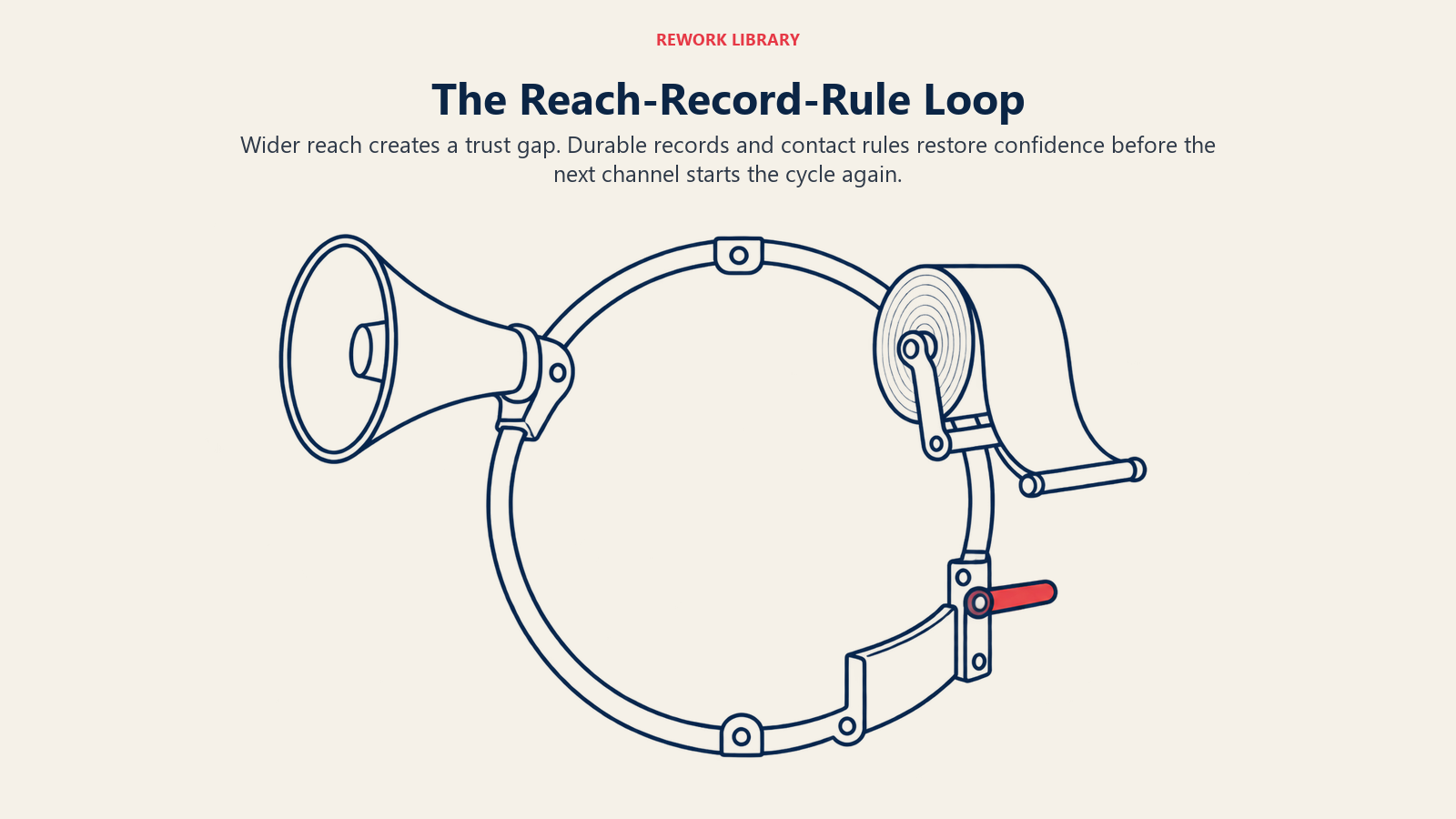
- A new channel extends reach. Caravans, catalogs, phones, inbound content and AI each let one seller touch many more buyers.
- Trust lags behind. The first response is always a guarantee, a receipt, a reference or a seal.
- A record is created. Tablets, ledgers, quotas, CRM and agent logs each exist so the next seller does not start from zero.
- Volume decays into a rule. When contact gets cheap enough, buyers or lawmakers push back, as the 1991 Act and the 2003 registry show.
- The next channel starts the loop again. Each cycle is shorter than the last.
What It Teaches Teams Today
- Write it down. From the Assyrian envelope to the NCR Primer, sales scaled when promises and pitches became records. Do the same with your playbook and your handoffs.
- Match every channel with a trust device. If you add a channel, add the proof that goes with it: references, guarantees, clear terms.
- Treat volume as borrowed. Buyers and regulators have capped cheap contact before. Relevance lasts longer.
- Fix inputs before automating. Each tool that removes manual work magnifies whatever data it is fed.
For the interpretive story behind these dates, return to the history of sales. To follow how the core idea of selling changed between these dates, read the evolution of selling; for the debate over who gets credit for the NCR model, see who invented modern sales. For the management ideas sales leaders borrowed, see the history of management.

Co-Founder, Rework.com
On this page
- Timeline at a Glance
- The Merchant Ages (c. 2000 BCE-1700s)
- The Catalog and Installment Age (1850s-1880s)
- The NCR Years (1884-1915)
- The Persuasion Craft (1915-1970s)
- Methods, Records and Rules (1980s-2003)
- The Buyer-Led Age (2006-present)
- Key People
- Key Facts
- The Pattern Behind the History
- What It Teaches Teams Today