The History of ARPANET
Turn this article into takeaways for your work.


Each assistant summarizes the article only for you and suggests best practices for your work.
In the early 1960s a researcher might need another lab's computer or software. The choices were to travel, mail tapes or rebuild the work. The problem was isolation.
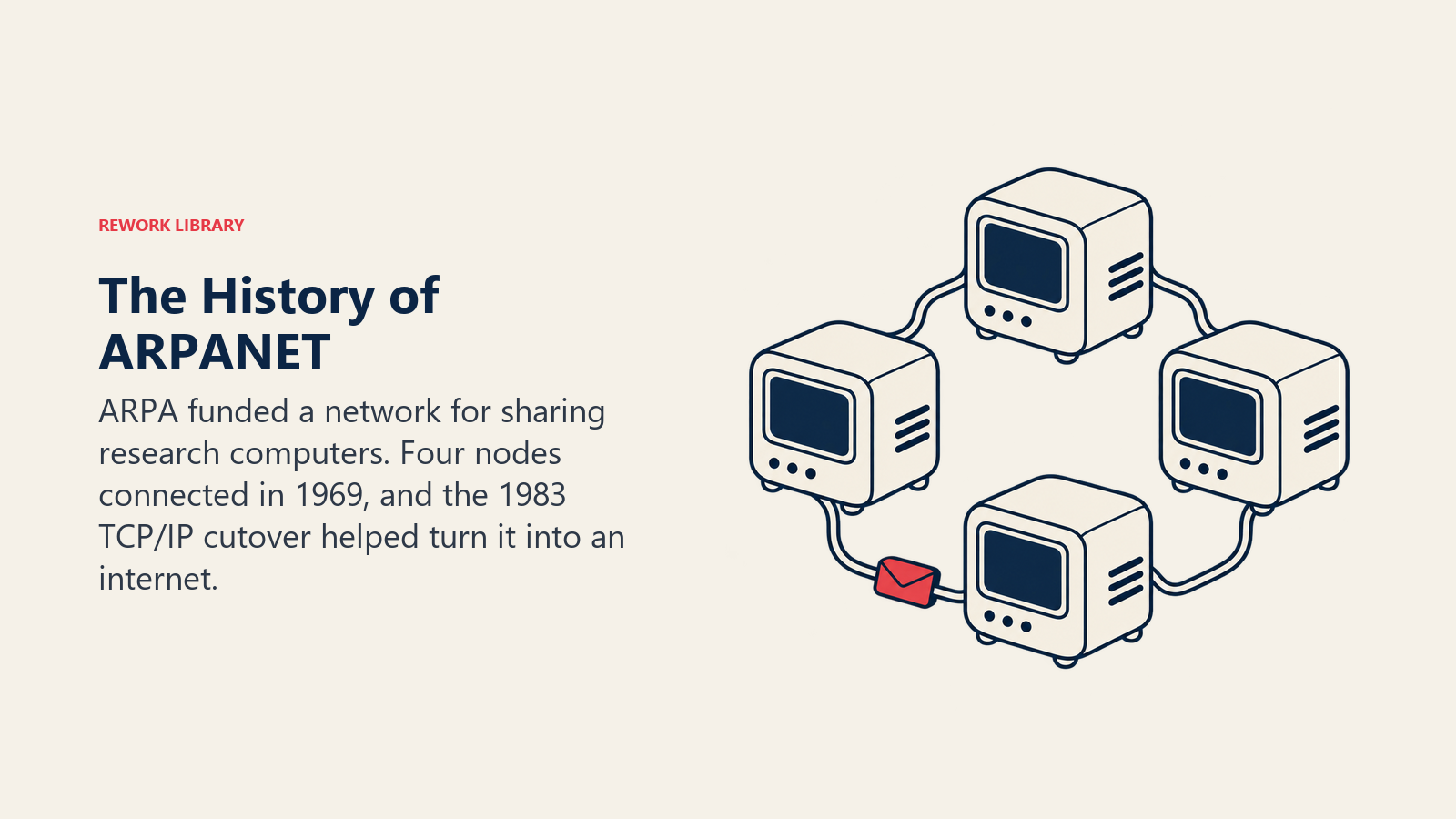
ARPANET was planned by the US Advanced Research Projects Agency in 1966 to 1968. It switched on in September 1969, with a first message on 29 October 1969. It moved to TCP/IP on 1 January 1983 and was decommissioned in 1990. The throughline: a research agency wanted expensive computers at different universities to share work. It paid a small company to build the switches. A group of graduate students then wrote the rules in public notes.
For the wider story of what ARPANET grew into, see The History of the Internet, the Internet timeline and who invented the Internet.
A few terms first. A "packet" is a small chunk of a message that travels on its own and is reassembled at the other end. An "IMP" (Interface Message Processor) was the small computer at each site that sent and received packets for the big host machine. A "host" is the research computer itself. A "protocol" is an agreed set of rules for talking.
Timeline at a Glance
| Year | Milestone | Why It Mattered |
|---|---|---|
| 24 May 1844 | Morse sends "What hath God wrought" from the Capitol to Baltimore | The precursor: a long-distance message wire, long before computers. |
| 7 Feb 1958 | ARPA is created after Sputnik | The agency that would fund the network. |
| Oct 1962 | Licklider becomes head of ARPA's computer research program | The vision of networked computing gets a budget holder. |
| 23 Apr 1963 | Licklider's memo to the "Intergalactic Computer Network" | The idea in writing, six years before the network. |
| 1965 | Roberts links two computers on opposite coasts over a dial-up line | Proved the phone network was the wrong tool. |
| Oct 1967 | Roberts presents the ARPANET plan at Gatlinburg, where "packet" is adopted | The design meets the British packet work. |
| Dec 1968 | BBN wins the IMP contract | A formal contract turns the plan into hardware. |
| 7 Apr 1969 | RFC 1, "Host Software" | The first of the informal notes that became the Internet's standards series. |
| 29 Oct 1969 | First host-to-host message, UCLA to SRI | The network carries its first traffic. |
| Dec 1970 | The Network Control Protocol is finished | The first host-to-host rules. |
| Oct 1972 | First public demonstration at the ICCC in Washington | The network is shown to the outside world. |
| May 1974 | Kahn and Cerf publish the TCP design | Networks of different kinds get a common language. |
| 1 Jan 1983 | ARPANET moves from NCP to TCP/IP | The network becomes an internet in practice. |
| 1983 | The network is split into ARPANET and MILNET | Military and research traffic separate. |
| 1990 | ARPANET is decommissioned | Its job is done; the Internet carries on. |
The Wire Precursors (1844-1957)
A message wire before any computer needed one
The turning point is the wire. On 24 May 1844 Samuel Morse sent a message over copper wire from the Senate wing of the US Capitol to Baltimore, which the Senate Historical Office calls the first long-distance demonstration of his electromagnetic telegraph. The wire ran 38 miles to the railroad depot in Baltimore, and Annie Ellsworth, the daughter of the patent commissioner, chose the words "What hath God wrought." Congress had paid for the test line with a $30,000 appropriation signed on 3 March 1843.
The same Senate account shows what Morse was up against. When the Treasury asked for proposals for a national telegraph, all but one respondent offered an optical telegraph, a chain of towers with people signalling in semaphore, a version of which France had already built. Morse was the lone bidder proposing signals over wire.
This is a precursor, not ARPANET. Nobody in 1844 imagined computers on the wire. But the pattern set here repeats: a government pays for a test line, a demonstration works, and the network later carries uses the funders never planned. A century on, the first computers sat alone. Time-sharing let several people use one machine from terminals, which raised a new question: could the machines talk to each other?
The era ends with a shock in space. DARPA's own history says the Soviet satellite launch in October 1957 triggered events that led to ARPA's creation on 7 February 1958.
For teams today: the technology that changes your work often exists years before the use case does. Fund the test line, then watch what people actually send over it.
The Two Threads (1958-1966)
A researcher's theory and an agency's budget find each other
The turning point is a meeting of two independent threads. In his 2010 history for IEEE, Leonard Kleinrock describes a research thread (packet switching theory) and an institutional thread (ARPA itself) that merged in the mid-1960s.
The research thread had three branches that mostly did not know about each other. Kleinrock published the first paper on packet switching theory in July 1961 and a book in 1964. At RAND, Paul Baran, who was working on military command and control, published a paper in September 1962 and a set of 11 reports in August 1964, according to Kleinrock. RAND's own memorandum on distributed networks asks how several hundred communications stations could keep talking after an enemy attack, and answers with a mesh of nodes using standard message blocks and no central control point. In the UK, Donald Davies at the National Physical Laboratory was working on the same problem. The Computer History Museum dates his network theorizing to 1966. The fuller story of those three branches is in the history of packet switching.
The institutional thread ran through ARPA's computer research office. The Computer History Museum says J.C.R. Licklider became its first head in October 1962. On 23 April 1963 he sent a memorandum addressed to "Members and Affiliates of the Intergalactic Computer Network," in which he said he wanted to develop a capability for integrated network operation. DARPA dates the same memo to 25 April 1963.
Then the threads met. In 1965 Lawrence Roberts and Thomas Merrill linked the TX-2 in Massachusetts to the Q-32 in California over a low-speed dial-up line, which the Internet Society calls the first wide-area computer network ever built, however small. Kleinrock says it showed the telephone network was the wrong tool. Also in 1965, Robert Taylor became associate director of ARPA's computer office. He saw a need to connect researchers to the few large, costly computers around the country so they could share hardware, software and applications. Kleinrock recounts that ARPA's director, Charlie Herzfeld, allocated $1 million to the project within 20 minutes of Taylor asking. Taylor became office director in August 1966 and brought Roberts in as chief scientist that December.
A note on motive. Kleinrock says resource sharing was the primary motivation and that Baran's nuclear-survival design gave rise to a myth about why ARPANET was built. DARPA's own account lists secure communications among the original goals, and notes that packet switching grew from the need to avoid depending on any single node. Both agree the network had to survive the loss of a node. They differ on whether war was the reason it was funded.
For teams today: a small, fast budget decision turned a theory into a program. If you want a long-shot project funded, bring the owner a concrete shared problem and a person who can run it.
The IMP Contract (1967-1968)
A plan becomes a purchase order
The turning point is a conference in Tennessee. In October 1967 Roberts presented his ARPANET design at Gatlinburg, where Roger Scantlebury of the NPL presented the British network paper. Kleinrock reports that Roberts adopted Davies' word "packet" there and raised the planned line speed from 9.6 kb/s to 50 kb/s. The Internet Society's account agrees that "packet" came from the NPL work and the speed rose to 50 kbps. Packets were fixed at 1,024 bits.
The paperwork moved quickly. Per Kleinrock, the ARPANET Program Plan was submitted to ARPA on 3 June 1968 and approved on 21 June. A Request for Quotation for the IMPs went to 140 potential bidders by the end of July (the Internet Society says August), and 12 proposals came back in August. IBM and AT&T were not among them. The sample network in the request had 19 nodes.
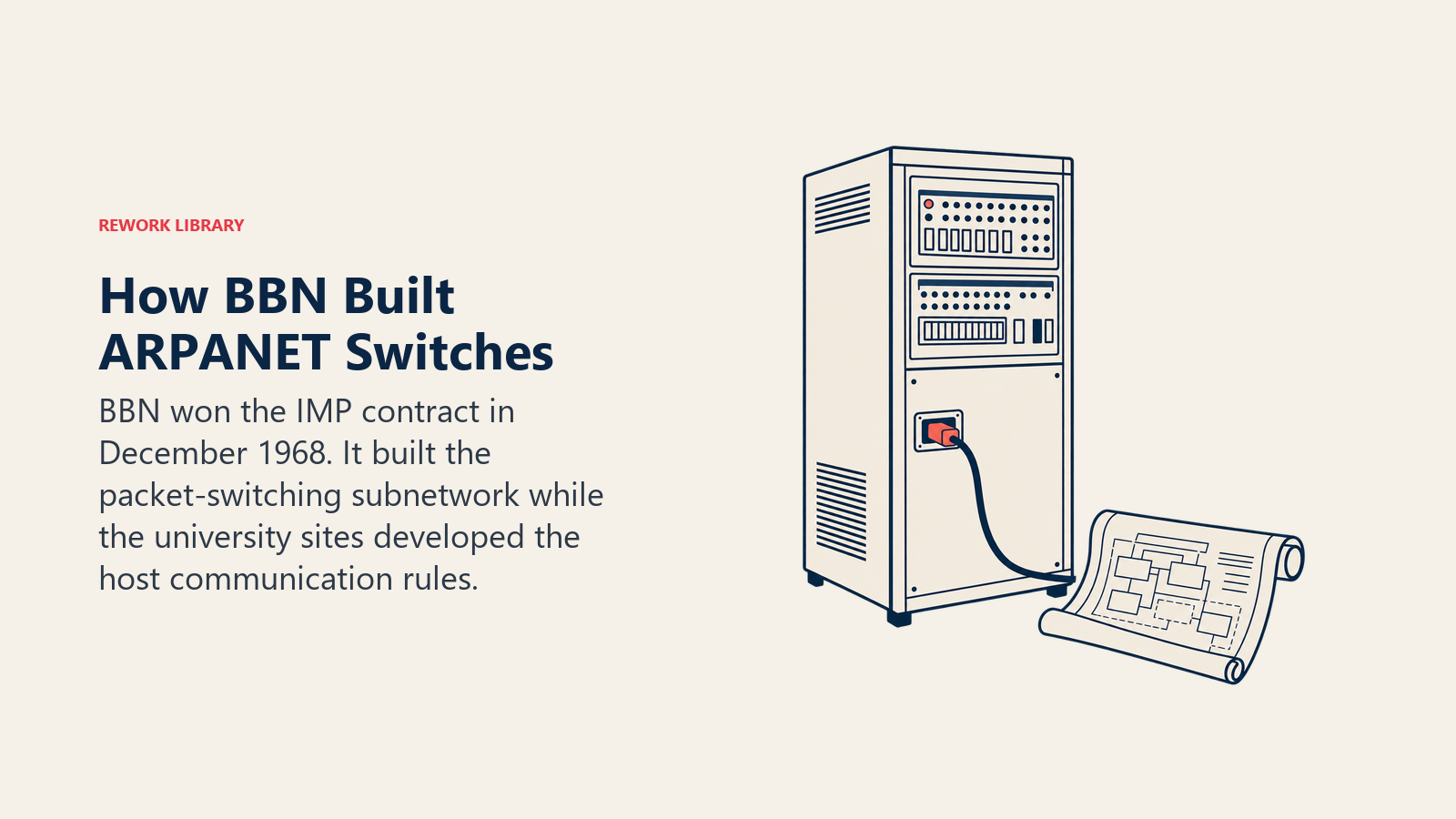
A week before Christmas 1968, Bolt, Beranek and Newman of Cambridge, Massachusetts won the contract. Frank Heart led the BBN team, and Kleinrock lists Robert Kahn, Severo Ornstein, Will Crowther, Dave Walden and others on it. BBN chose a Honeywell DDP-516 minicomputer with 12K of memory and had to deliver the first IMP to UCLA in under nine months, over 50 kb/s lines leased from AT&T. Kahn wrote the host-to-IMP specification, BBN Report 1822. The BBN history, prepared for DARPA in 1981, says the first four IMPs were developed and installed on schedule by the end of 1969.
The design split the work in two. BBN built the subnetwork of IMPs under a formal contract. The rules that host computers would use to talk to each other were left to the four sites. That informal arrangement is where the next era starts.
For teams today: ARPA bought one well-defined piece (the switches) from a contractor and left the open-ended piece (the rules) to the people who would use them. Contract what you can specify and give the rest to a working group.
The Four-Node Network (1969-1972)
Four campuses connect, then email takes over
The turning point is a Saturday in August 1969. Per Kleinrock's account, the first IMP arrived at UCLA on 30 August 1969 and was connected to UCLA's SDS Sigma-7 host on 2 September, the first node. The Internet Society lists the first IMP installation simply as September 1969. The second IMP went to the Stanford Research Institute in early October, and the first 50 kb/s link joined the two.
On the night of 29 October 1969, at 22:30, Kleinrock and his student Charley Kline tried to log in to SRI's SDS 940 computer from UCLA. Bill Duvall at SRI confirmed each letter by phone. Only the "l" and the "o" went through before the system crashed, so the first message on the network was "lo." The full login worked about an hour later. The only record, Kleinrock says, is an entry in the UCLA IMP log, and DARPA reproduces that log, dated 10/29/1969 at 22:30 Pacific Time.
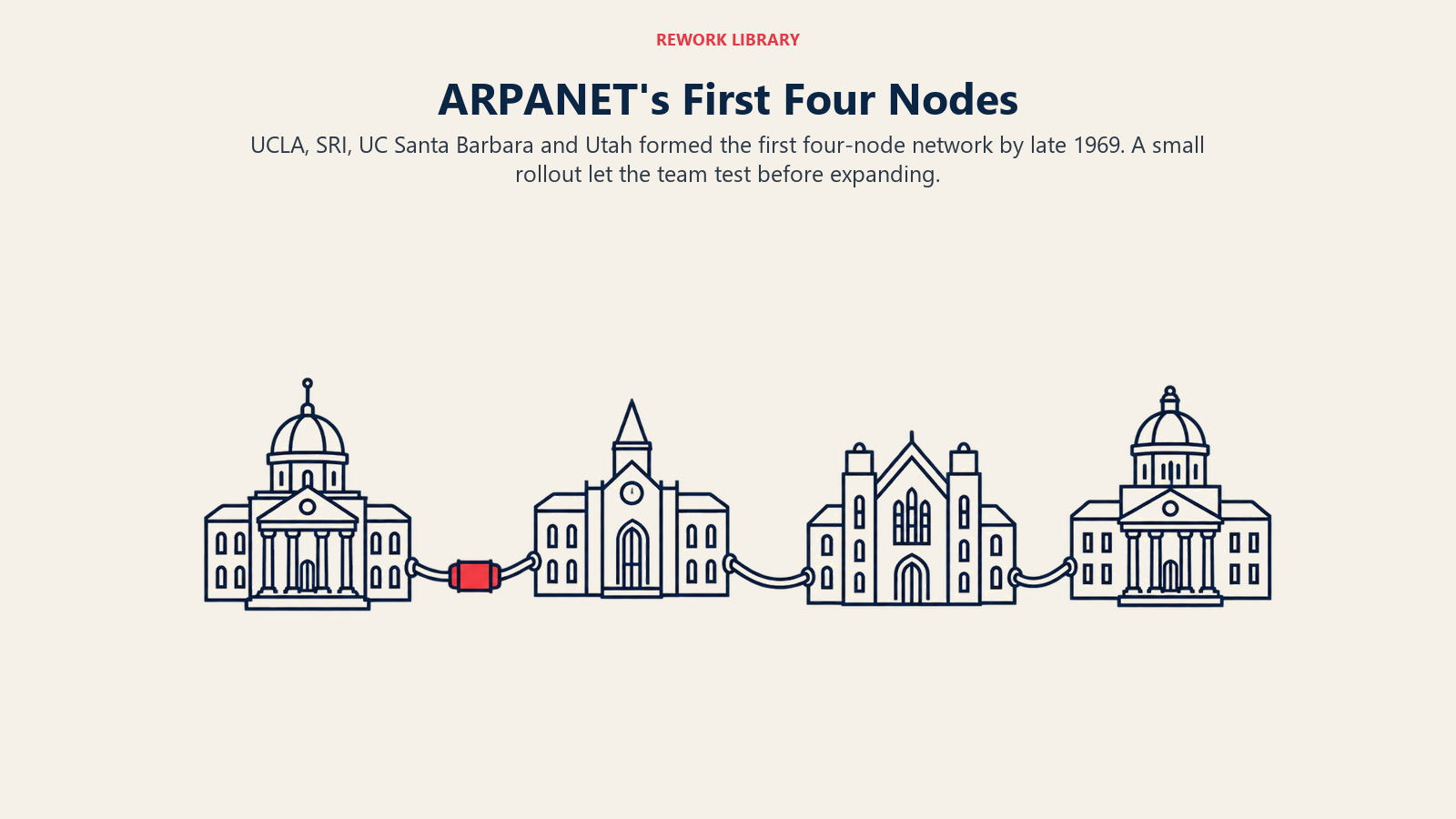
UC Santa Barbara and the University of Utah followed in November and December, completing the four-node network. The sites were chosen for what each could contribute: UCLA ran the Network Measurement Center, SRI ran Douglas Engelbart's research and the Network Information Center, UC Santa Barbara did interactive graphics and Utah did 3D graphics, according to Kleinrock.
Meanwhile the rules were being written in public. RFC 1, "Host Software," was written by Steve Crocker of UCLA and dated 7 April 1969. It records that representatives of the four initial sites had met in summer 1968 and says very little in it is firm. Crocker later called it a "modest and entirely forgettable memo" and said the group, then informal and junior, wanted notes that opened a dialog rather than asserted control. The Network Working Group finished the Network Control Protocol, NCP, in December 1970, and sites implemented it through 1971 and 1972. The group's structure later led to the IETF, Kleinrock notes.
Growth was steady, not explosive. Kleinrock counts 10 IMPs by July 1970 and 15 by March 1971, and the BBN report puts 13 IMPs installed by late 1970. In September 1971 BBN added a terminal interface processor so a terminal could connect without a host. Then came the use nobody had specified. Ray Tomlinson at BBN wrote software to pass mail between computers on the network. The Internet Society dates his send-and-read software to March 1972, while Kleinrock describes the patch in late 1971 and a general release in early 1972. By July 1972 Roberts had added a utility to list, file, forward and reply to mail, and Kleinrock says that in less than a year email carried the majority of network traffic.
In October 1972 Kahn organized the first public demonstration at the International Conference on Computer Communications in Washington. Dozens of terminals reached dozens of hosts for three days, per Kleinrock. The Computer History Museum lists a conversation between the ELIZA and PARRY programs among the demos. A related recorded session, a conversation between PARRY at Stanford and DOCTOR at BBN on 18 September 1972, was published by Vint Cerf as RFC 439. For that story see the history of chatbots.
This era proved the network worked and found its main use. It also created the next problem: NCP assumed one kind of network, and new networks of other kinds were arriving.
For teams today: ship small and measure. Four nodes were tested thoroughly before more were added. And expect the real use to differ from the plan: the network was funded for resource sharing, and people used it to write to each other.
The Open Network (1973-1982)
Radio, satellite and ARPANET learn to share one protocol
The turning point is the second network. In December 1972, according to Kleinrock, an IMP in California used a satellite channel to reach AlohaNet, a packet radio network in Hawaii, the first outside network to connect to ARPANET. ARPANET also reached Norway and then London in 1972, its first international connection. Each new network spoke its own protocol, and converting between every pair would not scale.
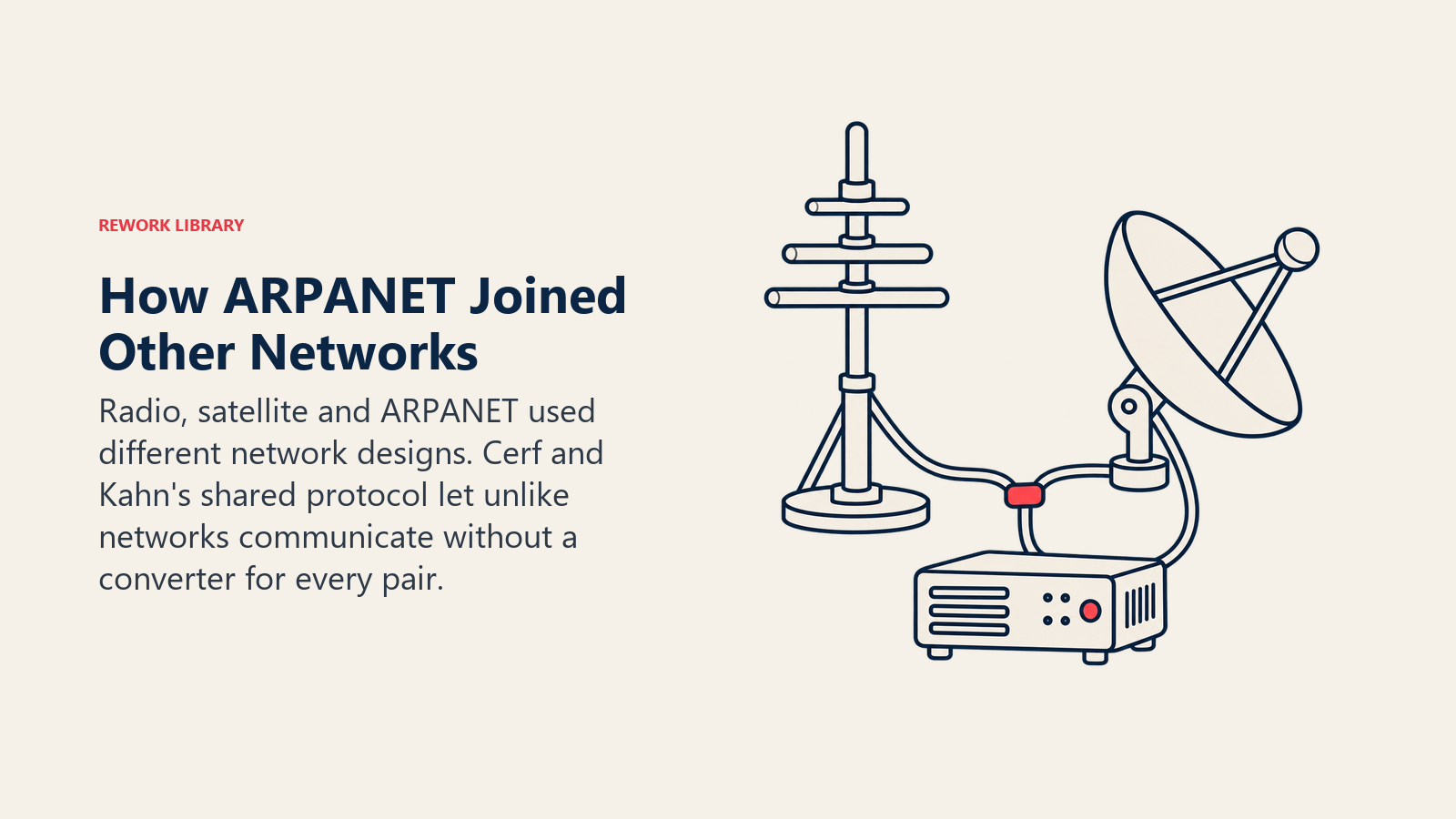
In early 1973 Robert Kahn, then a program manager at DARPA, set out to design an end-to-end protocol that dissimilar networks could share. In summer 1973 he worked out the design with Vint Cerf of Stanford, who had been part of the UCLA team on NCP. They distributed the design at a conference at Sussex University in September 1973. DARPA says Cerf recalls about six months of work on the architecture, and the Computer History Museum dates the published paper, "A Protocol for Packet Network Interconnection," to May 1974. DARPA says the first TCP/IP implementation happened at Stanford in 1975, and Kleinrock says DARPA commissioned three independent implementations in 1973 and 1974, at Stanford, BBN and University College London.
Tests followed. In August 1976 TCP connected the packet radio network and ARPANET for the first time, and on 22 November 1977 a three-network demonstration joined packet radio, the Atlantic satellite network and ARPANET, per Kleinrock. Roberts had left in October 1973 to run Telenet, the first commercial packet network carrier, and DARPA says Kahn hired Cerf as a program manager in 1976.
Switching every host from NCP to TCP/IP needed a plan. In November 1981 Jon Postel's RFC 801 set a goal of "a complete switch over from the NCP to IP/TCP by 1 January 1983." It asked every host organization to start implementing TCP/IP by 1 January 1982 and arranged relay hosts to bridge Telnet, FTP and mail between the two worlds in the meantime. How the protocol suite itself grew from the 1974 paper to IPv6 is told in the history of TCP/IP.
This era gave the network an open architecture, one that let networks of different types interconnect. Its new problem was logistics: hundreds of machines would have to change at the same time.
For teams today: when two systems cannot talk, a shared standard beats a converter for every pair. The same math applies to your integrations. See API architecture for how open interfaces work.
Flag Day and the Legacy (1983-present)
One date, a split, a shutdown, and a standard that stayed
The turning point is 1 January 1983. The Internet Society describes the move from NCP to TCP/IP on that date as a "flag-day style transition," meaning every host changed at once. DARPA says enough networks had interconnected by then that ARPANET had evolved into the internet. For a checklist built on the same principle, see data migration cutover day.
In 1983 the Defense Communications Agency divided the network into a public ARPANET and a classified MILNET, leaving 45 hosts on ARPANET, according to the Computer History Museum. In 1985 the National Science Foundation established NSFnet, which became the academic backbone. Naming changed in the same years: RFC 882 specified the Domain Name System in November 1983, replacing the single host table every ARPANET site had copied.
The end came quietly. The Internet Society says ARPANET was decommissioned in 1990. DARPA's text also says 1990, though its own timeline graphic labels the end as 1989. DARPA says the NSF shut its dedicated backbone in 1995 as commercial services grew. For that handoff and what came after, read The History of the Internet and Internet vs World Wide Web.
What remains is mostly invisible. The protocol suite that replaced NCP still carries the Internet. The habit of writing open, numbered notes that anyone could comment on began with RFC 1 in 1969, and Kleinrock says the working group behind it led to today's IETF. And the computer-utility idea Kleinrock floated in UCLA's July 1969 press release, that networks would one day serve homes and offices like electric and telephone utilities, reappears in the history of cloud computing.
For teams today: infrastructure funded for one purpose often outlives the program. Plan the handoff before the sponsor moves on.
Key People
| Name | Role | Contribution | Year |
|---|---|---|---|
| J.C.R. Licklider | First head of ARPA's computer research office | Wrote the 1963 network memo and set the vision | 1962-1964 |
| Leonard Kleinrock | UCLA professor | Packet switching theory; ran the Network Measurement Center; supervised the first message | 1961-1969 |
| Paul Baran | RAND researcher | Distributed network and message-block designs | 1962-1964 |
| Donald Davies and Roger Scantlebury | NPL, UK | Packet network work; the word "packet" | 1966-1967 |
| Robert Taylor | IPTO associate director, then director | Pushed for the network and got the initial funding | 1965-1969 |
| Lawrence Roberts | ARPA chief scientist, later IPTO director | Wrote the ARPANET design and managed procurement | 1966-1973 |
| Frank Heart | BBN team leader | Led the team that built the IMPs | 1968-1969 |
| Robert Kahn | BBN, then DARPA | IMP-host specification; organized the 1972 demo; co-designed TCP | 1968-1976 |
| Steve Crocker | UCLA graduate student | Wrote RFC 1; led the Network Working Group | 1969-1970s |
| Ray Tomlinson | BBN engineer | Network email | 1971-1972 |
| Vint Cerf | UCLA, then Stanford | NCP work; TCP design with Kahn | 1969-1976 |
Key Facts
- The first four IMPs were installed on schedule by the end of 1969, according to BBN's 1981 report to DARPA.
- The Request for Quotation went to 140 potential bidders, and 12 proposals came back; BBN won in December 1968.
- ARPANET's long-distance lines ran at 50 kb/s, leased from AT&T.
- Within a year of Roberts's mail utility, email carried the majority of network traffic, Kleinrock reports.
- After the 1983 split, 45 hosts remained on ARPANET.
The Pattern Behind the History
The same five moves run through the ARPANET story. We call the sequence the Contract and Commons Pattern. It is our synthesis of the history above, not a research finding.
- Fund the shared problem. Expensive computers sitting idle at different campuses paid for the network, not a grand design.
- Contract the hardware, open the rules. BBN built the IMPs to a spec, while a group of graduate students wrote the host protocols in open notes.
- Start with four. Four nodes were tested before the rest of the 19-node plan rolled out.
- Let the use find you. Email, a side feature, became most of the traffic.
- Cut over on a date. NCP gave way to TCP/IP on a single day announced more than a year ahead.
What It Teaches Teams Today
- Buy the part you can specify. BBN got a clear spec and a deadline. The protocol work went to people who would live with it.
- Pilot with a few sites. Four nodes gave the team time to measure before scaling.
- Publish your rules early, in draft. RFC 1 was tentative on purpose, and that made it easy to join.
- Watch what people actually do. Roberts's mail utility turned a side feature into the main traffic.
- Announce a flag day and offer a bridge. RFC 801 gave a year's notice and relay hosts for the transition.
- Know which date you mean. The first IMP arrived on 30 August, connected on 2 September, and carried its first host-to-host message on 29 October 1969.
ARPANET shows how a modest research budget, a clear shared problem and a loose group of people allowed to write the rules produced the base of today's Internet. Ask which part of your next project can be specified in a contract, and which part should be left to the people who will use it.

Co-Founder, Rework.com