Internet vs World Wide Web: Two Different Origins
Turn this article into takeaways for your work.


Each assistant summarizes the article only for you and suggests best practices for your work.
Picture two family trees. The network's ancestors are relay posts and signal towers. They were built to move messages faster than a rider could. The Web's ancestors are dreams of a desk that could follow links between documents.
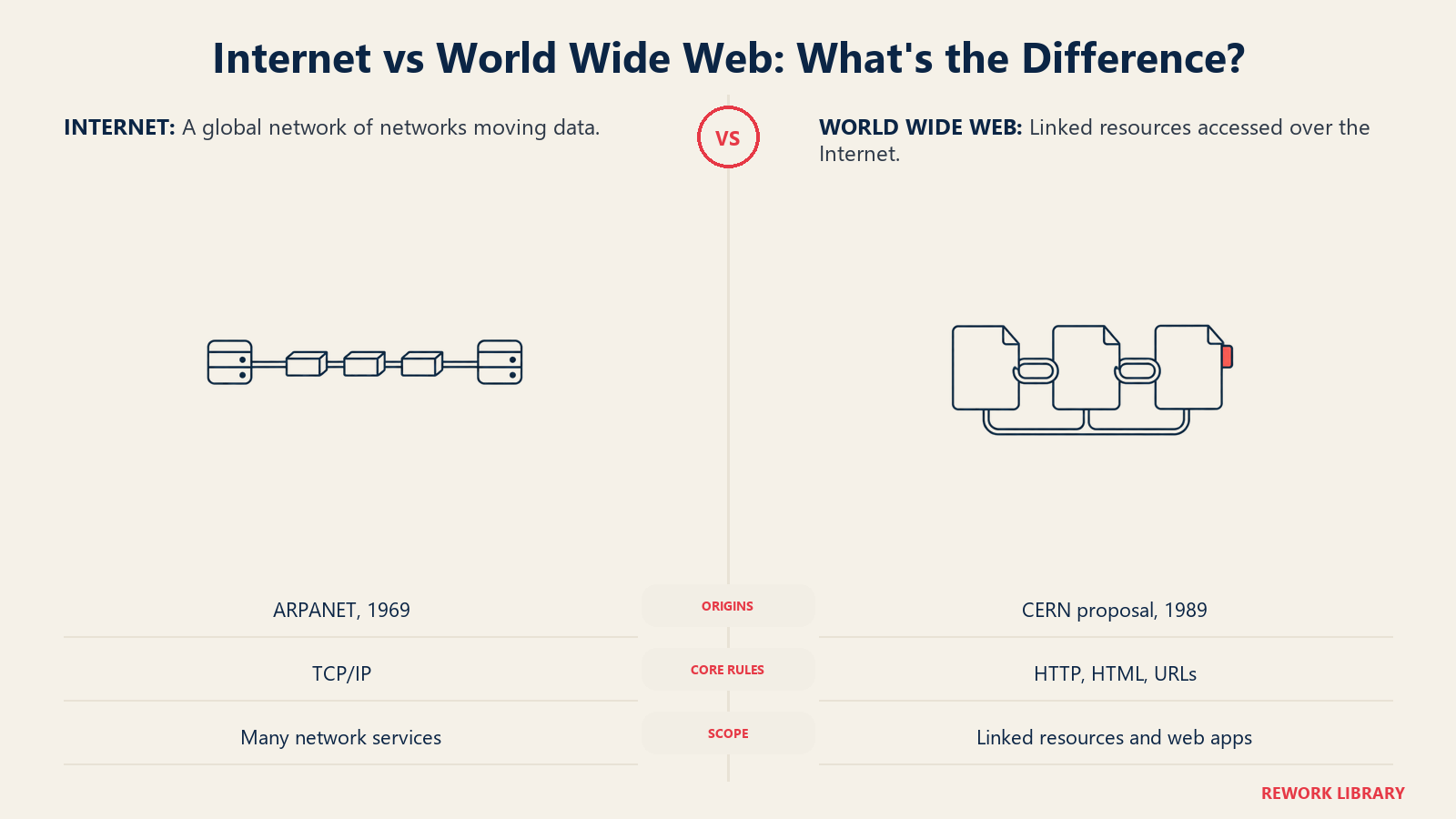
The Internet is the global network of networks: the cables, routers and shared rules (packet switching, TCP/IP) that move data between computers. It grew out of ARPANET, which connected its first four computers in 1969. The World Wide Web is a different thing. It's an information system of linked pages that runs on top of the Internet. Tim Berners-Lee proposed it at CERN in March 1989. CERN released its software to everyone on 30 April 1993. The Internet came first by two decades. Plenty of what travels on it, such as email, was never part of the Web.
The two lines ran apart for most of the twentieth century, met in the early 1990s, and have been so tangled together since that most people now use one word for both. This article tells the two stories side by side. For a year-by-year list, see the Internet timeline. For the argument over who deserves the credit, see who invented the Internet. The wider story is in the history of the Internet.
Timeline at a Glance
| Year | Milestone | Why It Mattered |
|---|---|---|
| 1794 | Claude Chappe's semaphore relay line links Paris and Lille | A chain of relay stations moves messages far faster than a courier, an early model of network thinking |
| July 1945 | Vannevar Bush publishes "As We May Think" in The Atlantic | Describes the memex, a desk for storing and linking documents |
| 1965 | Ted Nelson coins the word "hypertext" | Gives the Web's core idea a name |
| 9 December 1968 | Doug Engelbart demonstrates NLS in San Francisco | Shows hypertext browsing, the mouse and remote collaboration live |
| October 1969 | First host-to-host message on ARPANET, UCLA to SRI | The network side of the story begins to run |
| 1 January 1983 | ARPANET switches from NCP to TCP/IP | One shared protocol suite becomes the Internet's foundation |
| March 1989 | Berners-Lee proposes a linked information system for CERN | The Web lineage turns from idea to plan |
| November 1990 | First web server and first web page go live at CERN | The Web exists, on CERN's own machines |
| 30 April 1993 | CERN declares the Web technology free for anyone to use | No fees, no permission needed |
| 1 October 1994 | The World Wide Web Consortium is founded | The Web gets its own standards body |
| May 1996 | HTTP/1.0 is published as RFC 1945 | The Web's protocol is written down in the Internet's own document series |
| 2000 | Roy Fielding's dissertation describes the Web's architecture | Web-style design becomes the model for APIs |
The Two Precursors (1790s-1965)
A relay tower and a memory desk, neither with a computer
The network lineage and the Web lineage start in different places. For the network, the picture is a tower on a French hill in the 1790s. Claude Chappe's semaphore line ran from Paris to Lille as a chain of 15 stations, each with a telescope pointed both ways so the operators could read the next tower and pass the signal on, according to the Engineering and Technology History Wiki. The IEEE milestone record puts the stations about 10 to 15 km apart and says the Paris-Lille line was completed in July 1794, with its first message sent that August, and that by the middle of the next century the lines reached across Western Europe and North Africa. The wiki's Chappe biography adds that the network carried commercial messages as well as military ones. Nobody called it a network of networks, but the principle was the same: no one station knows the whole message route, and each only has to talk to its neighbour. The Internet Society's brief history says the invention of the telegraph, telephone, radio and computer "set the stage" for the Internet.
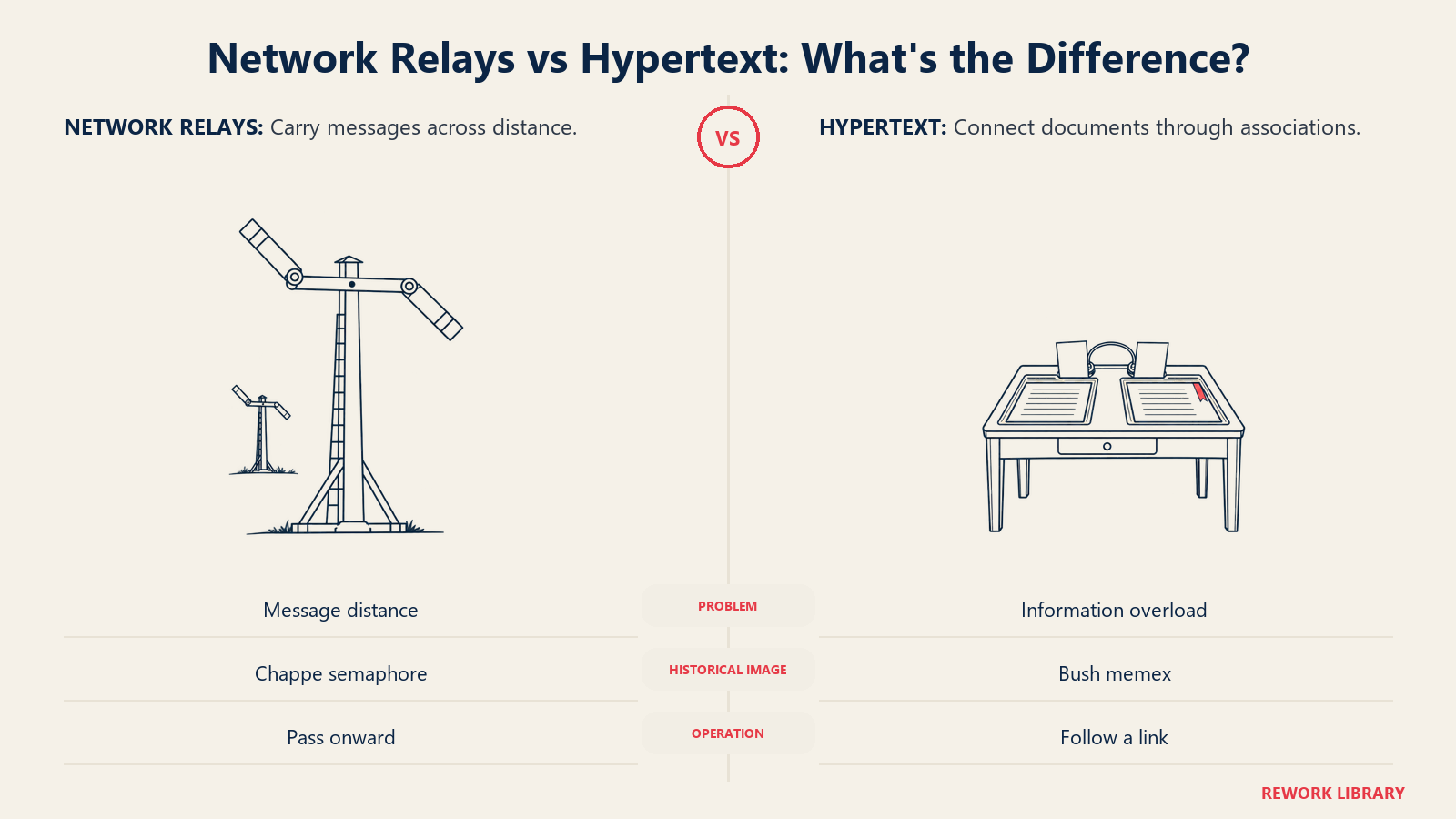
The Web's picture is a desk. In July 1945, Vannevar Bush, who ran the US wartime Office of Scientific Research and Development, published "As We May Think" in The Atlantic. He worried that scientists could not keep up with the growth of their own literature. His fix was a device he named the memex, in which a person stores all their books, records and communications, and calls them back quickly. He called it an "enlarged intimate supplement to his memory" (the Atlantic's PDF of the original). The key idea was selection by association rather than by index, the way the mind jumps from one thought to the next. The W3C's history of the Web opens its story with this article and describes the memex as a device that could make and follow links between documents on microfiche.
These were two different problems. Chappe's was distance: how to get a message across a country quickly. Bush's was overload: how to find and connect what is already written. Both ideas needed machines that did not yet exist, and the computer timeline shows how long that wait was. They also created a new problem for the next era: moving bits and linking meaning are separate jobs, and no single design would do both.
For teams today: When two tools both claim to "connect everything", ask which problem each solves. Moving data from A to B and helping a person find and relate information are not the same job, and a stack usually needs both.
The Packet and the Link (1961-1974)
ARPANET learns to send packets while hypertext learns its name
This era is where the two lineages run in parallel, each gaining its first working form. The turning point on the network side is the arrival of packet switching, and on the Web side the word hypertext.
On the network side, three groups worked on packet switching at once. According to the Internet Society, Leonard Kleinrock published the first paper on packet switching theory in July 1961. Paul Baran's RAND group wrote on packet networks for secure military voice in 1964, and Donald Davies and Roger Scantlebury at the UK's NPL proposed a packet network of their own. All three worked in parallel without knowing of each other. Larry Roberts, who was planning the ARPANET, learned of the NPL and RAND work at a 1967 conference, and the word "packet" was adopted from the NPL work. In September 1969, BBN installed the first interface message processor at UCLA. A month later the first host-to-host message went from UCLA to SRI, and by the end of 1969 four computers were connected. In March 1972 Ray Tomlinson wrote the first basic email software for the network. In 1974 Vint Cerf and Bob Kahn published their refined protocol design, the seed of TCP/IP.
On the Web side, the ideas got names and a public showing. The W3C's history records that Ted Nelson coined the word hypertext in a 1965 paper at the Association for Computing Machinery's national conference. It also notes that Andy van Dam and colleagues built the Hypertext Editing System and FRESS in 1967. On 9 December 1968, Doug Engelbart gave a session titled "A Research Center for Augmenting Human Intellect" at the Fall Joint Computer Conference in San Francisco. According to the Doug Engelbart Institute, he drove a computer about 30 miles away at SRI from a console on stage, with colleagues joining by video link. The W3C history adds that his NLS system offered hypertext browsing, editing and email, and that he invented the mouse for it.
Notice the overlap. SRI was the destination of the first ARPANET message in 1969 and the home of the NLS computer Engelbart drove in 1968, so the two lineages shared an institute before they shared a design. Still, nobody linked them. ARPANET carried messages, files and remote logins. Hypertext lived inside single machines. The new problem was that each side was incomplete: the network had no easy way to find or link what it carried, and the link systems had no worldwide network under them.
For teams today: Parallel invention is normal. Three groups reached packet switching independently, so do not assume the idea you have found has no rivals, and do not read agreement from far away as copying.
The Flag-Day Network (1974-1989)
One protocol suite, one cutover date, and a Web proposal waiting
The turning point for the network is a single day. On 1 January 1983, ARPANET switched from its old protocol to TCP/IP in a "flag-day" cutover, where all hosts had to convert at once, according to the Internet Society. TCP/IP had been adopted as a defense standard in 1980. Many separate networks could now join under common rules, which is what makes it the Internet rather than just ARPANET. Email also gained a written standard, when Jonathan Postel published the Simple Mail Transfer Protocol in RFC 821 in August 1982. The Domain Name System followed in November 1987, described in RFC 1034 by Paul Mockapetris.
Funding broadened too. The same Internet Society history reports that the National Science Foundation's NSFNET program announced in 1985 that it would serve the whole higher education community, and made TCP/IP mandatory. NSF put about $200 million into it between 1986 and 1995. Still, using the network meant command lines, and only specialists did.
Meanwhile, the Web's lineage moved from vision to a person. Between June and December 1980, while consulting at CERN, Tim Berners-Lee wrote a notebook program called ENQUIRE that linked arbitrary nodes together, as the W3C history records. In March 1989 he wrote "Information Management: A Proposal" and circulated it at CERN. The proposal itself argues that CERN needed a linked information system to keep track of people, projects, documents and hardware as the organisation changed, and it describes a "universal linked information system" built from nodes and links. It cites Ted Nelson's coinage of the term hypertext. Because the proposal solved a CERN problem, not a global one, it was written for a single lab.
The new problem was that both parts were in place but apart. The network had users but no friendly interface. The linked-document idea had a proposal but no network large enough to matter.
For teams today: A shared protocol beats a shared product. TCP/IP won because many parties could implement it independently. When you pick tooling, API architecture and open interfaces are the modern version of that choice.
The CERN Proposal (1989-1993)
A lab memo becomes a public tool
The turning point is Mike Sendall, Berners-Lee's boss, approving the purchase of a NeXT computer in September 1990. According to the W3C history, Berners-Lee then began a browser and editor, made up the name "WorldWideWeb" in October 1990, and chose "World Wide Web" for the project over alternatives such as Information Mesh and Mine of Information. Robert Cailliau co-authored a revised proposal. In November 1990 the first web server, nxoc01.cern.ch, later called info.cern.ch, went live with the first web page. The first website is still browsable, and its home page describes the project as a wide-area hypermedia information retrieval initiative.
A line-mode browser followed in March 1991, built with student Nicola Pellow. General release on CERN's central machines came in May 1991. In August 1991 the files were posted to Internet newsgroups, and in December 1991 Paul Kunz installed the first Web server outside Europe, at SLAC. Notice what is happening here. The Web is being delivered over the Internet: the software was posted for download by FTP and announced on Internet newsgroups such as alt.hypertext, both existing Internet services.
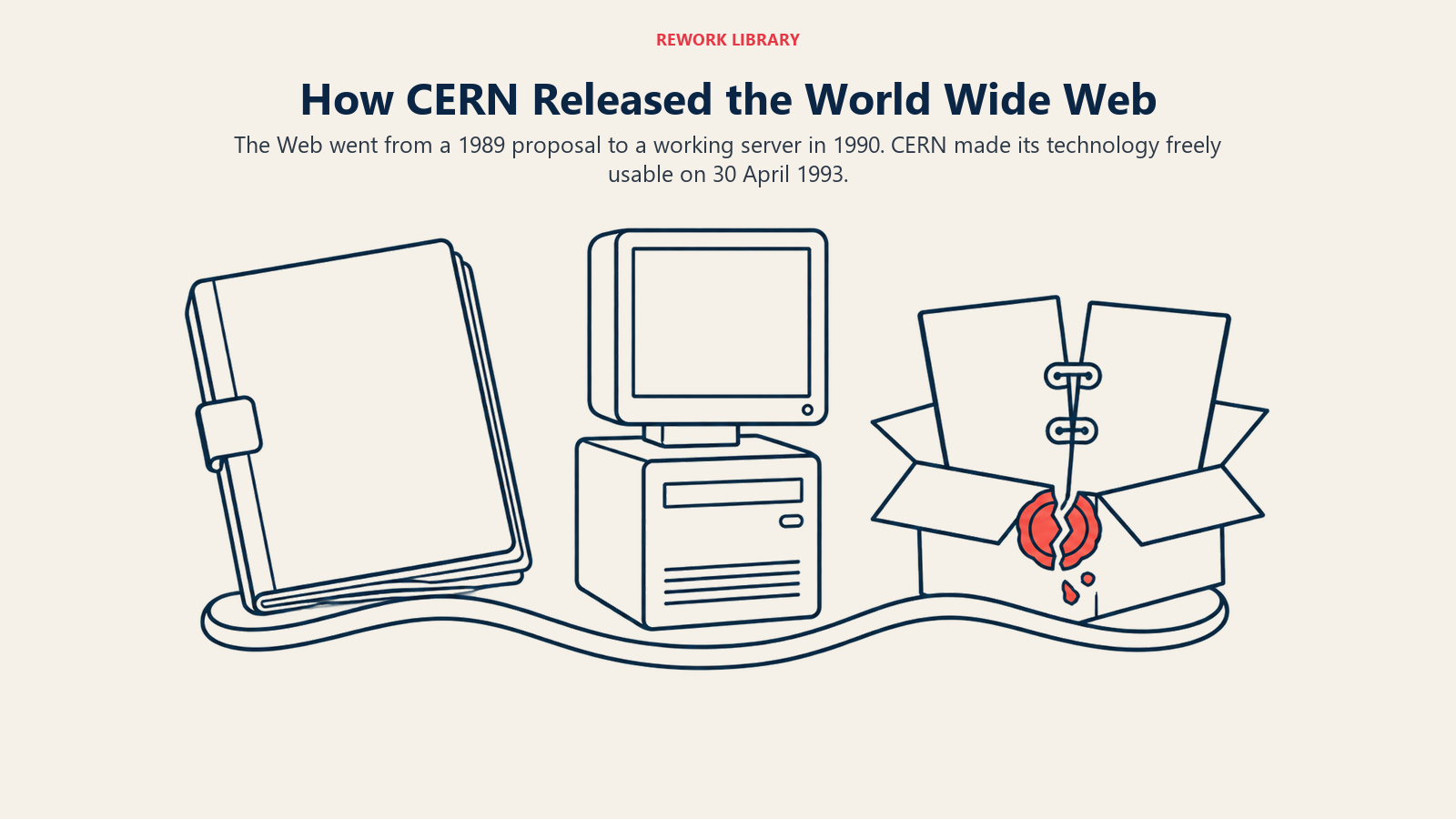
Then came the decision that made it a public good. On 30 April 1993, CERN's Director of Research Walter Hoogland and Director of Administration Helmut Weber signed a document, and CERN's account says it stated that CERN "relinquishes all intellectual property rights to this code". The W3C's history calls it the date of the declaration that Web technology would be freely usable by anyone, with no fees payable to CERN. A release of the code in 1994 moved to an open source licence, which let CERN keep the copyright while anyone could use and modify the software.
The dates have variants. The proposal is March 1989. The first server and page are November 1990. The first release on CERN's machines is May 1991. The release to the world, with rights waived, is 30 April 1993. Which date counts as the "birth" of the Web depends on whether you mean the idea, the software or the public release.
The new problem was reach. Only a few dozen servers existed, and the Web needed a browser people could actually install.
For teams today: Giving away the standard can be a growth strategy. CERN gave up the right to charge, and the Web spread faster than any product with a licence fee would have. See how the same logic shows up in SaaS tech stack choices that favour open integrations.
The Mosaic Years (1993-2000)
The Web rides the Internet into every office
This is the meeting point. Several things happened inside 1993. In February, NCSA released the first alpha of Marc Andreessen's Mosaic for X, per the W3C history. The University of Minnesota announced fees for Gopher, a rival information system, which pushed many volunteers towards the Web. In March, the Internet's Acceptable Use Policy was reinterpreted so commercial use became allowed, and Web traffic on the port-80 measure was 0.1% of NSF backbone traffic. By September, NCSA released working Mosaic versions for X, Windows and Macintosh, and Web traffic reached 1% of the NSF backbone. By October 1993 there were over 200 known web servers. By June 1994 there were over 1,500 registered servers, and the first web server's load was 1,000 times what it had been three years earlier.
Governance followed. The W3C history says the World Wide Web Consortium was founded on 1 October 1994, and W3C's own about page says Berners-Lee founded it that year to ensure the long-term growth of the Web. In April 1995, NSF stopped funding the NSFNET backbone, per the Internet Society, handing national connectivity to commercial providers. The Web's protocol was written down at the IETF: RFC 1945, by Berners-Lee, Roy Fielding and Henrik Frystyk in May 1996, describes HTTP/1.0. It is an Informational RFC, and its IESG note says the IESG expected a standards-track document to replace it.
That detail shows the line between the two. The Internet's bodies (the IETF and its RFC series) describe how packets and hosts behave. The Web's body (W3C) governs formats like HTML. HTTP sits across the boundary, written by Web people and published in the Internet's series. The two stories are now one product to most users: the Web is how most people experience the Internet. For a business, being findable on the Web became a core job, as covered in ecommerce SEO strategy.
The new problem was that the Web was now the default. People assumed the Internet was the Web, and engineers started building everything on it.
For teams today: When a vendor says "web-based", ask what it actually needs: a browser, an Internet connection, or specific web standards. Those are three different dependencies, and each fails differently.
The API and Cloud Age (2000-present)
Software starts talking to software over web rules
The turning point is a design document. In 2000, Roy Fielding finished a doctoral dissertation at the University of California, Irvine that explains the Web's success as the result of an architecture designed for an Internet-scale distributed hypermedia system. The dissertation also defines REST, an architectural style derived from that design.
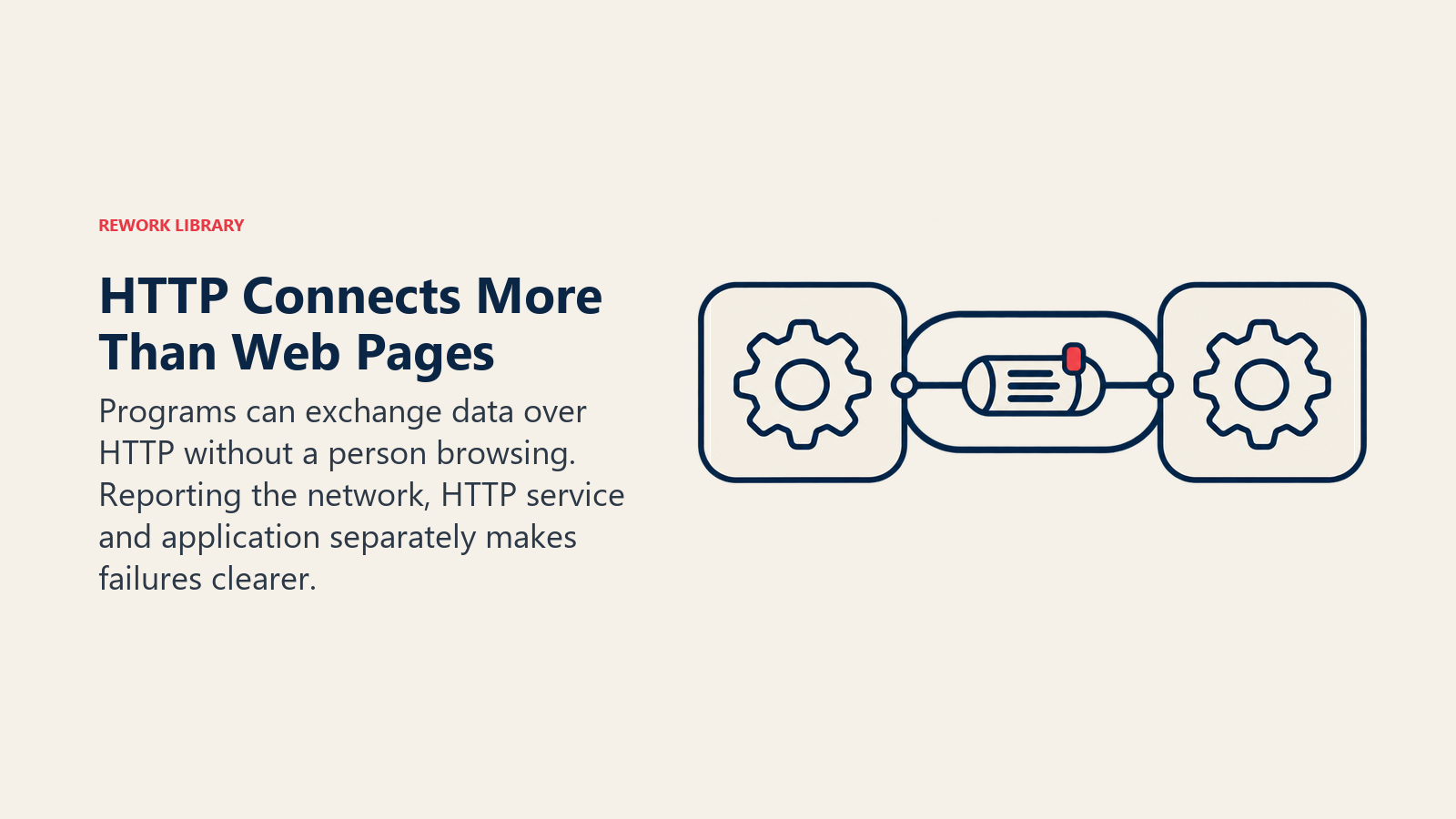
So what happened next was a split in how people use the pair. A browser still loads a page. But a phone app, a payment service or a CRM sync talks to another program over the same Internet with no page at all. Often those calls use HTTP, the Web's protocol, which the HTTP/1.0 specification says can serve tasks such as name servers and distributed object management. Nobody is browsing documents, so it is a blurry case. Other traffic, such as email, never touched HTTP. On scale, CERN reported in 2023, citing the ITU, that more than 5 billion people, two thirds of the world, rely on the Internet regularly.
The AI era repeats the pattern. Agents act through tools and interfaces, not through pages, so they lean on APIs even more than people do; the longer arc is in the history of AI. Organizations modernising their systems face the same question of what is network, what is web and what is application, as covered in digital transformation strategy.
The new problem is that the two words blur. Planning gets harder when a team says "the Internet is down" and means "the web app is slow".
For teams today: Name the layer when you report a problem: network, DNS, HTTP service, or the app itself. It gets the right person looking at the right thing faster.
Internet vs Web: The Comparison
| The Internet | The World Wide Web | |
|---|---|---|
| What it is | A global network of networks, with shared protocols for moving data | An information system of linked documents and resources, reached through addresses |
| Roughly when | First four ARPANET hosts connected in 1969; TCP/IP cutover on 1 January 1983 | Proposal in March 1989; first server and page in November 1990; public release 30 April 1993 |
| Where | US defense-funded and academic research, then NSFNET | CERN, the European particle physics laboratory near Geneva |
| Who | Kleinrock, Baran, Davies, Roberts, Kahn, Cerf, Postel, Mockapetris | Berners-Lee, Cailliau, Pellow, with Nelson, Bush and Engelbart as precursors |
| Key standards | TCP/IP, DNS, SMTP | HTTP, HTML, URLs |
| Standards bodies | IETF, whose stated goal is to make the Internet work better | W3C (founded 1994), with HTTP itself published as IETF RFCs |
| What runs on it | Email, file transfer, name lookup, remote login, and the Web | Pages, browsers, search, web apps |
Things That Use the Internet but Not the Web
| Service | Origin | Why it is not the Web |
|---|---|---|
| Basic software written by Ray Tomlinson in March 1972 (Internet Society); SMTP written down in August 1982 | Uses its own protocol and predates the Web by about 17 years | |
| File transfer | A file transfer protocol proposed in RFC 114 on 16 April 1971 | Moves files between hosts with its own commands, no pages or links |
| Domain name lookup | DNS described in RFC 1034, November 1987 | Translates names to addresses for every Internet service, including the Web |
| Software-to-software calls | Architecture style described in Fielding's dissertation, 2000 | Often rides on HTTP, but carries data between programs, not documents for a browser |
Key People
| Name | Role | Contribution | Year |
|---|---|---|---|
| Claude Chappe | French engineer | Built the semaphore relay line between Paris and Lille | 1794 |
| Vannevar Bush | Director, US Office of Scientific Research and Development | Described the memex in "As We May Think" | 1945 |
| Ted Nelson | Computer scientist | Coined the word "hypertext" | 1965 |
| Doug Engelbart | SRI researcher | Demonstrated NLS with hypertext browsing and the mouse | 1968 |
| Leonard Kleinrock | MIT researcher | Published the first paper on packet switching theory | 1961 |
| Paul Baran, Donald Davies | RAND and NPL researchers | Independent packet network proposals | 1964-1967 |
| Larry Roberts | ARPA network planner | Planned the ARPANET | 1967 |
| Vint Cerf, Bob Kahn | Protocol designers | Designed the TCP/IP approach | 1973-1974 |
| Tim Berners-Lee | CERN computer scientist | Proposed and built the Web | 1989-1990 |
| Robert Cailliau | CERN engineer | Co-authored the revised proposal | 1990 |
Key Facts
- ARPANET switched to TCP/IP on 1 January 1983, a flag-day cutover where all hosts converted at once, per the Internet Society.
- Berners-Lee wrote "Information Management: A Proposal" in March 1989, in the W3C's archive of the original.
- On 30 April 1993, CERN released the Web software to the public, as CERN reports.
- In September 1993, Web traffic reached 1% of NSF backbone traffic, per the W3C's history.
- The first email software dates to March 1972, 17 years before the Web proposal, per the Internet Society.
- The World Wide Web Consortium was founded on 1 October 1994, per the W3C history.
The Pattern Behind the History
Across both lineages, we see the same four steps. This is our own synthesis of the history above, not a published study.
- Idea before machine. Relay towers and the memex both came before a computer could carry them.
- Parallel invention. Three groups found packet switching; several found hypertext.
- Separate formation. The network was built by government and university research, the Web by one lab's information problem.
- Meeting through openness. They joined when shared protocols and a free release removed the permission barrier.
What It Teaches Teams Today
Name the layer you are talking about. When something breaks or something is bought, "the Internet", "the web" and "the app" are three different dependencies with different owners and different failure modes. Treat standards bodies as signals: the IETF writes down how networks behave, W3C how the Web looks and works, and a product that follows both is easier to integrate and replace. And when you give something away, as CERN did in 1993, plan for it to be built on by people you will never meet.

Co-Founder, Rework.com
On this page
- Timeline at a Glance
- The Two Precursors (1790s-1965)
- The Packet and the Link (1961-1974)
- The Flag-Day Network (1974-1989)
- The CERN Proposal (1989-1993)
- The Mosaic Years (1993-2000)
- The API and Cloud Age (2000-present)
- Internet vs Web: The Comparison
- Things That Use the Internet but Not the Web
- Key People
- Key Facts
- The Pattern Behind the History
- What It Teaches Teams Today