The History of Email
Turn this article into takeaways for your work.


Each assistant summarizes the article only for you and suggests best practices for your work.
A shared computer had many users. They needed to tell each other things. Your file is ready. Your job failed. Please call. The problem was almost modest.
Electronic mail started in August 1965, when two programmers at the Massachusetts Institute of Technology added a MAIL command to a shared time-sharing computer. It reached other computers in late 1971 or early 1972. Then Ray Tomlinson at BBN made messages travel across ARPANET with an "@" in the address. The throughline: email began as a way to leave a note for someone using the same machine. It grew into the first thing people really used a network for. Ever since, it has fought to prove that a message is who it says it is.
For the wider network story, see The History of the Internet, the Internet timeline and who invented the Internet.
A few terms first. A "mailbox" is a place where messages wait for their reader. A "protocol" is an agreed set of rules two computers follow to exchange data. "SMTP" is the protocol that moves mail between servers, and "POP" and "IMAP" are the protocols a mail program uses to read it.
Timeline at a Glance
| Year | Milestone | Why It Mattered |
|---|---|---|
| About 5th century BCE | Herodotus describes the Persian relay riders called the angareion | An early documented system for carrying written orders by relay. |
| 24 May 1844 | Morse's telegraph sends a message from the Capitol to Baltimore | Messages stopped traveling at the speed of a horse. |
| August 1965 | MIT's CTSS gets a MAIL command | The first documented computer mail. |
| 1971 | PLATO Notes email features take off | Mail and discussion boards spread on a teaching network. |
| Late 1971 to 1972 | Tomlinson modifies SNDMSG to send mail across ARPANET, chooses "@" | Mail between computers, not just between users of one. |
| September 1973 | RFC 561 standardizes network mail headers | From, Date and Subject become a shared convention. |
| 1973 | Email is well over half of ARPANET traffic | The first "killer app" of the network. |
| 3 May 1978 | A DEC marketer sends the first widely cited spam | Unwanted bulk mail arrives within ARPANET's first decade of email. |
| August 1982 | SMTP (RFC 821) and the message format (RFC 822) are published | Two documents that still shape every message. |
| 1996 | POP3 (May) and MIME (November) | Home mail clients and attachments. |
| 31 December 1997 | Microsoft announces it is acquiring Hotmail | Free webmail reaches millions of members. |
| 1 April 2004 | Gmail is announced with 1GB of storage | Storage stops being the limit. |
| 2008 | RFC 5321 becomes the current SMTP specification | SMTP is updated, not replaced. |
| 2014-2015 | SPF (April 2014) and DMARC (March 2015) are published | Domains can state who may send for them. |
| February 2024 | Gmail's bulk sender rules take effect | Authentication becomes a requirement for large senders. |
The Courier Age (about 480 BCE-1960s)
Written messages move only as fast as horses and wires
This era is the precursor, not email itself. Nobody in it could send an electronic message. But the problem email answers is old: getting a written instruction from one person to another far away, reliably.
Herodotus, writing in the fifth century BCE, describes the Persian version. In book 8 of his Histories, riders and horses were stationed a day's journey apart along the whole route, and each rider handed the message to the next. The Persians called the arrangement the angareion. He says the riders were not stopped by weather or darkness, and he rates nothing mortal faster. The key idea is the relay: no one rider covers the distance, and the system works because every handoff is standing by.
Rome built a larger version. Britannica calls the cursus publicus the "most highly developed postal system of the ancient world," with relay stations set at intervals along the empire's great roads and tied to its military and administrative system. Both systems were run for the state, and both carried official business first. That shaped the idea of a post for centuries: a private letter was an afterthought.
The telegraph removed the horse. On 24 May 1844, Samuel Morse sent "What hath God wrought" from a room in the Senate wing of the Capitol to Alfred Vail at the railroad depot in Baltimore, over a wire about 38 miles long. The phrase was chosen by Annie Ellsworth, the patent commissioner's daughter. Vail sent the same words back. Messages could now cross a distance in moments, but only through a trained operator at each end.
The new problem was access. Fast written messages existed, but sending one still meant going through someone else's office. Email's first step was to put the mailbox on the same machine where people already worked.
For teams today: every messaging system answers the same two questions, how a message gets there and who has to touch it on the way. Fewer handoffs is almost always the improvement.
The Mainframe Mailbox (1965-1971)
A shared computer learns to leave notes
The turning point is a new command at MIT. The Compatible Time-Sharing System, CTSS, let many people share one computer, as the history of operating systems explains. Tom Van Vleck, who helped write it, says in his history of electronic mail that he and Noel Morris wrote the MAIL command in summer 1965. It was added in August and announced in a CTSS bulletin. A 1964-65 proposal by Crisman, Schroeder and Pouzin had suggested the idea, but no one had time to write it.
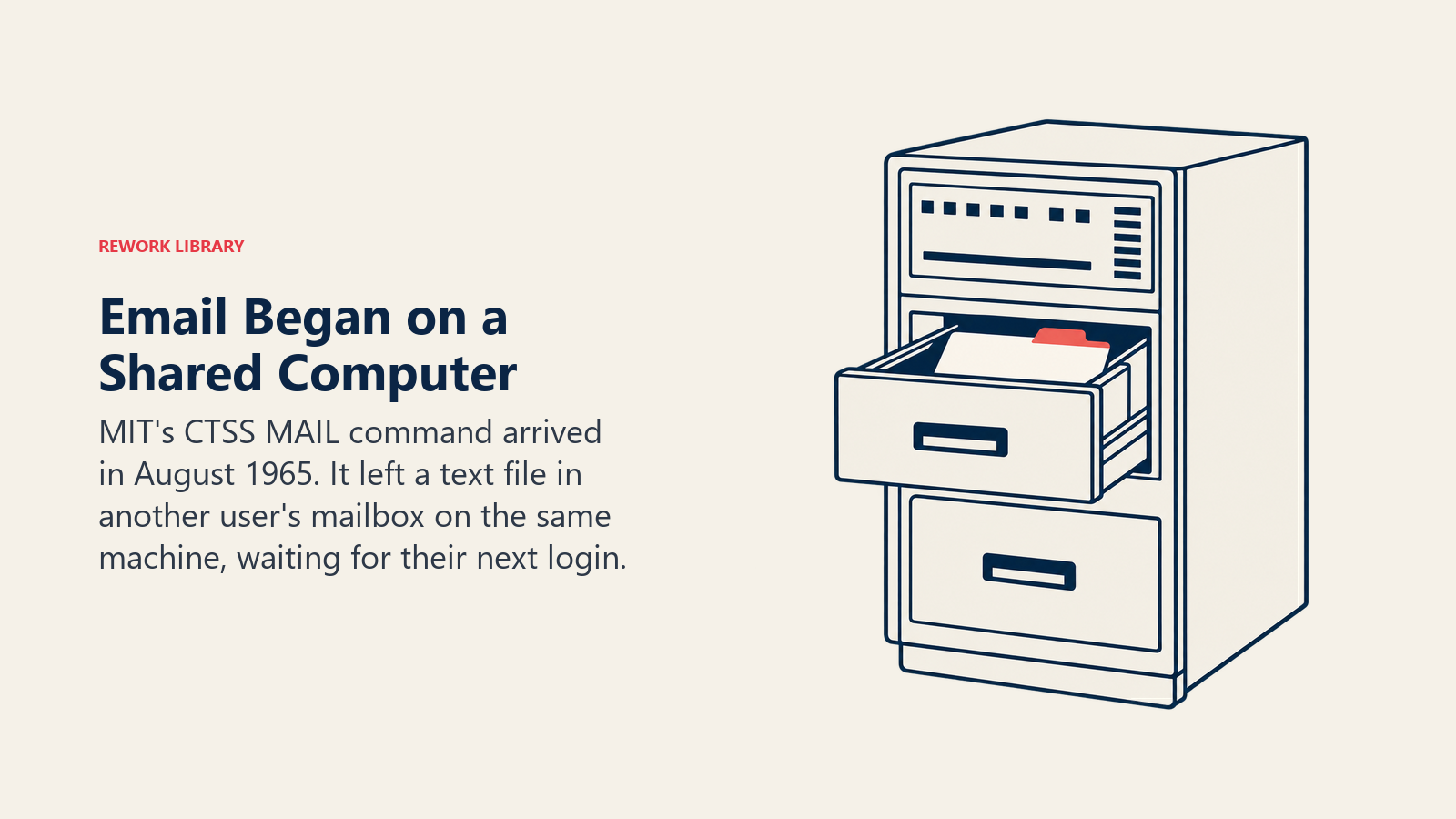
The picture is concrete. A user typed the command with the recipient's number and a file of text. The message went into a MAIL BOX file in the recipient's directory, and the next time that person logged in, the system reported that there was mail waiting. Messages were capped at one disk record, 2,592 characters. Only the system could write them, so the sender named in the header could be trusted. There was no subject line. Van Vleck says the facility was partly meant to notify users when operators had finished retrieving their files from tape.
Others did the same thing in parallel. Van Vleck says IBM's CP/CMS had mail as early as 1966, and he notes that the first Unix mail manual describes a mechanism much like CTSS mail. Around 1971 someone used CTSS MAIL to send a long anti-war message to every CTSS user, which Van Vleck calls an earlier mass electronic mail, years before the better-known case in 1978.
The limit was reach. Mail on these systems stopped at the edge of one computer. The next step was to cross that edge.
For teams today: the first version of a lasting tool solves a small internal annoyance. Notice what people use informally; it may be your next product.
The ARPANET Years (1971-1981)
Tomlinson's @ turns a feature into the network's main use
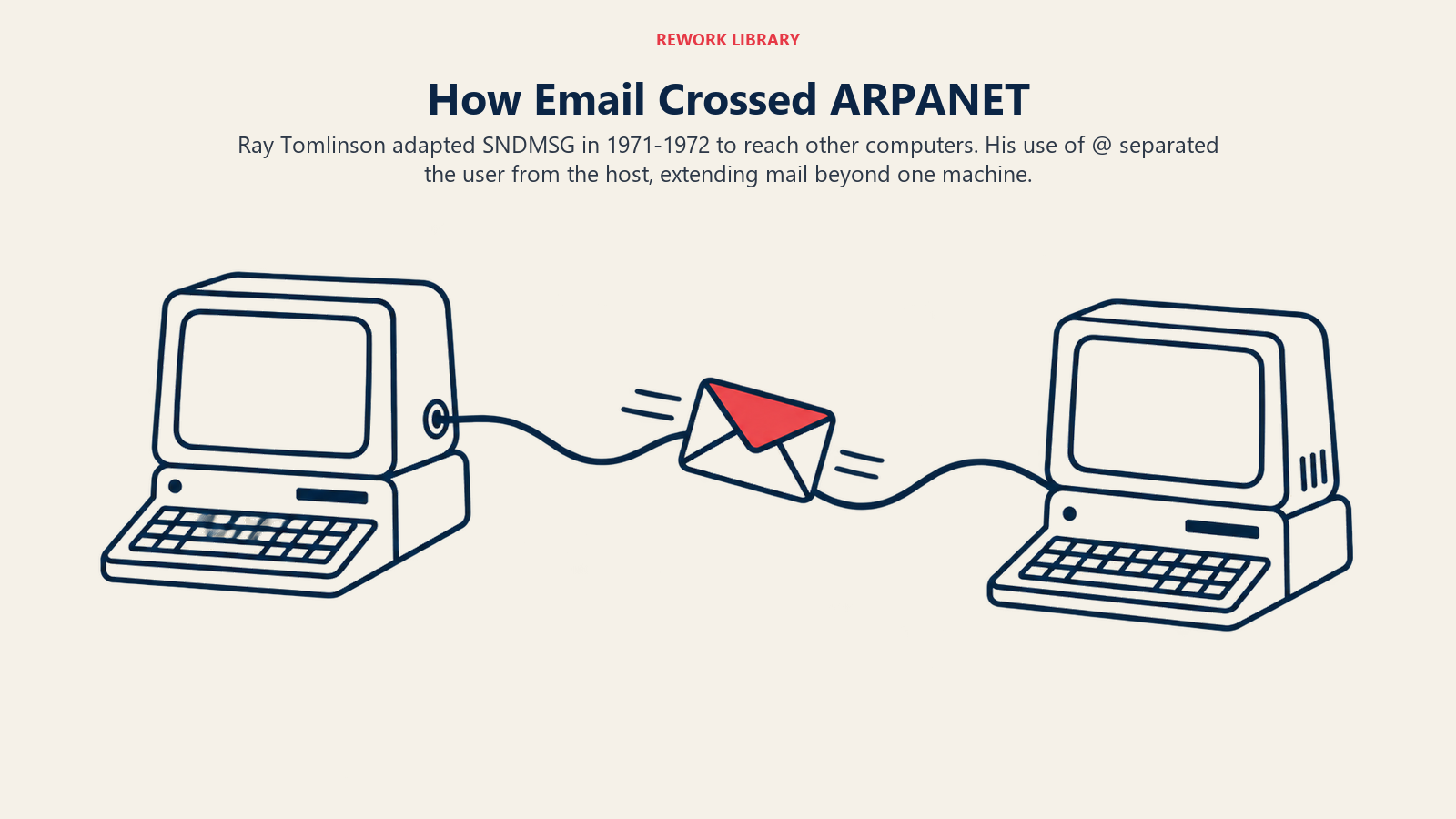
The turning point is a networked mail command. Van Vleck's history says that in late 1971 Ray Tomlinson of BBN modified SNDMSG, the mail program of the TENEX system, so it could send messages over ARPANET to users on other TENEX computers. It shipped in a TENEX release in early 1972, and Tomlinson chose the "@" sign to separate the user name from the host name. The Computer History Museum dates his choice of "@" to 1971, while the Internet Society dates his basic send-and-read software to March 1972. These are the same project described at two points in it, the first network test and the released software. The Internet Society adds that Roberts wrote the first email utility program in July 1972, and that email then "took off as the largest network application for over a decade."
The numbers back that up. The Computer History Museum says that by 1973 email made up well over half of ARPANET traffic. The same timeline records that on the PLATO teaching system in 1971, the email features of PLATO Notes were a runaway success, and that on 26 March 1976 Queen Elizabeth II sent an email from the Royal Signals and Radar Establishment in Malvern.
Standards followed practice. In September 1973, RFC 561, written by Bhushan, Pogran, Tomlinson and White, proposed an interim syntax so a message could state its author, date and subject, which the file-transfer mail commands did not carry. Then in November 1977, RFC 733, by Crocker, Vittal, Pogran and Henderson, set a standard format for ARPANET text messages, and it replaced RFC 561. Its preface says ARPA's Committee on Computer-Aided Human Communication wanted the standard. If you have ever used "From:", "Date:" and "Subject:", you are using a convention this era wrote down.
Then came the first complaint about volume. On 3 May 1978, the Computer History Museum says, Gary Thuerk of Digital Equipment Corporation composed a message promoting the DECSYSTEM-20 computer. The reaction, it says, was "swift and highly negative." Whether it is the first spam depends on how you count, given Van Vleck's earlier CTSS message. But it is the first well-documented case of commercial mail sent to a network list.
Who invented email? The honest answer depends on what you mean. If you mean computer mail between users of one machine, the documented answer is CTSS MAIL in 1965. If you mean mail between computers over a network, it is Tomlinson's work in 1971-1972. A different claim comes from V.A. Shiva Ayyadurai, who worked on an "electronic mail program" at the College of Medicine and Dentistry of New Jersey, with his papers starting in 1978. The Smithsonian's catalog record for his donated papers covers 1978 to 2007 and includes copyright papers. A catalog record describes what a donor gave, though. It does not date the concept, and the dated documents above (the 1965 command, the 1973 RFC) are earlier.
The new problem was that every network and every vendor had its own mail habits. Mail needed one agreed transport before it could scale.
For teams today: "who invented it" usually has several honest answers. Define the thing before you credit anyone, and look for the dated document.
The Standards Years (1982-1996)
Two RFCs and a handful of protocols make mail portable
The turning point is August 1982, when two documents appeared in the same month. RFC 821, by Jonathan Postel at the University of Southern California's Information Sciences Institute, defined the Simple Mail Transfer Protocol, whose aim, it says, is "to transfer mail reliably and efficiently." And RFC 822, by David Crocker, dated 13 August 1982, revised RFC 733 for the larger ARPA Internet. It dropped features that had gained little acceptance and added a new addressing scheme for inter-network mail. One RFC describes how servers hand a message to each other, the other describes what the message looks like. That split survives.
The wider network changed at the same time. ARPANET switched to TCP/IP on 1 January 1983, as the Internet timeline explains, and email moved with it. Addresses changed shape too: RFC 819 showed Fred@ISIF becoming Fred@F.ISI.ARPA, the hierarchical naming that the Domain Name System put into practice.
The next gaps closed in 1996. RFC 1939, by J. Myers and M. Rose, published POP3 in May 1996. It let a workstation fetch mail held for it on a server, which suited people with a personal computer and a dial-up connection. In November, RFC 2045, by N. Freed and N. Borenstein, defined MIME. RFC 822 had treated the body of a message as plain US-ASCII text, and MIME extended it to other character sets, non-text content and multi-part messages. That is why you can attach a photo or write in Vietnamese.
The era ended with a mail system that worked across vendors and networks. Its leftover problem was trust. SMTP as written does not check the sender, which later years would exploit. Email also stayed separate from the web, a distinction the Internet versus World Wide Web article covers.
For teams today: a boring written standard is a lasting asset. Two short documents from 1982 still decide how your messages cross the Internet.
The Webmail Boom (1996-2007)
Mail moves from a program on your desk to a page in your browser
The turning point is that mail left the desktop program. On 31 December 1997, Microsoft announced it was acquiring Hotmail, which it described as free, advertising-supported Web-based email with more than 9 million members, reachable from any provider or workplace. Microsoft's Laura Jennings called it "a Web-mail pioneer." For the first time, an address belonged to you rather than to your school or employer.
Storage was the next barrier. On 1 April 2004, Google announced Gmail, which the Computing History Museum says offered 1GB of free storage, a huge amount at the time. The date and the size led many to think it was an April Fools' joke. IMAP, the protocol for keeping mail on a server and reading it from several devices, was specified as IMAP4rev1 in RFC 3501 in March 2003, written by M. Crispin. That version served for almost two decades until RFC 9051 defined IMAP4rev2 in 2021.
Meanwhile, spam grew from a curiosity into a cost. The Computer History Museum says spam accounts for up to 90% of all email messages. Governments tried legislation, and in the United States the CAN-SPAM Act of 2003 set rules for commercial email. The FTC's guide says messages must carry accurate headers and a working opt-out, opt-outs must be honored within 10 business days, and each violating email can draw a penalty of up to $53,088 (the figure was updated for inflation in January 2024). The same period saw software move into the browser more generally, a story told in the history of cloud computing.
The era's lesson was that free and open invites abuse. The next problem was knowing whether a message was real.
For teams today: when a tool becomes free and universal, plan for the abuse that comes with it. Your inbox, and your customers', are shaped by what the worst senders did.
The Trust Years (2008-present)
Domains learn to prove who sent a message
The turning point is a rewrite of the transport. In April 2001, J. Klensin's RFC 2821 replaced the 1982 SMTP specification (along with RFC 974 and RFC 1869), and in October 2008 his RFC 5321 replaced RFC 2821 in turn. It keeps the old objective, and the transport remained recognizably the same.
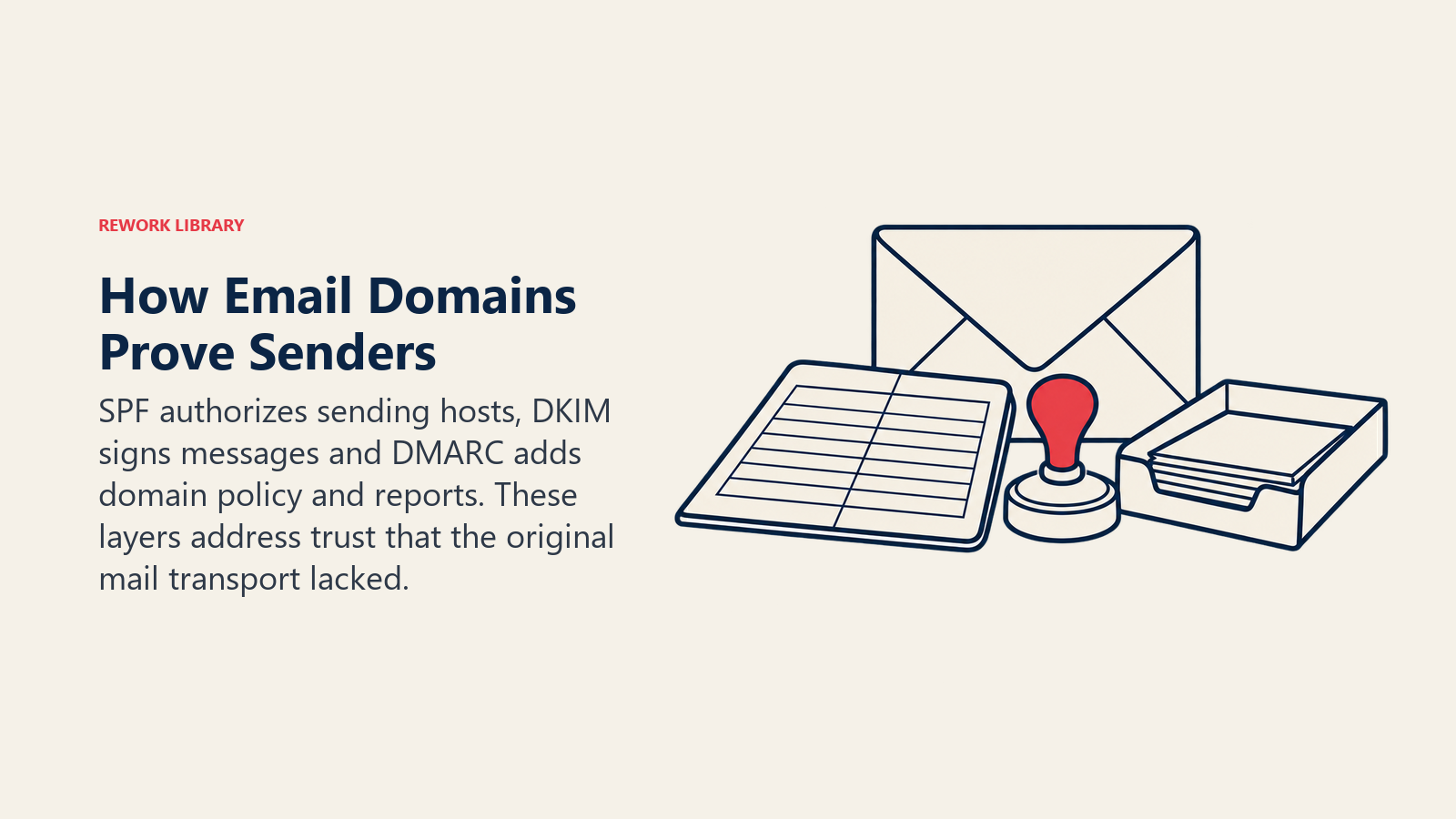
The new work was authentication. SPF, described in RFC 7208 by S. Kitterman in April 2014, notes that email can be forged in several ways and lets a domain publish which hosts may send for it. DKIM, edited by Crocker, Hansen and Kucherawy in September 2011, lets a signing domain claim responsibility for a message using a cryptographic signature. And DMARC, edited by Kucherawy and Zwicky, both of Yahoo, in March 2015, lets domain owners publish a policy and receive reports. It was published as an Informational RFC, and the RFC Editor now lists it as replaced by RFCs 9989, 9990 and 9991.
Rules then moved from standards bodies to mailbox providers. On 3 October 2023, Google announced requirements for anyone sending more than 5,000 messages a day to Gmail addresses: strong authentication, one-click unsubscribe for commercial mail, processed within two days, and a spam rate below a threshold. They took effect from February 2024. For teams that send outreach, the practical reading is in our guides to cold email deliverability and cold email strategy.
The leftover problem is the one the first mail command also faced: someone has to decide whose messages get through.
For teams today: deliverability is a permanent part of sending mail. Treat authentication records like locks on a door, not a one-time setup task.
Key People
| Name | Role | Contribution | Year |
|---|---|---|---|
| Tom Van Vleck and Noel Morris | MIT programmers | Wrote the CTSS MAIL command | 1965 |
| Ray Tomlinson | BBN engineer | Modified SNDMSG to send mail over ARPANET and chose "@" | 1971-1972 |
| Dave Crocker | Standards author | Co-wrote RFC 733, wrote RFC 822, edited DKIM | 1977-2011 |
| Jonathan Postel | USC Information Sciences Institute | Author of SMTP (RFC 821) | 1982 |
| Gary Thuerk | DEC marketer | Sent the best-known early spam | 1978 |
| J. Myers and M. Rose | RFC authors | Published POP3 | 1996 |
| N. Freed and N. Borenstein | RFC authors | Defined MIME | 1996 |
| Sabeer Bhatia | Hotmail CEO and co-founder | Sold the free webmail service to Microsoft | 1997 |
| M. Crispin | University of Washington | Author of IMAP4rev1 | 2003 |
| M. Kucherawy and E. Zwicky | Yahoo authors | Edited DMARC | 2015 |
Key Facts
- The MAIL command was added to CTSS in August 1965 and capped messages at one disk record.
- By 1973 email made up well over half of ARPANET traffic, according to the Computer History Museum.
- RFC 821 and RFC 822 were both published in August 1982.
- Hotmail had more than 9 million members when Microsoft announced its acquisition on 31 December 1997.
- Under US law, each email that violates CAN-SPAM can draw a penalty of up to $53,088.
- Since February 2024, senders of more than 5,000 messages a day to Gmail face authentication and one-click unsubscribe requirements.
The Pattern Behind the History
Four moves repeat across the email story. We call the sequence the Note to Trust Cycle. It's our synthesis of the history above, not a research finding.
- A note solves a small problem. A courier carried an order, a MAIL command told you a tape was ready.
- A standard makes it portable. RFC 561, 733, 821 and 822 turned local habits into shared rules.
- Free access invites abuse. Unwanted bulk mail followed the first lists and exploded with free webmail.
- Trust rules arrive late. SPF, DKIM, DMARC and provider requirements came decades after the transport was set.
What It Teaches Teams Today
- Start with a small, real need. The first mail command told people their files were ready.
- Write the standard early. Shared formats like From, Date and Subject outlived the systems they came from.
- Plan for abuse when you make something open. Authentication came more than 30 years after SMTP.
- Know which date you mean. Written, released, standardized and enforced were different years for the same feature.
- Credit with a document. Date a claim to a manual, an RFC or a press release before you repeat it.
Email shows how a feature built to leave a note on a shared computer became the base layer of business communication. The lasting lesson for teams is that the message is the easy part, and trust, standards and delivery are what take decades.

Co-Founder, Rework.com