The History of HTML and Web Standards

Turn this article into takeaways for your work.


Each assistant summarizes the article only for you and suggests best practices for your work.
In March 1989 Tim Berners-Lee wrote a proposal at CERN, the European physics laboratory near Geneva. It said CERN was losing information about complex, changing systems. It proposed a distributed hypertext system as the fix.
HTML was created by Berners-Lee between that proposal and the first web server in 1990. It borrowed its tag syntax from SGML, an earlier markup standard. It became a shared standard only after the browser makers started pulling it apart. The IETF published HTML 2.0 as RFC 1866 in November 1995. The W3C took over. Since 2019 one living document, kept by the WHATWG, is the single version. The throughline: HTML succeeded because it was simple and free. It stayed one language because people kept writing down what browsers really did.
The problem Berners-Lee faced was ordinary. Documents lived on many kinds of computer, in formats from SGML to LaTeX, Word and troff, according to Raggett. He needed one plain format that any machine could read, and links that worked between them.
Two terms first. "Markup" means tags added to text to say what each part is, such as a heading or a list item. A "standard" here means a written specification that rival browser makers agree to follow. The Internet beneath all this is a separate story, told in The History of TCP/IP, The History of the Internet and in Internet vs World Wide Web: Two Different Origins.
Timeline at a Glance
| Year | Milestone | Why It Mattered |
|---|---|---|
| Jul 1945 | Vannevar Bush describes the memex in The Atlantic | An early vision of linked records, with no markup and no computer. |
| 1969 | Goldfarb, Mosher and Lorie invent GML at IBM | Descriptive tags and formal document types enter publishing. |
| Oct 1986 | ISO publishes SGML as ISO 8879 | The international markup standard HTML would borrow from. |
| Mar 1989 | Berners-Lee circulates "Information Management: A Proposal" at CERN | The plan for a linked information system. |
| Nov 1990 | First web server and first web page go live at CERN | HTML exists in working form. |
| Apr 1993 | Mosaic 1 is released | Images, forms and nested lists arrive as browser extensions. |
| 1 Oct 1994 | The World Wide Web Consortium is founded | A neutral home for web standards. |
| Nov 1995 | IETF publishes HTML 2.0 as RFC 1866 | The first formal HTML specification. |
| Dec 1996 | CSS level 1 becomes a W3C Recommendation | Presentation moves out of the markup. |
| 14 Jan 1997 | HTML 3.2 is endorsed as a W3C Recommendation | Tables, applets and text flow around images are standardized. |
| 24 Dec 1999 | HTML 4.01 is published | Style sheets, scripting and accessibility join the language. |
| 26 Jan 2000 | XHTML 1.0 becomes a W3C Recommendation | HTML is recast in XML. |
| 2004 | Apple, Mozilla and Opera found the WHATWG | HTML development restarts outside the W3C. |
| 28 Oct 2014 | HTML5 becomes a W3C Recommendation | A finished HTML5 is formally recommended. |
| 28 May 2019 | W3C and WHATWG sign an agreement on a single HTML | One living specification replaces two competing ones. |
The Markup Roots (1945-1989)
Descriptive tags and linked records arrive as two separate ideas
The turning point is a split that matters later: HTML joined two older ideas that grew up apart. Neither idea was HTML, and nobody was building the Web.
The first idea is markup that describes meaning, not looks. The SGML Users' Group history, reposted by Cover Pages, says "generic coding" began in the late 1960s, using descriptive tags such as "heading" instead of a format code. It credits a September 1967 presentation by William Tunnicliffe at the Canadian Government Printing Office as a start of the movement, and a New York book designer, Stanley Rice, with proposing a catalog of editorial structure tags. In 1969 Charles Goldfarb, leading an IBM research project on law-office systems, invented the Generalized Markup Language with Edward Mosher and Raymond Lorie. The name is their three initials. The same account says GML added a formally defined document type with nested elements. After a first SGML working draft in 1980, the standard reached a published edition of ISO 8879 in October 1986.
The second idea is linked records. In July 1945 Vannevar Bush described a desk-sized device for a person's records, an "enlarged intimate supplement to his memory". The W3C's history page says Ted Nelson coined the word "hypertext" at an ACM conference in 1965 and that Douglas Engelbart prototyped a hypertext system called NLS in the 1960s. W3C's page on early ideas adds that Bill Atkinson's HyperCard, released in 1987, made hypertext easy for ordinary users.
Keep the lines apart. GML and SGML gave HTML its tag syntax. Bush, Nelson and Engelbart gave it the link. None of them built a web of documents across computers, because each system lived on one machine or in one lab. The new problem was that publishers had markup without a global network, and hypertext users had links without a shared format.
For teams today: the big idea in your field may arrive as two half-ideas from different communities. The work is often the join.
The CERN Years (1989-1993)
A physics lab gets a plain format and a link tag
The turning point is a memo with a one-line verdict. In March 1989 Berners-Lee gave his proposal to his boss, Mike Sendall, who wrote "Vague, but exciting" on it, according to CERN. The W3C's history records that Sendall approved the purchase of a NeXT computer in September 1990, that Berners-Lee wrote a browser and editor on it, and that the first server, nxoc01.cern.ch (later info.cern.ch), went live in November 1990 with the first web page.
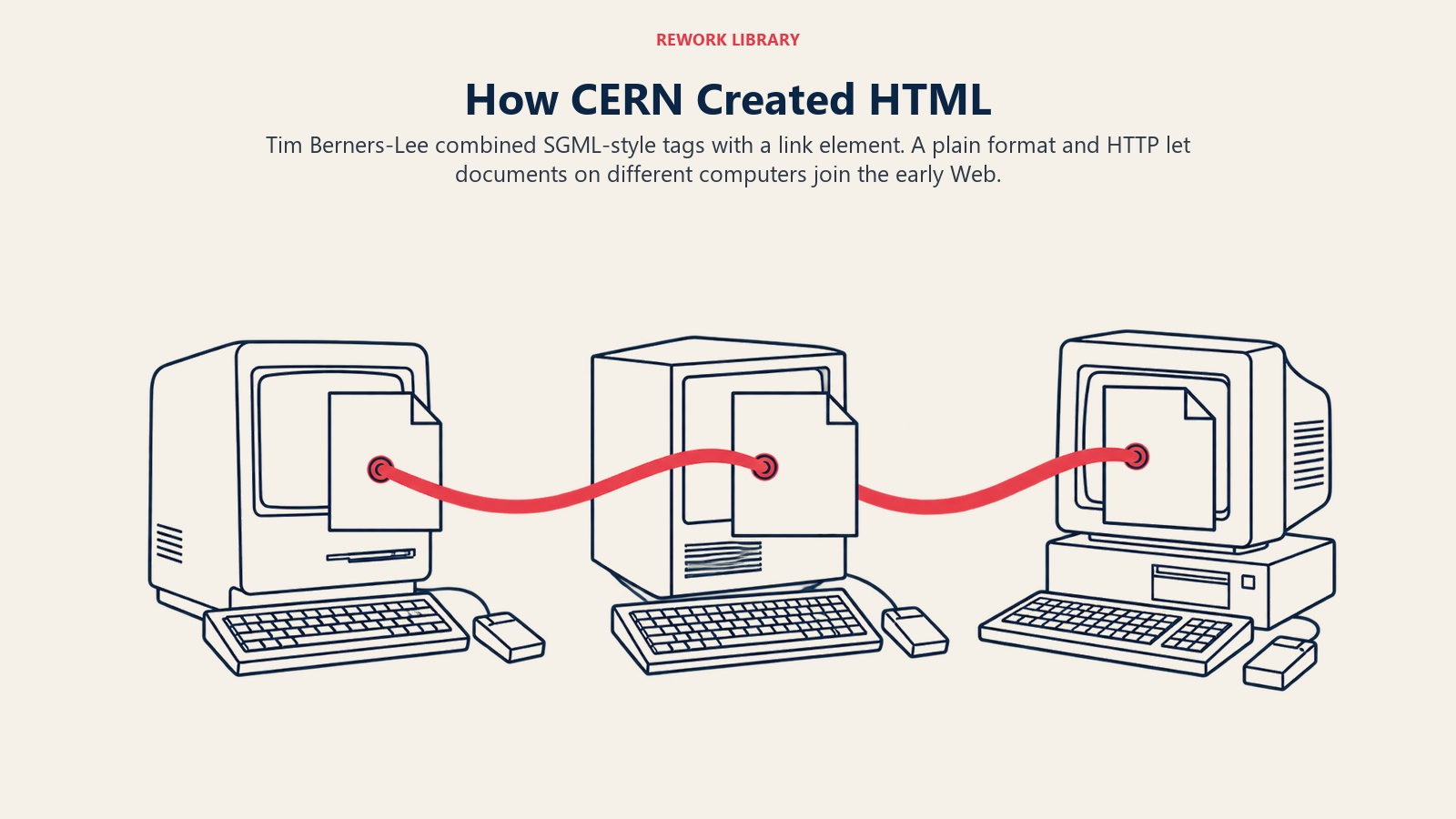
Picture the problem on a CERN desk: physicists on different machines, each with a favorite way to write. Dave Raggett's account in his chapter on the history of HTML says Berners-Lee wanted something simpler than any of them and built HTTP to fetch documents, with HTML as the text format. He based HTML on SGML for paragraphs, headings and lists, but the anchor element with an href attribute, the part that makes a link, was his own invention. An early page called "Tags used in HTML" lists the early tags and says they are kept as defined in the CERN SGML guide. W3C preserves a November 1992 copy of it.
Spread came through openness. The W3C history says the software was posted for FTP in August 1991, announced on newsgroups including alt.hypertext, and a public mailing list, www-talk, started in September 1991. Raggett writes that in December 1992 Marc Andreessen of the Mosaic team proposed the image tag on that list. The others were not keen on his design, but Mosaic shipped it, and it is still in HTML. Mosaic version 1 appeared in April 1993, Raggett adds, and extended HTML with images, nested lists and fill-out forms, additions that academics later called ad hoc.
Then came the legal decision. CERN's account says its directors signed a document on 30 April 1993 relinquishing intellectual property rights to the Web code. The W3C's history calls it the declaration that the technology is free for anyone to use. The new problem was control: with no fee and no owner, whoever shipped a browser could add tags.
For teams today: give the format away and you will be copied. But expect extensions you did not plan, because anyone is free to make them.
The Browser Wars (1993-1997)
Vendors invent tags faster than committees can describe them
The turning point is the first attempt to write HTML down. Raggett's chapter says that during 1993 and early 1994 many browsers added their own tags, so the language was becoming ill-defined. Dan Connolly collected the widely used tags into a draft that Berners-Lee called HTML 2, and wrote a formal document type definition for it. Raggett, at Hewlett-Packard Labs in Bristol, had meanwhile written HTML+, a richer version, and showed browser demos of tables and text flow around figures at the first international web conference at CERN in May 1994.
The venues multiplied. An IETF working group on HTML took over from an informal implementors group after that conference; its charter says its job was to describe existing practice before developing new features. The W3C history records that the World Wide Web Consortium was founded on 1 October 1994. W3C's own about page says Berners-Lee founded it that year to ensure the long-term growth of the Web. The IETF's output arrived in November 1995: RFC 1866, HTML 2.0, by Berners-Lee and Connolly. Its abstract says it covers roughly the HTML in common use before June 1994, and that it is an application of the ISO SGML standard.
By then the market had moved. Raggett writes that Netscape Communications was formed in November 1994, and that it began inventing its own tags without first discussing them with the web community. Microsoft announced Internet Explorer 1.0 in August 1995. Netscape proposed frames in September 1995 and shipped them before anyone could comment. Raggett's HTML 3 draft, published as an Internet Draft in March 1995, added tables, math and a style tag. It never became a standard: the IETF group found it too large, and browser makers each implemented a different subset.
Sources differ on how the IETF group ended. Raggett says it was dismantled in December 1995. RFC 2854 says the group closed in September 1996. What both agree on is that the work moved to the W3C. Raggett says he called browser makers together in November 1995, and the W3C formed an HTML Editorial Review Board in February 1996 with IBM, Microsoft, Netscape, Novell, SoftQuad and the W3C. In one trade, he says, Netscape agreed to drop its blink tag if Microsoft dropped marquee, and both went. The new problem was that agreeing on tags was now easier than agreeing on looks.
For teams today: when a standard moves slower than the market, the market writes its own. The fix was a small table of vendors and a strong chair.
The W3C Years (1996-2003)
HTML 3.2, HTML 4 and CSS pull structure and style apart
The turning point is a division of labor. Style would live in style sheets, not tags. The W3C's short history of CSS says Håkon Wium Lie, working at CERN in 1994, published the first draft of "Cascading HTML Style Sheets" three days before Netscape announced the first beta of Mozilla on 13 October 1994, and that Bert Bos joined him soon after. Its distinguishing idea was the cascade: the author's and the reader's wishes, and the browser's abilities, are combined. CSS level 1 became a W3C Recommendation in December 1996, and CSS level 2 in May 1998, per the same account. The first commercial browser with CSS support was Internet Explorer 3, released in August 1996; Netscape Navigator 4 followed with a patchy version.

The language itself was standardized next. HTML 3.2, written by Raggett, became a W3C Recommendation on 14 January 1997. It aimed to capture recommended practice as of early 1996 and to replace HTML 2.0. The HTML 4.01 specification's change log dates the HTML 4.0 text to 18 December 1997, with a revision on 24 April 1998 and HTML 4.01 on 24 December 1999. Its abstract says HTML 4 added support for style sheets, scripting, better printing and more accessible documents, plus internationalization. The WHATWG's history of HTML puts HTML 3.2 and HTML 4 in 1997 and notes that the W3C membership then decided to stop evolving HTML.
That decision led to XHTML. XHTML 1.0 was a reformulation of HTML 4 as an XML application, a W3C Recommendation on 26 January 2000. The W3C then worked on XHTML2, a language that, per the WHATWG history, was not compatible with the earlier HTML and XHTML. In June 2000, RFC 2854 retired the IETF's own HTML documents, including RFC 1866, from the Standards Track and pointed the "text/html" type at the W3C's recommendations.
Two other threads ran through these years. First, pressure from users. The Web Standards Project says it was founded in 1998 to push for standards that reduce the cost and complexity of development, and the CSS history says it published a list of Internet Explorer's top ten CSS problems in November 1998. Second, access. The W3C published Web Content Accessibility Guidelines 1.0 on 5 May 1999, through its Web Accessibility Initiative, explaining how to make content usable by people with disabilities. The new problem was drift: the XML path asked developers to follow stricter rules, while real pages were still plain HTML.
For teams today: separating content from presentation is an old lesson, and it paid off. Keep the facts in one layer and the look in another, so each can change alone.
The WHATWG Revolt (2004-2014)
Browser makers take HTML back from the XML path
The turning point is a rejected proposal. The WHATWG's HTML history says renewed interest in evolving HTML itself grew after the 2003 publication of XForms, and that Mozilla and Opera presented a forms proposal at a W3C workshop in 2004. The W3C staff and members voted to continue with XML-based replacements. Apple, Mozilla and Opera then announced the WHATWG. The WHATWG FAQ says the three were increasingly concerned about the W3C's direction with XHTML, its lack of interest in HTML and its apparent disregard for the needs of real-world web developers.
The new group set principles. Per the WHATWG history, technologies must be backwards compatible, specifications and implementations must match even if the specification has to change, and specifications must be detailed enough for interoperable implementations without reverse engineering. That meant folding what had been three documents (HTML4, XHTML1 and DOM2 HTML) into one. In 2006 the W3C signalled interest, and in 2007 it chartered a working group to work with the WHATWG on HTML5. For some years the two groups cooperated.
They split again in 2011. The W3C wanted to publish a finished HTML5, while the WHATWG wanted a Living Standard it could keep maintaining, per the WHATWG history. The W3C moved first to the formal finish line: HTML5 became a W3C Recommendation on 28 October 2014, its abstract calling it the fifth major revision of the language. The editors listed include Ian Hickson of Google for the WHATWG, with Robin Berjon, Steve Faulkner, Travis Leithead, Erika Doyle Navara, Theresa O'Connor and Silvia Pfeiffer for the W3C. The new problem was that two groups now each published a specification of the same language.
For teams today: when the official process stops matching what the people building the thing need, a smaller group with working code can win. But eventually someone has to merge the forks.
The Living Standard (2014-present)
Two specifications become one, and accessibility rules keep growing
The turning point is a signature. On 28 May 2019 the W3C and WHATWG signed a memorandum saying a single development stream for each specification serves the community best, because specification divergence is costly. The W3C's announcement lists the terms: they work together on HTML and DOM in the WHATWG repositories, the WHATWG maintains the HTML and DOM Living Standards, and the W3C stops independent publishing of a designated list of specifications and works to take WHATWG Review Drafts to Recommendation. The WHATWG's FAQ says Apple, Google, Microsoft and Mozilla helped develop its IPR policy and governance structure in 2017, and that a Living Standard is continuously updated and also snapshotted roughly every six months into a Review Draft for patent review.

Older specifications were formally retired. The W3C's pages mark HTML 3.2 as superseded on 15 March 2018 and XHTML 1.0 as superseded on 27 March 2018, both pointing readers to the current HTML specification. The HTML Living Standard itself carries a "last updated" date that was 20 October 2026 at the time of writing, which is the point: it never freezes.
Accessibility kept its own track. WCAG 2.0 followed, and its dated address places that Recommendation on 11 December 2008. WCAG 2.2 says WCAG 2.1 was published as a Recommendation in June 2018, and that WCAG 2.2 was first published on 5 October 2023 and also conforms to the earlier two. For a business, that is the version number a procurement team or lawyer is likely to cite.
For the wider network context, the dot-com years that followed the Mosaic era are in the history of the dot-com bubble, and the browser scripting language that arrived with Netscape is in the history of programming languages. The new problem is the old one in new clothes: a living standard can change under you.
For teams today: a standard that never freezes needs an owner who writes down what ships. Treat it like a dependency: pin the version you test against, and read the change log.
Key People
| Name | Role | Contribution | Year |
|---|---|---|---|
| Charles Goldfarb | IBM researcher | Led the invention of GML and later edited SGML | 1969-1986 |
| Tim Berners-Lee | CERN computer scientist | Proposed the Web and created HTML and HTTP; founded the W3C | 1989-1994 |
| Dan Connolly | HTML 2 editor | Collected widely used tags, wrote the HTML 2 DTD, chaired the review board | 1994-1996 |
| Dave Raggett | HP Labs, then W3C | Wrote HTML+ and the HTML 3 draft; edited HTML 3.2 and HTML 4 | 1993-1997 |
| Marc Andreessen | NCSA Mosaic, then Netscape | Introduced the image tag; co-founded Netscape | 1992-1994 |
| Håkon Wium Lie and Bert Bos | CERN and W3C | Created Cascading Style Sheets | 1994-1996 |
| Ian Hickson | WHATWG editor, Google | Edited the HTML specification for the WHATWG | 2004-2014 |
Key Facts
- RFC 1866 (November 1995) was HTML 2.0, covering the HTML in common use before June 1994.
- HTML 3.2 was a W3C Recommendation on 14 January 1997, authored by Dave Raggett.
- CSS level 1 became a W3C Recommendation in December 1996; Internet Explorer 3 (August 1996) was the first commercial browser to support CSS.
- HTML5 became a W3C Recommendation on 28 October 2014.
- W3C and WHATWG signed their single-HTML agreement on 28 May 2019.
The Pattern Behind the History
We call the sequence the Describe, Don't Decree Pattern. It is our synthesis of the history above, not a research finding.
- Borrow a proven base. HTML took its tag syntax from SGML instead of inventing one.
- Ship it simple and free. CERN waived its rights in 1993, so anyone could build on it.
- Let the market run ahead. Mosaic, Netscape and Microsoft each added tags before any committee approved them.
- Write down what already works. HTML 2.0, HTML 3.2 and the WHATWG's rule that specifications match implementations all put existing practice first and invention second.
- Merge the venues when forks get costly. The 2019 agreement ended two competing specifications of one language.
What It Teaches Teams Today
- Start with a plain format. HTML began as a few tags that any machine could handle.
- Pick a neutral table for rivals. The HTML review board worked because vendors sat in one room with a strong chair.
- Separate content from look. CSS let pages change style without rewriting the markup.
- Prefer description over decree. Standards that recorded real behavior were adopted. Large new designs stalled.
- Plan for accessibility early. WCAG began in 1999, only about a decade after the proposal, and is still being revised.
- Know which date you mean. Proposal, first page, RFC, Recommendation and Living Standard are different milestones. For the full network timeline, see the Internet timeline.
HTML shows how an open, simple format survives its own success. If you work with the systems built on top of it, read how APIs carry data between programs in API architecture, and how names resolve to addresses in the history of DNS.

Co-Founder, Rework.com