The History of Ethernet and Local Networks
Turn this article into takeaways for your work.


Each assistant summarizes the article only for you and suggests best practices for your work.
Until around 1970 the need for data communication was mostly long reach. Big computers sat far apart. Then cheap integrated circuits produced minicomputers and personal machines. People now needed to connect computers in the same building, at speeds a phone modem could not reach. The problem was distance, or rather the lack of it.
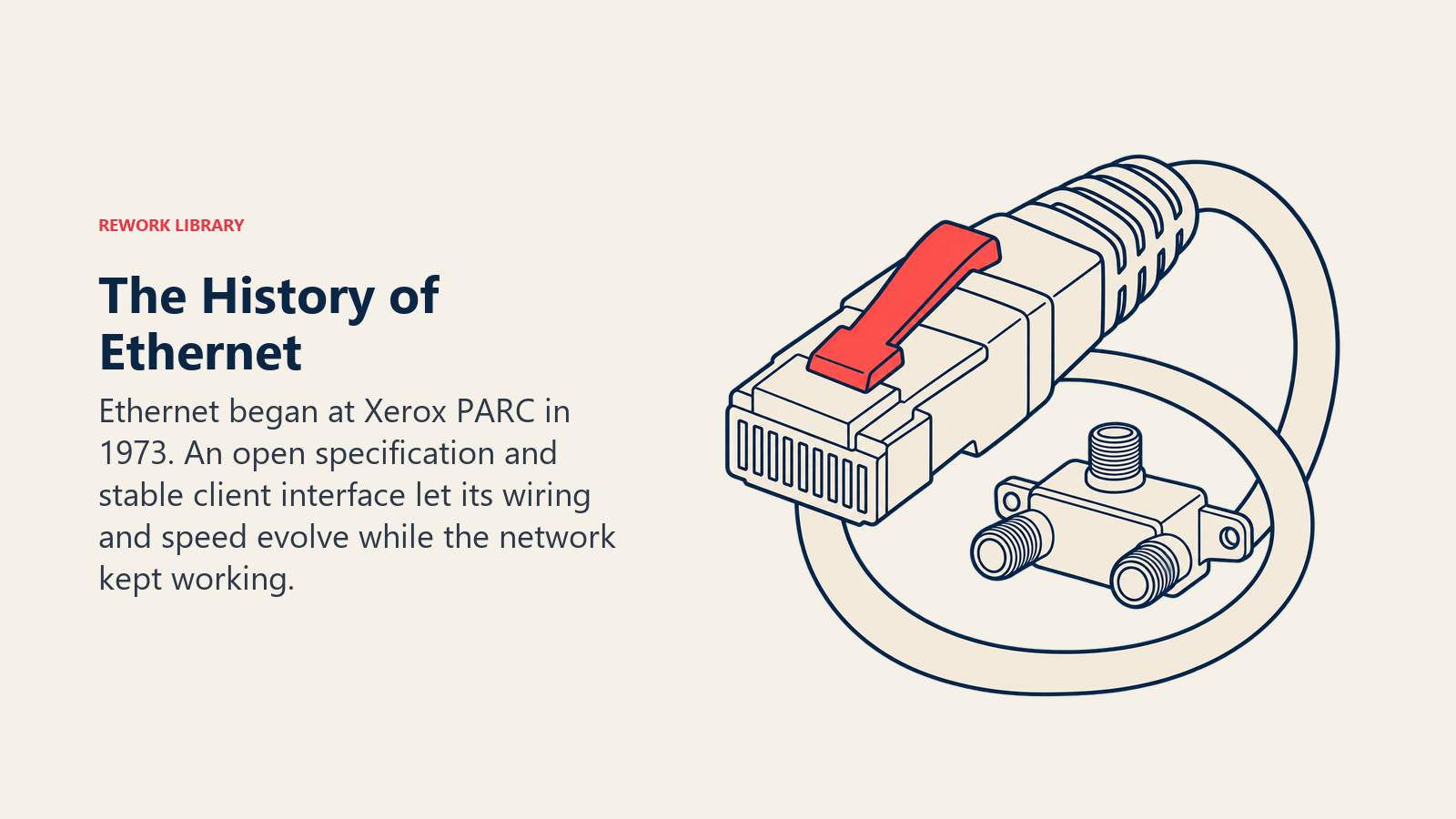
Ethernet was invented at Xerox's Palo Alto Research Center in 1973 by Bob Metcalfe, with David Boggs. It linked the lab's personal computers and printers. The Institute of Electrical and Electronics Engineers (IEEE) milestone record says it was inspired by the ALOHAnet radio network and the ARPANET. It adds that the IEEE 802.3 committee approved the standard on 24 June 1983. The throughline: take a simple idea from radio and keep the core dumb. Open the specification to rivals. Keep the interface stable while the wiring and the speed change underneath.
This article follows that short-distance story. For the long-distance one, see The History of ARPANET and the pillar, The History of the Internet.
Two terms first. A "local area network" (LAN) links computers within a building or campus. "Shared medium" means every machine uses the same wire, so the rules must decide who may talk and when.
Timeline at a Glance
| Year | Milestone | Why It Mattered |
|---|---|---|
| June 1971 | ALOHAnet begins serving inter-island computer access in Hawaii | Showed a shared channel could work with simple random access. |
| 22 May 1973 | Metcalfe writes the memo that names Ethernet | The idea on paper, at Xerox PARC. |
| 11 Nov 1973 | The system first functions | A working network for the Alto computers. |
| 1 Jul 1976 | Metcalfe and Boggs publish the design in Communications of the ACM | The design becomes public and citable. |
| 13 Dec 1977 | US patent 4,063,220 is published | Four PARC inventors are named on the collision-detection design. |
| 1979 | Metcalfe leaves Xerox and founds 3Com | Ethernet gets a company dedicated to selling it. |
| 30 Sep 1980 | DEC, Intel and Xerox publish the 10 Mb/s specification | A multivendor standard, not one firm's product. |
| 24 Jun 1983 | IEEE 802.3 is approved | Ethernet becomes an international standard. |
| 28 Sep 1990 | IEEE approves 10BASE-T | Ethernet moves onto telephone-style twisted pair. |
| 14 Jun 1995 | IEEE approves 802.3u, 100 Mb/s Fast Ethernet | Ten times the speed on the same style of cabling. |
| Jul 1998 | IEEE 802.3z, Gigabit Ethernet, is approved | The gigabit era begins. |
| Jun 2003 | IEEE 802.3af, power over the Ethernet cable, is approved | One cable carries data and power to phones and access points. |
| 6 Dec 2017 | IEEE 802.3bs, 200 and 400 Gb/s, is approved | Data-center speeds reach hundreds of gigabits. |
| 22 Mar 2023 | ACM announces Metcalfe as the 2022 Turing Award recipient | The field's top prize, for Ethernet. |
| 16 Feb 2024 | IEEE approves 802.3df, 400 and 800 Gb/s | The speed race continues for AI-scale networks. |
The ALOHA Idea (1968-1972)
Hawaii shares one radio channel without a traffic cop
The turning point is a radio network in the Pacific. At the University of Hawaii in the late 1960s, Norman Abramson, Franklin Kuo and Wes Peterson started the ALOHA System. The Computer History Museum's catalog entry says the project ran from late 1968 to the mid-1970s and produced a packet radio network linking user terminals and an ARPANET satellite to the department's time-shared mainframe. It describes the "random-access, broadcast channel" as a shift away from dividing a channel by time or frequency.
The setup was simple: remote terminals, each with a radio, all reaching one computer over a single shared channel. A terminal sent when it had something to say. If two sent at once and the messages collided, they tried again later. The IEEE milestone record for ALOHAnet says the network began serving inter-island access in June 1971, connected four remote terminals in late 1971, and soon had several hundred users. The University of Hawaii's own history page lists "random access" and "shared medium access" among ALOHAnet's firsts and says it led directly to Ethernet. In December 1972 the university was asked to prepare equipment for a satellite link to ARPANET, per the same IEEE record, which is why this story touches ARPANET.
Metcalfe was studying exactly this. The reference list on his 1976 paper cites his own January 1973 analysis of a slotted and controlled ALOHA system and his December 1973 Harvard thesis, "Packet communication." Before PARC he had worked on the ARPANET at MIT's Project MAC, according to the IEEE milestone record.
A note on precursor versus concept. ALOHAnet was a wireless network that fed terminals to a central computer. It was not Ethernet and not a local network of equals. What it proved was the idea underneath: many senders can share one channel, with no central controller, if they follow a simple rule and recover from collisions.
For teams today: the best idea for your problem may already exist in a neighboring field. Metcalfe borrowed from radio to solve an office wiring problem.
The PARC Years (1973-1979)
Metcalfe puts the radio idea on a coaxial cable
The turning point is a memo. Xerox PARC, founded in 1970, was building the Alto, a personal computer for one user, along with laser printers and file servers. The IEEE milestone record says PARC needed a high-speed, decentralized link for them, plus a gateway to the ARPANET. Each Alto had its own display screen, keyboard and mouse and was dedicated to one user, so the network had to tie many single-user machines together.
The memo is dated 22 May 1973 on the scan that DigiBarn hosts, addressed to the "Alto Aloha distribution" with the subject "Ether Acquisition." IEEE's Engineering and Technology History Wiki also gives 22 May 1973 and says Metcalfe coined the name that day. The Computer History Museum's 2013 anniversary post gives 23 May instead. IEEE Spectrum credits Charles Thacker with envisioning the network, Metcalfe with the design and Boggs with joining soon after, and says the name changed from Alto Aloha Network to Ethernet to show it could serve any computer. Spectrum adds that Thacker's remark that coaxial cable is nothing but captive ether lies behind the name.
ACM's Turing Award citation page summarizes the memo: a "broadcast communication network" for connecting PARC's Altos within a building, envisioning "communication over an ether" that could later ride other media. Metcalfe's design drew on ALOHAnet. He recruited Boggs, who helped build a 100-node PARC Ethernet, and that first network was then copied inside Xerox.
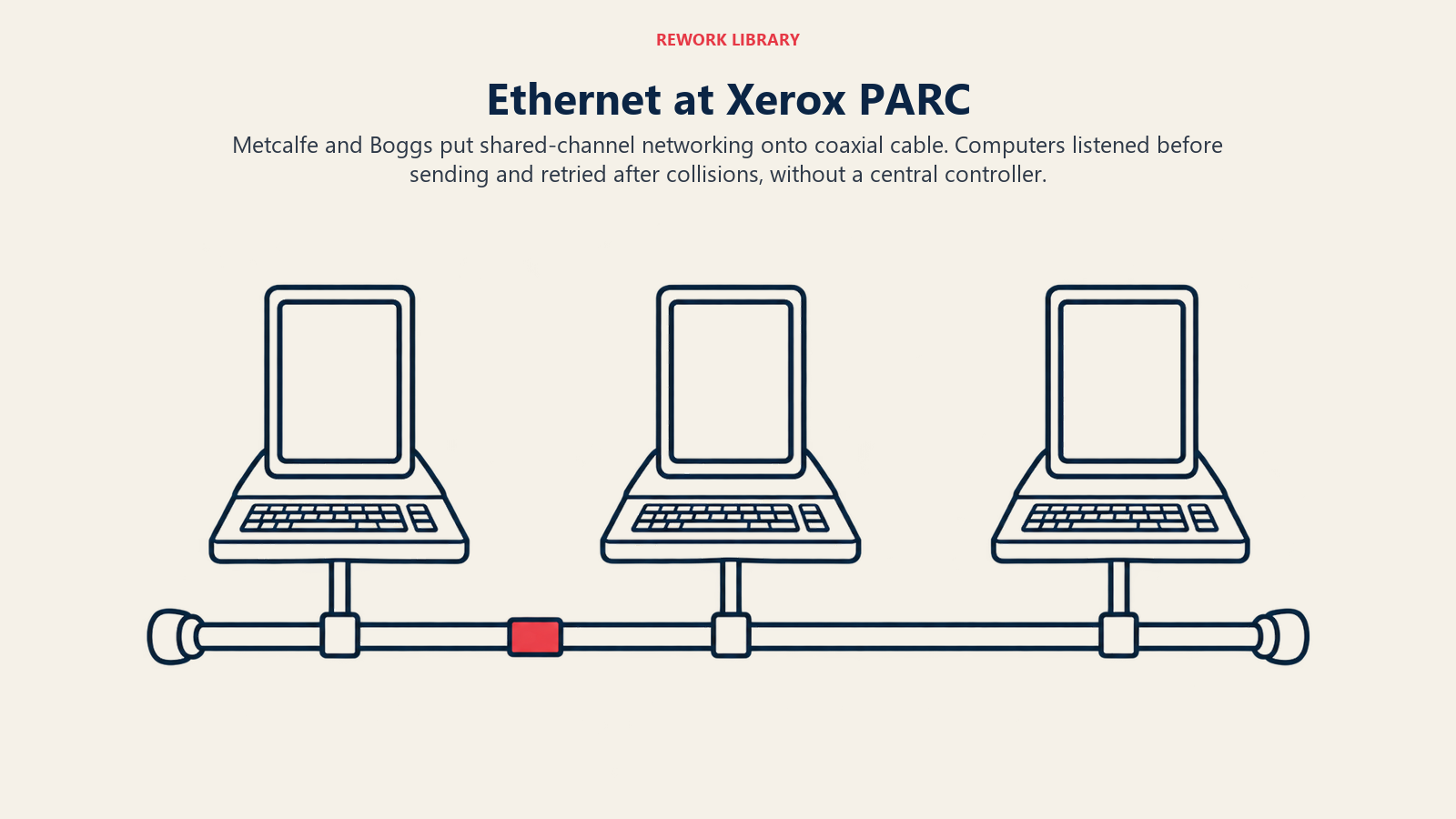
The design details come from the IEEE milestone record. Metcalfe moved ALOHA's wireless "ether" onto coaxial cable with no centralized control. He added carrier sense, so a machine transmits only when the cable is quiet, and a "binary exponential backoff" rule to keep retransmissions from locking up a busy network. That record also says critics objected that delivery was only "probabilistic" and delay was unpredictable under load, and that by 1975 PARC's experimental Ethernet had 25 nodes linking Altos, minicomputers, printers, a mainframe and the ARPANET. The Computer History Museum's exhibit text puts the rule in plain terms: send when the wire is quiet, every computer hears every message but ignores the ones not meant for it, and colliding messages are sent again later.
The system first functioned on 11 November 1973, at 2.94 megabits per second according to ACM, which says that was about 10,000 times faster than the terminal networks it replaced. The public paper followed on 1 July 1976: Metcalfe and Boggs, "Ethernet: Distributed Packet Switching for Local Computer Networks," in Communications of the ACM, volume 19, issue 7, pages 395 to 404. Its abstract describes a passive broadcast medium with no central control, based on experience with an operating Ethernet of 100 nodes along a kilometer of coaxial cable. The patent for the collision-detection design, US 4,063,220, was filed on 31 March 1975 and lists Metcalfe, Boggs, Thacker and Butler Lampson as inventors. Google Patents shows publication on 13 December 1977, while Spectrum says the patent was granted in 1978.
This era produced a working LAN and a published design. It also produced a business problem: one company's invention would stay a niche product unless others adopted it.
For teams today: build the thing you need, then write it up. The paper made Ethernet something other engineers could copy and improve.
The LAN Wars (1979-1989)
Metcalfe sells an open standard against IBM's ring
The turning point is Metcalfe's departure. In 1979 he left Xerox and, per ACM, founded 3Com, selling Ethernet software, transceivers and cards for minicomputers and workstations, and later one of the first Ethernet interfaces for IBM PCs. The Computer History Museum's Local Networks exhibit says he also persuaded Digital Equipment Corporation, Intel and Xerox to back Ethernet as a standard. The three companies' first meeting at PARC was in 1978, Gordon Bell of DEC recalls, with the standard completed in 1980. The ten-megabit "Blue Book" specification is dated 30 September 1980.
The rivals were real. The same Museum exhibit lists IBM's Token Ring and Datapoint's ARCNET, which circulated a "token" to control who could send, and academic systems such as the Cambridge Ring. In his 2019 IEEE Computer column, Geoff Thompson, who chaired the 802.3 working group from 1993 to 2002, describes the philosophical split. Ethernet was a passive network with no master, designed for peers. IBM wanted a ring with scheduled delivery and return receipts. General Motors and Boeing wanted assured delivery with the flexibility of a bus. The new IEEE 802 committee, which first met in February 1980, deadlocked.
It broke the deadlock by splitting. The IEEE milestone record on the 802 family says the committee approved its project on 13 March 1980 and eventually published three incompatible access standards in 1985: CSMA/CD (802.3), token bus (802.4) and token ring (802.5). Metcalfe later recalled the start of the meetings as the moment "war started." That record also notes IBM's reluctance to back a standard it did not own. The 802.3 standard was approved on 24 June 1983 and published on 31 December 1984 as ANSI/IEEE Std 802.3-1985, essentially taken from the Blue Book. By 1981 Xerox had installed 75 Ethernets at 40 sites serving over 1,350 Altos, and by 1985 an estimated 500,000 Ethernet adapters were in use, per the same record. Thompson adds that IBM's own Token Ring product was not ready until 15 October 1985.
Cost reshaped the war. 3Com and DEC added cheaper thin coaxial cabling, standardized as 802.3a-1985, Thompson writes. Then came the telephone wires. He notes AT&T agreed in 1982 to be broken up, and the 10BASE-T project started in August 1987 to run Ethernet over surplus telephone pairs in a star layout. The 802 milestone page says that by 1984 ownership of in-building phone cabling had passed to customers, which sent the industry rushing to convert LANs to phone wiring.
Metcalfe also gave the era a business rule. The Museum's 50th-anniversary account says selling Ethernet for IBM PCs led him to articulate "Metcalfe's Law," the idea behind network effects: a network gets more useful with each machine that joins.
For teams today: an open specification with several suppliers can beat a better-funded proprietary one. Ethernet won partly because buyers could choose among vendors.
The Twisted-Pair Age (1990-2002)
Phone wiring, hubs and switches bring Ethernet to every desk
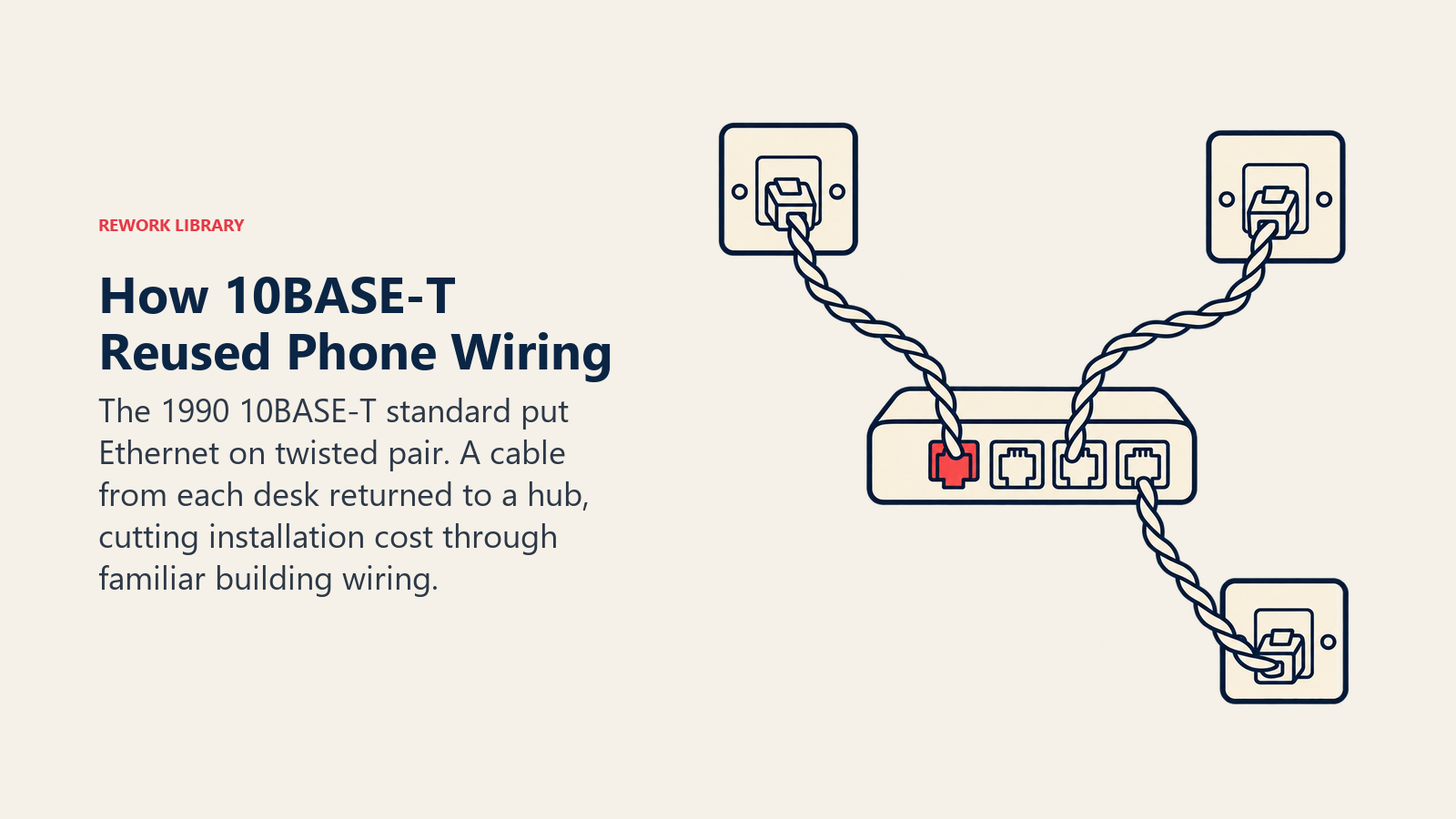
The turning point is a standard for twisted pair. IEEE approved 802.3i, 10BASE-T, on 28 September 1990 and published it on 30 December of that year. The cable closet that once held telephone switching equipment now held a hub, and every desk ran a thin cable back to it. Thompson says this reuse of existing cabling cut installation cost and gave Ethernet a big boost over Token Ring. The Computer History Museum adds that the hub-and-cable wiring of ARCNET, though not its token passing, was adopted for later versions of Ethernet.
Speed came next. After more than a decade, Thompson writes, Ethernet was running out of bandwidth in some installations while the proposed FDDI fiber standard failed to ship in volume. A start-up showed 100 Mb/s Ethernet, and a standards project followed. A rival proposal from Hewlett-Packard employees for a non-Ethernet access method was routed into a separate working group, 802.12. IEEE approved 802.3u, Fast Ethernet, on 14 June 1995. The group also added auto-negotiation, so equipment at each end of a wire picks the highest speed they share. Thompson says 10/100 network cards sold for under US$100 while IT managers had budgeted US$200 for Token Ring cards, and that swung the market.
Then the architecture changed. Thompson describes the shift from repeater hubs, which were half duplex and single speed, to multiport bridges, now called switches, which allowed full duplex and independent port speeds. The IEEE Standards Association says Ethernet moved from shared media to full duplex in 1997. Shared cable and its collisions faded; the original CSMA/CD rule mattered less each year.
Gigabit followed. Thompson says the project started in June 1996; the IEEE's task force page records approval of 802.3z in July 1998, and the 802.3 archive lists 1000BASE-T (802.3ab) in 1999. The twisted-pair version came early for the market and took off only after Apple included a 10/100/1000 port in its default Ethernet hardware, per Thompson. IEEE 802.3ae, 10 Gb/s Ethernet, was approved in June 2002.
Wireless was arriving beside it. A 1985 FCC decision loosened rules on unlicensed radio bands, which led to IEEE 802.11, and the 802 milestone page says that let Wi-Fi become hugely popular for connecting laptops to Ethernet. The history of Wi-Fi is its own story.
For teams today: the winning move was to reuse what the building already had. Adoption often follows the path that costs the least to install.
The Power and Speed Years (2003-2022)
Ethernet carries power, then 400 gigabits
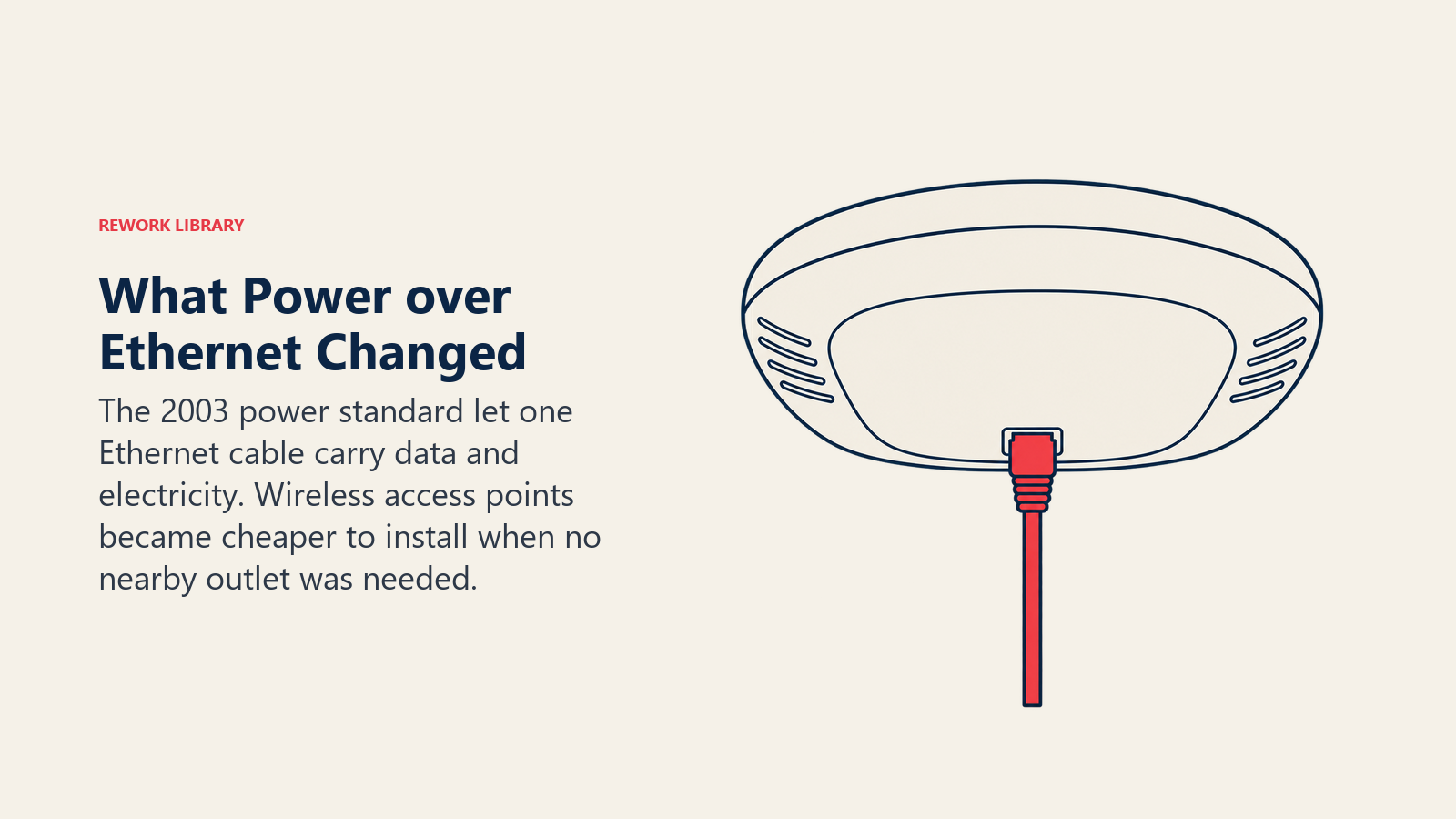
The turning point is a power standard. IEEE approved 802.3af in June 2003, delivering power over the same wires as data. Thompson says it began to support IP telephones, a smaller market than expected, but powering wireless access points made installation far cheaper because they were seldom near an outlet. A four-pair version, 802.3bt, followed in 2018.
The war ended quietly. The 802 milestone page records that the 802.4 token bus standard was withdrawn in 2001 and its group disbanded in 2004, and that 802.5 Token Ring was withdrawn on 26 September 2008. It says Ethernet had won "the LAN war."
Speeds climbed in steps. The 802.3 archive lists 10GBASE-T in 2006, 40 and 100 Gb/s in 2010, and 2.5G and 5GBASE-T in 2016. The IEEE Standards Association says the second half of Ethernet's history saw three times the growth of the first 25 years. IEEE approved 802.3bs, 200 and 400 Gb/s, on 6 December 2017. Ethernet also spread past offices. The archive lists single-pair standards for automotive (100BASE-T1 in 2015, 1000BASE-T1 in 2016) and a 10 Mb/s single-pair standard in 2019, and Thompson notes data centers and the Internet of Things drove the demand for speed.
For the warehouses of servers behind the cloud, see the history of cloud computing. IEEE's 802 milestone page says Ethernet has always been used in data centers, with speeds rising to support their growth.
For teams today: a standard that stays backward compatible lets you upgrade in pieces. The IEEE record says each step in Ethernet's evolution preserved the client interface of the version before.
The Cluster Age (2023-present)
Metcalfe wins the Turing Award while AI clusters demand 800G
The turning point is a prize and a new workload. ACM announced on 22 March 2023 that Metcalfe was the 2022 Turing Award recipient for the invention, standardization and commercialization of Ethernet, and, per its award page, scheduled the formal presentation for 10 June 2023. The page says Ethernet handles speeds from 10 Mbps to 400 Gbps, with 800 Gbps and 1.6 Tbps emerging, and that Ethernet switch revenue alone exceeded $30 billion in 2021, according to the International Data Corporation. Boggs had died in 2022, and the page names him as co-inventor. The IEEE dedicated its Ethernet milestone plaque on 17 May 2024, at PARC and at the Computer History Museum.
Then AI. In July 2023 the Linux Foundation announced the Ultra Ethernet Consortium, with founding members including AMD, Arista, Broadcom, Cisco, HPE, Intel, Meta and Microsoft, to build an Ethernet-based stack for AI and high-performance computing. Its chair said the goal was not overhauling Ethernet but tuning it for efficiency in demanding workloads. In March 2024 Meta described two 24,576-GPU clusters for training its Llama 3 models: one built on an Ethernet-based RoCE network, the other on InfiniBand. So both fabrics are in use for AI training, and Ethernet is not the only choice.
The standards keep moving. IEEE approved 802.3df, 400 and 800 Gb/s Ethernet, on 16 February 2024. The working group's home page lists an active task force, 802.3dj, for 200 Gb/s, 400 Gb/s, 800 Gb/s and 1.6 Tb/s, and an ad hoc group assessing Ethernet for AI.
A reader may wonder where Wi-Fi fits. It grew from the same IEEE 802 family; the ACM page notes that Metcalfe still calls Wi-Fi by its original name, Wireless Ethernet. Our coverage of the wired network stops here.
For teams today: a 50-year-old interface survived because each new workload reused it instead of replacing it. Before betting on a new fabric for a new workload, ask how much of the old one you can keep.
Key People
| Name | Role | Contribution | Year |
|---|---|---|---|
| Norman Abramson and Franklin Kuo | University of Hawaii | Led ALOHAnet, the random-access radio network behind Ethernet | 1968-1971 |
| Bob Metcalfe | Xerox PARC, later 3Com | Wrote the Ethernet memo; co-authored the 1976 paper; founded 3Com; 2022 Turing Award | 1973-1979 |
| David Boggs | Xerox PARC | Co-inventor; built the early PARC Ethernets | 1973-1976 |
| Charles Thacker and Butler Lampson | Xerox PARC | Named with Metcalfe and Boggs on the 1977 patent | 1975-1977 |
| Gordon Bell | DEC vice president of R&D | Recalls the first DEC, Intel and Xerox meeting on a standard | 1978-1980 |
| Maris Graube | Tektronix | Originated the IEEE 802 committee | 1979-1980 |
| Geoff Thompson | IEEE 802.3 chair 1993-2002 | Led the working group through 10BASE-T-era growth; wrote the history column | 1983-2002 |
Key Facts
- The first Ethernet ran at 2.94 megabits per second, about 10,000 times faster than the terminal networks it replaced, per ACM.
- Xerox had installed 75 Ethernets at 40 sites by 1981; an estimated 500,000 Ethernet adapters were in use by 1985.
- The original 802.3 standard was approved on 24 June 1983 and published at the end of 1984 as 802.3-1985.
- The 802.5 Token Ring standard was withdrawn on 26 September 2008.
- Ethernet switch revenue exceeded $30 billion in 2021, according to the International Data Corporation, as cited by ACM.
The Pattern Behind the History
We call the sequence the Simple Core, Open Door Pattern. It is our synthesis of the history above, not a research finding.
- Borrow a proven idea. Metcalfe moved ALOHAnet's shared-channel rule from radio to cable.
- Keep the core dumb. No master, no central control, just listen first and retry after a collision.
- Open the door to rivals. DEC and Intel joined Xerox, and the IEEE turned the specification into a public standard.
- Ride the cheapest path. Thin coax, then telephone twisted pair, then existing building wiring cut the cost of adoption.
- Hold the interface still while the speed changes. From 10 Mb/s to 800 Gb/s, each generation kept the one before it working.
What It Teaches Teams Today
- Look next door for the idea. The key rule came from a radio project in Hawaii.
- Standardize before the market does it for you. An open spec let 3Com and others sell Ethernet products that worked together.
- Cut the adoption cost. Reusing telephone wiring did more for Ethernet than any technical argument.
- Keep the interface stable. Customers can upgrade one piece at a time when the old and new generations still talk.
- Expect the rival to come back. Ring-style networks lost the LAN war, and now AI clusters compare Ethernet with InfiniBand.
- Know which date you mean. The memo was dated 22 May 1973, the system first ran on 11 November 1973, the paper appeared in July 1976 and the standard was approved in June 1983.
Ethernet shows how a modest, open idea becomes the wire under everything. If you want the packet-level and protocol story it carries, read the history of packet switching and the history of TCP/IP, then the Internet timeline and who invented the Internet to see where the local wire meets the global network.

Co-Founder, Rework.com