How to Build an AI Governance Framework: Executive Guide 2026
Turn this article into takeaways for your work.


Each assistant summarizes the article only for you and suggests best practices for your work.
AI adoption is accelerating. Most executives understand they need to move faster. But speed without governance creates risks that can derail entire organizations - regulatory penalties, reputation damage, biased decisions at scale, or security breaches that expose sensitive data.
The challenge isn't choosing between innovation and responsibility. It's building governance that enables both. The executives who solve this equation will lead their industries. Those who don't will either move too slowly and lose competitiveness, or move too fast and face consequences that set them back further.
Why AI Governance Is Different
Traditional technology governance doesn't translate directly to AI. Several factors make AI uniquely challenging:
Opacity. Many AI systems can't fully explain their decisions. This makes oversight harder than with rule-based systems where you can trace exactly why something happened.
Continuous learning. AI systems that learn from data can drift over time. A model that performed well at launch may behave differently six months later as it processes new information.
Scale of impact. AI decisions happen fast and at scale. A flawed algorithm doesn't affect one customer - it affects millions simultaneously.
Novel risks. AI introduces risks that most governance frameworks weren't designed to address: algorithmic bias, training data poisoning, adversarial attacks, and unintended behaviors.
The AI Governance Framework
Effective AI governance requires action in four domains:
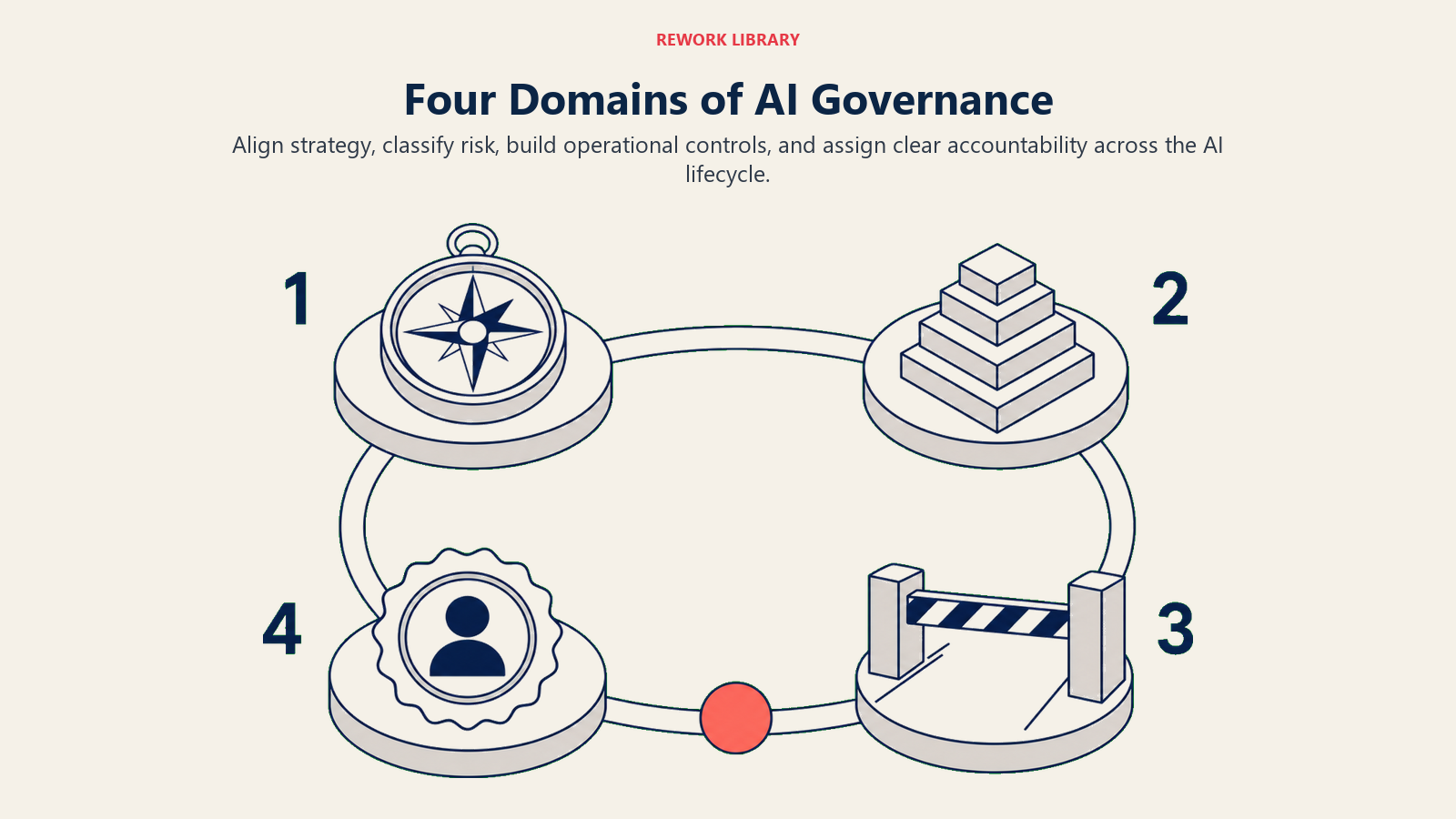
1. Strategic Alignment
Before governing AI use, clarify AI strategy. Governance without strategy becomes bureaucratic obstacle. Strategy without governance becomes reckless experimentation.
Key questions:
- Which AI use cases align with our strategic priorities?
- What's our risk appetite for different types of AI applications?
- Where should we lead, and where should we follow more mature implementations?
Not all AI applications carry equal risk. Customer-facing decisions, financial determinations, and healthcare applications require stricter governance than internal productivity tools.
2. Risk Assessment and Classification
Create a framework for classifying AI applications by risk level:
High risk - Decisions that significantly impact individuals (hiring, lending, healthcare), or that could cause substantial harm if wrong. These need extensive testing, human oversight, and ongoing monitoring.
Medium risk - Applications that affect business operations or customer experience, but with limited individual impact. These need standard testing and periodic reviews.
Lower risk - Internal productivity tools and applications with human oversight on outputs. These can move faster with lighter governance.
Match governance intensity to risk level. Applying the same rigor to a meeting scheduler as to a credit decision wastes resources and slows innovation unnecessarily.
3. Operational Controls
Build controls into AI development and deployment:
Data governance - Ensure training data is appropriate, representative, and properly sourced. Data problems become AI problems.
Testing and validation - Test for accuracy, bias, edge cases, and adversarial inputs before deployment. Continue testing after deployment.
Human oversight - Define where human judgment is required. Not every AI decision needs human review, but high-stakes decisions should have appropriate checkpoints.
Monitoring and alerts - Track model performance continuously. Detect drift before it causes problems. Know immediately when something goes wrong.
Documentation - Maintain records of model development, training data, testing results, and deployment decisions. This matters for regulatory compliance and internal learning.
4. Accountability Structure
Assign clear accountability for AI governance:
Executive sponsorship - AI governance needs board-level attention. Assign a senior executive as accountable owner.
Cross-functional governance body - Include technology, legal, risk, ethics, and business representatives. AI governance can't live in one department.
Clear escalation paths - Define how concerns get raised and addressed. Make it safe to flag problems early.
Regular review cycles - Governance frameworks need updating as AI capabilities and risks evolve. Build in periodic reassessment.
Putting This Into Practice
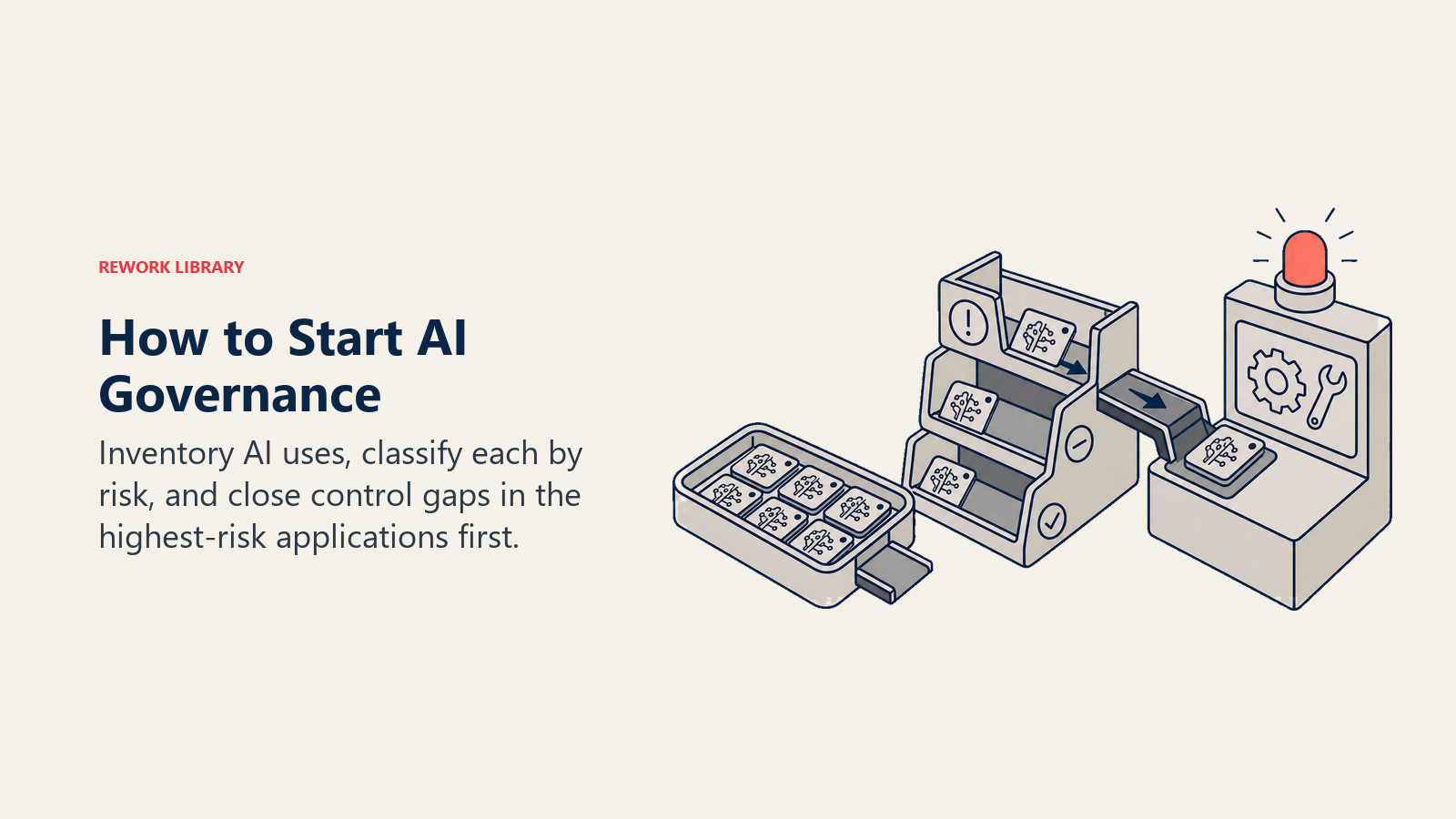
Start here: Inventory your current AI applications. Classify them by risk level. Identify which high-risk applications lack appropriate governance.
Common mistake: Creating governance so burdensome that teams work around it. Governance must enable, not just restrict.
Measure success by: Whether you can deploy AI applications faster than competitors while having fewer incidents and regulatory issues.
AI governance isn't about slowing down. It's about building the institutional capability to move fast responsibly. The organizations that figure this out will deploy AI more confidently, with fewer costly mistakes, and with the trust of customers, regulators, and employees. That's the actual competitive advantage.
