Burnout Culture: How Overwork Becomes the Norm (and How to Reverse It)
Turn this article into takeaways for your work.


Each assistant summarizes the article only for you and suggests best practices for your work.
Burnout culture is a set of workplace norms that reward overwork, treat exhaustion as a badge of commitment, and quietly penalize anyone who protects their time. It is not one employee having a rough quarter. It is what happens when hiring, staffing, promotion, and what leaders praise in a Monday standup all point the same direction: toward burnout as a predictable outcome, not an accident.
That distinction matters because most companies treat burnout as a personal resilience problem. They add a meditation app or a "no-meeting Friday" and wait for the exhaustion to lift. It rarely does, because the app never touches the workload, the unclear expectations, or the manager who still emails at 11 p.m. and expects a reply by breakfast. Fixing burnout culture means fixing the system that produces it, not coaching people to cope with it better.
What Burnout Culture Actually Is
The World Health Organization does not classify burnout as a medical condition, but it does classify it as an occupational phenomenon in the ICD-11, defined as "a syndrome conceptualized as resulting from chronic workplace stress that has not been successfully managed." The definition names three dimensions, and all three matter for diagnosing culture, not just individuals:
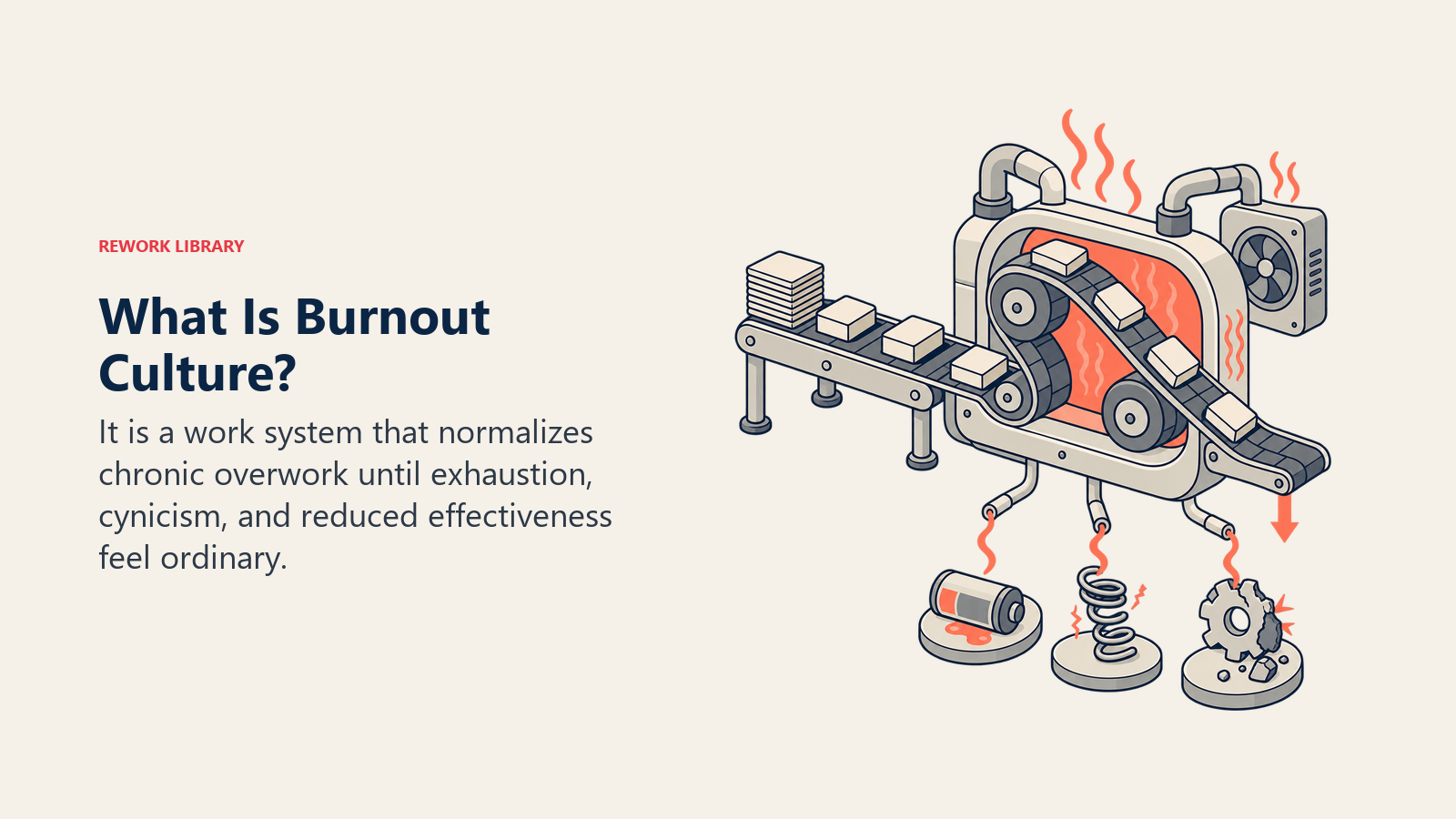
- Energy depletion or exhaustion. People feel drained before the workday even starts.
- Increased mental distance, cynicism, or negativism toward the job. The quiet-quitting precursor: people stop caring because caring stopped paying off.
- Reduced professional efficacy. People start believing, often correctly, that effort will not fix the underlying conditions, so they do less of it.
Burnout culture is the organizational condition that makes all three symptoms common instead of rare. One burned-out employee is a signal about that person's circumstances. A team where most people show at least one of these symptoms is a signal about the system, and no individual coping strategy fixes a system.
It also helps to separate burnout culture from a close cousin. Signs of a toxic culture covers the broader set of behaviors that erode trust and safety at work; burnout culture is one specific, workload-driven branch of that pattern, distinct from blame culture or favoritism, though the three often travel together.
The Drivers of Burnout Culture
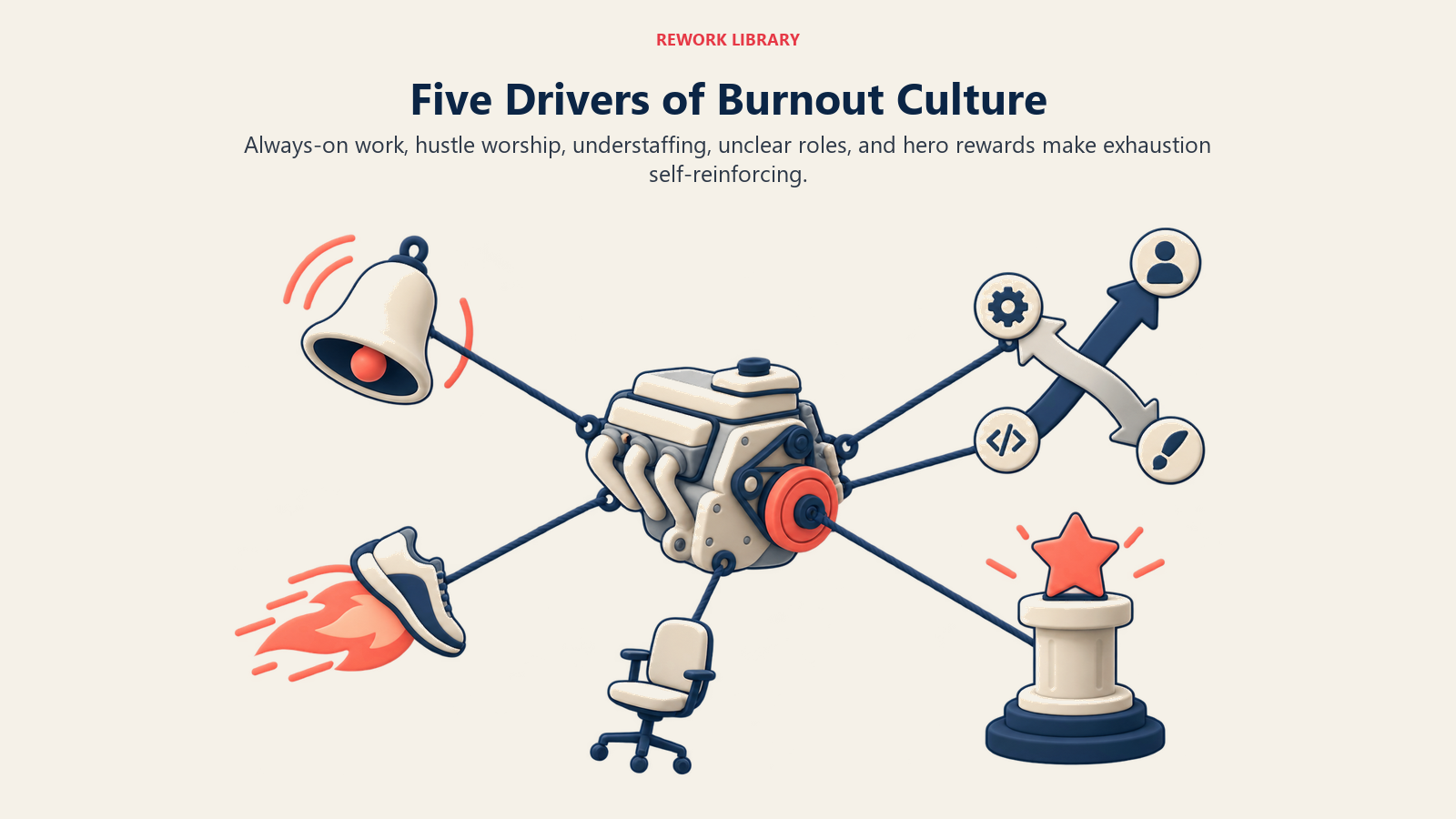
Burnout culture rarely traces back to one bad decision. It usually forms from a handful of reinforcing habits that each look defensible on their own.
Always-On Expectations
When a message sent at 9 p.m. gets a reply within minutes, that response time quietly becomes the norm, whether or not anyone said so out loud. Nobody has to write "we expect after-hours availability" into a handbook. The pattern teaches it faster than any policy, and once a few people answer off-hours messages, everyone else feels pressure to keep pace.
Hustle Glorification
Some cultures actively celebrate overwork: the founder who sleeps four hours a night, the "we grind because we care" slide, the quiet leaderboard for who logs in earliest. Glorifying hustle signals what gets noticed, and people optimize for what gets rewarded, even when they privately think the pace is unsustainable.
Chronic Understaffing
Sometimes there is no glorification at all, just a headcount plan that assumes five people can permanently do the work of seven. Understaffing turns overtime from an occasional crunch response into the baseline. Gallup names unmanageable workload as one of the top drivers of burnout, and no resilience training closes a structural staffing gap.
Unclear Boundaries and Role Ambiguity
When nobody has clearly defined who owns what, people compensate by doing everything, just in case. That produces duplicated effort, constant context-switching, and a background hum of anxiety about whether the important thing got covered. Gallup names lack of role clarity and lack of manager support among its top five burnout causes, alongside workload and time pressure.
Hero Culture
Every organization eventually has a moment where someone pulls an all-nighter to save a launch, and how leadership responds sets a precedent. Praise the hero publicly, and the lesson everyone learns is that burning out is the fastest path to recognition. The next crisis produces a volunteer for the same sacrifice.
Key Facts
- Burnout is classified as an occupational phenomenon in the ICD-11, defined as a syndrome from chronic workplace stress that has not been successfully managed, with three dimensions: exhaustion, cynicism, and reduced professional efficacy. Source: World Health Organization
- 76% of employees experience burnout on the job at least sometimes, and 28% say they are burned out "very often" or "always" at work. Source: Gallup
- Gallup's top five predictors of burnout are unfair treatment at work, unmanageable workload, lack of role clarity, lack of communication and support from managers, and unreasonable time pressure. Source: Gallup
- 77% of respondents say they have experienced burnout at their current job. Source: Deloitte Workplace Burnout Survey
- Managers account for at least 70% of the variance in team engagement scores across business units, one reason burnout culture can look completely different on two teams in the same company. Source: Gallup
- 40% of employees received AI-generated "workslop" in the past month, each incident costing nearly two hours of rework, an estimated $9 million a year in lost productivity at a 10,000-person company. Source: Harvard Business Review, September 2025
Why Burnout Is a Culture Problem, Not a Personal One
Christina Maslach, who created the Maslach Burnout Inventory and spent decades researching the condition, has been explicit on this point: burnout is not primarily a problem with the person experiencing it. It is a problem with the environment they work in. As she put it in a widely cited Harvard Business Review piece, treating burnout as an individual failing "misses the more powerful factor in the equation: the situation."
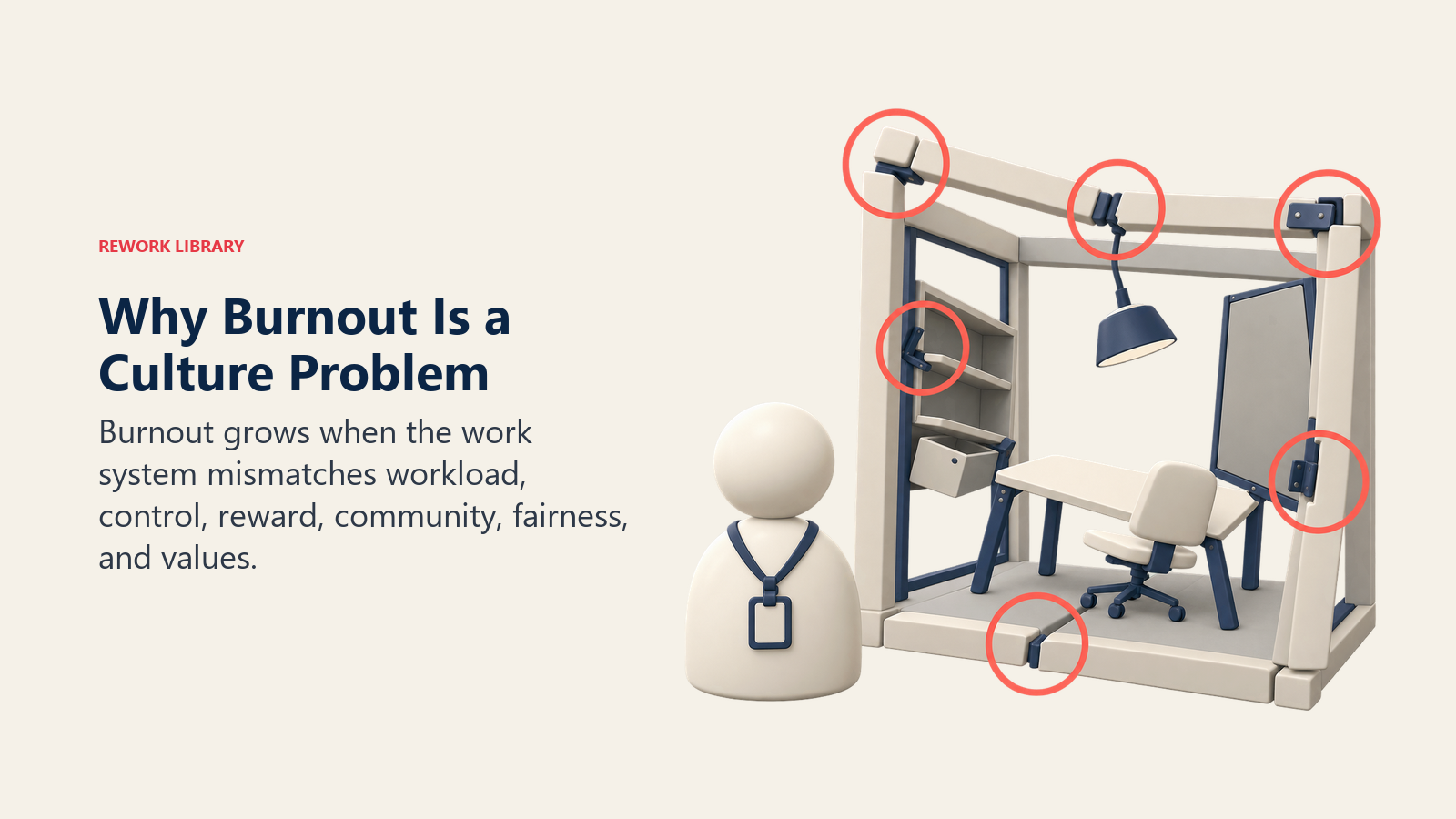
Maslach and her longtime collaborator Michael Leiter identified six areas of mismatch between a person and their job. Any one, if chronically misaligned, can produce burnout regardless of how resilient the person is:
| Mismatch area | What goes wrong |
|---|---|
| Workload | Demands consistently exceed the time and resources available |
| Control | People lack authority over decisions about their own work |
| Reward | Effort and results go unrecognized, financially or socially |
| Community | Relationships at work are marked by conflict or isolation |
| Fairness | Decisions on pay, promotion, and workload feel arbitrary |
| Values | A gap exists between what leadership says and what it rewards |
This framing is why "burnout culture" is more useful than "burned-out employees." It redirects the diagnosis toward six levers, all organizational design choices, not personality traits. A company can hire the most resilient people in its industry and still produce a burned-out workforce if several of these areas are misaligned at once. This is also why the link between culture and performance runs directly through burnout: a culture running on these mismatches is degrading the same execution capacity leadership is trying to protect with tighter deadlines.
The Business Cost of Burnout Culture
Burnout culture rarely shows up on a P&L line labeled "burnout." It shows up scattered across costs attributed to something else, which is exactly why it persists for years before anyone connects the dots.
- Turnover. Burned-out employees are more likely to be actively job-searching, and the people most likely to leave first are often the strongest performers, the ones with the most options and the least patience for a system asking more without adjusting.
- Quality and errors. Exhausted people make more mistakes and catch fewer of their own. In customer-facing, compliance, or safety-sensitive work, that drop is not abstract.
- Quiet quitting. The "increased mental distance" dimension in the WHO's own definition is, functionally, quiet quitting: a rational response to a system that stopped rewarding extra effort with anything except more of the same.
- Presenteeism. People show up sick or distracted because real time off feels riskier to their standing than working through it, costing more in lost output than the absence it was meant to avoid.
- Manager burnout compounding downward. A burned-out manager has less capacity for the attentive management Gallup's research shows prevents burnout on their own team, so it often reproduces down the reporting chain instead of staying contained.
Burnout Culture in Remote and Always-On Teams
Remote and hybrid work removed the boundary that used to separate "at work" from "at home": the commute, the office door, the physical act of leaving. Without it, the workday tends to expand into every open hour, especially for people trying to prove they are pulling their weight while out of sight.
Notification volume compounds the problem. A message that would once have waited until morning now arrives at dinner, and answering feels lower-effort than it is: one glance, one quick reply, and those small responses accumulate into a workday that never fully ends. We cover the specific practices that keep distributed teams from drifting here, protected meeting-free blocks, explicit response-time norms, manager training on remote burnout signals, in how to build culture in remote and hybrid teams.
The always-on default is rarely a written policy. It is an emergent norm, built the same way national vs. company vs. team culture forms at the team level: through what a manager models and reinforces day after day, regardless of what the handbook says.
The AI-Era Twist: "Do More With AI" Pressure
AI tools were supposed to reduce workload. In practice, many organizations use the productivity gains from AI as a reason to raise expectations rather than give anyone their time back, an honest tension worth naming: the same technology marketed as a relief valve is, in a growing number of workplaces, becoming a new source of pressure.
Two mechanisms drive this. First, "do more with AI" quietly resets the baseline: if a task used to take four hours and AI cuts it to two, expectations often shift to fitting in twice as much work rather than reclaiming the saved time. Second, AI output creates hidden labor. The Harvard Business Review study on "workslop" found that AI-generated content which looks polished but lacks real substance costs the recipient nearly two hours of cleanup per incident, and that cleanup rarely appears on anyone's task list.
Neither point argues against using AI. It argues for managing the transition deliberately rather than assuming productivity gains automatically become relief. We go deeper on the trust and workload erosion that follows unmanaged AI rollouts in AI cultural debt, the durable version of this same problem.
How to Reverse Burnout Culture
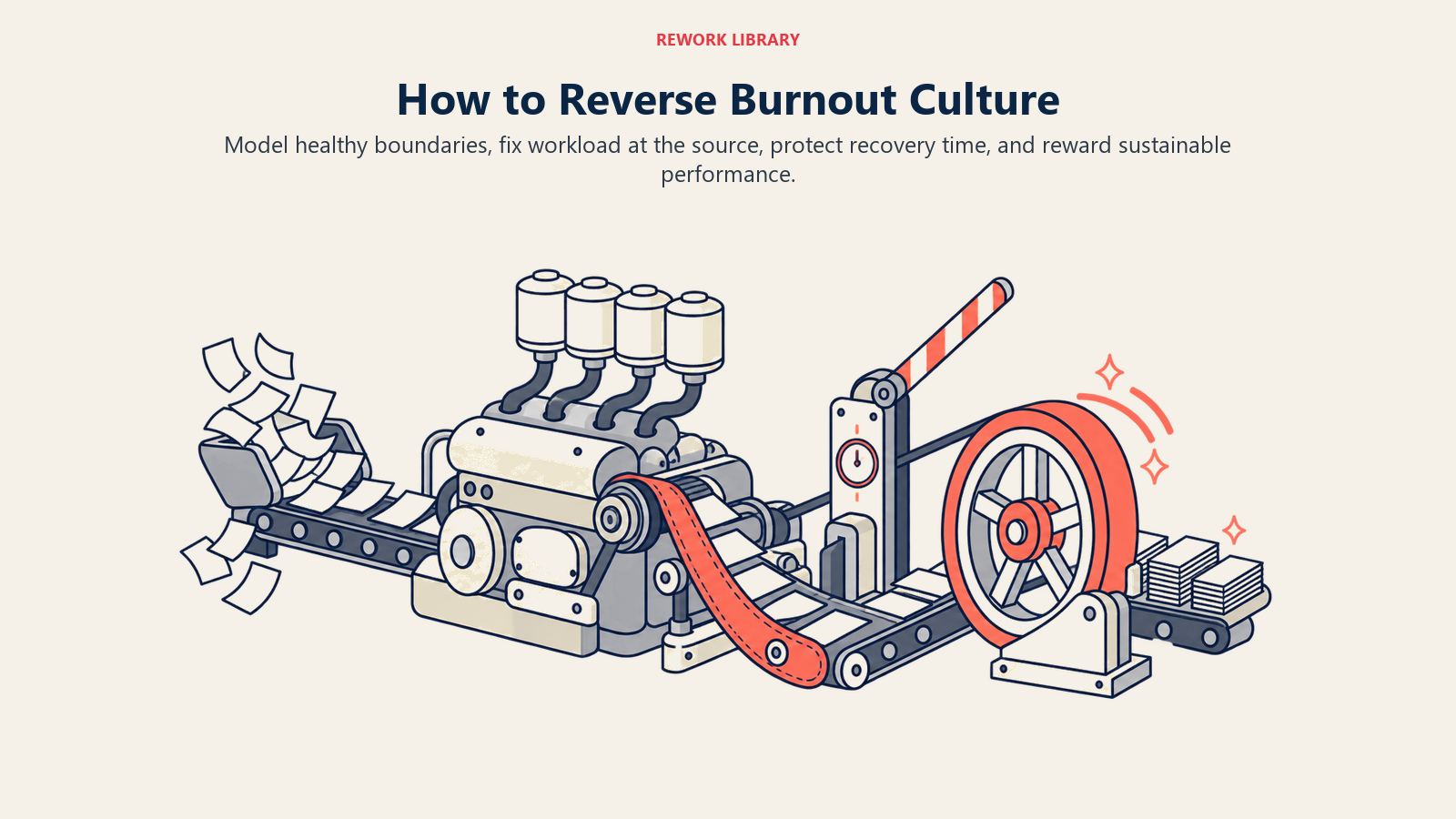
Reversing burnout culture means changing the systems that created it. None of the following works as a one-time initiative; they only work as standing practices that survive past the announcement.
Leadership Models the Behavior It Wants
If a founder sends emails at midnight, employees read late-night responsiveness as an unwritten requirement no matter what the handbook says. The cheapest fix available to any leader is to stop performing overwork themselves: take the vacation without checking Slack, leave visibly on time some days, say out loud when a deadline moved because the original one was unreasonable.
Fix the Workload, Not Just the Wellness Perks
A meditation app does not change headcount, deadlines, or scope. If workload is the driver, the fix is one of three levers: add capacity, cut scope, or extend the timeline. Naming that trade-off in front of the team is itself a culture signal: it tells people leadership sees the mismatch and will change the plan instead of asking them to absorb it silently.
Set and Protect Boundaries Systemically
Individual willpower loses to organizational habit almost every time. Boundaries that stick get built into the system: notifications off by default after hours, meeting-free blocks protected on the calendar rather than optional, and explicit response-time expectations so a 9 p.m. message does not require a same-night reply.
Build Psychological Safety So People Can Say "This Is Too Much"
Employees who fear that raising a workload concern reads as weakness will absorb the strain silently until they burn out or leave. Teams with real psychological safety at work surface capacity problems while they are still manageable, because they calibrate what is safe to say based on how the last person who spoke up was treated, not on what a values statement promises.
Redesign Reward Systems Around Sustainable Output
As long as promotions flow to whoever looks busiest, hustle glorification beats any stated value of balance. Fixing this means auditing what actually gets rewarded: does the person who delivers steadily in normal hours get recognized as much as the one who saves the day from a crisis they may have helped create? A real feedback culture helps here, because regular, honest feedback surfaces unsustainable patterns before they calcify into "that's just how things are done."
Tracking whether these changes land matters as much as making them. How to measure company culture and a well-run eNPS program both give leaders a way to see burnout signals in the data before they show up as resignation letters. Rework's People app, which puts time and attendance data in the same system as HR records, is one practical way to spot patterns like chronic overtime or vanishing PTO usage before they turn into an exit interview, though fixing what the data reveals is still the harder leadership work above it.
Where to Go Next
Burnout culture sits inside the broader pattern of unhealthy workplace norms. From here:
- Signs of a toxic work culture, for the wider set of behaviors that erode trust and safety
- Building trust in the workplace, for the foundation that makes it safe to say "this is too much" in the first place
- AI cultural debt, for the specific way unmanaged AI rollouts add a new layer of pressure on top of existing burnout drivers
Frequently Asked Questions about Burnout Culture
What is burnout culture in simple terms?
Burnout culture is a set of workplace norms that treat overwork as normal or admirable and quietly penalize people who protect their time or workload. Unlike one employee having a hard month, it describes a system, hiring, staffing, reward, and leadership behavior, that produces burnout as a predictable outcome.
Is burnout a medical diagnosis?
No. The World Health Organization classifies burnout in the ICD-11 as an occupational phenomenon, not a medical condition, defined as a syndrome from chronic workplace stress that has not been successfully managed. It has three dimensions: exhaustion, cynicism or mental distance from the job, and reduced professional efficacy.
Why does Christina Maslach say burnout is a workplace problem, not a personal one?
Maslach's research, and the Maslach Burnout Inventory she created, found that burnout tracks closely with six areas of mismatch between a person and their job: workload, control, reward, community, fairness, and values. Because these are organizational choices rather than personality traits, the same mismatches will burn out even highly resilient employees.
What are the main drivers of burnout culture?
The most common drivers are always-on communication expectations, hustle glorification that rewards visible overwork, chronic understaffing that makes overtime the baseline, unclear roles that push people to cover everything just in case, and hero culture that publicly praises whoever burns out hardest to save a deadline.
How does AI affect burnout culture?
AI can help or worsen burnout depending on the rollout. When productivity gains get converted into higher output expectations rather than reclaimed time, pressure increases instead of easing. AI-generated "workslop," content that looks finished but needs significant rework, also creates hidden labor: research published in Harvard Business Review in 2025 found each incident costs the recipient nearly two hours of cleanup.
Can wellness perks fix burnout culture?
Rarely on their own. Perks like meditation apps or occasional no-meeting days address symptoms without touching workload, staffing, or what leadership actually rewards. Paired with real changes to workload and boundaries, perks can help; used as a substitute for those changes, they usually do not move the numbers.
How do you know if your company has a burnout culture?
Watch systemic signals, not just individual complaints: consistently high after-hours message activity, vanishing PTO usage across a team, turnover concentrated among strong performers, and a pattern where the people who get promoted are the ones who visibly sacrifice the most. A well-run engagement or eNPS survey can surface these patterns in aggregate before they show up as resignations.
What is the fastest thing a leader can do to start reversing burnout culture?
Stop performing overwork and say so out loud. Leaders are the loudest cultural signal in any organization, and visibly protecting their own time, skipping the midnight email, taking a real vacation, naming an unreasonable deadline as unreasonable, changes what the rest of the organization believes is expected faster than any policy document can.
Burnout culture is not fixed by asking exhausted people to be more resilient. It is fixed the way any other culture problem gets fixed: by changing what gets rewarded, what gets measured, and what leadership is willing to model under pressure. The organizations that reverse it stop treating overwork as proof of commitment and start treating sustainable pace as the standard they hold everyone, including themselves, to.

Co-Founder, Rework.com
On this page
- What Burnout Culture Actually Is
- The Drivers of Burnout Culture
- Always-On Expectations
- Hustle Glorification
- Chronic Understaffing
- Unclear Boundaries and Role Ambiguity
- Hero Culture
- Key Facts
- Why Burnout Is a Culture Problem, Not a Personal One
- The Business Cost of Burnout Culture
- Burnout Culture in Remote and Always-On Teams
- The AI-Era Twist: "Do More With AI" Pressure
- How to Reverse Burnout Culture
- Leadership Models the Behavior It Wants
- Fix the Workload, Not Just the Wellness Perks
- Set and Protect Boundaries Systemically
- Build Psychological Safety So People Can Say "This Is Too Much"
- Redesign Reward Systems Around Sustainable Output
- Where to Go Next