The AI Adoption Divide: The Two-Speed Workforce Inside Your Company
Turn this article into takeaways for your work.


Each assistant summarizes the article only for you and suggests best practices for your work.
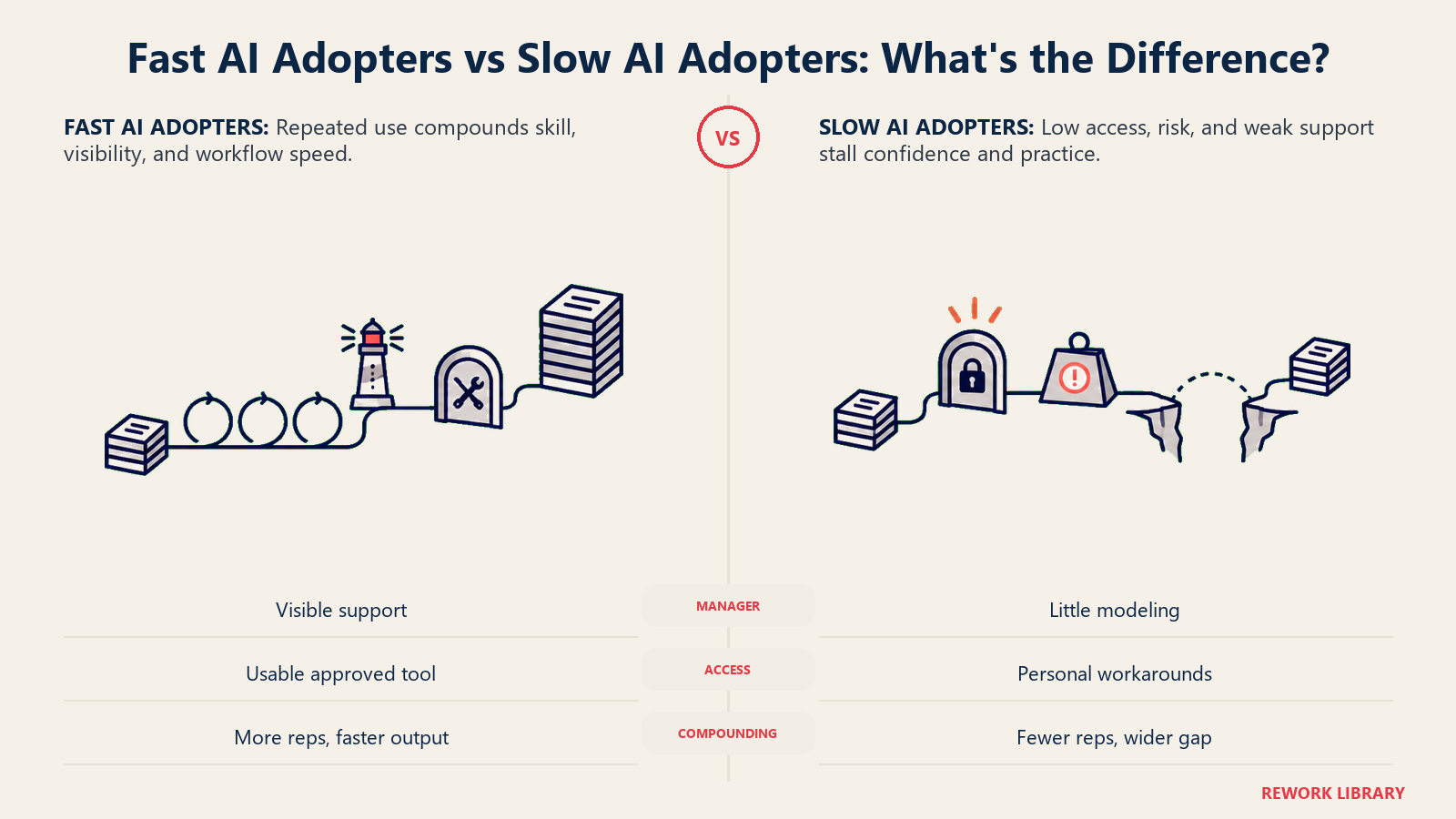
The AI adoption divide is the gap inside one company between employees who have rebuilt their daily workflow around AI and those who still use it rarely or not at all. It is driven less by age than by role, manager behavior, perceived job risk, tool access, and confidence, and left alone it compounds: the fast group gets faster and more visible, the slow group falls behind and starts to look like the problem.
If you run a team, you've probably noticed this without a survey. A handful of people have quietly changed how they draft, research, and plan. A larger group opens the AI tool occasionally, gets one unreliable result, and stops. And a third group is doing something in between that leadership can't see at all, because it's happening on a personal account outside any company tool.
Key Facts
- Daily AI use scales sharply with seniority: 43 percent of executives use AI every day, versus 35 percent of senior managers, 23 percent of middle managers, and roughly 10 percent of individual contributors (Slack Workforce Index, "The New AI Advantage," 2025).
- Employees who strongly agree their manager actively supports AI use are 2.1 times as likely to use it a few times a week or more, but only 28 percent of employees at companies rolling out AI say their manager actively supports it (Gallup, "Manager Support Drives Employee AI Adoption," May 2025, n=19,043 U.S. employed adults).
- 78 percent of AI users bring their own AI tools to work rather than using company-sanctioned ones, and 52 percent are reluctant to admit using AI for their most important tasks (Microsoft Work Trend Index 2024, "AI at Work Is Here, Now Comes the Hard Part," surveyed 31,000 workers in 31 countries).
- 69 percent of leaders use AI regularly at work versus 45 percent of employees, and 78 percent of leaders trust AI for high-stakes work versus 66 percent of employees (Microsoft Work Trend Index 2025, "2025: The Year the Frontier Firm Is Born").
- 57 percent of employees admit to hiding their AI use and presenting AI-generated work as their own, and roughly half say they use AI in ways that violate company policy, including pasting sensitive data into free public tools (KPMG and University of Melbourne, "Trust, Attitudes and Use of Artificial Intelligence: A Global Study 2025," 48,000+ respondents across 47 countries).
- 52 percent of U.S. workers say they're worried about AI's future impact on their job, 32 percent expect it to mean fewer opportunities for them long term, and only 6 percent expect more (Pew Research Center, "U.S. Workers Are More Worried Than Hopeful About Future AI Use in the Workplace," February 2025, n=5,273).
This Isn't Really a Generational Story
The easy explanation for an uneven AI workforce is age: younger people grew up online, older people are set in their ways. The data doesn't support that as the main story.
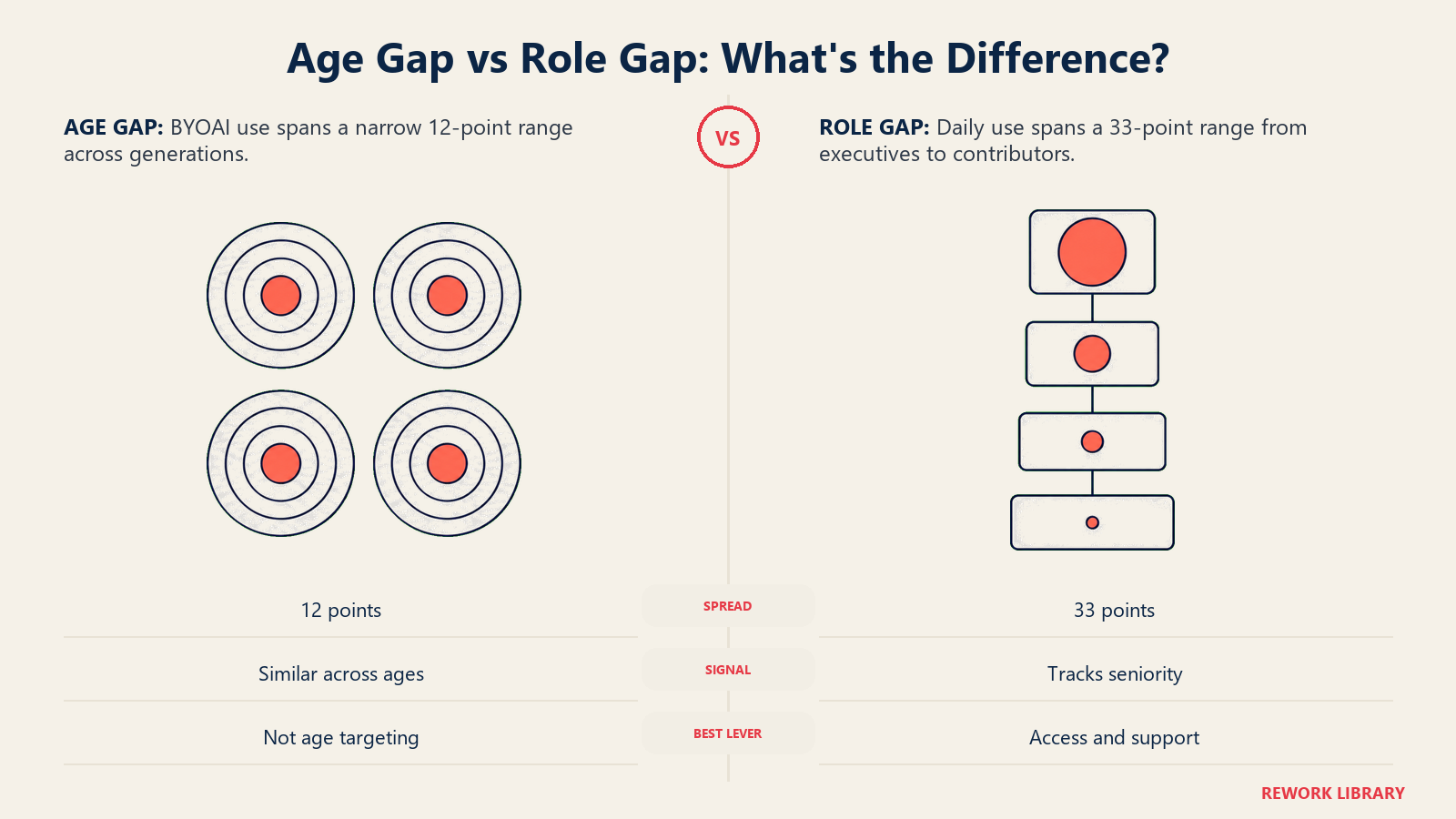
Microsoft's 2024 Work Trend Index broke down BYOAI (bring-your-own-AI) adoption by generation and found a much narrower band than the stereotype predicts: 85 percent of Gen Z, 78 percent of millennials, 76 percent of Gen X, and 73 percent of boomers and older all report bringing personal AI tools to work. That's a 12-point spread across four generations, all clustered well above three in four.
Compare that to the seniority spread in Slack's 2025 Workforce Index: 43 percent of executives use AI daily against roughly 10 percent of individual contributors, a 33-point gap, nearly three times wider than the entire generational spread. If age explained the divide, daily-use numbers would track birth year. They track org chart position instead, which points somewhere more useful: role, incentive, and access, not calendar age.
Treating this as a generational problem also lets leadership off the hook. "The younger staff will bring the older ones along" requires nothing of the organization. The real levers sit with managers, role design, and tooling, all of which a company can act on directly.
What Actually Drives the Divide
Role and genuine task fit
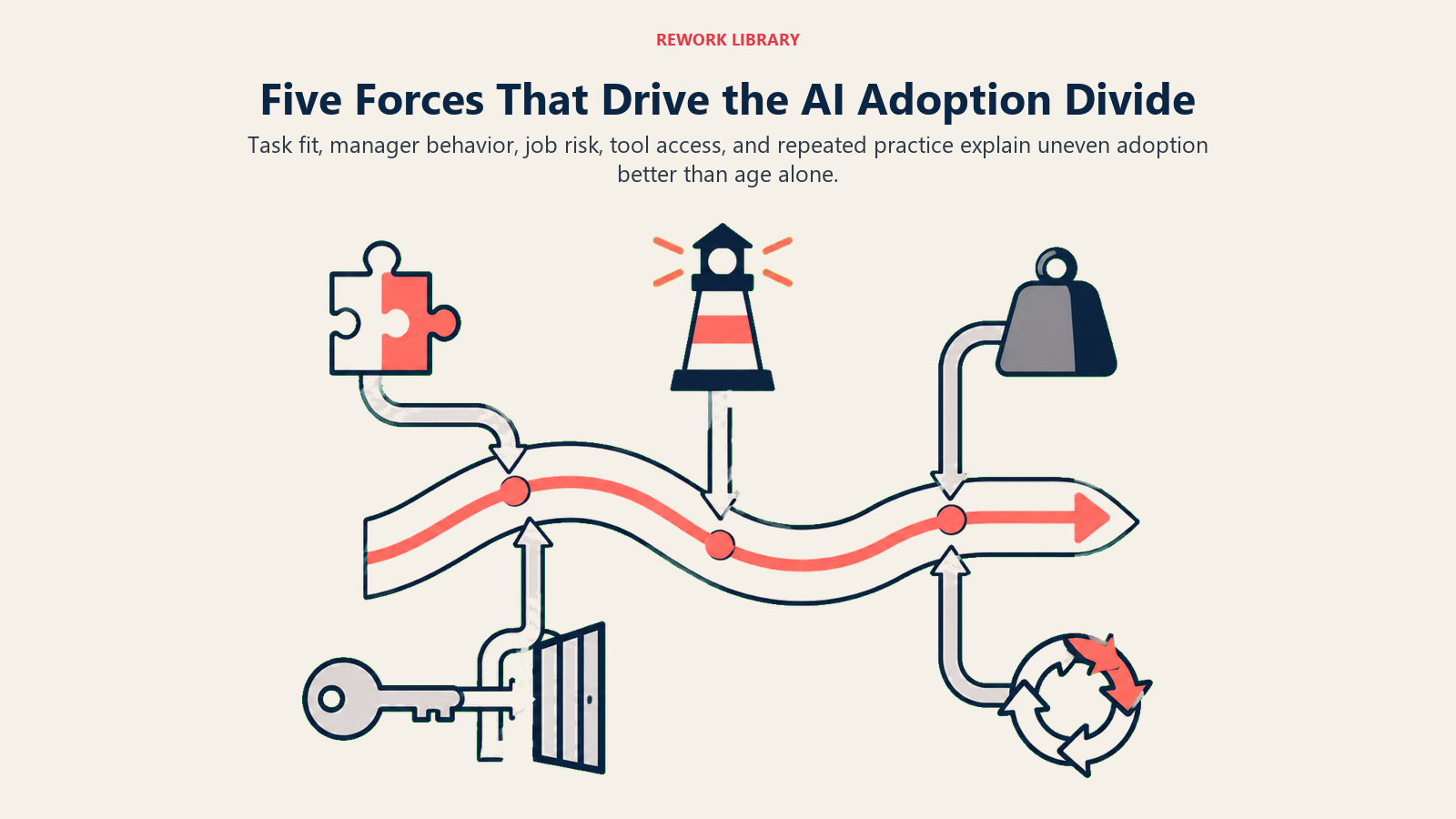
Some roles have obvious AI task fit: drafting, summarizing, first-pass research, and code scaffolding map cleanly onto what current tools do well. Roles built around physical presence, real-time judgment calls, or regulated documentation have a genuinely thinner set of use cases today. Some of what looks like resistance is accurate task assessment, and mandating a tool onto work it doesn't help with breeds cynicism about the next rollout too.
Manager behavior and modeling
This is the single most measurable lever in the data. Gallup found employees are 2.1 times as likely to use AI regularly when their manager visibly and actively supports it, yet only 28 percent say that support is actually there. Middle managers themselves show lower personal daily use (23 percent) than executives (43 percent) in Slack's data, meaning a lot of managers are being asked to champion a tool they haven't built real fluency with. You can't coach what you haven't done. The middle manager's job is already being reshaped by AI in ways that make this harder, since the same manager absorbs new expectations from above while trying to model new behavior below.
Perceived job risk
Pew found 52 percent of workers are worried about AI's future workplace impact and 32 percent expect it to reduce their own opportunities, against just 6 percent who expect more. If a meaningful share of the workforce believes getting visibly good at AI could accelerate their own redundancy, slow adoption is a rational hedge, not a character flaw. Nobody optimizes enthusiastically for a future they think ends with their own role.
Tool access, policy, and training
KPMG's global study found only 40 percent of workplaces have any policy governing generative AI use, and just 47 percent of workers report receiving training on it. Absent clear tools, rules, and instruction, people default to whatever is easiest to reach, rarely the sanctioned option, and that gap is exactly what produces the shadow-AI dynamic covered below.
Confidence built through repetition
Skill and confidence compound the way any capability does: early reps build fluency, fluency builds trust in the output, and trust drives more use. Someone who tried a tool once, got a mediocre result on a hard problem, and never returned is stuck at the bottom of a curve the confident group climbed months ago. Skills have a shorter half-life now, and a one-time training session doesn't fix a confidence gap that only closes through repeated, low-stakes use.
The Legitimate Reasons "Resisters" Hold Back
It's tempting to sort employees into "adopters" and "resisters" and treat the second group as a problem to manage out. The evidence, and simple fairness, doesn't support that framing.
Some holdouts are protecting quality they're accountable for. KPMG found 66 percent of workers rely on AI output without evaluating its accuracy, and 56 percent report making mistakes because of it. Someone who watched a colleague's AI-drafted analysis get corrected in front of a client has a reasonable reason to move carefully, especially if they'd be the one held responsible next time.
Some are protecting themselves from ambiguous accountability. If no policy exists for who owns an AI-assisted error, the safest move is to keep the human-only version of the process until that ambiguity resolves. That isn't fear of change; it's a sound read of an incomplete system.
And some are waiting for the tool to be worth the switching cost, since adopting a new way of working costs time now for a payoff that isn't guaranteed until fluency is built. That's a confidence problem the organization can address, not a motivation problem to punish.
None of this argues for standing still. It argues for building the case, the training, and the guardrails before expecting the slowest quarter of the workforce to close the gap on will alone.
Shadow AI: When Official Tools Lag Behind What People Already Use
The most disruptive part of the divide isn't the visible gap between heavy and light users. It's the invisible layer underneath it. Microsoft found 78 percent of AI users bring personal tools to work instead of sanctioned ones, rising to 80 percent at small and mid-size companies, and 52 percent are reluctant to admit using AI for their most important work. KPMG's global study sharpens the picture: 57 percent of employees admit to hiding their AI use and presenting AI-generated work as their own, and roughly half say they've used AI in ways that break company policy, including pasting sensitive company data into free public tools.
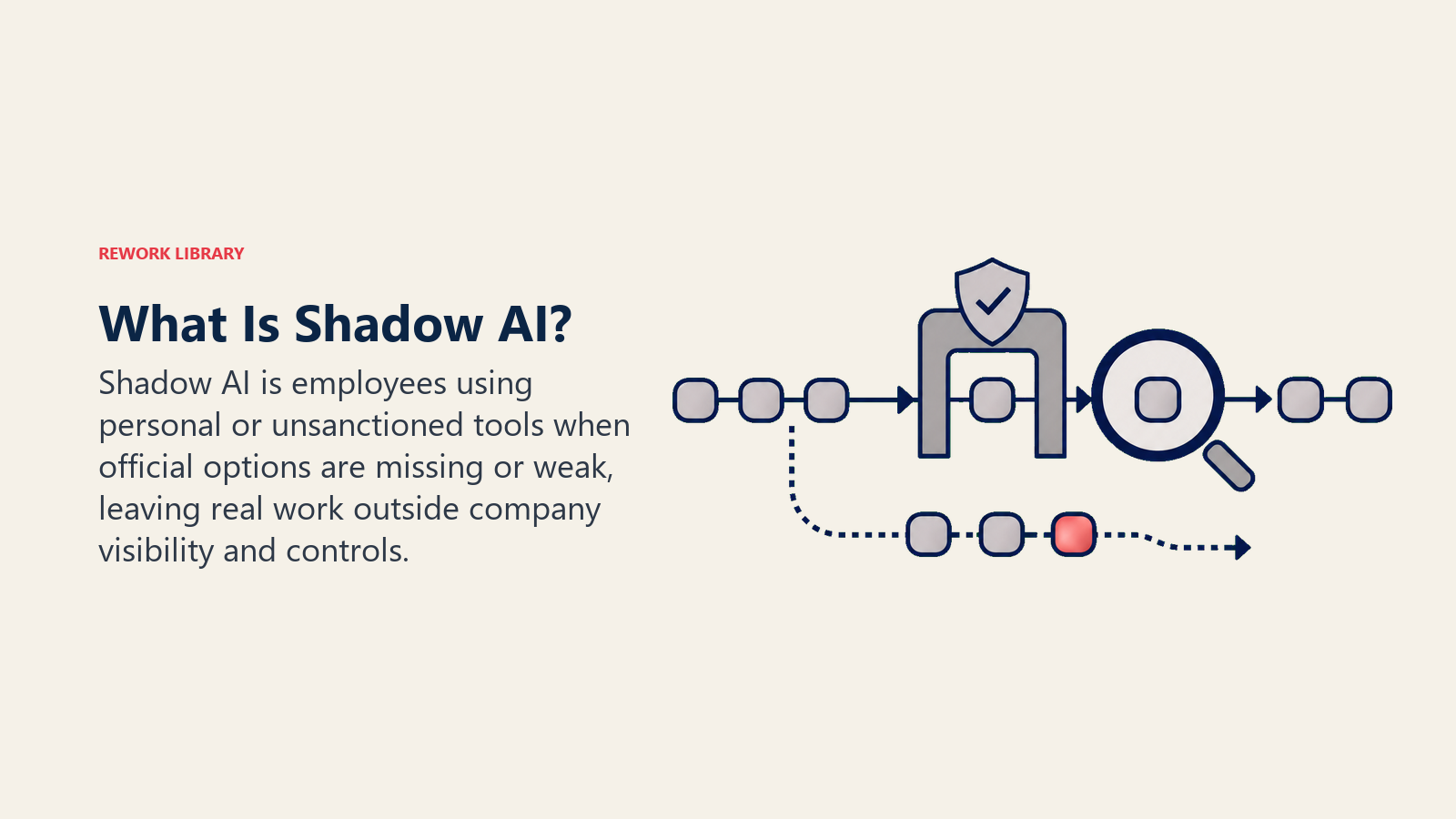
Official adoption dashboards are measuring the wrong thing. A company that thinks it has a 20 percent adoption problem, based on logins to its sanctioned tool, may have a workforce using AI at a much higher rate, just not through any channel it can see, secure, or learn from. This pattern has a name: shadow AI, the same dynamic behind shadow IT a decade earlier, now moving faster because the tools are free and need no procurement approval at all.
Shadow AI usually isn't rebellion. It's people solving a problem the official rollout hasn't solved: the sanctioned tool is clunky, slow to approve, or missing a capability a personal account already has. The fix isn't a crackdown; banning unsanctioned tools without offering a workable sanctioned one just pushes the behavior further underground, right when the company most needs visibility into how work actually gets done.
Driver, Symptom, and Fix at a Glance
| Driver of the divide | What it looks like day to day | What actually closes it |
|---|---|---|
| Role and task fit | Some teams see obvious, fast AI wins; others see none, and get told they're "behind" anyway | Audit real use cases per role before mandating adoption; don't force a tool onto work it doesn't fit |
| Manager behavior | Managers who don't personally use AI can't coach it, and their teams notice the gap between the mandate and the example | Get managers using the tool first, with their own visible reps, before asking their teams to follow |
| Perceived job risk | Employees who fear AI competence could accelerate their own redundancy adopt slowly and quietly | Be explicit and honest about how roles will change, and back it with real redeployment and reskilling commitments |
| Tool access and policy | No sanctioned option, unclear rules, and little training, so people default to personal tools off the record | Ship a genuinely usable sanctioned tool alongside a plain-language policy and real training, not a memo |
| Confidence and repetition | One bad early result ends adoption for good; fast adopters just kept practicing past their own bad results | Build structured, low-stakes practice time into the week, not a single onboarding session |
The Fairness and Performance Consequences of an Uneven Playing Field
An adoption gap left unmanaged doesn't stay flat. It compounds in ways that show up in reviews, pay, and who gets the next stretch assignment.
The fast-adopting group builds a visible track record faster: more output, faster turnaround, more chances to shine on stretch work. Managers, often without meaning to, start reading "comfortable with AI" as a proxy for "high performer," even when judgment quality is equal between the two employees. Performance management built for an AI-augmented team has to separate those two things deliberately, or a proxy metric that rewards visible tool use over actual judgment will quietly punish people who had legitimate reasons to move carefully.
The slower-adopting group often knows exactly what's happening. They see colleagues moving faster, sense the status shift, and either push into a tool they don't yet trust just to keep up, or disengage from a race they've concluded they can't win. Neither outcome is good; the first invites the shortcuts KPMG's accuracy numbers already warn about, the second quietly loses capable people. This is where the divide stops being a productivity issue and becomes a trust issue: teams that don't feel safe admitting "I haven't figured this out yet" hide it instead, the same instinct behind the 57 percent hiding number above, just expressed inside the team rather than outside it. Psychological safety inside AI-using teams determines whether that admission happens in the open, where it can be coached, or in private.
Left long enough, the two groups self-sort into informal camps: people who talk about prompts openly, and people who've stopped bringing it up. That's the early shape of a subculture forming around a shared grievance or a shared advantage, and subcultures built around who has power are hard to dissolve once they harden into an identity.
How to Close the Gap Without Mandating Enthusiasm
You cannot mandate confidence, and trying to usually backfires. What you can do is remove the specific, evidenced barriers above, one at a time.
Fix the tool and the policy before you fix the person
If 78 percent of your AI users already go around your sanctioned tool, the tool and the policy around it are the first things to fix, not the employee. Ship something people would actually choose to use, write the policy in plain language, cover what happens when the AI makes a mistake, and make the sanctioned option easier to reach than the workaround. Asking people to abandon a working shadow habit for a worse sanctioned one just teaches them to hide the next tool better.
Get managers using it before asking their teams to
Gallup's 2.1x multiplier is the highest-leverage number in this topic. Invest training time and real accountability in managers first, so they can speak from their own recent experience, including their own mistakes, rather than a slide-deck talking point. A manager who can say "here's where it helped and where it steered me wrong" earns far more trust than one who can only say "corporate wants adoption up."
Separate "must try it" from "must be excellent at it immediately"
Structured, low-stakes practice on real but non-critical work closes the confidence gap a single training session can't. The skills worth building around AI are judgment, verification, and domain-specific prompting, and all three only come from repetition.
Measure the workflow, not the tool
Reward outcomes: quality, cycle time, error rate. Don't reward visible AI usage as a stand-in for competence, and audit reviews for language that quietly does that. The broader adoption-versus-impact gap exists at the company level for the same reason: usage is easy to see and reward, and a poor proxy for what matters.
Take the legitimate objections seriously, in public
When someone raises an accuracy concern, an accountability question, or a job-security worry, treat it as real information about the rollout, not a problem to route around. A genuinely AI-ready culture is built partly on how an organization handles its skeptics, since how leadership responds to the first honest objection sets the norm for whether the next fifty raise theirs in the open or quietly keep doing things the old way. And sound judgment doesn't get less valuable as AI use increases; a workforce confident enough to say "I don't trust this output yet" is showing exactly the discernment needed once the stakes get higher.
Picture two people on the same team six months from now. One learned the tool alone, on their own time, and quietly worries every review is now graded on a curve they didn't know existed. The other had a manager who used it first, a policy that had their back when it got something wrong, and a few low-stakes weeks to get comfortable before anyone judged the output. Same company, same tool, two completely different odds of success. Closing the divide means making sure every employee gets the second version of that story, not just the ones who happened to land on the right team.
Frequently Asked Questions about the AI Adoption Divide
What is the AI adoption divide?
It's the gap inside a single company between employees who have restructured their daily workflow around AI and those who use it rarely or not at all. Research points to role, manager behavior, perceived job risk, tool access, and confidence as the main drivers, with seniority showing a far wider adoption gap (a 33-point spread by role in Slack's 2025 data) than age does.
Is the AI adoption gap really about generations?
The evidence says no. Microsoft's 2024 Work Trend Index found only a 12-point spread in AI use across four generations (73 to 85 percent), while Slack's 2025 data found a 33-point spread by seniority level alone. Role, incentive, and manager support explain far more of the gap than age does.
How much does a manager's own AI use affect their team's adoption?
Substantially. Gallup found employees are 2.1 times as likely to use AI regularly when their manager actively and visibly supports it, but only 28 percent of employees say that support currently exists. Manager modeling is one of the most direct levers a company has.
What is shadow AI and why does it matter here?
Shadow AI is employees using personal or unsanctioned AI tools instead of company-approved ones. Microsoft found 78 percent of AI users do this, and KPMG found 57 percent of employees hide their AI use entirely. It matters because it means official adoption metrics understate real usage and leave the company blind to how work actually gets done.
Are employees who avoid AI usually just resistant to change?
Not necessarily. KPMG found 66 percent of workers rely on AI output without checking its accuracy and 56 percent have made mistakes because of it, which gives cautious employees a legitimate reason to move slowly, especially without a clear policy on who owns an AI-assisted error.
What happens if a company ignores the adoption divide?
The gap compounds. Fast adopters build a more visible track record and can get read as higher performers even when judgment quality is equal, while slower adopters either force adoption before they trust it or quietly disengage. Both outcomes create fairness and performance problems that show up later in reviews and retention.
How can a company close the divide without forcing enthusiasm?
Fix the sanctioned tool and policy first, get managers building real fluency before asking teams to follow, create low-stakes practice time instead of a single training event, measure outcomes rather than visible tool use, and treat legitimate objections as real data about the rollout rather than resistance to manage away.

Co-Founder, Rework.com
On this page
- Key Facts
- This Isn't Really a Generational Story
- What Actually Drives the Divide
- Role and genuine task fit
- Manager behavior and modeling
- Perceived job risk
- Tool access, policy, and training
- Confidence built through repetition
- The Legitimate Reasons "Resisters" Hold Back
- Shadow AI: When Official Tools Lag Behind What People Already Use
- Driver, Symptom, and Fix at a Glance
- The Fairness and Performance Consequences of an Uneven Playing Field
- How to Close the Gap Without Mandating Enthusiasm
- Fix the tool and the policy before you fix the person
- Get managers using it before asking their teams to
- Separate "must try it" from "must be excellent at it immediately"
- Measure the workflow, not the tool
- Take the legitimate objections seriously, in public