Managing AI Agents as Part of the Team: An Operating Manual
Turn this article into takeaways for your work.


Each assistant summarizes the article only for you and suggests best practices for your work.
Managing an AI agent as part of a team means treating it as a capacity source with a defined scope, a measurable quality bar, an explicit handoff to a human, a monitored track record, and a cost line, the same disciplines a manager applies to any resource producing work under the team's name. The frontier firm and the agent boss covers the cultural shift; this is the mechanics underneath it.
Most teams skip straight to "give the agent a task" and find out the hard way that nobody defined what done looks like, who gets pinged when it's wrong, or what happens the week the model quietly starts reasoning differently. This is the manual for doing it in order.
Key Facts
- When managers actively modeled AI use themselves, employees reported a 17-point lift in perceived AI value, a 22-point lift in critical thinking about their AI use, and a 30-point lift in trust in agentic AI, across a Microsoft-led study of 1,800 workers. Source: Microsoft, 2026 Work Trend Index
- When managers created psychological safety for experimentation, employees reported up to 20 points higher AI readiness, and were 1.4 times more likely to be frequent agentic AI users. Organizational factors account for 67% of AI impact, roughly twice individual behavior. Source: Microsoft, 2026 Work Trend Index
- Active agents inside Microsoft 365 grew 15x year over year, rising to 18x in large enterprises. Source: Microsoft, 2026 Work Trend Index
- The cost of a complex, orchestrated agent interaction rose from roughly $0.04 in 2023 to about $1.20 in 2026, close to a 30x increase, driven mostly by tool calls and retries rather than raw model pricing. Source: EY, "Agentic AI Enterprise Token Cost"
- Gartner projects more than 40% of agentic AI projects will be canceled by the end of 2027 over escalating costs, unclear business value, or inadequate risk controls. Source: EY, "Agentic AI Enterprise Token Cost"
- Agentic drift, the gradual degradation of an agent's behavior, is typically triggered by model updates, shifts in the data it draws on, or changes to business context, not by a single dramatic failure. Source: IBM, "The Hidden Risk That Degrades AI Agent Performance"
Start by Scoping What the Agent Actually Owns
The single most common failure in agent management is skipping this step. A team gives an agent a broad mandate, "handle customer onboarding emails," then discovers weeks in that nobody agreed on what "handle" means, so the agent is drafting replies to billing disputes it was never meant to touch.
Write the scope like a job description
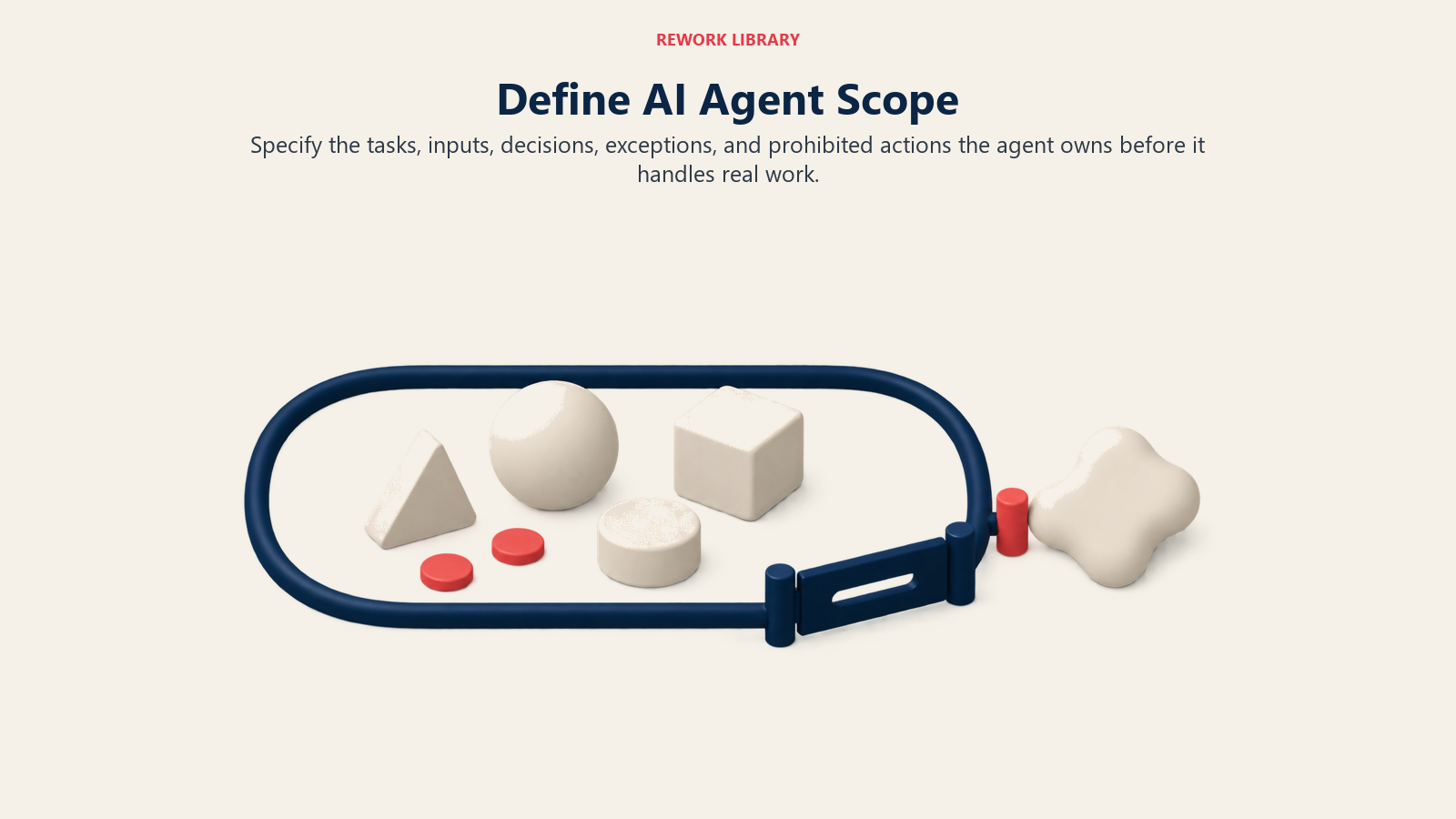
A feature list describes what the agent can technically do. A scope describes what it's accountable for: the workflow steps it owns end to end, the inputs it acts on, and the outputs it's responsible for. If you can't write a one-paragraph job description for it the way you would for a new hire, the scope isn't tight enough to hand off.
Draw the boundary of authority
Every scope needs a companion list of what the agent can't decide alone: changing a price, closing a ticket without a resolution code, sending a message past a certain size or audience. That's the practical edge of where automation should replace a step versus merely assist it, written down the way a new hire gets a spending limit before a company card. Guardrails make the boundary enforceable in code, not policy nobody rereads.
Size the scope to something reviewable
Too broad, and no human can meaningfully check ten different judgment calls at once. Too narrow, and it wastes the agent's capacity while burying the manager in handoffs. The right size lets one person look at ten outputs and credibly say whether the agent is doing the job well.
Set the Quality Bar and Acceptance Criteria Before Day One
"Good enough" can't be a judgment call made after the fact, or every review turns into a debate about a moving target. The bar has to exist, in writing, before the agent produces its first real output.
Make "correct" checkable
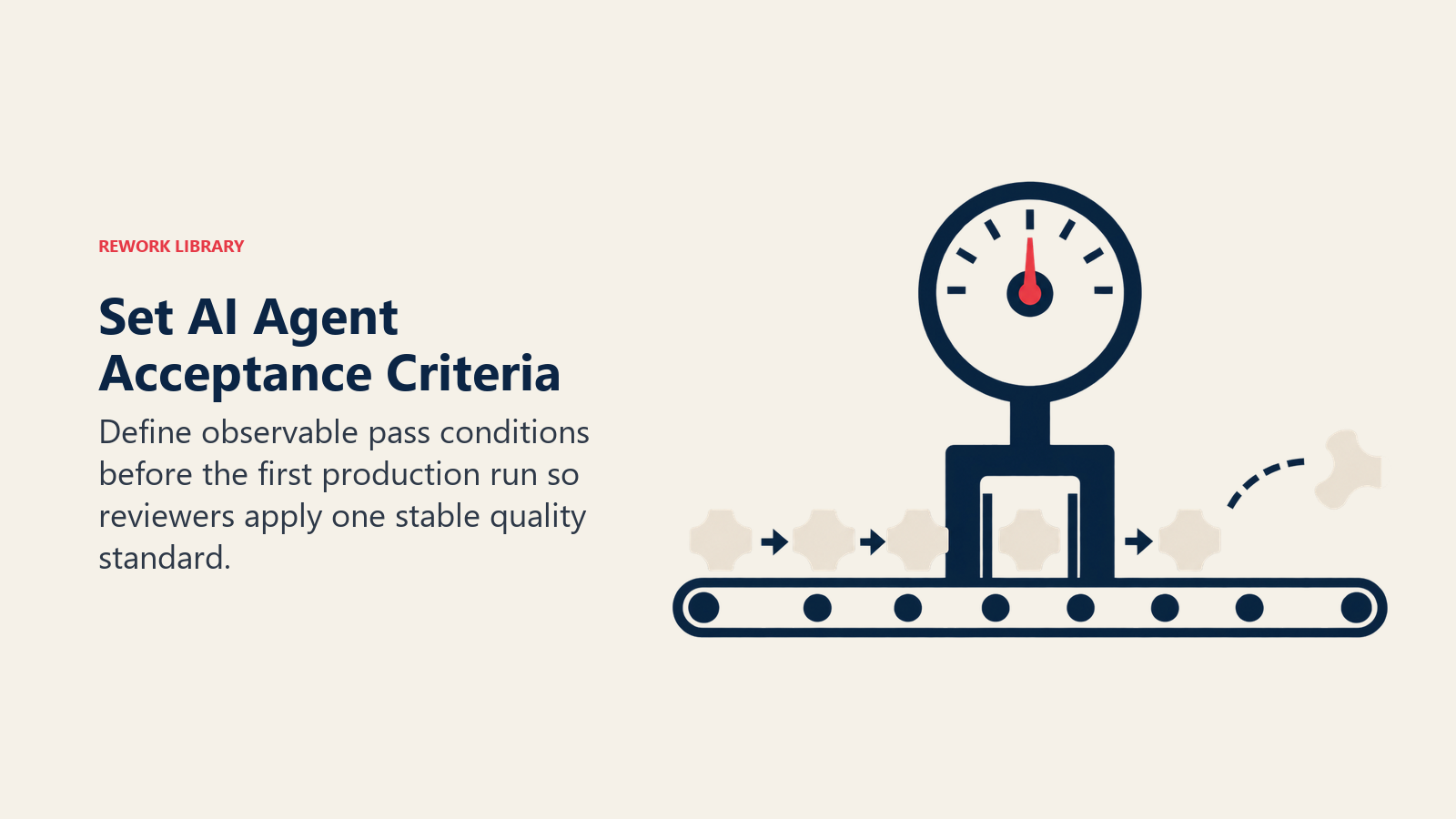
Acceptance criteria should be specific enough that a second person, or a second agent run, could check the work against the same standard without asking what you meant. "Sounds professional" isn't a criterion. "Matches the approved templates, includes the account number, and flags any request over $500" is. The from-doer-to-orchestrator shift applies directly: writing a checkable brief is now a core management skill.
Borrow from QA, not from vibes
Treat the agent's output the way a QA team treats a release candidate: define a small set of test cases covering the range of situations it will face, including a few deliberately hard ones, and run new versions against that set before shipping wider. IBM's research on agentic drift argues for asking whether an output is correct against the intent, not whether it matches a reference word for word, since two runs can be phrased differently and both be right.
Set a confidence threshold, not just pass or fail
Some outputs are clearly right or wrong. Many aren't. Build the bar around a confidence threshold: below it, the output routes for review automatically; above it, it ships. That threshold doubles as the backbone of the escalation design below.
Design the Handoff Between Agent and Human on Purpose
A handoff that isn't designed on purpose gets designed by accident, usually as whichever Slack message someone sent the first time something went wrong. That's a habit, not a process, and habits don't scale past the person who started them.
Name the handoff points before the agent runs
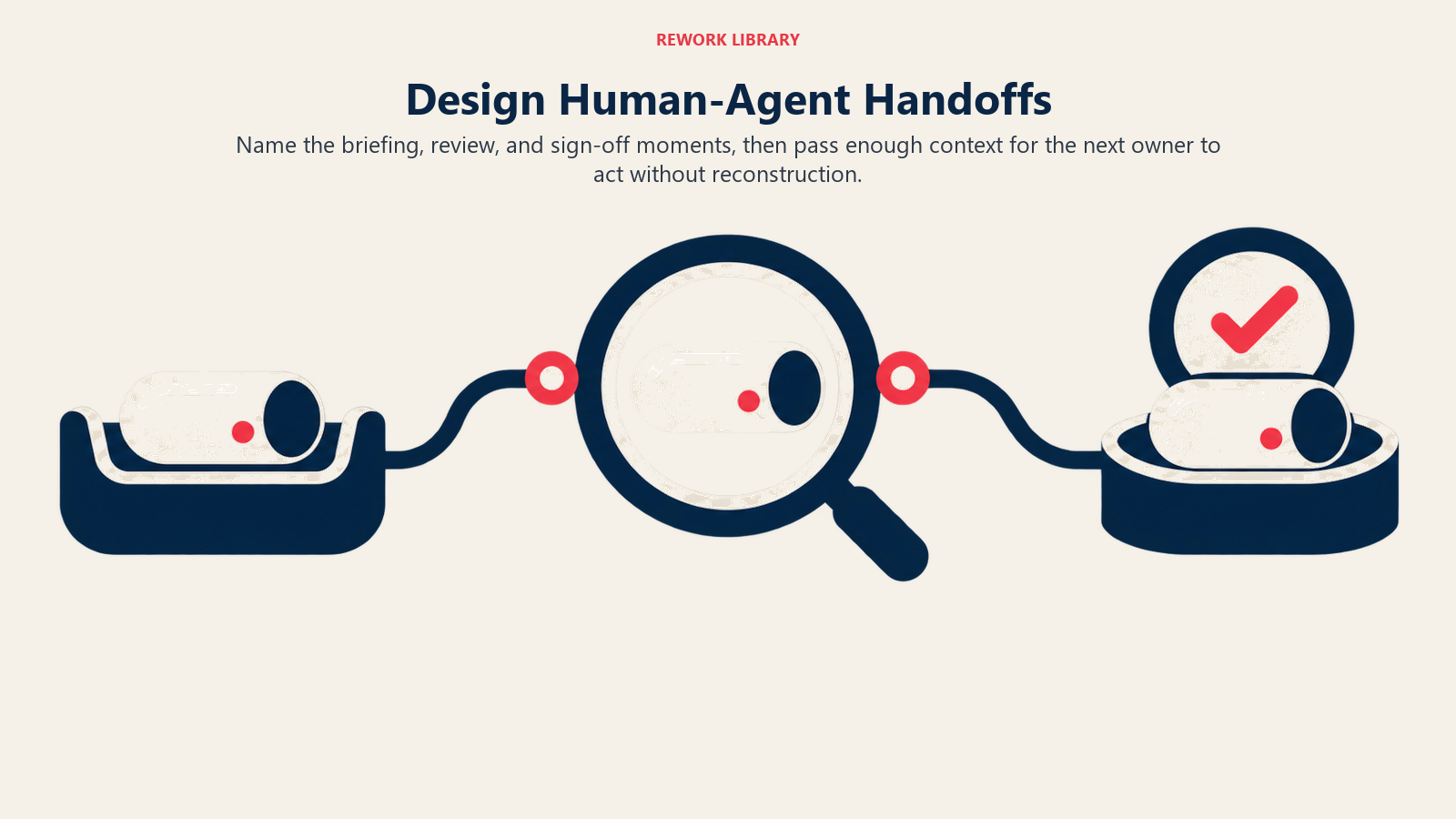
Three moments recur in almost every agent-owned workflow: before it starts, mid-task if it hits its confidence threshold or scope boundary, and after it finishes, when someone reviews, approves, or corrects the output. Each needs an owner, a channel, and a response-time expectation, the same as any handoff between two human roles.
Use the responsibility matrix to assign ownership
The table below is a starting template. Copy it, fill in your team's names and tools, and revisit it whenever the agent's scope changes.
| Agent-ops responsibility | What it means in practice | Who owns it |
|---|---|---|
| Scoping the agent's job | Writing the one-paragraph mandate and the explicit "not allowed" list | Team lead or process owner |
| Setting the quality bar | Defining checkable acceptance criteria and the confidence threshold for auto-ship vs. review | Team lead, with a subject-matter reviewer |
| Handoff design | Naming the pre-task, mid-task, and post-task handoff points, channels, and response times | Ops lead or workflow owner |
| Escalation routing | Deciding who gets paged for a low-confidence output vs. a scope violation vs. a system failure | On-call manager or designated reviewer |
| Monitoring and observability | Tracking task success rate, latency, cost per task, and escalation rate on a dashboard someone opens | Whoever owns the tool the agent runs in |
| Versioning and change control | Logging every prompt, tool, or model change, and running the regression set before wider rollout | Engineering or the AI platform owner |
| Capacity planning | Forecasting task volume and setting throughput limits against human review bandwidth | Team lead, reviewed monthly |
| Cost and budget | Tracking cost per task against a set ceiling and flagging when spend outpaces value | Finance partner or the team lead with budget authority |
| Incident response | Running the playbook when the agent fails badly: pause, notify, root-cause, patch, resume | On-call manager |
| Decommissioning | Deciding when a scope stops being worth the maintenance cost and retiring or narrowing it | Team lead, revisited quarterly |
Make the human side cheap
A handoff that takes a reviewer fifteen minutes to open and act on gets skipped under deadline pressure, however well-designed it looks on paper. Build it into the tool the reviewer already uses, with the agent's confidence score, the specific thing it's unsure about, and one-click approve or reject. If reviewing an escalation is harder than redoing the task by hand, people quietly stop trusting the agent, the same trust question human-agent teams run into constantly.
Build Escalation Paths People Will Actually Use
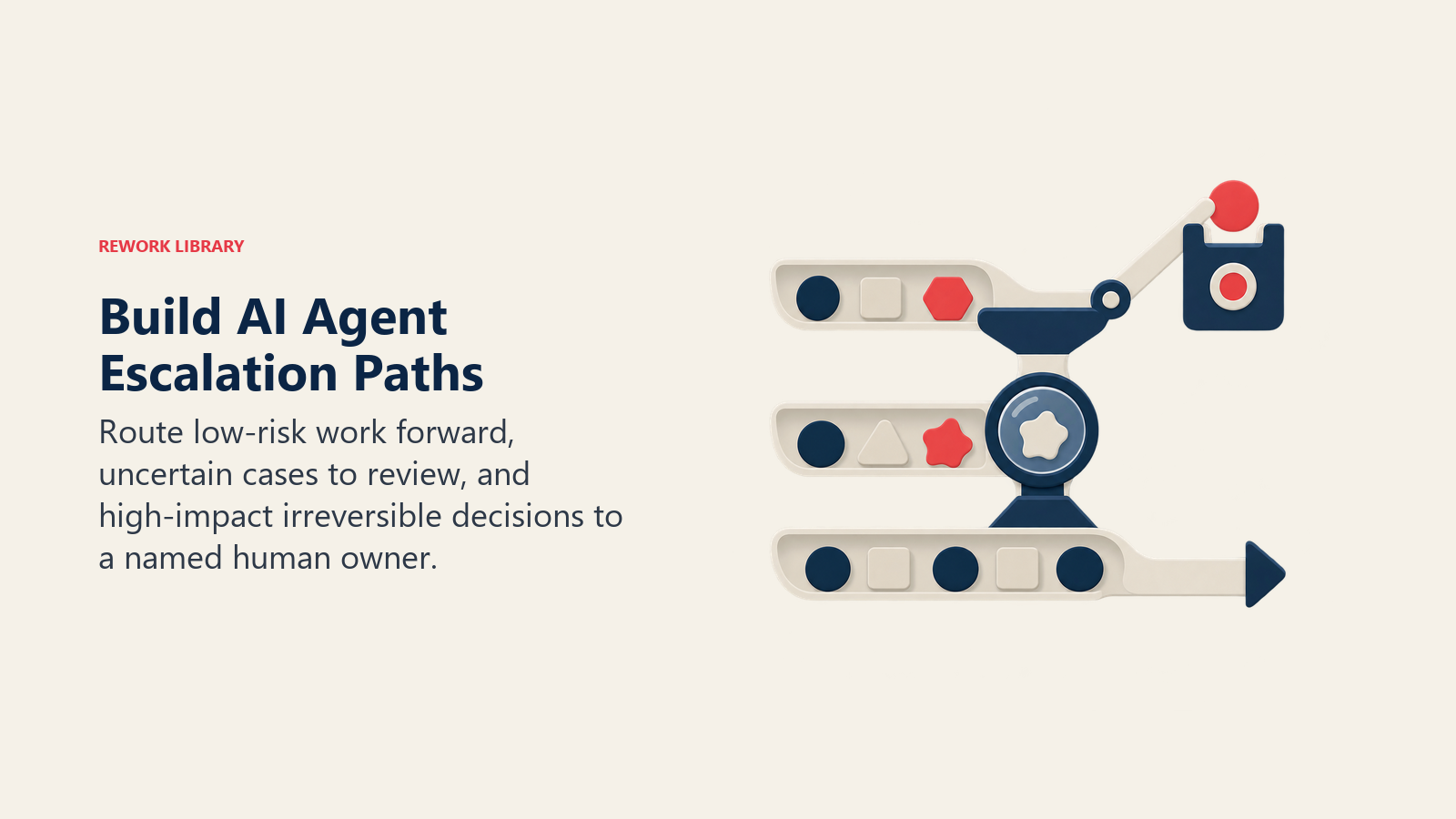
Escalation paths fail in one of two directions: too sensitive, so humans get paged constantly and start ignoring alerts, or too permissive, so the agent works around a problem instead of raising it, and nobody finds out until the output is already wrong in production.
Tier escalation by confidence and reversibility
A tiered structure maps onto most team workflows: fully autonomous for low-risk, reversible actions like reads; supervised, with a short veto window, for medium-risk writes like sending a message; and gated, requiring active approval, for irreversible actions like deletions, payments, or anything touching a customer contract. Set the thresholds per tier based on how costly a mistake actually is in your workflow, not a number copied from someone else's blog post.
Give the agent a real "I don't know" option
An agent that always sounds confident, even when it shouldn't, is more dangerous than one that stalls, since a stalled task gets noticed and a wrong one often doesn't. Build "escalate to a human" into its set of valid outputs, and treat an honest escalation as a success. Teams that quietly penalize escalation rate as an error rate train their agents, and their people, to stop raising hands.
Route to a specific person, not a queue
A shared queue with no owner is where escalations go to die. Every tier should map to a named role with a defined response time, the way an on-call rotation works for a production outage. Human-in-the-loop design only holds up if there's a specific, reachable human in that loop.
Monitor and Observe the Agent Like a System, Not a Tool
A tool you check when something looks wrong. A system you watch continuously, because by the time something looks wrong to the eye, it's usually already been wrong for a while.
Track behavior, not just uptime
Traditional uptime monitoring tells you the agent is running. It doesn't tell you it's right. Agent observability needs to cover system health (availability, latency, error rate) and behavioral health (task success rate, escalation rate, drift against a known-good baseline). An agent that responds instantly and confidently while quietly getting more wrong over time passes every uptime check and fails every user who relied on it, the same automation-bias risk covered in keeping human judgment sharp.
Log enough to reconstruct what happened
When an output is wrong, the question that matters isn't just "was it wrong," it's "why," and that needs a trail: inputs, tool calls and parameters, and the reasoning behind the output. Without it, every incident review turns into guesswork, and the same failure quietly repeats.
Set a dashboard someone actually opens
A dashboard nobody looks at is decoration, not monitoring. Pick a small number of metrics that map to the responsibilities in the table above, cost per task, success rate, escalation rate, time-to-resolution, and put them somewhere the accountable person checks on a fixed cadence, not just when something breaks.
Version the Agent and Control Change Like a Production System
The biggest source of surprise failures in agent management isn't a dramatic malfunction. It's a quiet behavior shift nobody flagged as a change, because from the outside it doesn't look like one.
Treat every change as a deployment
A prompt edit, a swapped model version, an updated tool, or a new data source can shift behavior in ways hard to predict from the diff alone. IBM's research on agentic drift names exactly this pattern: an agent skipping a step it used to reliably perform because an upstream model update changed how it weighs speed against thoroughness. Log every change with a timestamp and a description, so a shift traces back to a cause instead of getting investigated from scratch.
Run the regression set before, not after
Keep a fixed set of representative tasks, including the tricky ones, and run it against every version before rolling the change out broadly. That's the same logic as a regression suite in software: cheap to run repeatedly, and it catches the failure before a customer does.
Freeze a rollback path
Know, in advance, how you'd revert to the last known-good version if a change goes badly: a pinned model version, a saved prompt, a feature flag. Deciding this during an active incident costs time you don't have. Deploying agents to production safely means the rollback plan exists before the first deployment, not after the first bad one.
Plan Capacity the Way You'd Plan for a Growing Team
An agent's capacity isn't infinite or free to scale on demand. It's bounded by API rate limits, review bandwidth, budget, and the volume of work the humans around it can actually oversee.
Forecast against review bandwidth, not just throughput
The agent might process ten times the current task volume technically. What matters is whether your reviewers can handle ten times the escalations and spot-checks that come with it. Capacity planning for an agent-owned workflow is really capacity planning for the humans supervising it.
Reforecast when the scope or model changes
A capacity plan built around one model version, one scope, and one task mix goes stale the moment any of those change. Revisit it on the same cadence as the versioning log, since a better model version changes how much review time each output needs.
Headcount math shifts, it doesn't vanish
The 15x year-over-year growth in active agents inside Microsoft 365 didn't come with a matching drop in the humans managing those workflows. It came with a shift in what those humans spend their time on: less production, more scoping, reviewing, and judgment, the throughline of what the future of work actually looks like once agents take on more execution. Plan headcount around that shift rather than assuming agent capacity is a straight substitute for a person.
Manage the Cost Line Like a Budget, Not a Surprise
Agent cost doesn't scale the way most people expect. A single task can trigger many tool calls, retries, and reasoning steps, so cost per task can move sharply even as per-token model prices fall.
Know your real unit economics
Cost per task, not cost per token, is what matters for planning, since orchestration, retries, and tool calls typically make up a large share of total spend beyond the model invoice. Benchmark that number before scaling, the same way you'd cost out a new hire's total burden, not just base salary. See cost optimization tactics for AI agents for ways teams bring that number down without cutting quality.
Put a circuit breaker in the budget
Set a per-task cost ceiling and alert automatically when spend approaches it, rather than discovering the number at the end of a billing cycle. That's the practical answer to the Gartner projection above: most cost surprises are avoidable with a budget alert that fires weeks earlier.
Revisit cost against value on the same cadence
A workflow that made sense to automate at last quarter's cost might not clear the bar this quarter, or might clear it by more if a cheaper model became viable. Review cost, quality, and volume together, since the cheapest agent that produces unreliable output isn't actually cheap.
None of this is exotic. It's the same discipline applied to any resource producing work under your name: define the job, set the bar, design the handoff, watch the track record, know what it costs. The teams getting real value out of agents in 2026 aren't running the most sophisticated model. They wrote this manual down before they needed it, instead of improvising it during the first incident.

Co-Founder, Rework.com
On this page
- Key Facts
- Start by Scoping What the Agent Actually Owns
- Write the scope like a job description
- Draw the boundary of authority
- Size the scope to something reviewable
- Set the Quality Bar and Acceptance Criteria Before Day One
- Make "correct" checkable
- Borrow from QA, not from vibes
- Set a confidence threshold, not just pass or fail
- Design the Handoff Between Agent and Human on Purpose
- Name the handoff points before the agent runs
- Use the responsibility matrix to assign ownership
- Make the human side cheap
- Build Escalation Paths People Will Actually Use
- Tier escalation by confidence and reversibility
- Give the agent a real "I don't know" option
- Route to a specific person, not a queue
- Monitor and Observe the Agent Like a System, Not a Tool
- Track behavior, not just uptime
- Log enough to reconstruct what happened
- Set a dashboard someone actually opens
- Version the Agent and Control Change Like a Production System
- Treat every change as a deployment
- Run the regression set before, not after
- Freeze a rollback path
- Plan Capacity the Way You'd Plan for a Growing Team
- Forecast against review bandwidth, not just throughput
- Reforecast when the scope or model changes
- Headcount math shifts, it doesn't vanish
- Manage the Cost Line Like a Budget, Not a Surprise
- Know your real unit economics
- Put a circuit breaker in the budget
- Revisit cost against value on the same cadence