More in
Conversational Growth Insights
Are Chat Leads Lower Quality, or Just Handled Worse?
Oct 11, 2026
What B2B Sellers Everywhere Can Learn From Chat-First Selling in Southeast Asia
Oct 11, 2026
Why Customer Conversations Are the Most Underused Data in Your Revenue Engine
Oct 11, 2026
Is Chat Replacing Email as the Main B2B Sales Channel?
Oct 11, 2026
When WhatsApp Belongs in Your B2B Sales Motion (and When It Doesn't)
Mar 27, 2026
The Death of the Contact Form — What's Replacing It and Why
Mar 19, 2026
Conversational ROI: Measuring Beyond First-Touch Attribution
Feb 24, 2026
Ad-to-Chat Funnels: A CRO's Evaluation Framework
Jan 16, 2026 · Currently reading
The CMO's Case for Owning the Chat Layer (vs. Delegating to Support)
Jan 15, 2026
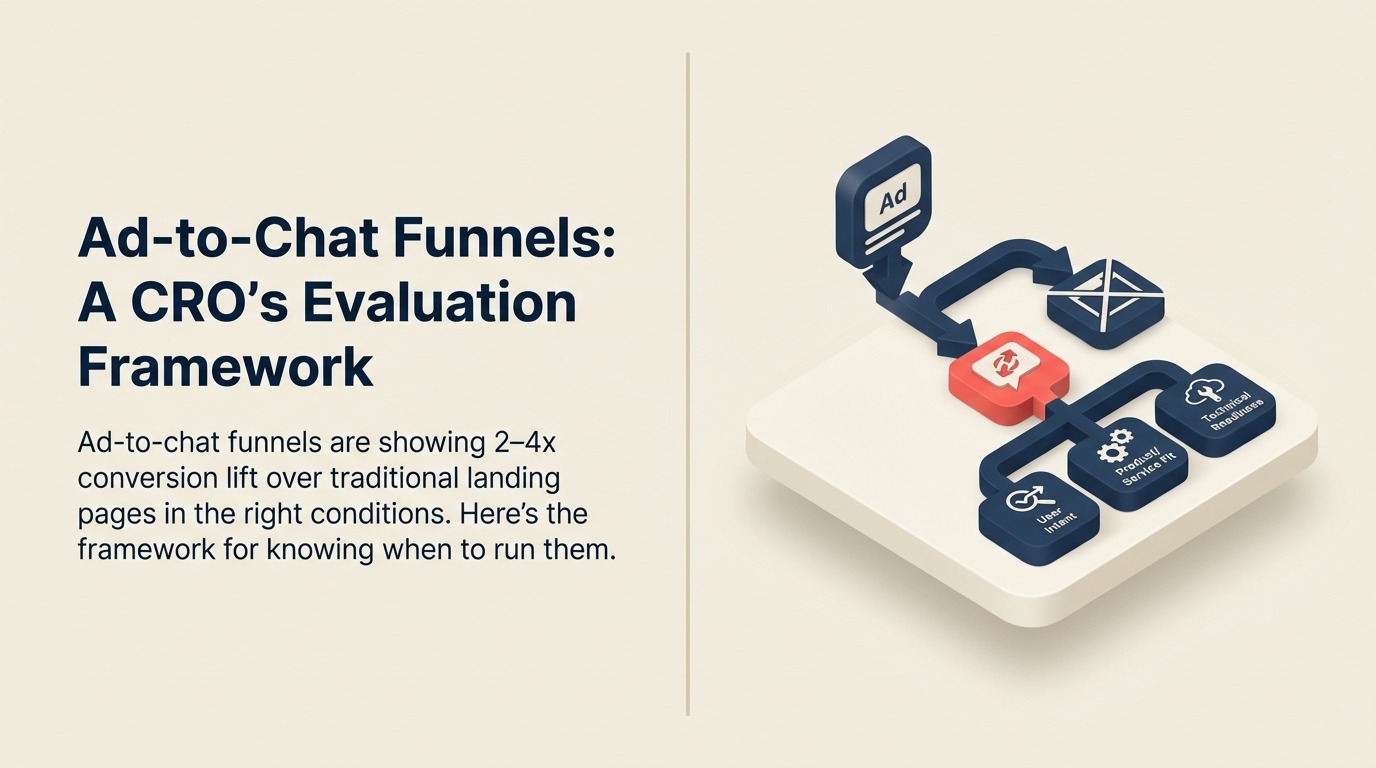
Ad-to-Chat Funnels: A CRO's Evaluation Framework
Turn this article into takeaways for your work.


Each assistant summarizes the article only for you and suggests best practices for your work.
Most B2B demand gen budgets still route paid traffic to landing pages with forms. But click-to-WhatsApp, click-to-Messenger, and direct-to-chat ad formats have been quietly outperforming that setup in markets where messaging apps are primary.
The performance gap isn't marginal. Teams running mature ad-to-chat funnels report 2–4x conversion rate improvements over their landing page equivalents. Not because the ads are better, but because the post-click experience is fundamentally different. A form asks the buyer to describe their intent in a text box and wait. A chat funnel opens a conversation immediately.
But ad-to-chat is not a universal upgrade. The conditions under which it works (and fails) are specific. Applying it to the wrong motion doesn't just underperform. It actively degrades pipeline quality because you end up with a high volume of low-quality conversations that burn sales capacity.
How Ad-to-Chat Actually Works
The architecture varies by platform and messaging channel, but the core mechanic is consistent: the ad's call-to-action button opens a conversation rather than a landing page.
Click-to-WhatsApp (available on Meta/Facebook, Google, and increasingly LinkedIn in select markets) routes the click directly to a WhatsApp Business conversation. The buyer is in a messaging app they already have open, which removes the context switch of landing on an unfamiliar page. On the business side, the incoming message is typically received by a WhatsApp Business API-connected platform (Respond.io and ManyChat are the two main orchestration layers here, see the Respond.io vs. ManyChat comparison for B2B sales to understand where each fits), where automation can qualify the lead and route to the right sales rep.
Click-to-Messenger works similarly but within the Meta ecosystem, routing to Facebook Messenger. This is more common for B2C, but some B2B companies use it effectively in markets where Messenger is the dominant platform.
Direct-to-chat ad formats on LinkedIn are less developed, but LinkedIn's Conversation Ads and Message Ads create a form-adjacent experience within the platform itself. These work differently from WhatsApp-based funnels. They're better understood as in-platform lead gen than true ad-to-chat.
The critical technical detail: for these funnels to function properly at scale, the incoming conversation needs to route into a system that can qualify, tag, and assign the lead, then sync that data to CRM. Without that integration, ad-to-chat creates a data silo. Respond.io handles this via HubSpot and Salesforce integrations; ManyChat has similar functionality for SMB-scale use cases. The full setup process is covered in the Meta ads to WhatsApp funnel guide. Without the CRM sync, pipeline attribution breaks, and you can't measure what you're building.
When Ad-to-Chat Outperforms Landing Page Optimization
Four conditions reliably favor ad-to-chat over traditional LPO.
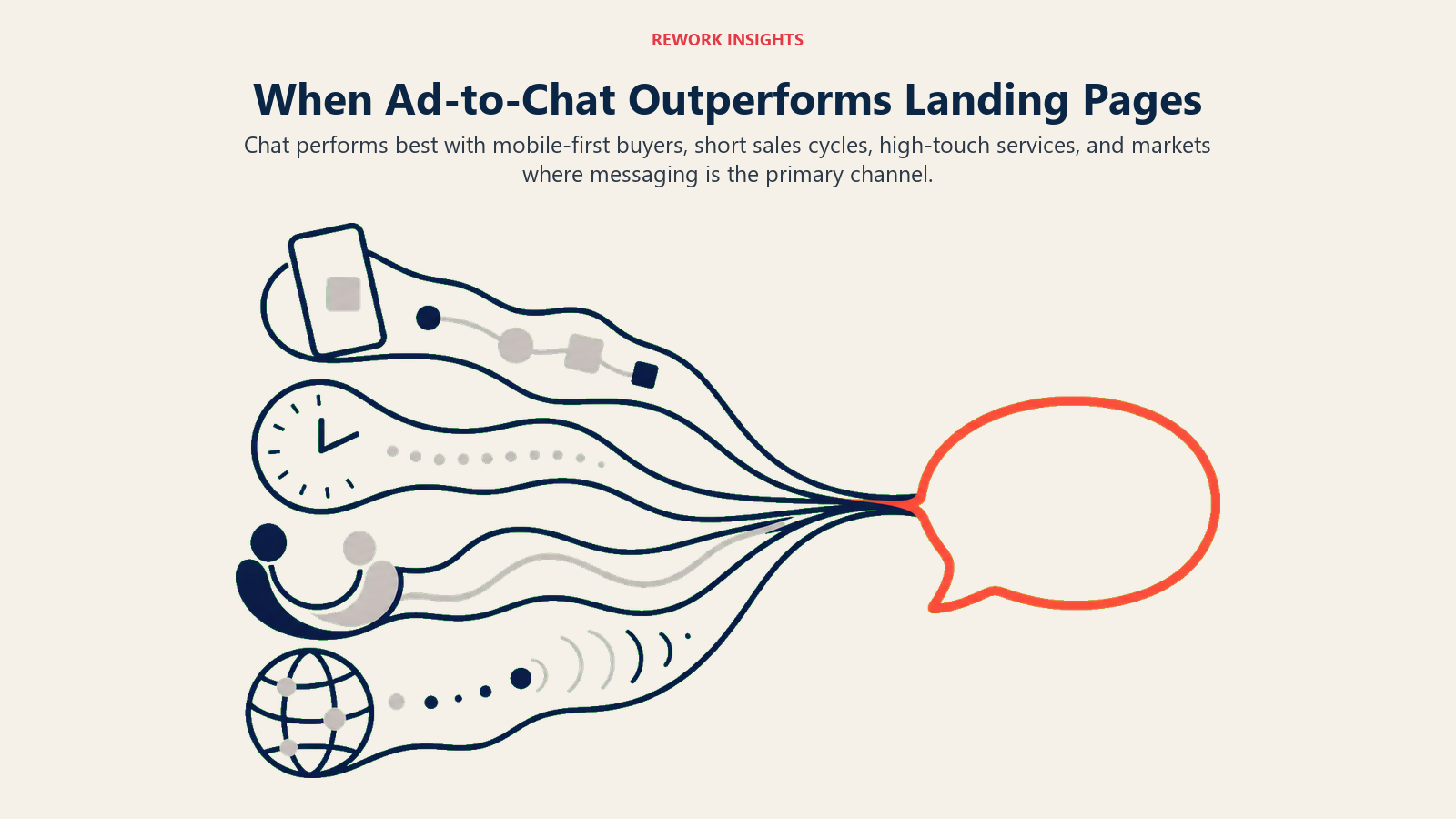
Mobile-first buyer behavior. If your target buyer is primarily on mobile, landing pages are disadvantaged by default. Tap-to-fill forms on mobile have higher abandonment rates than desktop equivalents. WhatsApp opens instantly on mobile with zero friction. Meta's own click-to-WhatsApp advertising data shows that mobile buyers in messaging-dominant markets engage at significantly higher rates with conversation-initiated flows than with form redirect ads. In Southeast Asia, Latin America, and parts of the Middle East, where B2B buyers conduct most of their research on phone, ad-to-chat consistently outperforms LP + form.
Shorter sales cycles. If your median deal closes in under 60 days, speed-to-first-conversation is a major conversion driver. Ad-to-chat compresses that gap to near zero: the buyer clicks, the conversation starts, qualification happens in the first two to four messages. The death of the contact form dynamic is most acute in short-cycle deals because the follow-up delay problem is proportionally larger relative to the total cycle.
High-touch service businesses. Professional services, staffing, financial services, and any business where the product is delivered through people often sees lift with ad-to-chat because buyers expect and prefer human interaction early. The ad-to-chat format signals that you're accessible. For a form-heavy competitor, that signal alone creates differentiation.
Regional messaging app dominance. This is the strongest condition. If you're running ads in Brazil, Indonesia, India, Colombia, or most of the Middle East and North Africa, WhatsApp is not a secondary channel. It's the channel. Running click-to-form in those markets is leaving pipeline on the table regardless of how good your landing page is.
When Ad-to-Chat Underperforms
Knowing when not to use it matters as much as knowing when to deploy it.
Enterprise multi-stakeholder deals. Complex B2B deals involving procurement, legal, and IT sign-off are not served well by chat-initiated funnels. Enterprise buyers expect formal documentation, structured demos, and a clearly mapped sales process. Opening with WhatsApp signals a sales motion that doesn't match the evaluation process they're running. You can use chat later in the cycle for quick communication, but as a top-of-funnel acquisition channel it creates a mismatch.
Long consideration cycles. If your average deal takes 90-180 days, the first touchpoint is rarely conversion-intent. Buyers in early awareness stages want content, not conversation. Routing ad clicks to a chat funnel at this stage generates low-quality conversations from buyers who aren't yet ready to talk, burning response capacity. Gartner's research on conversational AI in sales notes that chat-initiated outreach performs best in sub-60-day cycles where qualification speed is the dominant conversion variable. Chat works better as a later-stage acceleration mechanism than as a cold acquisition channel for long-cycle products.
Content-heavy evaluation journeys. Products with complex feature sets, compliance requirements, or technical evaluation criteria (enterprise security software, ERP systems, complex SaaS infrastructure) need buyers to self-educate before the first conversation is productive. Landing pages with well-structured content serve that journey better than chat, which requires the rep to educate in real time at scale.
Markets where messaging apps feel intrusive. In North America, Japan, and Germany, messaging apps carry strong personal associations. A B2B ad that routes to WhatsApp in these markets can feel like a boundary crossing, especially for enterprise buyers who deliberately separate professional and personal communication channels.
The Measurement Challenge
Ad-to-chat attribution is harder than landing page attribution, and this causes companies to underinvest in it even when it's performing well.
With a landing page funnel, the conversion event is a form fill: discrete, timestamped, attributable to the campaign and keyword that drove the click. With ad-to-chat, the conversion event is the conversation, which lives in WhatsApp or Messenger, not in your CRM. Most CRM attribution models don't natively capture conversation data. The pipeline shows up as "direct" or gets credited to the last email touch, which obscures what actually drove the engagement.
Proxy metrics that work when direct attribution fails:
Conversation-to-qualified-lead rate. Of all the conversations generated by ad-to-chat, what percentage become a CRM record with a qualification status? This measures whether your chat funnel is generating real pipeline or just volume.
Speed-to-qualified-conversation. How long between the ad click and the first substantive sales exchange? This is ad-to-chat's core advantage over LP + form and should be tracked explicitly.
Closed-won rate on chat-originated deals. If you can tag deals by originating channel, close rate comparison between form-originated and chat-originated deals is the most direct ROI signal. Some CMOs running mature funnels report 15-30% higher close rates on chat-originated pipeline because the relationship starts with a real exchange rather than a form submission. Tidio's live chat industry benchmarks suggest companies with response times under one minute see conversion rates 3-5x higher than those with average response delays over 10 minutes.
The Conversational ROI: Measuring Beyond First-Touch Attribution article goes deeper on building measurement frameworks when standard CRM attribution breaks.
The Ad-to-Chat Readiness Score
Before committing to ad-to-chat, evaluate your organization across five dimensions. Score each 1-5 (1 = not ready, 5 = fully ready):
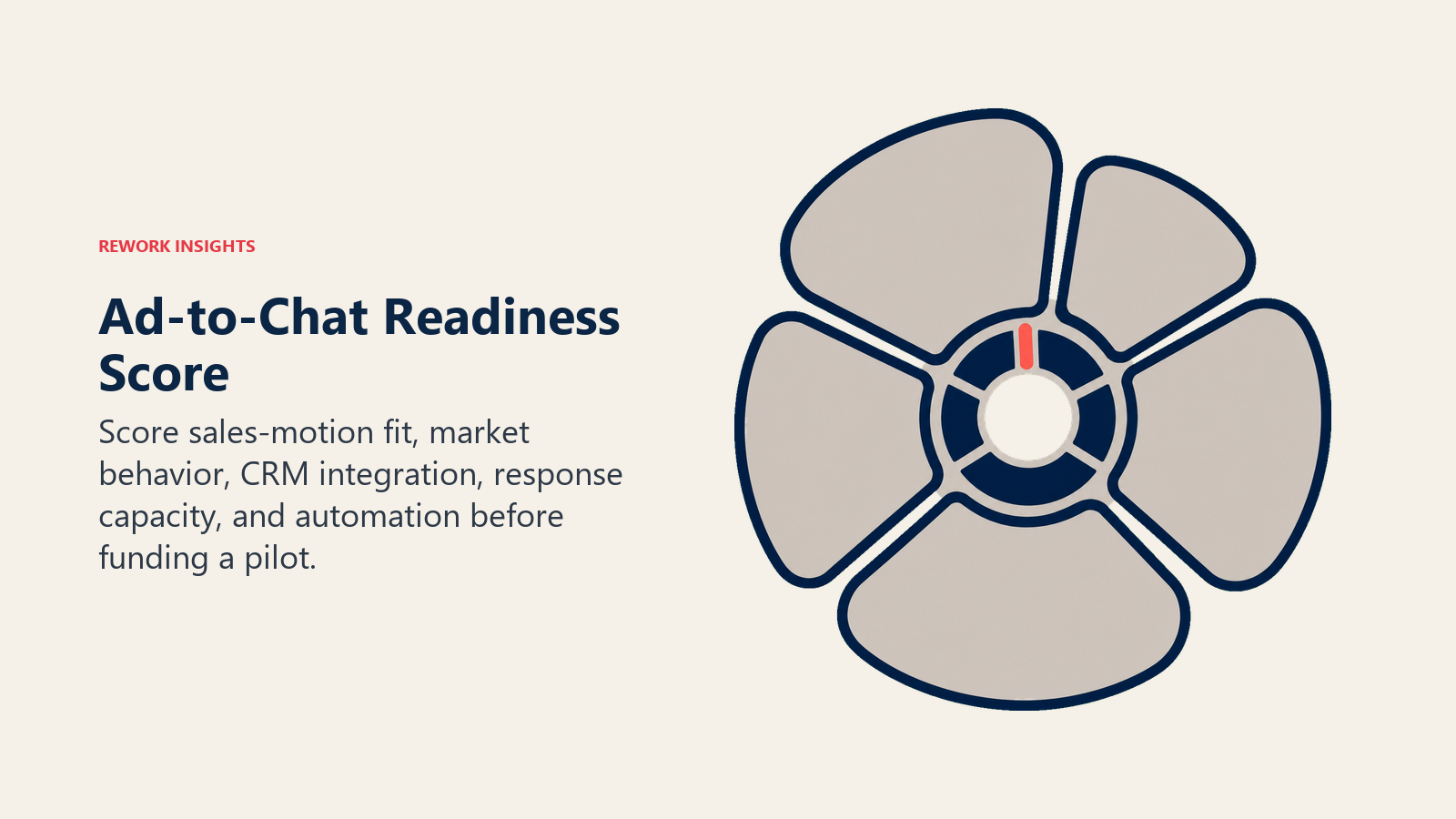
Sales motion fit (weight: 30%). Does your deal type, ACV, and sales cycle length align with the conditions where ad-to-chat outperforms? Short cycle, SMB or mid-market, service-oriented: score high. Long cycle, enterprise, compliance-heavy: score low.
Market and geography (weight: 25%). What percentage of your target market is in regions where WhatsApp or Messenger is a primary business channel? Over 50%: score high. North America/Japan/Germany only: score low.
Tech stack integration (weight: 20%). Do you have or can you build a connection between your messaging platform (Respond.io, ManyChat) and your CRM? Without this, attribution breaks. The multi-channel lead capture overview covers how teams track attribution across these channels. With mature integration: score high.
Team response capacity (weight: 15%). Can your sales or SDR team respond to incoming chat conversations within five minutes during business hours, with AI coverage outside them? If you can't staff real-time response, ad-to-chat generates an expectation you can't meet.
Automation maturity (weight: 10%). Have you built qualification logic in your messaging platform? Can bots handle the first two to three exchanges before routing to human? Without automation, volume becomes a capacity problem.
A score of 3.5 or above across weighted dimensions: run the pilot. Below 3.0: fix the gaps before investing in the channel.
A 30-Day Pilot Structure
If your readiness score warrants a pilot, structure it to be genuinely comparable to your existing LP + form setup.
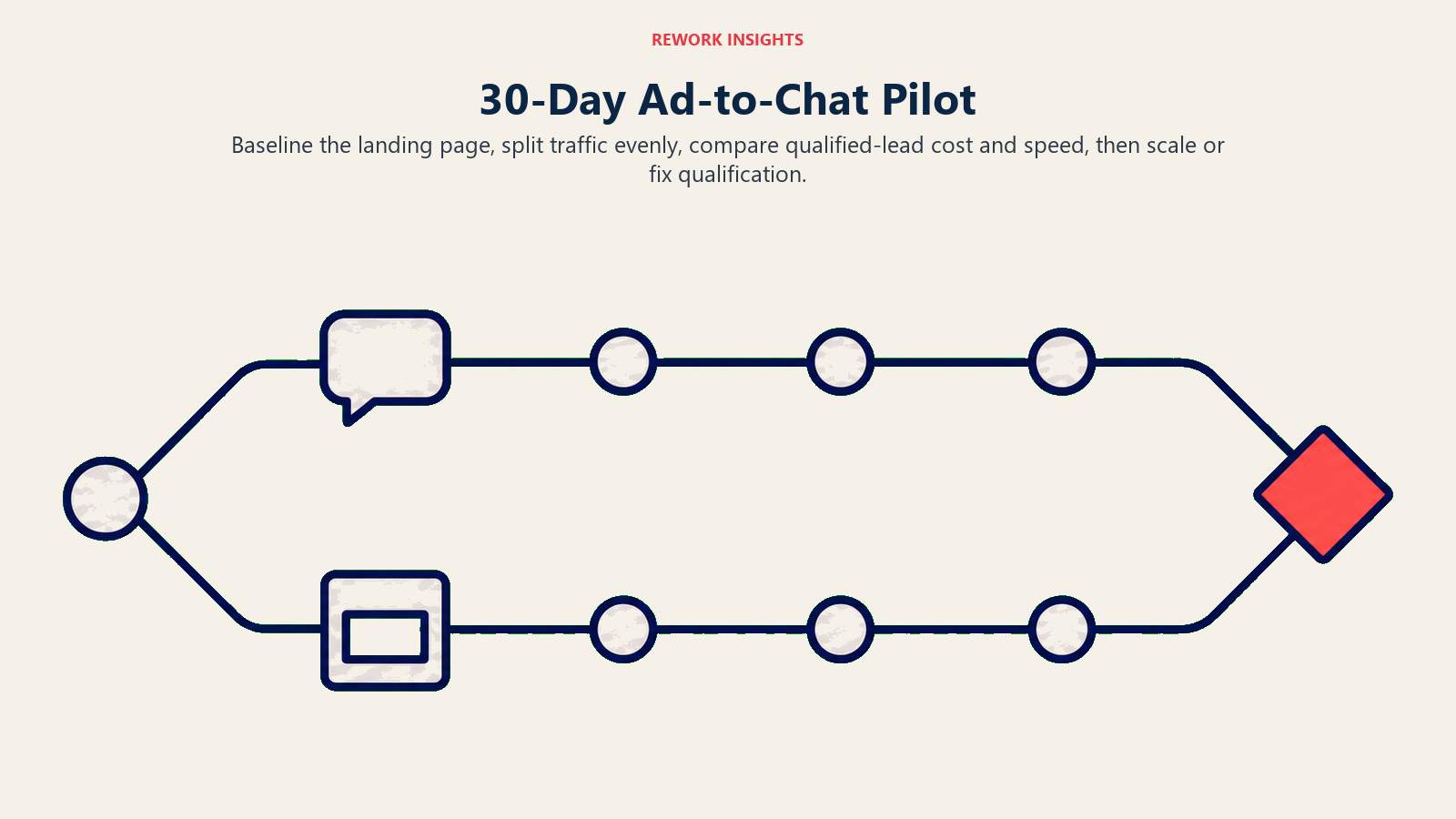
Week 1: Baseline and setup. Pull three months of data from your best-performing landing page funnel: click volume, conversion rate, cost-per-qualified-lead, time-to-first-contact. Set up your WhatsApp Business API connection through Respond.io or ManyChat. Build your qualification sequence: two to four automated messages that capture company size, use case, and buying timeline. The ManyChat qualification flow guide has a tested sequence structure you can adapt. Connect the CRM sync. Define what a "qualified lead" means consistently across both funnels.
Week 2-3: Run parallel traffic. Split a single campaign or ad set 50/50 between your existing landing page and the new chat funnel. Keep the audience, creative, and budget equal. This eliminates confounding variables. Track conversations started, conversations qualified, CRM records created, and time-to-qualified.
Week 4: Analyze and decide. Compare cost-per-qualified-lead, qualification rate, and response time across both legs. Flag any quality differences by tagging deals by origin in CRM. If ad-to-chat produces more qualified leads at equal or lower cost per qualified lead, scale it. If it produces more conversations but fewer qualified leads, the funnel has a qualification problem. Fix the bot sequence, not the channel.
Don't judge the pilot on total conversations. Judge it on cost per qualified lead and time-to-first-qualified-conversation. Those are the metrics that predict downstream revenue impact. A reference point for what "good" looks like: chat funnel metrics benchmarks covers the key indicators to track as you scale.
What Comes Next
Ad-to-chat is not a tactic. It's an architecture shift: from form-gated, delayed-response acquisition to conversation-first, real-time qualification. For WhatsApp-heavy markets and short-cycle B2B products, the case is straightforward. For enterprise and long-cycle deals, the case requires more nuance.
The next question after deciding to use ad-to-chat is where it fits in a broader multi-channel pipeline: how it interacts with your email sequences, your retargeting ads, and your outbound motion. That's where orchestration matters. When WhatsApp Belongs in Your B2B Sales Motion covers the governance and segmentation decisions that make WhatsApp a sustainable part of the pipeline rather than a one-quarter experiment.
Learn More
