More in
Conversational Growth Insights
When WhatsApp Belongs in Your B2B Sales Motion (and When It Doesn't)
Mar 27, 2026
The Death of the Contact Form — What's Replacing It and Why
Mar 19, 2026
Conversational ROI: Measuring Beyond First-Touch Attribution
Feb 24, 2026 · Currently reading
Ad-to-Chat Funnels: A CRO's Evaluation Framework
Jan 16, 2026
The CMO's Case for Owning the Chat Layer (vs. Delegating to Support)
Jan 15, 2026
Conversational ROI: Measuring Beyond First-Touch Attribution
Turn this article into takeaways for your work.


Each assistant summarizes the article only for you and suggests best practices for your work.
Conversational channels (chat, WhatsApp, AI agents) are notoriously hard to attribute in standard CRM models. Most of the pipeline they generate shows up as "direct" or gets credited to the last ad that ran. This attribution gap causes companies to systematically underfund their highest-converting channels.
The CMOs who have fixed this aren't using better attribution software. They've changed what they measure.
The problem isn't that chat doesn't generate pipeline. It clearly does. The problem is that the measurement architecture B2B companies built for email and paid campaigns doesn't map cleanly to the conversational layer. And instead of rebuilding the measurement model, most teams keep reporting on what's easy to track, cutting budget on what they can't prove.
This article covers why the attribution gap exists, which measurement dimensions actually matter, and how to build a quarterly reporting model that gives you defensible ROI numbers for conversational channels without perfect data.
Why CRM Attribution Undervalues Chat
Most B2B CRMs attribute pipeline to the first touchpoint (first-touch attribution) or the last touchpoint (last-touch attribution) before a contact becomes an opportunity. Both models have the same blind spot: they require the touchpoint to be a discrete, CRM-logged event.
A form fill is a discrete event: timestamp, source URL, UTM parameters, campaign ID. HubSpot or Salesforce captures it cleanly. An email click is a discrete event. An ad click through a tracked landing page is a discrete event. The infrastructure for connecting forms and ads to CRM is well-documented in form-to-CRM and Meta lead ads automation. According to Forrester's B2B attribution research, conversational touchpoints are among the most systematically undercounted in multi-touch models because they live outside the tracked-URL infrastructure that most attribution tools rely on.
A chat conversation is not a discrete CRM event by default.
When a buyer visits your pricing page, opens a chat widget, has a 15-minute qualification conversation with an SDR, and books a demo, that conversation is the conversion moment. But in a standard HubSpot setup, the lead record shows the form they filled out three weeks earlier or the ad that brought them to the site the first time. The chat conversation that closed the qualification gap is invisible to the attribution model.
The data lives in Intercom, Drift, or Respond.io. It's not in the CRM unless someone built the integration explicitly. Most companies haven't. The result: a high-performing channel that looks underperforming because its contribution is invisible in every report that reaches the CFO.
The same problem exists for WhatsApp-based funnels. Conversations happen in WhatsApp Business API-connected platforms like Respond.io or ManyChat. The CRM receives the contact record when the integration fires, but the conversation context (what was asked, what was discussed, when the buying intent appeared) typically doesn't transfer. Pipeline attributed to the associated source (the Meta ad, the organic click) gets credit. The chat that converted the lead gets none.
The Three Measurement Dimensions That Matter
Standard first-touch and last-touch attribution are wrong frameworks for conversational channels. The right measurement dimensions capture what chat actually does in the pipeline.
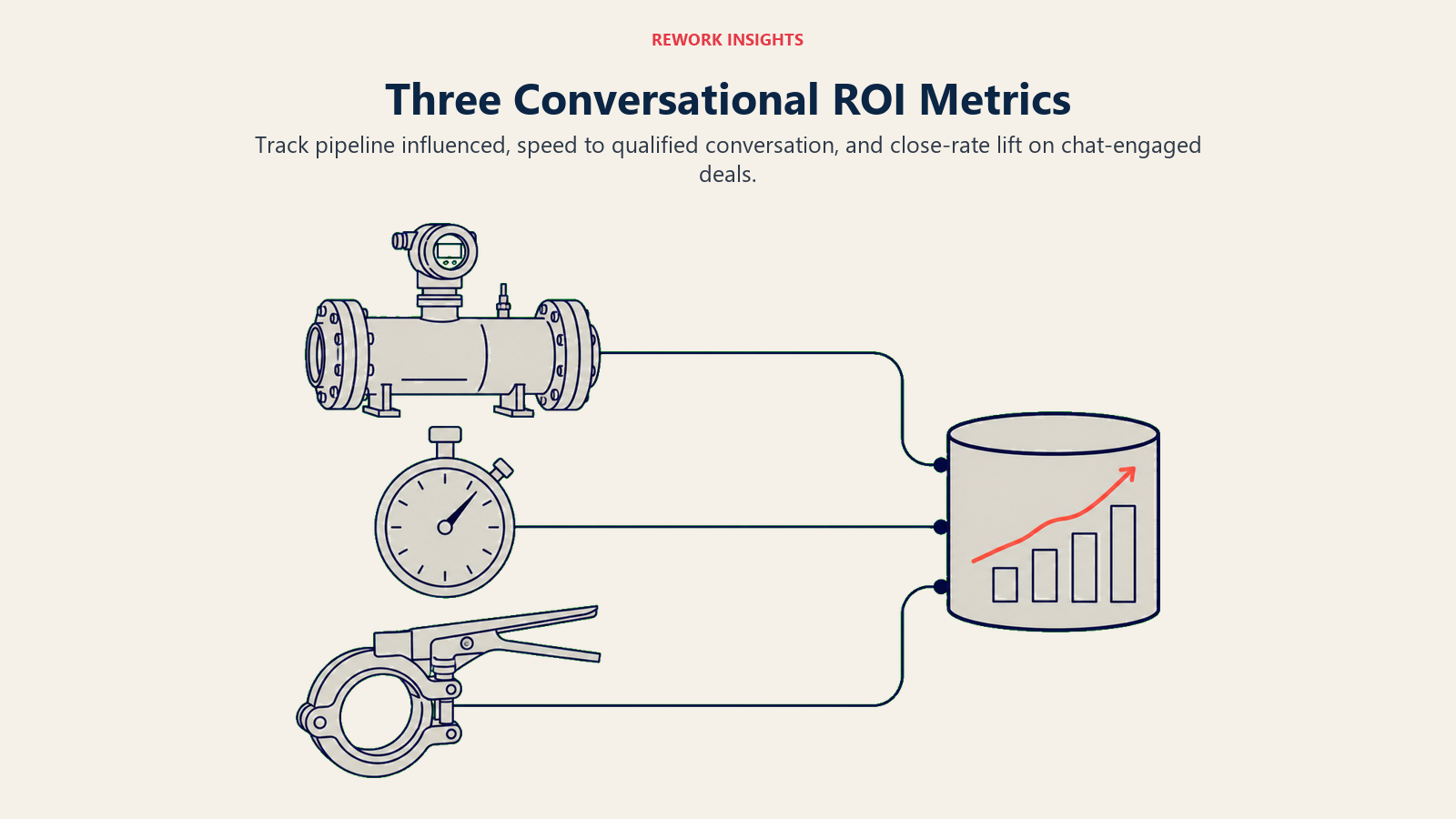
Dimension 1: Pipeline influenced, not just pipeline generated.
Chat rarely initiates a deal from scratch. More often, it accelerates one. A buyer who was three weeks into an email nurture sequence opens a chat widget, gets a qualifying conversation, and books a demo that afternoon. First-touch attribution credits the original ad or organic visit. Last-touch might credit the email that brought them to the site. Neither gives chat influence credit.
Influenced pipeline is the more accurate concept: what is the total contract value of deals where a chat interaction occurred in the pipeline? This requires tagging deals by whether a chat touchpoint existed, not whether chat was the source. HubSpot and Salesforce both support influenced pipeline reporting with the right contact/deal property tagging. The implementation requires someone to set it up; the logic isn't complicated.
Dimension 2: Speed-to-qualified-conversation.
The death of the contact form is partly a response-time problem. InsideSales research on lead response time found that the conversion rate advantage of responding within five minutes versus 30 minutes is over 20x. Chat's structural advantage over forms is that it can achieve near-zero time-to-first-contact. Speed-to-qualified-conversation measures how well you're capturing that advantage.
Define "qualified conversation" clearly: a chat interaction that results in a CRM record with a qualification status (MQL, SQL, or equivalent). Track median time from chat initiation to qualification completion. If this metric is under five minutes, you're capturing chat's conversion advantage. If it's 45 minutes because AI is handling initial routing and humans aren't picking up fast enough, you're losing most of the value.
Dimension 3: Close rate lift on chat-engaged deals.
This is the most direct ROI signal available without perfect attribution. Tag every closed deal by whether a chat interaction occurred at any point in the pipeline. Compare close rates between chat-engaged deals and non-chat-engaged deals within similar deal size and cycle length cohorts.
Some CMOs running this analysis have found 15-30% higher close rates on chat-engaged pipeline. The hypothesis is that chat creates a relationship foundation earlier. A buyer who has had a real conversation with a rep before the formal demo is warmer than one who filled out a form and got a cold discovery call. It's correlational, not causal, but it's a defensible number to bring to a CFO conversation about channel investment.
The Data Problem with Respond.io, ManyChat, and Intercom
The practical obstacle to measurement is data fragmentation. Conversation data lives in chat platforms; deal data lives in CRM. Connecting them requires explicit integration work.
Respond.io and HubSpot/Salesforce: Respond.io has native bidirectional integrations with both. When configured properly, contacts created in Respond.io sync to CRM with conversation tags and source metadata. The key configuration decision is what triggers the CRM sync: the moment a conversation starts, or the moment a lead qualification status is assigned. Triggering on qualification is cleaner (it keeps your CRM from filling with unqualified contacts), but requires that qualification logic be built in Respond.io before the sync fires. The Respond.io to HubSpot integration walkthrough covers the exact configuration steps.
ManyChat and CRM: ManyChat's CRM integration is more mature for SMB-scale automation than for enterprise pipeline tracking. For Facebook Messenger and Instagram DM funnels, ManyChat pushes contact data and custom field values to HubSpot or Salesforce. The conversation transcript typically doesn't transfer; custom fields capturing lead qualification answers do. The practical recommendation: design your ManyChat qualification sequence to capture the three to five data points your CRM needs for lead scoring, and use those as the sync payload.
Intercom and Salesforce: Intercom's Salesforce integration can sync contacts and create leads automatically, but the conversation data available in Salesforce is limited without custom field mapping. The more reliable approach is to use Intercom's webhook functionality to push conversation metadata (page visited, conversation duration, qualification outcome) to a CRM custom field that gets attributed to the deal record.
In all cases, the work is not technically complex. It's a configuration project, not an engineering project. The reason most companies haven't done it is that CRM hygiene projects rarely have a visible champion. Until a CMO decides to make chat's contribution visible.
Building a Chat-Influenced Pipeline Report
With the integrations in place, the reporting model has four components:
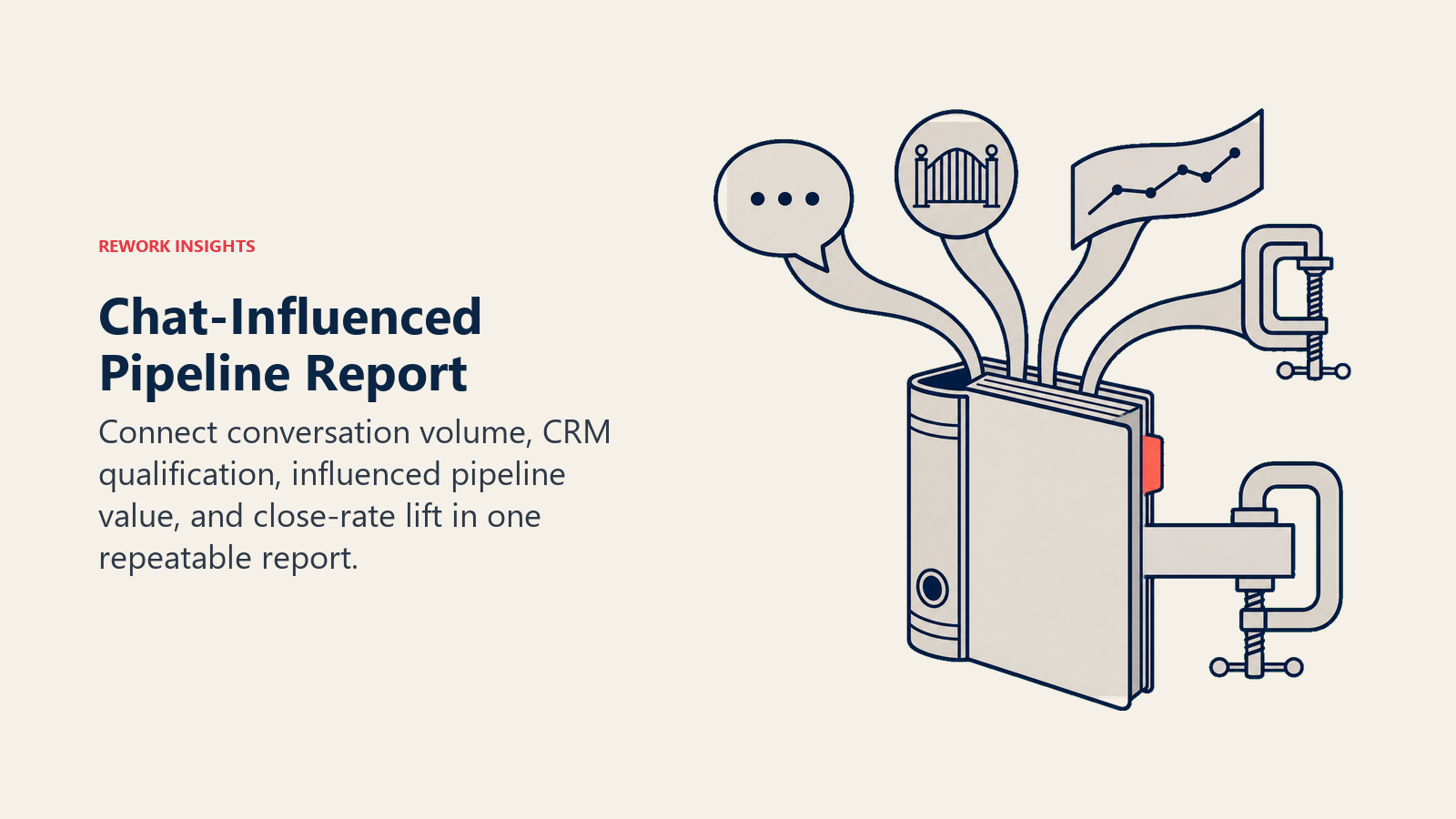
1. Chat origination volume. Total conversations initiated from pre-sale pages per week/month, segmented by page (pricing, features, case studies, demo request). This measures top-of-funnel chat engagement. Trend this over time as you optimize the chat configuration.
2. Conversation-to-CRM-record rate. Of all conversations initiated, what percentage result in a CRM contact with a qualification status? This measures funnel efficiency. Under 20% suggests your qualification sequence is too short or your routing is sending unqualified traffic into the chat funnel. Over 50% in a B2B context suggests you may be over-qualifying and missing genuine buyers. Lead routing automation covers how routing rules affect which conversations reach a human, and which drop off before qualification.
3. Chat-influenced pipeline. Total pipeline value where a chat interaction is tagged on the deal. Track monthly and compare to total pipeline. As you improve CRM integration, this number should grow. Not necessarily because chat is generating more deals, but because you're capturing credit it was already earning.
4. Close rate on chat-engaged vs. non-chat-engaged deals. Segment your closed-won/closed-lost data by chat engagement tag. If chat-engaged deals close at a materially higher rate, that's the ROI signal. Use it to justify investment in the channel.
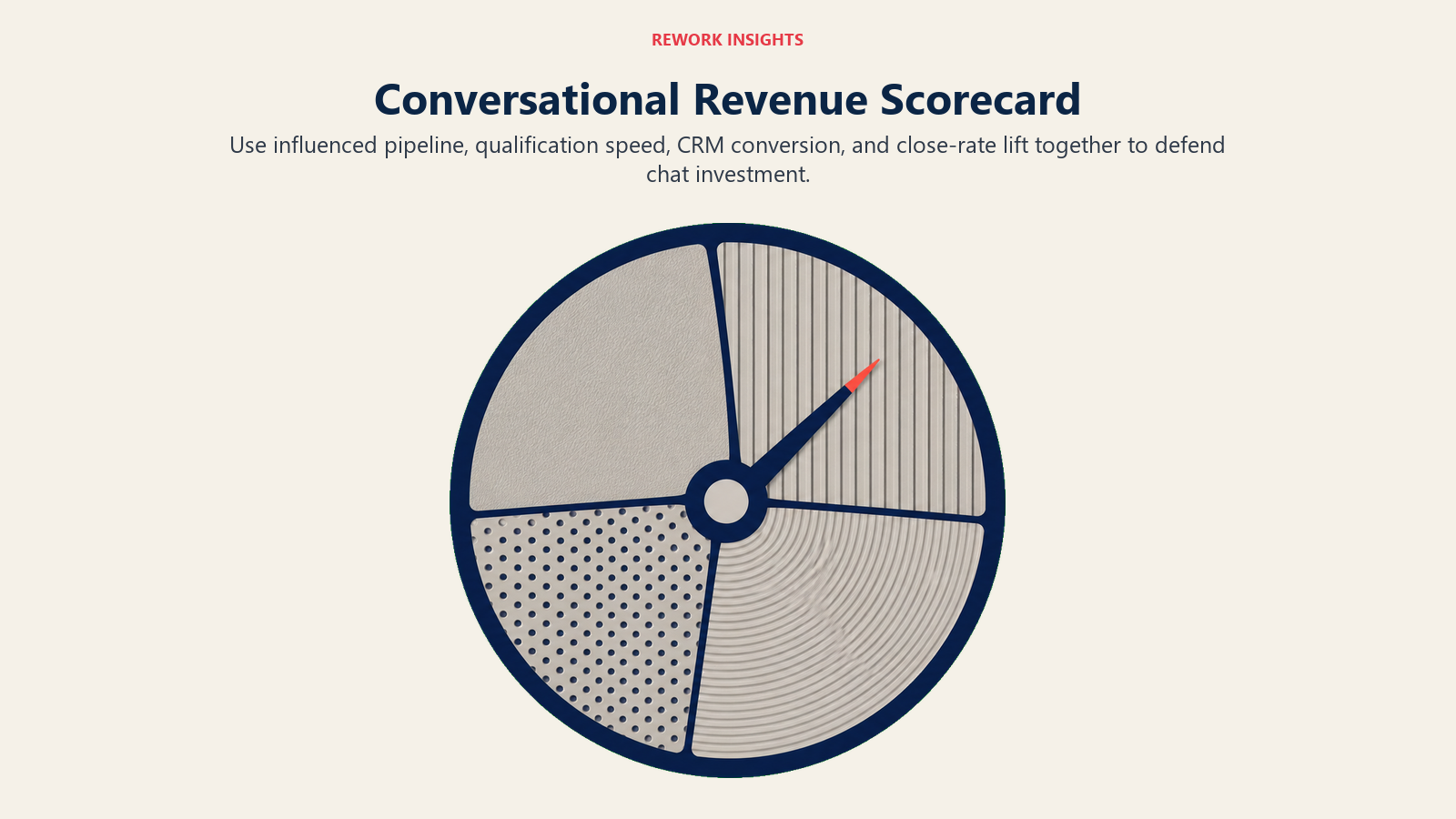
The Conversational Revenue Scorecard
For quarterly reporting to leadership, this four-metric model provides a defensible view of chat's contribution without requiring perfect attribution:
| Metric | What It Measures | Q-o-Q Target |
|---|---|---|
| Chat-influenced pipeline ($) | Revenue opportunity touched by chat | +15-20% growth |
| Speed-to-qualified-conversation (mins) | Response time advantage over form-fill | Maintain under 5 min |
| Conversation-to-CRM rate (%) | Funnel conversion efficiency | Above 25% |
| Close rate lift on chat deals (%) | Downstream deal quality | 10-20% above non-chat |
No single metric tells the full story. The scorecard uses them together to build a case that's harder to dismiss than any single attribution claim.
The CFO conversation built on this framework goes: "Chat-influenced pipeline is $2.4M this quarter. Our close rate on chat-engaged deals is 18% higher than non-chat. We're converting 31% of chat conversations to CRM records at a median five minutes to qualification. Based on that close rate lift, we're attributing $430K in incremental closed revenue to chat's influence this quarter."
That's not perfect attribution. But it's a defensible, data-backed case for the channel, and it's significantly stronger than "we think chat is working."
Three Metrics for the CFO
If you need to compress the reporting further for a CFO conversation, these three metrics carry the most weight:
Chat-influenced pipeline percentage. What share of total pipeline had a chat touchpoint? If 35% of your pipeline touched chat, that's the ceiling for chat's potential contribution. If it's under 10%, chat is underconfigured or underreported.
Incremental close rate on chat-engaged deals. The percentage point difference in close rate between chat-engaged and non-chat-engaged deals. This converts directly to revenue: if chat-engaged deals close 20 percentage points higher and your average deal size is $40K, each additional chat-engaged deal you close represents $40K. Model from there.
Cost per qualified conversation vs. cost per form-qualified lead. Compare the all-in cost of generating a qualified lead through chat (ad spend, SDR time, platform costs) to the same cost through form-fill and email follow-up. In markets with strong chat adoption, this metric often favors chat by 30-50%. That cost-efficiency argument is accessible to any CMO defending a channel investment decision.
These numbers don't require perfect attribution. They require configured integrations, consistent tagging, and a reporting cadence that keeps the data current. For the investment required, the payoff is substantial: finally being able to demonstrate that your highest-converting touchpoint is actually earning its place in the budget. McKinsey's research on AI-enabled customer engagement found that companies building explicit measurement infrastructure for conversational channels saw a 15-25% improvement in their ability to forecast pipeline from those channels within two quarters. If you're evaluating which CRM to anchor this reporting to, Rework vs. HubSpot CRM compares pipeline attribution capabilities across both platforms.
For how this measurement model connects to the broader decision about which conversational channels to invest in, The CMO's Case for Owning the Chat Layer covers the organizational structure that makes this reporting possible when Marketing owns the pre-sale conversational layer.
Learn More
