More in
Conversational Growth Insights
When WhatsApp Belongs in Your B2B Sales Motion (and When It Doesn't)
Mar 27, 2026 · Currently reading
The Death of the Contact Form — What's Replacing It and Why
Mar 19, 2026
Conversational ROI: Measuring Beyond First-Touch Attribution
Feb 24, 2026
Ad-to-Chat Funnels: A CRO's Evaluation Framework
Jan 16, 2026
The CMO's Case for Owning the Chat Layer (vs. Delegating to Support)
Jan 15, 2026
When WhatsApp Belongs in Your B2B Sales Motion (and When It Doesn't)
Turn this article into takeaways for your work.


Each assistant summarizes the article only for you and suggests best practices for your work.
WhatsApp has 2 billion users. In Southeast Asia, Latin America, the Middle East, and parts of Europe, it's how business actually gets done. Not email, not LinkedIn InMail. A procurement manager in Jakarta expecting a vendor response on WhatsApp and getting an email sequence instead isn't just mildly inconvenient. It signals that you don't understand how they work.
Most B2B SaaS companies are running their global sales motion with North American defaults: cold email, form fills, discovery calls. The result is qualified pipeline left on the table in every market where messaging-first is the cultural norm.
But WhatsApp isn't a universal upgrade. Used in the wrong context, it's an intimacy violation that kills the deal before it starts. A US-based enterprise buyer who gets a WhatsApp message from a vendor they've never spoken to will read it as unprofessional at best, boundary-crossing at worst. The same message sent to a business owner in São Paulo is exactly what they expected.
The framework for using WhatsApp in B2B isn't "use it everywhere" or "avoid it entirely." It's knowing precisely where it belongs.
The Geography-First Filter
The first question is whether your target market is in a geography where WhatsApp is a primary business communication channel. Not secondary. Primary.
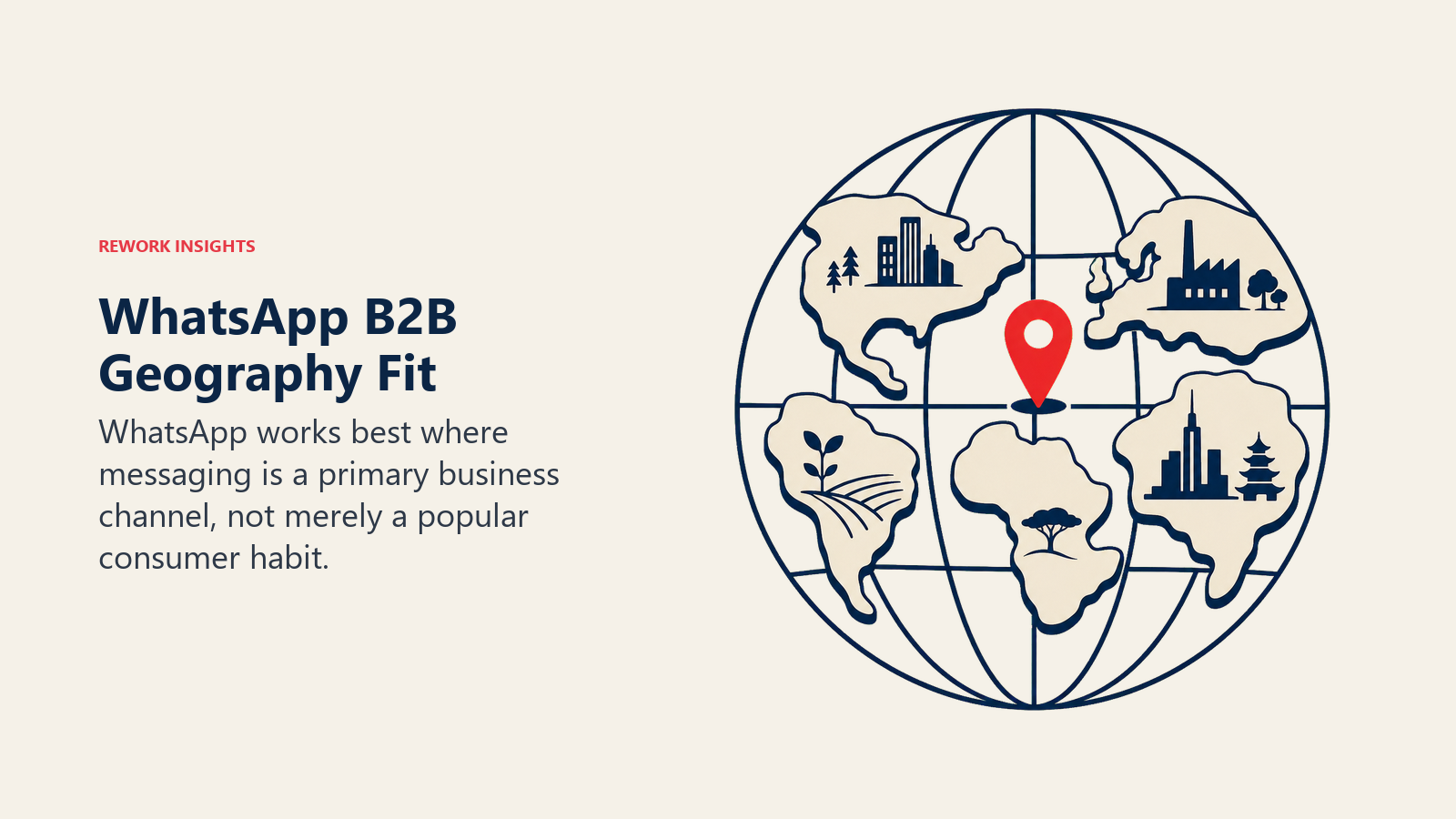
The markets where WhatsApp is standard for B2B communication:
Latin America: Brazil, Colombia, Mexico, Argentina, Chile. WhatsApp penetration in Brazil runs above 90% of smartphone users, making it the primary business communication channel across virtually every deal size and industry. A sales team operating in Brazil without WhatsApp isn't reaching buyers where they prefer to be reached.
Southeast Asia: Indonesia, Malaysia, the Philippines, Singapore, Vietnam. Usage patterns vary (Indonesia heavily favors WhatsApp, Singapore has more multichannel norms), but across the region, messaging apps are primary. For SMB buyers in Indonesia, WhatsApp is the business inbox.
Middle East and North Africa: UAE, Saudi Arabia, Egypt, and most of the region. WhatsApp is dominant for professional communication. Regional sales motions that skip it are operating with a structural disadvantage.
South Asia: India is a mixed picture. WhatsApp penetration is massive, but enterprise buyers in tech-heavy sectors often default to email for formal communication. SMB and mid-market Indian buyers, however, are very responsive on WhatsApp.
Parts of Europe: Spain, Italy, Germany in consumer contexts. But for B2B in these markets, WhatsApp is less uniform. Enterprise buyers in Germany, in particular, often associate WhatsApp with personal communication and may find its use in a sales context informal.
The simple test: ask your sales team in each market. If reps in Brazil are already using personal WhatsApp accounts to stay in contact with prospects because "that's just how it works," that's a signal that your official sales motion hasn't caught up to market reality. Respond.io or WhatsApp Business API-connected platforms can formalize what's already happening informally, giving you visibility, compliance, and CRM integration. The Respond.io vs. ManyChat breakdown for B2B sales teams can help you choose the right platform for your pipeline volume and routing complexity.
The Deal-Type Filter
Geography sets the baseline, but deal type determines whether WhatsApp fits the specific sales motion.

SMB and mid-market, shorter cycles. This is where WhatsApp delivers the most consistent value. Deals under $25K ACV with cycle lengths under 60 days benefit from the response speed and informal accessibility that WhatsApp provides. The buyer is often a single decision-maker or a two-person evaluation team. Communication doesn't need to be formal. Speed matters. WhatsApp fits.
Enterprise, multi-stakeholder, long cycles. Complex deals with procurement involvement, legal review, and formal evaluation processes have different communication norms. Enterprise buyers expect documented communication, tracked email chains, and formal meeting invites. WhatsApp can be useful for quick logistical exchanges ("can we push the call 30 minutes?") with champions who have chosen to communicate that way, but it should not be the primary communication channel for formal deal stages.
Relationship sales vs. product-led. Highly relational industries (professional services, financial products, staffing, healthcare) often see the best WhatsApp adoption in B2B because the communication style matches. Product-led growth motions targeting developers or technical buyers are less suited to WhatsApp because those buyers prefer async channels with less social presence (email, Slack, in-product messaging).
Inbound vs. outbound. WhatsApp initiated by the buyer (via click-to-chat ads, website widget, or ad-to-WhatsApp formats) is almost always appropriate if the buyer is in a WhatsApp-native market. WhatsApp initiated by the seller to a cold prospect crosses a different threshold: it requires more care and a clear opt-in signal before the outreach. For inbound-initiated WhatsApp, Meta ads to WhatsApp funnel setup covers the technical infrastructure to capture and route those conversations properly.
The Intimacy Calibration Problem
This is the subtlest challenge in B2B WhatsApp adoption, and it's the most commonly underestimated.

WhatsApp occupies a different psychological space than email. Email is formal business correspondence. WhatsApp is where people talk to family, friends, and trusted business contacts (in many markets). That positioning is simultaneously its strength and its risk in sales contexts.
The strength: a WhatsApp conversation from a salesperson feels personal and accessible in a way email doesn't. In relationship-driven markets, this accelerates trust. A rep who texts a prospect on WhatsApp with a quick follow-up after a meeting is signaling investment in the relationship.
The risk: the same informality can feel presumptuous with buyers who haven't established rapport. A cold WhatsApp opener that treats the prospect as an existing contact (first name, casual tone, no formality) can trigger discomfort rather than connection.
The calibration rule: WhatsApp's tone should match the relationship stage, not assume it. Early-stage outreach should be slightly more formal than a message between colleagues. As the relationship develops, the tone can relax. Never start with the same register you'd use with a close colleague, earn that register over time.
Also relevant: profile context. A WhatsApp Business profile with a company name, logo, and description signals a professional, expected communication. A personal WhatsApp number without business context looks like an individual who got hold of the prospect's number. Meta's WhatsApp Business research shows that verified business accounts see significantly higher response rates than unverified personal numbers in the same markets, because buyers recognize the communication as legitimate. Business API-connected accounts via Respond.io solve this structurally: every conversation originates from a verified business identity, not a personal number.
The CRM Integration Requirement
This is non-negotiable for any organization using WhatsApp at scale in a sales motion: conversations that don't sync to CRM become data silos.
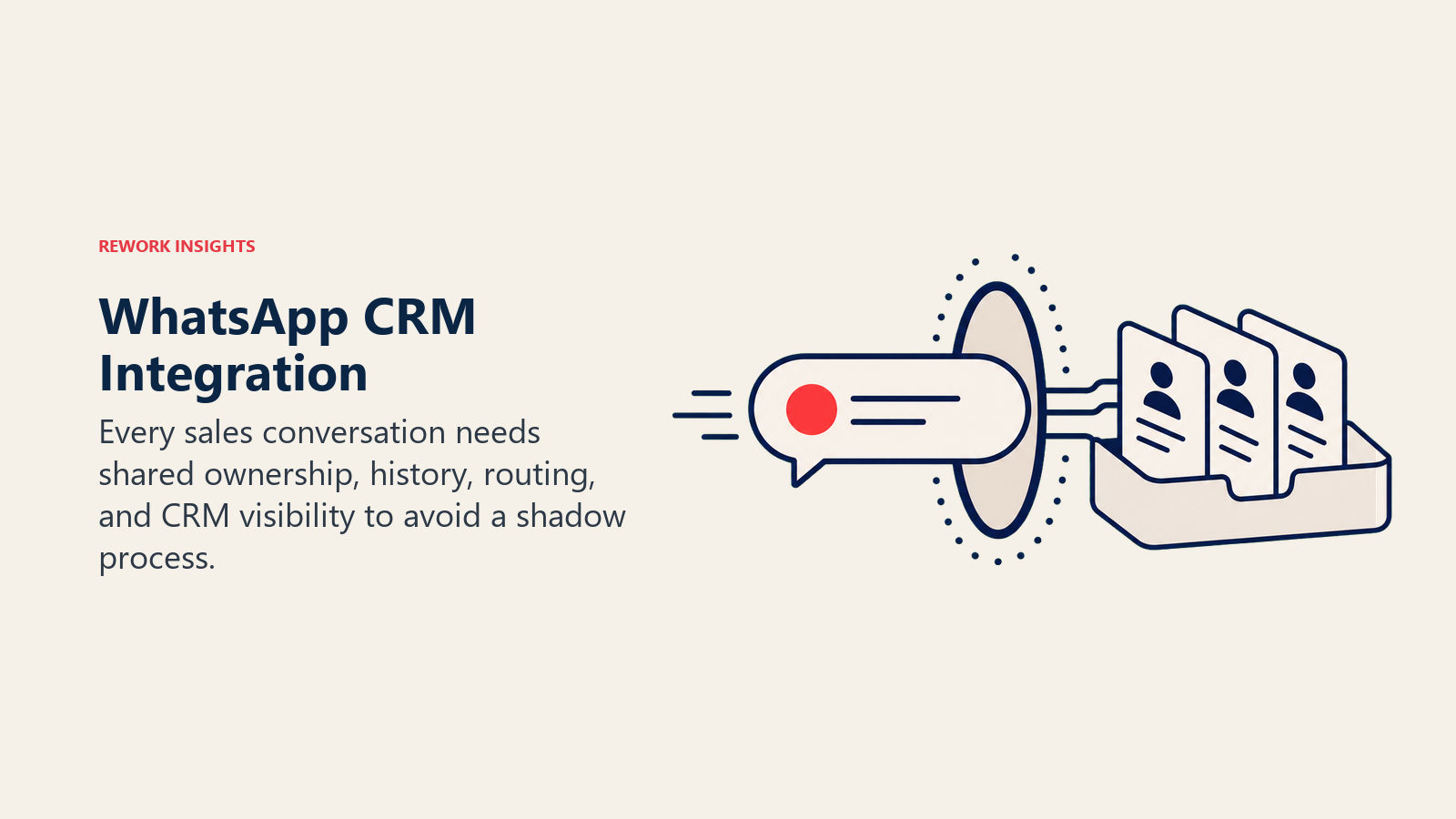
A rep who uses personal WhatsApp to communicate with 15 prospects has a deal management problem: there's no pipeline record, no conversation history accessible to the team, no handoff capability if the rep leaves, and no attribution data for marketing. Multiply this by a 20-person sales team and you have a significant information loss that breaks both pipeline visibility and revenue reporting. Juniper Research's analysis of business messaging platforms found that companies using structured Business API channels versus informal personal messaging saw measurably better CRM data completeness and customer satisfaction outcomes. The lead data management fundamentals article explains how teams structure data ownership to prevent exactly this kind of shadow process from developing.
The operational fix is deploying WhatsApp through a business API-connected platform. Respond.io is the most common choice for enterprise and mid-market B2B teams because it supports multi-agent routing, CRM sync (HubSpot and Salesforce), and conversation tagging. ManyChat is better suited for SMB automation, where the WhatsApp motion involves largely automated qualification sequences with lower contact volume and simpler routing.
With Respond.io or equivalent, every WhatsApp conversation is visible in a shared inbox, assigned to the right rep, tagged with deal context, and synced to CRM as contact notes or custom field values. The rep can hand off a conversation to a colleague without the buyer re-explaining context. Management can see conversation volume and qualification outcomes. Marketing can see which channels and campaigns are driving WhatsApp conversation volume.
Without this infrastructure, WhatsApp in B2B is a shadow process. Useful for individual reps, invisible to the organization.
The WhatsApp Sales Motion Checklist
These eight conditions should be true before adding WhatsApp as a formal channel in your B2B sales motion:
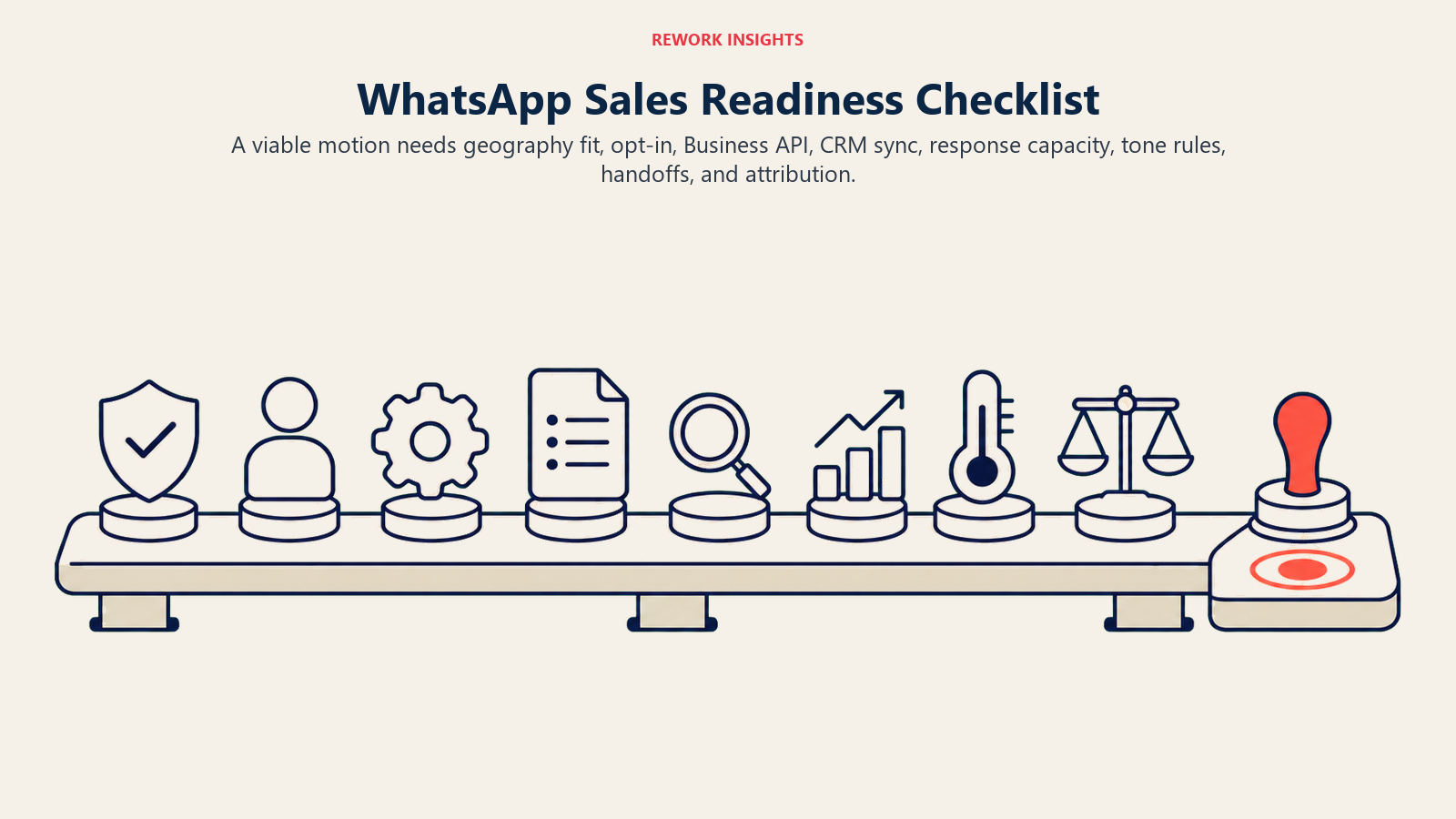
Geography match. More than 25% of your target pipeline is in markets where WhatsApp is a primary B2B communication channel.
Buyer opt-in exists. You have a clear mechanism by which buyers signal willingness to communicate via WhatsApp: a click-to-chat ad format, a website widget, or an explicit opt-in at form fill.
Business API connected. You're using WhatsApp Business API (not personal numbers), connected through a platform like Respond.io that provides shared inbox and CRM sync.
CRM sync configured. WhatsApp conversation contacts and outcomes sync automatically to your CRM with appropriate lead status tagging.
Response capacity exists. You can respond to incoming WhatsApp conversations within five minutes during business hours. If not, AI-assisted routing handles initial qualification outside those windows.
Tone guidelines documented. Your team has clear guidance on appropriate WhatsApp communication tone by deal stage and buyer seniority, not left to individual rep judgment.
Handoff process defined. When a rep changes, leaves, or the deal escalates to a senior contact, the WhatsApp conversation history transfers cleanly and the buyer isn't asked to re-establish context.
Attribution tagging in place. Deals touched by WhatsApp are tagged in CRM so you can measure close rate, cycle length, and pipeline contribution for the channel independently.
If you can check all eight, WhatsApp is ready to integrate. If you're missing three or more (particularly the API connection and CRM sync), fix the infrastructure first.
A Three-Step Pilot
You don't need to commit the full sales team to test WhatsApp's impact. A focused pilot on one market segment produces clean data without organization-wide disruption.
Step 1: Select one market. Pick the segment where WhatsApp adoption is strongest among your current customers. If you have pipeline in Brazil, Indonesia, or MENA and reps are already using personal WhatsApp informally, start there. You're formalizing an existing behavior, which lowers adoption friction.
Step 2: Set up the infrastructure before the first message. Get Respond.io or an equivalent platform connected to WhatsApp Business API. Build the CRM sync. Configure the qualification sequence for the initial automated response. Define the tagging convention for chat-originated leads. The multi-channel inbox setup guide walks through how to configure a shared inbox that handles WhatsApp alongside other channels without creating routing conflicts. This step takes one to two weeks but is what makes the pilot measurable.
Step 3: Run for 60 days and compare. Track qualified leads generated, time-to-qualified-conversation, and close rate on WhatsApp-engaged deals versus equivalent deals in the same market segment using email-first outreach. Use the Conversational Revenue Scorecard framework from Conversational ROI: Measuring Beyond First-Touch Attribution to build your reporting.
At the end of 60 days, you'll have data that answers the question: does WhatsApp generate qualified pipeline in this segment at better unit economics than our existing motion? If yes, expand. If the close rates are similar but WhatsApp reaches buyers faster, that's a speed argument for markets where deal timing matters.
What This Isn't
WhatsApp doesn't replace email. It doesn't replace outbound sequences. It doesn't replace discovery calls or demos. It adds a channel where buyers in specific markets prefer to communicate. And in those markets, not using it is a structural disadvantage.
The companies treating WhatsApp as a replacement for their full sales stack have a different problem than the companies treating it as irrelevant. The right framing is: WhatsApp is a conversation channel suited to specific market contexts, deal types, and relationship stages. Used precisely, it closes the gap between buyer preference and seller reach in markets that your current motion is underserving.
For the paid acquisition side of this, Ad-to-Chat Funnels: A CRO's Evaluation Framework covers how click-to-WhatsApp formats are performing against traditional landing page funnels, including the conditions and measurement model.
Learn More
