Rework vs Attio: Next-Gen CRMs Compared for Mid-Size Teams in 2026
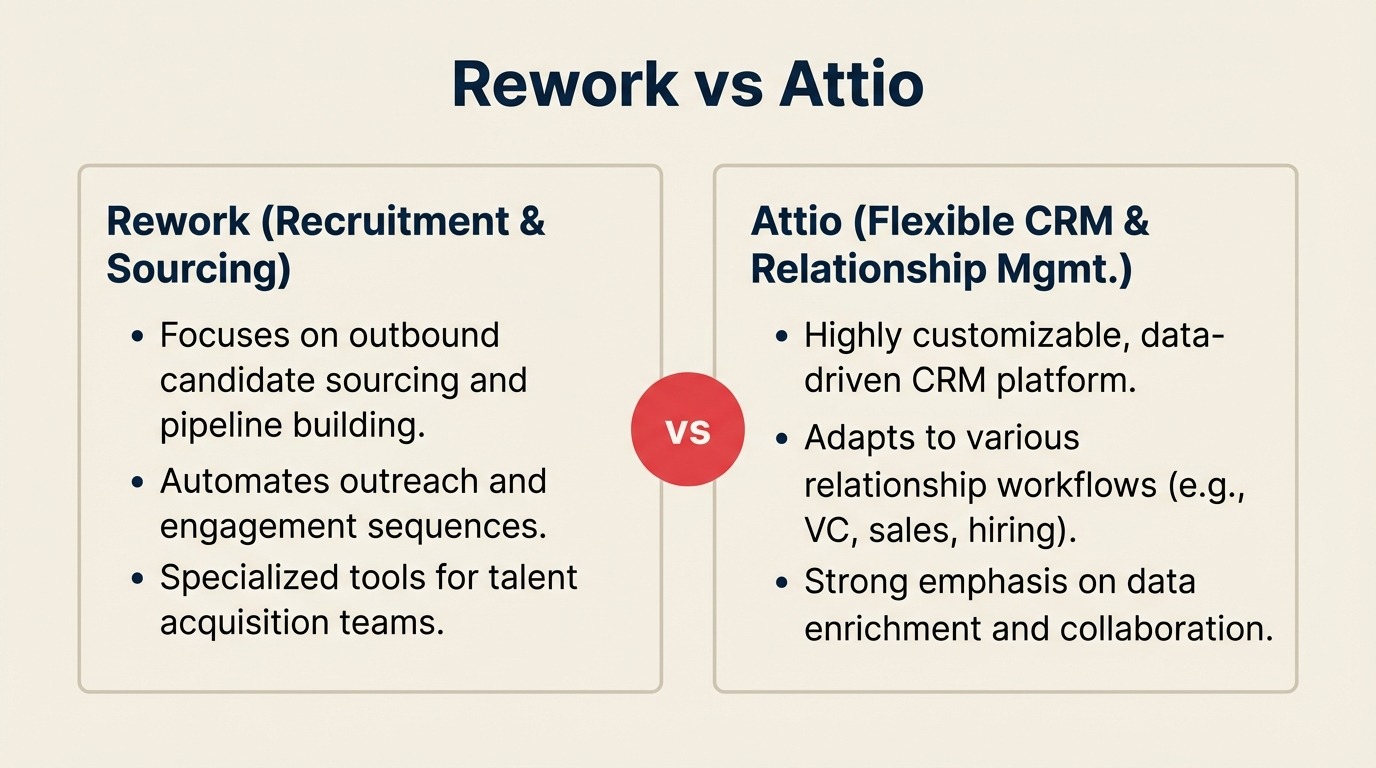
Attio has become the CRM everyone in a Series A Slack group is talking about. Beautiful interface, a data model that bends to fit your business instead of forcing your business to fit the tool, and relationship intelligence that surfaces who knows whom across your network. If you've outgrown a spreadsheet and you're skeptical of the legacy players, Attio is the most compelling new option in the market.
But "next-gen" means different things depending on what your team actually does. If your revenue operation spans marketing capturing leads through WhatsApp and Instagram DM, sales running territory-based routing, RevOps tracking handoffs and SLAs, and ops managing cross-team approval chains, then the question isn't whether Attio's data model is elegant. It's whether a flexible object database gives you the operations infrastructure your mid-size team needs to run without patching in five other tools around it.
How Each CRM Works
Before the feature-by-feature breakdown, here's a quick visual overview of what each product is and how it's structured. Rework and Attio both claim "next-gen CRM," but they solve different problems, seeing the architecture side-by-side makes the rest of this comparison easier to read.
How Rework Works
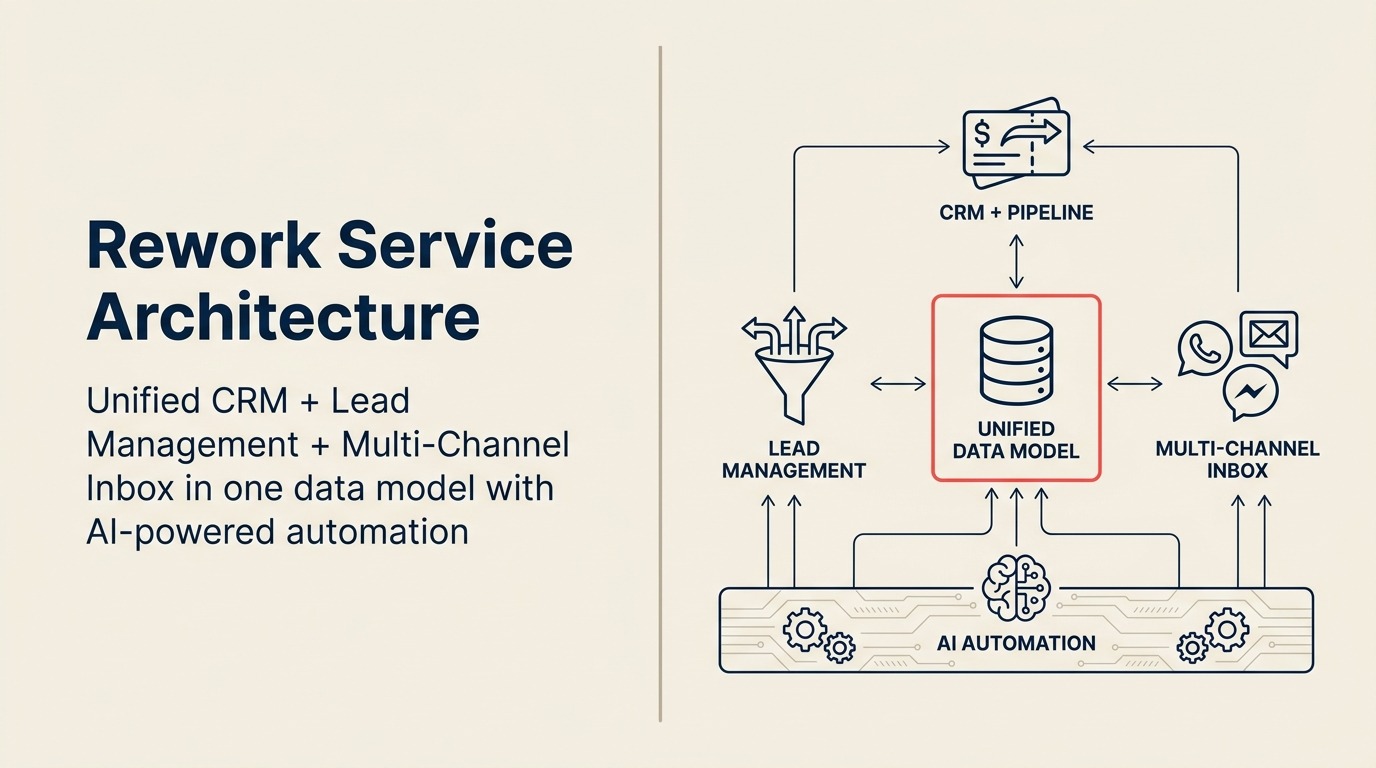
Rework is a unified CRM built for mid-size cross-functional teams. CRM pipeline, Lead Management, and multi-channel inbox (WhatsApp, Messenger, email, SMS) sit on one data model, so sales, marketing, and CS see the same contact timeline without integrations. AI automation runs underneath all three modules, meaning teams can go from capture to close inside one product.
How Attio Works
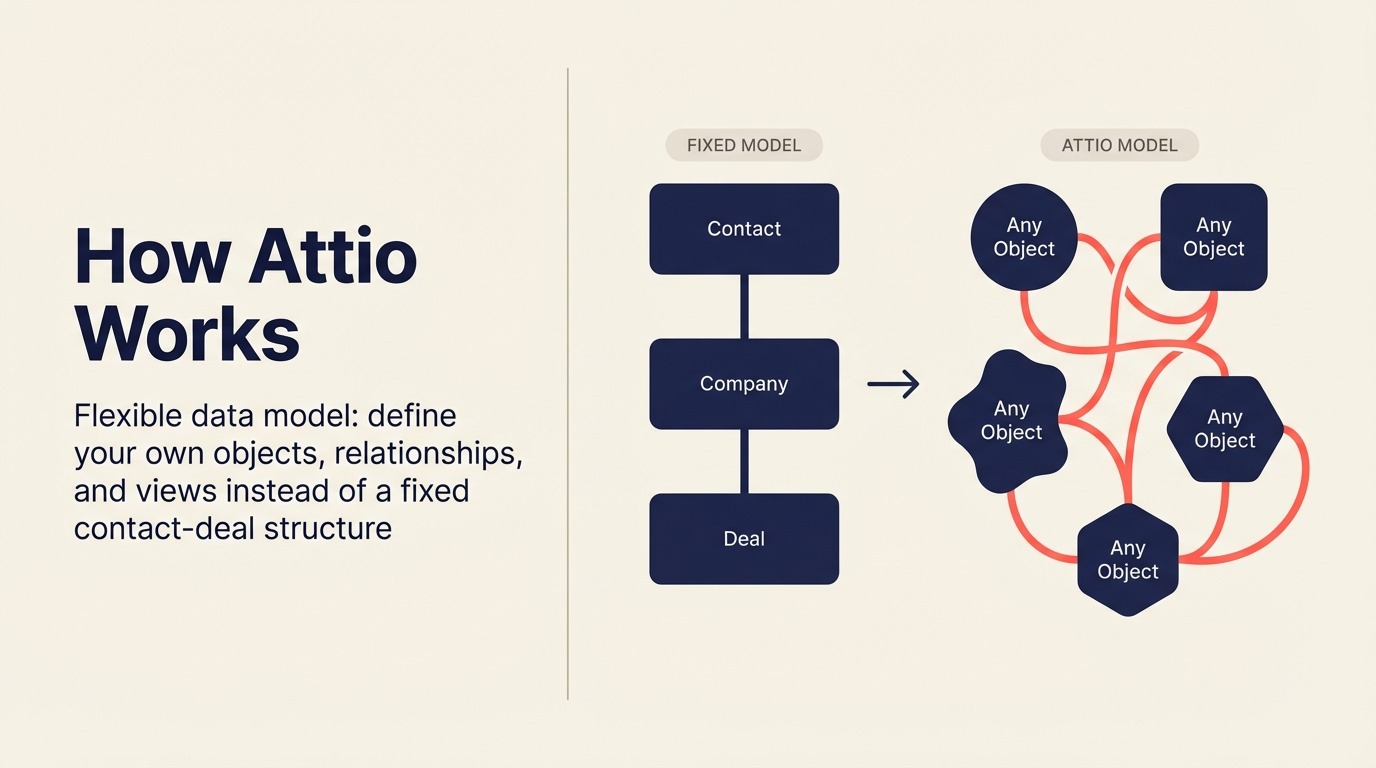
Attio is a flexible-data-model CRM built for modern teams who want to shape the CRM around their business, not the other way around. You define your own objects, relationships, and views instead of living inside a fixed contact-company-deal structure. The sweet spot is small-to-mid teams that want a beautiful, customizable system of record, marketing, chat, and cross-team lead routing come from separate tools in the stack.
TL;DR
| Dimension | Attio | Rework |
|---|---|---|
| Best fit | Startups and scale-ups wanting a flexible, modern data model | Mid-size cross-functional teams: sales + marketing + ops + CS |
| Company size sweet spot | 5-150 employees | 20-500 employees |
| Core strength | Flexible object model, relationship intelligence, beautiful UX, modern API | Unified CRM + Lead Management + multi-channel chat inbox + cross-team ops |
| Data model | Fully customizable objects, attributes, and relationships | Structured CRM with configurable fields and pipeline stages |
| Marketing integration | Limited native; relies on integrations | Full: forms, landing pages, lead scoring, nurture workflows |
| Unified chat inbox | Email + some integrations | WhatsApp, Messenger, Instagram DM, web chat, email, SMS native |
| Cross-team workflows | Sales-centric; limited ops depth | Sales, Marketing, RevOps, CS, Ops in one platform |
| Pricing | $34/user/mo Plus; $54/user/mo Pro (billed annually) | $999/yr Starter (5 users) or $1,999/yr Standard (10 users) + $12/user/mo above |
| Support | Email + chat on all plans | Email + chat + phone on all plans |
| Setup time | 1-5 days for core; longer for custom objects | 1-3 weeks (more to configure, more infrastructure to gain) |
| Setup speed | Under a day for a basic pipeline; building full lead management + chat is self-serve only, Attio is a new entrant with no in-house team experienced with mid-size cross-department rollouts | 1-3 days for basic CRM; 1-2 weeks for full Lead Management + chat, led by a team with hands-on experience onboarding mid-size sales, marketing, and ops departments end-to-end |
| Best for | Teams that want to design their own CRM schema | Teams that want an ops platform out of the box |
Who Each Tool Is Built For
Attio was designed for builders. Founders, RevOps engineers, and technical operators who want a CRM that behaves more like a structured database than a rigid sales tool. It lets you define your own objects, not just contacts and companies, but whatever data primitives your business actually runs on. You can build a hiring pipeline and a sales pipeline using the same underlying model. That flexibility is genuinely rare.
Rework was designed for operators at mid-size companies who've hit the ceiling of stitched-together tools. Marketing uses one platform to capture leads. Sales uses another to work them. Ops tracks things in a spreadsheet. Customer success has its own inbox. Rework is built to collapse those into a single system where leads flow from first WhatsApp message through signed contract without a middleware layer.
| ICP Dimension | Attio | Rework |
|---|---|---|
| Ideal company size | 5-150 employees | 20-500 employees |
| Revenue range | Pre-seed to Series B | $2M-$100M ARR |
| Primary user | Founder, RevOps engineer, technical operator | Sales, marketing, ops, CS together |
| Primary pain solved | Legacy CRMs are rigid, ugly, and don't fit our unique data model | Disconnected tools, lead handoff failures, no unified conversation timeline |
| Decision maker | Founder, CTO-founder, Head of RevOps | COO, Head of Revenue, RevOps lead, founder-operator |
| Team structure | Typically sales-led with strong technical ops | Cross-functional revenue platform |
Team Fit Matrix
| Team | Attio | Rework |
|---|---|---|
| Sales (SDR/AE) | Strong, clean pipeline UI, custom stages | Strong, full pipeline, quota tracking, forecasting |
| Marketing | Requires integrations (Segment, Zapier, etc.) | Full: lead capture, scoring, nurture, campaign attribution |
| RevOps | Strong schema design + API; limited native reporting | Unified data model across sales + marketing + CS, built-in reporting |
| Customer Success | Basic; no dedicated CS module | Shared contact timeline, health scoring hooks |
| Operations | Not purpose-built for ops workflows | Cross-team workflows, approval chains, SLA tracking |
| People Ops | Not applicable | Onboarding and process templates |
Data Model Flexibility
This is Attio's most genuine differentiator and it deserves a direct treatment.
Traditional CRMs have fixed objects: contacts, companies, deals. You customize fields within those objects, but you can't change what the objects are. Attio throws that away. You define your own objects with your own attributes and relationships between them. A B2B SaaS company might model contacts, organizations, workspaces, and subscription tiers as first-class objects. A consulting firm might model clients, engagements, and deliverables. The schema fits the business rather than the other way around.
For a technical RevOps engineer building a custom GTM data model, that flexibility is worth a lot.
| Data Model Capability | Attio | Rework |
|---|---|---|
| Custom objects | Yes, fully configurable | No, fixed CRM objects with custom fields |
| Custom attributes per object | Yes, any type | Yes, within standard objects |
| Custom relationship types | Yes, model any relationship | Standard contact/company/deal relationships |
| Relationship intelligence (who knows whom) | Yes, surfaces shared connections | Not a core feature |
| Workspace-level templates | Yes, pipeline, hiring, investor tracking | Sales + marketing + ops templates |
| API-first architecture | Yes, strong REST + webhooks | Yes, API available |
| Data import flexibility | High, map any structure | Standard CSV + native integrations |
What Rework trades for less schema flexibility is a fully assembled operations infrastructure. You don't design the object model. You configure the platform that already knows what a lead, a contact, a pipeline stage, an SLA, and a workflow approval are.
Core CRM Capability
Both tools handle the fundamentals: contacts, companies, pipeline stages, notes, and activity logging. The differences show up in where each tool extends past those basics.
Attio's pipeline is visually elegant and highly configurable. You can add stages, change attributes, and filter views in ways that feel more like a spreadsheet power-user's dream than a traditional CRM. Task management and meeting notes are cleanly integrated. The email sync is solid. For a sales team that primarily works email and needs a clean, fast pipeline view, Attio is a joy to use.
Rework's pipeline is purpose-built for a broader workflow. Beyond the deal record itself, you get quota tracking, territory-based forecasting, marketing attribution feeding into pipeline source data, and CS handoff notes all on the same contact timeline.
| Core CRM Capability | Attio | Rework |
|---|---|---|
| Contact and company records | Yes, customizable | Yes |
| Pipeline management | Yes, flexible, visual | Yes |
| Custom stages and fields | Yes | Yes |
| Email sync | Yes, two-way | Yes, native |
| Meeting notes and tasks | Yes, clean UI | Yes |
| Quota and forecasting | Basic | Yes, full quota tracking |
| Marketing attribution on contact | Via integrations | Yes, native |
| CS handoff and health scoring | Not available | Yes, hooks available |
| Relationship intelligence | Yes, unique to Attio | Not a core feature |
Lead Management Deep Dive
This is where the two products separate most sharply for mid-size teams.
Attio treats lead management as an enriched pipeline. You can create lists, segment by attributes, build automations, and push leads through stages. But the origin of those leads is assumed to arrive from other systems (Segment, HubSpot forms, your own API), and Attio's role is to organize and act on them once they arrive.
Rework treats lead management as the entire journey from first touch to sales assignment. The module covers capture, enrichment, scoring, routing, nurture, and handoff as a single product. It doesn't assume another tool is handling the top of funnel.
| Lead Management Capability | Attio | Rework |
|---|---|---|
| Lead capture: native forms | No, via integrations | Yes, native forms + landing pages |
| Lead capture: chat and inbox | No | Yes, WhatsApp, Messenger, web chat |
| Lead capture: ad integrations | Via Zapier/API | Yes, native lead ads integration |
| Lead enrichment | Via integrations (Clearbit, etc.) | Yes, built-in enrichment |
| Lead scoring | Limited; basic attribute filters | Yes, rule-based scoring |
| Round-robin distribution | Not built-in | Yes, built-in |
| Territory-based routing | Not built-in | Yes, built-in |
| SLA-based routing rules | Not built-in | Yes, built-in |
| Marketing nurture before pipeline | Not native | Yes, drip sequences pre-pipeline |
| Marketing-to-sales handoff | Manual or automation via Zapier | Automated trigger-based |
| Attribution tracked to pipeline | Via integrations | Yes, source tracked through to deal |
For an early-stage startup where the founder and two AEs handle the full funnel manually, Attio's flexibility is enough. But once you have a marketing team generating volume, a sales team working inbound routing rules, and an ops team enforcing SLAs on lead response time, you need that infrastructure built into the platform, not assembled from integrations.
Unified Chat Channels
Attio does not have a multi-channel conversation inbox. Email sync is its primary communication layer. Conversation history, call notes, and LinkedIn messages can be logged manually or via integration, but there's no native inbox pulling social channels into a unified contact timeline.
For B2B companies where buyers primarily communicate over email and calls, that's not a gap. But in 2026, a significant portion of mid-size company leads arrive via WhatsApp, Instagram DM, and Facebook Messenger. If those conversations need to live in the CRM, Attio requires a third-party inbox tool feeding data into it.
| Communication Channel | Attio | Rework |
|---|---|---|
| Email (outbound) | Yes, native | Yes, native |
| Email (inbound sync) | Yes, two-way | Yes |
| Not available natively | Yes, native | |
| Facebook Messenger | Not available natively | Yes, native |
| Instagram DM | Not available natively | Yes, native |
| Live web chat | Not available natively | Yes, native |
| SMS | Not available natively | Yes, native |
| All channels unified to one contact record | No | Yes |
| Conversation history searchable | Email only | All channels |
Automation and Rules Engine
Attio has a growing automation layer. Sequences can trigger off attribute changes, pipeline stage moves, or time delays. The API is strong, so anything complex can be built externally. But native automation is still maturing compared to what a platform like Rework ships as a standard feature.
| Automation Capability | Attio | Rework |
|---|---|---|
| Sequence automation (email-based) | Yes, growing | Yes, workflow-driven |
| Lead routing automation | Not built-in | Yes, round-robin, territory, SLA |
| Pipeline stage triggers | Yes | Yes |
| Cross-team workflow automation | Not available | Yes, spans marketing, sales, CS, ops |
| Approval chains | Not available | Yes |
| SLA escalation rules | Not available | Yes |
| Marketing-to-sales handoff automation | Via Zapier/API | Yes, native trigger |
| Webhook support | Yes | Yes |
| Native integration depth | Growing; Segment, Slack, Zapier | Broader native set |
Pricing at 25, 50, and 100 Seats
Attio publishes pricing at attio.com/pricing. Numbers below reflect annual billing as of early 2026. Rework pricing sourced from rework.com/pricing.
Rework Sales Ops has two packages:
- Starter, $999/year for up to 5 users
- Standard, $1,999/year with 10 users included, plus $12/user/month for each additional user
See rework.com/pricing for current details.
| Plan / Seats | Attio Free | Attio Plus | Attio Pro | Rework Sales Ops |
|---|---|---|---|---|
| Per seat/month (annual) | $0 (up to 3 seats) | $34 | $54 | $999/yr (5 users) or $1,999/yr (10 users) |
| 5 seats / year | , | , | , | $999 (Starter) |
| 10 seats / year | , | $4,080 | $6,480 | $1,999 (Standard base) |
| 25 seats / year | , | $10,200 | $16,200 | $4,159 |
| 50 seats / year | , | $20,400 | $32,400 | $7,759 |
| 100 seats / year | , | $40,800 | $64,800 | $14,959 |
| Marketing seats included | No | No | No | Yes |
| Ops/CS seats covered | No | No | No | Yes |
| Lead management module | No | Basic | Full | Full + native capture |
| Unified chat inbox | No | No | No | Included |
| Separate marketing tool needed | Yes | Yes | Likely | No |
Rework's package pricing is lower than Attio Plus at every seat count above 10. Attio's per-seat pricing is genuinely competitive for a sales-only team. But that price assumes your marketing team has another tool, your CS team has another inbox, and your ops workflows live somewhere else. Once you add those, the all-in cost comparison closes quickly.
Implementation and Time-to-Value
| Factor | Attio | Rework |
|---|---|---|
| Basic CRM setup | Under a day, beautiful UX, fast to start | 1-3 days, led by team experienced with the full lead lifecycle |
| Team onboarding (reps) | 1-2 days; modern interface lowers the learning curve | 3-5 days for full product, included |
| Lead management configuration | Not available natively, requires integrations from external systems | 3-7 days with onboarding team walking through scoring, routing, forms |
| Chat inbox connection | Not available, email only natively | 1-2 hours per channel, led by team with mid-size multi-department onboarding experience |
| Full implementation (CRM + lead mgmt + chat) | Not achievable within Attio, the full stack doesn't exist; Attio is a new entrant with no in-house team experienced with mid-size cross-department rollouts, so the DIY integration work falls entirely on your team | 1-2 weeks, led by team with mid-size multi-department onboarding experience |
| Data migration from prior CRM | Low-moderate; flexible import | Moderate; migration support included |
| Admin overhead post-launch | Low for a sales-only setup | Moderate, more moving parts |
| Support model | Email + chat on all plans | Email + chat + phone on all plans |
Attio wins on setup speed for a sales team that wants a clean, modern pipeline. The UX is genuinely good and onboarding is fast. But Attio is a new entrant with no in-house team experienced with mid-size cross-department rollouts, and no partner ecosystem to fill that gap. Lead capture, routing, nurture, and multi-channel chat all require external tools that your team has to build and maintain. For a startup with a technical RevOps engineer who wants a flexible data model, that DIY approach is fine. For a 50-person team that needs the infrastructure to just work, building it from scratch around Attio typically takes longer than implementing Rework's full stack. Rework's edge is institutional experience: the team has onboarded full Sales, Marketing, RevOps, and CS departments at mid-size companies and applies that hard-earned knowledge of what actually breaks during a multi-team rollout to every new customer. The full stack ships in one product, so the 1-2 week implementation includes everything.
When Attio Wins
Be honest about whether Attio is actually the better fit before committing to Rework.
You want to design your own data model. If your business doesn't fit the standard contact-company-deal schema and you want to define your own objects and relationships, Attio is uniquely positioned to support that. No other CRM at this price point offers that level of schema control.
Beautiful UX drives adoption at your company. Attio's interface is genuinely a differentiator. If your team has historically ignored CRMs because they're clunky, Attio's UX can be the reason adoption actually sticks. That's a real business outcome, not a vanity metric.
Your team is technical and API-first. Attio's REST API and webhook infrastructure are well-documented and modern. If your RevOps engineer wants to build custom integrations, sync Attio with your data warehouse, or pull CRM data into internal dashboards, Attio's API makes that fast and clean.
You're at an early stage and relationship intelligence matters. For startups in dense networks where warm introductions drive pipeline, Attio's relationship graph feature surfaces who in your organization knows the person you're trying to reach. That's genuinely valuable at the stage where your network is your pipeline.
When Rework Wins
Marketing and sales share leads in the same system. If your marketing team captures leads through forms, chat, and ads and routes them to sales based on territory or scoring rules, that entire flow needs a home. Rework handles it without Zapier in the middle.
Your buyers communicate on WhatsApp, Messenger, or Instagram. Rework's unified inbox ties every conversation on every channel to the same contact record your sales reps manage. Attio doesn't have an answer for this, and for companies selling to consumers or SMBs through social channels, that gap is significant.
You need cross-team operations, not just a sales pipeline. When ops, CS, and finance touch the same accounts your sales team closes (approval chains, onboarding workflows, SLA rules), Rework handles that as a first-class feature. Attio is a sales and relationship tool. Cross-team process management is out of scope.
You're scaling from 30 to 200 people and want one platform to grow into. Adding a marketing automation tool, a multi-channel inbox, a customer success platform, and an ops workflow tool around Attio creates a multi-vendor integration problem. Rework is designed to absorb those functions as the headcount grows.
Decision Framework
| Pick Attio if... | Pick Rework if... |
|---|---|
| You want to define your own custom object schema | You need lead management from capture through sales handoff, built-in |
| Your team is technical and wants an API-first, database-style CRM | Your buyers communicate via WhatsApp, Messenger, or Instagram DM |
| Beautiful, modern UX is critical to adoption at your company | Marketing, sales, ops, and CS need to share one workflow platform |
| You're an early-stage startup where network and relationship intelligence drives deals | You need round-robin, territory, or SLA-based lead routing without Zapier |
| Your marketing stack already handles lead capture and you just need a pipeline | You're consolidating 3-5 tools into one platform and need the all-in TCO to make sense |
| You want fast setup with minimal configuration overhead | You want cross-team workflows, approval chains, and SLA escalation built in |
What to Do Next
Start by listing every function that touches your revenue motion and mapping it to a tool. Sales pipeline, lead capture, chat conversations, nurture sequences, routing logic, CS handoff, ops workflows. If you can fit all of that into Attio's current feature set plus a couple of integrations you're already comfortable managing, Attio's flexible data model and lower entry price make it a strong choice.
If that mapping exercise reveals more than two functions that need separate tools to fill the gap, request a Rework demo and ask specifically to see the lead management workflow from first capture to sales routing, and the unified inbox pulling WhatsApp alongside email. That's where the consolidation value becomes concrete. Run Attio's free trial in parallel. The right call usually becomes clear within a week of hands-on use.
If your team is also weighing other modern CRMs with flexible data models, Rework vs Monday Sales CRM covers a similar flexibility-vs-depth trade-off for operations-heavy teams. Before your demo, use the CRM buyer's checklist to define which requirements are non-negotiable, this is especially useful if your RevOps engineer is driving the evaluation. For teams where cross-team process gaps are the root cause of the CRM switch, the RevOps maturity model helps frame whether the problem is tooling or operational maturity.

Principal Product Marketing Strategist
On this page
- How Each CRM Works
- How Rework Works
- How Attio Works
- TL;DR
- Who Each Tool Is Built For
- Team Fit Matrix
- Data Model Flexibility
- Core CRM Capability
- Lead Management Deep Dive
- Unified Chat Channels
- Automation and Rules Engine
- Pricing at 25, 50, and 100 Seats
- Implementation and Time-to-Value
- When Attio Wins
- When Rework Wins
- Decision Framework
- What to Do Next