More in
CRM Comparisons
Rework vs Monday Sales CRM: Flexibility vs Depth in 2026
Apr 14, 2026
Rework vs Close: Modern CRMs Head to Head for Mid-Size Sales Teams in 2026
Apr 9, 2026
Rework vs Copper: Which CRM Fits a Google Workspace Team in 2026
Apr 8, 2026
Rework vs Pipedrive: The SMB CRM Showdown in 2026
Apr 6, 2026
Rework vs Folk: Relationship CRMs Compared for Mid-Size Teams in 2026
Mar 31, 2026
Rework vs Salesforce: Which Fits a Growing Sales Team in 2026
Mar 30, 2026
Rework vs SugarCRM: Enterprise Flexibility vs Unified Operations in 2026
Mar 30, 2026 · Currently reading
Rework vs Zoho CRM: What You Gain and Lose in 2026
Mar 24, 2026
Rework vs Insightly: Project-Aware CRMs Compared for Mid-Size Teams in 2026
Mar 19, 2026
Rework vs Freshsales: Which CRM Is Easier to Adopt in 2026
Mar 17, 2026
Rework vs SugarCRM: Enterprise Flexibility vs Unified Operations in 2026
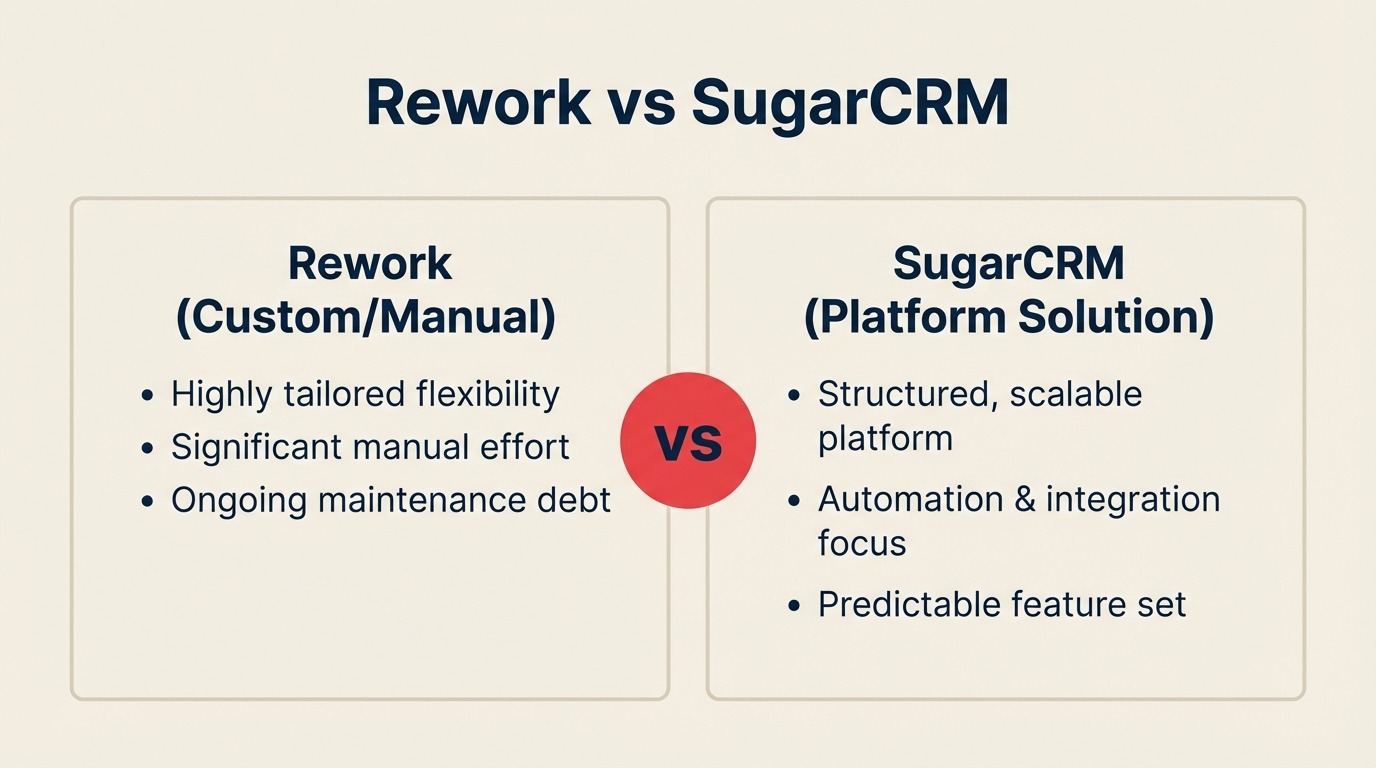
SugarCRM has been in the enterprise CRM market for two decades. Its modular suite (Sugar Sell for sales, Sugar Market for marketing automation, Sugar Serve for service) is built for organizations that need deep customization, on-premise hosting options, and AI-driven predictions through SugarPredict. If you're an IT director at a compliance-heavy company who needs a CRM you can run on your own infrastructure and extend with custom objects, Sugar's flexibility is genuinely impressive.
But "flexibility" and "unified" are different things. Many mid-size and growing companies ($5M to $100M ARR, 20 to 500 employees) don't need sovereign deployment or enterprise-grade object modeling. What they need is a revenue platform where marketing, sales, ops, and customer success share the same data model, the same contact timeline, and the same workflows without requiring a multi-year configuration project. That's a different problem, and it points to a different tool.
How Each CRM Works
Before the feature-by-feature breakdown, here's a quick visual overview of what each product is and how it's structured. Rework and SugarCRM serve adjacent but distinct buyers, seeing the architecture side-by-side makes the rest of this comparison easier to read.
How Rework Works
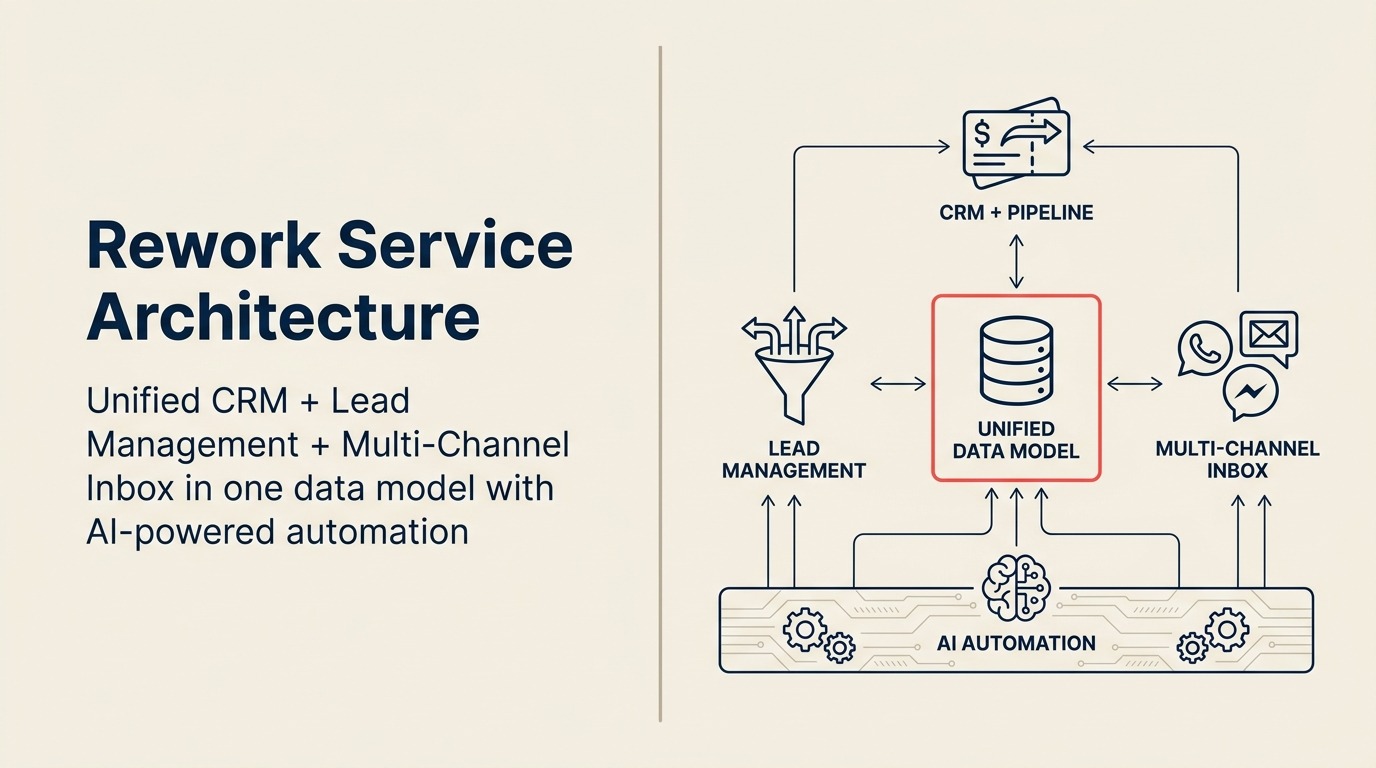
Rework is a unified CRM built for mid-size cross-functional teams (20-500 employees). CRM pipeline, Lead Management, and multi-channel inbox (WhatsApp, Messenger, email, SMS) sit on one data model, so sales, marketing, and CS see the same contact timeline. One product, cloud-only, ships pre-wired, the opposite of a configure-from-scratch enterprise platform.
How SugarCRM Works
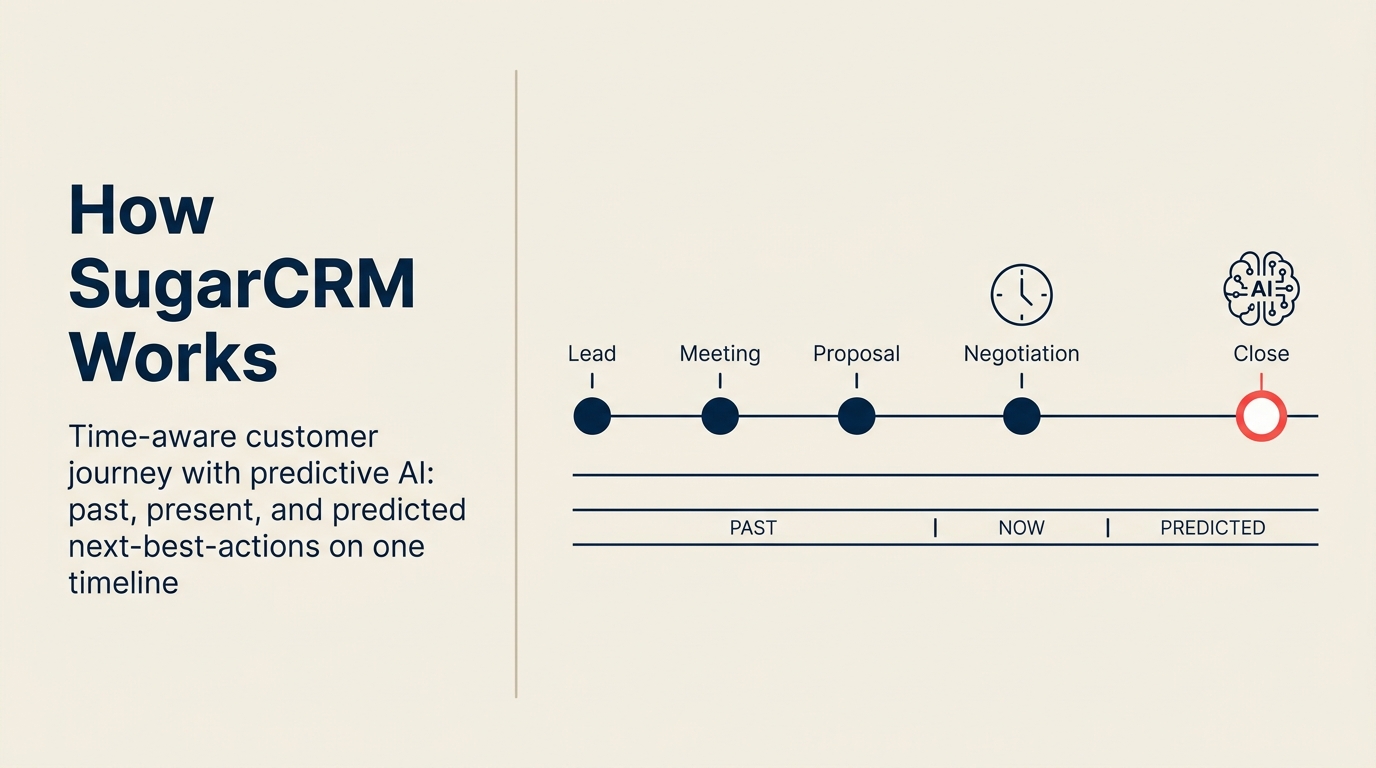
SugarCRM is an enterprise customizable CRM suite (Sugar Sell, Sugar Market, Sugar Serve) known for deep customization, on-premise deployment, and the SugarPredict AI layer that places past, present, and predicted next-best-actions on one time-aware timeline. The strength is flexibility for regulated or compliance-heavy organizations. The tradeoff for mid-size buyers: a longer configuration project, admin burden, and a different cost profile than out-of-the-box SaaS CRMs.
TL;DR
| Dimension | SugarCRM | Rework |
|---|---|---|
| Best fit | Compliance-heavy enterprises, IT-controlled deployments, deep customization needs | Mid-size cross-functional orgs: sales + marketing + ops + CS in one system |
| Company size sweet spot | 50-5,000 employees | 20-500 employees |
| Core strength | Modular enterprise suite, on-premise option, SugarPredict AI forecasting | Unified CRM + Lead Management + multi-channel chat inbox, out of the box |
| On-premise deployment | Yes (Sugar Sell, Sugar Serve) | No, cloud-only |
| AI capabilities | SugarPredict (lead scoring, churn prediction, opportunity scoring) | Built-in lead scoring and pipeline intelligence |
| Marketing module | Sugar Market (separate SKU) | Fully integrated: forms, landing pages, scoring, nurture |
| Unified chat inbox | Not native (requires integration) | WhatsApp, Messenger, Instagram DM, web chat, email, SMS |
| Starting price | ~$49/user/mo (Sugar Sell Essentials, billed annually) | $999/yr Starter (up to 5 users) or $1,999/yr Standard (10 users included) |
| Mid-tier price | ~$85/user/mo (Sugar Sell Advanced, billed annually) | $1,999/yr Standard + $12/user/mo above 10 users |
| Support | Standard support; premium support add-on | Email + chat + phone on all plans |
| Setup time | 4-12 weeks (enterprise configuration) | 1-3 weeks |
| Setup speed | 1-3 days for basic CRM; 1-2 weeks for full Lead Management + chat, led by a team with hands-on experience onboarding mid-size sales, marketing, and ops departments end-to-end | 4-12 weeks for a functional Sugar Sell deployment; SugarCRM partners charge $20,000-$200,000 for properly scoped enterprise configurations, Sugar has no in-house team experienced with mid-size cross-department rollouts |
| Best for decision stage | IT-led evaluation, compliance requirements, enterprise customization | Ops-led evaluation, unified GTM platform, fast time-to-value |
Who Each Tool Is Built For
SugarCRM serves a particular enterprise profile: organizations with an IT team that wants to own the deployment, compliance requirements that make cloud-first tools risky, and enough operational complexity to justify modular purchasing across Sell, Market, and Serve. Financial services, healthcare, government contractors, and defense-adjacent companies appear regularly in Sugar's customer base because of the on-premise option and the depth of its data governance controls.
Rework targets a different buyer. The COO or Head of Revenue at a 30-300 person company who has patched together a marketing tool, a CRM, a chat platform, and a workflow app, and keeps watching leads drop between handoffs. The pain isn't "we need on-premise." The pain is "our stack has too many seams and no one owns the full picture."
| ICP Dimension | SugarCRM | Rework |
|---|---|---|
| Ideal company size | 50-5,000 | 20-500 |
| Revenue range | $10M-$1B+ | $2M-$100M ARR |
| Primary user | Sales, IT admins, service agents | Sales, marketing, ops, CS together |
| Primary pain solved | Compliance risk, rigid customization needs, enterprise reporting | Disconnected tools, lead handoff failures, no unified timeline |
| Decision maker | CIO, VP Sales, IT Director | COO, Head of Revenue, RevOps lead, founder-operator |
| Team structure | Modular by department (Sell / Market / Serve as separate products) | Cross-functional revenue platform in one product |
Team Fit Matrix
| Team | SugarCRM | Rework |
|---|---|---|
| Sales (SDR/AE) | Strong with Sugar Sell, pipeline, forecasting, activity logging | Strong, full pipeline, quota tracking, round-robin routing |
| Marketing | Sugar Market (separate license), enterprise automation, nurture | Fully integrated, forms, landing pages, scoring, nurture, attribution |
| RevOps | Reporting across Sugar modules (requires setup) | Unified data model across sales + marketing + CS |
| Customer Success | Sugar Serve, case management, SLA tracking | Shared contact timeline, handoff from sales, health scoring hooks |
| Operations | Custom modules, Studio customization | Cross-team workflows, approval chains, SLA tracking built-in |
| IT / Compliance | On-premise option, data governance, audit trails | Cloud-only, limited for compliance-heavy orgs |
Core CRM Capability Comparison
Sugar Sell is a mature sales CRM. Opportunity management, account hierarchies, forecasting, territory management, and quota tracking are all present and well-developed. The Studio and Module Builder tools let IT teams create custom objects and fields without code, which is a genuine differentiator for companies with complex data models. SugarCRM's workflow automation engine (Sugar BPM) handles multi-step conditional logic that can get quite sophisticated.
Rework's CRM is built for the same pipeline fundamentals (contacts, accounts, deals, activities, forecasting), but the product decision is different. Instead of offering unlimited extensibility, Rework ships an opinionated data model that works out of the box for sales + marketing + ops + CS as one system. Less configuration, faster deployment, but a lower ceiling for organizations that genuinely need enterprise-grade object modeling.
| Core Capability | SugarCRM | Rework |
|---|---|---|
| Pipeline management | Full, stages, probabilities, weighted forecasting | Full, stages, forecasting, quota tracking |
| Account & contact management | Enterprise-grade, hierarchies, custom objects | Strong, unified contact timeline across all channels |
| Custom objects & fields | Extensive (Studio, Module Builder, no-code) | Limited, opinionated data model |
| Workflow automation | Sugar BPM, complex conditional logic, multi-step | Built-in automation, rules, triggers, SLA workflows |
| Territory management | Yes, enterprise territory hierarchies | Yes, territory and round-robin routing |
| Forecasting | Advanced, commit, best-case, pipeline scenarios | Standard pipeline forecasting |
| API & integrations | REST API, extensive third-party ecosystem | REST API, native integrations for common tools |
| On-premise deployment | Yes, available for Sugar Sell and Serve | No, cloud-only |
Lead Management Deep Dive
Lead management is where the structural difference between Sugar and Rework becomes clearest. In SugarCRM, leads live in a separate module from contacts and accounts. The transition from "Lead" to "Contact/Account/Opportunity" requires a manual conversion step, which is a familiar friction point for any team that has used Sugar seriously. Sugar Market handles marketing automation, but it's a separate product with its own license, its own interface, and its own data sync requirements.
Rework treats lead management as a first-class, fully integrated part of the revenue workflow. Marketing captures leads through forms, chat, ads, and imports. Scoring, distribution, nurture, and pipeline handoff all happen inside one product without syncing data across modules.
| Lead Management Capability | SugarCRM | Rework |
|---|---|---|
| Lead capture sources | Forms, imports, API; Sugar Market for campaign capture | Forms, landing pages, chat (WhatsApp/Messenger/IG DM), ads API, imports |
| Lead-to-contact conversion | Manual module conversion required | Automatic, leads flow directly into pipeline |
| Lead scoring | SugarPredict AI scoring (predictive model) | Built-in rule-based and behavioral scoring |
| Lead distribution | Requires custom workflow or Sugar BPM setup | Round-robin, territory, skill-based, SLA routing, built-in |
| Marketing nurture | Sugar Market (separate SKU), drip campaigns, email sequences | Integrated, nurture workflows, email sequences, campaign attribution |
| Marketing-to-sales handoff | Cross-module sync (Sugar Market to Sugar Sell) | Same product, handoff is a workflow step, not a sync |
| Attribution back to pipeline | Available with Sugar Market integration | Native, campaign attribution to closed revenue |
| Duplicate management | Merge tools in Lead module | Automatic deduplication on capture |
Most mid-size teams that buy SugarCRM end up purchasing both Sugar Sell and Sugar Market to get the full lead lifecycle. That doubles the per-seat cost and adds integration complexity between two interfaces. For a 50-person team, that's a meaningful budget and ops decision.
Unified Chat Channels
SugarCRM is a traditional CRM. Its communication model is built around email, phone logging, and case management. Native multi-channel chat (WhatsApp, Messenger, Instagram DM, SMS) is not part of the Sugar suite. Teams typically integrate these channels through third-party connectors like Zapier, Twilio, or specialized middleware, which means a separate tool cost, a separate admin layer, and a non-unified contact timeline.
Rework's unified inbox is a core product feature, not an add-on. Every channel lands in the same contact record.
| Channel | SugarCRM | Rework |
|---|---|---|
| 3rd party (Twilio, middleware) | Native | |
| Facebook Messenger | 3rd party | Native |
| Instagram DM | 3rd party | Native |
| Live web chat | 3rd party or Sugar Serve (limited) | Native |
| Native (bi-directional sync) | Native | |
| SMS | 3rd party (Twilio integration) | Native |
| Unified contact timeline | No, channels siloed by module | Yes, all channels in one contact record |
For companies where customers and leads initiate conversations through social messaging apps, this gap is a real operational cost. Every separate integration is a separate failure point, a separate seat cost, and a separate training burden for your team.
AI Features: SugarPredict
SugarPredict is SugarCRM's AI layer, and it's worth taking seriously. It uses historical CRM data to generate predictive scores for lead conversion likelihood, opportunity win probability, churn risk, and expected deal value. Unlike simpler rule-based scoring, SugarPredict trains on your actual pipeline history, which means the model improves as your data grows. For a mature sales organization with 3-5 years of CRM history loaded into Sugar, SugarPredict's predictions can be genuinely useful for sales managers prioritizing their team's attention.
Rework's AI capabilities are built around rule-based and behavioral lead scoring, pipeline intelligence, and automated workflow triggers. The product does not currently offer a self-training predictive model comparable to SugarPredict. For organizations where AI-driven forecasting is a top-three purchase criterion, Sugar holds an advantage.
| AI Capability | SugarCRM | Rework |
|---|---|---|
| Lead conversion prediction | SugarPredict, ML-trained on your data | Rule-based and behavioral scoring |
| Opportunity win probability | SugarPredict, dynamic, historical | Standard pipeline forecasting |
| Churn risk scoring | SugarPredict | Not native |
| Account health signals | SugarPredict | Contact timeline signals |
| Forecast accuracy improvement over time | Yes, model retrains on new data | Not applicable |
| AI training data requirement | Needs 6-12 months of CRM history to get accurate | Not applicable |
On-Premise Deployment Option
This is a genuine SugarCRM differentiator with no Rework equivalent. Sugar Sell and Sugar Serve can be deployed on-premise or in a private cloud, giving IT teams full control over data residency, backups, and network access. For financial services firms, healthcare organizations, government contractors, and defense-adjacent companies, this matters. Regulatory frameworks like HIPAA, FedRAMP, or industry-specific compliance regimes sometimes require data to live on infrastructure you control.
Rework is cloud-only. If your compliance requirement is "data must not leave our data center" or "our industry cannot accept shared cloud infrastructure," Rework is not the right answer. That's not a weakness to paper over. It's a structural constraint worth naming clearly.
Pricing at 25, 50, and 100 Seats
SugarCRM pricing is modular, which means your actual bill depends on which products you purchase. Sugar Sell is the sales CRM. Sugar Market is marketing automation (priced per contacts or users separately). Sugar Serve is the service module. The numbers below reflect Sugar Sell tiers only. Adding Sugar Market or Sugar Serve increases total cost.
Rework Sales Ops has two packages:
- Starter, $999/year for up to 5 users
- Standard, $1,999/year with 10 users included, plus $12/user/month for each additional user
See rework.com/pricing for current details.
| Seats | SugarCRM Sugar Sell (Essentials ~$49/user/mo) | SugarCRM Sugar Sell (Advanced ~$85/user/mo) | Rework Sales Ops |
|---|---|---|---|
| 5 seats / year | ~$2,940 | ~$5,100 | $999/yr (Starter) |
| 10 seats / year | ~$5,880 | ~$10,200 | $1,999/yr (Standard base) |
| 25 seats / year | ~$14,700 | ~$25,500 | $4,159/yr |
| 50 seats / year | ~$29,400 | ~$51,000 | $7,759/yr |
| 100 seats / year | ~$58,800 | ~$102,000 | $14,959/yr |
Rework pricing sourced from rework.com/pricing.
Important context: if you need Sugar Market alongside Sugar Sell, expect to add $1,000-$2,000+ per month depending on contact volume and user count. A 50-person team running Sell + Market together lands in the $55,000-$70,000+ per-year range. Sugar Serve adds further cost if you need case management.
Rework bundles CRM, lead management, marketing automation, unified chat, and ops workflows in one product. The pricing comparison only makes sense when you account for the total stack cost, not just the CRM seat count. On that basis, Rework is dramatically less expensive than any SugarCRM configuration.
Implementation and Time-to-Value
| Dimension | Rework | SugarCRM |
|---|---|---|
| Basic CRM setup | 1-3 days, led by team experienced with the full lead lifecycle | 2-4 weeks for a minimal Sugar Sell configuration |
| Team onboarding (reps) | 3-5 days for full product, included | Formal training costs $500-$2,000/seat; often skipped with adoption consequences |
| Lead management configuration | 3-7 days with onboarding team walking through scoring, routing, forms | Sugar Market is a separate SKU; cross-module integration requires a partner engagement |
| Chat inbox connection | 1-2 hours per channel, led by team with mid-size multi-department onboarding experience | Requires 3rd-party integration (Twilio, middleware); no self-serve path |
| Full implementation (CRM + lead mgmt + chat) | 1-2 weeks, led by team with mid-size multi-department onboarding experience | 4-12 weeks minimum with a SugarCRM partner ($20,000-$200,000); enterprise configurations routinely exceed $100,000 |
| Data migration from prior CRM | CSV import + API, migration support on all plans | Requires SI partner for complex migrations; data prep typically underestimated |
| Admin overhead post-launch | Low, no dedicated admin required | High, Sugar without active admin degrades; ongoing customization costs $150-$250/hour |
| Support model | Email + chat + phone on all plans | Standard support; premium support add-on |
SugarCRM isn't a tool you configure yourself and turn on Monday. Even for a 25-person team, a properly scoped Sugar Sell deployment with custom modules, workflow automation, and data migration runs 4-12 weeks with a certified SugarCRM partner, and those engagements typically start at $20,000. Enterprise-complexity implementations regularly exceed $100,000 before a single rep logs a deal. That's before Sugar Market (separate SKU) and before the ongoing admin overhead. Sugar has no in-house team experienced with mid-size cross-department rollouts, so that partner cost is unavoidable. Rework's edge is institutional experience: the team has onboarded full Sales, Marketing, RevOps, and CS departments at mid-size companies and applies that hard-earned knowledge of what actually breaks during a multi-team rollout to every new customer. The full stack ships in one product, so the 1-2 week implementation includes everything without a multi-month configuration project or a partner invoice.
When SugarCRM Is the Right Call
SugarCRM is genuinely the better fit in four specific situations:
On-premise or private cloud is a hard requirement. If your compliance framework, legal team, or IT policy requires data to live on infrastructure you control, Sugar's deployment flexibility is your primary shortlist criterion. No cloud-native CRM matches this.
You need SugarPredict's AI forecasting. If your sales org has 3+ years of CRM history and your VP Sales is making quota allocation decisions based on pipeline predictions, SugarPredict's self-training model gives forecast confidence that Rework's scoring doesn't match.
Enterprise customization depth is non-negotiable. If your CRM needs 50+ custom objects, complex multi-level account hierarchies, or deeply customized workflows that only an IT team running Studio and Module Builder can design, Sugar's extensibility ceiling is higher.
You're in a compliance-heavy regulated industry. Financial services, healthcare, government, and defense verticals often have vendor risk requirements, audit trail standards, and data governance needs that Sugar's on-premise option and enterprise controls are designed to satisfy.
When Rework Is the Right Call
Rework fits best when the problem is operational fragmentation, not enterprise customization.
If your marketing team runs leads through forms and chat, your sales team works those leads in a pipeline, your ops team tracks handoffs and approvals, and your CS team picks up after close, and all four functions are currently on different tools that barely talk to each other, Rework was built for that situation. The unified data model, native multi-channel chat inbox, and integrated lead management eliminate the sync overhead and handoff failures that come with a modular stack.
Rework also wins when implementation speed matters. Sugar's enterprise configuration timeline is measured in months. Rework's typical onboarding for a 30-100 person team runs 1-3 weeks. For a COO who needs the team operating on a new system before the next quarter, that gap is material.
Decision Framework
| Pick SugarCRM if... | Pick Rework if... |
|---|---|
| On-premise or private cloud deployment is required | Cloud-based deployment is acceptable |
| SugarPredict AI forecasting is a top purchase criterion | Rule-based lead scoring and pipeline intelligence are sufficient |
| You need 50+ custom objects or deep IT-controlled data modeling | Your data model fits standard CRM + lead + contact + account structure |
| You're in financial services, healthcare, government, or defense with strict compliance requirements | You're in B2B SaaS, professional services, e-commerce, education, or real estate |
| Your IT team will own deployment, configuration, and maintenance | Your ops or revenue team will own configuration and rollout |
| You need enterprise case management (Sugar Serve) | You need unified multi-channel chat inbox native to the CRM |
| Budget timeline allows a 4-12 week implementation project | You need the team operational within 1-3 weeks |
| You're already running Sugar and the migration cost outweighs the consolidation benefit | Your team is using 3-5 separate tools and paying the overhead in dropped handoffs and manual syncs |
What to Do Next
If your shortlist includes SugarCRM because of on-premise requirements or SugarPredict AI, request a proof-of-concept deployment from Sugar's enterprise team. The configuration investment is significant, and you want to validate that the forecasting model trains accurately on your historical data before committing.
If your shortlist includes Rework because your team is patching together a marketing tool, a CRM, a chat inbox, and workflow software, book a live walkthrough focused on the lead-to-pipeline flow. Ask them to demo the handoff from a WhatsApp conversation or ad form submission through to a closed deal, including the marketing attribution. That's the workflow where the consolidated model either proves itself or doesn't.
For teams at the enterprise end of the mid-market who are also evaluating Salesforce, Rework vs Salesforce covers the complexity and cost trade-offs in detail. If the core argument for SugarCRM is compliance and data control, it's worth reading about the RevOps maturity model to understand whether your team is operationally ready to extract value from a highly configurable enterprise platform. Before signing any enterprise CRM contract, the CRM buyer's checklist helps ensure the right requirements get scoped into the vendor conversation.

Principal Product Marketing Strategist
On this page
- How Each CRM Works
- How Rework Works
- How SugarCRM Works
- TL;DR
- Who Each Tool Is Built For
- Team Fit Matrix
- Core CRM Capability Comparison
- Lead Management Deep Dive
- Unified Chat Channels
- AI Features: SugarPredict
- On-Premise Deployment Option
- Pricing at 25, 50, and 100 Seats
- Implementation and Time-to-Value
- When SugarCRM Is the Right Call
- When Rework Is the Right Call
- Decision Framework
- What to Do Next