More in
CRM Comparisons
Rework vs Monday Sales CRM: Flexibility vs Depth in 2026
Apr 14, 2026
Rework vs Close: Modern CRMs Head to Head for Mid-Size Sales Teams in 2026
Apr 9, 2026 · Currently reading
Rework vs Copper: Which CRM Fits a Google Workspace Team in 2026
Apr 8, 2026
Rework vs Pipedrive: The SMB CRM Showdown in 2026
Apr 6, 2026
Rework vs Folk: Relationship CRMs Compared for Mid-Size Teams in 2026
Mar 31, 2026
Rework vs Salesforce: Which Fits a Growing Sales Team in 2026
Mar 30, 2026
Rework vs SugarCRM: Enterprise Flexibility vs Unified Operations in 2026
Mar 30, 2026
Rework vs Zoho CRM: What You Gain and Lose in 2026
Mar 24, 2026
Rework vs Insightly: Project-Aware CRMs Compared for Mid-Size Teams in 2026
Mar 19, 2026
Rework vs Freshsales: Which CRM Is Easier to Adopt in 2026
Mar 17, 2026
Rework vs Close: Modern CRMs Head to Head for Mid-Size Sales Teams in 2026
If your revenue team runs inbound and outbound calls all day, logs every touch in a single pipeline, and doesn't really need marketing or customer success on the same platform, Close was built for you. Its dialer is class-leading, setup is fast, and the UX keeps SDRs focused on the next call rather than the next menu.
But that picture describes a specific team shape: an inside sales floor where the CRM lives exclusively in the sales department. Many mid-size companies growing from $5M to $100M ARR look different. Marketing captures leads through chat, forms, and ads. Sales works those leads and manages pipeline. Ops tracks handoffs, approvals, and SLAs. Customer success picks up the account after close. When all four functions share workflows, the question isn't which tool has the best dialer. It's which platform can hold the whole revenue operation together without stitching four separate tools into a fragile stack.
How Each CRM Works
Before the feature-by-feature breakdown, here's a quick visual overview of what each product is and how it's structured. Rework and Close are both modern CRMs, but they optimize for very different motions, seeing each architecture side-by-side makes the rest of this comparison easier to read.
How Rework Works
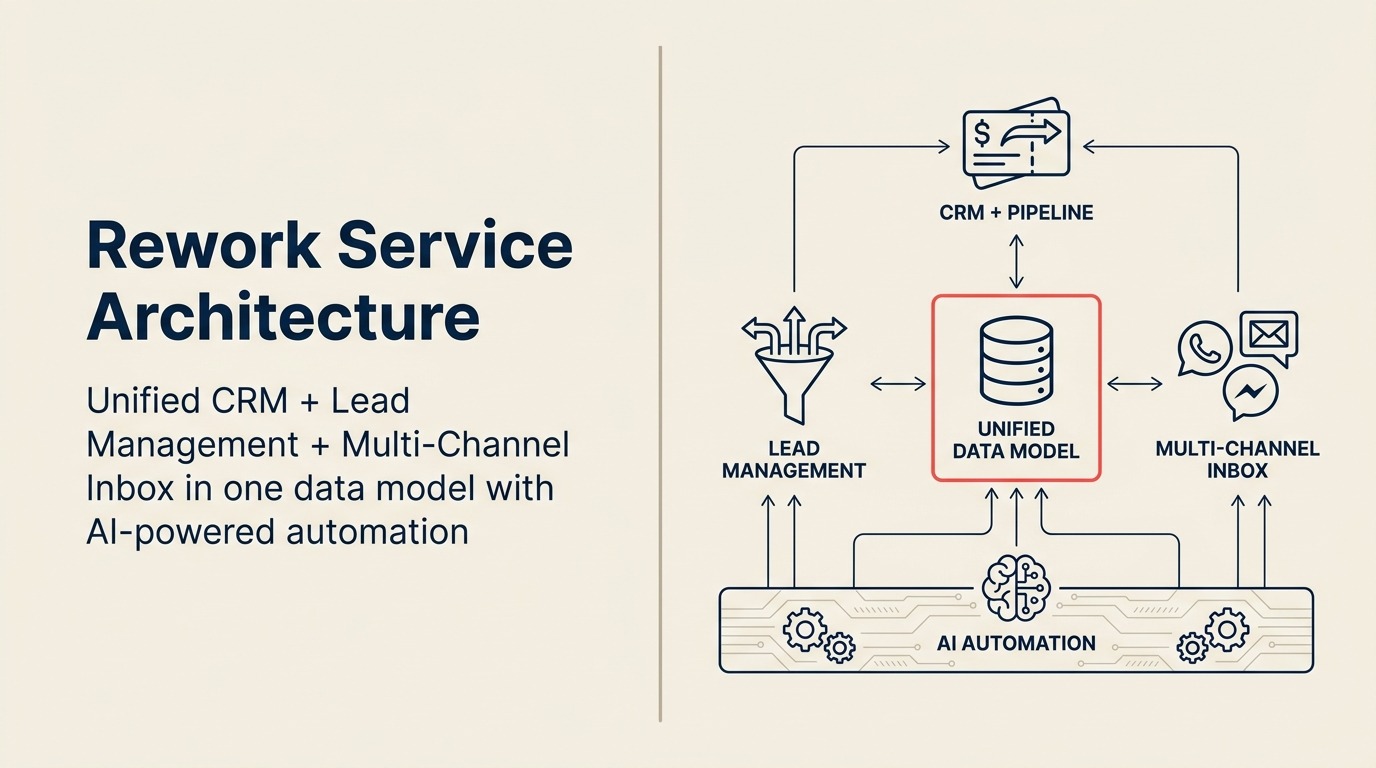
Rework is a unified CRM built for mid-size cross-functional teams. CRM pipeline, Lead Management, and multi-channel inbox (WhatsApp, Messenger, email, SMS) sit on one data model, so sales, marketing, and CS see the same contact timeline without integrations. AI automation runs underneath all three modules, meaning teams can go from capture to close inside one product.
How Close Works
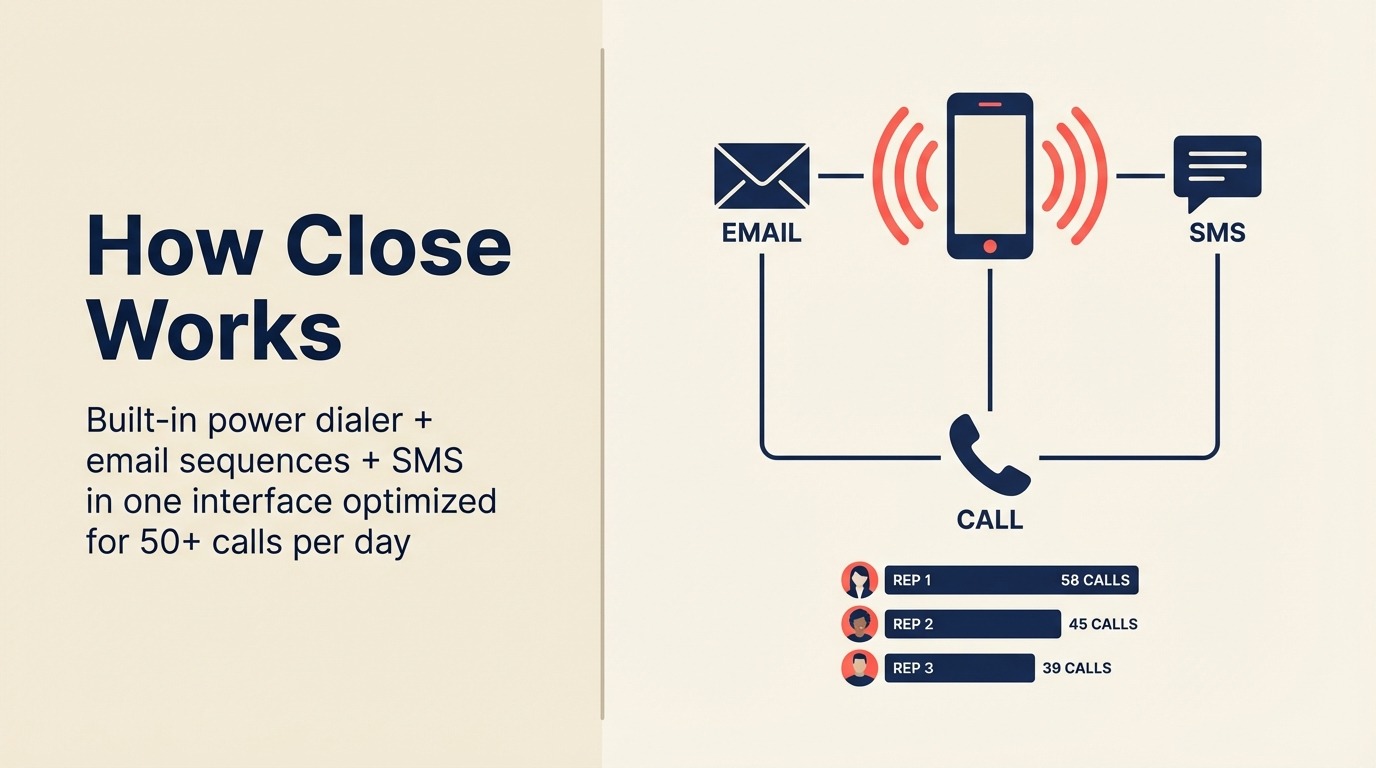
Close is an inside-sales CRM built around a class-leading power dialer, email sequences, and SMS in a single interface optimized for reps making 50+ calls a day. The product is deliberately scoped to sales velocity, marketing, lead routing across WhatsApp/Messenger, and cross-team workflows are not part of the core product.
TL;DR
| Dimension | Close | Rework |
|---|---|---|
| Best fit | Inside sales teams, SDR-heavy orgs, call-volume businesses | Mid-size cross-functional orgs: sales + marketing + ops + CS |
| Company size sweet spot | 5-200 employees | 20-500 employees |
| Core strength | Built-in power dialer, fastest email sync, pure SDR UX | Unified CRM + Lead Management + multi-channel chat inbox |
| Marketing integration | None native | Full: forms, landing pages, lead scoring, nurture |
| Unified chat inbox | Email + calling only | WhatsApp, Messenger, Instagram DM, web chat, email, SMS |
| Cross-team workflows | Sales-only | Sales, Marketing, RevOps, CS, Ops in one platform |
| Pricing | $49/user/mo Startup; $99/user/mo Professional (billed annually) | $999/yr Starter (5 users) or $1,999/yr Standard (10 users) + $12/user/mo above |
| Support | Email + in-app on all plans; phone on Enterprise | Email + chat + phone on all plans |
| Setup time | 1-3 days | 1-3 weeks (more to configure, more to gain) |
| Setup speed | Under a day for a functional pipeline; building full lead management + chat is DIY-only since Close has no in-house team experienced with mid-size cross-department rollouts | 1-3 days for basic CRM; 1-2 weeks for full Lead Management + chat, led by a team with hands-on experience onboarding mid-size sales, marketing, and ops departments end-to-end |
| Best for decision stage | Evaluating a calling-first CRM | Evaluating a full GTM operating platform |
Who Each Tool Is Built For
Close doesn't try to be everything. It's explicitly positioned as CRM for inside sales teams that measure success in calls made, emails sent, and deals closed. That focus is a feature, not a gap, it keeps the UX clean and the dialer deeply integrated.
Rework targets a different situation: the ops or revenue leader at a 30-300 person company who keeps patching together a marketing tool, a CRM, a chat platform, and a workflow tool, and watching handoffs fall through the gaps between them.
| ICP Dimension | Close | Rework |
|---|---|---|
| Ideal company size | 5-200 | 20-500 |
| Revenue range | Pre-Series A to Series B | $2M-$100M ARR |
| Primary user | SDRs, AEs, sales managers | Sales, marketing, ops, CS together |
| Primary pain solved | Slow dialing, fragmented call logging, poor email sync | Disconnected tools, lead handoff failures, no unified timeline |
| Decision maker | VP Sales, Sales Director | COO, Head of Revenue, RevOps lead, founder-operator |
| Team structure | Sales-only CRM | Cross-functional revenue platform |
Team Fit Matrix
| Team | Close | Rework |
|---|---|---|
| Sales (SDR/AE) | Excellent, purpose-built | Strong, full pipeline + quota tracking |
| Marketing | Not supported natively | Full: lead capture, scoring, nurture, attribution |
| RevOps | Limited to sales reporting | Unified data model across sales + marketing + CS |
| Customer Success | Requires separate tool | Shared contact timeline, health scoring hooks |
| Operations | Not applicable | Cross-team workflows, approval chains, SLA tracking |
| People Ops | Not applicable | Onboarding and process templates |
Core CRM and Calling Capability
This is where Close earns its reputation. The power dialer is genuinely best-in-class for inside sales. Predictive dialing, local presence, voicemail drop, and automatic call logging are woven into the core product, not added on. Email sync is fast and two-way out of the box. The sequences engine handles multi-step call + email cadences cleanly. For a team that lives on the phone, that depth is hard to match.
Rework's calling capability is solid for a platform its scope, but it's not where Rework was designed to win. Rework wins on breadth: the same contact record that shows pipeline stage also shows every WhatsApp message, every form submission, every nurture email, every CS ticket. Close doesn't build that kind of record because it doesn't manage those channels.
| Capability | Close | Rework |
|---|---|---|
| Built-in power dialer | Yes, predictive, local presence, voicemail drop | Basic calling available |
| Email sync | Yes, fast, two-way, native | Yes, native |
| Calling + email sequences | Yes, core feature | Yes, workflow-driven |
| SMS | Via integration | Yes, native inbox |
| Pipeline management | Yes | Yes |
| Quota + forecasting | Basic | Yes, full quota tracking |
| Contact timeline (all channels) | Calls + email only | All channels unified |
| Marketing contact history | Not available | Included: form fills, ad source, nurture history |
Lead Management Deep Dive
Lead management is where the product philosophies split most clearly. Close treats leads as sales objects: a lead is something an SDR calls and emails. That's the full lifecycle from Close's perspective.
Rework treats leads as the entire pre-pipeline journey from first touch through close, spanning marketing and sales. The lead record captures the source (ad, form, chat, import), enriches it, routes it based on territory or round-robin rules, queues it for nurture if it's not sales-ready, and hands it off to a rep when the scoring threshold triggers. That whole chain lives in one module.
| Lead Management Capability | Close | Rework |
|---|---|---|
| Lead capture: forms | Via integration | Yes, native forms + landing pages |
| Lead capture: chat/inbox | Not available | Yes, WhatsApp, Messenger, web chat |
| Lead capture: ads | Via integration | Yes, native lead ads integration |
| Lead enrichment | Basic | Yes, built-in enrichment |
| Lead scoring | Not available | Yes, rule-based scoring |
| Round-robin distribution | Not available natively | Yes, built-in |
| Territory-based routing | Not available | Yes, built-in |
| SLA routing rules | Not available | Yes, built-in |
| Marketing nurture loops | Not available | Yes, drip sequences pre-pipeline |
| Marketing-to-sales handoff | Manual or Zapier | Automated trigger-based |
| Attribution to pipeline | Limited | Yes, source tracked through to deal |
For an SDR team that gets warm leads handed to them by marketing, Close's lead workflow is enough. But if your marketing team is generating the leads and handing them off to sales, that handoff process needs to live somewhere. In the Close stack, it lives in a separate marketing tool, a spreadsheet, or Zapier. In Rework, it's the same platform.
Unified Chat Channels
Close is an email and calling platform. That is not a criticism. It's accurate positioning. If your buyers respond to calls and emails, Close covers the communication layer completely.
But B2B buyers in 2026 respond on WhatsApp. They message on Instagram DM. They fill out chat widgets. If your team works those channels, you need either a separate inbox tool feeding into Close or a platform that handles multi-channel natively.
| Channel | Close | Rework |
|---|---|---|
| Outbound calling | Yes, power dialer | Basic |
| Inbound calling | Yes | Basic |
| Email (outbound) | Yes, native | Yes, native |
| Email (inbound sync) | Yes, fast, two-way | Yes |
| SMS | Via integration | Yes, native |
| Not available | Yes, native | |
| Facebook Messenger | Not available | Yes, native |
| Instagram DM | Not available | Yes, native |
| Live web chat | Via integration | Yes, native |
| All channels → one contact timeline | No, calls + email only | Yes, unified |
Built-in Dialer vs Separate Tools
Close's single biggest competitive advantage over Rework is the depth of its built-in dialer. This deserves a direct treatment rather than a footnote.
The Close power dialer handles:
- Predictive and manual dialing from a queue
- Local presence (caller ID matches the prospect's area code)
- Voicemail drop (pre-recorded message on no-answer)
- Automatic call logging with recordings and transcripts
- Call coaching (listen-in, whisper, barge for managers)
- Call outcome tracking tied to sequences
Getting equivalent calling depth in Rework requires either relying on the built-in calling or integrating a third-party VoIP tool. For a team where call volume is the primary activity and rep coaching on calls is a daily practice, that gap matters.
| Calling Feature | Close | Rework |
|---|---|---|
| Power dialer | Yes, core product | Not a core feature |
| Local presence calling | Yes | Not available |
| Voicemail drop | Yes | Not available |
| Auto call logging + transcript | Yes | Basic |
| Call coaching (listen/whisper/barge) | Yes | Not available |
| Call queues | Yes | Limited |
| Call analytics | Deep | Basic |
If your VP Sales measures reps by dials per day, and call coaching is how your managers improve performance, Close is the stronger tool. That's a genuine win for Close that you shouldn't paper over with "integrations can fill the gap."
Automation and Rules Engine
| Automation Capability | Close | Rework |
|---|---|---|
| Sequence automation (call + email) | Yes, strong | Yes, workflow-driven |
| Lead routing automation | Not built-in | Yes, round-robin, territory, SLA |
| Pipeline stage automation | Yes, workflows | Yes |
| Cross-team workflow triggers | Not available | Yes, spans marketing, sales, CS, ops |
| Approval chains | Not available | Yes |
| SLA escalation | Not available | Yes |
| Marketing → sales handoff automation | Requires Zapier | Yes, native trigger |
| Integration via Zapier/API | Yes | Yes |
Pricing at 25, 50, and 100 Seats
Close publishes its pricing at close.com/pricing. Numbers below reflect annual billing as of early 2026. Rework pricing sourced from rework.com/pricing.
Rework Sales Ops has two packages:
- Starter, $999/year for up to 5 users
- Standard, $1,999/year with 10 users included, plus $12/user/month for each additional user
See rework.com/pricing for current details.
| Plan / Seats | Close Startup | Close Professional | Close Enterprise | Rework Sales Ops |
|---|---|---|---|---|
| Per seat/month (annual) | $49 | $99 | $139 | $999/yr (5 users) or $1,999/yr (10 users) |
| 5 seats / year | $2,940 | $5,940 | $8,340 | $999 (Starter) |
| 10 seats / year | $5,880 | $11,880 | $16,680 | $1,999 (Standard base) |
| 25 seats / year | $14,700 | $29,700 | $41,700 | $4,159 |
| 50 seats / year | $29,400 | $59,400 | $83,400 | $7,759 |
| 100 seats / year | $58,800 | $118,800 | $166,800 | $14,959 |
| Marketing seats included | No | No | No | Yes |
| Ops/CS seats covered | No | No | No | Yes |
| Separate marketing tool cost | Add separately | Add separately | Add separately | Included |
Rework's package pricing undercuts Close Startup ($49/seat) at every seat count. The all-in TCO comparison favors Rework even more when you account for the separate marketing tool cost Close teams typically add.
Two things to factor in when comparing: Close pricing is sales-seats only. If your marketing team (say, 5-8 people) needs a lead management and nurture tool, that's a separate purchase. If your CS team needs a shared inbox, that's another. Rework is priced to include those functions. The all-in TCO comparison typically closes the gap significantly for cross-functional teams.
Implementation and Time-to-Value
| Factor | Close | Rework |
|---|---|---|
| Basic CRM setup | Under a day, self-serve and genuinely fast | 1-3 days, led by team experienced with the full lead lifecycle |
| Team onboarding (reps) | 1-2 days for pipeline basics; minimal learning curve | 3-5 days for full product, included |
| Lead management configuration | Not applicable, no native lead management module | 3-7 days with onboarding team walking through scoring, routing, forms |
| Chat inbox connection | Email and calling only; no social channels available | 1-2 hours per channel, led by team with mid-size multi-department onboarding experience |
| Full implementation (CRM + lead mgmt + chat) | 1-3 days (sales pipeline only), the full stack simply doesn't exist in Close | 1-2 weeks, led by team with mid-size multi-department onboarding experience |
| Data migration from prior CRM | CSV import + API; self-serve | CSV import + API, migration support on all plans |
| Admin overhead post-launch | Low for basic pipeline | Moderate, more moving parts |
| Support model | Email + in-app on all plans; phone on Enterprise | Email + chat + phone on all plans |
Close wins on setup speed, if your definition of "setup" is a working pipeline for an inside sales team. That speed is real and it matters if you need something live this week. But Close has no in-house team experienced with mid-size cross-department rollouts. Teams that need lead management from capture through routing, or multi-channel chat tied to the CRM, have to build those pieces entirely themselves using Zapier and third-party tools, because Close doesn't offer them. Rework's edge is institutional experience: the team has onboarded full Sales, Marketing, RevOps, and CS departments at mid-size companies and applies that hard-earned knowledge of what actually breaks during a multi-team rollout to every new customer. The full stack ships in one product, so the 1-2 week implementation includes everything, not just the dialer.
When Close Is the Right Call
Be honest with yourself about whether Close is actually the better fit before signing a Rework contract. Close wins clearly in these scenarios:
Your team is SDR-heavy and call volume is the primary metric. Dials per day, connection rates, talk time: if those are the numbers that drive your sales culture, Close's power dialer and call analytics are built exactly for that motion. Rework doesn't match that depth.
You want to be live in a day. Close's onboarding is genuinely fast. Import your contacts, connect email, set up sequences, start dialing. If you're coming off spreadsheets or a lightweight CRM and need something working this week, Close gets you there faster.
Your marketing and sales are already separated by tool intentionally. Some companies run HubSpot for marketing and want a pure pipeline tool for sales. Close plays well in that stack. It's focused enough to complement a marketing automation platform without overlap.
You're under 20 seats and don't need cross-team workflows. Close's Startup plan at $49/seat is competitively priced for small, pure sales teams that don't need the broader platform Rework provides.
When Rework Is the Right Call
Marketing and sales share leads in the same system. If your marketing team captures leads through forms, chat, and ads and hands them to sales through any kind of routing logic, that process needs a home. Rework handles the full journey from first touch to closed deal without a middleware layer.
You need multi-channel conversation management. If your buyers are messaging on WhatsApp, Messenger, or Instagram DM alongside email, Rework's unified inbox ties every conversation to the same contact record your sales reps work in. Close doesn't have an answer for this.
Ops, CS, or finance touch the same accounts your sales team closes. Cross-team workflows (handoff from sales to CS, approval chains for deal discounts, onboarding checklists triggered by a closed-won stage) are native to Rework. Close doesn't do this.
You're scaling from 30 to 200 people and need one platform to scale with you. Adding a marketing automation tool, a customer success platform, and a workflow tool to a Close stack creates a multi-vendor integration management problem. Rework is designed to absorb those functions as the team grows.
Decision Framework
| Pick Close if... | Pick Rework if... |
|---|---|
| Your team is primarily SDRs and AEs making high call volumes | Your revenue motion spans sales, marketing, ops, and CS |
| Built-in power dialer and call coaching are non-negotiable | You need a unified lead management pipeline from capture to close |
| You want to be live in 1-3 days without heavy configuration | Your buyers communicate on WhatsApp, Messenger, or other social channels |
| Marketing already has its own tool and you want sales-only CRM | You're consolidating 3-5 tools into one platform |
| You're under 25 seats and primarily sales-focused | You need round-robin, territory, or SLA-based lead distribution built-in |
| Budget is constrained and the Startup plan covers your needs | You want marketing-to-sales handoff automated without Zapier |
What to Do Next
The fastest way to make this decision concrete is to map your team's workflow against each platform. List every function that touches your CRM (sales, marketing, CS, ops) and note whether Close's sales-only model covers it or whether each function needs its own tool. If you count more than one additional tool to fill the gaps, Rework's consolidated pricing and platform almost always wins on total cost of ownership.
Request a Rework demo and ask specifically to see the lead management workflow from capture to sales handoff and the unified inbox pulling WhatsApp alongside email. That's where the comparison becomes tangible. If your workflow is genuinely inside sales only, go back and run Close's 14-day free trial. It's the fastest way to confirm the fit before committing.
If you're comparing multiple CRMs at the same time, Rework vs Pipedrive covers a similar trade-off for teams weighing pipeline simplicity against unified ops. For teams where the marketing-to-sales handoff is the core pain, lead management vs CRM explains why the distinction matters before you finalize your requirements. And if you're building out the sales team that will run this process, the first 90 days as a sales leader covers the decisions that shape how much CRM infrastructure you actually need on day one.

Principal Product Marketing Strategist
On this page
- How Each CRM Works
- How Rework Works
- How Close Works
- TL;DR
- Who Each Tool Is Built For
- Team Fit Matrix
- Core CRM and Calling Capability
- Lead Management Deep Dive
- Unified Chat Channels
- Built-in Dialer vs Separate Tools
- Automation and Rules Engine
- Pricing at 25, 50, and 100 Seats
- Implementation and Time-to-Value
- When Close Is the Right Call
- When Rework Is the Right Call
- Decision Framework
- What to Do Next