Lewin's Change Management Model: Unfreeze-Change-Refreeze
Turn this article into takeaways for your work.


Each assistant summarizes the article only for you and suggests best practices for your work.
Lewin's change model is one of the most referenced frameworks in organizational change management, and it's been that way since Kurt Lewin introduced it in 1947. If your team is about to go through a structural shift, a process overhaul, or a culture reset, this three-stage model gives you a clean mental map for what to do before, during, and after.
What Is Lewin's Change Management Model?
Key Facts
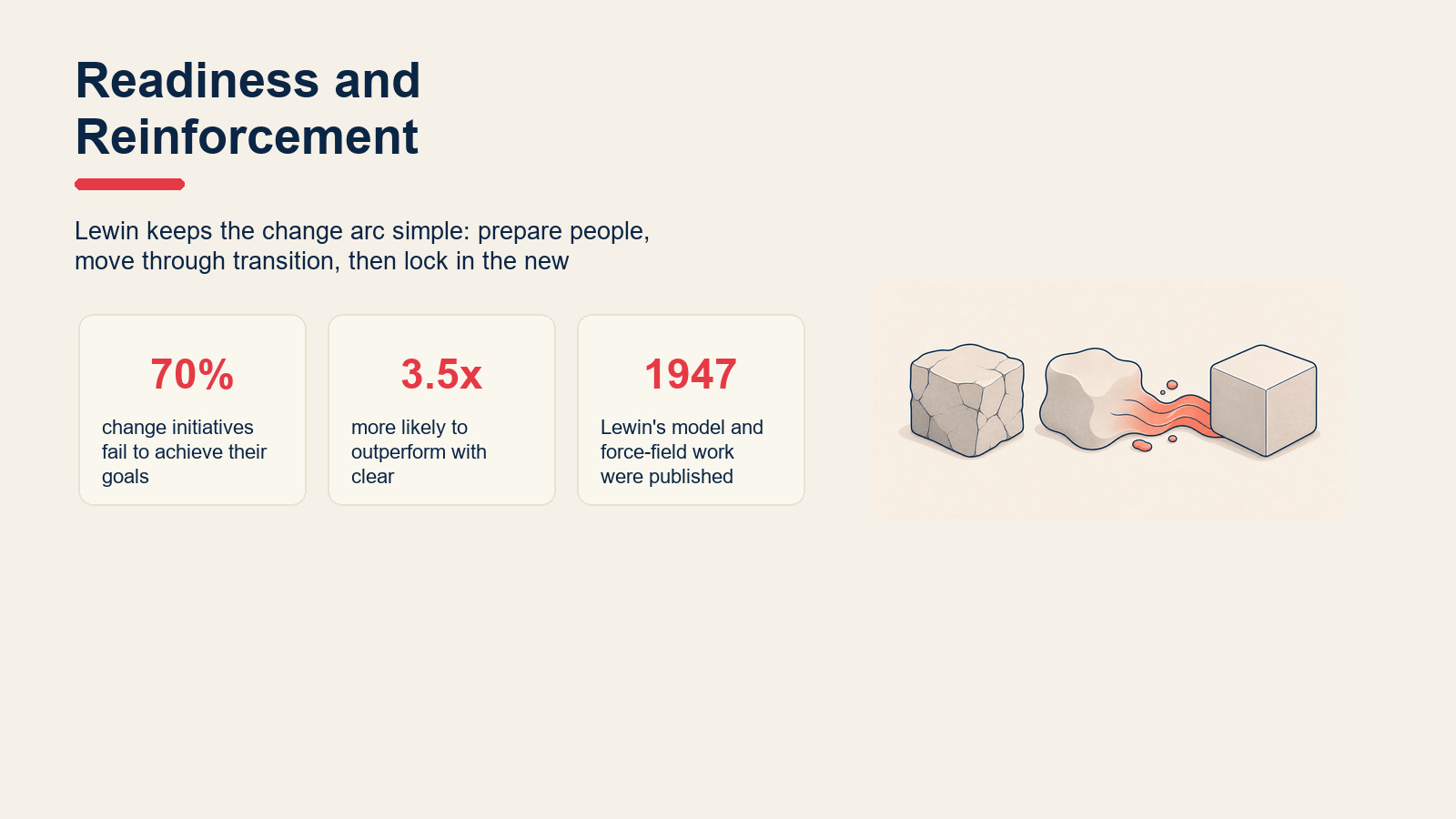
- About 70% of organizational change initiatives fail to achieve their goals (McKinsey, 2023).
- Organizations that communicate clearly during change are 3.5x more likely to outperform peers (McKinsey, 2022).
- Kurt Lewin developed his model alongside Force Field Analysis as part of his broader work on group dynamics at MIT, published in 1947.
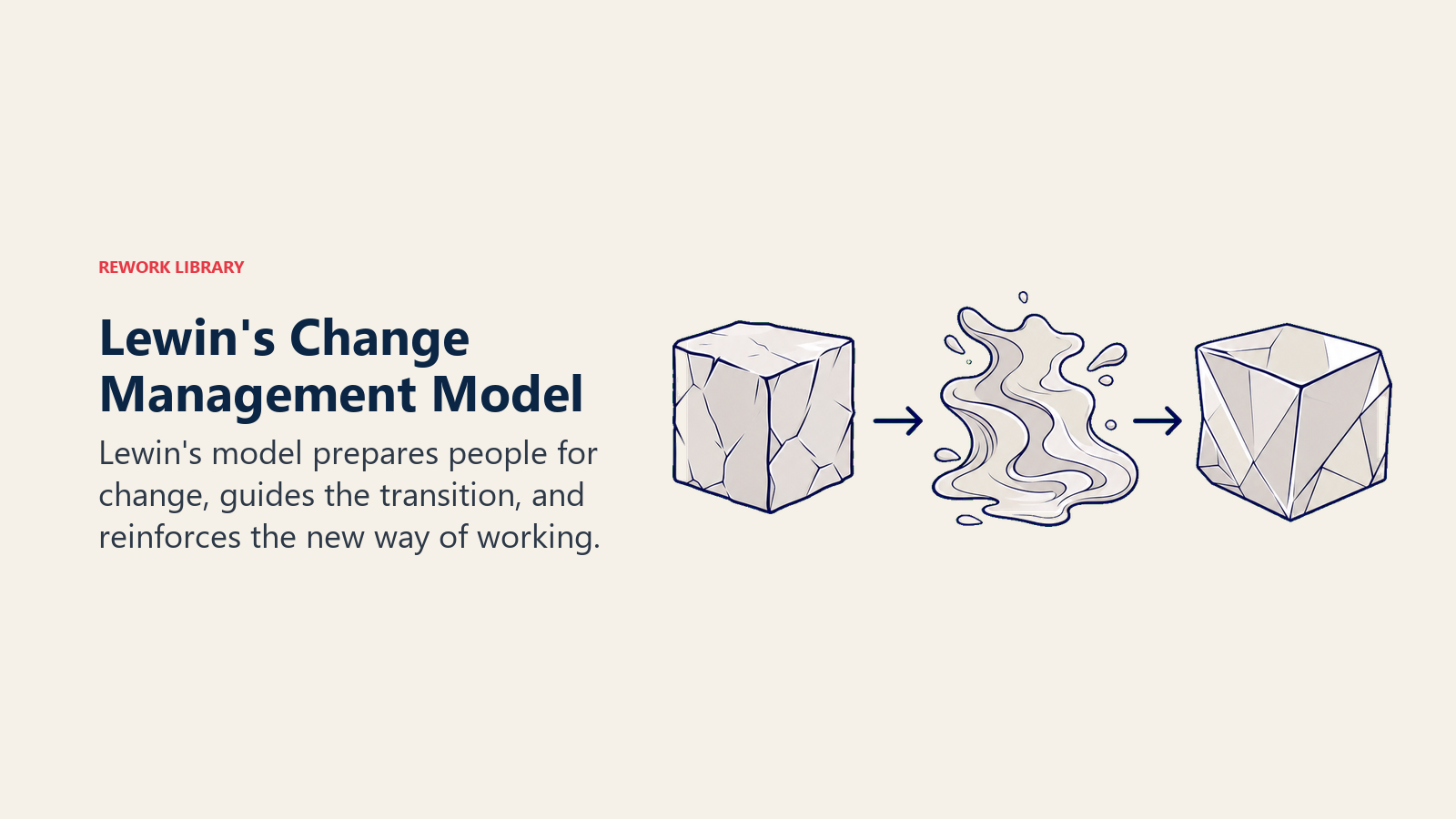
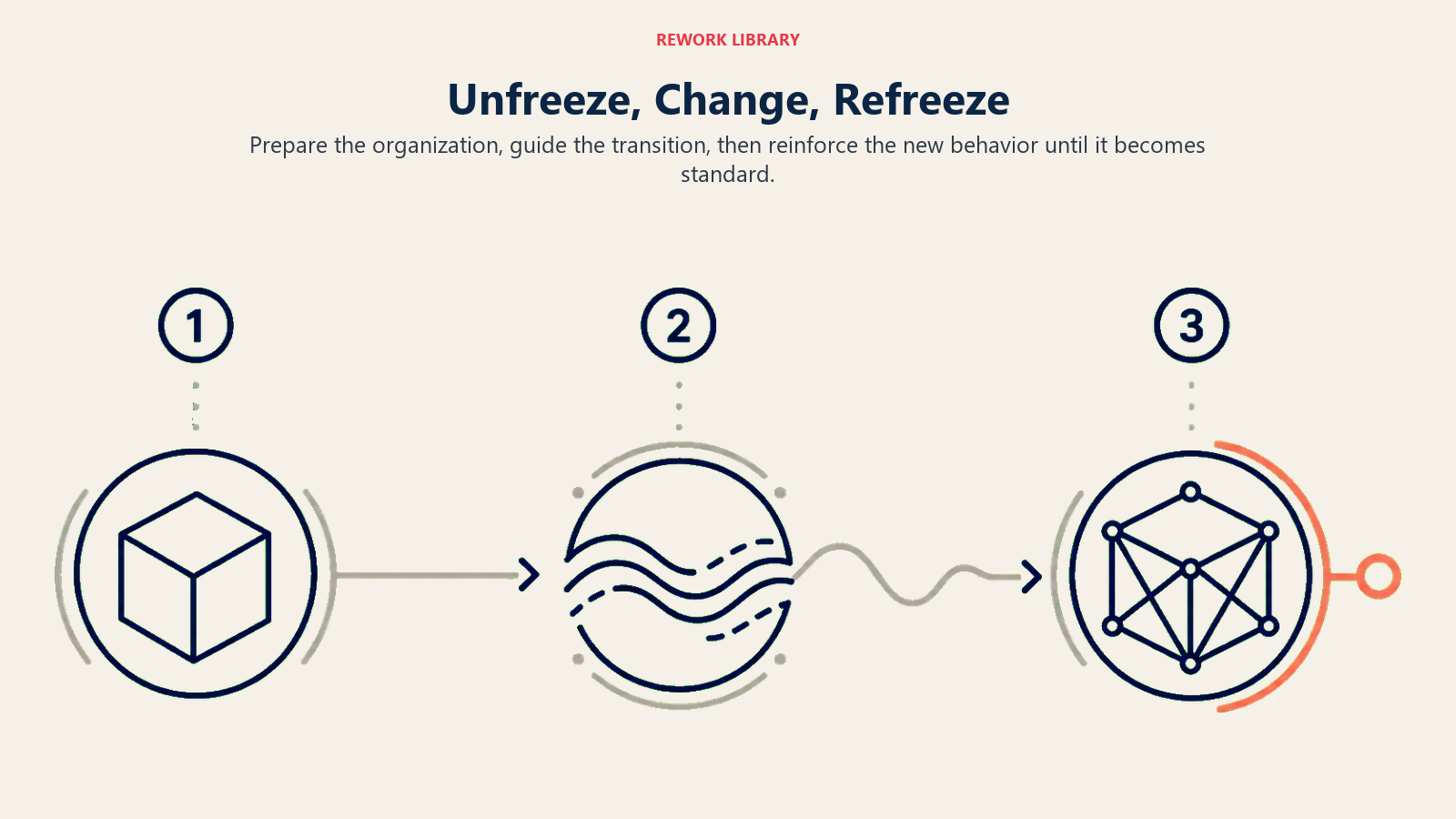
Kurt Lewin's Change Management Model is a three-stage framework that describes how organizations move from a current state to a desired future state. The three stages are Unfreeze, Change, and Refreeze. Lewin, a social psychologist, used the metaphor of ice: you melt the block (unfreeze), reshape it (change), then solidify the new form (refreeze).
The model's strength is its simplicity. It doesn't try to map every nuance of a change project. Instead, it forces leaders to ask three questions: Are people ready to change? Are we executing the change? And have we locked in the new behavior?
It's often used alongside Kotter's 8-Step Change Model and the ADKAR Model, which go deeper into the mechanics of each stage. But for executive alignment or early-stage planning, Lewin's simplicity is a feature, not a limitation.
The 3 Stages: Unfreeze, Change, Refreeze
Each stage has a distinct character. Leaders who skip or rush a stage are almost always the ones dealing with change fatigue, reversion to old habits, or initiative failure six months in.
| Stage | What Happens | Leader Actions | Key Risks |
|---|---|---|---|
| Unfreeze | The organization is prepared for change. Existing beliefs, norms, and processes are questioned. Psychological safety is built. | Communicate the "why," surface dissatisfaction with the status quo, reduce fear, build urgency. | Moving to Change too fast; not enough buy-in; resistance left unaddressed. |
| Change | New behaviors, systems, or structures are introduced. People learn and adapt. Ambiguity is high. | Provide training, clear direction, visible leadership support, and regular check-ins. | Inconsistent messaging; mid-project fatigue; lack of quick wins. |
| Refreeze | New ways of working become the standard. Systems, policies, and culture are updated to reflect and reinforce the change. | Update processes, reward new behavior, celebrate milestones, close out the old way formally. | Declaring victory too early; reverting under pressure; not updating supporting structures. |
Stage 1: Unfreeze
This is where most change programs actually fail, and it happens before anything visible begins. Unfreeze is about dismantling the "this is how we do things" attitude that makes people resistant to new approaches.
Lewin believed that the equilibrium people settle into, their current habits and assumptions, has to be actively disrupted before learning can happen. A merger announcement, a competitive threat, a failed quarter: all of these can trigger a natural unfreeze. But if the trigger isn't there, leaders have to create it. That might mean sharing data about where the business is falling behind, running town halls that acknowledge problems openly, or simply being honest with the team about what's not working.
The Unfreeze stage isn't just about information. It's about emotional readiness. People need to feel that the current state is untenable AND that the future state is achievable. Both conditions matter.
Stage 2: Change
Once people are open to change, the actual transition begins. This is the longest and most resource-intensive stage. New processes are introduced, teams are trained, org structures may shift, and workflows get redesigned.
But Change isn't linear. People move through it at different speeds. Some adopt quickly; others need repeated exposure and reinforcement. Leaders often make the mistake of front-loading communication (big launch, big announcement) and then going quiet. The opposite is what works: consistent, frequent, small updates keep people oriented as ambiguity rises.
Quick wins matter here too. Early successes, even small ones, give people evidence that the change is working. This is something Kotter's 8-Step Change Model calls out explicitly in its structure.
Stage 3: Refreeze
Refreeze gets the least attention and causes the most post-change regression. It's the work of embedding the new behaviors into the organization's DNA so they don't erode when leadership attention moves on.
That means updating SOPs, job descriptions, performance metrics, and incentives to match the new way of working. It means celebrating teams that adopted the change and making visible examples of what "good" looks like. And it means formally closing out the old methods, not just tolerating both side-by-side indefinitely.
Some critics argue that "Refreeze" is the wrong metaphor for an era of continuous change, since it implies things should go back to being static. That's a fair point. But the underlying insight still holds: new behaviors need reinforcement structures, or they won't stick.
Force Field Analysis
Lewin didn't just give us the three-stage model. He also developed Force Field Analysis as a companion diagnostic tool, and the two work best together.
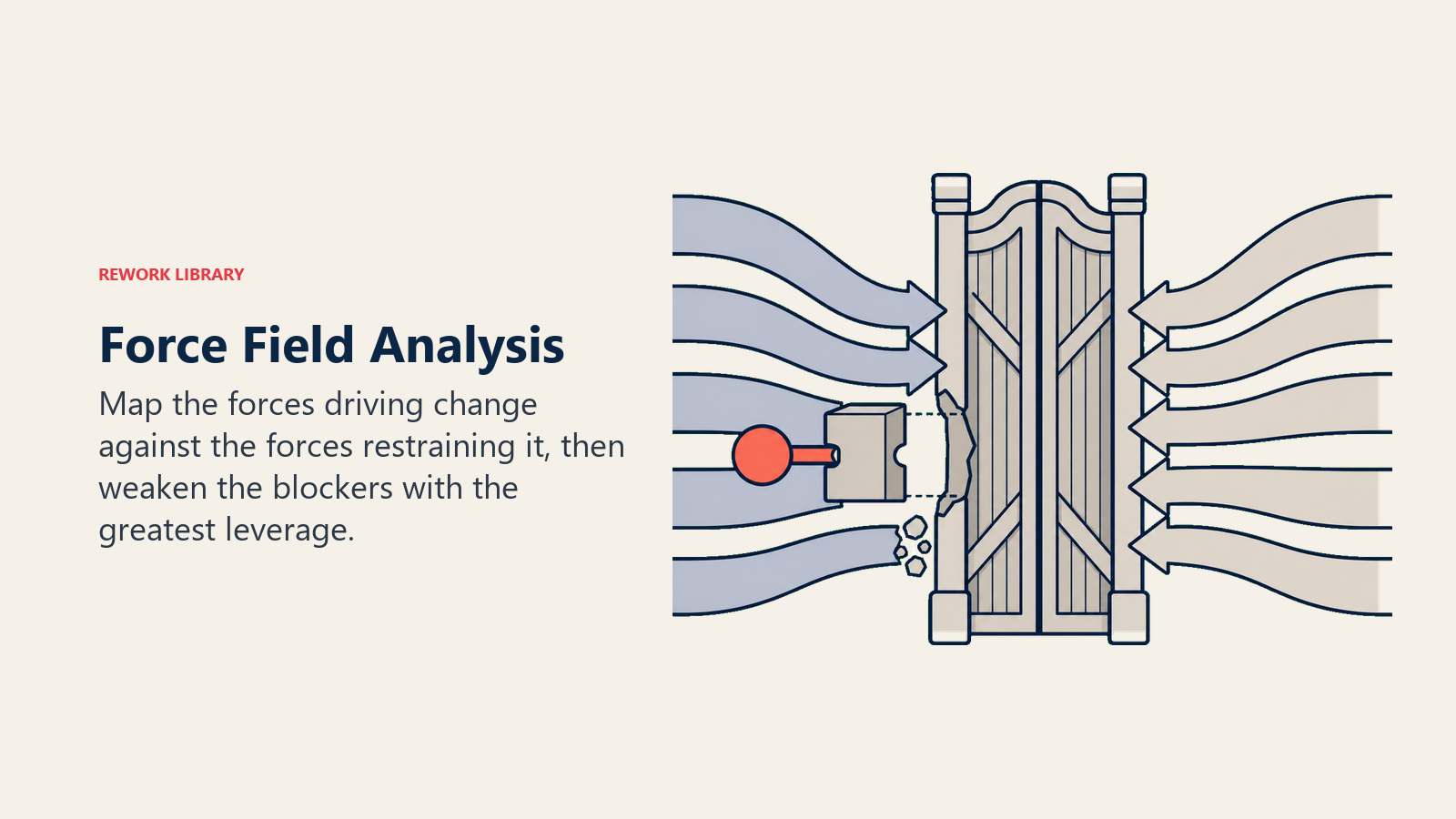
Force Field Analysis maps the forces pushing toward a change (driving forces) against the forces resisting it (restraining forces). You draw a vertical line: driving forces on the left, restraining forces on the right. The change happens when driving forces are stronger, or when restraining forces are weakened.
In practice, it looks like this for a company migrating to a new CRM system:
Driving forces: Sales leaders want better pipeline visibility. Marketing wants shared contact data. The current system is slow and frequently breaks.
Restraining forces: Sales reps are comfortable with the old system. Training takes time away from selling. IT is worried about integration complexity. Legal needs data migration sign-off.
The analysis helps leaders stop thinking about change as a single persuasion challenge and start treating it as a system of forces. Often, removing a restraining force is more effective than adding more driving force. In this example, solving the IT integration concern early removes a blocker that's holding back multiple adopters.
Lewin vs ADKAR vs Kotter's 8-Step Model
These three models are the most commonly referenced change management frameworks. They're complementary, not competing, but understanding the differences helps you pick the right tool for your context.
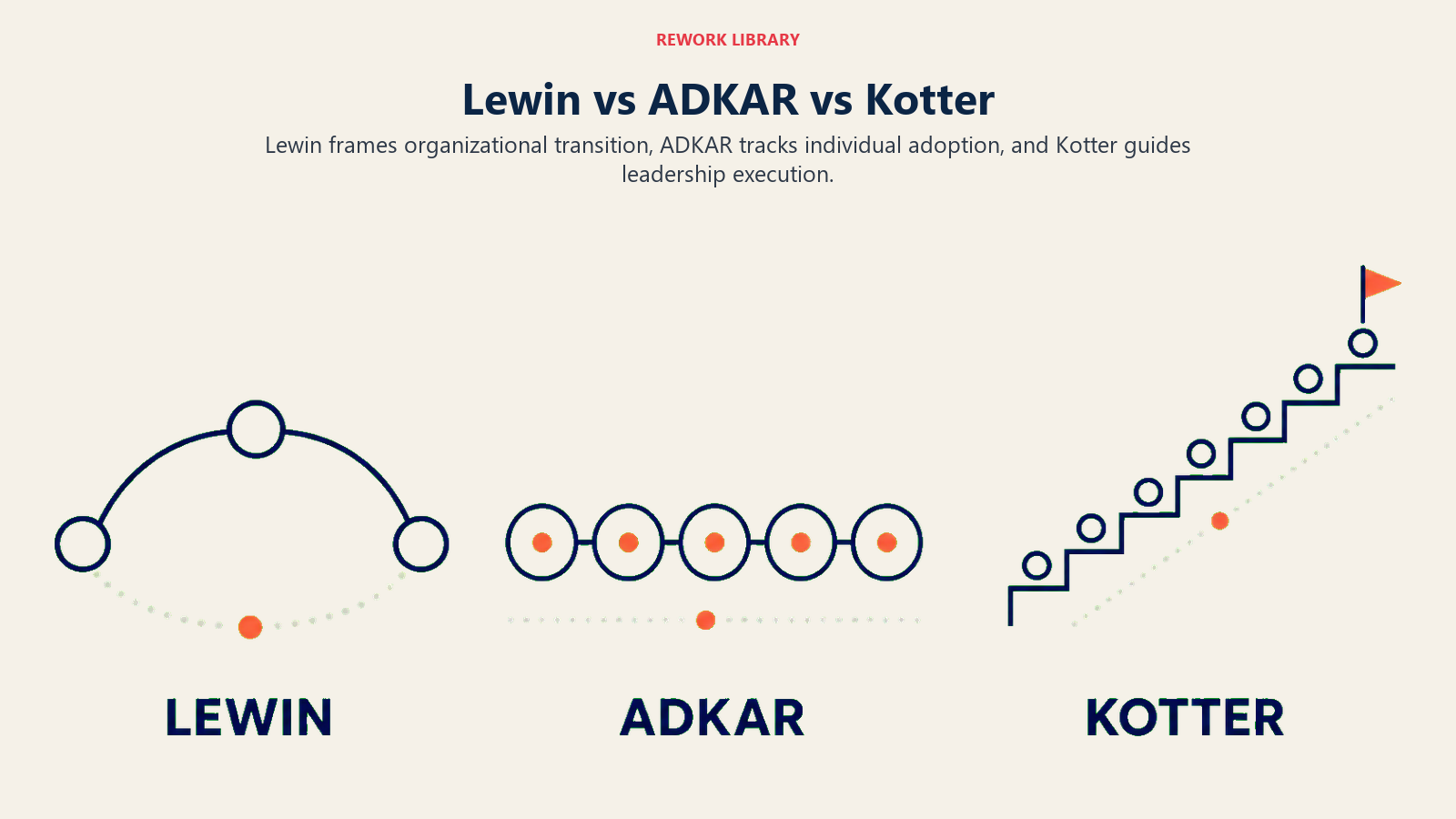
| Dimension | Lewin's Model | ADKAR | Kotter's 8-Step |
|---|---|---|---|
| Origin | Kurt Lewin, 1947 | Jeff Hiatt / Prosci, 1998 | John Kotter, 1996 |
| Stages | 3 (Unfreeze, Change, Refreeze) | 5 (Awareness, Desire, Knowledge, Ability, Reinforcement) | 8 steps |
| Focus | Organizational readiness and stabilization | Individual psychology and adoption | Leadership-driven execution |
| Best for | High-level planning, executive alignment | People-centered change, HR-led programs | Complex, multi-phase transformation |
| Limitation | Less granular on execution mechanics | Can feel clinical; doesn't address org structure | Can feel prescriptive; requires significant leadership bandwidth |
| Companion tools | Force Field Analysis | Change Impact Assessment | Coalition mapping |
For a full breakdown of ADKAR's individual-change mechanics, see the ADKAR Model article. For an 8-step execution roadmap for large transformations, see Kotter's 8-Step Change Model.
Why Lewin's Model Matters
The model has lasted nearly 80 years for a reason. Here's what makes it useful:
It's universally accessible. Anyone in the organization can understand Unfreeze-Change-Refreeze without a change management certification. That matters when you're trying to build alignment across functions with different vocabularies.
It forces the Unfreeze conversation. Most leaders want to skip straight to Change. Lewin's model makes Unfreeze a formal, non-optional stage. This alone has probably saved more failed change programs than any other structural nudge.
It diagnoses stalled changes. If a change initiative is stuck, the model immediately gives you a diagnostic question: Are we stalled in Unfreeze (not enough readiness), Change (execution problems), or Refreeze (new behaviors not reinforced)? That's a fast triage, and it often points directly to the intervention.
It pairs well with other strategic tools. The McKinsey 7S Framework maps the seven elements that must align during change (strategy, structure, systems, skills, staff, style, shared values). Running a 7S analysis during Lewin's Refreeze stage is a practical way to check whether all organizational elements have been updated to reflect the new operating model.
How to Apply Lewin's Model
Here's a practical walkthrough for using this model in an organizational change project:
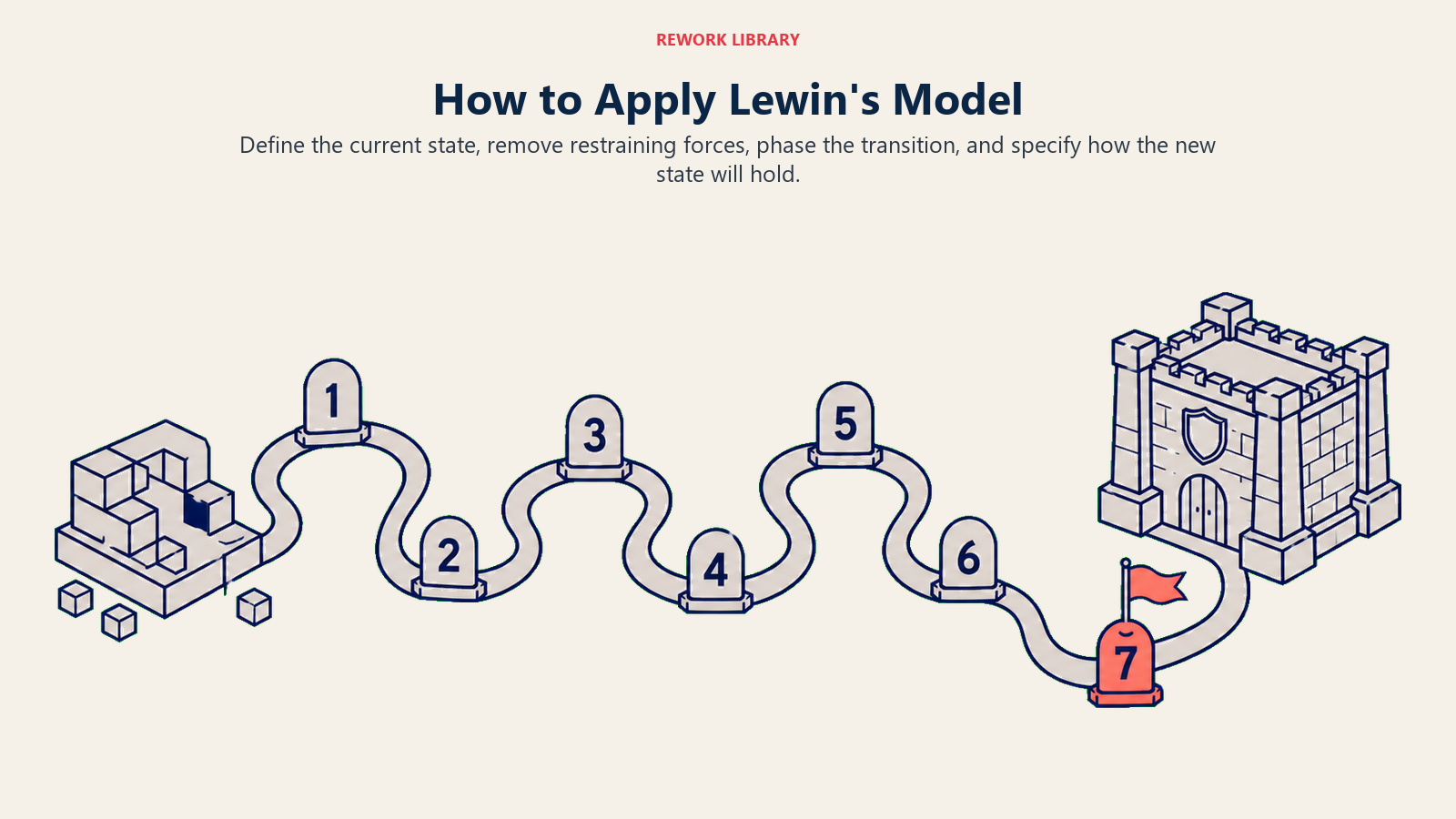
Define the current state. Write down exactly what behaviors, systems, and beliefs you're trying to change. Be specific. "We have a culture problem" isn't actionable. "Sales reps log calls inconsistently, so pipeline data is unreliable" is.
Run a Force Field Analysis. List all the driving and restraining forces for this change. Identify which restraining forces are strongest and which are easiest to address.
Design your Unfreeze activities. This might include town halls, skip-level meetings, sharing competitive or performance data that creates urgency, or involving skeptics in the problem-framing process.
Plan the Change stage in phases. Break the transition into chunks with visible milestones. Assign owners for each phase. Build in feedback loops so you can course-correct.
Define success for Refreeze. Before you start, agree on what "locked in" looks like. Which KPIs change? Which processes get updated? How will you know in 90 days that the change held?
Align with your strategy frameworks. Use the Balanced Scorecard to track whether the change is producing the strategic outcomes you intended.
Communicate throughout all three stages. Not just at the launch. Map out a communication rhythm for the full change arc. Different audiences need different messages at different times.
Lewin's Model Examples
Here's how this plays out in a real-world scenario: a mid-size company transitioning from in-person to hybrid work.
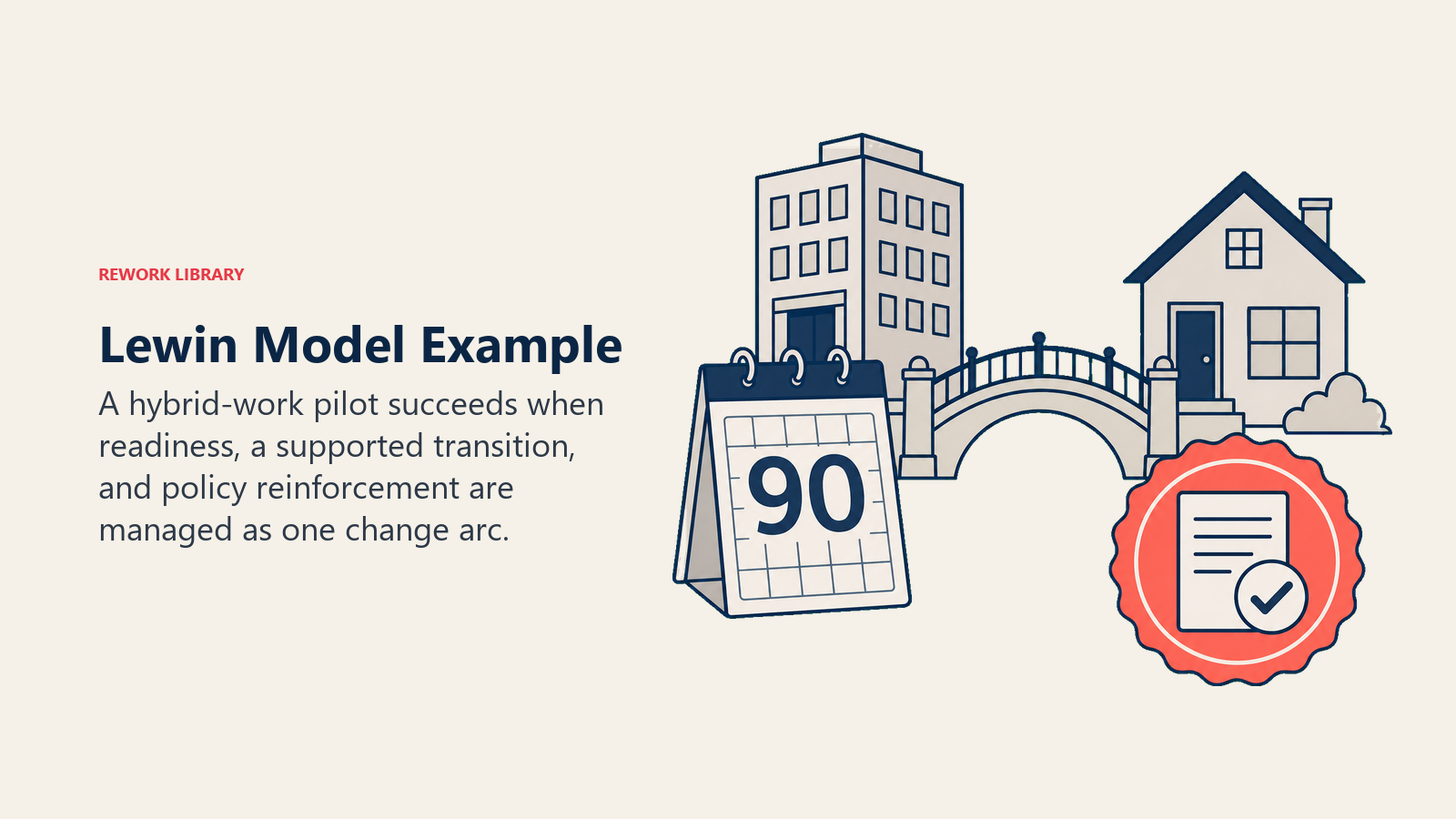
| Stage | What the Organization Did |
|---|---|
| Unfreeze | HR shared data showing 40% of employees were considering leaving without flexible work options. Leadership ran listening sessions. A cross-functional task force was formed with skeptics included. |
| Change | New hybrid policy launched with a 90-day pilot. Managers received training on remote team management. Weekly pulse surveys tracked adoption and surfaced friction. IT deployed collaboration tools. |
| Refreeze | Policy was formalized in the employee handbook. Manager scorecards added a team engagement metric. Office layout was redesigned for hybrid-first use. New-hire onboarding updated to set expectations from day one. |
The Refreeze step here is the one most companies skip. They run the pilot, it goes reasonably well, and then they move on. Six months later, the old habits creep back because the supporting structures were never updated.
Limitations
No framework is perfect. Here are the honest limitations of Lewin's model:
It's sequential, but change isn't always. Real change projects have parallel workstreams, unexpected setbacks, and stages that overlap. The tidy three-step progression can give a false sense of linearity.
"Refreeze" assumes stability. In markets where strategy shifts constantly, the Refreeze metaphor can be misleading. Some organizations need a model that assumes continuous change as the default state.
It's light on individual psychology. The model operates at the organizational level. It doesn't give you much guidance on why a specific person is resisting change or how to address their individual concerns. That's where ADKAR fills the gap.
It doesn't prescribe leadership behaviors. Kotter's 8-step model, by contrast, is much more explicit about what leaders need to do at each stage. Lewin tells you what needs to happen; Kotter tells you how to make it happen.
Best Practices
- Don't rush Unfreeze. The urgency you feel to get to the Change stage is exactly the urgency that kills change programs. Spend more time than you think you need on readiness.
- Make resistance visible. Don't treat skeptics as problems to be managed. Bring them into the Force Field Analysis. Their concerns often point to real risks.
- Refreeze proactively. Before you close out the change project, do a structured audit: which supporting systems, incentives, and processes still reflect the old way? Fix them.
- Document the journey. Teams that document what they learned during a change cycle build institutional knowledge that makes future changes faster. Use a SWOT Analysis retrospective to capture what worked and what didn't.
- Use the model for diagnosis, not just planning. If a change is stalling mid-flight, map where you are in the three stages and what's blocking progress. It takes 10 minutes and often surfaces the root cause fast.
Frequently Asked Questions about Lewin's Change Management Model
What is the main idea behind Lewin's change model?
Lewin's model says that successful organizational change requires three stages: dismantling the status quo (Unfreeze), introducing and embedding new behaviors (Change), and reinforcing the new state so it sticks (Refreeze). The ice metaphor captures it: you can't reshape ice without melting it first.
How is Lewin's model different from ADKAR?
Lewin operates at the organizational level and focuses on readiness, transition, and stabilization. ADKAR operates at the individual level and tracks five psychological states each person must pass through: Awareness, Desire, Knowledge, Ability, and Reinforcement. They're often used together, with Lewin providing the macro structure and ADKAR guiding individual-level interventions.
What is Force Field Analysis and how does it connect to Lewin's model?
Force Field Analysis is a diagnostic tool Lewin developed alongside his change model. It maps the forces driving change against the forces resisting it. Leaders use it during the Unfreeze stage to understand the change landscape before committing to a plan. Reducing restraining forces is often more effective than adding driving forces.
When should you use Lewin's model vs Kotter's 8-Step Model?
Use Lewin when you need a simple, high-level framework for executive alignment or early-stage planning. Use Kotter when you're executing a complex, multi-phase transformation and need prescriptive guidance on what leaders should do at each step. The two frameworks are compatible and often used in combination.
Does Lewin's model work for continuous change environments?
It works with some adaptation. The Refreeze stage doesn't have to mean "lock things in forever." It can mean "stabilize this change before beginning the next one." In high-velocity environments, you can think of it as a rapid cycle: quick Unfreeze, focused Change, brief Refreeze, then repeat.
Change management doesn't get easier, but it does get more predictable when you have a framework. Lewin's model has persisted for nearly eight decades because it captures something true about how people and organizations move through transitions. The Unfreeze stage is still the one most leaders skip, the Change stage is still where most communication breaks down, and the Refreeze stage is still the invisible failure mode of programs that seemed to work.
Use it as a diagnostic, a planning structure, and a leadership conversation starter. It's a starting point, not a complete playbook, but that's exactly what makes it useful.

Senior Operations & Growth Strategist