PESTEL vs SWOT: When to Use Each Analysis
Turn this article into takeaways for your work.


Each assistant summarizes the article only for you and suggests best practices for your work.
PESTEL vs SWOT is one of the most common strategy questions teams wrestle with before a planning cycle. The short answer: they solve different problems, and the best strategies use both.
What Is the Difference Between PESTEL and SWOT?
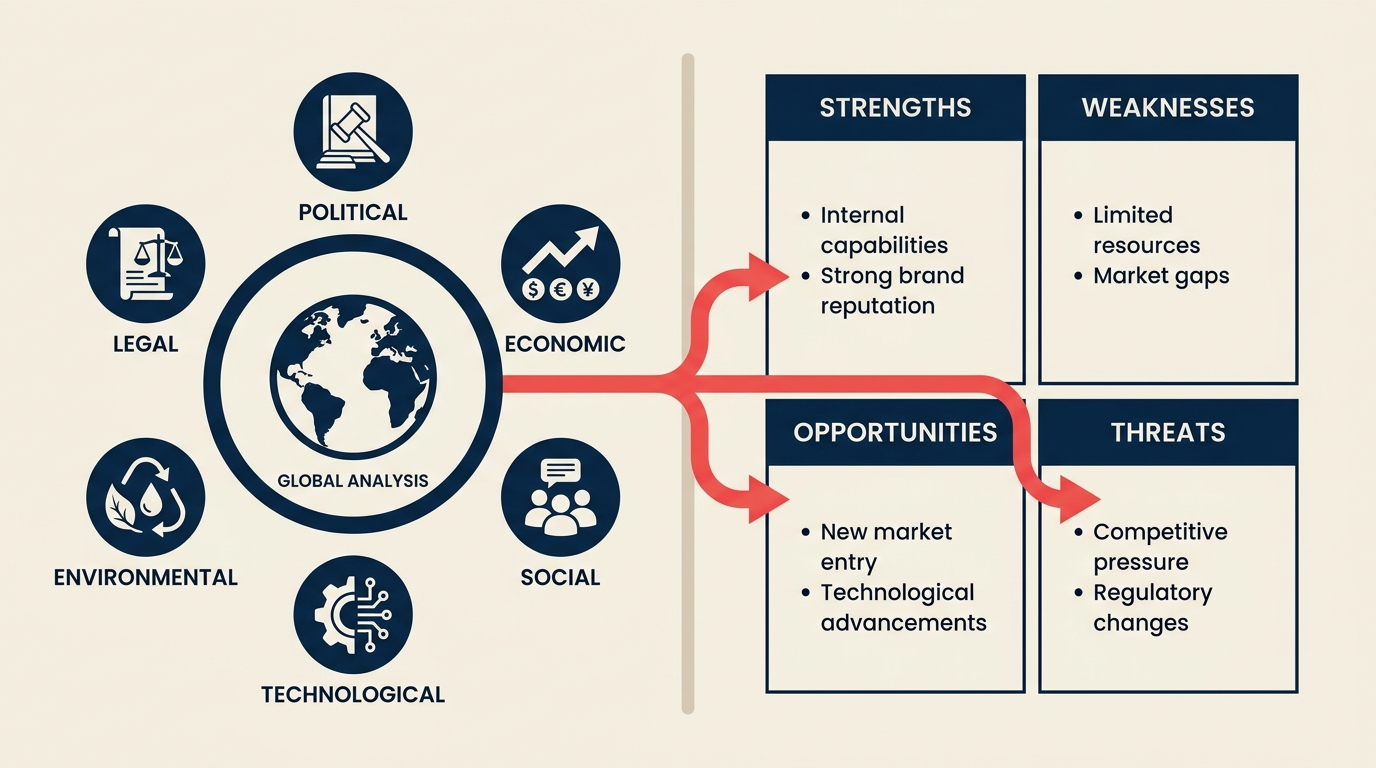
PESTEL scans the macro-environment outside your organization across six dimensions: Political, Economic, Social, Technological, Environmental, and Legal forces. SWOT assesses a specific organization across four categories: internal Strengths and Weaknesses, and external Opportunities and Threats. PESTEL is purely external and operates at the macro, industry-wide level; SWOT is mixed, combining internal self-assessment with a curated view of external factors. They are complementary tools, not competing alternatives.
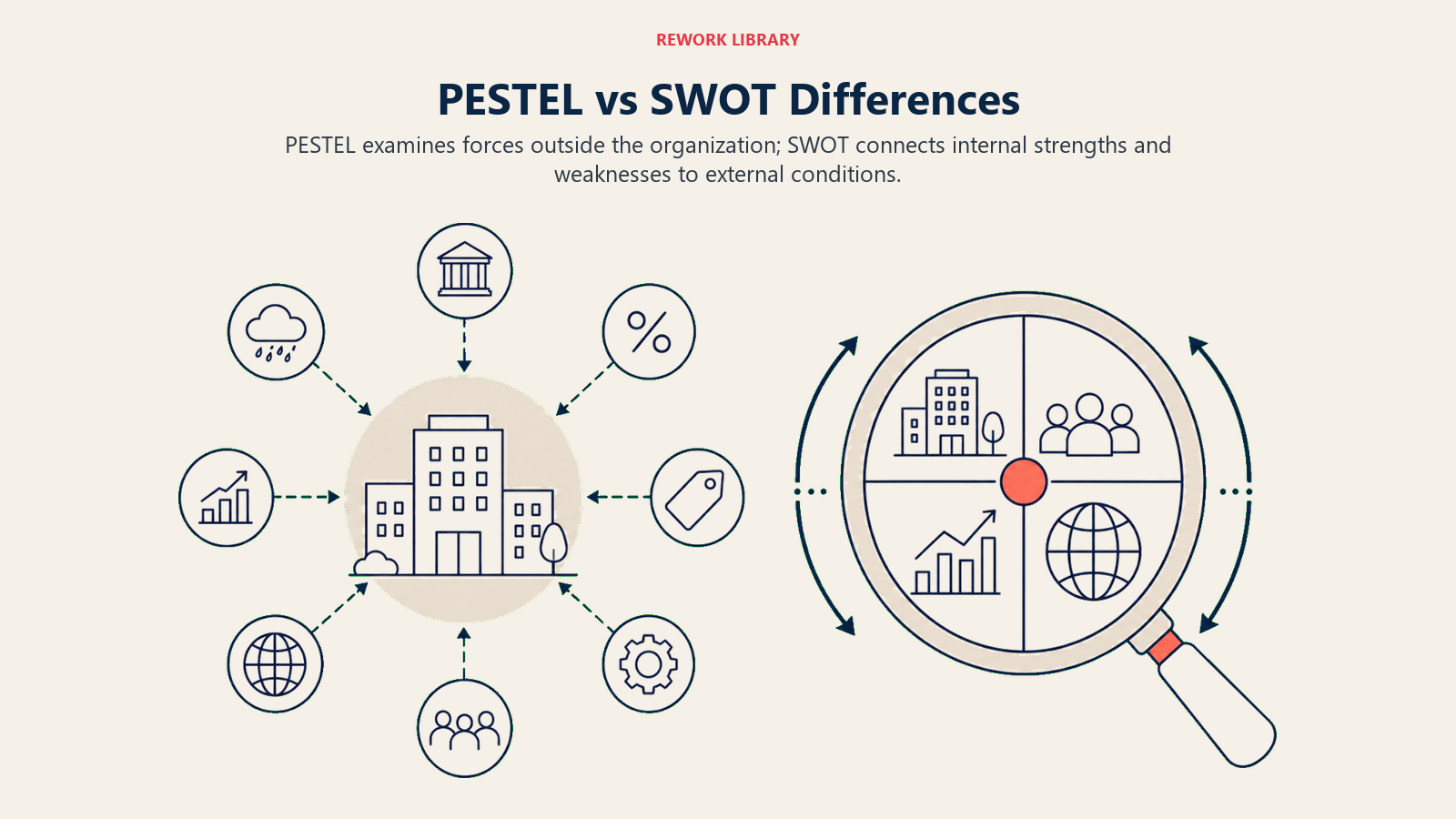
PESTEL tells you what the weather is doing; SWOT tells you whether your boat can handle it.
Key Facts
- The SWOT framework was developed at Stanford Research Institute (SRI) by Albert Humphrey and colleagues during a 1960s research project studying Fortune 500 planning failures. (Stanford Research Institute archives)
- The PESTEL lineage traces to Harvard professor Francis Aguilar, who published Scanning the Business Environment in 1967, introducing the ETPS scan (Economic, Technical, Political, Social) as a structured environmental analysis method. (Aguilar, 1967)
- A 2023 Deloitte Global Resilience Report found that 72% of senior executives increased their investment in formal environmental scanning after supply-chain disruptions exposed blind spots in their strategic plans. (Deloitte Global Resilience Report, 2023)
What Is PESTEL Analysis?
A PESTEL analysis is a structured scan of the macro-environment that surrounds your organization. It helps strategists surface forces they cannot control but must plan around.
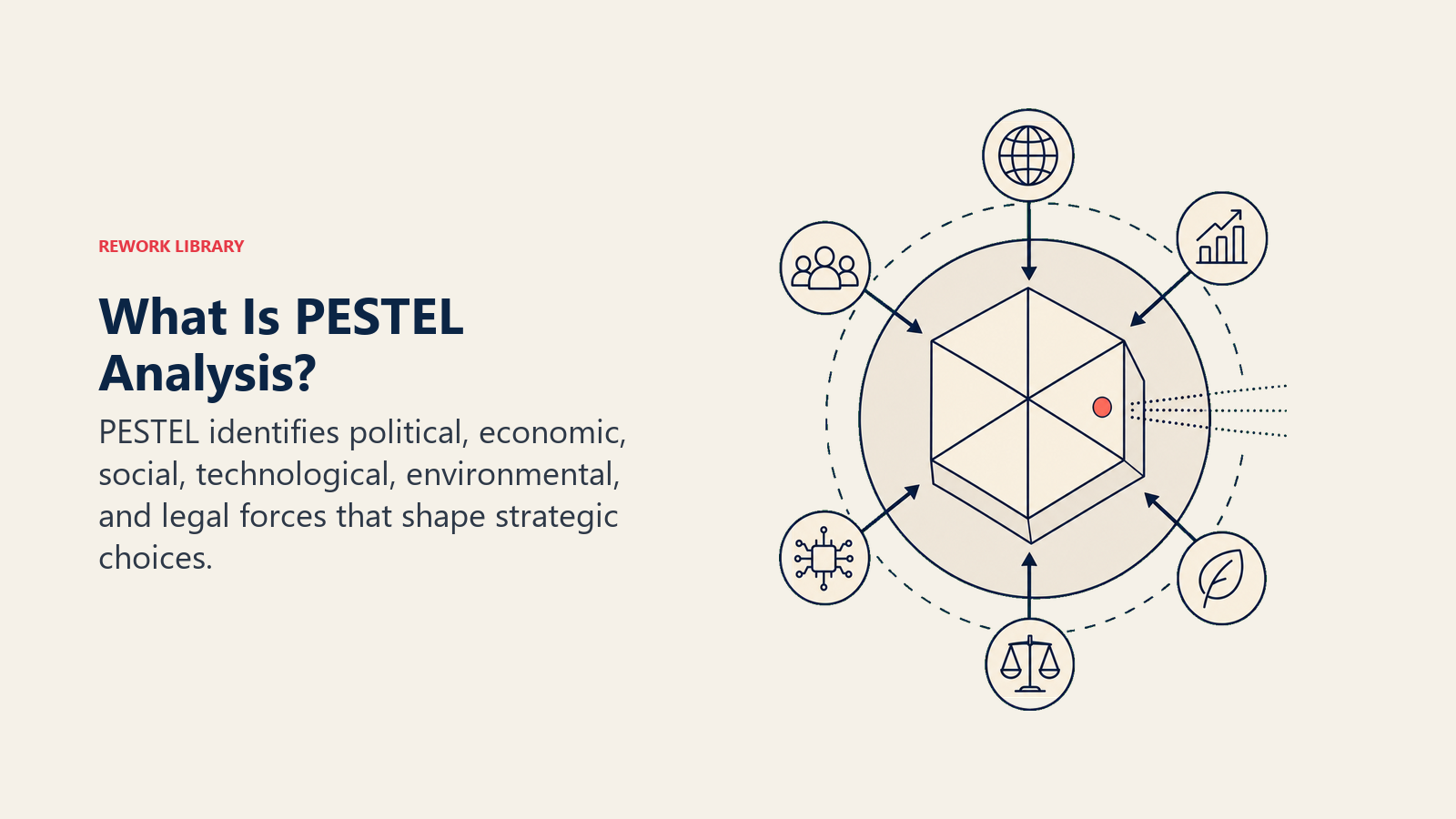
The six dimensions are:
- Political: government stability, trade policy, taxation, regulation, political risk in key markets.
- Economic: GDP growth, interest rates, inflation, exchange rates, unemployment, consumer confidence.
- Social: demographic shifts, cultural attitudes, lifestyle trends, education levels, workforce expectations.
- Technological: emerging technologies, automation, R&D pace, digital infrastructure, cybersecurity risk.
- Environmental: climate change impacts, sustainability regulations, carbon commitments, resource scarcity.
- Legal: employment law, data protection (GDPR, CCPA), industry-specific regulation, intellectual property rules, antitrust.
PESTEL does not tell you what your organization should do. It tells you what conditions your organization must operate in. That distinction matters: it's the input, not the strategy.
What Is SWOT Analysis?
A SWOT analysis is a structured audit of your organization's strategic position. It combines an internal inventory with an external scan.
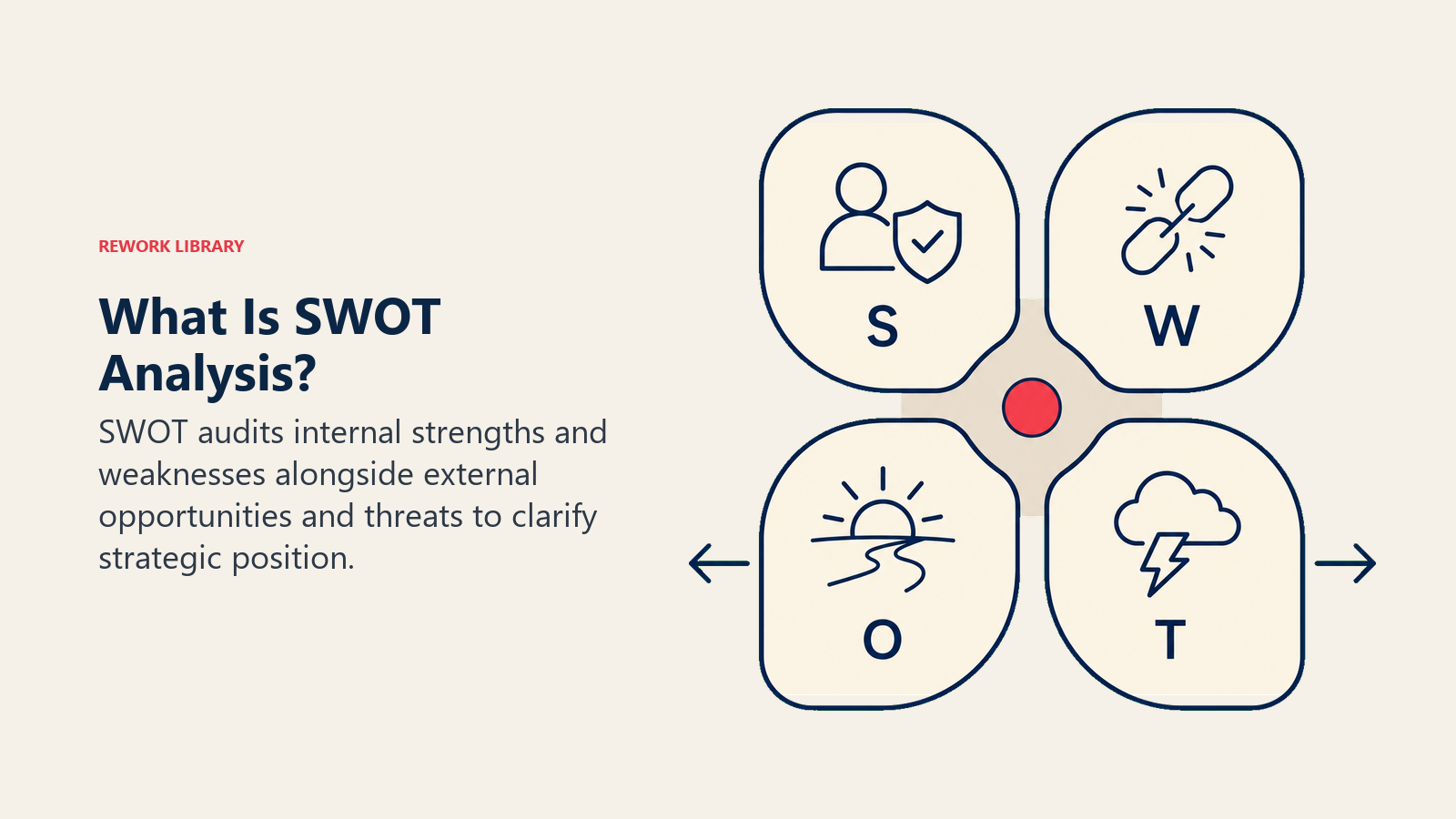
The four quadrants are:
- Strengths (internal, positive): capabilities and resources that give you a competitive edge. A strong brand, proprietary data, low-cost production, loyal customer base.
- Weaknesses (internal, negative): internal limitations holding you back. High debt, skills gaps, poor brand awareness in new markets, outdated technology.
- Opportunities (external, positive): external conditions your organization can exploit. A growing market segment, a competitor's exit, a regulatory change that favors your model.
- Threats (external, negative): external forces that could harm your position. A new entrant, rising input costs, regulatory tightening, shifting customer preferences.
The Opportunities and Threats in a SWOT are selected judgments from a wider set of external data. PESTEL is one of the best sources for that data.
PESTEL vs SWOT: Side-by-Side Comparison
The comparison is clearest when you separate scope, focus, timing, and output before deciding which framework belongs in the planning workflow.
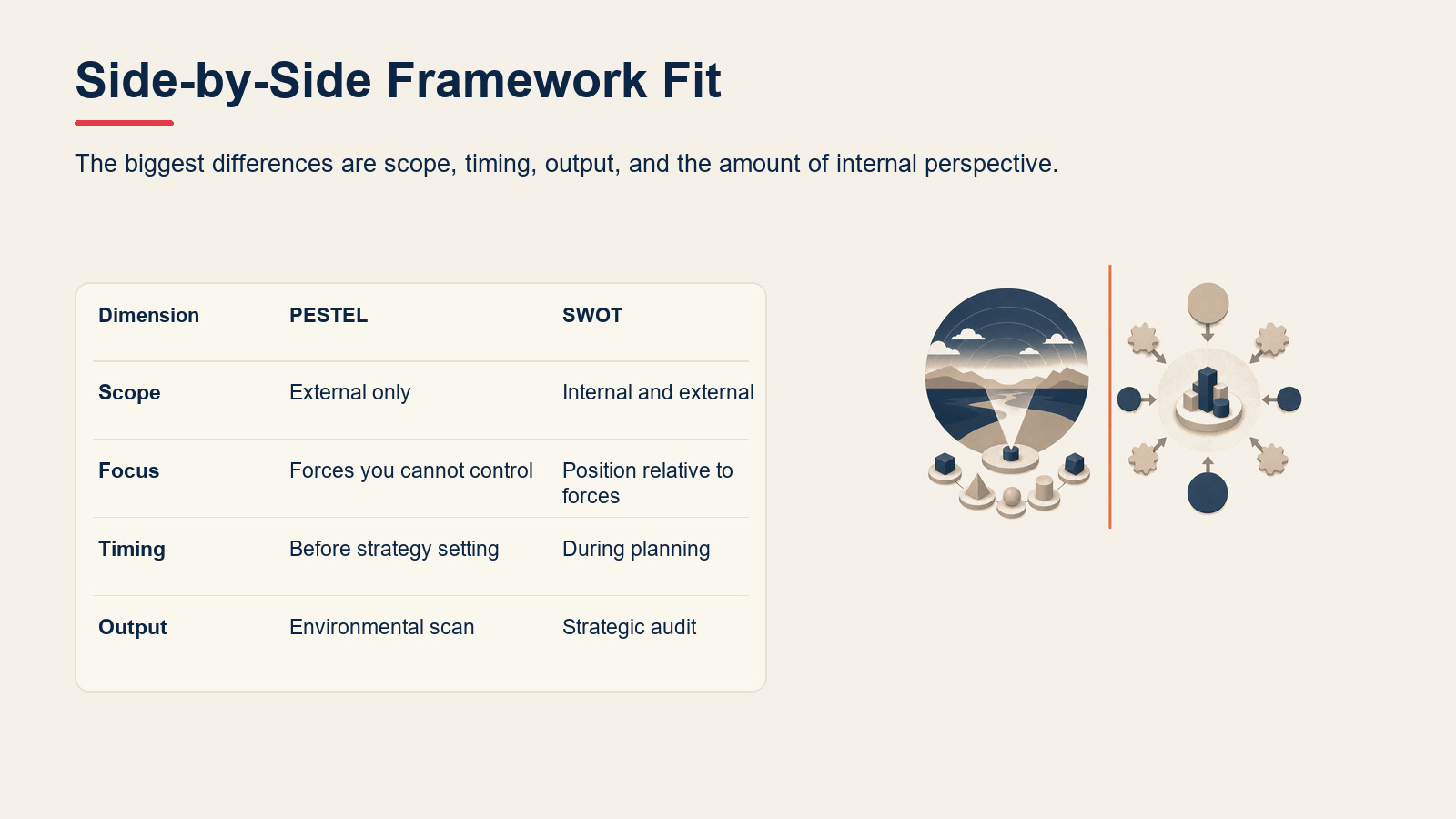
| Dimension | PESTEL | SWOT |
|---|---|---|
| Scope | External macro-environment only | Internal and external |
| Focus | Forces the organization cannot control | Organization's strategic position relative to those forces |
| Level of analysis | Industry-wide and macro | Organization-specific |
| Primary output | Catalog of environmental forces (political, economic, social, technological, environmental, legal) | Strategic audit: strengths, weaknesses, opportunities, threats |
| Typical timing | Before strategy setting; also used for market entry or annual refresh | During strategy planning; often follows environmental scanning |
| Key limitation | No internal perspective; no prioritization of forces | Opportunities and Threats can become vague without rigorous external data |
When to Use PESTEL vs When to Use SWOT
Use PESTEL when you need to understand the world your organization operates in before making a strategic choice. Common triggers:
- Entering a new country or market segment.
- Planning for the next 3-5 years when macro conditions are shifting.
- Conducting an industry or sector study.
- Trying to understand why competitors are winning or losing.
Use SWOT when you need to assess whether your specific organization is positioned to act on a market opportunity. Common triggers:
- Deciding whether to launch a new product or service.
- Evaluating a merger, acquisition, or partnership.
- Building an annual operating plan.
- Diagnosing why growth has stalled.
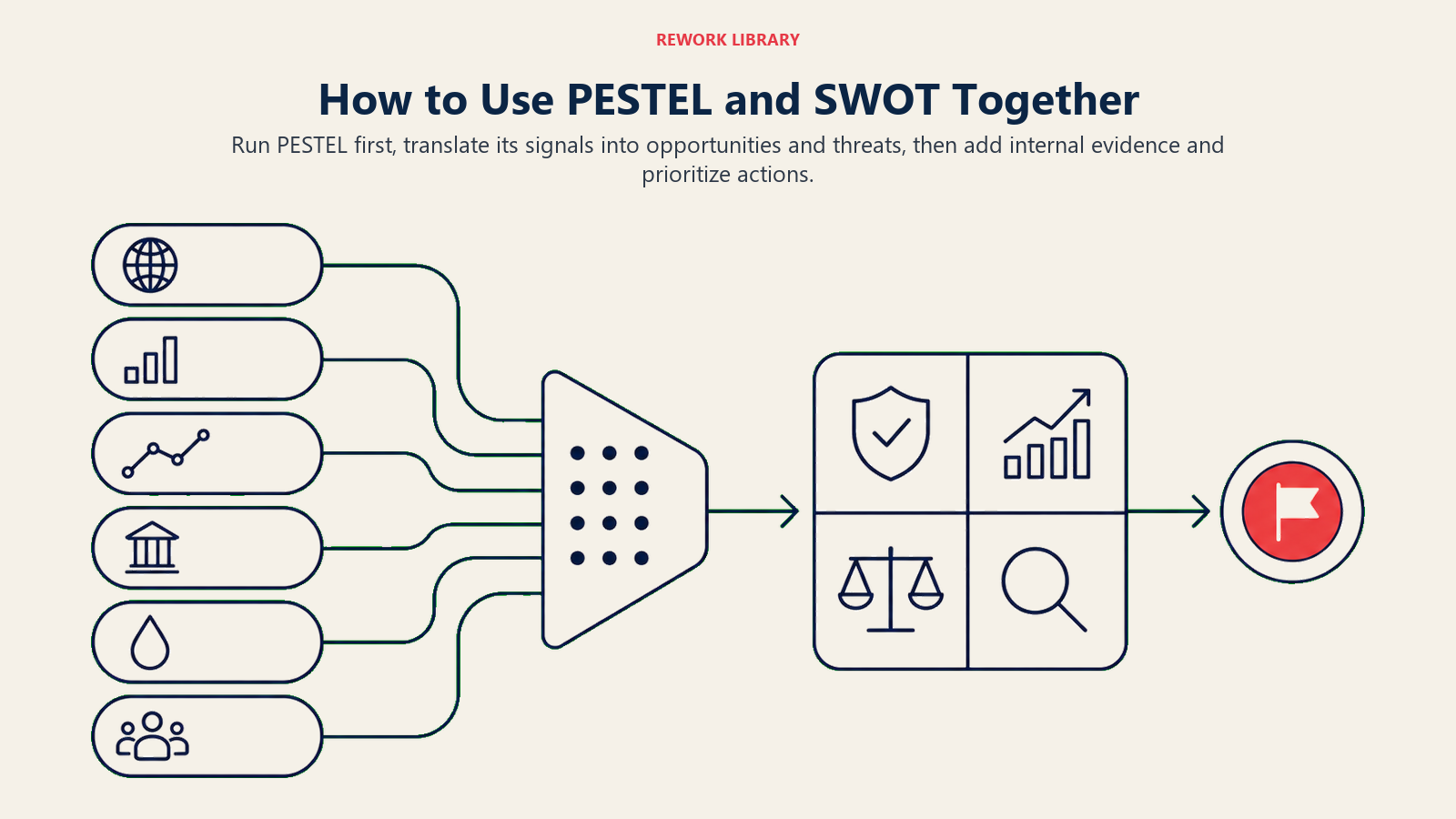
The typical sequence is: run PESTEL first, use its findings to populate the Opportunities and Threats columns of your SWOT, then layer in the internal Strengths and Weaknesses your team knows. This ordering prevents the common trap of imagining opportunities from inside a conference room without grounding them in real market forces.
How to Use PESTEL and SWOT Together
Running both frameworks in sequence turns disconnected analysis into a coherent strategic picture. Here is the four-step process.
Step 1: Run a Full PESTEL Scan
Assemble a cross-functional group (finance, operations, commercial, legal) and systematically work through each of the six PESTEL dimensions. The goal is a comprehensive list of forces, not a curated short-list. Capture evidence: data points, regulatory signals, trend reports. Treat this as primary research, not brainstorming.
Step 2: Filter Into Opportunities and Threats
Review the PESTEL output and identify which forces represent realistic Opportunities your organization could exploit and which represent credible Threats it needs to hedge against. Apply two filters: relevance to your business model and likely impact over your planning horizon. This converts the raw PESTEL scan into the external half of your SWOT.
Step 3: Add Internal Strengths and Weaknesses
Now turn inward. Assess your competitive advantage honestly: what capabilities, assets, and positions genuinely differentiate you, and where are the real gaps? Use data where possible (market share, cost benchmarks, customer satisfaction scores) rather than opinions.
Step 4: Convert to Strategy With TOWS
A completed SWOT is still just an inventory. To generate strategies, apply the TOWS Matrix: pair Strengths with Opportunities (SO strategies: how do you capitalize?), Strengths with Threats (ST strategies: how do you defend?), Weaknesses with Opportunities (WO strategies: how do you fix gaps to seize opportunities?), and Weaknesses with Threats (WT strategies: how do you minimize exposure?). TOWS converts your SWOT into an action agenda.
See SWOT vs TOWS for a deeper explanation of the TOWS step.
Example: PESTEL Into SWOT
Consider a mid-size European logistics company evaluating an expansion into Southeast Asia.
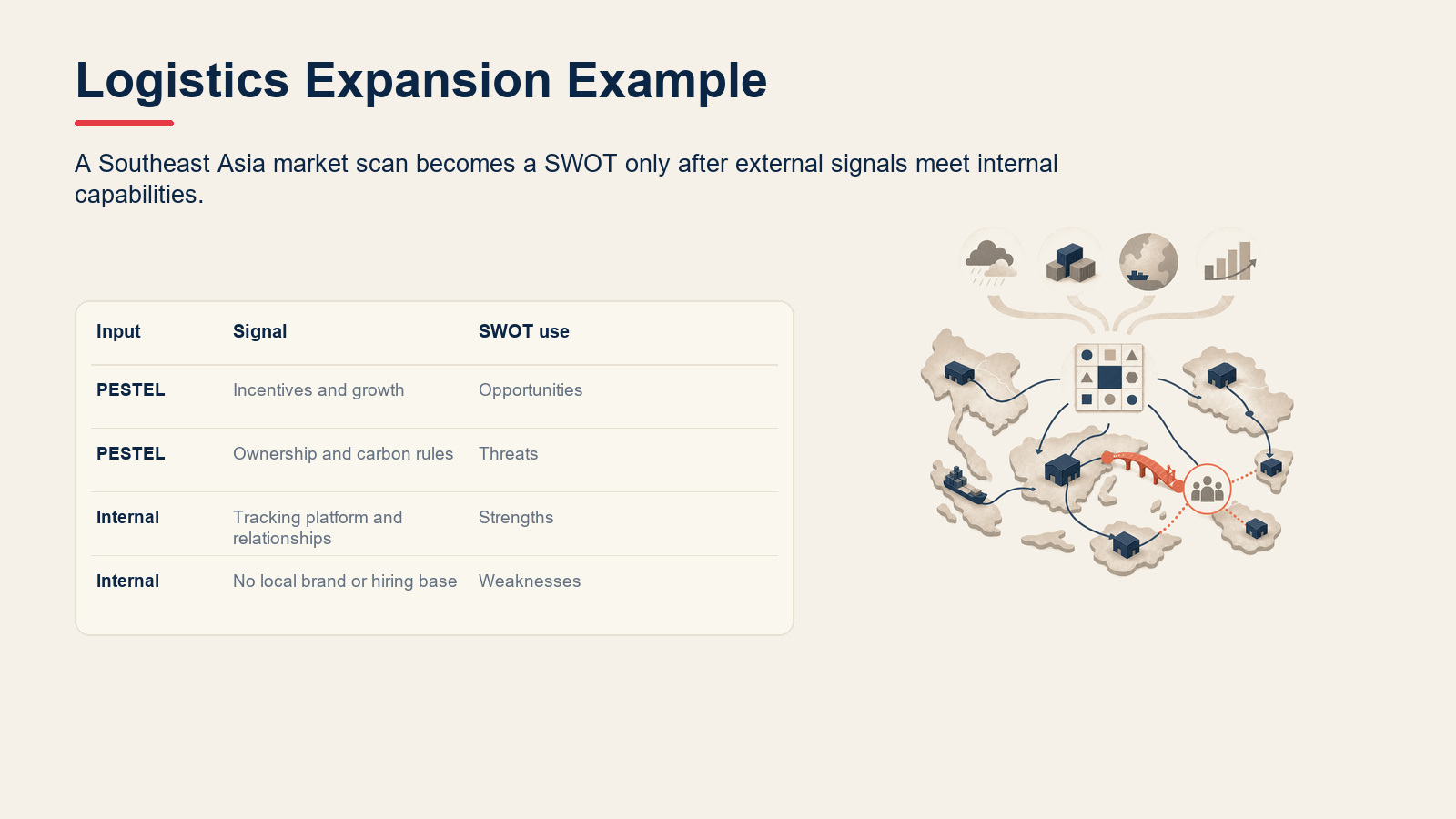
Their PESTEL scan surfaces these signals:
| PESTEL Factor | Finding |
|---|---|
| Political | Several ASEAN governments are offering logistics infrastructure incentives for foreign investors |
| Economic | GDP growth in Vietnam and Indonesia averaging 5-6% annually; rising middle-class consumption |
| Social | E-commerce penetration growing rapidly; younger population comfortable with digital ordering |
| Technological | Domestic competitors rely on legacy systems; 4PL and real-time tracking are underpenetrated |
| Environmental | New carbon-reporting mandates for freight operators entering Singapore |
| Legal | Foreign ownership caps in certain logistics sub-sectors; complex customs harmonization still in progress |
From this scan, they extract SWOT Opportunities (infrastructure incentives, e-commerce growth, technology gap to exploit) and Threats (ownership restrictions, carbon compliance cost, customs complexity).
They add internal factors: Strengths include their real-time tracking platform and European enterprise customer relationships. Weaknesses include no regional brand presence and limited local hiring capability.
The resulting SWOT gives them a factually grounded picture, not a whiteboard guess. The TOWS step then reveals their strongest move: an SO strategy that uses their tracking technology to partner with a local operator who already holds the necessary licenses.
This is the whole point of running the frameworks in sequence. PESTEL feeds the external reality. SWOT frames it relative to the organization. TOWS turns it into a decision.
Common Mistakes
Using only one when you need both. A SWOT without a prior PESTEL scan often fills the Opportunities box with wishful thinking rather than real market signals. A PESTEL without a SWOT gives you context but no organizational perspective.
Treating PESTEL as a checklist. Teams sometimes fill in one bullet per dimension and call it done. PESTEL is most useful when you go two or three levels deep into each factor and trace the second-order implications for your business model.
Vague factors with no "so what." "Technology is changing rapidly" is not a PESTEL finding. "Machine learning is automating the document verification step our team does manually, reducing our cost advantage by an estimated 30% within 18 months" is a finding. Precision is what makes the downstream SWOT useful.
Running them in the wrong order. Teams that start with SWOT sometimes construct their Opportunities and Threats from internal assumptions and then use PESTEL to confirm those assumptions. That is confirmation bias with extra steps. Run PESTEL first.
Forgetting Porter's Five Forces. PESTEL maps macro forces; Porter's Five Forces maps competitive intensity at the industry level. Both sit above SWOT in the analysis hierarchy. For a complete external picture before SWOT, run both.
Strategy does not live in a single framework. PESTEL and SWOT each answer a different question: one maps the territory, the other maps your position in it. Run them in sequence, convert to action with the TOWS Matrix, and you have a strategy process grounded in evidence rather than assumption.
Related Reading

Senior Operations & Growth Strategist
On this page
- What Is the Difference Between PESTEL and SWOT?
- What Is PESTEL Analysis?
- What Is SWOT Analysis?
- PESTEL vs SWOT: Side-by-Side Comparison
- When to Use PESTEL vs When to Use SWOT
- How to Use PESTEL and SWOT Together
- Step 1: Run a Full PESTEL Scan
- Step 2: Filter Into Opportunities and Threats
- Step 3: Add Internal Strengths and Weaknesses
- Step 4: Convert to Strategy With TOWS
- Example: PESTEL Into SWOT
- Common Mistakes
- Related Reading