Corporate, Business, and Functional Strategy Explained
Turn this article into takeaways for your work.


Each assistant summarizes the article only for you and suggests best practices for your work.
Most organizations don't fail because they lack strategy. They fail because their three levels of strategy never actually talk to each other. The corporate team sets a direction, the business units build their own plans, and the functional departments execute something else entirely. By year-end, everyone worked hard and nothing aligned.
Understanding the levels of strategy gives executives and managers the framework to close that gap. It also helps to remember that strategy itself wears several faces. Mintzberg's 5 Ps of strategy shows how a plan, a pattern, a position, a perspective, and a ploy each describe a different way strategy shows up in practice. When all three layers pull in the same direction, you get compounding momentum instead of internal friction.
What Are the Levels of Strategy?
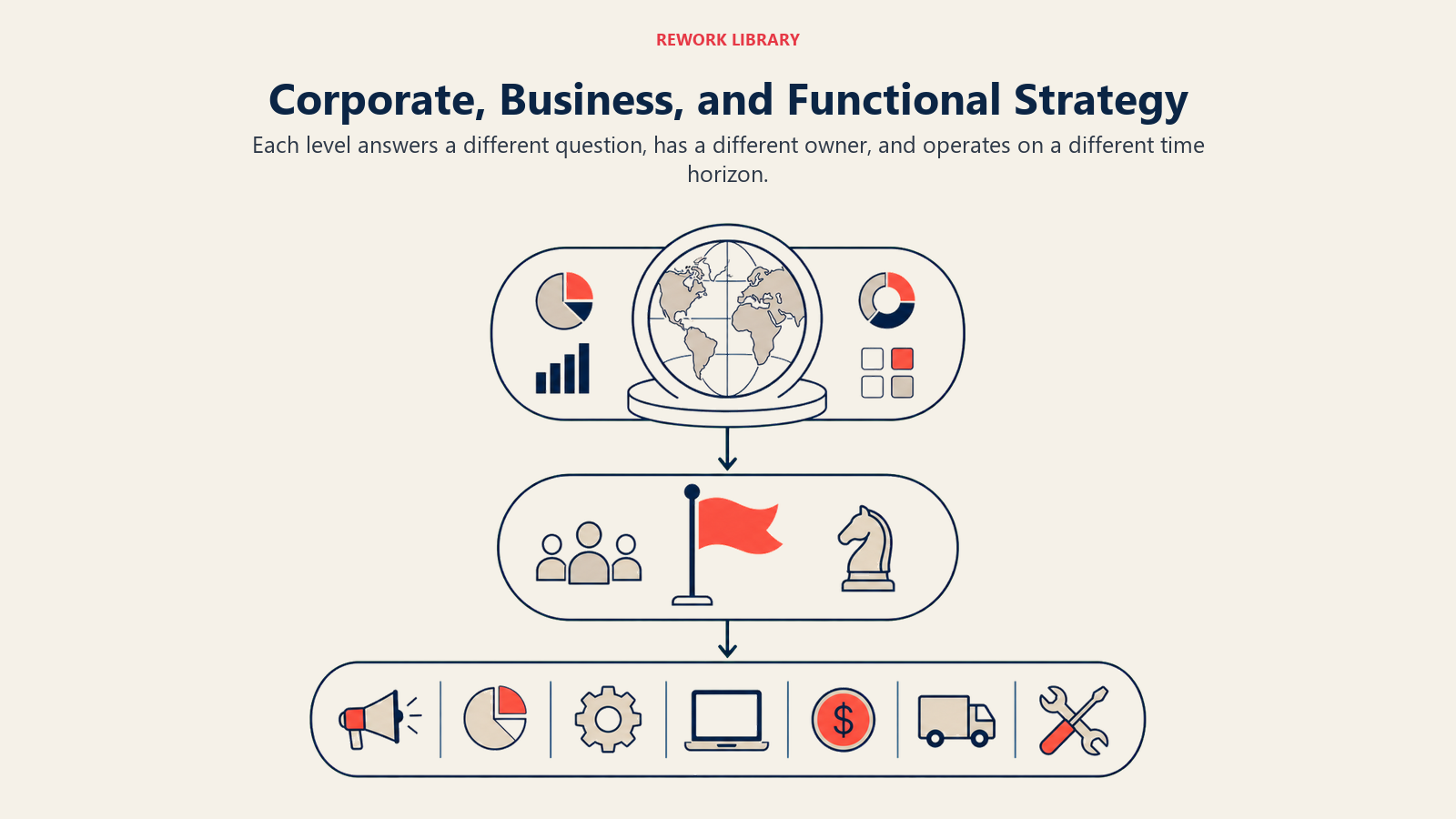
The levels of strategy are three distinct tiers of organizational decision-making: corporate strategy (what businesses to be in), business strategy (how to compete within each business), and functional strategy (how each department supports the competitive approach). Each level has a different scope, a different owner, and a different time horizon, but all three must reinforce each other for the organization to perform.
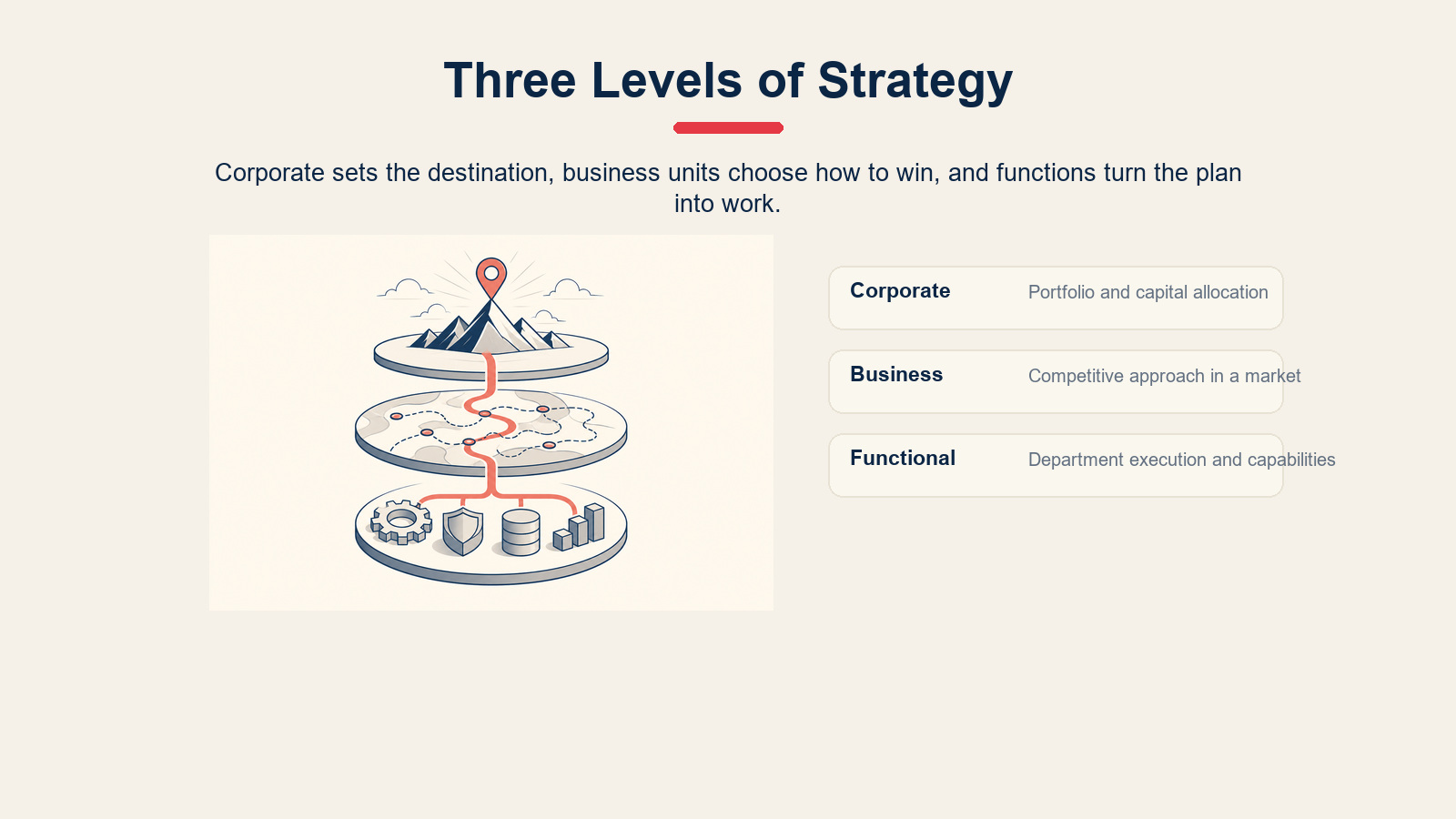
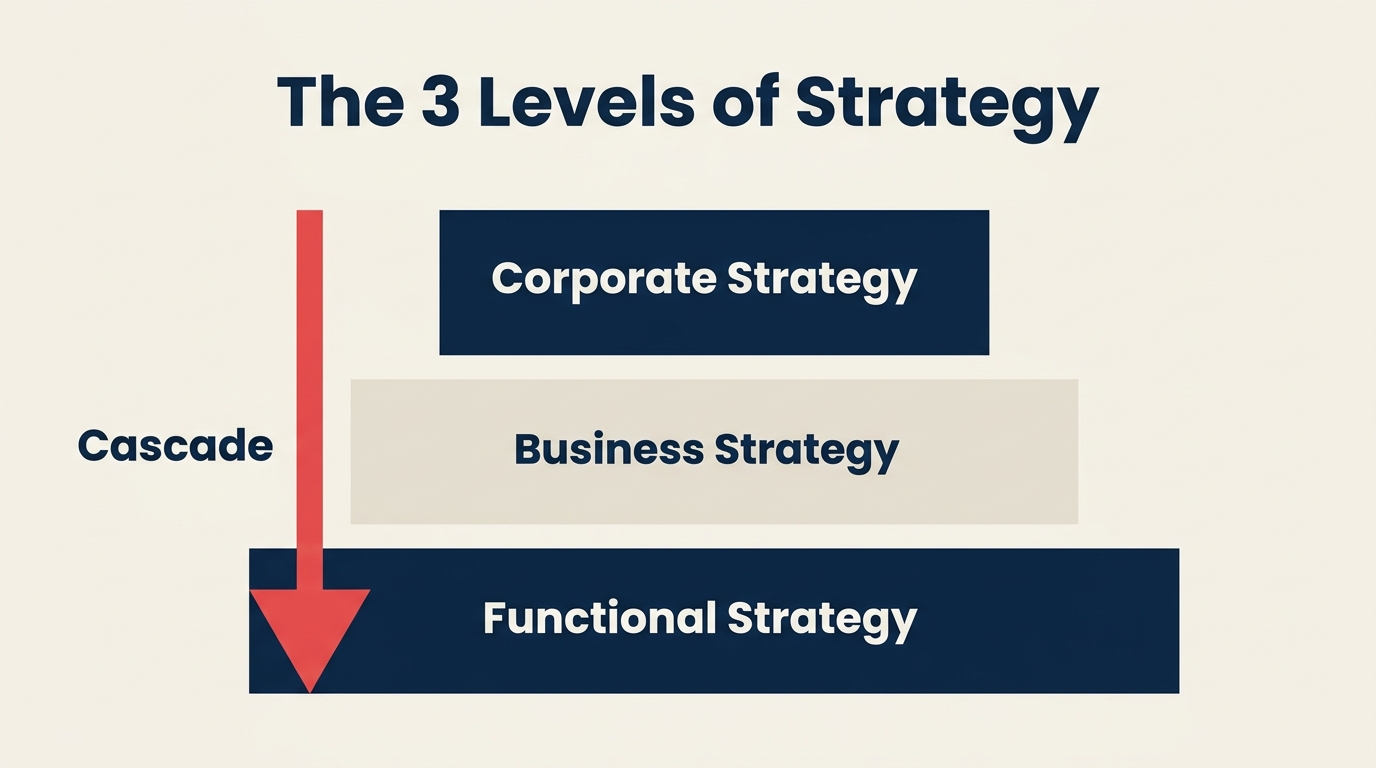
Think of them as a cascade: corporate sets the destination, business units chart the route, and functions handle the engine room. A gap at any level creates misalignment that compounds over time.
Key Facts
- Companies that align business-unit and corporate strategies achieve 24% higher revenue growth than those that don't, according to McKinsey research (2023).
- Only 28% of employees believe their company's strategy is clearly communicated to the people executing it, per a Gartner workforce survey (2022).
- Organizations with cross-functional strategy alignment are 2.1x more likely to exceed financial targets, according to a Deloitte Insights study (2023).
The Three Levels at a Glance
Here is how the three levels compare across the dimensions that matter most for practical planning:
| Level | Focus | Primary Owner | Time Horizon | Example Decision |
|---|---|---|---|---|
| Corporate | Which businesses to own and how to allocate capital | CEO, Board, C-Suite | 3 to 10 years | "We will acquire a logistics company to control our supply chain." |
| Business | How to compete and win within a specific market | Division head, BU President | 1 to 3 years | "We will differentiate on customer service, not price." |
| Functional | How each department executes the business strategy | VP of Marketing, VP of HR, etc. | 0 to 12 months | "We will hire 15 customer support reps and implement live chat by Q3." |
The levels are not just boxes on an org chart. Each one asks a fundamentally different strategic question, uses different data, and requires different skills to execute.
For a deeper look at the top layer, see Corporate Strategy.
Why the Levels of Strategy Matter
When the levels operate in silos, strategy becomes theater. Each tier produces compelling slide decks, but the actual work on the ground moves in a dozen different directions. Here is why the cascade matters in practice.
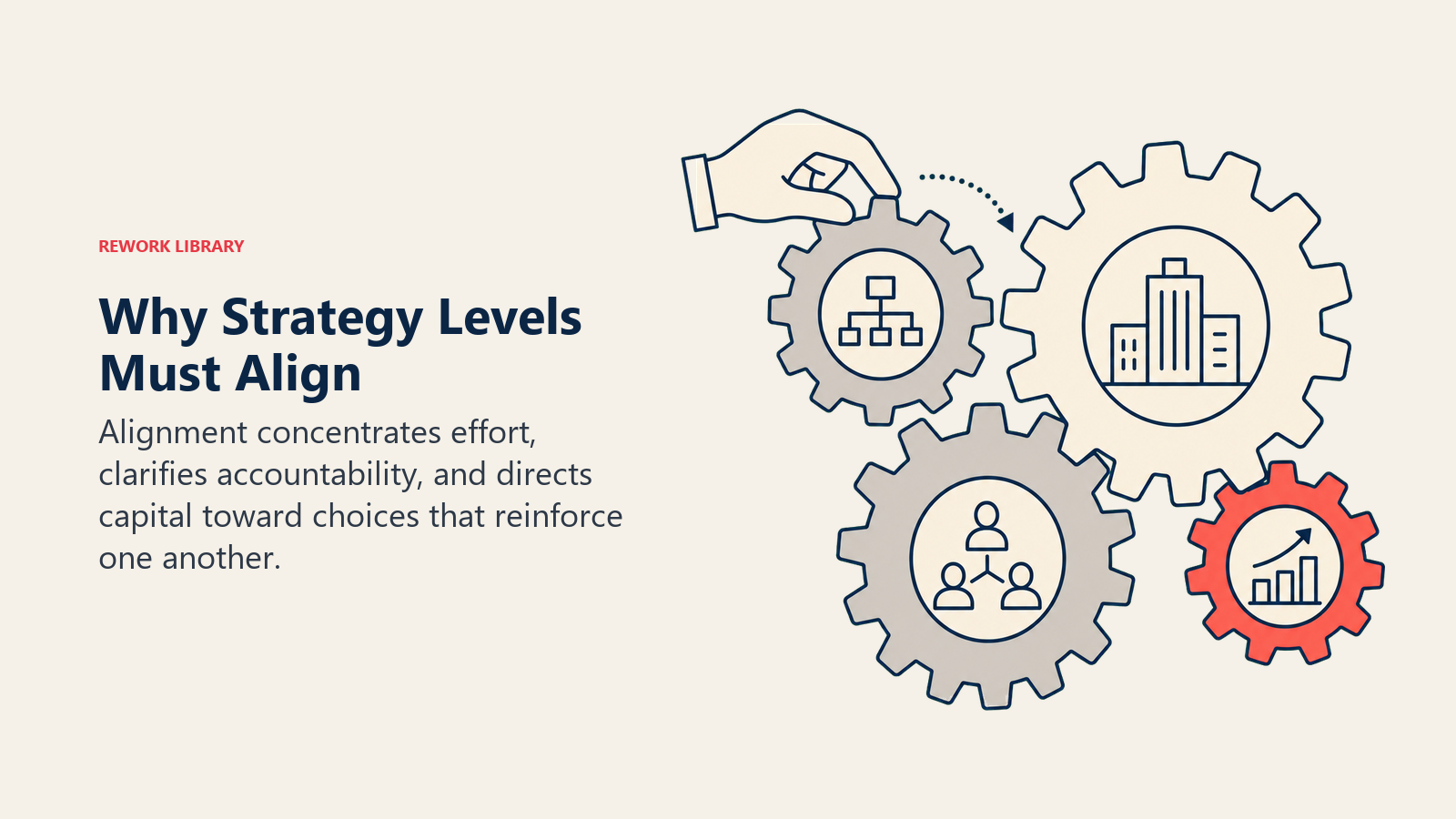
Alignment multiplies effort. A sales team running a volume-based incentive model will undercut a business strategy built around premium positioning. The conflict isn't visible in any single meeting, but it shows up in margin erosion and confused customers.
Accountability becomes cleaner. When each level has a defined scope, you can trace a poor outcome back to its source. Did the corporate portfolio choice limit competitive options? Did the BU strategy choose the wrong battleground? Did a function fail to execute? These are very different problems with very different fixes.
Resource allocation improves. Corporate strategy is, at its core, a resource allocation exercise. Capital, talent, and attention flow to the businesses that fit the portfolio logic. Without a clear corporate-level framework, resources get spread thin or directed by the loudest voice in the room.
The balanced scorecard and OKR framework are both tools designed specifically to translate upper-level strategy into functional-level execution. They work best when the underlying level structure is already clear.
Corporate Strategy: The Portfolio View
Corporate strategy answers the question: what should we be doing as an enterprise? It is not about beating a specific competitor. It is about deciding which arenas to compete in at all.
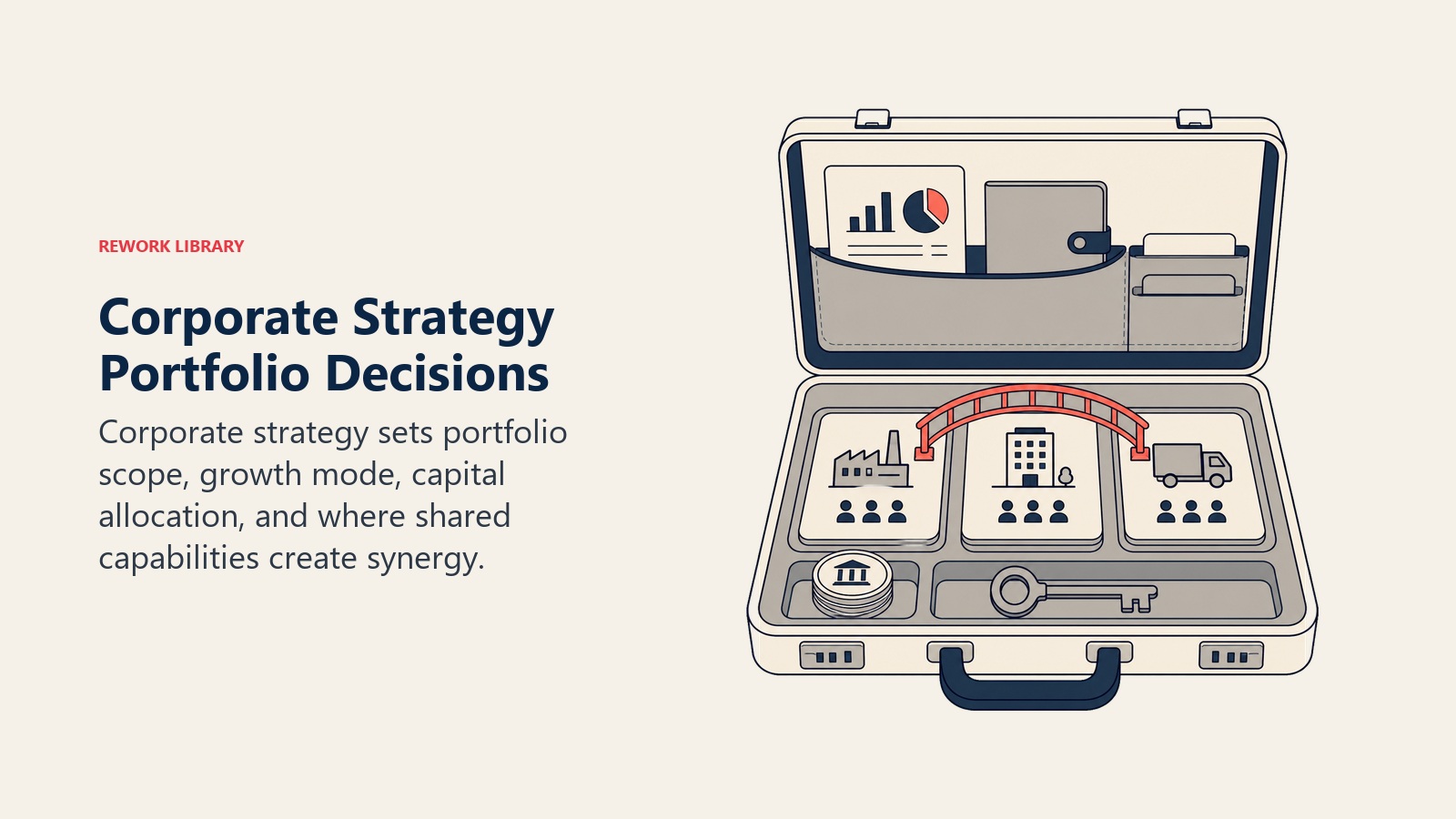
Key decisions at this level include:
- Portfolio scope: Which business units, products, or geographies to invest in, hold, or exit
- Growth mode: Whether to grow organically, through acquisition, or through partnerships
- Capital allocation: How to distribute budget, talent, and executive attention across the portfolio
- Synergy creation: Where business units can share resources, customers, or capabilities to create value that no single unit could capture alone
The Ansoff Matrix is a classic corporate-level tool for framing growth decisions across existing and new markets. Diversification strategy is a specific corporate-level choice with its own risk and return profile.
Business Strategy: The Competitive Approach
Business strategy asks: how do we win in the markets we've chosen? Each business unit operates in a specific competitive environment and needs its own answer to that question.
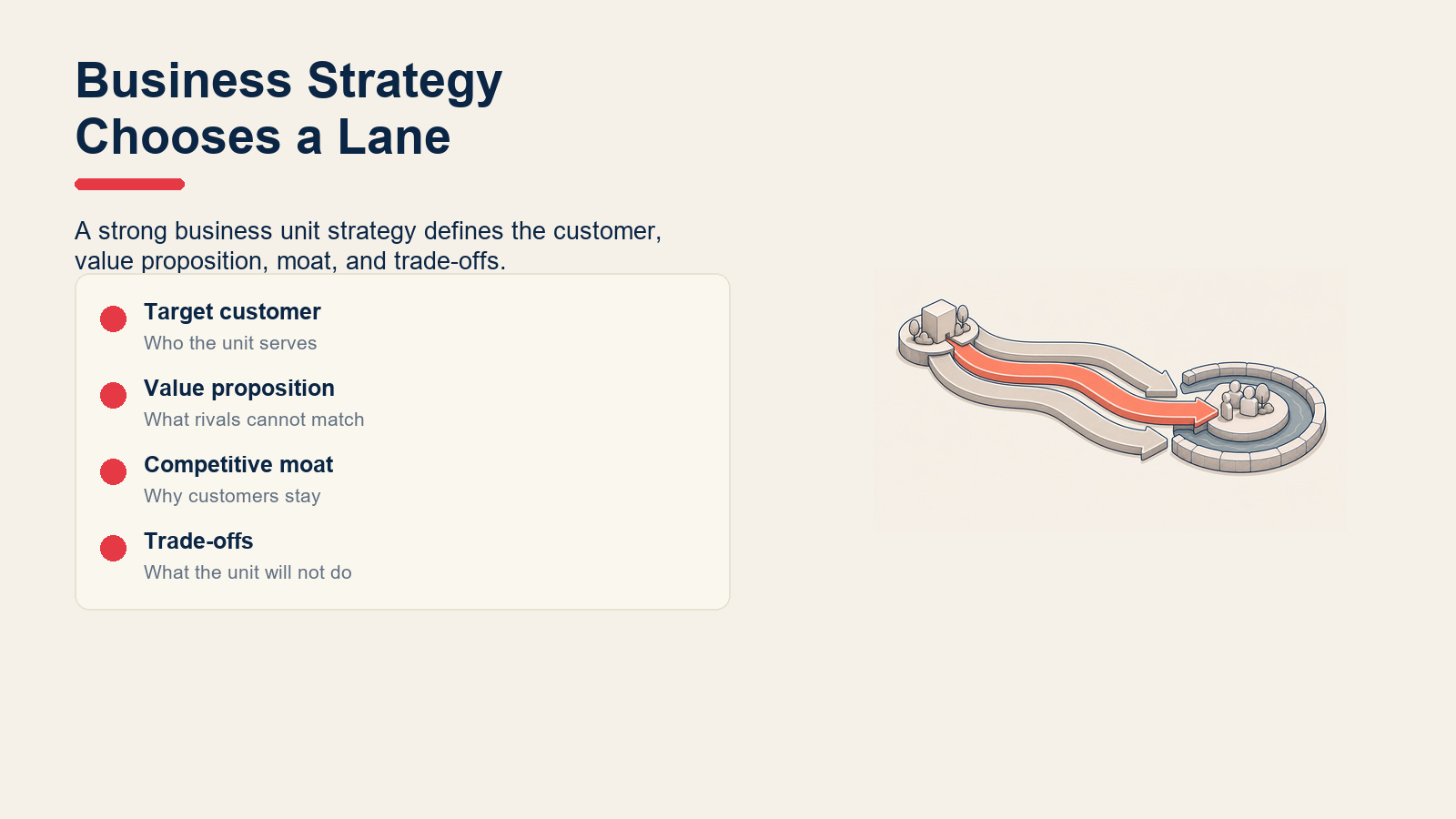
Michael Porter's competitive advantage framework and Porter's generic strategies are the most widely used models here. They push BU leaders to pick a lane: cost leadership, differentiation, or focus, rather than trying to be all things to all buyers.
A strong business strategy specifies:
- Target customer: Who exactly the unit is trying to serve, and who it is not
- Value proposition: What the unit offers that competitors don't or can't
- Competitive moat: Why customers will stay even when alternatives appear
- Key trade-offs: What the unit will deliberately NOT do in order to stay focused
Business strategy without a clear corporate mandate risks pursuing opportunities that don't fit the portfolio. Business strategy without clear functional alignment risks being a plan that only exists in presentations.
Functional Strategy: Where Plans Become Work
Functional strategy is where decisions finally hit the calendar. Each department takes the business strategy as its input and works out how its specific activities, budget, and people will support the competitive approach.
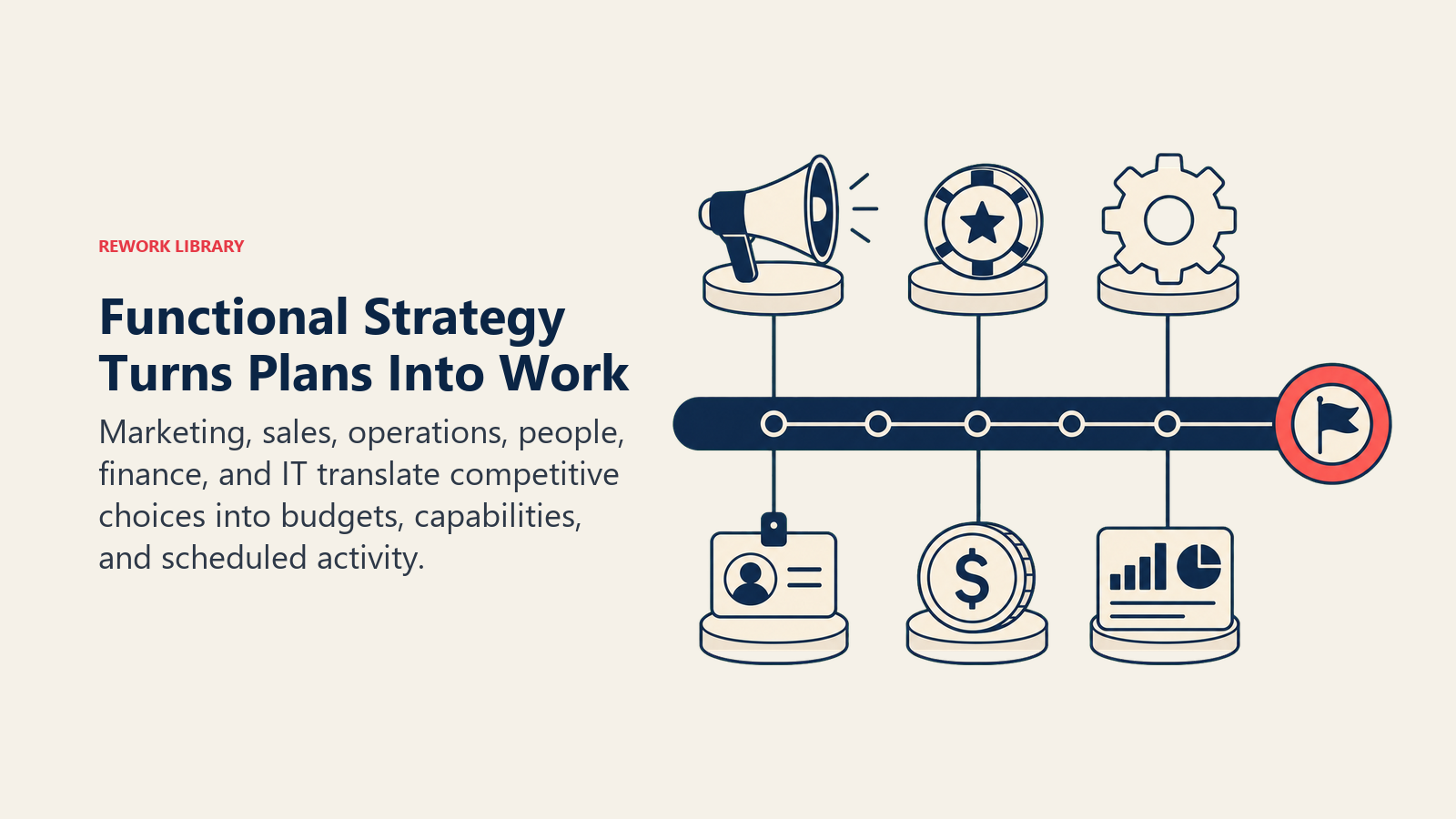
Common functional areas and their strategic contributions:
- Marketing: How to position, message, and generate demand in ways that reinforce the BU's differentiation
- Sales: Which segments to prioritize, which channels to build, and what the conversion model looks like
- Operations/Supply Chain: How to configure processes, capacity, and suppliers to deliver the value proposition at the right cost
- HR and People: What capabilities to hire, develop, and retain to support the strategy
- Finance: How to allocate budget and measure financial performance against strategic priorities
- IT: Which systems and data infrastructure to build or buy to enable execution
The McKinsey 7S Framework and core competencies models are useful at this level for stress-testing whether the organization's structure, culture, and skills actually match the stated strategy.
Common Mistakes
Even experienced leaders make predictable errors when working across the three levels. These are the most damaging ones.
Confusing levels. A CEO who spends most of their time on functional decisions is micromanaging. A marketing VP who tries to set portfolio strategy is overstepping. Each level requires a different cognitive mode, and leaders often default to the level where they feel most comfortable, not the one their role demands.
Strategy without cascade. A corporate strategy that never gets translated into BU-level competitive choices is just a vision statement. The cascade has to be explicit: here is what corporate decided, here is what that means for this business unit, here is what that means for your function.
Functional plans disconnected from business strategy. This is the most common failure. A product team builds features based on what's technically interesting. A marketing team pursues brand awareness when the BU strategy depends on direct sales velocity. No single decision seems wrong, but the pattern adds up to drift.
Over-planning at the functional level, under-planning at corporate. Organizations often produce elaborate departmental plans while leaving the corporate portfolio logic vague. The result is well-executed work pointed at the wrong destination.
Ignoring strategy-to-tactics separation. Strategy answers "where" and "why." Tactics answer "how" and "when." Mixing them at any level creates confusion about what is fixed (strategic intent) and what is flexible (execution approach). See Strategy vs Tactics for a full breakdown.
How to Align Strategy Across the Three Levels
Alignment doesn't happen automatically. It requires deliberate design and regular reinforcement. Here is a structured approach:
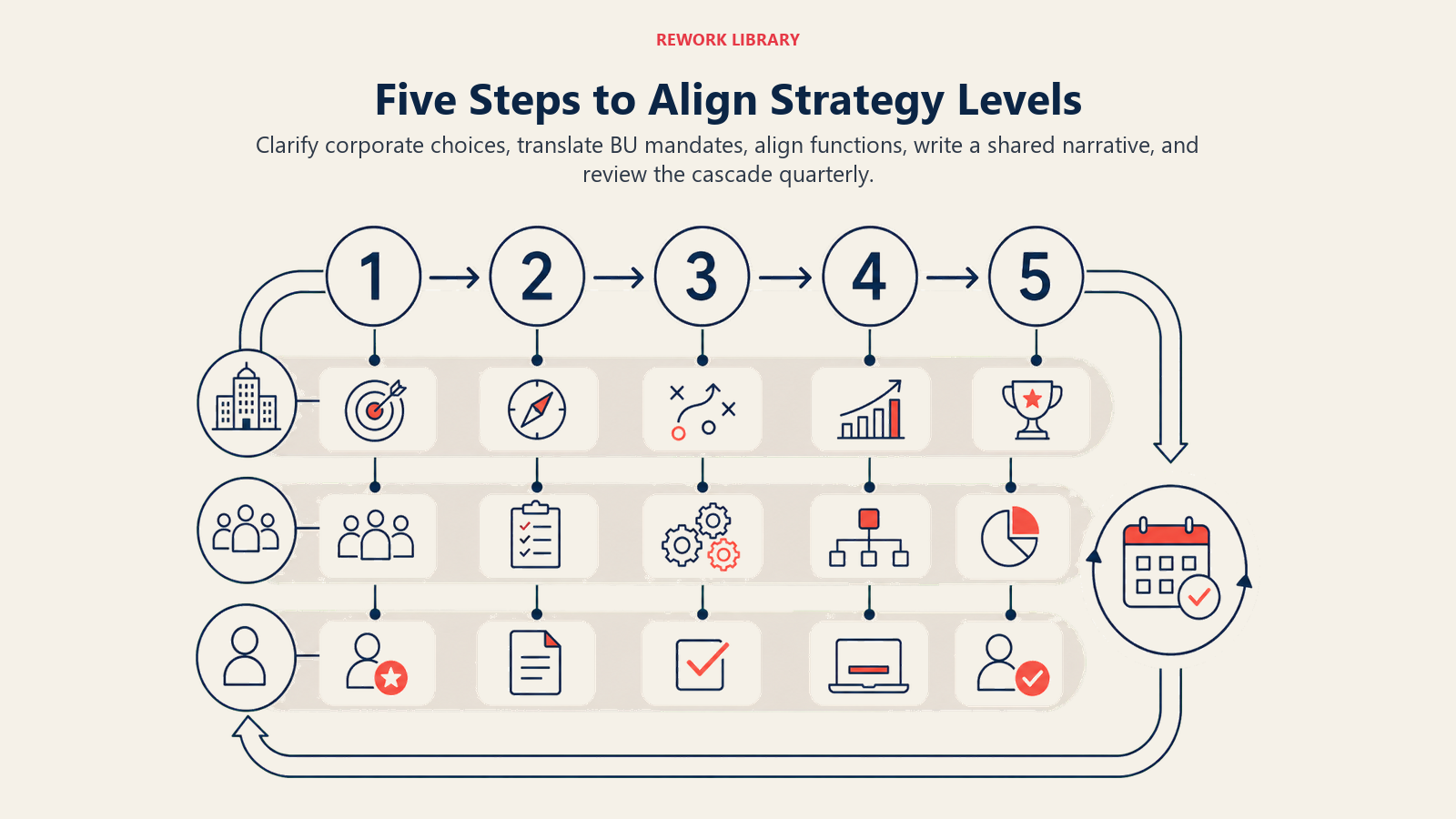
Step 1: Clarify Corporate Strategy First
Before business units or functions build plans, the corporate level must answer three questions: What businesses are we in? What is our basis for being in each? How do we allocate capital across them? If these answers are vague, every downstream level will fill the gaps differently.
Step 2: Translate Corporate Intent into BU Mandates
Each business unit should receive an explicit mandate from corporate: which markets to target, what financial expectations to meet, and what constraints apply (brand standards, shared services, capital limits). This mandate is the input that BU leaders use to build their competitive strategy.
Step 3: Run a Functional Strategy Session Anchored to the BU Plan
Once BU strategy is clear, gather functional leaders and work through the implications for each department. What does this strategy require from marketing? From operations? From HR? The goal is to surface conflicts early, before budget is locked and headcount is hired.
Step 4: Build a Shared Strategic Narrative
Write a one-page summary that traces the logic from corporate to business to functional for each major initiative. This is not a deck. It is a reference document that anyone in the organization can read to understand how their work connects to the company's direction. The OKR framework is one useful format for making this cascade visible.
Step 5: Review Alignment Quarterly, Not Annually
Markets shift, competitors move, and internal capabilities change. A quarterly review at each level, with explicit cross-level check-ins twice a year, catches misalignment before it compounds. The balanced scorecard is built for exactly this kind of structured review.
Levels of Strategy Example
Here is how a single company plays out across all three levels. Consider a mid-sized consumer electronics company called Apex Devices.
| Level | Strategic Question | Apex Devices' Answer |
|---|---|---|
| Corporate | What businesses are we in? | Consumer devices (70% of revenue) and enterprise IoT hardware (30%). We are exiting the PC accessories segment. |
| Business (Consumer Devices BU) | How do we compete? | Premium design-led differentiation for urban professionals, priced 20-30% above mass-market alternatives. We compete on brand and experience, not specs or price. |
| Functional (Marketing) | How does marketing support this? | Focus 80% of budget on lifestyle content and design press coverage. Drop performance ads targeting price-sensitive buyers. Build a creator partnership program. |
| Functional (Operations) | How does ops support this? | Reduce SKU count by 40% to concentrate manufacturing quality. Shift to a single contract manufacturer with design-grade quality standards. |
| Functional (HR) | How does HR support this? | Prioritize industrial design and UX hiring. Create a retention package for the top 15 engineers on the premium product line. |
Notice that each functional decision flows directly from the BU strategy, which flows from the corporate portfolio choice. None of these decisions makes sense in isolation. All of them make sense together.
Best Practices
- Write strategy at each level in plain language. If the strategy requires a consultant to interpret, it won't cascade.
- Give each level a distinct owner who is accountable for it. Shared ownership usually means no ownership.
- Use strategy tools that match the level. Ansoff and portfolio matrices work at corporate. Porter's frameworks work at business. OKRs and scorecards work at functional.
- Treat cross-level conflicts as signals, not noise. When a functional plan contradicts a business strategy, that's important information about an unrealistic strategy, not just a planning error.
- Revisit corporate strategy when the environment shifts significantly. Technology disruption, regulatory change, and competitor moves can invalidate a portfolio logic faster than the annual planning cycle.
Related Reading
- Corporate Strategy
- Strategy vs Tactics
- Competitive Advantage
- Porter's Generic Strategies
- Ansoff Matrix
- OKR Framework
Frequently Asked Questions about Corporate, Business, and Functional Strategy Explained
What is the difference between the three levels of strategy?
Corporate strategy decides which businesses to compete in and how to allocate resources across them. Business strategy determines how to win within a specific market or segment. Functional strategy defines how each department (marketing, operations, HR, finance) executes the business-level competitive approach. Each level has a different owner, scope, and time horizon.
Who is responsible for each level of strategy?
Corporate strategy is owned by the CEO and board, sometimes with input from a Chief Strategy Officer. Business strategy is owned by division or business unit presidents. Functional strategy is owned by department heads: VP of Marketing, VP of Operations, VP of HR, and similar roles. In small companies, one person often spans two levels, which can create confusion.
How often should each level of strategy be reviewed?
Corporate strategy typically holds for 3 to 5 years, with major reviews triggered by significant market shifts. Business strategy should be reviewed annually, with quarterly check-ins. Functional strategy is often reviewed quarterly, since tactics need to adapt faster than direction.
What happens when the levels of strategy are misaligned?
Misalignment produces wasted effort, internal conflict, and poor financial outcomes. A classic example: a BU pursues a premium positioning strategy while the sales function runs discount-heavy promotions. Each team believes it is doing its job correctly, but the combined effect confuses customers and erodes margins.
Can a small business use the three levels of strategy?
Yes, though the levels compress in smaller organizations. A founder often handles corporate and business strategy simultaneously. But even small teams benefit from separating portfolio questions (should we enter this market?) from competitive questions (how do we win here?) from execution questions (who does what by when?). The structure prevents the confusion that comes from treating every decision as equally strategic. The three levels of strategy are not a bureaucratic framework. They are a clarity tool. When each level knows its job and connects to the others, strategy stops being something that lives in a deck and starts being something the organization actually does.

Senior Operations & Growth Strategist
On this page
- What Are the Levels of Strategy?
- The Three Levels at a Glance
- Why the Levels of Strategy Matter
- Corporate Strategy: The Portfolio View
- Business Strategy: The Competitive Approach
- Functional Strategy: Where Plans Become Work
- Common Mistakes
- How to Align Strategy Across the Three Levels
- Step 1: Clarify Corporate Strategy First
- Step 2: Translate Corporate Intent into BU Mandates
- Step 3: Run a Functional Strategy Session Anchored to the BU Plan
- Step 4: Build a Shared Strategic Narrative
- Step 5: Review Alignment Quarterly, Not Annually
- Levels of Strategy Example
- Best Practices
- Related Reading