OKR Framework: How to Write Objectives and Key Results (Examples + Template)
Turn this article into takeaways for your work.


Each assistant summarizes the article only for you and suggests best practices for your work.
Most companies have a strategy deck. Very few can recite it on a Wednesday morning. The OKR framework (Objectives and Key Results) fixes that gap by turning high-level strategy into short-cycle commitments every team can name, track, and actually care about.
What is the OKR framework?
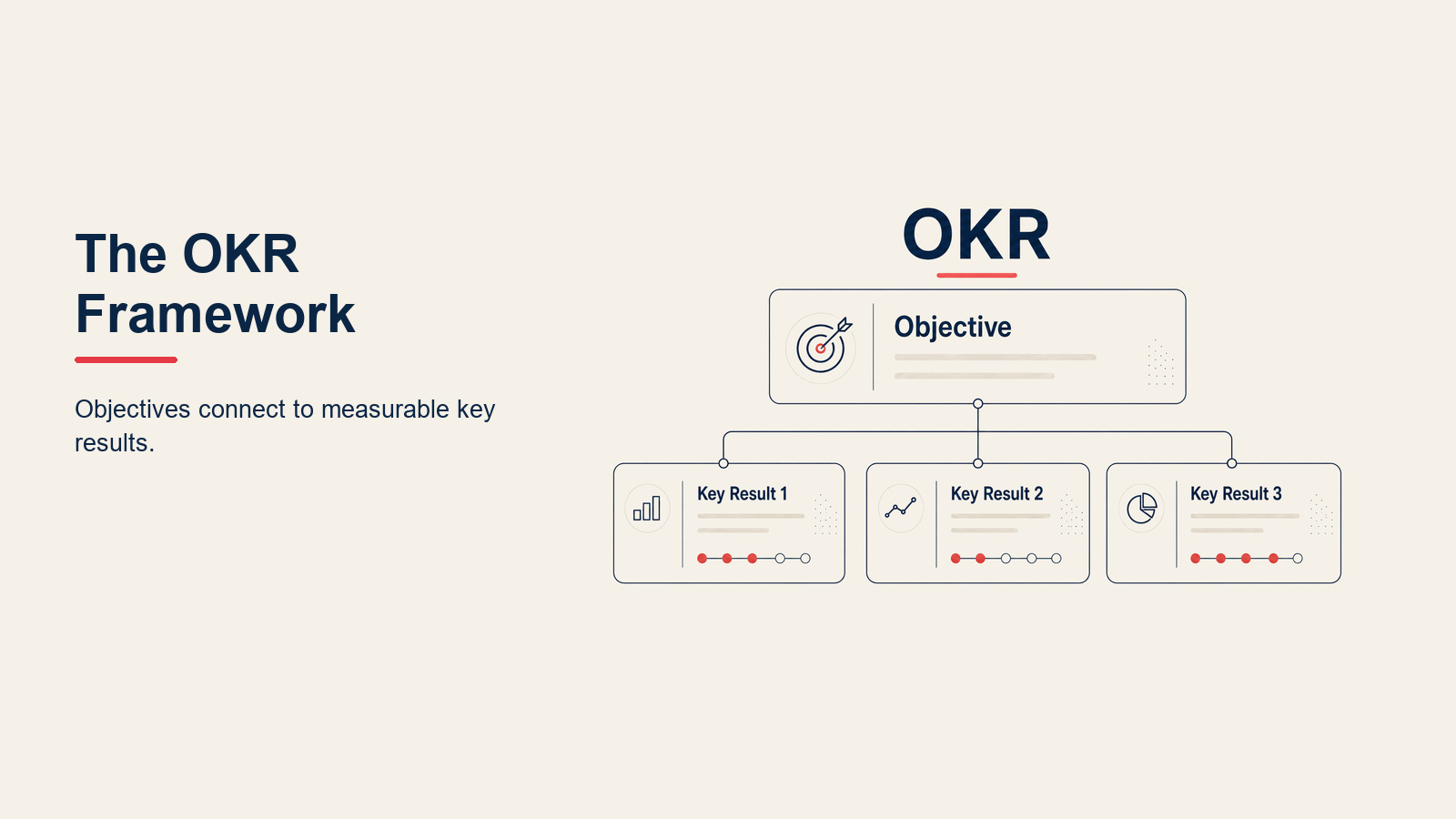
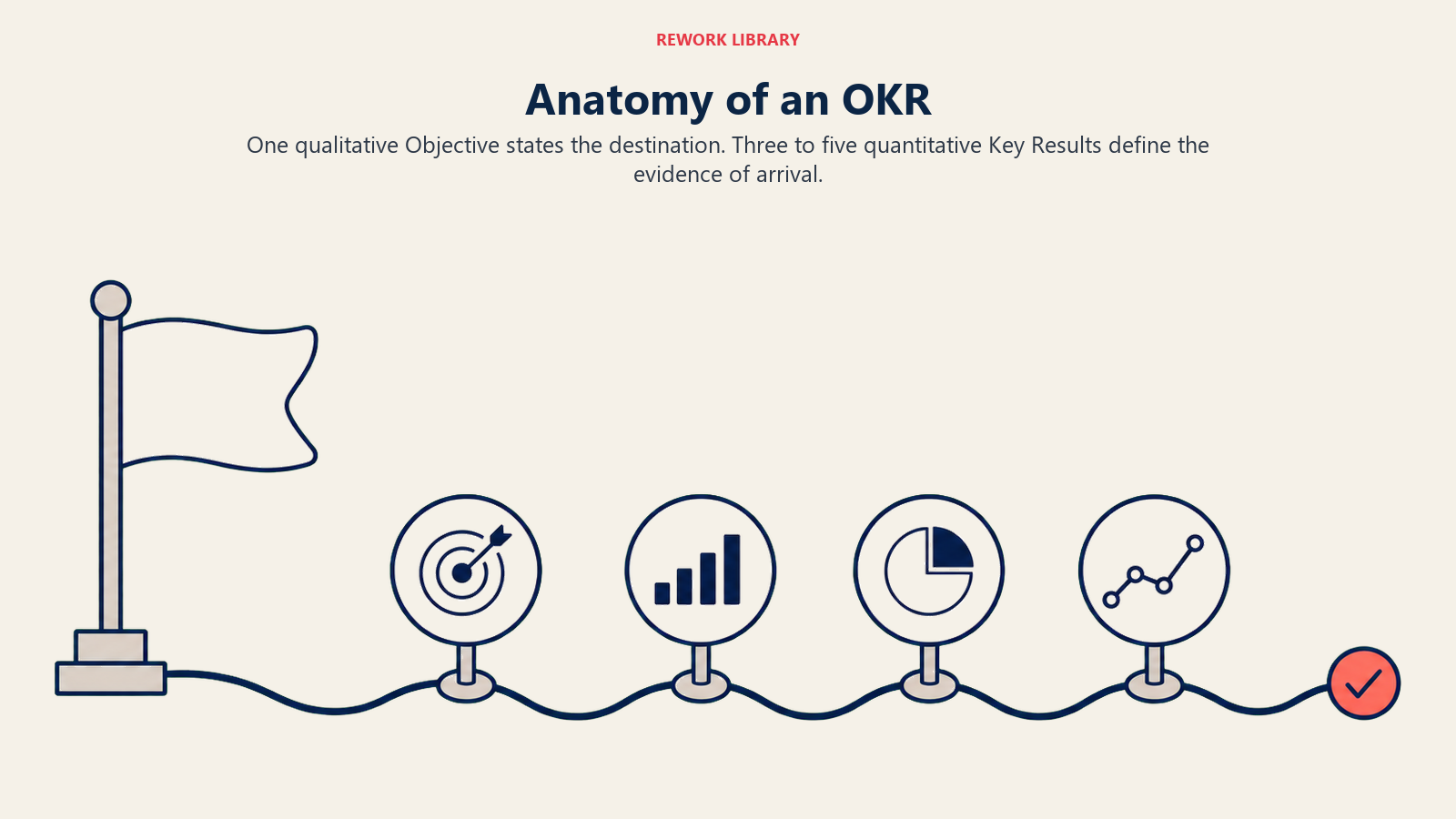
The OKR framework is a goal-setting and execution system that pairs a qualitative Objective (what you want to achieve) with three to five quantitative Key Results (how you'll measure progress toward that goal). Objectives are aspirational and direction-setting. Key Results are numbered, falsifiable, and time-bound.
The method was created by Andy Grove at Intel in the 1970s as a refinement of Peter Drucker's Management by Objectives (MBO). In 1975, Grove taught the system to a young venture capitalist named John Doerr. In 1999 Doerr walked into Google's offices in Mountain View and introduced OKRs to a 30-person company. His 2018 book, Measure What Matters (Penguin Portfolio), turned that story into the canonical playbook read by tens of thousands of management teams.
Today OKRs are used at Google, Intel, LinkedIn, Spotify, Twitter, and thousands of companies well outside Silicon Valley.
Key Facts
- Andy Grove introduced the iMBO (Intel Management by Objectives) method in the late 1970s and documented it in High Output Management (Random House, 1983). That book is the original source text for OKRs.
- John Doerr brought OKRs to Google in Q4 1999. In Measure What Matters (Penguin Portfolio, 2018), Doerr writes: "OKRs surface your primary goals. They channel effort and coordination. They link diverse operations to the overall mission." (p. 8)
- A 2023 Workboard survey of 400 enterprise leaders found that 83% of respondents whose organizations use OKRs reported better cross-functional alignment than those using traditional annual goal-setting approaches alone.
The anatomy of an OKR
Every OKR has exactly two parts. Understanding what each part does, and what it doesn't do, is the difference between a system that energizes teams and one that generates busy paperwork.
Objective
An Objective is qualitative, inspirational, and time-bound. It answers the question: what do we want to achieve this quarter? It should be short enough to remember without notes, ambitious enough to make people want to show up, and specific enough to rule things out.
Good Objectives have an emotional pull. "Become the most trusted payments provider in Southeast Asia" works. "Improve customer satisfaction" doesn't, because it could mean anything and motivates nobody.
One test: can a new team member read your Objective and immediately understand what winning looks like? If not, rewrite it.
Key Result
A Key Result is quantitative, outcome-based, and measurable without judgment. It answers the question: how will we know we've reached the Objective? Good Key Results describe a change in state, not a list of activities.
"Launch three new marketing campaigns" is a task, not a Key Result. "Grow qualified pipeline from $2M to $4M" is a Key Result, because it describes an outcome you can measure.
Each Objective should have three to five Key Results. Fewer than three and you probably haven't defined the Objective clearly enough. More than five and your team is managing a spreadsheet instead of a strategy.
Worked example:
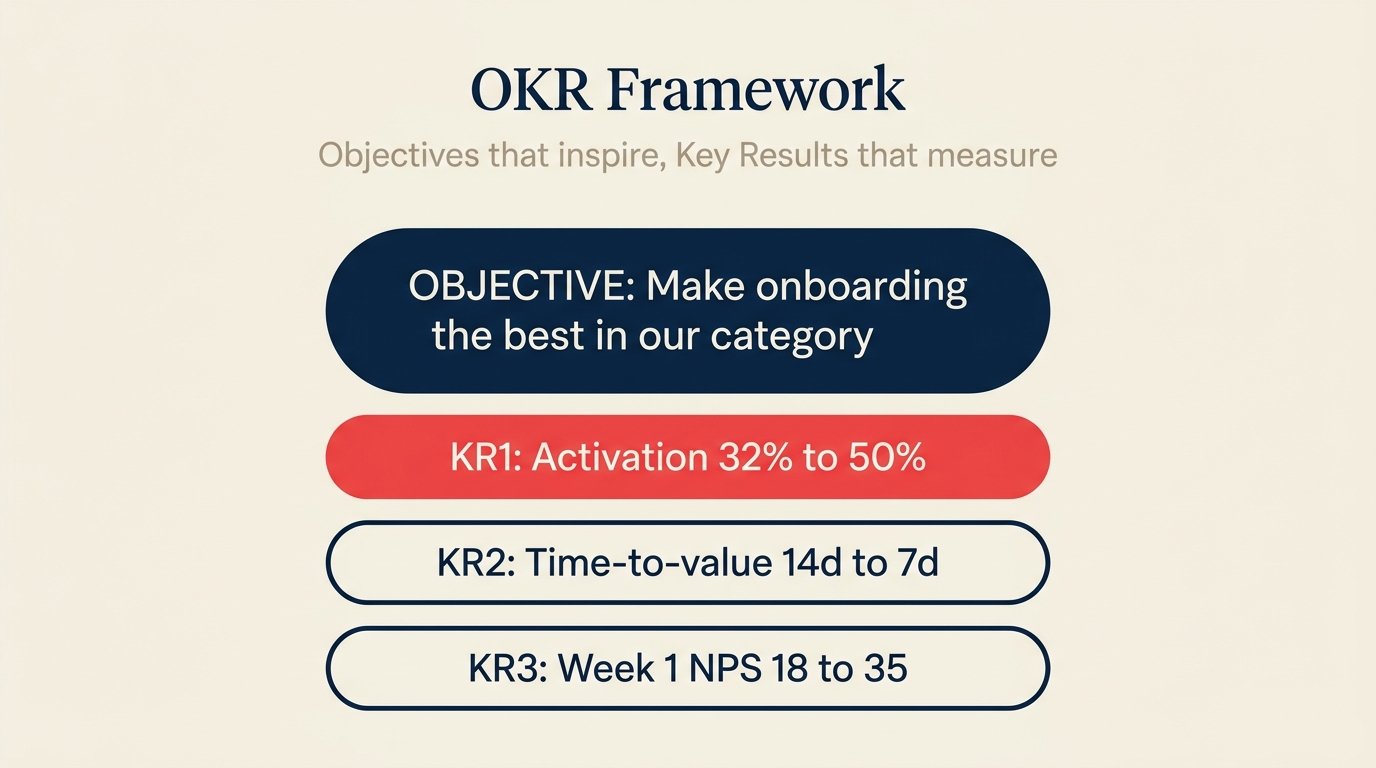
- Objective: Make our onboarding the best in our category.
- KR1: Lift activation rate from 32% to 50% by end of quarter.
- KR2: Reduce time-to-first-value from 14 days to 7 days.
- KR3: Raise Net Promoter Score for week-1 users from 18 to 35.
Notice that none of the Key Results tell the team how to achieve the goal. That's deliberate. The team decides the how. The OKR defines the what and the measure.
OKR scoring: the 0.0 to 1.0 system
Google grades OKRs on a 0.0 to 1.0 scale. The target is not 1.0. A score of 0.6 to 0.7 is considered a healthy result for stretch OKRs, because if you're consistently hitting 1.0, your goals weren't ambitious enough.
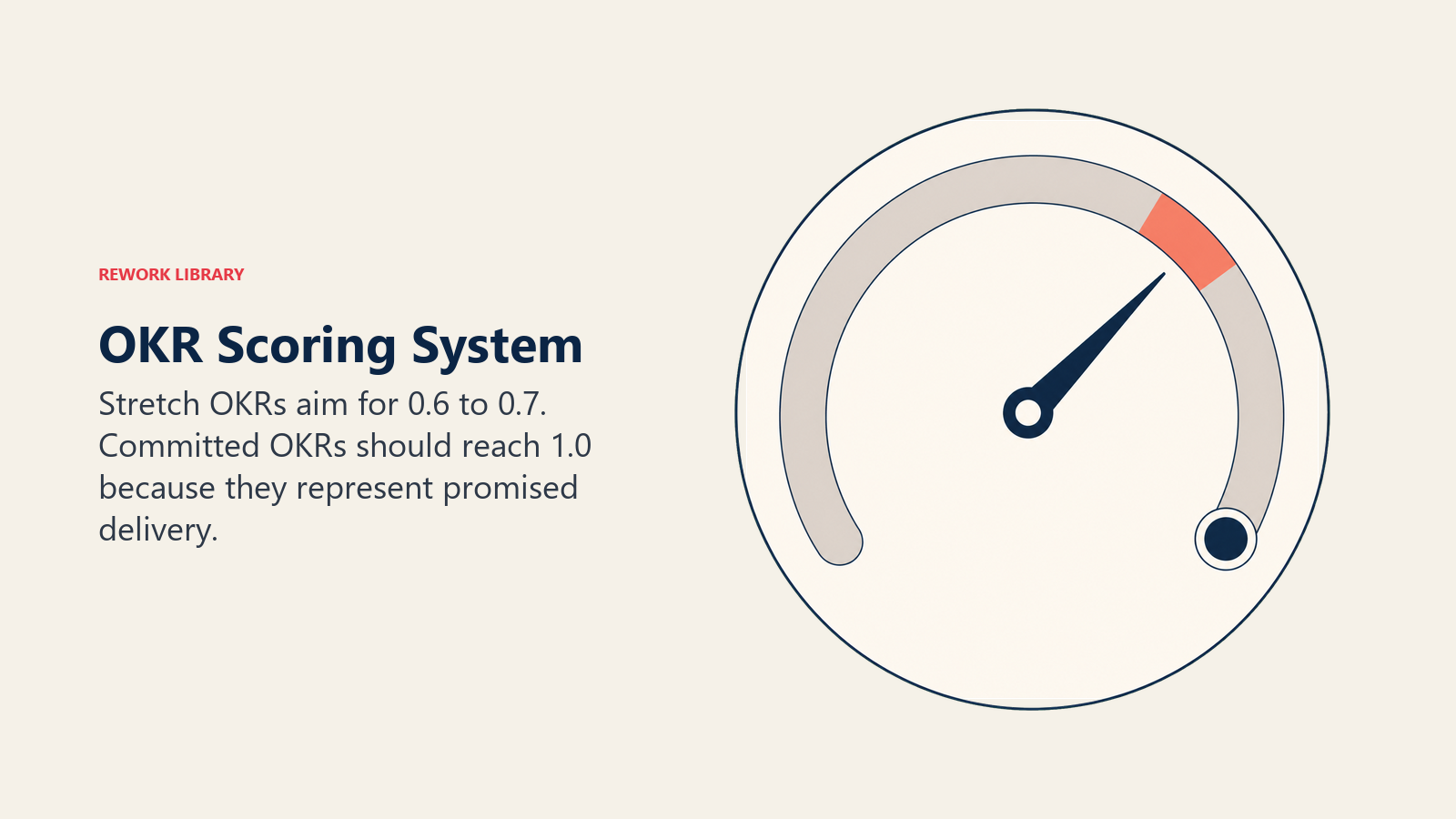
There's an important distinction between stretch OKRs (aspirational goals where 0.6 to 0.7 is a win) and committed OKRs (operational commitments that must reach 1.0, like "migrate 100% of customers to the new data center by March 31").
| Score | Meaning | Typical action |
|---|---|---|
| 0.0 to 0.3 | We barely started or badly missed | Root-cause review; was the goal wrong or the execution? |
| 0.4 to 0.6 | Meaningful progress, fell short | Inspect blockers; carry forward or revise |
| 0.7 | Target zone for stretch OKRs | Celebrate progress; raise the bar next quarter |
| 0.8 to 1.0 | Exceptional, or goal was too safe | Verify the goal was ambitious; don't penalize 1.0 but probe it |
Scores should not be linked to compensation. When bonuses ride on OKR scores, teams sandbag. We'll come back to that.
OKR cascade: company, team, individual
OKRs work at three levels: company, team (or department), and individual. But "cascade" doesn't mean the CEO hands down goals and everyone else fills in their own version. It means alignment, and alignment runs in both directions.
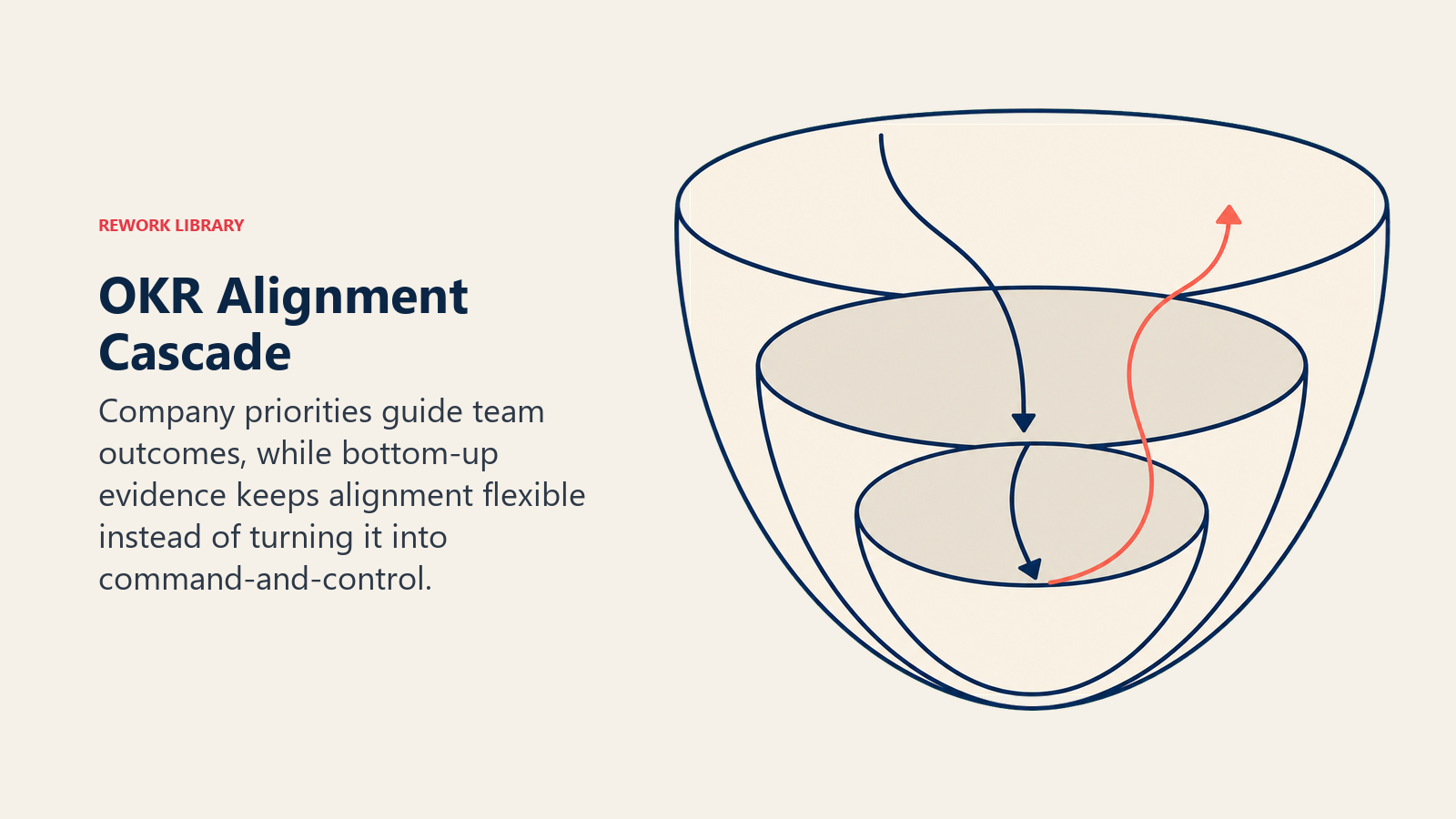
Top-down: Company OKRs define what the organization is trying to achieve this quarter. Teams write their own OKRs that contribute to those company-level bets. If the company Objective is "Become the #1 choice for mid-market CFOs," the Finance Product team's Objective might be "Ship the features CFOs tell us they can't live without."
Bottom-up: Teams often surface their own OKRs first, and leadership sees whether they naturally point toward company priorities. If they don't, that's a signal, not a correction order. Good OKR conversations surface misalignment early, when it's cheap to fix.
Not every individual needs personal OKRs. In many organizations, individual contributors are most effective contributing directly to their team's OKRs rather than maintaining a separate personal set. Force-fitting OKRs to every individual layer often creates measurement overhead without strategic benefit.
The goal is alignment without rigidity. A team that understands the company's three priorities will make better daily decisions, even without a formal cascade chart on the wall.
OKR examples by function
These examples follow the format: one Objective with three Key Results. Use them as starting points, not templates to copy word-for-word.
Marketing
| Objective | Make our content the go-to resource for sales leaders in our category |
| KR1 | Grow organic search sessions from 45K to 80K per month |
| KR2 | Increase newsletter subscribers from 8,000 to 15,000 |
| KR3 | Generate 200 qualified inbound leads from content channels |
Sales
| Objective | Build the most productive outbound motion in our company history |
| KR1 | Increase qualified meetings booked from 40 to 70 per month |
| KR2 | Reduce average sales cycle from 62 days to 45 days |
| KR3 | Close $1.8M in new ARR, up from $1.1M last quarter |
Product
| Objective | Deliver a mobile experience users prefer over desktop |
| KR1 | Raise mobile DAU from 12% to 28% of total active users |
| KR2 | Reduce mobile session crash rate from 4.2% to below 1% |
| KR3 | Lift mobile feature adoption score from 31 to 55 |
Engineering
| Objective | Ship with confidence, not crossed fingers |
| KR1 | Achieve 95% CI pass rate (up from 78%) |
| KR2 | Reduce mean time to recovery from 4 hours to under 45 minutes |
| KR3 | Increase test coverage on core payment flows from 60% to 90% |
Customer Success
| Objective | Turn customers into advocates before their first renewal |
| KR1 | Lift 90-day NPS from 22 to 45 |
| KR2 | Reduce time-to-first-value from 21 days to 10 days |
| KR3 | Increase expansion revenue from existing accounts by 25% |
The quarterly OKR cadence
OKRs live on a quarterly clock. The rhythm is what makes the framework work; without it, you get annual goals with a new acronym.
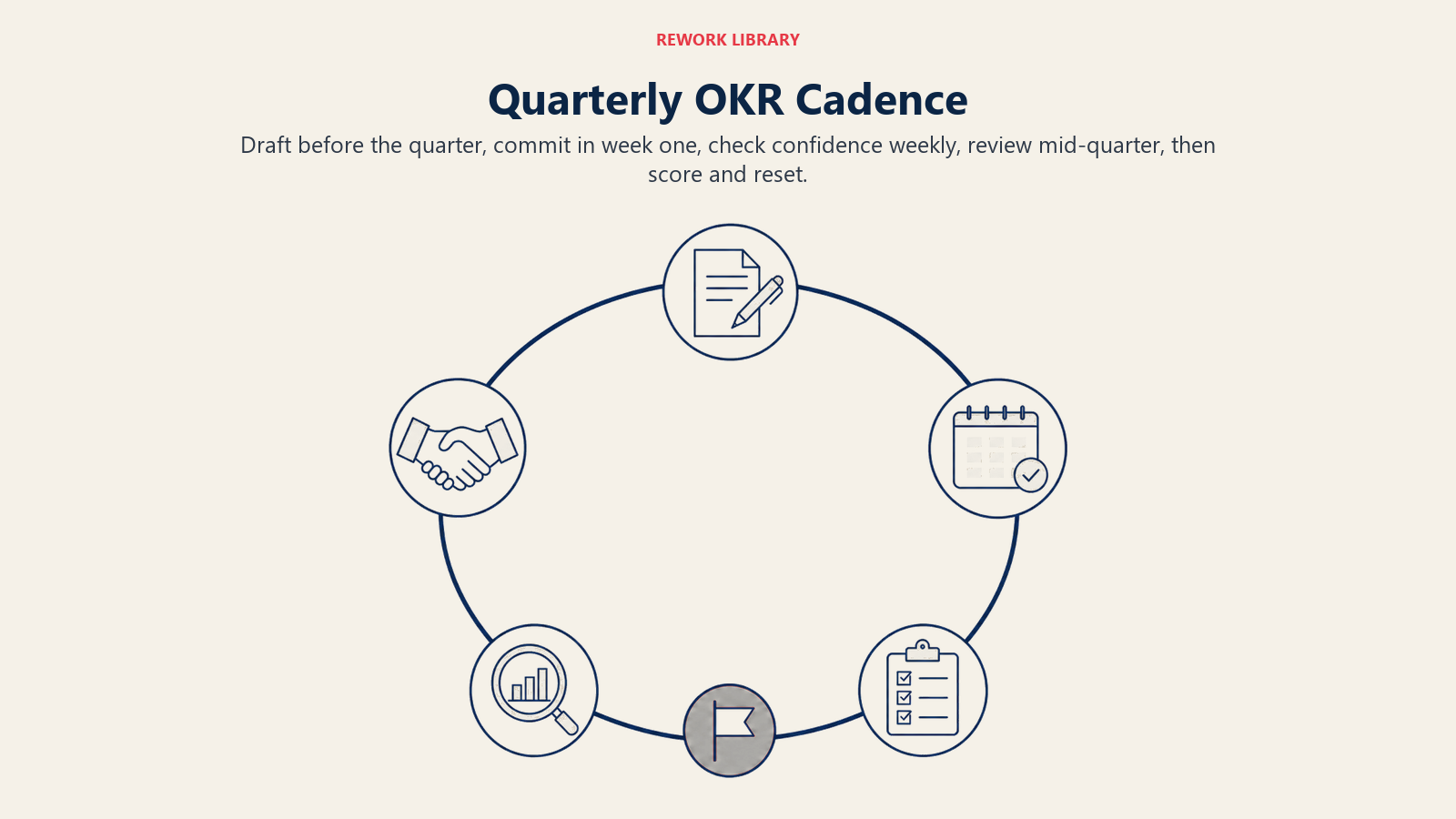
Weeks 11 to 12 of the prior quarter: Draft the next quarter's OKRs. Don't wait until the new quarter starts. Use the final two weeks of the current quarter to write, discuss, and pressure-test next quarter's goals while you're still in the thick of current execution.
Week 1 of new quarter: Publish and commit. Every team presents their OKRs. Leadership confirms alignment. Adjustments happen now, not in week six.
Weeks 2 to 12 (weekly check-ins): Brief, lightweight updates. Not a status report meeting. The question is: "What's your confidence score on each KR, and what do you need to move it?" Teams track progress in a shared tool, not via email chains.
Week 6 (mid-quarter review): A structured look at scoring trajectory. If a KR is at 0.2 at mid-quarter, either the approach changes now or the team consciously accepts missing it. This review prevents the end-of-quarter surprise.
Week 13 (score and retrospective): Score every KR from 0.0 to 1.0. Discuss what drove results and what didn't. Close the quarter intentionally. Don't roll OKRs forward automatically without a reset conversation.
The quarterly cadence creates a feedback loop that annual planning never can. You learn fast, correct fast, and build a compounding organizational memory about what actually moves the needle.
OKRs vs KPIs vs MBOs
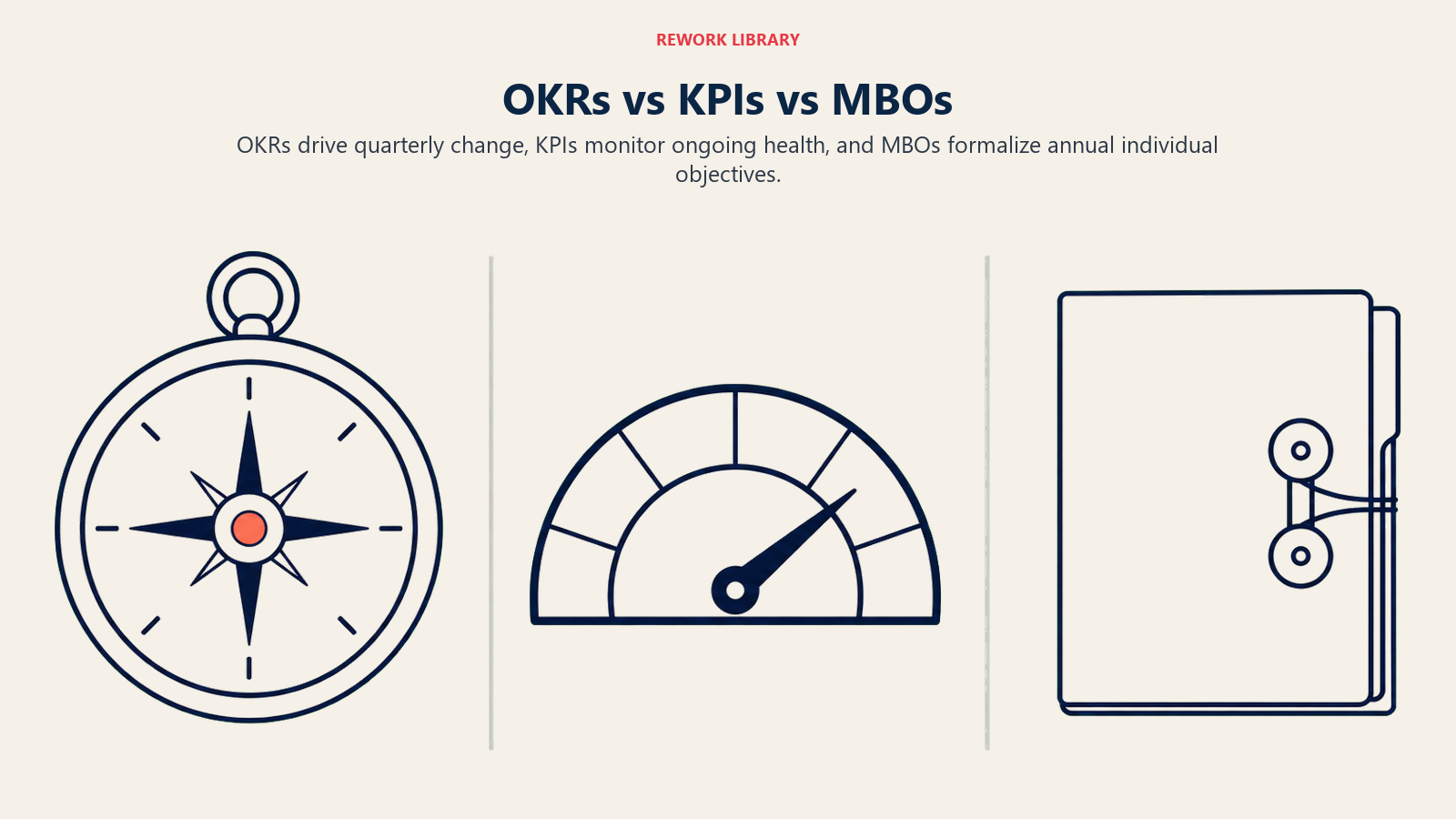
Leaders often ask how OKRs relate to the other goal systems they already know. They're complementary, not competing.
| Framework | Created by | Focus | Time horizon | Scoring | Best for |
|---|---|---|---|---|---|
| OKR (Objectives and Key Results) | Andy Grove, Intel, 1970s | Ambitious directional goals | Quarterly | 0.0 to 1.0, stretch target 0.7 | Aligning teams around company priorities |
| KPI (Key Performance Indicator) | Management accounting tradition | Ongoing operational health | Continuous | Green/amber/red thresholds | Monitoring business-as-usual metrics |
| MBO (Management by Objectives) | Peter Drucker, 1954 | Individual performance agreements | Annual | Pass/fail or rated scale | Formal performance reviews and comp decisions |
KPIs and OKRs often coexist. Your KPI dashboard tracks whether the business is healthy. OKRs define what you're trying to improve this quarter. If revenue is a KPI you monitor always, "Grow enterprise ARR from $5M to $7M" could be a Key Result inside an OKR this quarter.
For a deeper look at how to set measurable targets before you write your first OKR, SMART business objectives is a useful pre-read: the specificity and measurability criteria from SMART translate directly into well-written Key Results.
Common OKR mistakes
Most OKR programs fail in the first two quarters. The cause is almost always one of these six patterns.
Sandbagging the Key Results. When OKRs feed into compensation, people write goals they know they'll hit. Stretch goals vanish. The fix is to formally separate OKRs from bonuses.
Writing Key Results as tasks. "Launch the new pricing page" is a task. "Increase trial-to-paid conversion from 8% to 14%" is a Key Result. If your KR starts with a verb like "launch," "build," or "complete," it's probably a task in disguise.
Too many OKRs. Three company OKRs with three to five Key Results each is a maximum for most organizations. Five company OKRs with five KRs each is 25 things you're supposedly prioritizing equally. Nothing is prioritized.
No weekly check-ins. OKRs written in week one and reviewed in week thirteen aren't OKRs. They're aspirations. Weekly progress conversations are what turns a goal into a habit.
Tying OKRs directly to bonuses. Doerr is explicit about this in Measure What Matters: link OKRs to compensation and you'll get sandbagged goals, gaming, and political fights over scoring. Use OKRs for direction and KPIs or separate performance criteria for comp.
Copying Google's culture wholesale. Google's OKR culture took 20 years to develop. A 40-person SaaS company pasting Google's exact OKR process on top of a very different operating model will find the friction immediately. Start simpler: one Objective per team, three Key Results, a weekly check-in. Evolve from there.
OKR template (copy this)
Use this structure for any team's quarterly OKRs. Fill in the blanks; leave nothing as "TBD" when you commit at week one.
QUARTER: Q[n] [Year]
TEAM: [Team name]

OBJECTIVE 1: [Short, inspiring, qualitative goal, 10 words or fewer]

  KR1: [Metric] from [baseline] to [target] by [end of quarter]
  KR2: [Metric] from [baseline] to [target] by [end of quarter]
  KR3: [Metric] from [baseline] to [target] by [end of quarter]

OBJECTIVE 2 (optional): [Short, inspiring, qualitative goal]

  KR1: [Metric] from [baseline] to [target] by [end of quarter]
  KR2: [Metric] from [baseline] to [target] by [end of quarter]
  KR3: [Metric] from [baseline] to [target] by [end of quarter]

---
SCORING GUIDE:
  0.6 to 0.7 = target zone for stretch OKRs
  1.0         = target for committed/operational OKRs
  Below 0.4   = root-cause review required

END-OF-QUARTER NOTES:
  - What drove results?
  - What would we do differently?
  - What rolls forward vs. closes?
OKRs don't make strategy easier. They make its absence impossible to hide. A team that can write a sharp Objective and three honest Key Results already understands what it's trying to do and why. That clarity, built and rebuilt every quarter, is where execution actually starts.
For frameworks that feed into OKR-setting, explore how PESTEL analysis surfaces the external forces shaping your priorities, how Porter's Five Forces reveals competitive pressures worth building OKRs around, and how the Ansoff Matrix helps you choose which growth bet to make your Objective this quarter. If you're choosing which markets or products to double down on, the BCG Matrix and Business Model Canvas give you the map before you set the destination.

Senior Operations & Growth Strategist