Kotter's 8-Step Change Model Explained (With Examples)
Turn this article into takeaways for your work.


Each assistant summarizes the article only for you and suggests best practices for your work.
Kotter's 8-step change model is one of the most widely used frameworks for leading organizational transformation, and for good reason: most change initiatives fail not because the strategy is wrong, but because the people side is ignored. This guide breaks down each step, compares it to other models, and shows you how to apply it in a real-world context.
What Is Kotter's 8-Step Change Model?
Kotter's 8-step change model is a structured framework for planning and executing organizational change. It was introduced by Dr. John Kotter, a professor at Harvard Business School, first in his 1995 Harvard Business Review article "Leading Change: Why Transformation Efforts Fail" and then expanded into his 1996 book Leading Change.
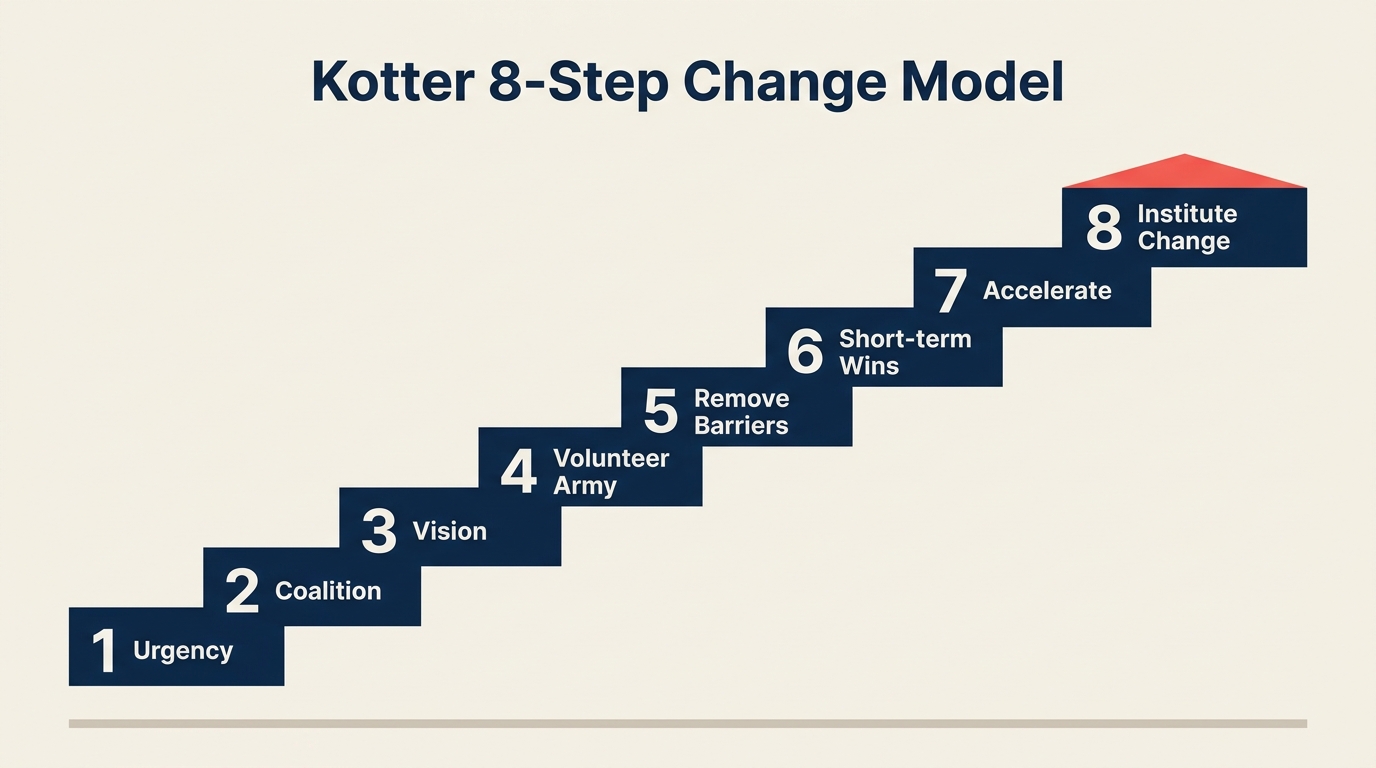
The model argues that successful change is less about installing new systems and more about shifting mindsets, behaviors, and culture. Kotter identified eight sequential stages that organizations must move through to make change stick. Skip one, and you risk the whole initiative unraveling.
The framework has been applied across industries, from healthcare systems overhauling patient records to manufacturers adopting lean production. It's particularly strong for top-down, large-scale transformations where leadership alignment and employee buy-in are the real bottlenecks.
Key Facts
- John Kotter's research, published in his 1995 HBR article, found that 70% of major change efforts fail to achieve their goals (HBR, "Leading Change: Why Transformation Efforts Fail," 1995).
- In Leading Change (1996), Kotter analyzed over 100 companies attempting significant transformation and identified eight common error patterns behind failure.
- A 2013 McKinsey survey confirmed the pattern: roughly 70% of change programs fail to achieve their goals, largely due to employee resistance and lack of management support.
The 8 Steps of Kotter's Model
Here's a full overview of the eight steps, with a practical example for each.
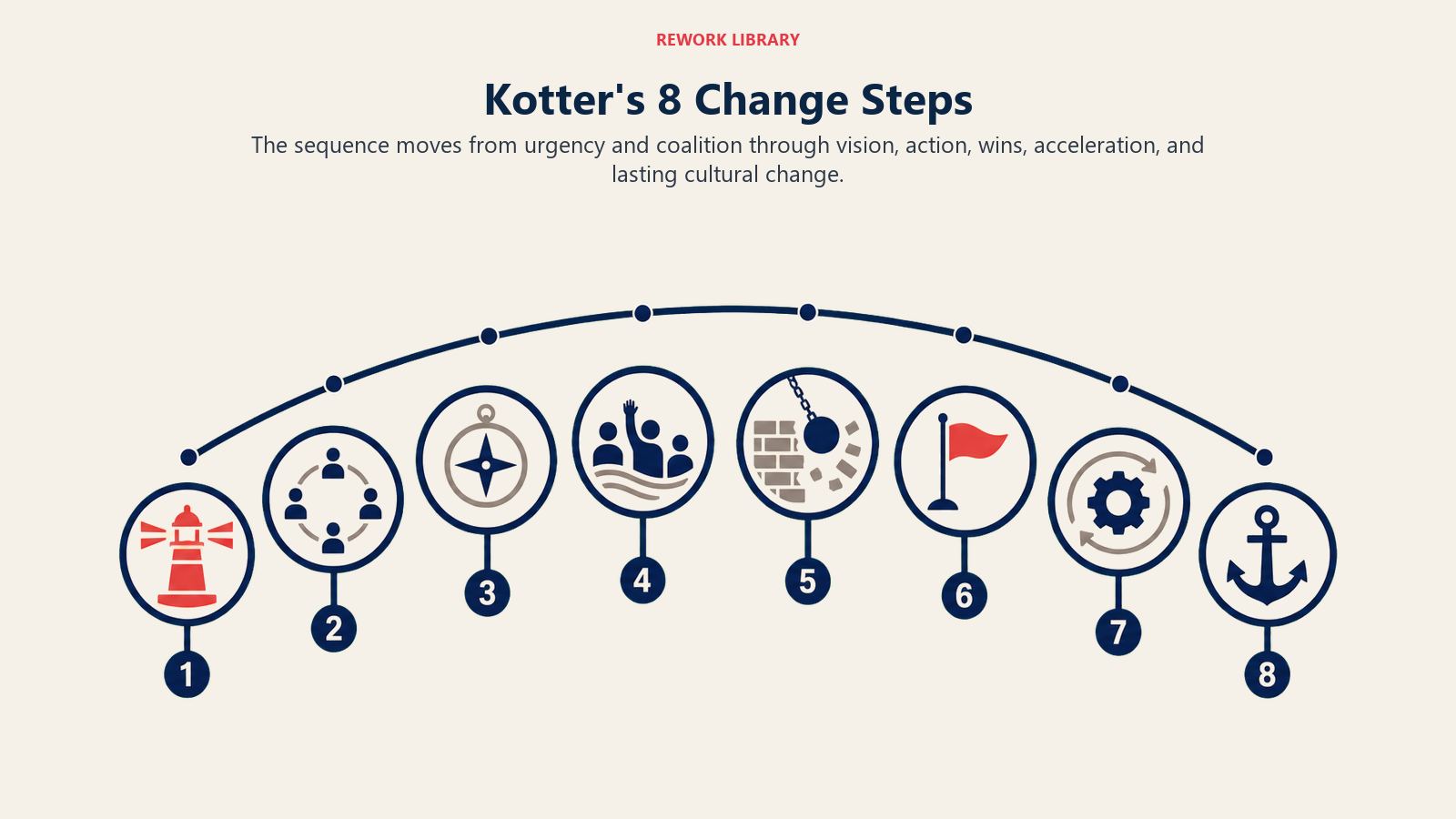
| Step | Name | Core Question | Example |
|---|---|---|---|
| 1 | Create urgency | Why must we change now? | Sharing market data showing a 20% revenue decline if the company doesn't digitize |
| 2 | Build a guiding coalition | Who will lead this? | Forming a cross-functional team of VP, IT lead, and HR director |
| 3 | Form a strategic vision | Where are we going? | Defining a clear 3-year digital transformation roadmap |
| 4 | Enlist a volunteer army | Who will carry this forward? | Recruiting 50 internal change champions across departments |
| 5 | Enable action by removing barriers | What's in the way? | Updating approval processes that slow down experimentation |
| 6 | Generate short-term wins | What proves it's working? | Celebrating a 15% efficiency gain in a pilot team after 60 days |
| 7 | Sustain acceleration | How do we build momentum? | Expanding the pilot across three additional departments |
| 8 | Institute change | How do we make it permanent? | Tying new behaviors to hiring criteria and leadership promotions |
Step 1: Create Urgency
Before anyone will follow you into change, they need to feel why it matters. Urgency isn't panic, it's a clear-eyed case for why the status quo is more dangerous than the disruption ahead.
This means sharing honest data: competitive threats, customer feedback, financial forecasts, or market shifts. At a mid-sized retailer facing e-commerce pressure, this might look like presenting a slide deck to the entire leadership team showing that three competitors have already launched same-day delivery while yours hasn't.
Step 2: Build a Guiding Coalition
No single leader can drive change alone. You need a guiding coalition: a small group of influential people who believe in the vision and have the authority, credibility, and relationships to make things happen.
This isn't just the CEO and their direct reports. It should include respected voices from across the organization, people who others trust even without formal authority. A global tech rollout, for example, might include the CTO, a senior regional manager with strong local credibility, and a front-line team lead who people actually listen to.
Step 3: Form a Strategic Vision
A guiding coalition without a clear direction is just a committee. Forming a strategic vision means translating the urgency into a picture of the future that people can rally around: simple, compelling, and memorable enough to repeat in 60 seconds.
The vision should also include a strategy, the broad strokes of how you'll get there. A hospital system transitioning to electronic health records might frame it as: "By 2027, every patient interaction will be fully digital, reducing admin errors by 40% and freeing nurses for direct care."
Step 4: Enlist a Volunteer Army
Kotter's original model used the phrase "communicate the vision," but his 2014 update sharpened this to enlisting a volunteer army. The idea is that change doesn't spread through memos. It spreads through people who genuinely believe in it and bring others along.
This means recruiting early adopters and informal influencers at every level, not just waiting for the org chart to do the work. At a manufacturing company, this might mean identifying floor supervisors who are curious about the new process and giving them extra training and visibility.
Step 5: Enable Action by Removing Barriers
Even motivated people hit walls. Enabling action means systematically identifying and clearing whatever is blocking progress, whether that's outdated policies, misaligned incentives, missing tools, or managers who quietly undermine the change.
A common blocker is a performance review system that still rewards the old behaviors. If you're asking salespeople to focus on long-term account relationships but still paying them purely on monthly close rates, you've created a structural barrier that no amount of communication will fix.
Step 6: Generate Short-Term Wins
Long transformation journeys need visible milestones. Short-term wins do two things: they prove the change is working, and they give skeptics less ammunition. Kotter recommends actively planning for these wins, not just hoping they happen.
A short-term win should be unambiguous, meaningful, and clearly connected to the change effort. If you're rolling out a new CRM platform, a win might be: "The pilot team closed 30% more follow-ups in Q1 using the new tool." That's specific, real, and repeatable as a proof point.
Step 7: Sustain Acceleration
This is where many organizations stumble. After early wins, leadership often declares victory and moves on. Sustaining acceleration means using the momentum from those wins to go deeper and wider, updating more systems, onboarding more teams, tackling the harder problems.
Think of it as not letting your foot off the gas. The guiding coalition should be continuously analyzing what's working, removing new barriers as they appear, and keeping the change agenda active rather than letting it quietly fade.
Step 8: Institute Change
The final step is anchoring the change in culture. This means making the new way of working the expected way of working, embedded in how you hire, promote, train, and recognize people.
If the change isn't reflected in your culture and systems, it will erode the moment leadership attention shifts elsewhere. A company that successfully digitized its operations needs to hire for digital fluency, celebrate leaders who role-model the new behaviors, and explicitly connect new practices to the organization's success stories.
Kotter vs ADKAR vs Lewin
These three models are often compared because they're all designed to manage organizational change. But they take very different approaches.
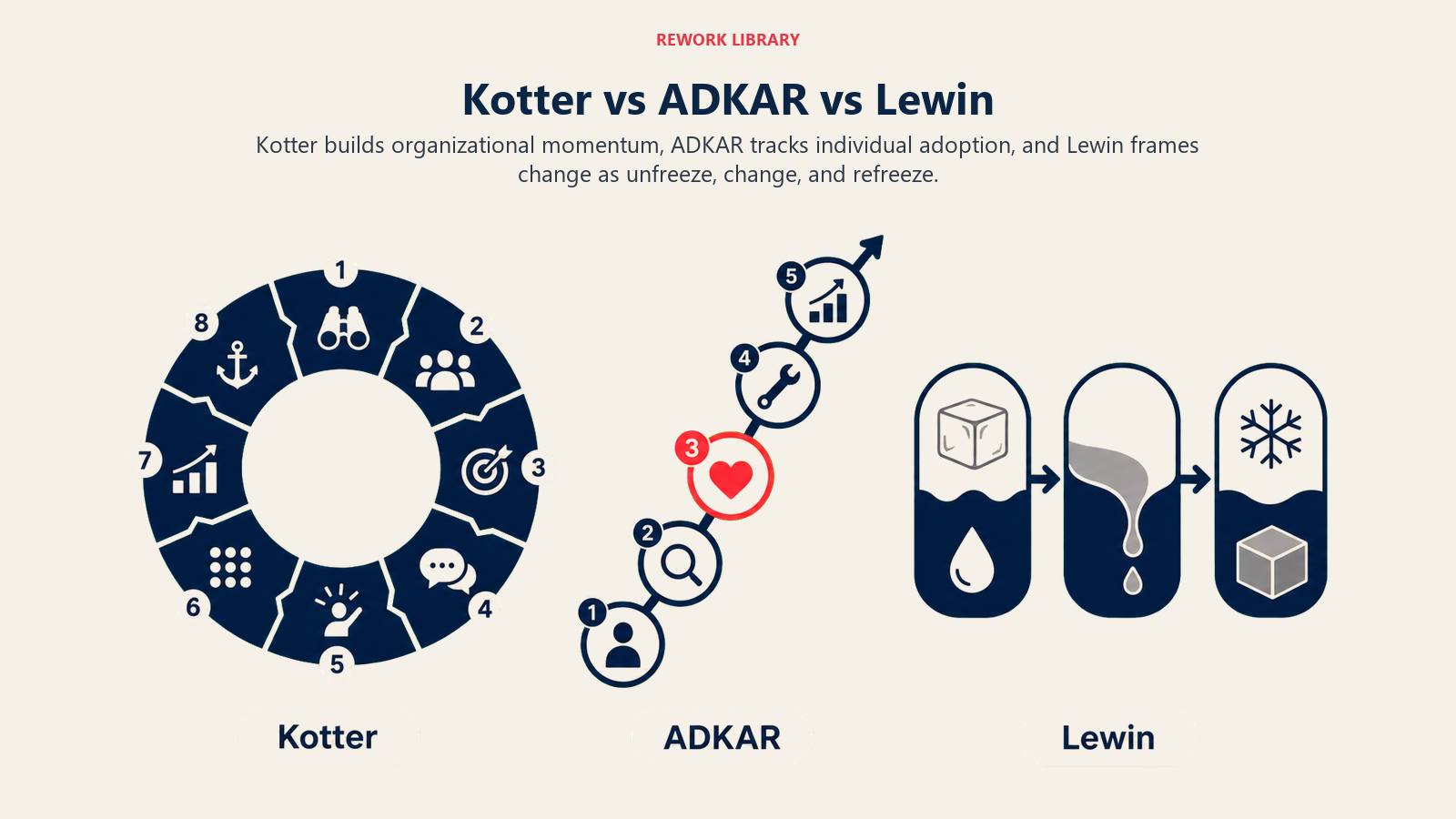
| Dimension | Kotter's 8-Step | ADKAR | Lewin's 3-Stage |
|---|---|---|---|
| Primary focus | Organizational momentum and leadership | Individual behavior change | Systemic unfreezing and refreezing |
| Unit of change | The organization as a whole | Each individual person | The social system |
| Sequence | 8 sequential steps | 5 milestones per person | 3 phases (Unfreeze, Change, Refreeze) |
| Best for | Large-scale, top-down transformation | People-side change management | Cultural and structural shifts |
| Strength | Strong on leadership and momentum | Strong on diagnosing individual blockers | Simple and conceptually clear |
| Limitation | Less granular on individual resistance | Less useful for org-wide rollout strategy | Can be too abstract for complex programs |
Kotter and ADKAR are actually complementary. Kotter gives you the organizational playbook; ADKAR tells you what's happening inside each person at each stage. Many change practitioners use both in parallel.
Lewin's model (Unfreeze, Change, Refreeze) is the oldest of the three and the most conceptually compact. It's useful for understanding the logic of change but doesn't give you the operational steps that Kotter does.
For more on complementary strategic tools, see McKinsey 7S Framework and Balanced Scorecard.
How to Apply Kotter's Model
Here's how each step translates into practical action for a leadership team.
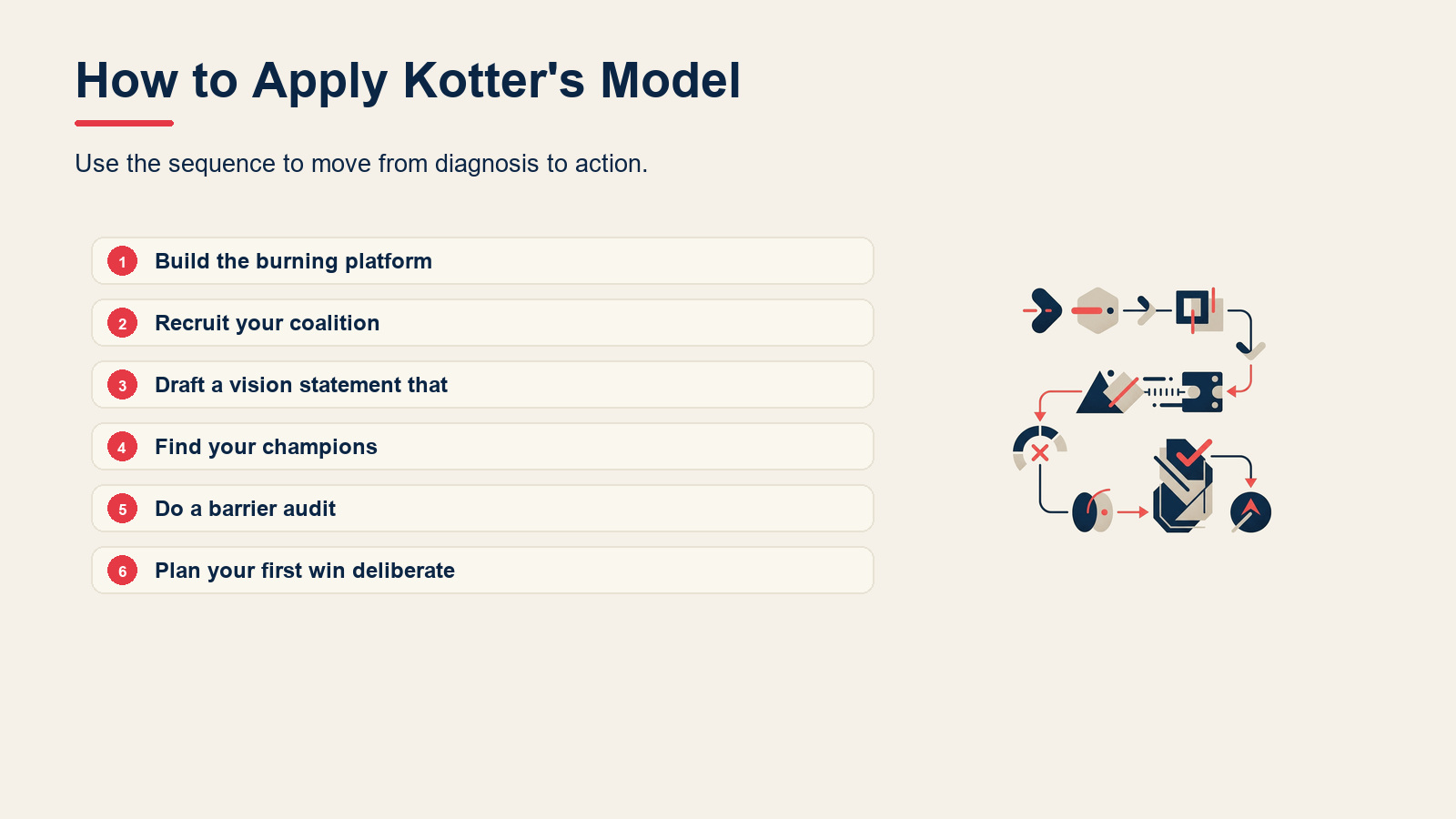
Step 1: Build the burning platform
Gather real data: financials, customer churn rates, competitive benchmarks, employee survey results. Don't soften the picture. Present the cost of inaction, not just the case for change.
Step 2: Recruit your coalition deliberately
Don't default to seniority. Look for people with credibility, influence, and genuine commitment to the outcome. Include at least one skeptic who's persuadable, because when they come around, others notice.
Step 3: Draft a vision statement that passes the "elevator test"
If you can't explain the vision in 60 seconds in plain language, it's not ready. Workshop it with the coalition until it's clear and specific enough to guide real decisions.
Step 4: Find your champions
Identify 20-50 people across the organization who are excited about the change. Give them information, training, and visibility. Let them carry the message in their own words.
Step 5: Do a barrier audit
Ask people closest to the work: "What would stop you from doing this differently?" Map the answers and prioritize the most common blockers. Fix at least two before the formal rollout expands.
Step 6: Plan your first win deliberately
Don't wait for wins to emerge. Identify a pilot team or project where success is likely, give it extra support, measure it carefully, and communicate the result loudly and specifically.
Step 7: Keep the change team active post-launch
Resist the urge to disband the guiding coalition after go-live. Keep meeting monthly. Track leading indicators, not just lagging ones. Actively look for where momentum is slipping.
Step 8: Tie the change to people decisions
The clearest signal that change is real is when promotions, recognition, and performance conversations reflect the new behaviors. Update hiring criteria, onboarding programs, and leadership competency frameworks to reflect what "good" looks like in the new world.
Kotter's 8-Step Model Example
Here's how a 1,200-person B2B services company applied Kotter's model during a CRM and sales process transformation.
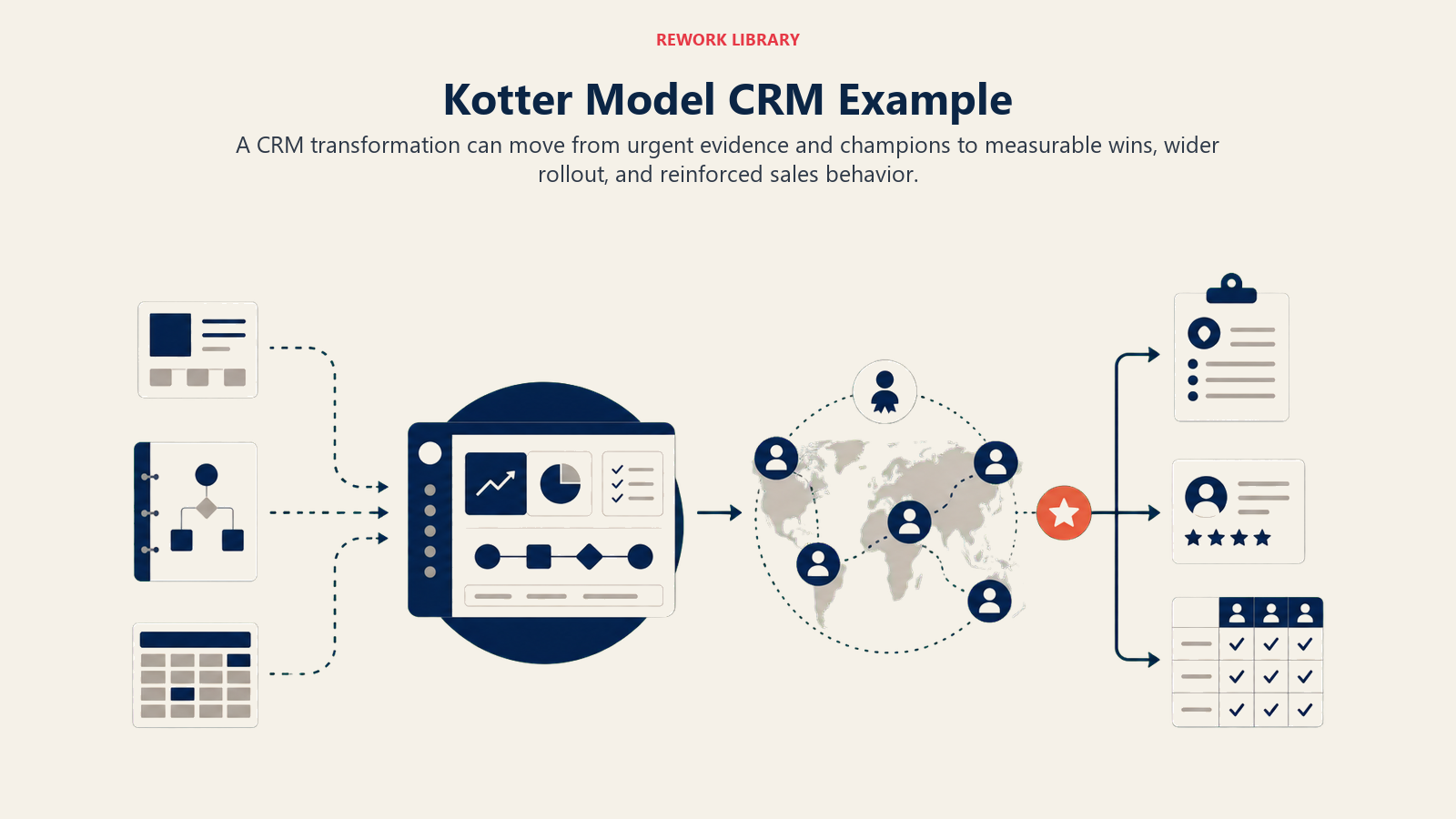
Context: The company's sales team was using three different tools with no integration, leading to duplicated data, missed follow-ups, and a 6-month average sales cycle. Leadership decided to consolidate onto a single CRM and redesign the sales process around it.
Step 1 (Create urgency): The CEO presented data showing that competitors with modern CRM systems had 40% shorter sales cycles. The company had lost two enterprise deals in the past quarter because follow-ups fell through the cracks. The case for change was concrete and financially visible.
Step 2 (Build coalition): A task force was assembled with the VP of Sales, the Head of Revenue Operations, a respected senior sales rep, the IT director, and the CMO. Each member had credibility in their part of the organization.
Step 3 (Form vision): The vision: "By Q4, every sales rep will run their entire pipeline from one platform, and leadership will have real-time visibility into the funnel at every stage."
Step 4 (Enlist volunteer army): 30 sales reps across three regions were recruited as pilot users and CRM champions. They got early access, extra training, and a direct line to the project team for feedback.
Step 5 (Remove barriers): The barrier audit revealed two blockers: the old expense approval process required manual data entry that duplicated CRM fields, and some regional managers were telling reps to "keep using the old spreadsheets just in case." Both were addressed directly.
Step 6 (Short-term win): After 60 days, the pilot team reported a 20% reduction in time spent on data entry and a 15% increase in follow-up completion rates. The results were shared at the all-hands meeting with specific numbers and named contributors.
Step 7 (Sustain acceleration): The rollout expanded to the full sales team in month three. The project team stayed active, running weekly office hours and publishing a monthly dashboard showing adoption rates and pipeline health.
Step 8 (Institute change): CRM proficiency was added to the sales hiring scorecard. The annual performance review was updated to include "pipeline hygiene" as a competency. The VP of Sales referenced the transformation in every new rep's onboarding session.
Twelve months in, the average sales cycle had dropped from six months to four. The change held because it was built into how the organization hired, measured, and talked about success.
Benefits and Limitations
Benefits
Clear, actionable sequence. The 8 steps give leaders a practical roadmap rather than abstract principles. Each step has a clear goal and observable output.
People-first logic. Kotter's model starts with urgency and coalition-building because it recognizes that most change failures are people problems, not technical ones. This is a significant advantage over purely process-focused frameworks.
Scalable. It works for a 50-person company redesigning its operations and for a 50,000-person enterprise rolling out a new ERP system. The steps scale with the scope of the initiative.
Integration-friendly. You can use Kotter alongside OKR frameworks for goal-setting, SWOT analysis for strategic context, or ADKAR for individual change tracking.
Limitations
Assumes a top-down structure. Kotter's model was built for traditional hierarchical organizations. It works less well in flat, self-organizing, or highly agile environments where change often emerges from the bottom up. The Cynefin framework is a useful companion here, because it helps you tell whether a change sits in a complicated domain that suits a structured plan or a complex one that calls for emergent, experiment-led approaches.
Sequential by design. The model treats the eight steps as linear. In reality, real transformations are messy: you might need to rebuild urgency in step six, or find new coalition members in step five. Kotter's 2014 revision acknowledged this by presenting the model as more iterative, but many practitioners still apply it rigidly.
Dependent on leadership quality. The model puts enormous weight on leaders building urgency, forming coalitions, and communicating vision effectively. If leadership isn't credible or committed, the model breaks down at step one.
Long-cycle bias. The 8-step process is designed for sustained transformation over months or years. It's not the right tool for rapid tactical shifts or short-cycle agile sprints. For those contexts, Kaizen or iterative product approaches are better fits.
For broader leadership context when applying this model, see transformational leadership and the TOWS matrix for strategic option development.
Frequently Asked Questions about Kotter's 8-Step Change Model
Who created Kotter's 8-step change model, and when?
Dr. John Kotter, a professor at Harvard Business School, introduced the model in his 1995 Harvard Business Review article "Leading Change: Why Transformation Efforts Fail." He expanded it into his 1996 book, Leading Change. Kotter updated the model in 2014 to emphasize its iterative nature.
What is the difference between Kotter's model and ADKAR?
Kotter's model focuses on organizational-level momentum: building urgency, forming coalitions, and anchoring change in culture. ADKAR focuses on individual-level change, tracking each person through Awareness, Desire, Knowledge, Ability, and Reinforcement. Many organizations use both together: Kotter for the org-wide rollout strategy, ADKAR for diagnosing where individual adoption is stalling.
Do you have to follow Kotter's 8 steps in order?
The steps are designed to be sequential, and skipping steps is one of the most common reasons transformations fail. That said, Kotter's 2014 revision acknowledged that real change is not perfectly linear. You may need to revisit earlier steps (rebuilding urgency, for example) even as you're executing later ones. The sequence is a guide, not a rigid rule.
What is the most common failure point in Kotter's model?
Declaring victory too early (the transition between steps 6 and 7) is the most cited failure point. After early wins, organizations often relax their efforts before the change is embedded in culture and systems. The result is that old habits return. Kotter specifically warns against this in both his HBR article and his book.
Is Kotter's model still relevant today?
Yes, though with some caveats. The core insight, that change fails when human factors are underestimated, remains as valid as ever. The model is less well-suited to fast-moving agile environments or bottom-up change initiatives. Many practitioners update it by applying Kotter's steps more iteratively and combining it with tools like ADKAR for the individual dimension or OKRs for goal alignment.
Change initiatives fail when leaders treat transformation as a project with an end date. Kotter's model pushes back against that instinct by insisting that the last step, making change permanent in culture and people decisions, is not a formality. It's the point where most of the real work happens. Start with honest urgency, build a coalition that actually has credibility, and don't declare victory until the new way of working is how people are hired and promoted. That's when the change is real.

Senior Operations & Growth Strategist
On this page
- What Is Kotter's 8-Step Change Model?
- The 8 Steps of Kotter's Model
- Step 1: Create Urgency
- Step 2: Build a Guiding Coalition
- Step 3: Form a Strategic Vision
- Step 4: Enlist a Volunteer Army
- Step 5: Enable Action by Removing Barriers
- Step 6: Generate Short-Term Wins
- Step 7: Sustain Acceleration
- Step 8: Institute Change
- Kotter vs ADKAR vs Lewin
- How to Apply Kotter's Model
- Step 1: Build the burning platform
- Step 2: Recruit your coalition deliberately
- Step 3: Draft a vision statement that passes the "elevator test"
- Step 4: Find your champions
- Step 5: Do a barrier audit
- Step 6: Plan your first win deliberately
- Step 7: Keep the change team active post-launch
- Step 8: Tie the change to people decisions
- Kotter's 8-Step Model Example
- Benefits and Limitations
- Benefits
- Limitations