Capability Development in Professional Services: Building the Expertise Engine That Drives Growth
Turn this article into takeaways for your work.


Each assistant summarizes the article only for you and suggests best practices for your work.
The most dangerous growth constraint in professional services isn't a lack of clients. It's a lack of people who can serve them.
Most professional services firms hit the same ceiling at some point in their growth: business development is working, the pipeline looks good, and then the senior partners realize they can't take on more work without being in every client engagement. They're the bottleneck. Not because they want to be, but because the firm's capability is concentrated in them and hasn't been transferred to anyone else.
This is a capability development failure. And it's almost always a consequence of neglecting to build the systems that develop expertise at the level below the partners.
What Capability Development Actually Is
Capability development in professional services is the systematic process of building, deepening, and transferring expertise across the firm. It's distinct from training (which typically means courses or certification programs) and from performance management (which evaluates whether people are meeting current expectations).
Capability development is forward-looking. It asks: what expertise does the firm need to serve clients at a higher level in 12-24 months, and what do we need to build today to be there?
For most professional services firms, capability development happens informally: senior practitioners work alongside junior ones, knowledge transfers through proximity, and expertise develops through trial and error on real client work. This works when the firm is small enough that proximity is guaranteed and when the senior practitioners have enough bandwidth to mentor actively.
As firms grow past 15-20 people, informal capability transfer breaks down. The partners are too busy with client work and business development to mentor consistently. The junior staff don't have a clear path to developing the skills they need. The firm's capability stays concentrated in the original team rather than spreading through the organization.
Formal capability development systems solve this. They're not complicated, but they require deliberate investment in infrastructure that doesn't directly produce client revenue.
The Four Capability Dimensions
When practice leaders talk about building capability, they often default to technical skills: the specific methodologies, frameworks, and domain expertise the firm uses in its work. Technical skills matter, but they're only one of four dimensions.
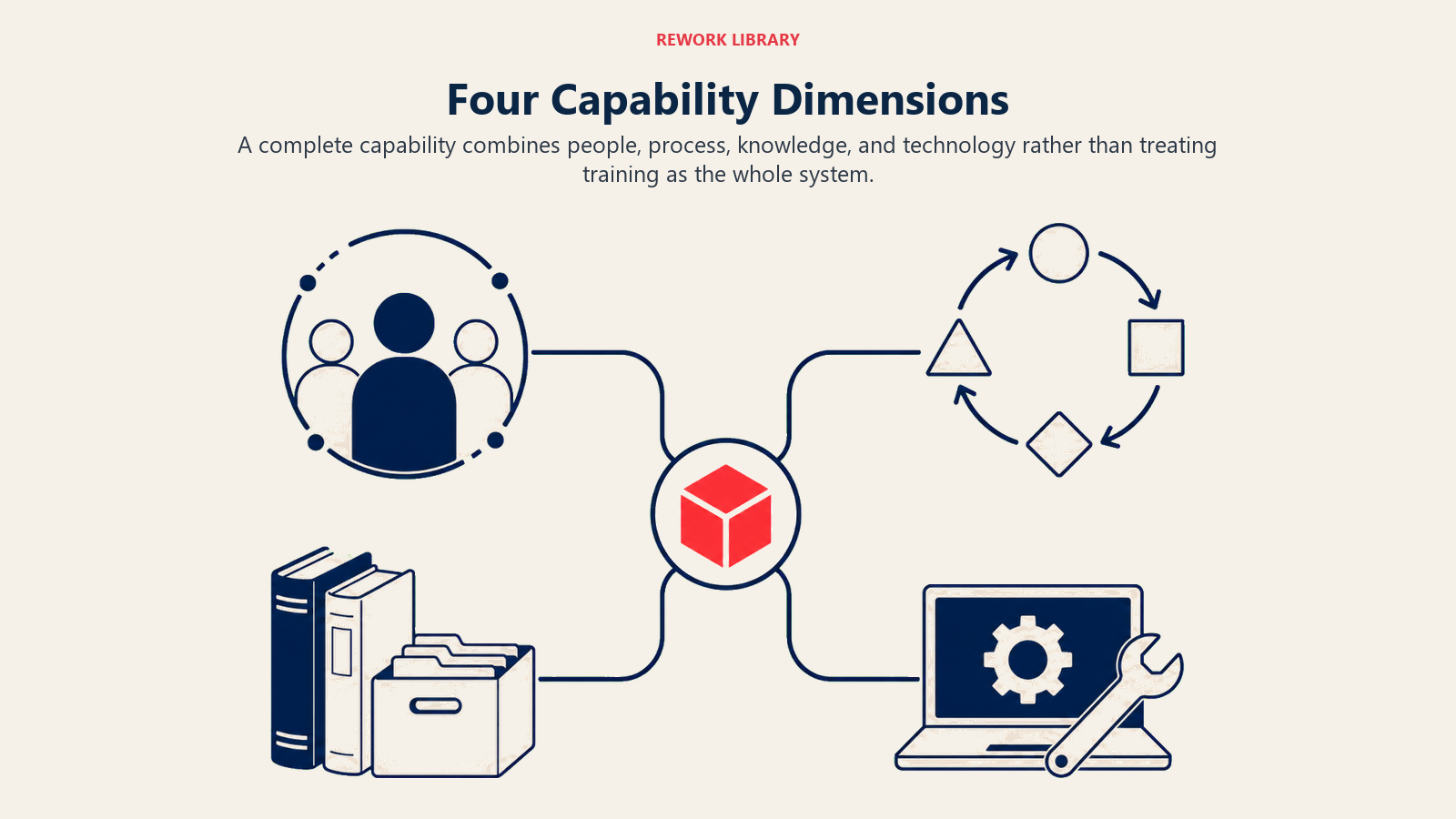
Technical expertise. The domain-specific knowledge and methodology the firm uses. This includes industry knowledge, functional expertise (strategy, operations, finance, etc.), and the specific frameworks and approaches the firm has developed or adapted. Technical expertise is the most visible form of capability and the one most often invested in.
Client management skills. The ability to understand client context, manage expectations, navigate organizational politics, communicate insights to non-technical audiences, and build the trust that creates long-term relationships. These skills are often the difference between a practitioner who produces good work and one who builds the client relationships that drive repeat engagements and referrals.
Commercial judgment. Understanding how clients make buying decisions, how to scope engagements that produce value for both client and firm, when to pursue or pass on an opportunity, and how to price and position the firm's work. Commercial judgment is typically developed last in professionals' careers, which is why business development feels concentrated at the partner level.
Practice leadership. The ability to develop others, build team capability, manage an engagement at the leadership level, and contribute to the firm's methodological evolution. This is the dimension that enables delegation and scale.
Most firms invest heavily in technical expertise and relatively little in the other three. The talent development program described later in this article addresses all four systematically.
See talent development program for the full framework for building all four dimensions.
Building a Capability Architecture
A capability architecture is the explicit map of what the firm needs to be excellent at, what it needs to be competent at, and what it can depend on partners and contractors for rather than building internally.
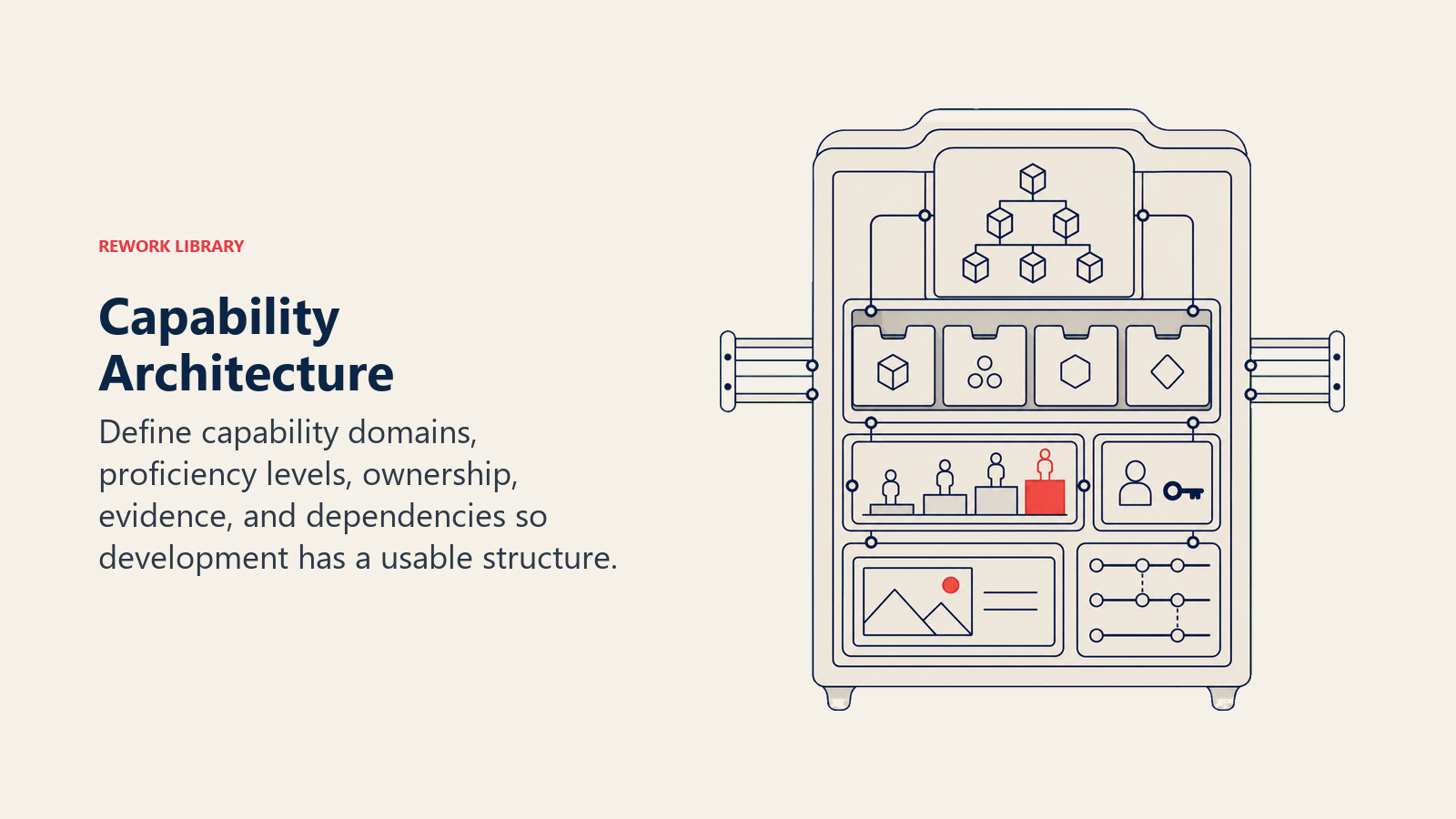
This is a strategic decision, not just an HR question. Firms that try to build deep capability in everything dilute their expertise. Firms that identify the 3-5 capabilities where they want to be genuinely excellent can invest resources accordingly.
The starting point is mapping current capabilities against the services the firm offers and the work it aspires to do. For each service or type of engagement, answer three questions:
Who can currently deliver this at the level clients expect? Be honest. If the answer is "only the managing partner and one senior director," that's a key-person risk and a growth constraint.
Who is close to being able to deliver this with light supervision? These are the people in the development pipeline for this capability.
Who could realistically get there in 18 months with the right development investment? These are the people to invest in now.
The output is a capability map that shows where the firm is robust (multiple people can deliver), where it's fragile (one or two key people), and where it has gaps.
Combine this with the firm's growth strategy. If you're planning to expand into a new service area or industry, what capabilities need to be built ahead of that expansion? The firm specialization strategy and service line strategy decisions directly shape what you need to develop.
Structured Development for Professional Staff
The most effective capability development systems in professional services share several structural elements.
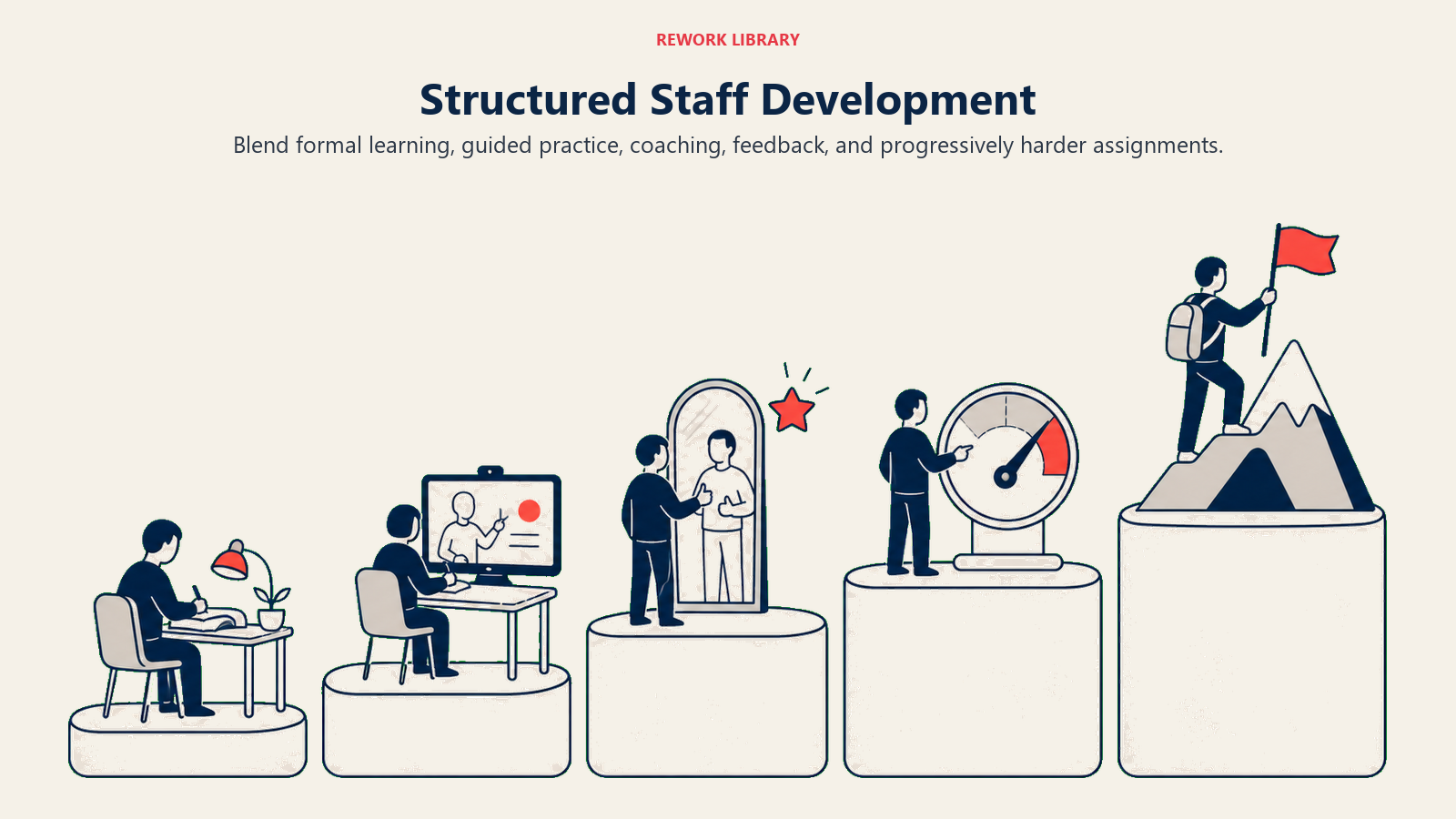
Clear progression frameworks. People develop faster when they know what "excellent" looks like at the next level. A well-designed progression framework doesn't just list job titles. It describes the observable behaviors, capability milestones, and engagement types that characterize each level.
For each level from analyst to managing director, describe: what kinds of engagements can they lead independently, what technical skills are expected, what client relationship behaviors are demonstrated, and what commercial contributions are expected. Make these frameworks specific enough to be useful in development conversations, not generic enough to apply to anyone.
Deliberate stretch assignments. Capability develops through experience, specifically through experience that requires new skills. The most reliable capability development mechanism is assigning people to engagements that stretch them beyond their current comfort zone, with enough support that they can succeed without failing the client.
"Stretch" is calibrated by individual. For a consultant who is technically strong but hasn't managed client relationships independently, a stretch assignment is one where they lead the client communication with a senior backstop. For someone who is excellent with clients but hasn't managed a multi-stream project, a stretch is leading a complex engagement with regular check-ins.
Managing this deliberately requires knowing your people well enough to identify their specific development edges, not just their general performance level.
Regular capability reviews. Twice a year, practice leaders should review the capability map against the current staff. Who has developed? Where are there new gaps? What engagements in the next six months offer development opportunities for specific people?
This prevents capability development from becoming a background activity that only happens in annual reviews. Capability planning, like financial planning, benefits from regular review cycles.
The Knowledge Transfer Problem
One of the least-solved problems in professional services is knowledge transfer: the process of taking expertise that exists in individuals' heads and making it accessible to others in the firm.
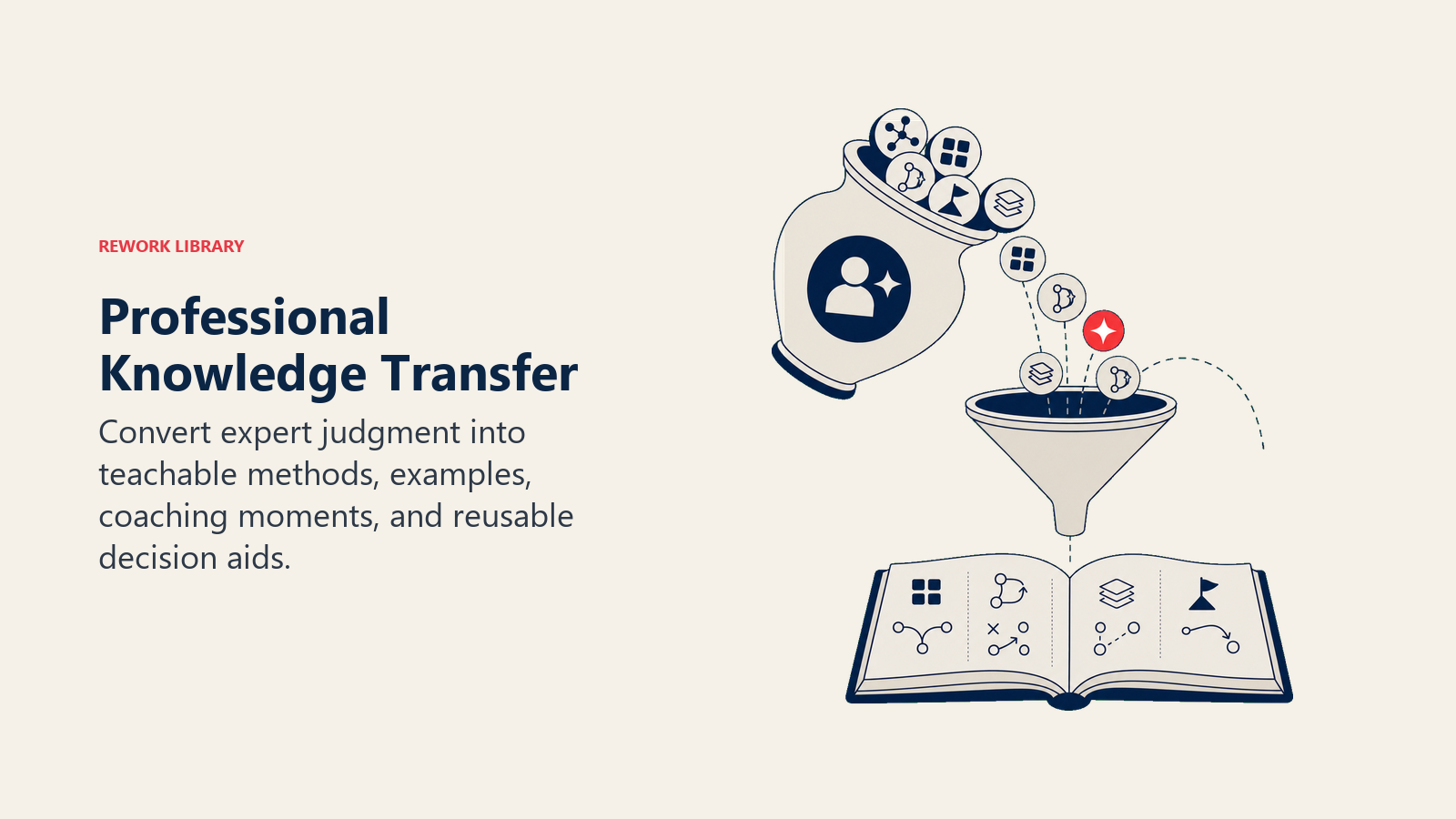
Most firms know this is a problem. They have case studies on a shared drive that nobody reads. They have engagement documents that get filed and never referenced. They have frameworks that the partner who developed them can articulate, but that no one else in the firm knows how to apply.
Structured knowledge transfer systems change this. The components that work:
Post-engagement debriefs. At the end of every significant engagement, run a structured session to capture what worked, what didn't, what the team learned about the client sector, and what methods they'd apply differently. Document this in a consistent format. One page. Key insights only.
These debriefs take 60-90 minutes and produce a written output that a future team can read in 15 minutes before starting a similar engagement. Over three years, a firm doing this consistently builds a proprietary knowledge base that new hires can access and that improves every subsequent engagement.
Method documentation. The frameworks and approaches that define how the firm works should be documented well enough that someone who wasn't involved in developing them can apply them with guidance. This isn't about creating rigid checklists. It's about capturing the thinking behind the approach well enough that practitioners can adapt it intelligently.
Structured case study development. Case studies serve double duty: they're the most persuasive content in business development, and they're excellent learning documents for internal teams. A well-constructed case study that describes the client situation, the approach, the key decisions made and why, and the outcomes achieved is both a sales asset and a capability development tool.
See client testimonials and case studies for the process of building and maintaining these.
Building a Methodology That's Yours
The professional services firms that build the most durable competitive advantage are the ones that develop a proprietary methodology: a distinctive approach to solving the problem they specialize in that is recognizably theirs.
McKinsey has its seven-S framework and structured problem-solving methodology. Boston Consulting Group has growth-share matrix and various portfolio frameworks. These aren't just intellectual property. They're capability anchors: the methods that practitioners learn, apply, and continuously improve, and that clients come to associate with the firm.
Smaller firms can do the same thing at a smaller scale. A management consulting boutique that specializes in post-merger integration can develop a proprietary integration methodology with their own phases, tools, and decision criteria. A digital marketing agency can develop a proprietary audit and strategy framework. This methodology becomes the core of their capability development program: everyone in the firm learns it, applies it, and contributes to evolving it.
Building a proprietary methodology takes two to three years of consistent application and documentation. It's not an academic exercise. It emerges from doing the work, capturing what works, and synthesizing the patterns.
Connecting Capability Development to Commercial Growth
The link between capability development and firm growth is most direct through two channels.
Premium pricing. Firms with demonstrably superior capability in their specialization can price at a premium. Clients pay for expertise when they can see evidence of it. A firm with documented methods, named practitioners with track records, and specific case studies in their domain can defend higher rates than a generalist firm doing similar work.
The billable hour vs value-based pricing and leverage model optimization decisions both depend on having the capability depth to justify the premium.
Delegation and scale. The firms that grow past the founder bottleneck do so by developing practitioners who can lead engagements with light senior supervision. This requires the capability architecture described earlier: clear progression frameworks, deliberate stretch assignments, and regular development reviews.
When you can staff a client engagement with a senior manager leading, a consultant and analyst executing, and a partner available for 10% of the time for client relationship and quality review, your revenue-per-partner ratio improves significantly compared to a model where partners have to be deeply involved in every engagement.
The math is simple: if a partner can be meaningfully involved in 10 engagements per quarter instead of 5, because the rest of the team can handle execution independently, you've doubled the partner's commercial leverage without hiring another partner.
Capability development isn't a soft HR investment. It's the mechanism that determines whether your firm can grow revenue without growing headcount proportionally.
Building Development Into the Business Rhythm
The practical barrier to capability development is time. In a professional services firm, every hour spent on internal development is an hour not spent on billable client work. This is real, but it's also a false economy.
The firms that invest most consistently in capability development are the ones that treat it as a non-negotiable business activity rather than a nice-to-have. They schedule it into the firm calendar. They build learning objectives into engagement staffing decisions. They account for development time in utilization targets. They recognize that the short-term cost of development time is smaller than the long-term cost of staying dependent on a handful of senior people.
Practically, this often means protecting two to four hours per week per practitioner for development activities, building capability reviews into the monthly or quarterly management calendar, and making learning and teaching an explicit part of how senior people's contributions are recognized.
The staffing and resource allocation decisions need to account for development time, or it will always get crowded out by client work pressure.
Professional services firms that neglect capability development tend to plateau at the size where the original founders can personally oversee everything. Firms that invest in it systematically can scale past that ceiling because they've built the infrastructure to replicate and transfer the expertise that made them successful in the first place.

Senior Operations & Growth Strategist
On this page
- What Capability Development Actually Is
- The Four Capability Dimensions
- Building a Capability Architecture
- Structured Development for Professional Staff
- The Knowledge Transfer Problem
- Building a Methodology That's Yours
- Connecting Capability Development to Commercial Growth
- Building Development Into the Business Rhythm