Revenue Streams in Professional Services: How Firms Build More Predictable, Scalable Income

Turn this article into takeaways for your work.


Each assistant summarizes the article only for you and suggests best practices for your work.
The most common financial stress pattern in professional services firms is called the "feast or famine" cycle. A firm closes two large engagements in Q1. Utilization runs at 95% for six months. Toward the end of those engagements, business development has been neglected because everyone was heads-down in client work. Q3 arrives and the pipeline is thin. Revenue drops. Stress rises. The firm cuts costs, works harder to rebuild the pipeline, eventually closes new work, and the cycle repeats.
This cycle isn't a failure of ambition or capability. It's a structural problem with project-based revenue. When your revenue model is "close a project, do the work, go find the next project," volatility is built in. Business development and delivery compete for the same people's time, and the cycle ensures they can never both be fully attended to simultaneously.
The firms that escape this cycle have diversified their revenue streams so that a significant portion of income is predictable and doesn't require a new sale every quarter.
The Revenue Stream Landscape
Professional services firms have more revenue stream options than most of their leaders recognize. The common perception is that professional services is inherently project-based and therefore inherently volatile. But many firms have demonstrated that this isn't true.
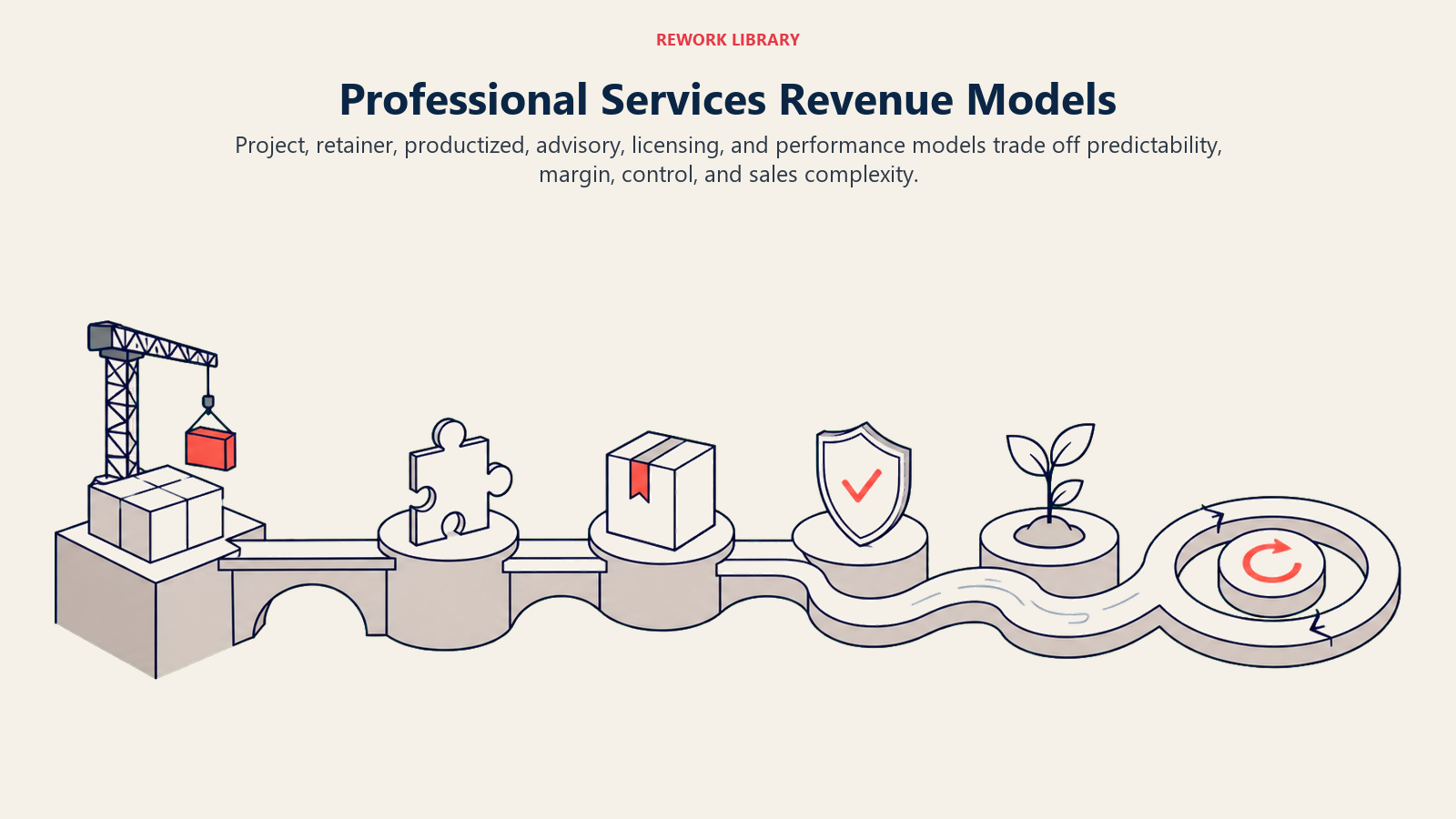
Understanding the landscape of options is the first step.
Project-based revenue. The traditional model. Client has a defined problem, firm proposes a scoped engagement, work is done, engagement ends. Revenue is recognized over the project duration, and when the project ends, revenue ends.
Project revenue has advantages: it's familiar, clients understand it, and it's flexible. The disadvantage is exactly the volatility described above.
Retainer revenue. A client pays a fixed monthly or quarterly fee for ongoing access to the firm's expertise, typically for an agreed scope of work or an agreed number of hours. The firm has guaranteed revenue without requiring a new sale each month. The client has predictable cost and on-demand access.
Retainers work best when the client has ongoing needs in the firm's area of expertise (not a one-time project need) and when the relationship has enough trust that the client is comfortable with outcome-based rather than fully scoped engagement.
See retainer vs project model for the detailed comparison of structures, pricing, and client fit criteria.
Productized services. A service offering that is scoped, priced, and delivered in a standardized way, with minimal customization per engagement. Rather than a fully bespoke project, the client buys a specific product: a 90-day financial diagnostic, a brand positioning workshop, an organizational design sprint, a market entry analysis.
Productized services can be sold at fixed price, packaged in bundles, and delivered by more junior practitioners (since the methodology is defined), which improves margin and scalability.
Advisory and fractional roles. A firm principal or senior practitioner serves as a part-time senior resource for the client, typically in a fractional executive capacity (fractional CFO, fractional CMO, fractional Head of Strategy) or as an advisory board member. Compensation is typically a monthly retainer plus equity or a performance component.
Advisory arrangements generate relatively modest fees but have excellent economics (low delivery cost, high margin) and often produce project work downstream.
Licensing and intellectual property. Firms that have developed proprietary frameworks, tools, assessment instruments, or training programs can license them to other organizations or to other firms in adjacent markets. This creates revenue that is not tied to human delivery hours.
This model requires significant upfront investment to develop the IP and takes time to build, but once established, it's among the most scalable revenue streams available to professional services firms.
Training and education products. Courses, workshops, cohort programs, and certification programs based on the firm's expertise. These serve two purposes: they generate revenue directly, and they serve as top-of-funnel demand generation that attracts potential clients by demonstrating expertise.
The Retainer Transition: Why It's Harder Than It Looks
Most professional services firms eventually decide they want retainer revenue. Few manage the transition successfully. Understanding why the transition is hard is as important as knowing what retainers look like.
The first problem is trust. Clients commit to ongoing retainer arrangements with firms they trust deeply, after a track record of project work. Trying to sell a retainer to a client you've never worked with requires a different kind of value proposition. Most retainer relationships emerge from successful project engagements, not as cold-sale products.
The second problem is scope definition. Project work has defined deliverables and timelines. Retainers require a different scoping conversation: what is the client getting for their monthly fee, how is value measured, and what happens if the scope creeps in either direction?
Firms that successfully sell retainers have learned to answer these questions clearly. They've defined what "ongoing advisory relationship" means specifically: two senior-level calls per month, access to the firm's research and frameworks, draft review for key internal documents, and attendance at two board or leadership team meetings per year. Specific, not vague.
The third problem is operational. Projects are finite and can be staffed specifically for their scope. Retainers create ongoing obligations that have to be staffed into ongoing capacity plans. Firms that sell retainers beyond their operational capacity to service them create quality problems that destroy client relationships.
The practical implication: start with one or two retainer relationships with your strongest existing clients before building retainers into your standard business development process. Learn the operational model at small scale before scaling it.
Productized Services: The Path to Efficiency
Productized services deserve a closer look because they solve several problems simultaneously.
They enable junior delivery. When a service is standardized (defined phases, defined tools, defined outputs), it can be delivered by more junior practitioners with senior oversight. This dramatically improves margins compared to fully bespoke project work, where senior practitioners often need to be deeply involved throughout.
They reduce the sales cycle. Scoping a bespoke project requires detailed discovery, proposal development, and negotiation. Selling a productized service is closer to selling a product: the client knows what they're buying, what they'll get, and what it costs. Sales cycles are shorter and conversion rates are higher.
They improve utilization predictability. When you know how long a productized service takes to deliver (because you've done it 30 times), you can predict staffing needs accurately. This reduces the utilization volatility that characterizes bespoke project work.
They generate case studies efficiently. Doing the same type of engagement repeatedly generates a coherent set of case studies that demonstrate your expertise in that specific service. This improves marketing effectiveness.
The most successful productized services start as something the firm has been doing in various forms for clients anyway. A consulting firm that has repeatedly run leadership team strategy sessions can productize that into a "Leadership Strategy Sprint" with a standard agenda, standard preparation materials, standard facilitation process, and standard output. The first version will be imperfect. By the fifth iteration, it's polished.
The service productization process walks through how to take existing firm capabilities and translate them into standardized, saleable service products.
Building Recurring Revenue: The Financial Case
The financial case for recurring revenue in professional services is straightforward once you model it.
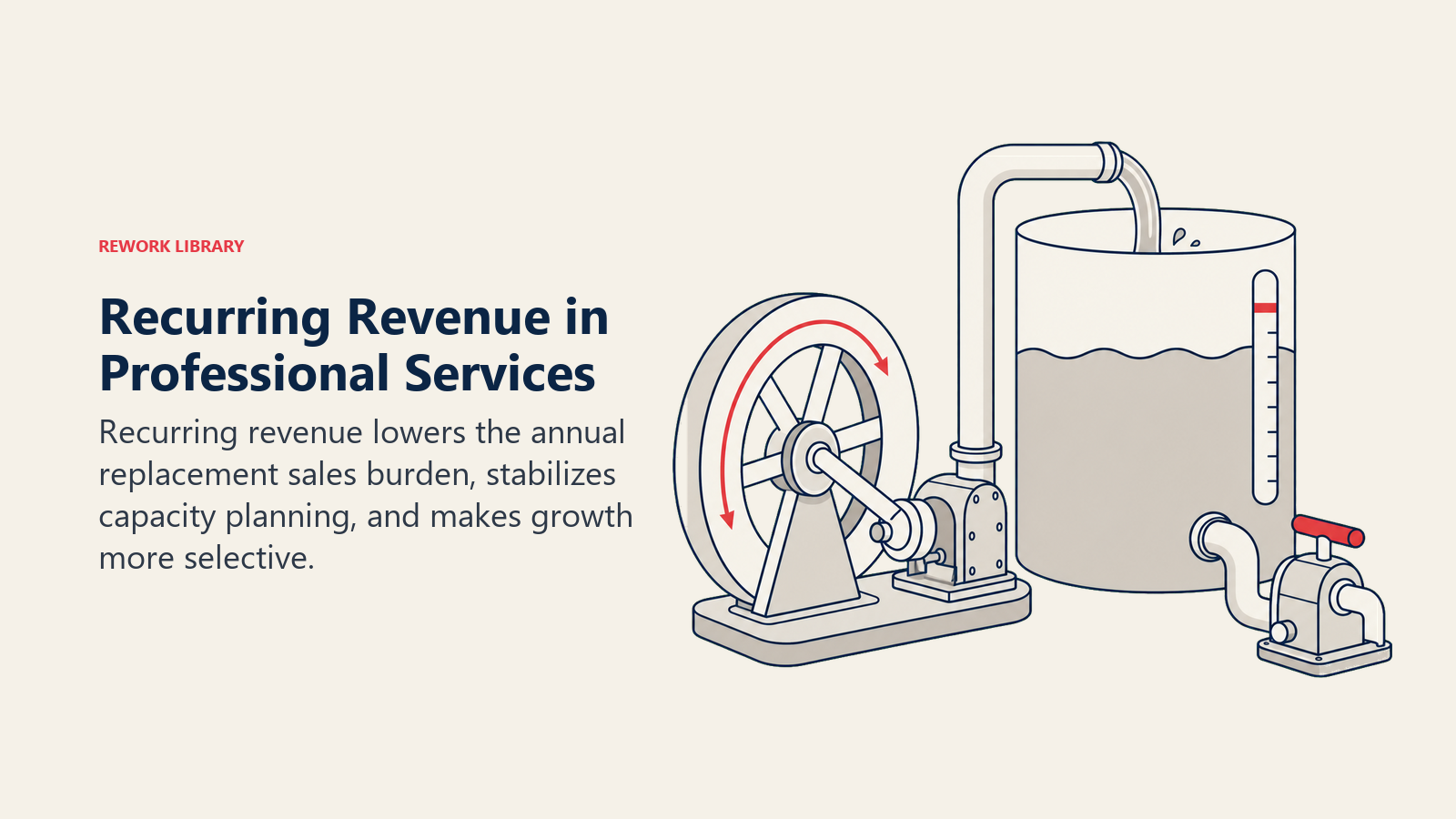
A firm with $2M in annual revenue from projects has to regenerate $2M of sales each year to sustain flat revenue. If the average project is $150K and takes three months of sales cycle, the firm is continuously managing a pipeline of 13-15 opportunities in various stages.
A firm that converts 30% of revenue to retainers has $600K arriving predictably and needs to sell only $1.4M in new project revenue to sustain flat revenue. The reduced sales burden allows more time for delivery quality, retention of existing clients, and more selective new client pursuit.
The compounding effect over five years is significant. If the firm retains its retainer clients (which requires delivering value consistently), the retainer base grows as project clients convert. After five years, a firm that has consistently converted 20-30% of clients to retainers may have 50-60% of revenue on retainer, fundamentally changing the business's financial stability.
This math is why growing professional services firms prioritize retention and expansion as much as new client acquisition. The client penetration strategy and multi-year engagements articles cover the specific tactics for building long-term client relationships that support this kind of revenue diversification.
Revenue Stream Mix by Firm Stage
Different revenue stream mixes make sense at different stages of firm development.
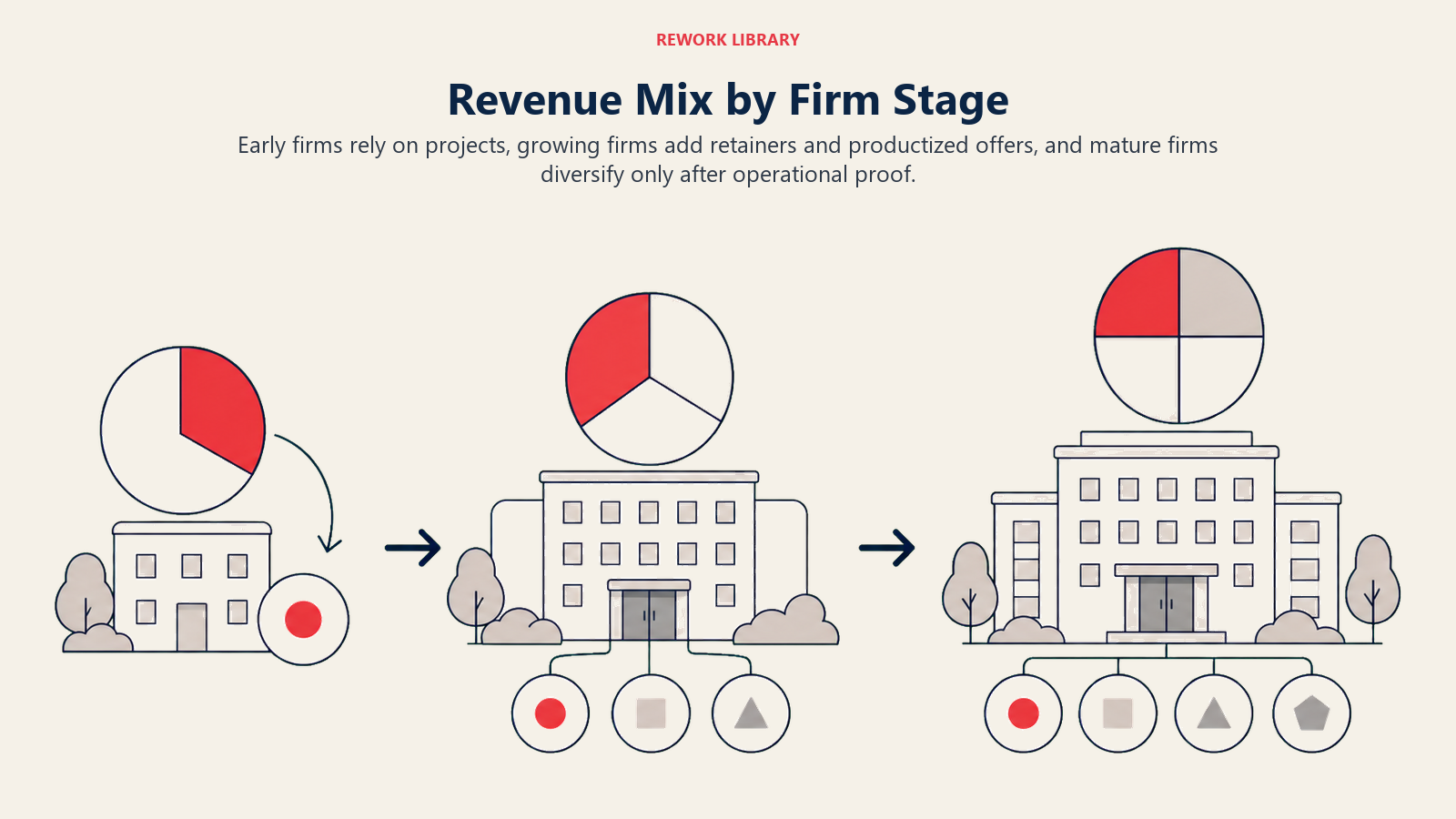
Early stage (under $1M, fewer than 8 people). Revenue is almost entirely project-based, which is appropriate. The primary goal is establishing expertise, building case studies, and understanding what types of engagements the firm does well. Diversification comes later.
One strategic move at this stage: start tracking which clients might convert to retainers as you deepen the relationship. Don't attempt retainer transitions actively yet, but identify the two or three clients who seem like candidates.
Growth stage ($1M to $5M, 8-25 people). This is when the feast/famine cycle becomes most painful and when the tools to address it become available. Two or three anchor retainer relationships can provide the financial stability needed to sustain quality business development without the pressure spikes.
Productized services also become viable at this stage: the firm has done enough of the same type of work to standardize it, and the team has enough capacity to run delivery without senior partner involvement throughout.
Established stage ($5M+, 25+ people). Multiple revenue streams are operational: retainers provide predictable income, productized services serve volume segments, project work handles complex bespoke engagements, and potentially IP licensing or training products provide scalable revenue.
The professional services growth model positions revenue stream diversification within the broader six-pillar framework. Revenue streams are the result of all the other systems working together, not a standalone initiative.
Common Revenue Stream Mistakes
Launching retainers with unclear scope. Retainer relationships that are too vague about what the client is getting lead to scope creep, client dissatisfaction, and firm-side delivery overruns. Define specifically what the retainer includes.
Pricing productized services the same as bespoke projects. Productized services should be priced lower than bespoke project work of the same scope because the firm is bearing less risk (standardized delivery) and has lower delivery cost (junior staff). Pricing them at bespoke rates removes the client's incentive to buy them.
Diversifying too early. Firms that try to build retainer, productized, and advisory revenue streams before they have a clear positioning and a handful of strong project case studies are spreading themselves too thin. Get the core project business working first.
Treating revenue diversification as a marketing project. Diversified revenue streams require operational changes: different staffing models, different client management approaches, different billing and contracts. This is an operations and strategy project, not just a business development exercise.
The billable hour vs value-based pricing guide covers how pricing strategy connects to revenue stream choices. The two decisions are deeply linked: firms that move toward value-based pricing find it easier to justify retainer and productized service models to clients who are used to hourly billing.
Revenue stream diversification is not about chasing every possible revenue model. It's about identifying the two or three models that fit your firm's expertise, your clients' needs, and your operational capacity, then building those deliberately while maintaining the project work that is the core of the business. The goal is resilience and growth, not complexity.