Market Positioning for Professional Services: How to Be the Obvious Choice in Your Category
 Ask the managing partners of ten professional services firms to describe their positioning and you'll hear some version of the same thing: "We're a full-service firm that works with mid-market companies and delivers exceptional results through our deep expertise and client-focused approach."
Turn this article into takeaways for your work.


Each assistant summarizes the article only for you and suggests best practices for your work.
Every word in that sentence is true for most firms. And none of it helps a prospective client decide whether to hire them.
The problem isn't that these firms lack genuine strengths. It's that they've positioned themselves as a category member rather than as the specific solution to a specific problem for a specific type of client. And in a market where every firm has 20 years of experience, exceptional client service, and deep expertise, those descriptors aren't differentiating. They're table stakes.
Market positioning is the strategic choice of what your firm stands for in the minds of your ideal clients. It's not a tagline. It's the answer to the question every buyer asks, consciously or not: why this firm instead of the alternatives?
The Positioning Failure Modes
Understanding why positioning fails is as useful as knowing what good positioning looks like.
The capability trap. Firms that list their capabilities as their positioning are describing what they can do, not why a client should choose them. "We offer strategy consulting, operations improvement, technology implementation, and change management" tells a buyer you're broad, not that you're excellent.
The problem with capability-based positioning is that every firm in your category has similar capabilities. It creates no comparative advantage.
The process trap. "We use a proprietary six-step framework and a collaborative approach that puts clients first" is process-based positioning. It describes how you work. The buyer's question is what outcome they'll get, not how you'll produce it.
Process differentiation is hard to sustain anyway. Another firm can adopt your process. They can't replicate your specific experience in a specific domain.
The client segment trap. "We serve mid-market companies" or "we work with private equity-backed businesses" describes a market segment, not a positioning. Many firms serve those segments. What makes you the best choice for that segment?
The vague differentiation trap. "We're different because we become a true extension of your team" or "we're different because we actually care about results, not just deliverables" are true for almost every firm that would say them, which means they're not differentiating.
The firms that escape these traps make a harder choice: they commit to owning a specific problem, for a specific type of client, in a way that makes them visibly, verifiably different.
The Four Axes of Professional Services Positioning
Positioning in professional services can be built around four axes. Strong positioning typically combines two or three of them.
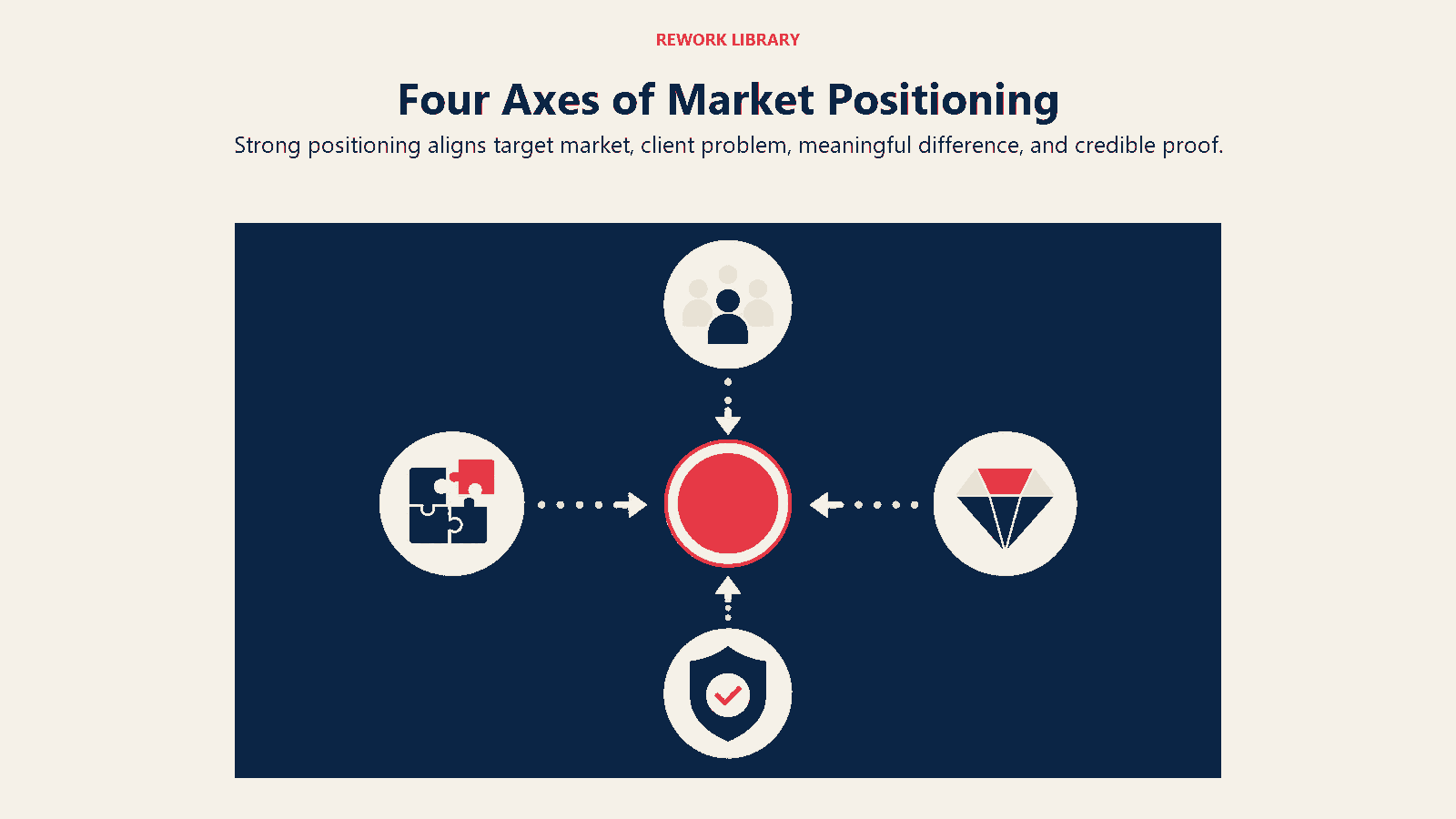
Specialization. A narrow focus on a specific problem domain, industry, functional area, or type of work. The more specific the specialization, the stronger the positioning.
A firm that does HR consulting for all industries positions differently from one that does HR transformation for healthcare systems. The broader firm may be technically capable of serving the healthcare client. But the specialist firm carries an implicit message: we've done this exact type of work, in your exact type of organization, and we know where the problems are before we start.
The tradeoff is smaller addressable market. But the conversion rate, pricing power, and referral quality that come from genuine specialization usually outweigh the opportunity cost of saying no to out-of-scope work.
The firm specialization strategy covers the decision framework for choosing where to specialize.
Point of view. A distinctive perspective on the problem your clients face that separates you from firms that approach the same problem conventionally.
The Boston Consulting Group's growth-share matrix wasn't just a tool. It was a point of view: that portfolio strategy could be made analytical rather than intuitive, and that this changed how you should allocate investment across business units. That POV differentiated BCG from strategy consultants who were doing similar work with different mental models.
A point of view doesn't require a formal framework. It requires a consistent, specific perspective on why clients are struggling with a problem and what they need to do differently. This perspective should be evident in your content, your conversations, and your proposals.
Client type. Specialization in a specific type of client organization, buyer, or situation. This isn't just industry vertical. It's organizational maturity, deal size, complexity level, or decision-making context.
"We work with newly-appointed CFOs navigating their first 90 days in the role" is client-type positioning. It identifies a specific situation (new CFO, early tenure) that creates specific needs (establish credibility, build relationships, make quick wins visible) that a generalist consulting firm isn't positioned to speak to specifically.
Client-type specialization often produces better referrals than problem-domain specialization because clients in the same situation talk to each other. A CFO who has gone through a successful first-90-days engagement will refer other incoming CFOs.
Outcome ownership. Positioning around a specific, measurable outcome rather than the work you do to produce it.
"We help private equity portfolio companies improve EBITDA by 15-25% within 24 months of acquisition" is outcome-based positioning. It describes the result, not the activities. It implies accountability in a way that capability or process-based positioning doesn't.
Outcome-based positioning is harder to defend because you need evidence that you deliver the outcomes you claim. But for firms that have that evidence, it's the most persuasive form of positioning in markets where buyers are sophisticated about what they're buying.
Developing Your Positioning Statement
A positioning statement isn't marketing copy. It's an internal compass that makes hundreds of downstream decisions easier. Every piece of content, every proposal, every hiring decision, every service offering decision should be evaluated against it.

A useful positioning statement answers four questions:
Who do you serve? Not "mid-market companies." The specific type of organization, buyer role, and situation you're best equipped to serve. Be as specific as you can be while still having enough of a market to build a firm.
What problem do you solve? From the client's perspective, not yours. What does the client call this problem? What does it cost them if they don't solve it? What have they tried that hasn't worked?
How do you solve it in a way that's different? This is your differentiating approach. It could be your specialization, your point of view, your methodology, or your experience in specific contexts. This needs to be genuine and verifiable, not aspirational.
What does the client have after working with you? The specific, tangible outcome of your work. Not "a clearer strategy" but "a prioritized three-year growth plan with financial models, implementation roadmap, and executive team alignment around one strategic choice."
Draft the positioning statement. Then test it against your last ten won clients: would this statement have resonated with them at the point when they were deciding to hire you? If not, refine it.
Validating Positioning in the Market
Positioning exists in the minds of clients and prospects, not in your documents. The only way to know if your positioning is working is to test it in the market.
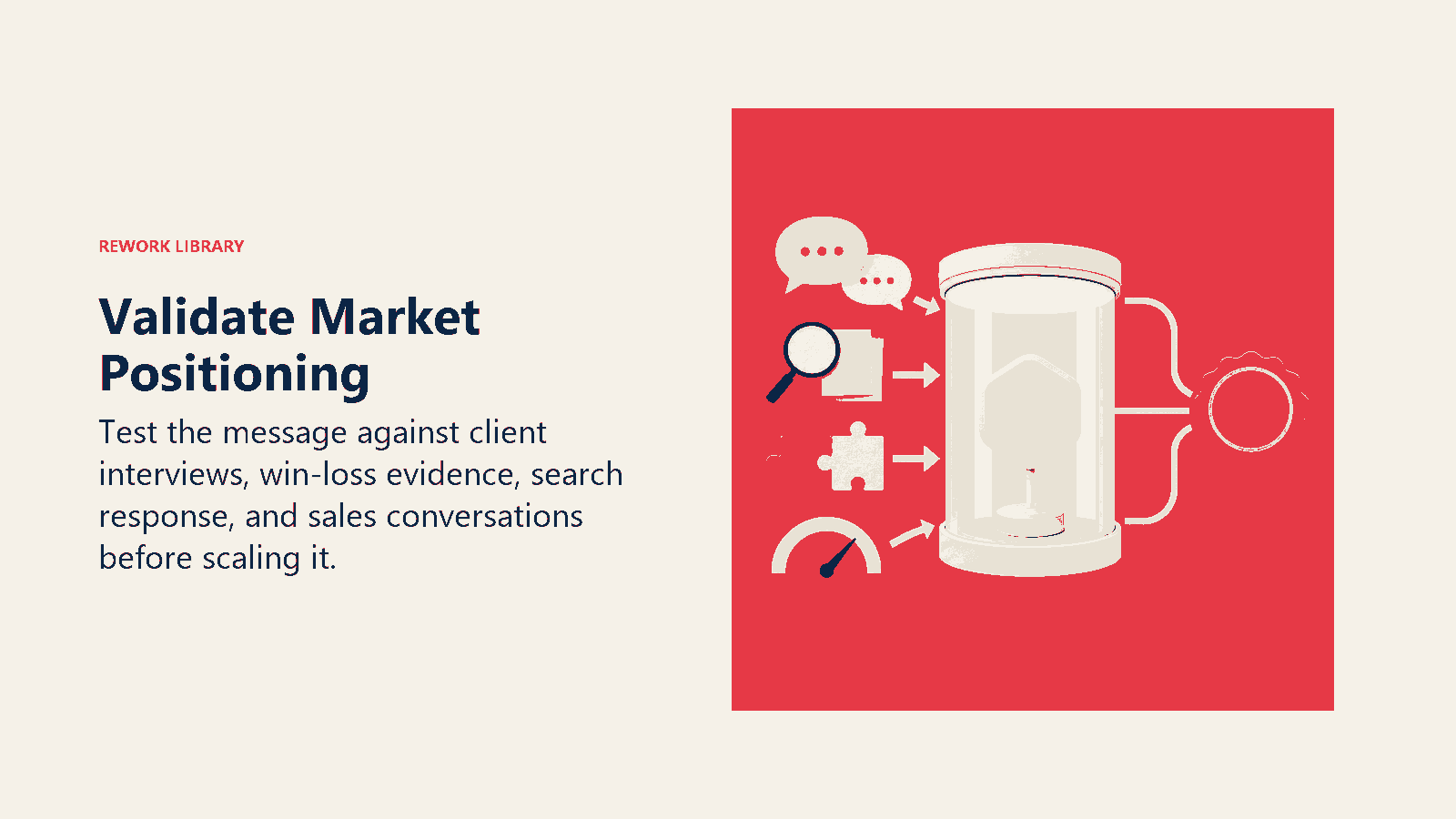
Test 1: The referral precision test. When your existing clients refer you, what do they say? If they say "you should talk to these guys, they're great consultants," your positioning hasn't landed. If they say "you should talk to these guys, they're the best in the market for integrating post-acquisition HR systems in manufacturing companies," your positioning has landed.
Ask your three best clients what they tell people about you when they refer you. The gap between what they say and what you want them to say is the gap in your positioning.
Test 2: The competitive comparison test. When prospects are comparing you to alternatives, how do they describe the comparison? "We're also looking at two other strategy firms" means you're competing on price and relationship. "We're also looking at one other firm that does what you do, but they're more focused on tech companies and we're a services business" means your positioning is distinct enough to create a clear choice.
Test 3: The inbound signal test. Does your inbound contact (website, LinkedIn, conference follows) reflect the kind of company you're trying to attract? If your positioning is working, inbound should filter toward your ideal client profile. If you're getting inbound from a wide range of company types and problems, your positioning isn't specific enough to attract selectively.
Messaging: Translating Positioning Into Communication
Once positioning is clear, messaging is the language that expresses it consistently across touchpoints.
The most common messaging failure in professional services is positioning-message misalignment: the positioning says one thing and the website says something else. This happens because positioning is decided by the leadership team and website copy is written by whoever builds the website, and they're not given the positioning statement as a brief.
Every external-facing communication should express the same positioning. The homepage headline, the LinkedIn profile, the case study opener, the pitch deck introduction, the proposals, the networking elevator pitch. Not the same words, but the same core message.
For the core message to land, it needs to:
Lead with the problem, not the firm. Start with what the client is dealing with. If your positioning is strong, the client who reads a problem description that precisely matches their situation will lean forward to find out who can solve it.
Prove specificity with evidence. Generic claims require no proof. Specific claims require specific evidence. "We helped a 180-person SaaS company reduce customer churn from 22% to 14% in 18 months" is more persuasive than "we produce measurable results for our clients" because it's specific and verifiable.
Make the next step obvious and low-risk. Strong messaging ends with a clear, low-commitment action. Not "contact us to learn more" but "download our framework for post-acquisition HR integration" or "book a 30-minute call to discuss your situation."
The go-to-market strategy outlines how this messaging architecture connects to the channels you're using to reach your ideal clients.
Defending Positioning Against Short-Term Pressure
One of the hardest aspects of positioning is maintaining it when business is slow. When the pipeline is thin, the temptation is to broaden positioning, take on out-of-scope work, and expand the client definition to include anyone who might pay.
This is the most common way professional services firms erode their positioning over time. They specialize narrowly when business is good, broaden when it's slow, rebuild specificity when business picks up, and broaden again in the next slow period. The result is an inconsistent brand that never fully delivers on the value of specialization.
The alternative is to treat the slow period as an investment in the positioning, not a reason to abandon it. The firms that use slow periods to deepen their specialization (write the white paper, develop the methodology, invest in the conference relationships) come out stronger. The ones that chase out-of-scope work come out with diluted positioning and a longer path back to their core market.
This requires financial discipline: enough reserves to maintain discipline during slow periods rather than taking survival work that undermines positioning. The professional services metrics framework includes the financial buffer metrics that give you the discipline to hold your positioning.
Positioning is a long game. The firms that win it are the ones that make the hard choice to be specific rather than comprehensive, and then maintain that choice when the pressure is to be everything to everyone.

Senior Operations & Growth Strategist