RocketReach vs Lusha (2026): Per-Seat Lookups vs Bundled Credits, Priced for 1, 3 and 5 Users
Turn this article into takeaways for your work.


Each assistant summarizes the article only for you and suggests best practices for your work.
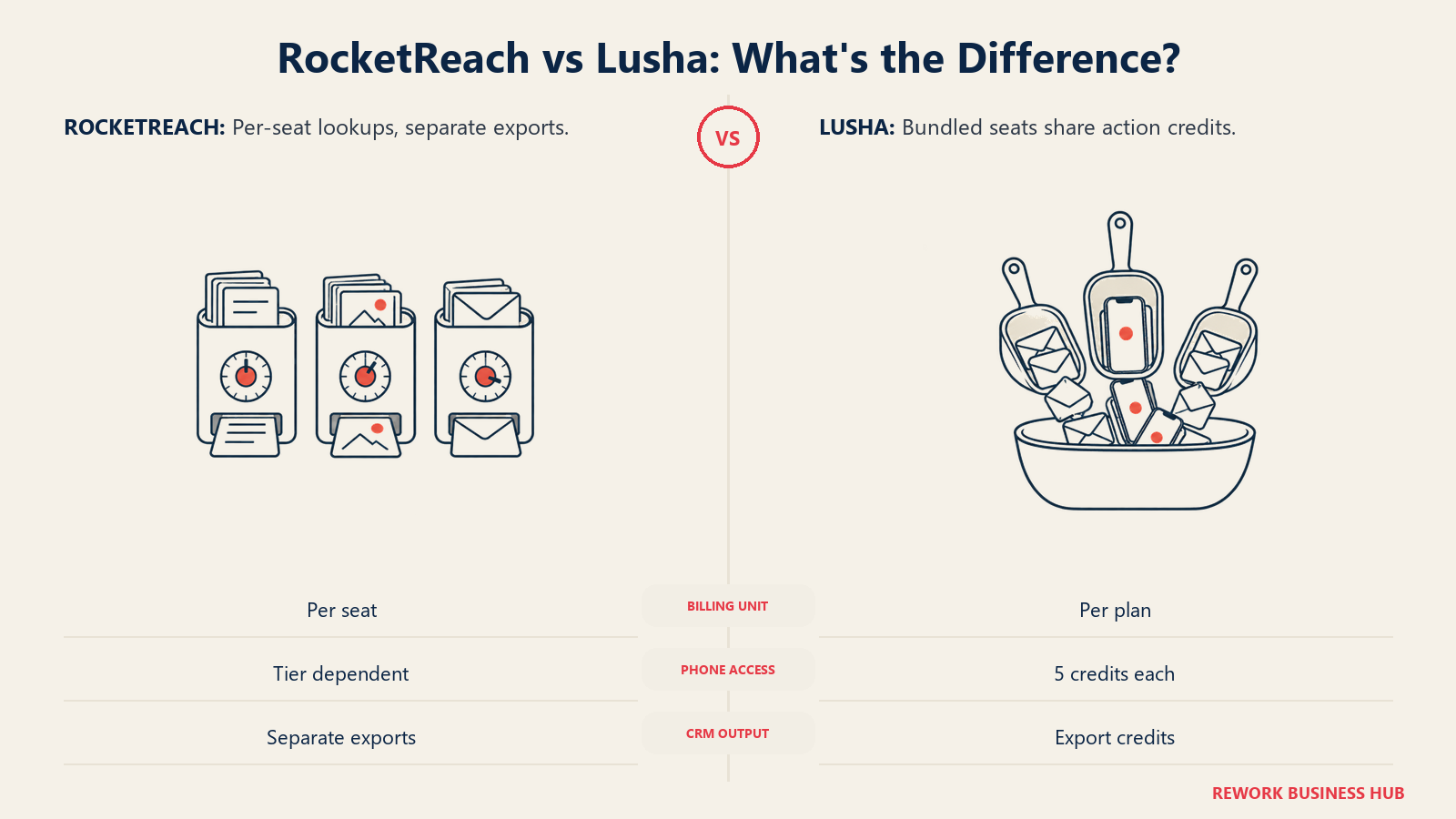
If you're a sales leader, a recruiting lead or an SDR manager comparing RocketReach and Lusha, you've probably noticed that the two price lists don't line up. One sells you a seat and a count of lookups. The other sells you a plan, bundles one, two or five seats into it, and meters everything in credits where a phone number costs five times an email. A table of "plan names and prices" can't answer which is cheaper, because the answer changes with the number of users and with how many of the contacts you pull need a phone number.
So this comparison is built around that arithmetic. You'll get a worked cost table for one, three and five users, a second table that splits the same budget into email-heavy and phone-heavy work, and a plain read on data claims, compliance and who should pick which. Every price is the vendor's published figure with its billing term attached, because the annual and monthly numbers on both sites sit far apart. For the wider market, the best sales intelligence tools hub covers data, intent and enrichment vendors. If you already know you want to leave one of these two, go straight to the best RocketReach alternatives or the best Lusha alternatives.
Key Facts
- Meter: RocketReach counts lookups per seat and, separately, exports. Lusha counts credits per plan: an email is 1 credit and a phone number is 5, per Lusha's pricing page.
- Seats: RocketReach is priced per seat. Lusha is flat per plan with 1 seat on Starter, 2 on Pro and 5 on Premium.
- RocketReach monthly billing: Essentials $49, Pro $99, Ultimate $209 a month, capped at 100, 250 and 1,000 lookups a month.
- RocketReach annual billing: from $399 a year (US list), Pro $899, Ultimate $1,699, with "unlimited" lookups under a 10,000 a month fair-use cap.
- Lusha monthly billing: Starter $49.90, Pro $69.90, Premium $399.90 a month.
- Lusha annual billing: Starter $37.45, Pro $52.45, Premium $299.95 a month, billed as $449.10, $629.10 and $3,599.10 a year.
- Free tiers: RocketReach gives 5 free lookups. Lusha gives 40 credits a month.
- Biggest trap on RocketReach: API calls, bulk lookups, CSV, list upload and CRM pushes consume exports, not lookups.
- Biggest trap on Lusha: annual credits are issued up front and reset at year end, while monthly plans roll over up to 2x the monthly cap.
TL;DR
| Factor | RocketReach | Lusha |
|---|---|---|
| Pricing unit | Per seat | Per plan, seats bundled (1, 2 or 5) |
| Usage meter | Lookups, plus a separate export allowance | Credits: email 1, phone 5, export 1 per 1 to 25 results |
| Monthly billing | Essentials $49, Pro $99, Ultimate $209 per seat | Starter $49.90, Pro $69.90, Premium $399.90 per plan |
| Annual billing | From $399/yr (US list), Pro $899/yr, Ultimate $1,699/yr per seat | Starter $449.10/yr, Pro $629.10/yr, Premium $3,599.10/yr per plan |
| Free tier | 5 free lookups | 40 credits a month, 1 user |
| Charged when nothing is found? | No, a lookup is charged only when a verified email or phone is found | Confirm refund behaviour with the vendor |
| Cheapest for | One or two people, occasional lookups, email only | Teams of three to five who share a pool of credits |
| Watch out for | Exports metered on top of lookups | Phone numbers burn credits five times faster than emails |
Who Each Tool Is Built For
RocketReach is a search-first product. You look up a person or a company, you get an email and often a phone number, and you're charged per verified hit. Its pricing assumes that each person who prospects has their own seat and their own allowance. That fits recruiters, founders doing their own outreach and small sales pods where the work is spread unevenly: one heavy user, two light ones.
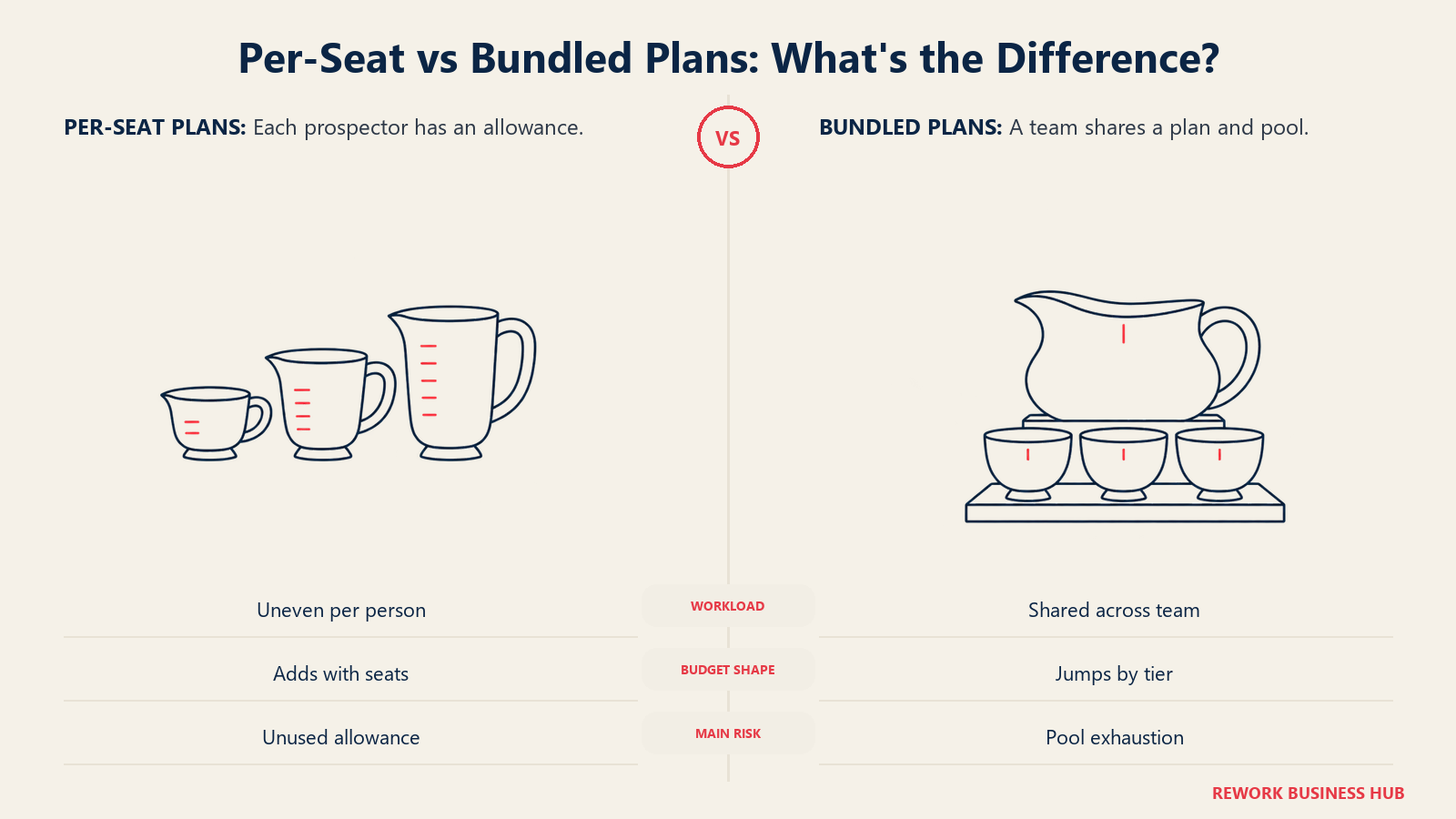
Lusha is a browser-extension and CRM-enrichment product sold the way a lot of SMB SaaS is sold: a plan with a headline price, a credit pool and a few seats thrown in. It fits a small team that wants one invoice, one pool and no per-seat arithmetic. The catch is that the pool is finite, and a team that leans on phone numbers will see it drain quickly.
| Dimension | RocketReach | Lusha |
|---|---|---|
| Typical buyer | Recruiter, founder, individual rep, small pod with uneven usage | SDR or AE team of 2 to 5 sharing one budget |
| Ideal team size | 1 to 3 seats, or enterprise on a custom plan | 1 to 5 users on a self-serve plan |
| Where it starts | Free account with 5 lookups | Free plan with 40 credits a month |
| Where it ends | Team and custom plans start at $6K annually | More than 5 users goes through sales; Scale is custom |
| Heaviest use case | Targeted lookups of named people and roles | Browser-side reveals and CRM enrichment at modest volume |
| Budget style | Variable: grows with every seat | Step function: jumps at each plan boundary |
If your reps are spread across several territories and each needs a handful of contacts a week, per-seat pricing can come out ahead. If three reps all pull from the same pool of accounts, a bundled plan is usually easier to forecast. The cost tables below show where the crossover sits. If you're evaluating the whole category rather than these two, the best LinkedIn contact finder tools page ranks the browser-extension tools that both of these compete in.
Capability Comparison
Before the money, here is what you actually get for it.
| Capability | RocketReach | Lusha |
|---|---|---|
| Email lookup | Yes, on every paid plan (annual Essentials is email only) | Yes, 1 credit each |
| Phone lookup | Pro and Ultimate on annual billing; confirm Essentials phone access on monthly billing | Yes, 5 credits each |
| Browser extension | Yes | Yes |
| CRM push | Yes, consumes exports | Yes, export costs 1 credit per 1 to 25 results |
| API | Yes, consumes exports | Plan and tier dependent, confirm with the vendor |
| Bulk lookups and list upload | Yes, consume exports | Export credits apply |
| Do-not-call awareness | Confirm with the vendor | A "Do not call list" row appears in the plan comparison |
| Extra signals | Company and people search | De-anonymized IP (2 credits), call intelligence (8 credits) |
| Free option | 5 lookups | 40 credits a month |
| Team admin | Seat management; team plans from $6K a year | Seats bundled; per-user credit caps only on Scale |
Two details deserve a second look. First, RocketReach annual Essentials is email only. If you need direct dials, you start at Pro, which is $899 a year per seat rather than $399. Second, RocketReach's exports are a separate meter from lookups. A rep who finds 500 contacts and pushes them into the CRM can spend 500 lookups and 500 exports. The lookups are "unlimited" on an annual plan; the exports are not.
The Core Difference: Lookups vs Credits
Both vendors use the word "credit" loosely, so it's worth defining the meters precisely.
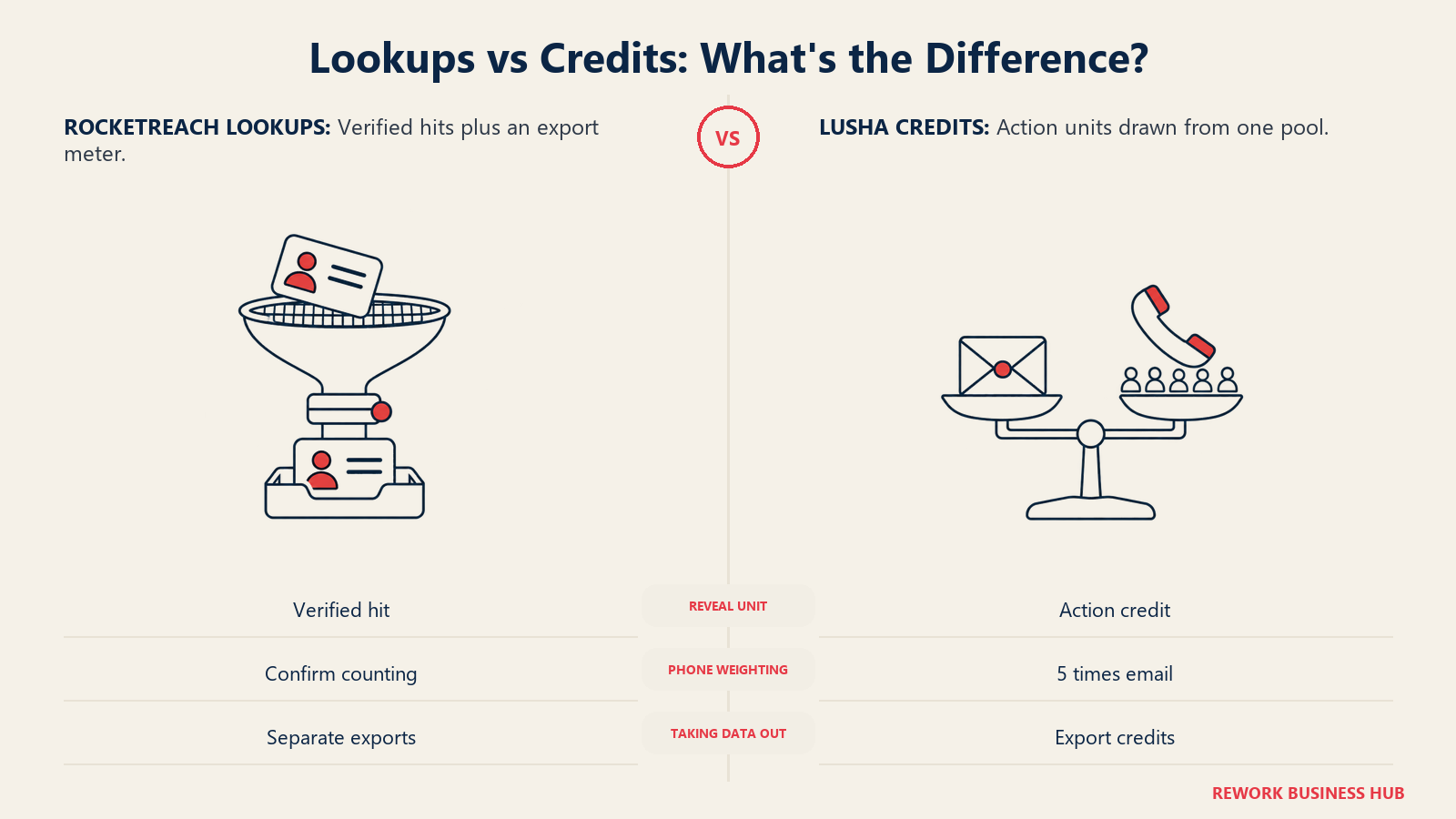
RocketReach prices a lookup: an attempt to reveal a verified email or phone for a person. On monthly billing, the number of lookups is capped at 100, 250 or 1,000 a month depending on plan. On annual billing, lookups become "unlimited," subject to a fair-use cap of 10,000 a month. A lookup is charged only when a verified result comes back, which means a miss costs you nothing. Separately, an export is what you spend when you take data out of RocketReach in bulk or through an integration. Annual plans include 1,200, 3,600 and 20,000 exports a year on Essentials, Pro and Ultimate. Monthly plans include 100, 250 and 1,000 exports a month.
Lusha prices a credit, and the credit's value depends on what you reveal. An email is 1 credit and a phone number is 5. Exports to CSV or CRM cost 1 credit per 1 to 25 results. A de-anonymized IP is 2 credits and a call-intelligence action is 8. On monthly plans, unused credits roll over up to twice the monthly cap. On annual plans, credits arrive up front and reset at year end.
| Question | RocketReach | Lusha |
|---|---|---|
| What is a "unit"? | A lookup that returns a verified email or phone | A credit, worth 1 (email) or 5 (phone) |
| Does a phone cost more than an email? | Published as lookups; confirm how a contact with both is counted | Yes, 5 times more |
| What do integrations cost? | Exports (separate allowance) | Export credits |
| Is "unlimited" real? | Annual only, under a 10,000 a month fair-use cap | Not offered on self-serve plans |
| Unused volume | Confirm rollover with the vendor | Monthly rolls over to 2x the monthly cap; annual resets at year end |
| Per-seat or pooled? | Per seat | Pooled across the bundled seats |
| Failed lookup | Not charged | Confirm with the vendor |
A simple way to hold the difference in your head: RocketReach gets expensive as you add people, and cheap as you add volume on one person. Lusha gets expensive as you add phone numbers, and cheap as you add people up to the seat limit.
RocketReach in Detail
RocketReach's pricing page sells per seat, with a seat selector and a discount for each extra seat added. The headline says "Save 50% with annual." Monthly billing is Essentials at $49, Pro at $99 and Ultimate at $209 a month. Annual billing is geo-served: the US list shows Essentials from $399 a year, Pro at $899 and Ultimate at $1,699. Read the annual figures on your own screen before you budget, because they vary by region.
| Plan | Monthly billing (per seat) | Annual billing (per seat) | Lookups | Exports |
|---|---|---|---|---|
| Free | $0 | n/a | 5 lookups | Confirm with the vendor |
| Essentials | $49/mo | From $399/yr (US list) | 100/mo, or "unlimited" email only on annual | 100/mo, or 1,200/yr |
| Pro | $99/mo | $899/yr (US list) | 250/mo, or "unlimited" email and phone on annual | 250/mo, or 3,600/yr |
| Ultimate | $209/mo | $1,699/yr | 1,000/mo, or "unlimited" email and phone on annual | 1,000/mo, or 20,000/yr |
| Team and custom | On request | From $6K annually | Custom | Custom |
The annual fair-use cap is 10,000 lookups a month, which is generous for one seat but worth knowing about if one account is shared by several people. Because exports are consumed by API calls, bulk lookups, CSV downloads, list uploads and CRM pushes, the practical ceiling for a team that automates its workflow is the export number, not the lookup number. On annual Pro, 3,600 exports is 300 a month. A rep who enriches 400 records a month into the CRM will run out before the year does.
Divide each plan's price by its export allowance and you get an implied rate: $399 over 1,200 exports is about $0.33 each, $899 over 3,600 is about $0.25, and $1,699 over 20,000 is about $0.085. That's arithmetic on the published figures, not a rate card, but it shows why Ultimate is the plan for anyone doing real volume.
RocketReach states SOC 2 Type II and ISO 27001 and publishes CCPA request metrics in its privacy policy. It claims 700 million professionals and 60 million companies and 98% accuracy on its pricing page. The free account is a real trial: 5 lookups, no card.
Lusha in Detail
Lusha prices by plan, not by seat. On Lusha's pricing page, the Free plan gives 40 credits a month to one user with no card. Starter, Pro and Premium bundle 1, 2 and 5 seats. Scale is custom and advertises "50%+ off price per credit."
| Plan | Monthly billing | Annual billing | Credits | Seats |
|---|---|---|---|---|
| Free | $0 | n/a | 40/mo | 1 |
| Starter | $49.90/mo | $37.45/mo ($449.10/yr) | 400/mo or 4,800/yr | 1 |
| Pro | $69.90/mo | $52.45/mo ($629.10/yr) | 600/mo or 7,200/yr | 2 |
| Premium | $399.90/mo | $299.95/mo ($3,599.10/yr) | 3,400/mo or 40,800/yr | 5 |
| Scale | Custom | Custom | Custom | Custom |
Annual billing is described as "25% off." The jump from Pro to Premium is the one to study. Going from two seats to five costs $330.00 more a month on monthly billing ($399.90 against $69.90), and delivers 2,800 more credits a month. That's a steep step if you need three users, but a much better rate per credit once you're using the pool.
Lusha's implied cost per credit, again straight arithmetic on the published prices: Starter is about $0.125 a credit on monthly billing and $0.094 on annual. Pro is about $0.117 monthly and $0.087 annual. Premium is about $0.118 monthly and $0.088 annual. So a phone number, at five credits, lands at roughly $0.44 to $0.62 depending on plan and term, and an email lands at $0.09 to $0.12.
Credits can be spent on exports too (1 credit per 1 to 25 results), de-anonymized IP lookups (2 credits) and call intelligence (8 credits). Per-user credit caps exist only on Scale. If you have more than five users, you talk to sales.
Data Coverage, Accuracy and Verification
Every figure in this section is a vendor claim. Neither company publishes an independent audit, and the two sets of claims are not measured the same way.
| Claim | RocketReach | Lusha |
|---|---|---|
| Database size | 700 million professionals, 60 million companies | 515M+ verified contacts, 29M+ companies |
| Verified emails | Confirm with RocketReach | 165M+ verified emails |
| Email accuracy | 98% accuracy on the pricing page; "90-98% deliverability on verified emails" on the homepage | 98% email accuracy |
| Phone accuracy | Confirm with RocketReach | 85% US and 86% global |
| Verification model | Lookup charged only when a verified result is found | Confirm credit behaviour on a miss with the vendor |
| Badges | SOC 2 Type II, ISO 27001 | SOC 2 Type II, ISO 27701, ISO 42001 |
Read these as positions. RocketReach's pitch is breadth: a bigger headline database and a charging model that only bills on a verified hit. Lusha's pitch is that it publishes a phone accuracy number, which RocketReach does not break out. A "98% accurate" email claim also means different things depending on whether it describes syntactic validity, a deliverability check or a human-reviewed sample. Ask each vendor which one.
The only test that matters is on your own list. Take 100 contacts from the segment you actually sell to (same titles, same regions, same company sizes) and run them through both free tiers. Lusha's free plan gives 40 credits, enough to test 40 emails or 8 phones. RocketReach gives 5 lookups, which is too few to say anything except whether your target persona is present at all, so plan to pay for one month to run a proper test. Then send the emails through a verifier and dial a sample of the phones. Measure bounce rate and answer rate, not the percentage on the website.
Email accuracy has a cost beyond wasted credits. Google requires bulk senders to keep spam rates below 0.30%, with under 0.10% as the recommended target. A list with stale addresses is the quickest route to complaints and a damaged sending domain. People also move. The Bureau of Labor Statistics reports a median job tenure of 4.1 years as of January 2026, and its latest JOLTS release shows 3.2 percent total separations in August. No vendor can promise that data bought last quarter is still right today.
Salesforce's State of Sales research is a useful reminder of why this matters. Reps spend 40% of their week selling, and the same report notes that 46% of sales professionals with agents say data quality issues hurt their sales. A cheaper per-contact rate is no bargain if a meaningful share of what you buy bounces or goes to voicemail.
Pricing at 1, 3 and 5 Users
Here's the worked cost. All prices come from RocketReach's pricing page and Lusha's pricing page. RocketReach is multiplied by the number of seats at list price, so it's before any discount for adding seats. Lusha is the smallest plan that bundles enough seats. Annual billing first.
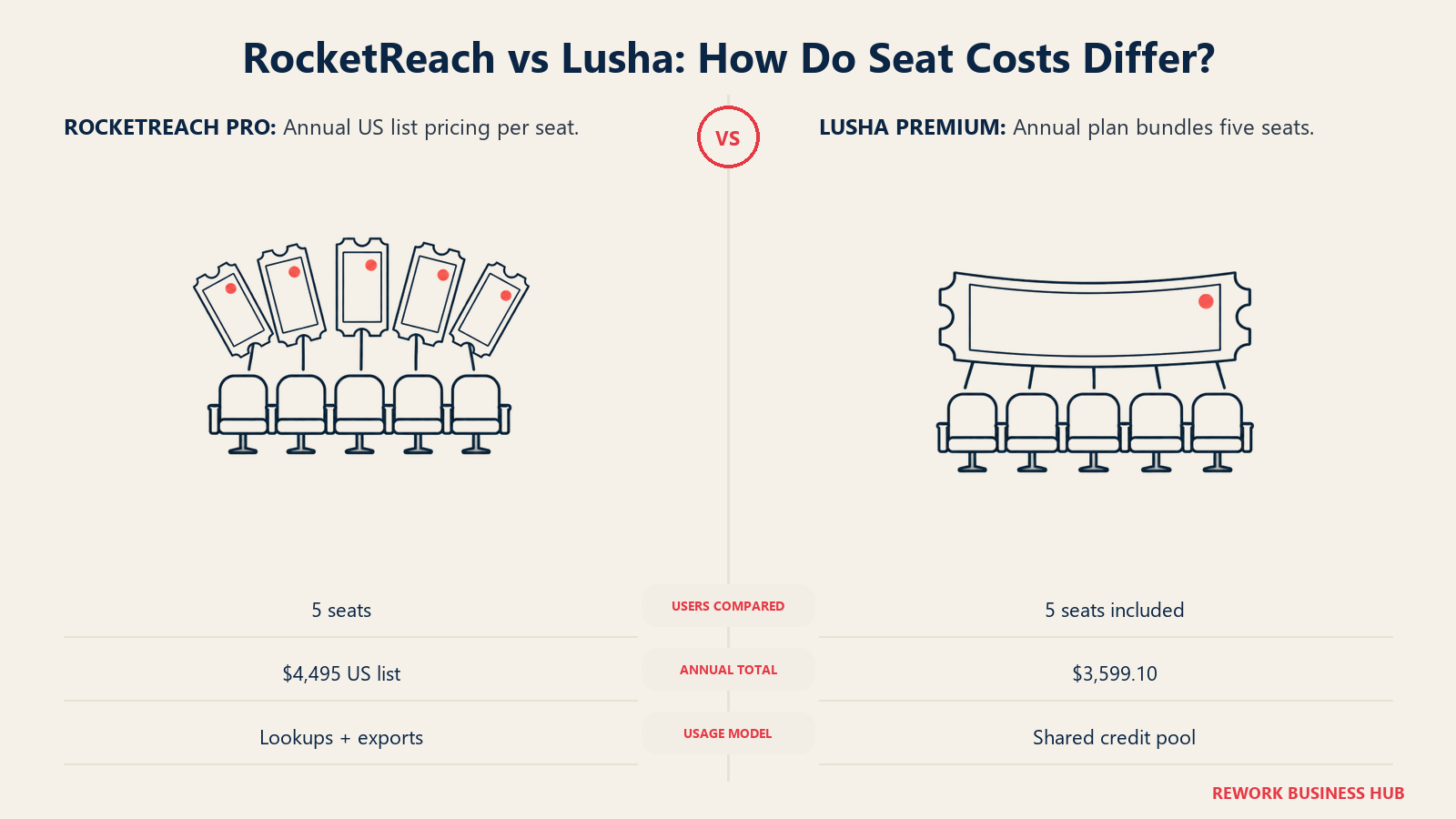
| Users | RocketReach Essentials (annual) | RocketReach Pro (annual) | RocketReach Ultimate (annual) | Lusha (annual) |
|---|---|---|---|---|
| 1 user | $399/yr (US list) | $899/yr (US list) | $1,699/yr | Starter $449.10/yr |
| 3 users | $1,197/yr (3 x $399) | $2,697/yr (3 x $899) | $5,097/yr (3 x $1,699) | Premium $3,599.10/yr (5 seats bundled) |
| 5 users | $1,995/yr (5 x $399) | $4,495/yr (5 x $899) | $8,495/yr (5 x $1,699) | Premium $3,599.10/yr |
For two users, Lusha Pro at $629.10 a year (annual billing) covers both seats. For three users, Lusha has no three-seat plan: the self-serve choices are Premium at $3,599.10 a year, or two separate subscriptions such as Pro plus Starter at $1,078.20 a year in total on annual billing. Ask Lusha whether separate subscriptions can share a pool before you plan around that second option.
Now monthly billing. The monthly figure is per month, so the bill compounds over a year; the right-hand column multiplies it by 12 so you can compare with the annual table above.
| Users | RocketReach Essentials (monthly) | RocketReach Pro (monthly) | RocketReach Ultimate (monthly) | Lusha (monthly) |
|---|---|---|---|---|
| 1 user | $49/mo ($588 over 12 months) | $99/mo ($1,188 over 12 months) | $209/mo ($2,508 over 12 months) | Starter $49.90/mo ($598.80 over 12 months) |
| 3 users | $147/mo (3 x $49) | $297/mo (3 x $99) | $627/mo (3 x $209) | Premium $399.90/mo (5 seats bundled) |
| 5 users | $245/mo (5 x $49) | $495/mo (5 x $99) | $1,045/mo (5 x $209) | Premium $399.90/mo |
Three things stand out.
One user: close, and RocketReach wins on volume. On annual billing, RocketReach Essentials at $399 is lower than Lusha Starter at $449.10, and it offers unlimited email lookups against Lusha's 4,800 credits a year. But Essentials has no phone numbers. A solo rep who needs direct dials starts at RocketReach Pro, $899 a year, against Lusha Starter at $449.10 with 960 phone reveals a year if every credit goes to phones. For a solo user, the right choice depends on whether your daily work is emails or phones.
Three users: RocketReach is cheaper unless you need a large pool. Three Essentials seats are $1,197 a year, a third of Premium's $3,599.10. Three Pro seats are $2,697, still below Premium. The comparison flips only when the work needs Premium's pool, which on annual billing is 40,800 credits.
Five users: Lusha Premium's flat price is hard to beat if you use the pool. Five Pro seats on RocketReach annual are $4,495. Five Essentials seats are $1,995, which is cheaper but email only. The same five people on Lusha Premium cost $3,599.10 a year and share 40,800 credits. That's an average of 8,160 credits a seat, or 1,632 phone reveals per person a year if all credits go to phones.
One more point on timing. Monthly billing is more expensive per month on both sides, and the gap is large: RocketReach Essentials is $49 monthly against $399 a year (US list), which is about $33 a month. Lusha Starter is $49.90 monthly against $37.45 a month on annual. If you aren't sure the tool will stick, pay monthly for one quarter, run the accuracy test, and then switch to annual billing.
Phone-Heavy vs Email-Heavy: Where the Meters Bite
Per-user cost doesn't tell the whole story. A team doing 400 email reveals a month and a team doing 300 phone reveals a month are buying very different things. The table below uses two clear scenarios and the published limits only. Billing term is in every cell.
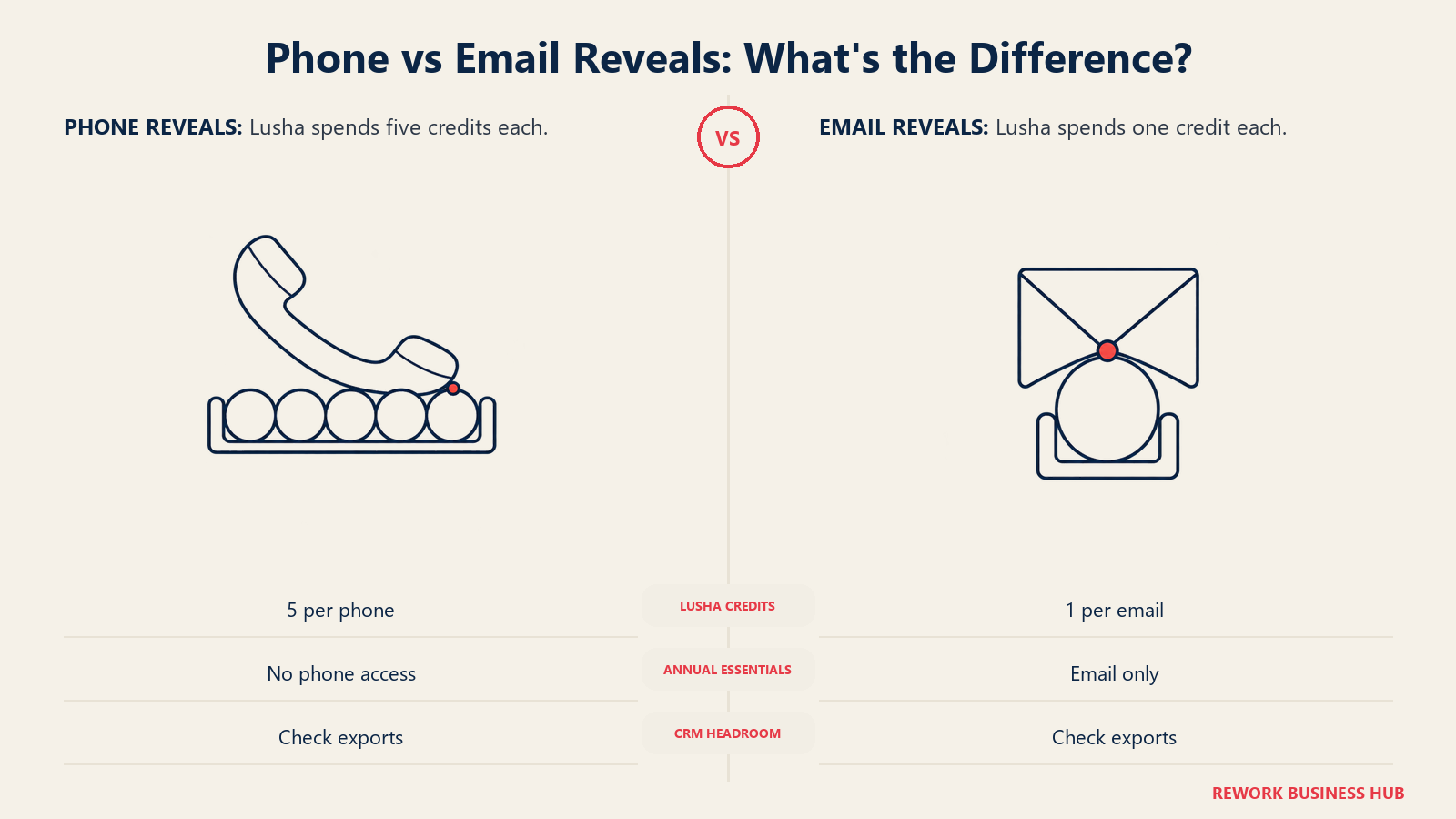
Scenario 1, phone-heavy: one rep reveals 300 phone numbers a month (3,600 a year). Scenario 2, email-heavy: three reps each reveal 400 emails a month (1,200 emails a month in total, 14,400 a year).
| Scenario | RocketReach fit | Lusha fit |
|---|---|---|
| 1 user, 300 phones a month, monthly billing | Pro allows 250 lookups a month, so it falls short. Ultimate at $209/mo (1,000 lookups) fits. | 300 phones is 1,500 credits a month. Pro (600) and Starter (400) fall short. Premium at $399.90/mo (3,400 credits) fits. |
| 1 user, 300 phones a month, annual billing | Pro at $899/yr (US list) includes phone lookups, but 3,600 exports a year is exactly 300 a month, with no headroom if you push to CRM. Ultimate at $1,699/yr has headroom. | 3,600 phones a year is 18,000 credits. Pro (7,200 a year) falls short. Premium at $3,599.10/yr (40,800 credits) fits. |
| 3 users, 400 emails each a month, monthly billing | Essentials at 3 x $49 = $147/mo gives 300 lookups total, so it falls short. Pro at 3 x $99 = $297/mo gives 750, still short. Ultimate at 3 x $209 = $627/mo gives 3,000 and fits. | 1,200 credits a month. Premium at $399.90/mo (3,400 credits) fits and leaves room for some phones. |
| 3 users, 400 emails each a month, annual billing | Essentials at 3 x $399 = $1,197/yr (US list) has unlimited email lookups under the fair-use cap. Exports (3 x 1,200 = 3,600 a year) limit how much you can push out. | Premium at $3,599.10/yr (40,800 credits) covers 14,400 email credits with room to spare. Pro at $629.10/yr (7,200 credits) falls short. |
What this shows is simple. On phone-heavy work, the cheapest RocketReach path that works is Pro on annual billing, with export headroom as the pinch point; Lusha needs Premium, because phones cost five credits. On email-heavy work, RocketReach annual Essentials is the cheapest path on the table by a wide margin, but it only holds if exports aren't your bottleneck. If the team pushes every record into a CRM (the data enrichment tools page covers products built around that workflow), export allowances decide the plan, and the "unlimited" lookups are beside the point.
For a mixed team, try the plan by reading your own history. Count how many contacts your reps revealed last month, how many needed a phone, and how many were pushed to the CRM. Those three numbers decide the plan more than any price list. If you're a mixed team that isn't sure, Lusha vs Apollo shows how the same exercise looks against a third vendor with a much larger credit pool.
Compliance: GDPR, PDPA, CCPA and Do-Not-Call
Buying contact data means you inherit some of the legal exposure of using it. Neither vendor's badge settles that for you.

| Area | What to know | RocketReach | Lusha |
|---|---|---|---|
| GDPR (EU, UK) | You need a lawful basis to contact a person, and a notice duty applies | Confirm the lawful-basis and notice position with the vendor | GDPR (ePrivacyseal) listed |
| PDPA (Singapore, Malaysia) | Consent and purpose rules apply to marketing contact | Confirm coverage with the vendor | Confirm coverage with the vendor |
| CCPA (California) | Rights to know, delete and opt out of sale | CCPA request metrics in the privacy policy | CCPA (TrustArc) listed |
| Do-not-call | Phone data needs screening before dialing | Confirm DNC handling with the vendor | A "Do not call list" row appears in the plan comparison |
| Security audits | Third-party attestations | SOC 2 Type II, ISO 27001 | SOC 2 Type II, ISO 27701, ISO 42001 |
The regulatory risk is not hypothetical. In December 2024 the French regulator fined the contact-data vendor KASPR €240,000 for collecting the details of LinkedIn users who had restricted visibility of their profile, citing breaches of GDPR Articles 5, 6, 12, 14 and 15. That's a data vendor, not a buyer, but it's the clearest recent warning about how scraped B2B data can fail a regulator's test. If your reps sell into Europe, ask each vendor how the contact data was sourced, what lawful basis they rely on, and what they do when someone asks to be removed. Singapore's PDPC and its Malaysian counterpart enforce consent and purpose limits under the PDPA, and California's CCPA gives residents the right to know, delete and opt out.
Phone data adds its own rules. In the US, the FTC says the Do Not Call registry carries civil penalties of up to $53,088 for each violation and that telemarketers must synchronize their lists every 31 days. The registry rule does not apply to business-to-business calls, but the Telephone Consumer Protection Act is a separate matter: it allows a private action for $500 per violation, which courts can treble for willful violations. In the UK, the ICO fined Energy Prices Direct £160,000 in May 2026 for over 700,000 unsolicited marketing calls to TPS and CTPS numbers, including businesses. A number being easy to reveal doesn't mean it's safe to dial.
In practice: screen phone numbers against the relevant do-not-call lists before they go into a dialer, keep a record of the lawful basis for each campaign, and honor opt-outs on the same day. Neither tool does that for you. For European or Asia-Pacific selling, see the Kaspr alternatives guide and Cognism alternatives for vendors that lead with screened phone data.
Implementation and Time to Value
Both tools are self-serve, and a rep can be up and running in an afternoon. The differences are in rollout.
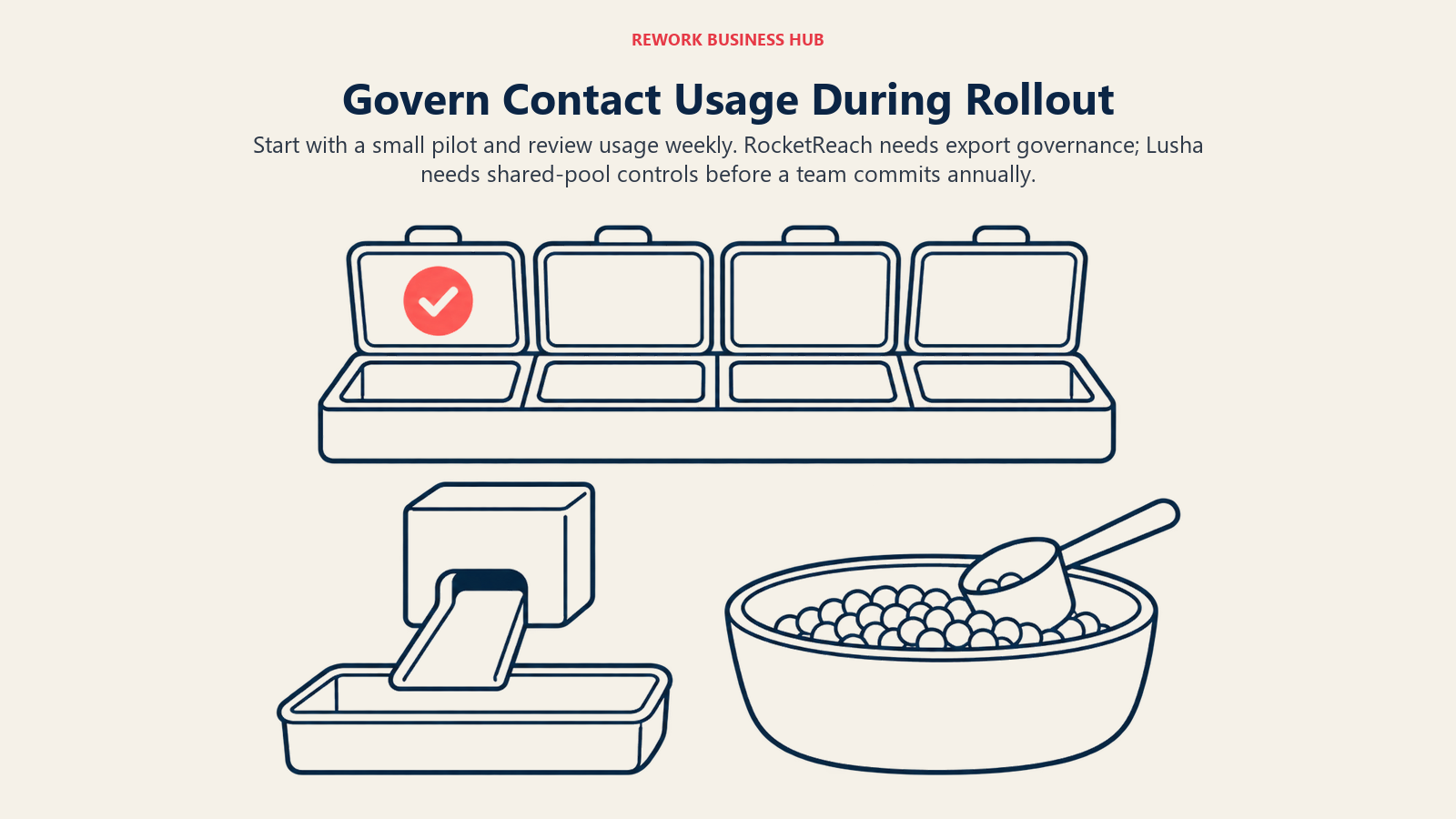
RocketReach: Create the free account, test the five lookups, then add seats one at a time. Each rep has their own allowance, which makes it easy to see who is using what, but harder to rebalance if one person burns through theirs. Set rules early for who pushes to the CRM, since exports are the scarce meter on annual plans. Budget one afternoon for setup and one to two weeks to learn which plan tier you actually need.
Lusha: Install the extension for the bundled seats, connect the CRM, and set a rule for how credits are spent. Because the pool is shared, one enthusiastic user can empty it for everyone, and on annual billing the credits reset at year end rather than rolling over. A monthly plan gives you the 2x rollover, which suits uneven months. Budget an afternoon for setup and a week of watching burn rate against the pool before you decide whether to move up to Premium.
Either way, appoint one person to review credit or lookup consumption weekly for the first month. Teams that skip this step find out at the end of the term, not the start.
When RocketReach Is the Right Call
- You have one or two prospectors and want the lowest annual bill. At $399 a year (US list) for email lookups under a fair-use cap, annual Essentials is the cheapest path in this comparison for email-only work.
- Your volume is spiky and uneven between people. Per-seat pricing means a light user costs little, and a heavy user can step up to Ultimate without forcing the whole team to upgrade.
- You want to pay only for hits. A lookup is charged only when a verified email or phone is found, so misses are free.
- You're a recruiter or a founder searching for named people. The search-first workflow fits one-off lookups of specific people better than bulk reveals.
- Your procurement team needs SOC 2 Type II and ISO 27001 on paper. RocketReach lists both.
When Lusha Is the Right Call
- You have three to five reps sharing a pool. Premium at $3,599.10 a year (annual billing) or $399.90 a month bundles five seats and 3,400 credits a month.
- You want a larger free tier to test with. Forty credits a month against five lookups lets you run a real pilot before paying.
- You want a published phone accuracy figure. Lusha claims 85% US and 86% global phone accuracy, which RocketReach doesn't separate out.
- You like predictable step pricing. A plan price is easier to put in a budget than a per-seat total that grows with the team.
- Your usage varies month to month. On monthly billing, credits roll over up to 2x the monthly cap.
Decision Framework
| If this describes you | Pick | Why |
|---|---|---|
| Solo user, email-only prospecting, lowest cost | RocketReach Essentials (annual) | $399/yr (US list) with unlimited email lookups under fair use |
| Solo user who needs direct dials, modest volume | Lusha Starter, or RocketReach Pro | Starter is $449.10/yr (annual) for 960 phones; Pro is $899/yr (US list) with phone lookups |
| Two users, light volume | Lusha Pro (annual) | $629.10/yr for 2 seats and 7,200 credits |
| Three users, email-heavy | RocketReach Essentials x 3 (annual) | $1,197/yr (US list), if exports aren't the bottleneck |
| Three users, phone-heavy | Lusha Premium, or RocketReach Pro x 3 | Premium is $3,599.10/yr; Pro x 3 is $2,697/yr (US list) |
| Five users, shared pool | Lusha Premium (annual) | $3,599.10/yr flat for 5 seats and 40,800 credits |
| Heavy CRM automation and exports | RocketReach Ultimate (annual) | 20,000 exports a year at $1,699 |
| Uneven month-to-month usage | Lusha on monthly billing | Rollover up to 2x the monthly cap |
| Regulated outreach in the EU or Asia-Pacific | Run a vendor review for both | Neither badge replaces your own lawful-basis record |
If neither fits, look wider. The best email finder tools page covers cheaper email-only options, the best B2B data providers page covers larger platforms, and the guide to choosing sales intelligence software walks through the buying process.
What to Do Next
Run a two-week pilot with real numbers, not a demo. Pick the three reps who will use the tool most and one list of 100 contacts from your actual territory. Put each rep on a free tier first, then pay monthly for whichever tool looks stronger. Record four things: how many contacts were found, how many emails bounced, how many phone numbers connected, and how many credits or lookups plus exports were spent. Divide the spend by connected contacts, not revealed contacts. If the result is within 20% either way, choose the tool whose billing model fits how your team works: per-seat if usage is uneven, a bundled plan if the team shares a pool. Then move to annual billing, which is cheaper on both vendors.

Principal CRM Strategist
On this page
- Key Facts
- TL;DR
- Who Each Tool Is Built For
- Capability Comparison
- The Core Difference: Lookups vs Credits
- RocketReach in Detail
- Lusha in Detail
- Data Coverage, Accuracy and Verification
- Pricing at 1, 3 and 5 Users
- Phone-Heavy vs Email-Heavy: Where the Meters Bite
- Compliance: GDPR, PDPA, CCPA and Do-Not-Call
- Implementation and Time to Value
- When RocketReach Is the Right Call
- When Lusha Is the Right Call
- Decision Framework
- What to Do Next