Best Video Interview Software in 2026: 14 Tools for Structured, Compliant Hiring
Turn this article into takeaways for your work.


Each assistant summarizes the article only for you and suggests best practices for your work.
The best video interview software in 2026 depends on a question most buyers skip: do you need live conversations, one-way recorded screening, or both, and how much of that process needs to survive a bias audit? HireVue and VidCruiter win for enterprise teams that need both formats plus structured, defensible scoring. Hireflix and Willo win for teams that just need clean, affordable one-way screening. Talview and Harver win when video sits inside a bigger assessment and proctoring workflow. And Rework wins when the real gap isn't the interview itself, it's that the interview, the candidate record, and the eventual employee file live in three different systems.
This guide ranks 14 platforms for HR leads, hiring managers, talent acquisition teams, and the COOs who sign off on hiring stacks. Every price below came from the vendor's own pricing page as of August 2026, or is explicitly labeled a third-party estimate where no vendor pricing is published. Evaluation criteria: interview mode (live, one-way, or both), how the platform handles AI scoring and disclosure, ATS integration depth, and total cost against your actual hiring volume.
Key Facts
- 63% of US job seekers say they've been interviewed by AI as of April 2026, a 13-point jump from the year before, per Greenhouse's 2026 Candidate AI Interview Report (2,950 respondents across the US, UK, Ireland, Germany, and Australia).
- 38% of candidates have already walked away from a hiring process because it included an AI interview, and another 12% say they would, according to the same Greenhouse report.
- 70% of candidates who went through an AI-scored interview say the employer never clearly disclosed that AI would evaluate them before the interview started, per Greenhouse.
- Only 26% of job applicants trust AI to evaluate them fairly during an interview, according to a Gartner survey of job applicants published July 2025.
Quick Comparison Table
| Tool | Best For | Starting Price | Key Strength | Key Limitation |
|---|---|---|---|---|
| HireVue | Enterprise teams needing live plus one-way plus assessments in one vendor | Custom quote (Essential and Premium packages) | Deepest enterprise track record, absorbed Modern Hire's assessment suite | No public pricing, sales-led process |
| Spark Hire | SMBs wanting video interviews with an optional bundled ATS | $249/mo (video-only, annual) or $335/mo (Recruit Pro ATS) | Flexible standalone product or full ATS bundle | Pricing structure got more complex after 2024 acquisitions |
| VidCruiter | Structured, audit-ready hiring at scale | Custom quote (reported from roughly $5,000/yr) | Ranked #1 on Gartner Peer Insights for video interviewing | No published self-serve pricing |
| Willo | Budget-conscious one-way screening, pay-as-you-go | GBP 49/live role/mo (Lite) | Genuinely pay-per-role, no long contract required | Enterprise tier requires a 1 to 3 year commitment |
| Hireflix | Teams that only need one-way interviewing, at a flat fee | $75/mo (Small, under 50 employees) | Unlimited seats, positions, and responses on every tier | Live interviewing isn't part of the product |
| Rework | Teams that want interview scheduling on the same platform as HR records | Quote on request | Interview, E-Hiring, and Career unified with HRIS and time tracking | Not a specialist one-way video platform |
| Talview | Enterprise assessment and proctoring with video interviewing built in | Custom quote (150 to 200 candidate minimum) | Strong anti-cheating and proctoring layer for high-volume screening | No published pricing, unit-based quote model |
| Interviewer.AI | Small teams wanting credit-based AI screening | $199/mo (Essential, 50 credits) | Transparent, published credit pricing | Credits run out fast on higher-volume hiring |
| RecRight | Small European teams doing occasional one-way hiring | Quote on request (reported EUR 265 to 475/mo historically) | Simple, focused one-way interview builder | Vendor's own page no longer lists self-serve tiers |
| Vervoe | Skills-first hiring with AI-graded video responses | Custom quote (Enterprise only) | Strong AI grading plus generative-AI-cheating detection | Self-serve tiers were retired from the public pricing page |
| Canditech | Teams wanting video plus skills testing in one flow | Custom quote (free-to-start entry tier) | 500+ assessment library, one-way video, and auto-scoring together | No dollar figures published for any tier |
| Odro | Staffing and recruitment agencies | Custom quote (scoped to license count and CRM) | Purpose-built for agency workflows, not corporate hiring | Not designed for in-house TA teams |
| Harver | High-volume, assessment-led enterprise hiring | Custom quote (reported from roughly $5,000/yr) | Video interviewing embedded in a full assessment and reference-check stack | Overkill if all you need is interview scheduling |
| Zoom or Google Meet + Your ATS | Very small teams doing live interviews only, on a budget | Roughly $7 to $14/user/mo (reported, general video conferencing rate) | Cheapest possible path to live interviews | No scorecards, no AI scoring, no compliance tooling |
Live Interviews, One-Way Interviews, or Both: What Actually Matters
Before comparing vendors, it helps to separate what "video interview software" actually covers, because the category bundles two genuinely different workflows.
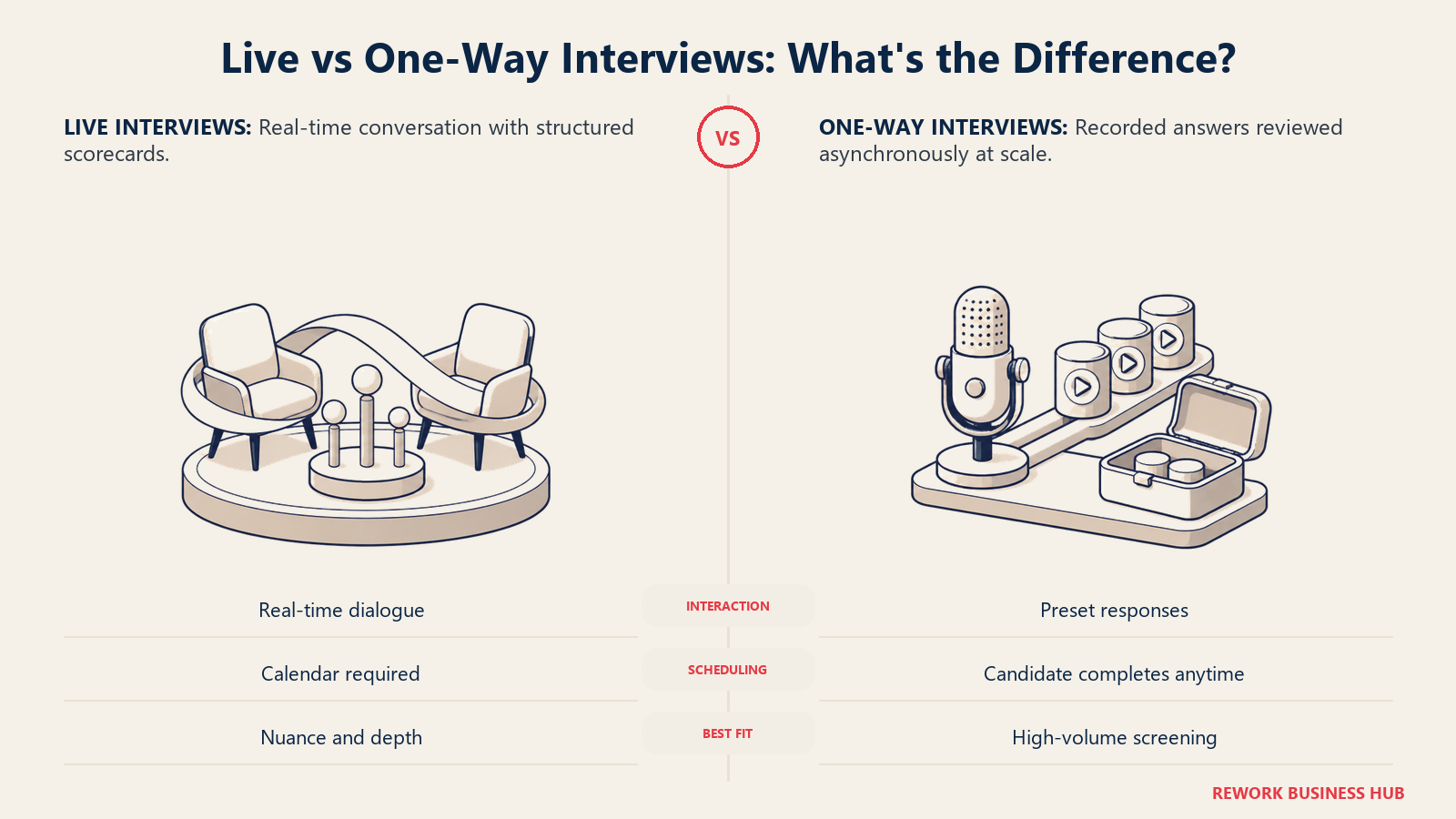
Live video interviewing replaces an in-person or phone conversation with a scheduled video call, usually with scorecards and structured questions layered on top so every interviewer evaluates candidates against the same criteria. One-way (asynchronous) video interviewing replaces the phone screen entirely: a candidate records answers to preset questions on their own time, and a recruiter or hiring panel reviews the recordings later, often with AI-assisted scoring or transcription to speed up review.
Neither format is inherently better. One-way screening moves high volume fast and removes scheduling friction, but it strips out the back-and-forth that catches nuance a rigid script misses. Live interviewing preserves that nuance but doesn't scale past a handful of open roles without adding headcount to run it. Most of the platforms in this guide pick a primary lane and support the other as a secondary feature, which is worth checking before you buy, not after.
| Tool | Live Interviews | One-Way (Async) | AI Scoring | Ideal Team Size |
|---|---|---|---|---|
| HireVue | Yes | Yes | Yes (language-based, not facial) | 500+ employees |
| Spark Hire | Yes | Yes | Yes | 20-500 employees |
| VidCruiter | Yes | Yes | Limited, structure-first | 200-5,000+ employees |
| Willo | Live add-on | Yes (core product) | Yes (Willo Intelligence) | 5-200 employees |
| Hireflix | No | Yes (core product) | No | 5-250 employees |
| Rework | Yes (scheduling and coordination) | No | No | 20-500 employees |
| Talview | Yes | Yes | Yes, plus proctoring | 500+ employees, campus and high-volume |
| Interviewer.AI | No | Yes (async and conversational AI) | Yes | 5-200 employees |
| RecRight | Live on Premium tier | Yes (core product) | Limited | 5-100 employees |
| Vervoe | No | Yes | Yes (AI grading) | 50-2,000+ employees |
| Canditech | No | Yes | Yes | 20-500 employees |
| Odro | Yes | Yes | No | Staffing agencies, any size |
| Harver | Limited | Yes | Yes, assessment-led | 500-10,000+ employees |
| Zoom or Google Meet + ATS | Yes | No | No | Under 20 employees |
Structured scorecards and interview kits matter as much as interview mode, and the research backs that up: interviews built around a fixed set of job-relevant questions, scored on a consistent rubric, predict performance far better than freeform conversation. That's the .51 versus .38 validity gap in the Key Facts above, and it's a big part of why platforms like VidCruiter, HireVue, and Rework lead with scorecards and structured kits rather than treating them as an afterthought bolted onto a video call.
Cost per hire is the number this whole category is trying to move. The median cost per hire for non-executive roles reached $1,300 in 2026, according to SHRM's 2026 Recruiting Benchmarking data, and every unstructured phone screen a recruiter has to schedule and re-schedule adds real time to that number. Video interview software doesn't eliminate that cost, but it moves a chunk of the screening work out of a recruiter's calendar and into something a candidate can complete asynchronously or a panel can review on its own time.
The Compliance Question: EU AI Act, NYC Local Law 144, and Illinois AIVIA
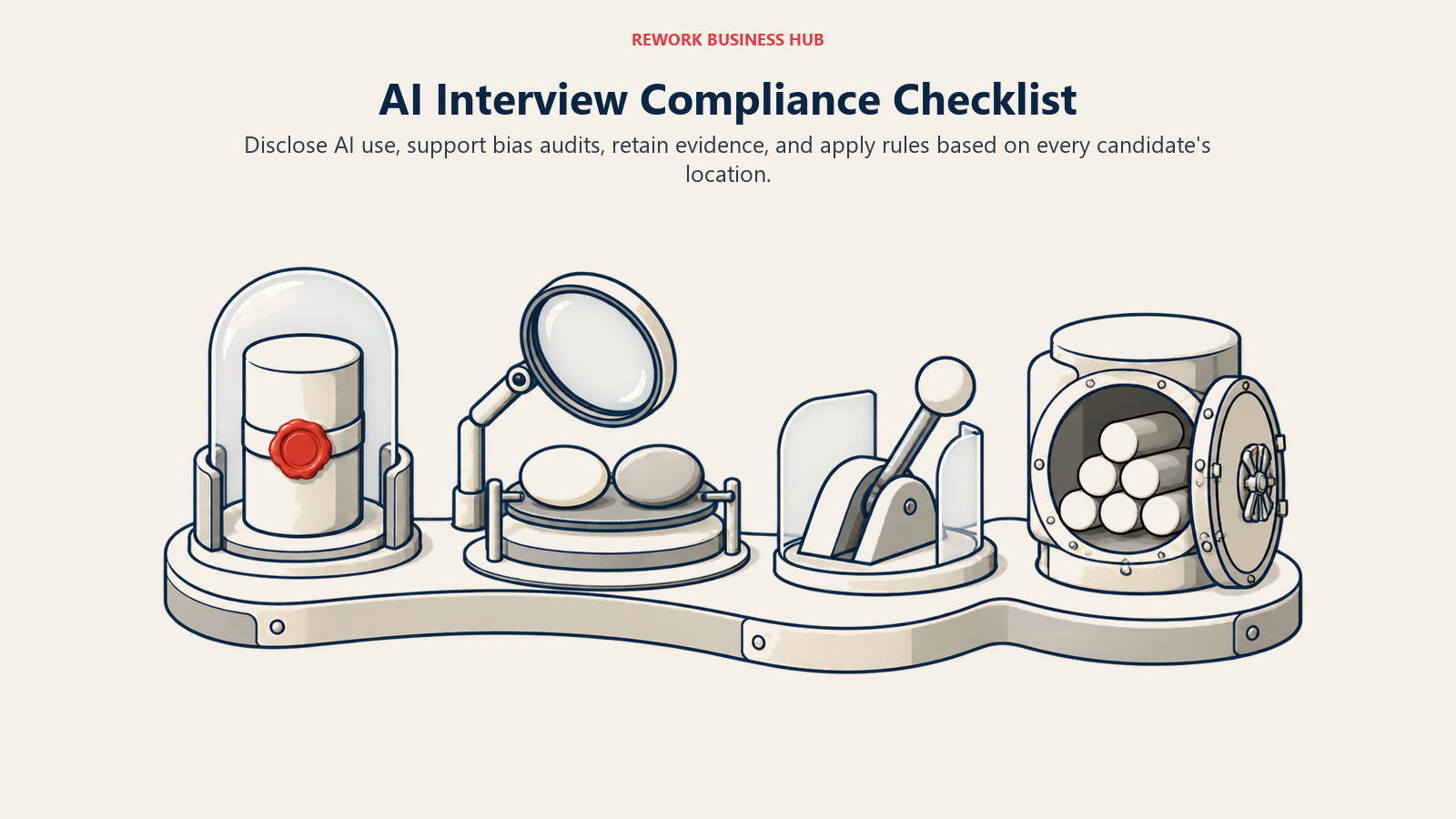
If your video interview tool uses AI to score, rank, or filter candidates, you're not just buying software anymore, you're taking on regulatory obligations that vary by where your candidates live. Three rules matter most heading into the rest of 2026.
| Regulation | Applies To | Key Requirement | Deadline or Penalty |
|---|---|---|---|
| EU AI Act, Annex III | AI used to place targeted job ads, filter applications, or evaluate candidates | Human oversight, input-data quality checks, worker transparency, six-month log retention | High-risk hiring obligations deferred from August 2, 2026 to December 2, 2027 under the Digital Omnibus |
| NYC Local Law 144 | Automated Employment Decision Tools that substantially assist or replace discretionary hiring or promotion decisions | Independent bias audit within the past year, published audit summary, 10 business days' candidate notice | Up to $500 for a first violation, $500 to $1,500 for each subsequent violation |
| Illinois AIVIA plus HB 3773 | Any AI that screens, evaluates, or ranks candidates, not just video interviews, effective January 1, 2026 | Disclosure of the AI product and vendor, affected decisions, data categories collected, and a named contact | Violations treated as a breach of the Illinois Human Rights Act |
The pattern across all three: disclosure isn't optional, and "the vendor handles compliance" isn't a defense that holds up. NYC's law puts the bias-audit obligation on the employer using the tool, not just the vendor building it, and Illinois now requires notice for AI used anywhere in screening, not only inside a video interview.
Candidate sentiment backs up why regulators are moving here. Only 26% of applicants trust AI to evaluate them fairly, and the top reason candidates cite for walking away from an AI-scored interview process is discovering it was pre-recorded and scored without a human reviewing it, ahead of even the disclosure failure itself, per Greenhouse's 2026 report cited above. If you're evaluating AI scoring as a feature, ask the vendor directly how they support a bias audit, what the candidate-facing disclosure looks like out of the box, and whether audit logs are retained long enough to satisfy the strictest jurisdiction you hire in.
Names You Won't Find Here (and Why)
A few brands that show up in older "best video interview software" roundups aren't on this list, and it's worth being upfront about why rather than quietly dropping them.
- Modern Hire was acquired by HireVue in May 2023. HireVue confirmed it would continue supporting existing Modern Hire products during integration, but the product name itself is now marked discontinued on review sites, and its assessment technology lives inside HireVue's platform. See HireVue below rather than looking for Modern Hire separately.
- Wepow was acquired by OutMatch in January 2019. OutMatch then acquired the original Harver in 2021 and rebranded the combined company as Harver. Wepow's video interviewing technology lives inside what's now sold as Harver, which is why Harver appears on this list instead of Wepow.
- Jobvite (and its Talemetry sourcing product) are part of Employ Inc's applicant tracking and recruiting-marketing lineup, alongside Lever and JazzHR. Neither ships a dedicated video-interviewing product the way the tools above do, so they're out of scope here even though they get mentioned in adjacent buyer guides. Jobvite belongs in an ATS comparison, not this one.
Sizing and Persona Table
| Tool | Ideal Team Size | Primary Buyer Persona |
|---|---|---|
| HireVue | 500-50,000+ employees | VP Talent Acquisition, Head of TA Ops |
| Spark Hire | 20-500 employees | HR Manager, Talent Acquisition Lead |
| VidCruiter | 200-5,000+ employees | Head of Talent, TA Ops Director |
| Willo | 5-200 employees | Founder, HR Manager, agency recruiter |
| Hireflix | 5-250 employees | HR Generalist, first HR hire |
| Rework | 20-500 employees | COO, Head of People, founder-operator |
| Talview | 500-50,000+ employees | Head of Campus Recruiting, TA Ops |
| Interviewer.AI | 5-200 employees | Founder, Talent Acquisition Manager |
| RecRight | 5-100 employees | HR Manager, small-team recruiter |
| Vervoe | 50-2,000+ employees | Head of Talent, skills-first hiring lead |
| Canditech | 20-500 employees | Talent Acquisition Manager, TA ops |
| Odro | Staffing agencies, any size | Agency Director, Head of Recruitment Marketing |
| Harver | 500-10,000+ employees | VP Talent Acquisition, high-volume hiring lead |
| Zoom or Google Meet + ATS | Under 20 employees | Founder, first-time hiring manager |
1. HireVue: The Enterprise Standard That Rebuilt Its Own AI Story
HireVue has been in video interviewing longer than almost anyone on this list, and the company's biggest move in the last five years wasn't a feature launch, it was a retreat. In January 2021, HireVue dropped facial-expression analysis from its scoring models after bipartisan criticism that micro-expression scoring risked discriminating against candidates with facial differences, autism, or non-neurotypical affect, plus an FTC complaint from the Electronic Privacy Information Center. The company shifted scoring toward language-based signals instead, using natural language processing on what candidates actually say rather than how their face moves while they say it.
The platform now spans live interviewing, one-way screening, and structured assessments, broadened further by HireVue's May 2023 acquisition of Modern Hire, which added game-based and cognitive assessment tools to the stack. That breadth is exactly why enterprise TA teams shortlist it: one vendor, one contract, one integration for interviewing and assessment together. If you're comparing it against the field, see our best HireVue alternatives roundup and the direct HireVue vs Spark Hire comparison.
| What you get | What you don't |
|---|---|
| Live, one-way, and assessment tools in one platform | No public pricing, fully sales-led process |
| Language-based AI scoring, facial analysis retired since 2021 | Overkill and overpriced for teams under a few hundred employees |
| Modern Hire's game-based assessments now included | Long implementation cycles typical of enterprise platforms |
| Deep enterprise track record and compliance experience | Support and onboarding geared to large TA ops teams, not solo HR |
Pricing: Custom quote across Essential and Premium packages. HireVue does not publish pricing; request a demo scoped to your hiring volume.
Best for: Enterprise employers (500+ employees) that want live interviewing, one-way screening, and structured assessments from a single vendor with a long compliance track record.
2. Spark Hire: Video Interviewing With an Optional ATS Attached
Spark Hire's core product is exactly what it sounds like: a focused, affordable video interviewing tool that does live and one-way interviews well without trying to be everything else. That focus made it a favorite among SMB hiring teams for years, and the standalone product is still the only piece of Spark Hire genuinely available month to month, at $299 per month capped at 5 jobs and 5 users, or $249 per month billed annually with unlimited jobs and users.
What's changed is the rest of the company. Spark Hire acquired Comeet (an applicant tracking system) and Chally (a behavioral assessment vendor) in 2024, and the combined "Recruit" ATS product now bundles video interviewing, AI resume review, and automated reference checks starting at $335 per month for Pro and $499 per month for Growth, both on annual contracts only. That means shopping Spark Hire today means picking a lane: the lean standalone video tool, or the fuller ATS bundle. For a direct look at how it stacks up, see our best Spark Hire alternatives roundup and the HireVue vs Spark Hire comparison.
| What you get | What you don't |
|---|---|
| Standalone video product available month to month | Pricing structure got more complex after 2024 acquisitions |
| Unlimited live and one-way interviews with 50+ language transcription | Advanced workflow customization trails purpose-built enterprise tools |
| Optional bundled ATS (Recruit) if you want one vendor | Recruit ATS plans require an annual contract, no monthly option |
| Transparent, published pricing on every tier | AI resume-review credits are capped per plan and cost extra past that |
Pricing: Standalone video: $299/mo (monthly, 5 jobs/5 users) or $249/mo (annual, unlimited); Recruit Pro $335/mo; Recruit Growth $499/mo, both billed annually.
Best for: SMBs (20-500 employees) that want a focused video interviewing tool, with the option to add a full ATS from the same vendor later.
3. VidCruiter: Structured, Defensible Hiring at Enterprise Scale
VidCruiter's whole pitch is that hiring should hold up if someone questions it later, whether that's an internal audit, a rejected candidate's appeal, or a regulator. Structured interview guides, panel scheduling, live and one-way formats, and detailed audit trails are built around that idea, and the market has noticed: VidCruiter was ranked #1 video interview software on Gartner Peer Insights in May 2026, explicitly tied to what the company frames as a decade of investment in structured, defensible hiring.
VidCruiter doesn't publish self-serve pricing on its own site, directing every prospect to a "request pricing" form instead. Third-party buyer aggregators report a starting point around $5,000 per year on a usage-based model (reported, via Capterra's VidCruiter listing), though actual cost depends heavily on hiring volume and modules.
| What you get | What you don't |
|---|---|
| Structured interview guides and panel scheduling built for audits | No published self-serve pricing, quote required |
| Gartner Peer Insights #1 ranking for video interviewing (May 2026) | Third-party estimates suggest enterprise-level cost, not SMB-friendly |
| Live and one-way interviewing in one platform | AI scoring is intentionally structure-first, lighter than HireVue's |
| Strong compliance and audit-trail focus | Implementation likely needs a dedicated TA ops contact |
Pricing: Custom quote; third-party benchmarking reports a starting point around $5,000/year (reported), scaling with candidate volume and modules.
Best for: Mid-market to enterprise employers (200-5,000+ employees) that need structured, auditable hiring across live and one-way interviews. If VidCruiter is already on your shortlist and the quote-only process is the sticking point, see best VidCruiter alternatives for the published-price options ranked against it.
4. Willo: Pay-Per-Role One-Way Interviewing, Priced in GBP
Willo's Lite plan is the rare video interviewing offer that's genuinely pay-as-you-go: 49 British pounds per live role per month, covering up to 5 live roles, 5 users, and 150 assessed candidates per role, with no long-term contract required. For a small team hiring occasionally, that structure means you're not paying for a year of software you use for three months of it.
The Enterprise tier flips that model: 2,999 pounds per year on a 1-year contract, with 2,699 pounds per year on a 2-year term and 2,549 pounds per year on a 3-year term, bundling custom live roles, multiple users, an assessment library, 18+ language support, "Willo Intelligence" AI summaries and benchmarking, SSO, and ATS integrations. Note the currency: Willo is priced and billed in GBP, which matters if you're budgeting in USD or another currency.
| What you get | What you don't |
|---|---|
| Genuine pay-as-you-go pricing on the Lite tier | Enterprise tier requires a 1 to 3 year contract |
| AI-assisted summaries and benchmarking (Willo Intelligence) | Priced in GBP, adds a currency-conversion step for USD budgets |
| 18+ language support and anti-cheat technology | Live interviewing sits behind the Enterprise tier as an add-on |
| 50% discount for qualifying non-profits and startups | Smaller integration ecosystem than HireVue or VidCruiter |
Pricing: Lite GBP 49/live role/mo (pay-as-you-go); Enterprise GBP 2,999/yr (1-year), GBP 2,699/yr (2-year), GBP 2,549/yr (3-year).
Best for: Small to mid-size teams (5-200 employees) that hire occasionally and want to pay only for the roles they're actively screening.
5. Hireflix: The One-Way Specialist at a Flat Company-Size Fee
Hireflix doesn't try to do live interviewing at all, and that focus is deliberate. The entire product is built around one-way recorded interviews: candidates get a link, record their answers on their own time, and the hiring team reviews responses (with transcription in 18 languages) whenever it's convenient. Every plan, regardless of company size, includes unlimited user seats, unlimited open positions, and unlimited candidate responses, which removes one of the more common budget surprises on cheaper screening tools.
Pricing is simple: $75 per month for companies under 50 employees, $150 per month for 50 to 250 employees, both billed annually, and a custom quote for larger corporates, high-volume processes, or staffing agencies. Hireflix integrates with most major ATS platforms, including Lever, Greenhouse, Workable, Teamtailor, SmartRecruiters, JazzHR, and BambooHR, plus Zapier and Make for everything else, and a free first month lets you test the workflow before committing.
| What you get | What you don't |
|---|---|
| Unlimited seats, positions, and responses on every plan | No live interviewing, one-way only, by design |
| Simple, transparent flat-fee pricing by company size | No native AI scoring, review is manual |
| 18-language support with transcription included | Fewer enterprise compliance features than VidCruiter or HireVue |
| Broad ATS integrations plus Zapier and Make | Custom tier requires a sales conversation for larger volume |
Pricing: Small $75/mo (under 50 employees); Medium $150/mo (50-250 employees); Custom for larger or agency use, billed annually.
Best for: Small to mid-size teams (5-250 employees) that only need one-way screening and want to skip live-interview features entirely.
6. Rework: Interview Scheduling on the Same Platform as the Employee Record
Rework's Interview module runs inside the same People product line as E-Hiring, Career, HRIS, and time and attendance. The pitch here is narrower than "another video interviewing tool with more AI features": it's that a structured interview, the resulting candidate scorecard, and the employee record that candidate becomes the day they're hired shouldn't live in three separate systems that someone has to manually reconcile.
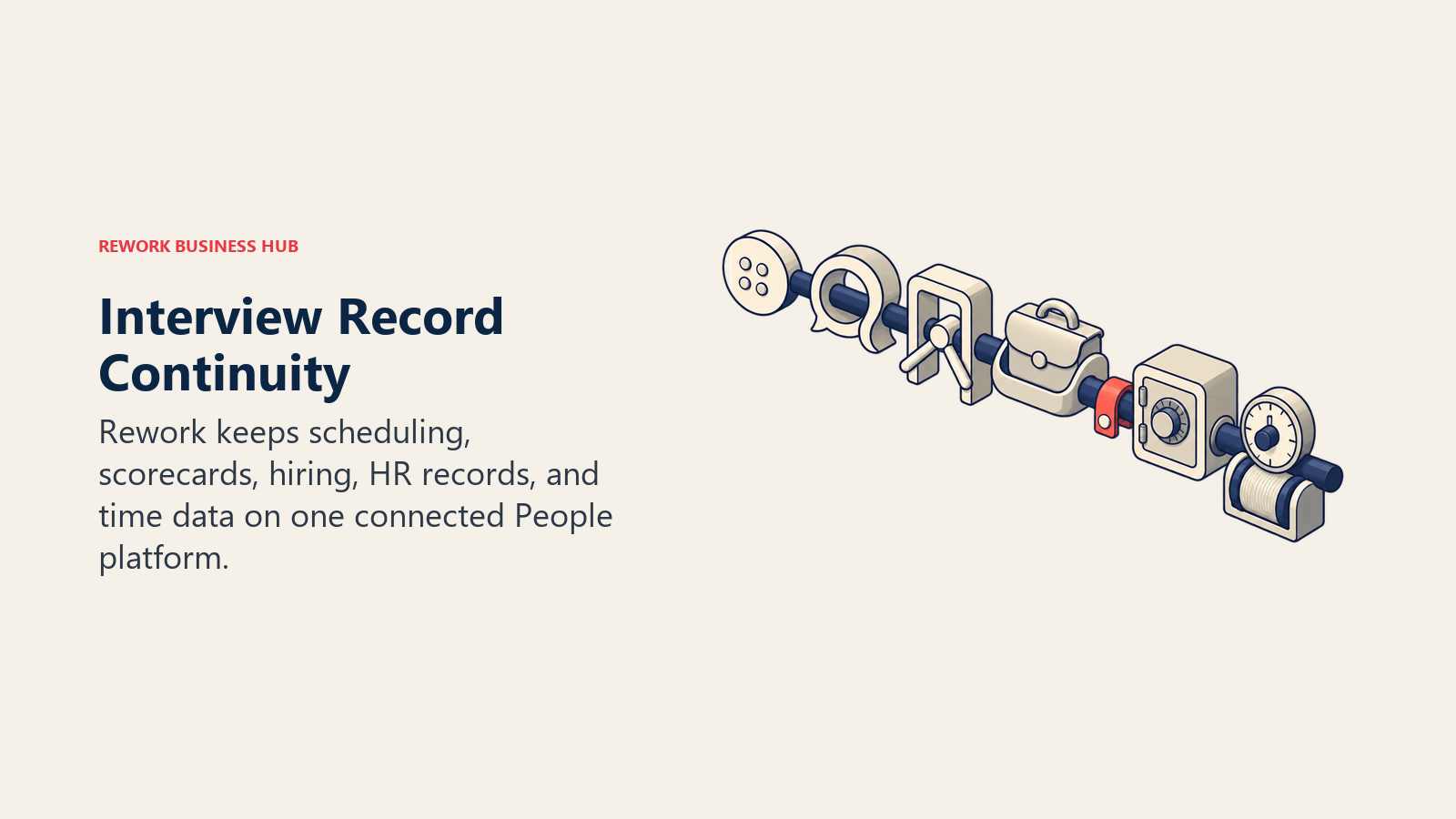
A candidate who applies through Career, moves through E-Hiring's pipeline, and gets scheduled and evaluated through Interview becomes an employee record inside the same platform that already tracks attendance, timesheets, and HR data, with no export-and-reimport step in between. For teams whose real friction isn't the interview itself but the handoff after it, that continuity is the whole point.
Where Rework doesn't compete is the specialist end of this category. There's no one-way async recording pipeline like Hireflix's, no AI-scored video grading like Vervoe's or Interviewer.AI's, and it isn't built for the high-volume hourly screening that Talview or Harver handle at scale. Rework's Interview module is about structured scheduling and coordination among your hiring team, tied to the rest of the People platform, not a replacement for a dedicated one-way video specialist.
| What you get | What you don't |
|---|---|
| Interview scheduling unified with E-Hiring, Career, and HRIS | Not a specialist one-way async video platform |
| New hire becomes an employee record automatically, no re-entry | No AI-scored video grading or facial/language analysis |
| One platform instead of separate interview tool plus HRIS logins | Not built for high-volume hourly or campus screening |
| Packages, not per-user licenses, across the People line | Fewer video-specific compliance features than category specialists |
Pricing: Quoted per organization; the People line (which includes E-Hiring, Interview, and Career) does not have published per-seat pricing. See rework.com/pricing for current details.
Best for: 20 to 500 person teams that want interview scheduling, HR records, and staff time on one platform instead of stitching together a video tool, an ATS, and an HRIS.
Not ideal for: Teams whose core need is a specialist one-way video platform, or high-volume hourly hiring that needs proctoring and AI grading at scale.
7. Talview: Assessment and Proctoring First, Video Interviewing Built In
Talview's center of gravity is talent measurement at volume: assessments, proctoring, and interviewing bundled into one workflow for organizations that screen hundreds or thousands of candidates a cycle, campus recruiting programs and high-volume hourly hiring being the clearest fit. Live and on-demand video interviewing sit alongside AI-driven analysis of tone, language, and behavioral signals, plus a proctoring layer built to catch cheating on the assessment side of the process.
Pricing is unit-based and entirely custom. Talview's own pricing page walks prospects through a four-step form (solution type, product, annual candidate volume, contact details) before a quote arrives, and the company sets a practical floor around 150 to 200 candidates to begin, with additional charges for pilots over 10 candidates. That structure signals who this is built for: it's not designed for a company hiring a handful of roles a year.
| What you get | What you don't |
|---|---|
| Assessment, proctoring, and interviewing in one workflow | No published pricing, unit-based quote model only |
| Strong anti-cheating and proctoring for high-volume screening | Practical minimum around 150-200 candidates to start |
| Global reach across 120+ countries | Overkill for low-volume or selective hiring |
| AI analysis of tone, language, and behavioral signals | Heavier compliance overhead given AI-scoring depth |
Pricing: Custom, unit-based quote; practical minimum of roughly 150-200 candidates to begin engagement.
Best for: Enterprise employers and campus recruiting programs running high-volume screening that also need proctoring and assessment in the same platform.
8. Interviewer.AI: Credit-Based AI Screening for Small Teams
Interviewer.AI prices by the interview, not the seat, which is unusual in this category and worth understanding before you buy. The Essential Edition runs $199 per month for 50 interview credits, 20-minute interviews, and 3 job posts; Professional runs $399 per month for 120 credits, 30-minute interviews, and 5 job posts; Enterprise is a custom quote with unlimited job posts and dedicated account management. One credit covers a standard async video interview, while conversational AI interviews (a back-and-forth format rather than a fixed script) cost two credits, and unused credits roll over rather than resetting to zero each month.
That per-interview cost structure is transparent, which is a real advantage over quote-only competitors, but it also means the math changes fast at higher volume. Extra credits cost $150 for 50 more, so a hiring surge can push the effective cost per interview well past what the base plan implies.
| What you get | What you don't |
|---|---|
| Transparent, published per-credit pricing | Credits run out fast once hiring volume spikes |
| Rollover credits, nothing wasted month to month | Job-post caps on lower tiers limit concurrent roles |
| Both async and conversational AI interview formats | Enterprise tier still requires a custom quote |
| 14-day free trial, no credit card required | Newer entrant, smaller integration ecosystem than HireVue |
Pricing: Essential $199/mo (50 credits); Professional $399/mo (120 credits); Enterprise custom quote, all with monthly or annual billing options.
Best for: Small to mid-size teams (5-200 employees) that want predictable, published pricing tied directly to interview volume.
9. RecRight: A Focused One-Way Tool That Went Quote-Only
RecRight built a straightforward one-way video interview product with an integrated lightweight ATS layer, aimed at small teams that don't need a full enterprise platform. As of August 2026, RecRight's own pricing page no longer lists self-serve tiers; it redirects every visitor to book a demo instead, which is a real shift from the tiered pricing the vendor previously advertised.
Third-party buyer aggregators still report RecRight's earlier list pricing: an Easy plan around 265 euros per month for 10 to 20 positions a year, a Pro plan around 475 euros per month for 30 to 50 positions, and a Single Hire option around 395 euros as a one-time fee for 60 days (reported, per TrustRadius's RecRight pricing page and Capterra's listing). Treat those figures as historical context rather than current rates, since RecRight itself no longer confirms them, and get an actual quote before budgeting.
| What you get | What you don't |
|---|---|
| Focused one-way interview builder, easy to learn | Vendor's own page no longer publishes self-serve pricing |
| Live interviewing available on the Premium tier | Historical pricing reports may no longer be accurate |
| Integrated lightweight ATS functionality | Smaller feature set than VidCruiter or HireVue |
| Straightforward setup for occasional small-team hiring | Limited AI scoring compared to category specialists |
Pricing: Quote on request; third-party sources report historical list pricing around EUR 265 to 475/mo (reported), no longer confirmed on RecRight's own site.
Best for: Small teams (5-100 employees) in Europe doing occasional, low-volume one-way hiring.
10. Vervoe: Skills-First Video Assessment, Now Sold as Enterprise-Only
Vervoe's angle is skills over resumes: candidates complete video and skills-based assessments, and Vervoe's AI grades responses against the actual work the role requires rather than credentials or keyword matching. The platform has also leaned into a newer problem this category is starting to face: candidates using AI tools to generate or coach their own interview answers, which Vervoe addresses with generative-AI-detection built into its grading.
Pricing has changed meaningfully. Vervoe's current pricing page shows a single quote-only Enterprise tier, a shift from the self-serve Starter and Professional tiers (roughly $79 and $399 per month) that third-party review sites still reference from earlier in the product's life. If you're comparing skills-testing platforms broadly, our best TestGorilla alternatives roundup covers the wider skills-assessment category Vervoe competes in.
| What you get | What you don't |
|---|---|
| AI grading built around actual job-relevant skills | Self-serve pricing tiers retired, Enterprise-only now |
| Generative-AI-cheating detection, ahead of most competitors here | No live interviewing, video assessment only |
| Custom integrations and enterprise-grade security on the current tier | Older third-party pricing estimates are now unreliable |
| SSO, regional data storage, and priority support SLAs | No free or low-cost entry point for very small teams |
Pricing: Custom quote (Enterprise only); earlier self-serve pricing (reported around $79 to $399/mo) is no longer published on Vervoe's site.
Best for: Mid-market to enterprise employers (50-2,000+ employees) running skills-first hiring at scale.
11. Canditech: Video Interviewing Bundled With a Skills-Test Library
Canditech pairs one-way video responses with a library of more than 500 ready-to-use skills assessments and a pre-qualifying chatbot step, so a candidate can move through screening questions, a skills test, and a short video response in one flow instead of three separate tools. AI auto-scoring and cheating-prevention features apply across the whole flow, not just the video portion.
The pricing page names four tiers (Individual, Team, Pro, Enterprise) with a free-to-start entry point that doesn't require a credit card, but no dollar figures are published for any of them; a full feature-comparison matrix is public, the price tags aren't. For teams evaluating the coding-specific end of this space instead, our best HackerRank alternatives roundup covers that adjacent category directly.
| What you get | What you don't |
|---|---|
| Video interviewing plus 500+ assessment library in one flow | No dollar pricing published for any of the four tiers |
| Free-to-start entry point, no credit card required | No live interviewing, async video and testing only |
| AI auto-scoring and cheating-prevention across the whole flow | Newer entrant with a smaller market track record |
| ATS integrations and an AI assessment builder | Full pricing requires a sales conversation |
Pricing: Custom quote across Individual, Team, Pro, and Enterprise tiers; a free-to-start option is available with no published dollar pricing on any tier.
Best for: Teams (20-500 employees) that want video screening and skills testing combined in a single workflow.
12. Odro: Video Interviewing Purpose-Built for Recruitment Agencies
Odro solves a different problem than most of this list, and it's worth naming that up front: Odro is built for staffing and recruitment agencies engaging candidates and clients, not for a company screening applicants for its own open roles. Live and asynchronous video interviewing sit alongside video shortlisting tools and a "Producer" feature for quickly creating polished candidate-facing video content, aimed at agencies that need to move fast and stand out to win client business.
Pricing depends on which product combination you need (CV formatting, response-rate tools, video shortlisting, video interviewing, business-development features), license count, which CRM you run, and how many candidates sit in your database, all gathered through a custom quote process rather than published tiers. If your agency also needs a broader agency ATS comparison, the Bullhorn section of our ATS roundup covers the category leader for that adjacent workflow.
| What you get | What you don't |
|---|---|
| Purpose-built for staffing and recruitment agency workflows | Not designed for in-house corporate hiring teams |
| Live and asynchronous interviewing plus video shortlisting | No published pricing, fully custom quote |
| Content tools built for candidate and client-facing video | Pricing depends on CRM and database size, hard to estimate upfront |
| Strong fit for UK and European staffing agencies | Smaller footprint outside the staffing/agency niche |
Pricing: Custom quote scoped to product bundle, license count, CRM used, and candidate database size.
Best for: Staffing and recruitment agencies of any size that need video interviewing tied to client and candidate engagement, not internal corporate hiring.
13. Harver: Volume Hiring Assessments With Video Interviewing Inside
Harver's story is a merger, not a single product build. OutMatch acquired video interviewing vendor Wepow in January 2019, then acquired the original Harver in 2021 and rebranded the combined company under the Harver name that November. What that history means today: video interviewing at Harver isn't a standalone feature, it's one piece of a broader "Hiring Experience Stack" that also includes predictive assessments, reference checking, and automated workflows, all aimed at high-volume, hourly, and professional-role hiring at enterprise scale.
Harver doesn't publish pricing and runs a request-demo process typical of enterprise volume-hiring platforms. Third-party analysis puts entry pricing around $5,000 per year (reported, per Hirevire's Harver pricing breakdown), though actual cost scales with assessment volume and modules.
| What you get | What you don't |
|---|---|
| Video interviewing embedded in a full assessment and reference-check stack | No published pricing, request-demo process |
| Built for high-volume, hourly, and professional-role hiring at scale | Overkill if all you need is standalone interview scheduling |
| Predictive assessments layered on top of video responses | Reported entry pricing (around $5,000/yr) is a third-party estimate |
| Enterprise-grade automated workflows across the hiring funnel | Heavier implementation than a focused video-only tool |
Pricing: Custom quote; third-party analysis reports entry pricing around $5,000/year (reported), scaling with assessment volume.
Best for: Enterprise employers (500-10,000+ employees) running high-volume or hourly hiring that needs assessments and video interviewing together.
14. Zoom or Google Meet Plus Your ATS: The DIY Combo
Plenty of small teams never buy dedicated video interview software at all, they just run live interviews over Zoom or Google Meet and track candidates in whatever ATS they already use. It's worth including honestly, because for a company hiring for two or three roles a year, it's a legitimate answer, not a shortcut to feel guilty about.
Zoom's Pro tier runs around $14.16 per user per month (reported, per tech.co's Zoom pricing guide, updated June 2026), including 30-hour meetings and AI Companion note-taking. Google Workspace's Starter tier is published directly at $7 per user per month on annual commitment (or $3.50 introductory for the first 20 users through September 2027), including Meet for up to 100 participants. Neither includes structured scorecards, one-way async interviewing, AI candidate scoring, or the disclosure and bias-audit tooling that regulated hiring increasingly requires, so pairing either with an ATS (see our best Applicant Tracking Systems roundup) covers pipeline tracking, but not the structured-interview piece this whole category exists to solve.
| What you get | What you don't |
|---|---|
| Cheapest possible path to live video interviews | No structured scorecards or interview kits built in |
| Tools your team likely already knows how to use | No one-way async interviewing option |
| Recording and basic transcription on paid tiers | No AI scoring, disclosure tooling, or bias-audit support |
| No new vendor relationship or contract to manage | Manual tracking of who interviewed whom, easy to lose consistency |
Pricing: Zoom Pro roughly $14.16/user/mo (reported); Google Workspace Starter $7/user/mo (annual commitment), $3.50/user/mo introductory rate for the first 20 users.
Best for: Very small teams (under 20 employees) doing occasional, live-only interviews without the budget or volume to justify dedicated software yet.
How to Choose: Decision Framework
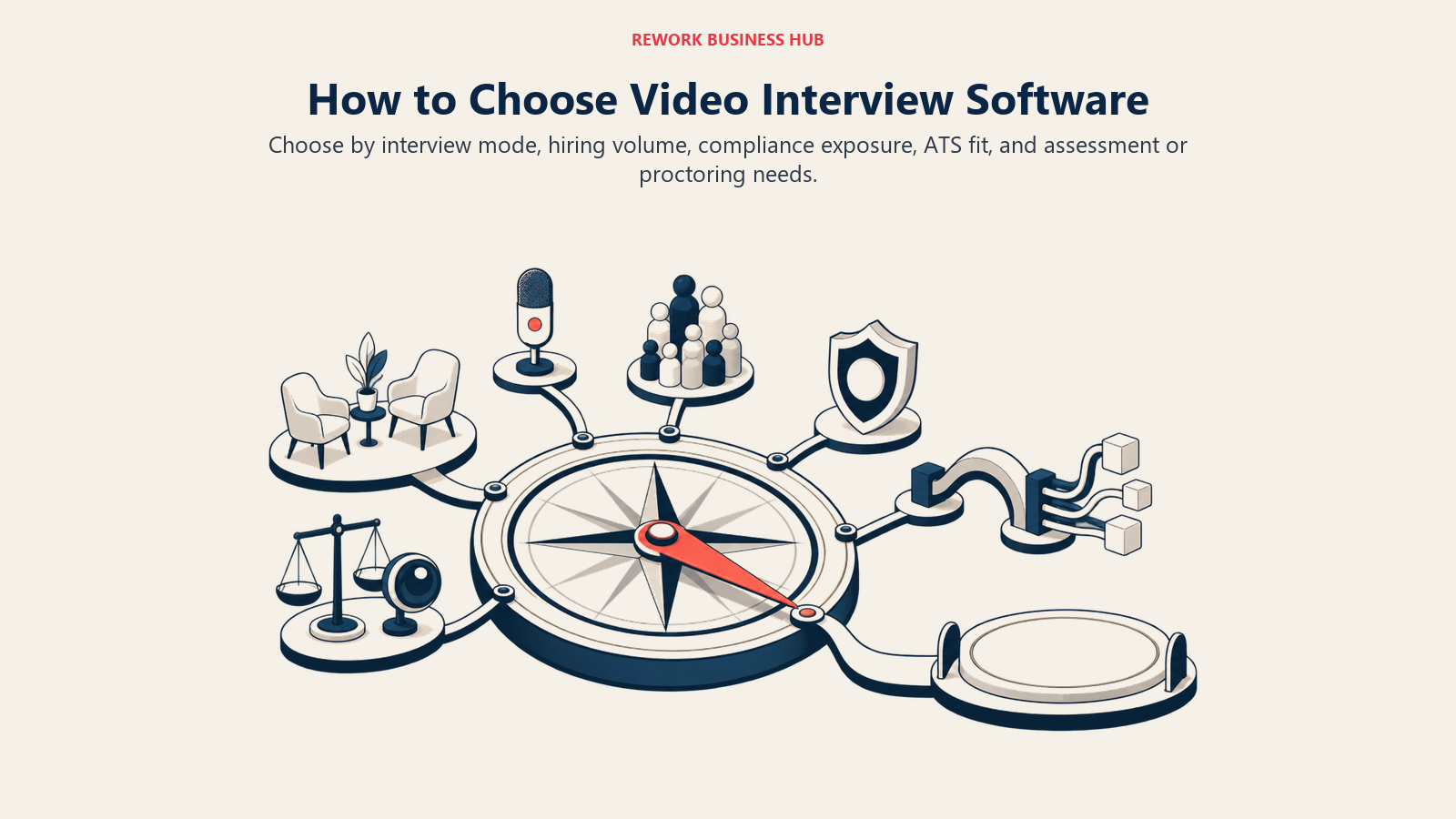
Choose by interview mode first, then hiring volume, assessment depth, ATS fit, and the compliance obligations attached to candidate geography.
| If you need... | Pick... | Why |
|---|---|---|
| Live, one-way, and assessments from one enterprise vendor | HireVue | Broadest platform, absorbed Modern Hire's assessment tools |
| Video interviewing with an optional bundled ATS | Spark Hire | Standalone product or full Recruit ATS, your choice |
| Structured, audit-ready hiring at scale | VidCruiter | Gartner Peer Insights #1 for structured, defensible hiring |
| Pay-as-you-go one-way screening without a contract | Willo | Lite tier is genuinely pay-per-role |
| One-way interviewing only, at a flat company-size fee | Hireflix | Unlimited seats and responses, no live-interview complexity |
| Interview scheduling on the same platform as HR records | Rework | Interview, E-Hiring, Career, and HRIS unified |
| Assessment and proctoring with video interviewing built in | Talview | Strong anti-cheating layer for high-volume screening |
| Transparent, per-credit AI screening pricing | Interviewer.AI | Published pricing tied directly to interview volume |
| Small-team one-way hiring in Europe | RecRight | Focused, simple builder, though pricing now requires a quote |
| Skills-first hiring with AI-graded video responses | Vervoe | AI grading plus generative-AI-cheating detection |
| Video screening combined with a skills-test library | Canditech | 500+ assessments and video in one flow |
| Video interviewing for a staffing or recruitment agency | Odro | Purpose-built for agency client and candidate engagement |
| Volume hiring assessments with video interviewing inside | Harver | Full Hiring Experience Stack for hourly and high-volume roles |
| The cheapest possible path to live interviews, no vendor | Zoom or Google Meet + ATS | Tools you likely already have, paired with your existing ATS |
Before you sign anything, run the compliance check from earlier in this guide against your actual candidate geography, not just your headquarters. A team hiring only in one US state has a very different obligation set than one hiring across the EU and New York City at the same time, and the vendor's marketing page won't always spell that out clearly.
Most video interview tools sit on top of an ATS rather than replacing one, so it's worth locking in the ATS side of your stack at the same time. If you haven't picked one yet, our Greenhouse vs Lever comparison covers the two platforms most of the tools above integrate with first.
Frequently Asked Questions about Video Interview Software
What's the difference between live and one-way video interview software?
Live video interviewing replaces an in-person or phone conversation with a scheduled video call, usually structured with scorecards. One-way (asynchronous) interviewing has candidates record answers to preset questions on their own time, which a recruiter or panel reviews later, often with AI-assisted scoring or transcription.
Is AI video interview scoring legal in 2026?
It depends on where your candidates are. NYC's Local Law 144 requires an independent bias audit within the past year plus 10 business days' candidate notice before using an AI hiring tool. Illinois requires disclosure of the AI product, vendor, and affected decisions as of January 1, 2026. The EU AI Act's high-risk hiring obligations were deferred from August 2026 to December 2027, but they still apply eventually if you hire in the EU.
What happened to HireVue's facial analysis technology?
HireVue dropped facial-expression analysis from its scoring models in January 2021 after criticism that it risked discriminating against candidates with facial differences or non-neurotypical affect, plus a complaint filed with the FTC. The platform moved to language-based AI scoring instead.
Is myInterview still available as a standalone product?
No. Radancy acquired myInterview in September 2025 and folded its screening and scheduling capabilities into the Radancy Talent Acquisition Cloud, retiring the myInterview brand across its own web properties.
Can I just use Zoom or Google Meet instead of buying video interview software?
For a very small team hiring occasionally, yes, paired with whatever ATS you already use for candidate tracking. What you lose is structured scorecards, one-way async screening, AI-assisted review, and the disclosure and bias-audit tooling that dedicated platforms build in, which starts to matter once hiring volume or regulatory exposure grows.
Which video interview tools work best for staffing and recruitment agencies specifically?
Odro is purpose-built for agency workflows, including video shortlisting and client-facing content tools. Most of the rest of this list, including HireVue, Spark Hire, and VidCruiter, are built for companies hiring for their own roles rather than agencies placing candidates with clients.
What to Do Next
Pick two tools before you book a demo: the one that matches your interview mode (live, one-way, or both) and hiring volume today, and one tier up as a stretch comparison. Run each through the same test: record or sit through one real interview yourself, check what the candidate actually sees and is told about AI involvement, and get the fully loaded first-year cost in writing rather than trusting a marketing page.
If the real gap in your process isn't the interview itself but what happens after someone accepts, start with Rework and see what Interview looks like unified with E-Hiring, Career, and the rest of the People platform.

On this page
- Key Facts
- Quick Comparison Table
- Live Interviews, One-Way Interviews, or Both: What Actually Matters
- The Compliance Question: EU AI Act, NYC Local Law 144, and Illinois AIVIA
- Names You Won't Find Here (and Why)
- Sizing and Persona Table
- 1. HireVue: The Enterprise Standard That Rebuilt Its Own AI Story
- 2. Spark Hire: Video Interviewing With an Optional ATS Attached
- 3. VidCruiter: Structured, Defensible Hiring at Enterprise Scale
- 4. Willo: Pay-Per-Role One-Way Interviewing, Priced in GBP
- 5. Hireflix: The One-Way Specialist at a Flat Company-Size Fee
- 6. Rework: Interview Scheduling on the Same Platform as the Employee Record
- 7. Talview: Assessment and Proctoring First, Video Interviewing Built In
- 8. Interviewer.AI: Credit-Based AI Screening for Small Teams
- 9. RecRight: A Focused One-Way Tool That Went Quote-Only
- 10. Vervoe: Skills-First Video Assessment, Now Sold as Enterprise-Only
- 11. Canditech: Video Interviewing Bundled With a Skills-Test Library
- 12. Odro: Video Interviewing Purpose-Built for Recruitment Agencies
- 13. Harver: Volume Hiring Assessments With Video Interviewing Inside
- 14. Zoom or Google Meet Plus Your ATS: The DIY Combo
- How to Choose: Decision Framework
- What to Do Next