HireVue vs Spark Hire: Which Video Interview Platform Fits Your Hiring Volume in 2026?
Turn this article into takeaways for your work.


Each assistant summarizes the article only for you and suggests best practices for your work.
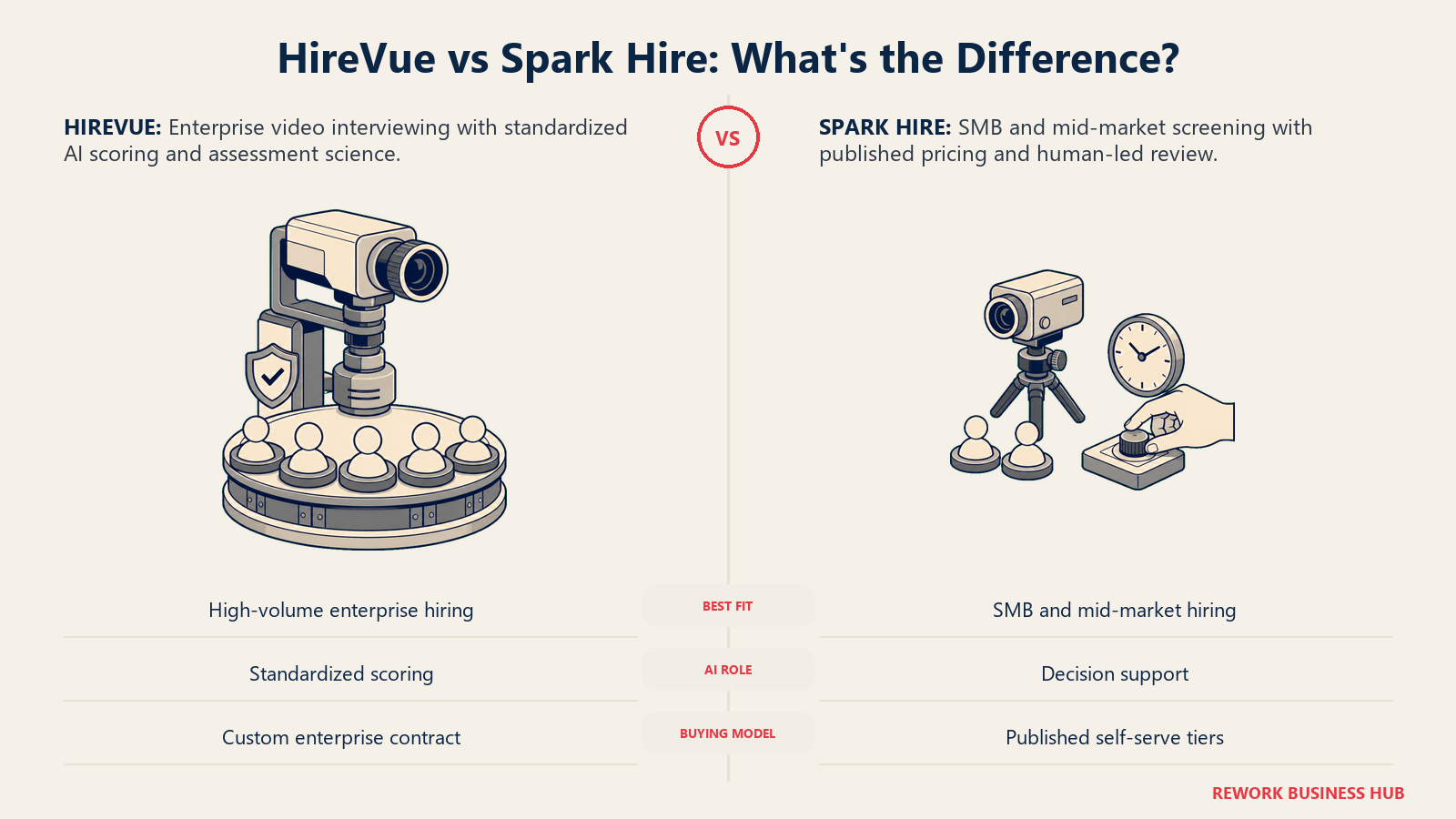
If you're evaluating video interview software, HireVue and Spark Hire show up on opposite ends of almost every shortlist, and for good reason. Both let candidates record responses on their own time or join a live call, both score interviews against structured criteria, and both now bolt a full assessment suite onto what used to be a simple recording tool. But the resemblance stops at the feature list. One is built for enterprise hiring teams screening tens of thousands of applicants a year and willing to pay enterprise money for standardized, auditable AI scoring. The other is built for growing SMB and mid-market teams who need a fast, affordable way to stop scheduling first-round calls by hand.
That gap in who each tool is actually for matters more than usual right now, because video interviewing sits at the center of a regulatory story that's moving fast. New York City, Illinois, and the European Union have all put specific rules around AI-scored video interviews on the books, and picking the wrong tool for your hiring model doesn't just cost you a bad fit, it can add real compliance work your team wasn't planning for. Here's how HireVue and Spark Hire actually compare, and which one fits your hiring volume.
TL;DR
| HireVue | Spark Hire | |
|---|---|---|
| Core philosophy | Enterprise AI-scored video interviews plus assessment science, built for scale | SMB and mid-market video interviewing, ATS, and assessment in one affordable platform |
| Best for | High-volume enterprise hiring teams that need standardized, auditable scoring | Growing SMB and mid-market teams that need fast, budget-friendly screening |
| Interview formats | On-demand (one-way) and live video interviews | One-way and live video interviews |
| Pricing model | Not published; "Essential" and "Premium" packages, quote-only | Published tiers starting at $335/month billed annually, plus standalone monthly plans |
| Reported or typical annual cost | Vendr-reported median $20,900/year (range $9,794 to $41,056, reported) | Recruit Pro from $4,020/year; Recruit Growth from $5,988/year (billed annually) |
| G2 rating | 4.1 out of 5 (253 reviews) | 4.7 out of 5 (678 reviews) |
| Capterra rating | 4.5 out of 5 (40+ reviews) | 4.7 out of 5 (109 reviews) |
| Built through | Combined with Modern Hire in 2023 for deeper assessment science | Acquired Comeet (ATS) and Chally (assessment) in 2023 |
Who Each Platform Is Actually Built For
HireVue's own product pages lean hard into scale and science. Its Interview Builder ships with more than 1,000 job-specific interview guides built by IO psychologists, standardized rating scales, and shared scorecards, with assessments like Virtual Job Tryouts and game-based simulations layered on top of the interview itself. That's a toolkit built for a talent acquisition function running structured hiring across thousands of applicants a year, not a hiring manager filling one open role.
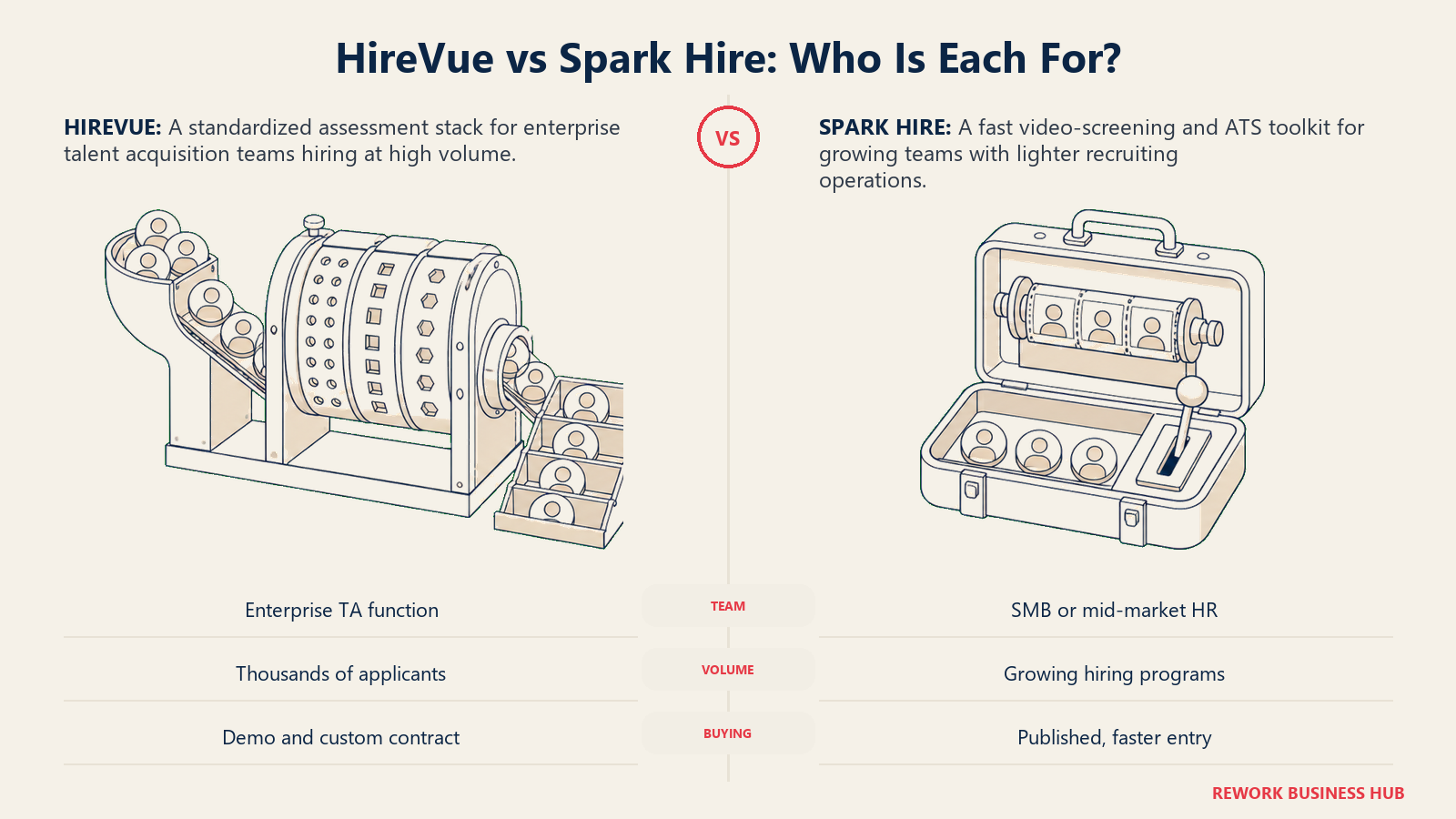
Spark Hire's pricing page tells a different story. Its top published tier caps out at 500 employees, and its own product marketing points squarely at HR teams and hiring managers who want video interviewing, AI resume screening, and reference checks in one tool without a dedicated recruiting operations function running it. The 2023 Comeet acquisition added a real applicant tracking system underneath, and the Chally acquisition added predictive behavioral assessment, but the buying motion stays fast and largely self-serve rather than enterprise sales-led.
| HireVue | Spark Hire | |
|---|---|---|
| Sweet-spot team | Enterprise TA function screening high volume against standardized scorecards | SMB or mid-market HR team, or a hiring manager without dedicated recruiting ops |
| Company size fit | Enterprise; 1,150+ combined customers, more than half the Fortune 100 | Up to 500 employees per the published Recruit Growth tier |
| Buying motion | Sales-led, demo-only, custom contract | Self-serve signup with published tiers; sales-assisted for Enterprise |
| Primary use case | Standardized, scored first-round screening at scale | Fast scheduling and screening without a dedicated recruiter |
| HireVue | Spark Hire | |
|---|---|---|
| Team maturity | Has already built, or is building, a formal assessment strategy | Comfortable delegating first-round screening without deep selection science behind it |
| Typical buying trigger | Standardizing screening across a huge, geographically spread applicant pool | Outgrowing manual phone-screen scheduling and spreadsheet tracking |
| Assessment depth needed | High: competency models, job simulations, technical evaluations | Moderate: structured video plus an optional behavioral assessment |
Neither posture is wrong. It's the difference between a platform built to standardize evaluation at industrial scale and a platform built to get a growing team out of scheduling chaos fast. If you're comparing this decision against every option in the category, not just these two, see our Best Video Interview Software roundup.
Key Facts
- The broader applicant tracking system market that video interview tools plug into grew from an estimated $2.96 billion in 2025 to $3.17 billion in 2026, a 7.1% CAGR, per Research and Markets.
- HireVue combined with Modern Hire on May 9, 2023, forming a company that now serves more than 1,150 customers and over half of the Fortune 100, according to HireVue's own acquisition announcement.
- Spark Hire built out its assessment stack through two 2023 acquisitions: Comeet, an applicant tracking system, in June, and Chally, a predictive behavioral assessment company, in September, per Spark Hire's announcement.
- 63% of job seekers reported facing an AI-scored interview by early 2026, up 13 percentage points in six months, and 38% said they'd walked away from a hiring process specifically because it included one, per a Greenhouse-commissioned survey of nearly 3,000 job seekers.
- HireVue holds a 4.1 out of 5 rating on G2 across 253 reviews and 4.5 out of 5 on Capterra; Spark Hire holds 4.7 out of 5 on G2 across 678 reviews and 4.7 out of 5 on Capterra.
One-Way vs Live Interviewing: Where Each Platform Starts
Both platforms support one-way, on-demand interviews and live, real-time video calls, so this isn't really a feature gap. The difference is which format each company built its reputation on and how much AI sits behind the scoring.
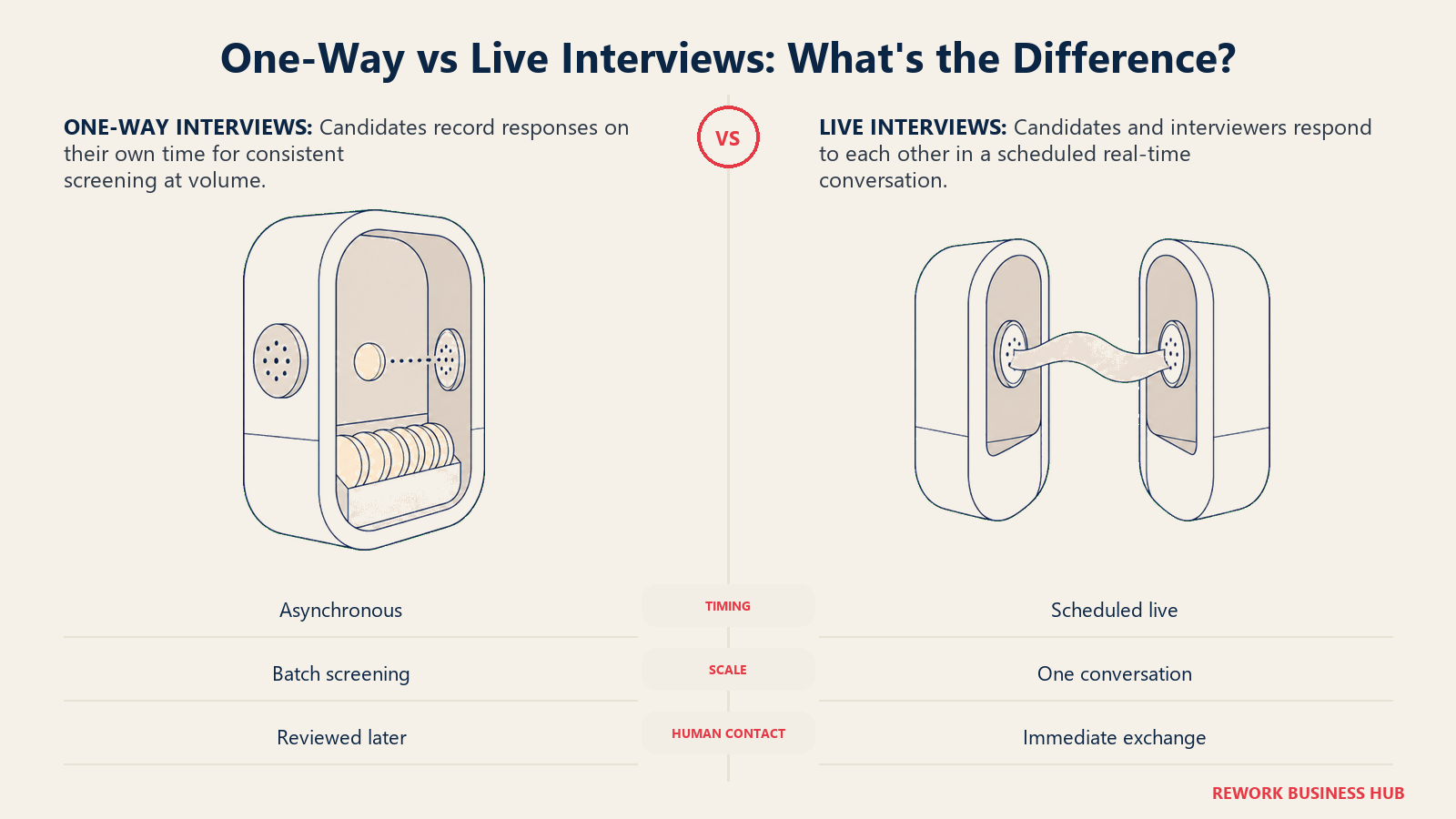
HireVue's brand is built around on-demand interviewing at scale: candidates record responses to a fixed set of questions on their own time, and an AI Interviewer scores language patterns and competency signals against a standardized rubric, giving a hiring team a consistent first pass across hundreds or thousands of applicants before a human ever watches a clip. Live interviews are available too, but the on-demand, AI-scored path is where HireVue's structured-hiring pitch lives.
Spark Hire built its reputation the other way around: fast, simple scheduling for both formats, with AI doing lighter lifting. Its resume-screening AI scores candidates against criteria you define, and its interview AI generates summaries and transcripts rather than an automated competency score that determines who advances. The company describes this explicitly as a "no black-box" approach: "You're not hiring with AI, you're using AI to hire," with final decisions staying human-led.
| Interview format | HireVue | Spark Hire |
|---|---|---|
| One-way / on-demand | Yes, candidates respond to preset questions on their own time | Yes, unlimited on the annual video interview plan |
| Live video | Yes, real-time interviews from any device | Yes, live interviews with built-in scheduling |
| AI scoring on responses | Yes, competency-based and game-based algorithms score language and competency signals | AI scores resumes and generates interview summaries against user-defined criteria; final scoring stays human-led |
| Structured question sets | 1,000+ job-specific interview guides built by IO psychologists | Custom question sets with an AI-assisted builder |
HireVue's Wedge: AI Scoring and Assessment Science at Scale
If your problem is evaluating thousands of candidates consistently, not sourcing more of them, HireVue's structured, AI-scored approach is the more direct fix. The Interview Builder standardizes what every candidate is asked and how it's scored, and the platform pairs that with Modern Hire's Virtual Job Tryout simulations, game-based assessments, technical evaluations, and language proficiency tests, so a hiring team can layer real assessment science on top of the interview itself rather than relying on interviewer judgment alone.
That depth shows up in G2 reviews too: reviewers consistently flag video interview functionality as a standout, while pricing feedback splits by company size, strong ROI at enterprise scale, harder to justify for smaller organizations. See our Best AI Recruiting Tools guide for how HireVue's AI Interviewer fits into a broader recruiting toolkit.
Spark Hire's Wedge: Simplicity, Speed, and Price for Growing Teams
If your problem is that your team is still scheduling first-round calls one by one and tracking candidates in a spreadsheet, Spark Hire's wedge is speed to value, not assessment depth. Onboarding gets consistent praise in reviews for being quick, with a dedicated onboarding specialist assigned regardless of tier, and recruiters and candidates alike describe the interface as simple to navigate with minimal technical friction.
The 2023 acquisitions widened what "simple" includes without changing the buying experience: Comeet added a real ATS, and Chally added a predictive behavioral assessment for teams that want more than a scored video before making an offer. Reviewers who've compared it directly to enterprise tools describe Spark Hire as the platform that gets a growing team out of scheduling chaos fastest, at a price a mid-market budget can actually plan around.
AI Scoring, Bias Audits, and the Compliance Burden
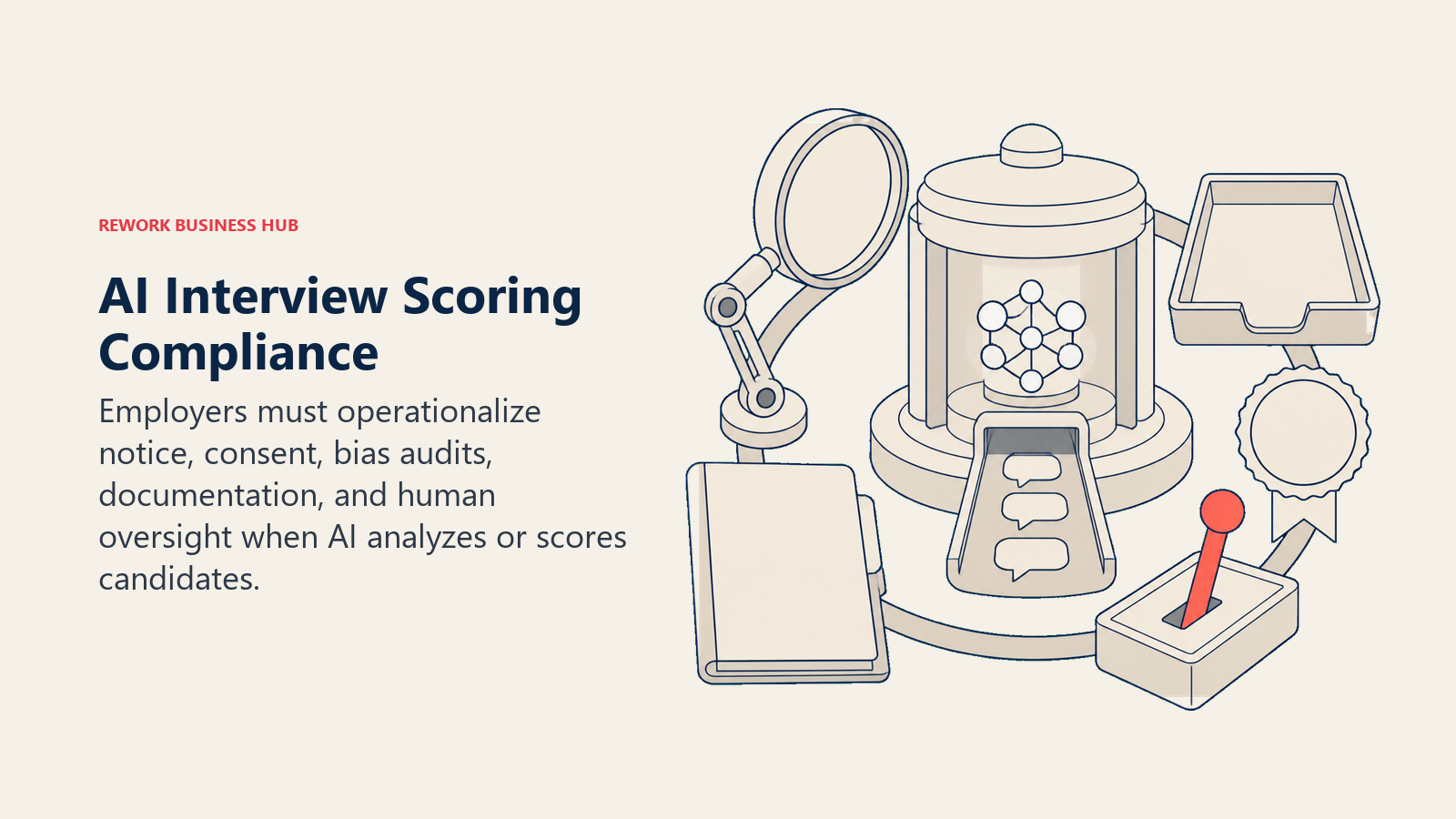
Any tool that scores a candidate's video interview with AI now sits inside an active regulatory perimeter. Three rules matter most for this decision, and all three place the compliance obligation on the employer using the tool, not on the vendor selling it.
| Rule | Jurisdiction | What it requires | Penalty |
|---|---|---|---|
| Local Law 144 | New York City (since July 2023) | Annual independent bias audit of the AI tool, a published audit summary, 10 business days' candidate notice before use, and a right to request an alternative process | $500 to $1,500 per violation, per day, per DCWP |
| AI Video Interview Act (AIVIA), expanded by HB 3773 | Illinois | Notify candidates AI will analyze their video, explain how and what it measures, and get consent first; report race/ethnicity pass rates if AI alone determines advancement; candidates can request deletion within 30 days | Enforced through the Illinois Human Rights Act |
| EU AI Act | European Union | Classifies recruitment and candidate-evaluation AI as high-risk: risk assessments, technical documentation, bias testing, human oversight, and pre-deployment transparency | Up to €35 million or 7% of global turnover |
None of that makes either HireVue or Spark Hire non-compliant by default. It means the compliance workload lands on your HR and legal team the moment you turn AI scoring on, and it scales with how much of the hiring decision the AI is actually making.
HireVue has leaned into this directly. Starting in January 2023, it engaged DCI Consulting Group, an independent equal-employment-opportunity analytics firm, to audit its competency-based and game-based algorithms for race, gender, and intersectional bias across multiple job levels, with audits completed in 2023 and 2024 in line with NYC's Local Law 144 rules. HireVue's own position, stated in its audit announcement, is candid about where the line sits: current regulation "place[s] audit responsibility on the employer," and the company has argued publicly that vendors should share that burden and that audit requirements should be standardized industry-wide. Practically, a HireVue customer inherits a vendor-level audit to point to, but the Local Law 144 obligation to commission, publish, and notify is still theirs to execute.
Spark Hire's AI sits in a different spot on the regulatory spectrum. Its resume scoring, interview summaries, and scorecards evaluate "user-defined criteria like work experience, skills, and education" rather than facial expression or vocal tone, and the company frames the product explicitly as a no-black-box tool where "AI assists, but final decisions are always human-led." That matters under Illinois AIVIA specifically, since the law's heaviest reporting obligation triggers when an employer relies solely on AI analysis of video to determine advancement, a bar Spark Hire's human-in-the-loop model is built to stay under. It doesn't exempt a Spark Hire customer from AIVIA's consent and disclosure requirements, which apply whenever AI analyzes a video interview at all, but it changes how much of the decision the AI itself is making.
| HireVue | Spark Hire | |
|---|---|---|
| What the AI scores | Video responses (language and competency signals against structured rubrics) plus Virtual Job Tryout and game-based results | Resumes against user-set criteria and interview summaries; scorecards stay human-scored |
| Independent bias audit | Yes, DCI Consulting Group audits completed 2023 and 2024, covering race, gender, and intersectional bias | Not published at the same depth; company points to SOC 2 Type II controls and human review |
| Vendor's stated compliance position | Audit responsibility should be shared between employer and vendor, and standardized industry-wide | Positions the product as decision support, not automated decision-making, to stay under AIVIA's solely-AI trigger |
| Employer's Local Law 144 / AIVIA / EU AI Act obligation | Unchanged: still commission your own audit, publish results, and give notice, regardless of vendor | Unchanged: still disclose AI use and get consent before any AI-analyzed interview |
Whichever platform you pick, put your own legal counsel on the actual audit and disclosure requirements for the jurisdictions you hire in before turning AI scoring on for a live requisition. The EU AI Act's high-risk obligations for employment AI were originally set to fully apply from August 2026, though a proposed Digital Omnibus package could push standards-dependent deadlines to December 2027 or August 2028, still working through the EU's trilogue process. The rules differ enough between New York City, Illinois, and the EU that a process built for one won't automatically satisfy the others.
Assessment Depth: Structured Science vs Practical Screening
The meaningful difference is how far each platform goes beyond the interview itself. HireVue is built for multi-layered simulation and competency testing, while Spark Hire keeps screening lighter and closer to practical recruiter workflows.
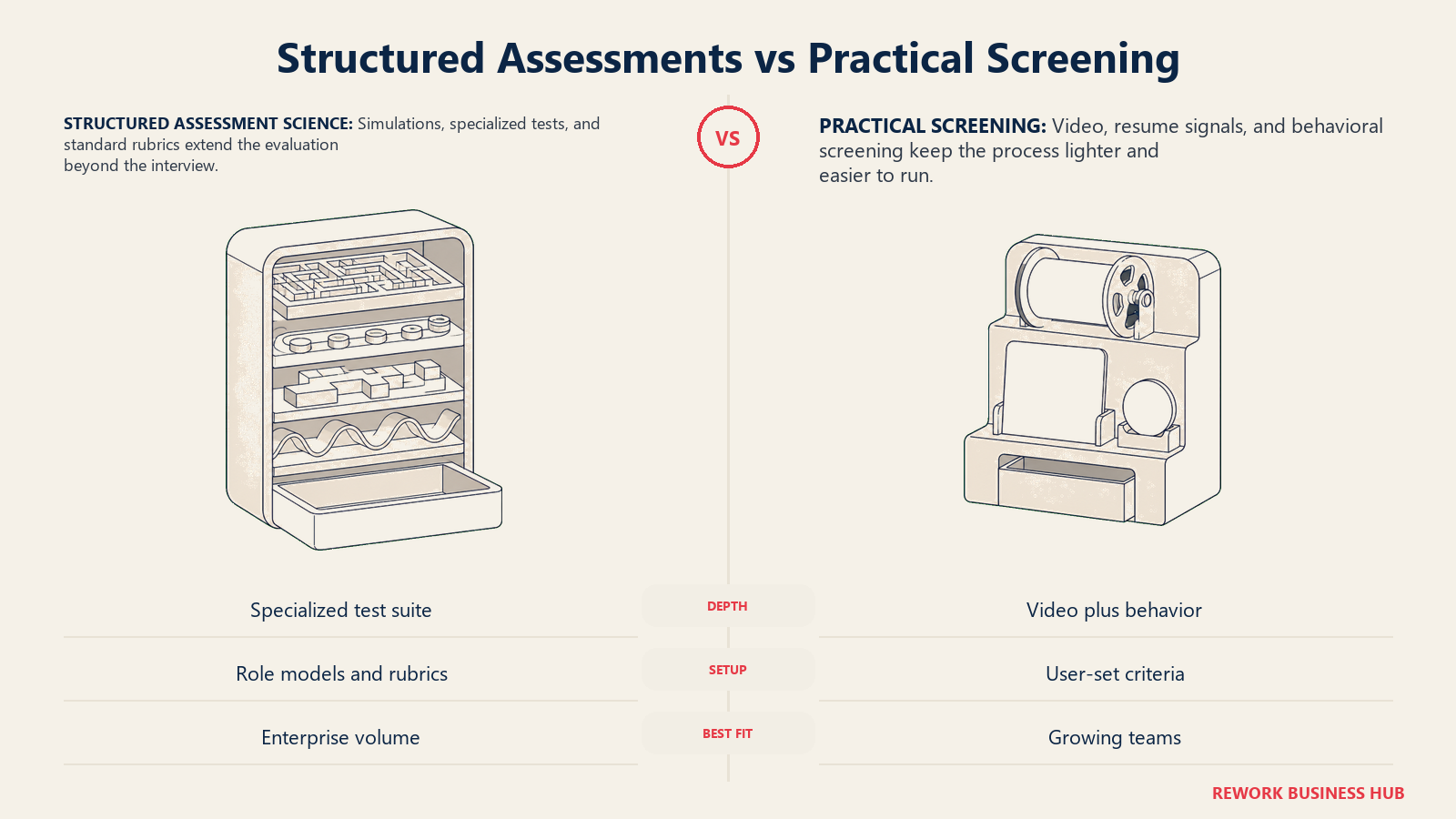
| Assessment type | HireVue | Spark Hire |
|---|---|---|
| Behavioral / predictive assessment | Available through Modern Hire's assessment library | Chally predictive behavioral assessment, included on Recruit Growth and above |
| Job simulation | Virtual Job Tryout role-based simulations | Not a native feature |
| Game-based assessment | Yes | Not a native feature |
| Technical / coding assessment | Yes, dedicated technical assessments | Not native; typically paired with a third-party tool |
| Language proficiency testing | Yes | Not native |
| Reference checks | Available via integration and partner tools | Native, automated reference checks included on Recruit Pro and above |
| AI resume screening | Not the product's focus | Native; up to 6,000 to 24,000 AI resume reviews a year depending on tier |
ATS Integrations
| HireVue | Spark Hire | |
|---|---|---|
| Native ATS | No; video interviewing and assessment layer that plugs into your existing ATS | Yes, built-in ATS following the 2023 Comeet acquisition; standalone video interviewing is also sold separately |
| Named ATS integrations | Greenhouse, Avature, BrassRing, Oleeo, Cornerstone ATS and Talentlink, SmartRecruiters (via marketplace), PageUp (via marketplace), Eightfold | ApplicantStack, Avature, BambooHR, Bullhorn, Ceipal, Crelate, Dayforce, Greenhouse, iCIMS, JazzHR, JobAdder, Lever, and others |
| Best fit | Enterprise TA stack layering AI-scored interviews onto an existing system of record | Teams that want the ATS and the interview tool as one connected system, or the interview layer alone |
Candidate Experience
Candidate reaction to AI-scored interviews is a live risk for either platform, not just a feature to compare. In a Greenhouse-commissioned survey of nearly 3,000 active job seekers published in May 2026, 63% said they'd faced an AI-scored interview, up 13 percentage points in six months, and 38% said they'd walked away from a hiring process specifically because it included one. Only 21% said they believed most employers use AI responsibly in hiring.
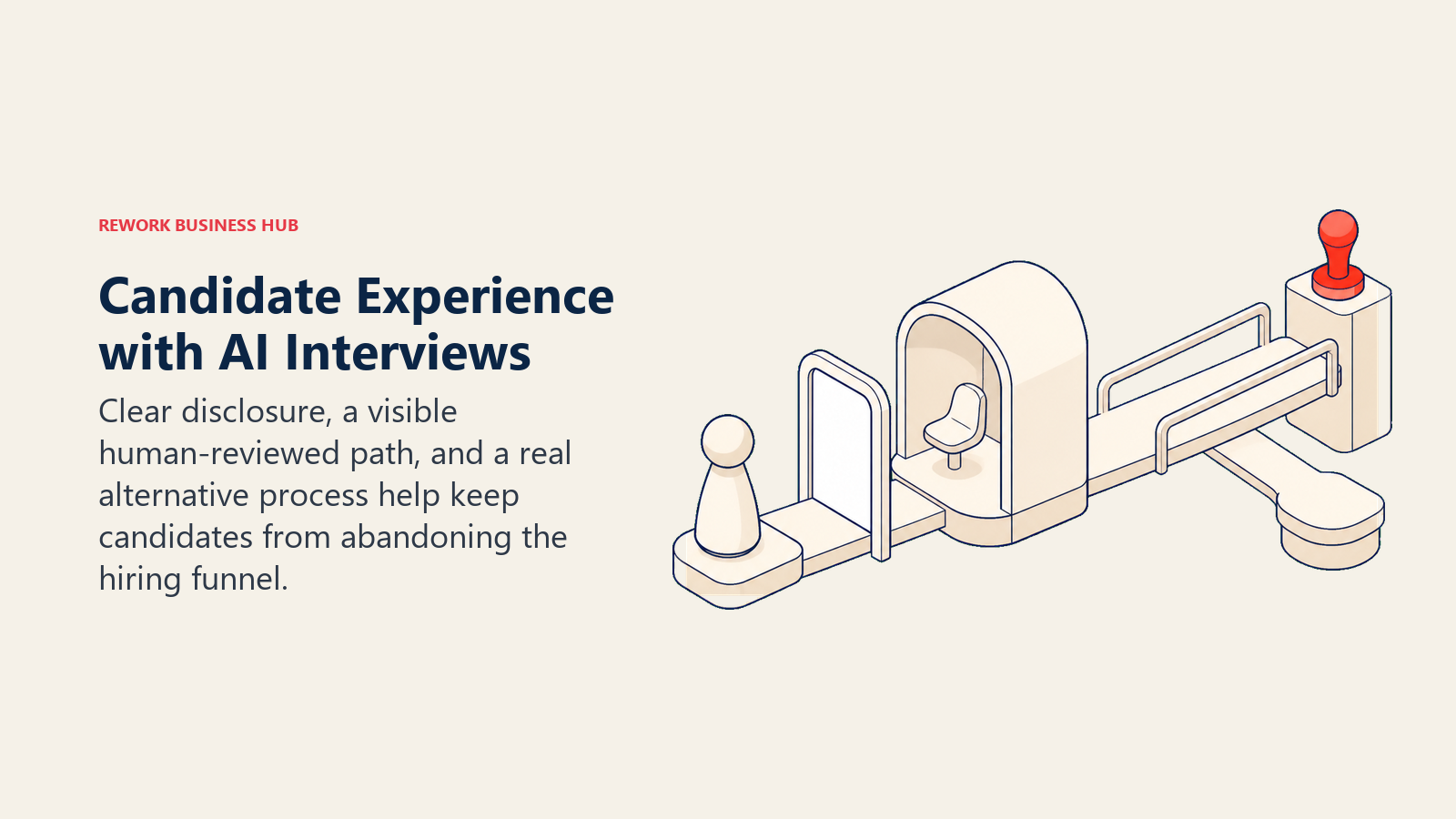
That's a real consideration for the buying decision, not just an HR policy footnote. Whichever platform you choose, clear disclosure and a human-reviewed path aren't optional extras, they're what keeps part of your applicant pool from quitting the funnel before you ever see them.
Reviewer feedback on the two platforms points in different directions. HireVue's reviews consistently flag the platform as polished at enterprise scale, though candidates sometimes describe on-demand interviews as impersonal at high volume. Spark Hire's reviews lean the other way: simple and fast, with onboarding drawing consistent praise, though the tradeoff is less assessment depth behind the interview itself.
Pricing and the True Cost of Ownership
HireVue publishes no pricing anywhere on its site. Its pricing page names an "Essential" package and a "Premium" package without a single dollar figure attached to either, and every path leads to a demo request. The only numbers available come from Vendr's buyer-reported purchase data: a median annual contract of $20,900, ranging from $9,794 to $41,056, reported by actual buyers rather than confirmed by HireVue itself.
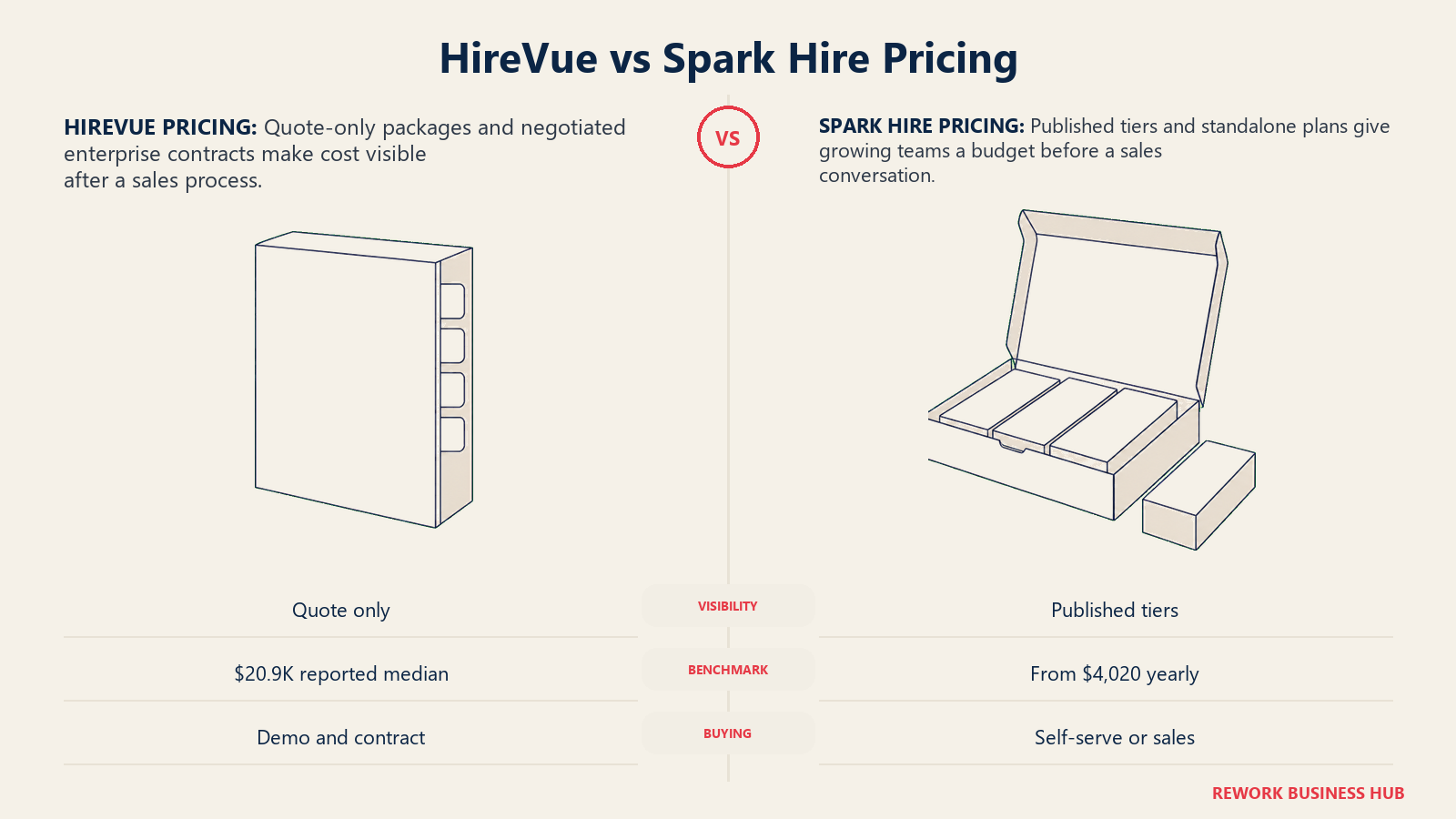
Spark Hire is the opposite. Its pricing page lists exact monthly rates for every tier, distinguishes month-to-month from annual billing, and names the employee-count cap for each plan.
| Plan or data point | HireVue | Spark Hire |
|---|---|---|
| Published pricing | No, quote-only via demo request | Yes, published on sparkhire.com/pricing |
| Entry tier | Not published; Vendr reports a $9,794/year low end (reported) | Recruit Pro: $335/month billed annually ($4,020/year), up to 200 employees |
| Mid tier | Not published | Recruit Growth: $499/month billed annually ($5,988/year), up to 500 employees |
| Enterprise tier | Not published; Vendr reports a $41,056/year high end (reported) | Recruit Enterprise: custom quote, adds custom contracts, location-based data retention, and SSO |
| Median reported contract | $20,900/year (Vendr, reported) | Not separately benchmarked at this granularity |
| Standalone video interviewing | Not offered outside the main platform | $299/month month-to-month (5 jobs, 5 users) or $249/month billed annually (unlimited) |
| Standalone behavioral assessment | Not offered as a standalone SKU | Same $299/$249 monthly structure as standalone video interviews |
| Billing terms | Annual contract, custom-negotiated | ATS plans are annual only; standalone video and assessment plans offer monthly or annual |
Sources: HireVue's pricing page for the Essential/Premium framing, Vendr's HireVue marketplace data for the reported contract range, and Spark Hire's pricing page for confirmed tier pricing.
The honest takeaway: Spark Hire is the only one of these two vendors you can budget against without a sales call. HireVue's number only shows up after a demo, and buyer-reported data suggests it can run 2.5 to nearly 10 times Spark Hire's entry tier depending on scale and modules. That gap is the real story here, not a pricing footnote. It's the clearest single signal for which company you actually are.
Implementation and Time to Go Live
| HireVue | Spark Hire | |
|---|---|---|
| Typical time to go live | Weeks to months for enterprise rollouts, longer with ATS integration, custom scorecards, and change management | Days to a few weeks; reviewers describe onboarding as quick, with a dedicated specialist assigned regardless of tier |
| Change management load | Meaningful: interview guides, scorecards, and assessment selection need to be built out per role family | Lighter: most teams are replacing manual scheduling, not redesigning a structured hiring program |
| Reported learning curve | Steeper for admins configuring assessments and reporting | Described by reviewers as intuitive for day-to-day recruiter use |
Two Roll-Ups Built Through Acquisition: What That Means for Either Roadmap
Worth stating plainly before you sign a contract with either company: neither HireVue nor Spark Hire is the single, organically built product its name implies anymore. HireVue's Virtual Job Tryout and game-based assessment depth arrived through the 2023 Modern Hire deal; Spark Hire's ATS and behavioral assessment arrived through the same year's Comeet and Chally acquisitions.
Neither history is a red flag by itself; feature consolidation through acquisition is standard in HR tech. What it does mean practically: ask each vendor how long the acquired piece you care about most has been fully integrated into the core product versus still running as a semi-separate system, and how support gets routed when your issue touches the acquired half.
When HireVue Is the Right Call
- You're hiring at genuine enterprise volume and need consistent, AI-scored evaluation across thousands of applicants
- You need job simulations, game-based assessments, or technical evaluations layered on top of the interview itself, not just a scored video
- Your legal and compliance team wants a vendor that already runs independent bias audits you can reference alongside your own Local Law 144 obligation
- You already have a dedicated ATS and just need a deep video interviewing and assessment layer that plugs into it
- Budget isn't the primary constraint, and you're comfortable negotiating a custom contract to get there
When Spark Hire Is the Right Call
- You're a growing SMB or mid-market team (roughly up to 500 employees) that needs video interviewing without an enterprise sales process
- You want published, plannable pricing you can put in a budget before you ever talk to sales
- You'd rather have an ATS, video interviewing, and behavioral assessment bundled in one connected platform than stitch several tools together
- You want AI that stays visibly in a support role (resume scoring, summaries, scorecards) rather than an opaque score that decides who advances
- Fast time to value matters more than deep assessment science; you need to stop scheduling calls by hand this quarter, not next year
If Neither Fits: Hiring on the Same Platform as HR and Time Tracking
Worth naming honestly: HireVue and Spark Hire both solve a specific slice of hiring, the interview and assessment stage, and neither is trying to be your full HR system of record (Spark Hire now ships a basic ATS through Comeet, but that's not the pitch that got you evaluating video interview tools) or your broader workforce operations platform. If your actual friction point is that hiring, employee records, and staff time tracking live in disconnected systems that don't share a single employee record, that's a different shape of problem than either tool solves.
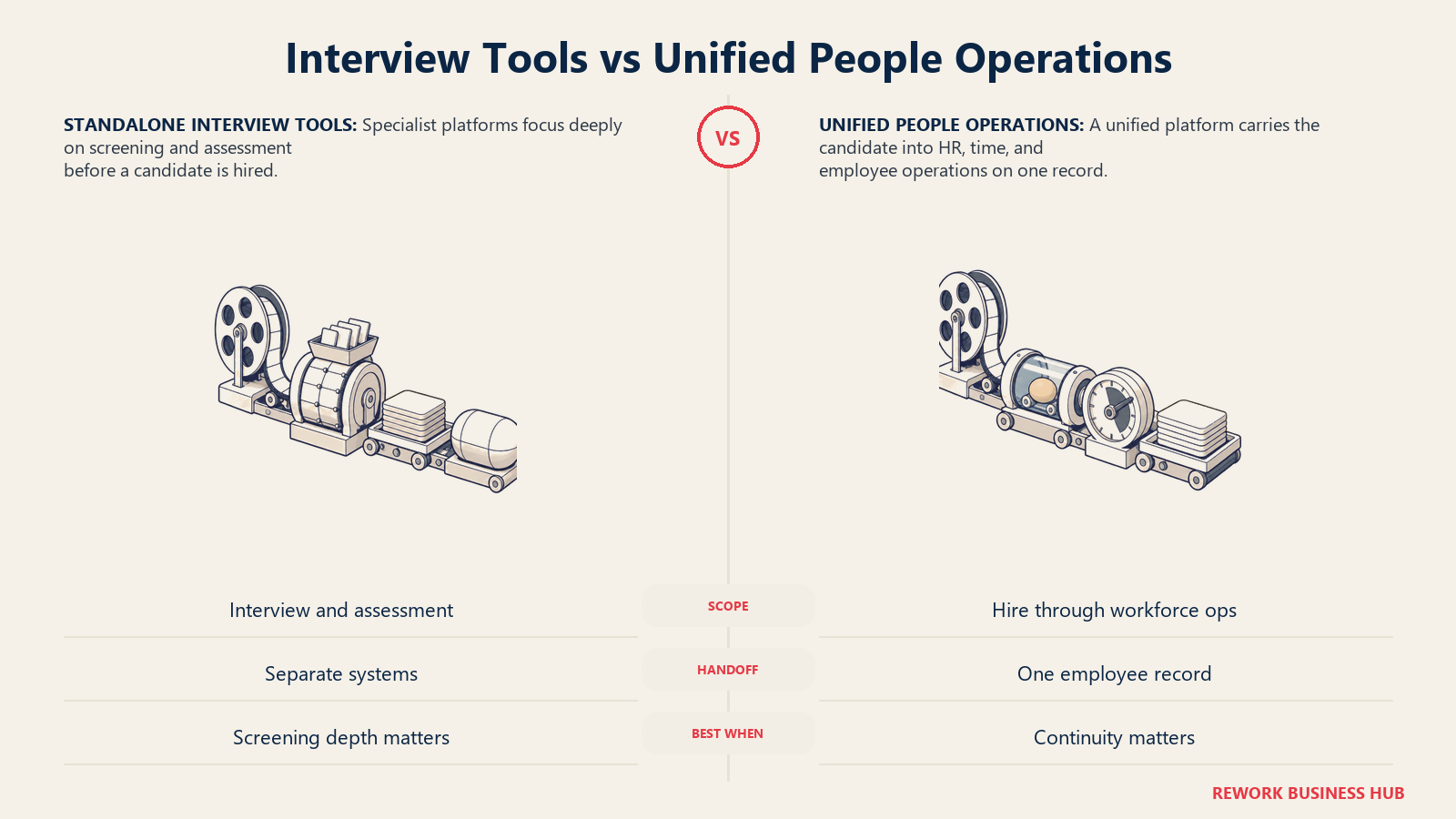
Rework's People line includes E-Hiring, Interview, and Career modules running on the same platform as HRIS, time and attendance, and timesheets, so a candidate becomes an employee record without a handoff between separate systems. It's not a replacement for HireVue's assessment science at enterprise scale or Spark Hire's fast, affordable interview scheduling; it's worth a look if hiring is one piece of a broader people-operations platform you'd rather run in one place. Rework People is quoted per organization rather than sold at a published rate; see rework.com/pricing for current details.
Decision Framework
| If you are... | Pick |
|---|---|
| Screening a huge applicant pool and need standardized, auditable AI scoring | HireVue |
| A growing SMB or mid-market team that needs fast, affordable interview scheduling | Spark Hire |
| Prioritizing deep assessment science: job simulations, game-based and technical evaluations | HireVue |
| Prioritizing published pricing and a self-serve buying process | Spark Hire |
| Looking for hiring as one part of a broader HR and workforce platform | Rework (see rework.com/pricing) |
| Comparing every option in the category, not just these two | See our Best Applicant Tracking Systems roundup |
What to Do Next
- Map your hiring volume and assessment needs before you take a demo. If you can't say roughly how many candidates you screen a year and whether you need job simulations or just a structured video, sit with that question first.
- Get HireVue's real number in writing before you assume it fits your budget. Spark Hire's published tiers give you a planning baseline that HireVue's demo-only process doesn't.
- Ask both vendors directly how they handle Local Law 144, Illinois AIVIA, and EU AI Act obligations for the jurisdictions you hire in. The compliance work is yours either way, but the documentation each vendor hands you differs.
- Outgrowing either platform's fit? Our Best HireVue Alternatives guide and Best Spark Hire Alternatives guide cover lighter and heavier options on either side.
- Not sure a standalone interview tool solves your problem? Our guide to choosing recruiting software walks through the evaluation criteria before you sit through a single sales call.
Frequently Asked Questions about HireVue vs Spark Hire
Is HireVue or Spark Hire cheaper?
Spark Hire, by a wide margin at typical SMB and mid-market scale. Its published tiers start at $335/month billed annually ($4,020/year) for up to 200 employees. HireVue publishes no pricing, but Vendr's buyer-reported data puts the median annual contract at $20,900, ranging from $9,794 to $41,056 depending on volume and modules.
Does using AI-scored video interviews make my company non-compliant with NYC Local Law 144 or Illinois AIVIA?
Not by itself. Both laws regulate how an employer uses an automated employment decision tool, not whether the tool exists. Local Law 144 requires an annual independent bias audit, published results, and candidate notice; Illinois AIVIA requires disclosure and consent before the interview, plus additional reporting if AI analysis alone determines advancement. The compliance obligation sits with the employer regardless of which vendor you choose.
Which platform is better for high-volume enterprise hiring?
HireVue. Its Interview Builder, standardized scorecards, and Modern Hire assessment science (Virtual Job Tryouts, game-based and technical assessments) are built for consistent evaluation across thousands of applicants, and the company already runs independent bias audits through DCI Consulting Group.
Which platform is better for a small or mid-market team on a tighter budget?
Spark Hire. Its pricing is published, its tiers cap at a company size SMB and mid-market employers actually hit, and its AI stays in a support role (resume scoring, summaries, scorecards) rather than an automated score that decides who advances.
Are HireVue and Spark Hire independently owned companies?
Both have grown through acquisition rather than staying single-product. HireVue combined with Modern Hire in May 2023 to add assessment science. Spark Hire acquired Comeet (an ATS) in June 2023 and Chally (predictive behavioral assessment) in September 2023. Neither is currently known to be part of a larger portfolio holding company the way some ATS brands are.
Related Resources:
- Best Video Interview Software in 2026
- Best Applicant Tracking Systems in 2026
- Greenhouse vs Lever: Which ATS Fits Your Hiring Model
- Best Greenhouse Alternatives in 2026
- Best Lever Alternatives in 2026
- Best Workable Alternatives in 2026
- Best AI Recruiting Tools in 2026
- How to Choose Recruiting Software

On this page
- TL;DR
- Who Each Platform Is Actually Built For
- Key Facts
- One-Way vs Live Interviewing: Where Each Platform Starts
- HireVue's Wedge: AI Scoring and Assessment Science at Scale
- Spark Hire's Wedge: Simplicity, Speed, and Price for Growing Teams
- AI Scoring, Bias Audits, and the Compliance Burden
- Assessment Depth: Structured Science vs Practical Screening
- ATS Integrations
- Candidate Experience
- Pricing and the True Cost of Ownership
- Implementation and Time to Go Live
- Two Roll-Ups Built Through Acquisition: What That Means for Either Roadmap
- When HireVue Is the Right Call
- When Spark Hire Is the Right Call
- If Neither Fits: Hiring on the Same Platform as HR and Time Tracking
- Decision Framework
- What to Do Next