Best Greenhouse Alternatives in 2026: 13 Tools for Growing Talent Teams
Turn this article into takeaways for your work.


Each assistant summarizes the article only for you and suggests best practices for your work.
Greenhouse is the applicant tracking system a lot of talent teams graduate into, and sometimes graduate out of. If you're a hiring team of 20 to 150 people staring at a Greenhouse renewal that jumped into five figures, the strongest swaps are Workable and JazzHR for budget relief, Lever and Ashby for real structure without the price tag, and Rework if hiring lives disconnected from the rest of your HR stack. This list evaluates 13 alternatives on pricing, structured-hiring depth, and fit by size.
Give Greenhouse its due first. Interview kits and scorecards that interviewers actually use, a deep integration marketplace, and a brand enterprise buyers trust: Greenhouse earns its 4.4 out of 5 rating across more than 1,800 G2 reviews honestly (G2). The trouble starts underneath the size it was built for. Greenhouse prices in three tiers, Core, Plus, and Pro, by headcount, then sells sourcing automation, CRM, and DEI reporting as separate add-ons many buyers assumed were part of "the ATS." A 40-person company commonly lands at $9,500 to $12,000 a year for workflows a five-person recruiting function only partly uses. That gap is where the tools below matter.
Key Facts
Key Facts: Hiring Costs and ATS Adoption
- The average US cost per hire climbed to $5,475 for non-executive roles in 2025, up from $4,129 in 2016. (SHRM, 2025)
- Structured interviews with a fixed rubric predict job performance at roughly .51 validity versus .38 for unstructured interviews. (Schmidt and Hunter meta-analysis, Psychological Bulletin, 1998, via Pin)
- 97.8% of Fortune 500 companies now run an applicant tracking system, close to universal adoption among large employers. (Jobscan, 2025)
- Greenhouse holds a 4.4 out of 5 rating across more than 1,800 reviews, with 94% of reviewers rating it 4 or 5 stars. (G2, 2026)
- Nearly six in ten candidates have abandoned a job application before finishing it, part of why simpler application flows matter. (HR Dive, 2025)
Quick Comparison Table
This list is evaluated against Greenhouse's own core job: structured, auditable hiring. Rework is the exception; it wins on putting E-Hiring, Interview, and Career on the same platform as HRIS, attendance, and timesheets. For the full shortlist, see Best Applicant Tracking Systems in 2026.
| Tool | Best For | Starting Price | Key Strength | Key Limitation |
|---|---|---|---|---|
| Workable | Mid-size, transparent-price swap | $299/mo monthly, $3,588/yr annual (Standard) | Published pricing, built-in AI sourcing | Price scales with headcount regardless of hiring volume |
| Lever | Recruiting CRM inside the ATS | Custom quote (reported ~$3,500-$15,000+/yr) | Talent relationship management, nurture campaigns | No public pricing; owned by JazzHR's parent |
| Ashby | Native analytics without a BI add-on | $400/mo (Foundations, up to 100 employees) | Best-in-class built-in reporting, all-in-one stack | Priciest entry point on this list |
| SmartRecruiters | SAP SuccessFactors enterprises | Custom quote (enterprise, SAP-owned) | AI sourcing, backed by SAP's roadmap | Enterprise sales process, not built for small teams |
| JazzHR | Small businesses on a tight budget | $1,000/yr (Hero, billed annually) | Cheapest published-price ATS here | Hard 3-job cap forces a fast upgrade |
| Rework | Hiring unified with HR and timesheets | Quote on request (rework.com/pricing) | E-Hiring, Interview, Career on the HRIS platform | Not built for agency recruiting or deep sourcing |
| Recruitee (Tellent) | Hiring managers in the loop | No published price (reported ~€301/mo Start, annual; 1-year minimum) | Easy manager collaboration, unlimited users | Pricing not published; headcount-based billing |
| Breezy HR | Free-to-start, flat-fee ATS | Free (1 job); $157/mo (Startup, annual) | Flat pricing regardless of user count | Scorecards gated behind higher tiers |
| Teamtailor | Employer branding and career sites | Custom quote (reported ~$300-400/mo, per Vendr) | Best career site builder here | Weaker AI sourcing than newer entrants |
| Pinpoint | Candidate-first hiring, blind screening | Custom quote (roughly $345/mo est.) | Best candidate-facing experience | No public rate card, annual contracts only |
| Zoho Recruit | Teams already in the Zoho ecosystem | Free tier; $25/user/mo (Standard) | Very affordable, deep Zoho integration | AI (Zia) gated behind the Professional tier |
| iCIMS | Full enterprise Talent Cloud | Custom quote (reported avg. ~$20,781/yr, per Vendr) | Broadest enterprise suite, strong analytics | Year-one cost often 1.5-2x the base license |
| Bullhorn | Staffing and recruiting agencies | $99/user/mo (Starter) | Purpose-built agency ATS and CRM | Wrong tool for in-house hiring teams |
Pricing note: Most tools here, including Greenhouse itself, don't publish full pricing. Figures marked "custom quote" or "est." come from vendor-reported ranges and third-party research current as of August 2026; confirm exact numbers with the vendor before you budget.
What changed in 2026: SAP completed its SmartRecruiters acquisition in September 2025. Recruitee rebranded to Tellent Recruitee after PSG Equity consolidated Recruitee, Javelo, and KiwiHR into one brand. And AI sourcing moved from differentiator to table stakes: most tools here now ship some form of AI matching by default. See AI in the Recruiter Workflow for where that helps versus where it creates risk.
1. Workable: The Straightforward, Transparently Priced Swap
Workable is the closest like-for-like swap for a team that likes how Greenhouse works but not what it costs. It's priced around company headcount rather than recruiter seats, same as Greenhouse, but publishes its prices instead of routing you through a sales call. Starter runs $149 a month for up to 50 employees, Standard is $299, and Premier is $599, all billed annually with roughly a 20% discount over month-to-month.
The catch is real. Crossing from 20 to 21 employees can trigger a tier jump, and core-feeling add-ons like video interviews ($99/month) and SMS ($79/month) can push a $299 plan closer to $477. G2 reviewers also report 10 to 20% renewal increases year over year, so the sticker price is a starting point, not a ceiling.
| What you get | What you don't |
|---|---|
| Published pricing, no sales call required | Flat pricing as headcount grows |
| AI-assisted sourcing and candidate matching | Video interviews and SMS included by default |
| Fast implementation, minimal setup time | Greenhouse-depth DEI and compliance reporting |
| Free trial available | A guaranteed flat renewal rate |
Pricing: $299/month Standard ($3,588/yr annual), $599/month Premier ($7,188/yr), $719/month Enterprise ($8,628/yr); pay-per-job at $189/job/month for occasional hirers.
Best for: Growing teams (20-300 employees) that want Greenhouse's structured workflow at a lower, published price. The full side-by-side is Workable vs Greenhouse. Not ideal for: Teams adding video interviews and SMS while scaling past 100 employees without budgeting for the add-ons. If Workable's gaps rule it out, see the best Workable alternatives.
2. Lever: Recruiting CRM Built Into the ATS
Lever, now part of the Employ Inc. portfolio alongside JazzHR and Jobvite, is the pick for teams whose real complaint about Greenhouse is that it tracks candidates but doesn't nurture them. LeverTRM bakes CRM-style pipelines, nurture campaigns, and passive-candidate tracking into the ATS, so recruiters aren't bolting a separate sourcing CRM on.
Pricing isn't published. Based on procurement data, a 200-employee company pays a median of roughly $12,240 a year after negotiation, a 500-employee company around $36,778, and a 1,000-employee company around $63,172. Like Greenhouse, Lever bills by total headcount rather than active recruiter seats, so a 500-person company with a 4-person TA team still pays for all 500.
| What you get | What you don't |
|---|---|
| CRM-style nurture campaigns built into the ATS | Published, self-serve pricing |
| Strong reporting and pipeline visibility | Pricing that reflects recruiter seats rather than total headcount |
| Established mid-market track record | Independence from Employ Inc.'s shared roadmap with JazzHR and Jobvite |
| Solid interviewer experience | A budget option for small teams |
Pricing: Custom quote only; typically $12,000-$65,000 a year depending on size, billed annually.
Best for: Mid-market companies (200-2,000 employees) that want recruiting CRM and nurture sequences without a bolted-on tool. Not ideal for: Small teams, or anyone who wants a number before a sales call. See best Lever alternatives or Greenhouse vs Lever if pricing opacity is the dealbreaker.
3. Ashby: Native Analytics for High-Growth Teams
Ashby is the ATS high-growth, VC-backed tech companies reach for once they've outgrown spreadsheet dashboards. It combines sourcing, scheduling, CRM, and an ATS with genuinely native, deep analytics, the kind most competitors bolt on through a BI export.
That depth costs more than almost anything else here at entry level. Foundations starts at $400 a month for up to 100 employees (roughly a 10% discount for an annual commitment), and Plus and Enterprise are custom quoted, with real-world contracts running about $14,656 a year for SMBs to $59,112 or more for enterprise. Hidden costs include a 200-lookup monthly email-enrichment cap and paid add-ons for AI Notetaker and advanced scheduling.
| What you get | What you don't |
|---|---|
| Best-in-class native reporting and analytics | The cheapest entry price on this list |
| All-in-one sourcing, scheduling, and ATS | A large third-party integration marketplace |
| Strong fit for technical and product hiring | Predictable costs as headcount grows mid-contract |
| Modern, fast interface | A free tier or low-commitment trial |
Pricing: From $400/month (Foundations, up to 100 employees); custom quote for Plus and Enterprise.
Best for: High-growth, VC-backed tech companies wanting deep sourcing and hiring analytics without a separate BI tool. Greenhouse vs Ashby compares them directly. A data-driven sourcing strategy pairs naturally with it. Not ideal for: Budget-conscious teams under 50 people; Ashby's entry price runs roughly double Greenhouse's at the same headcount.
4. SmartRecruiters: Now an SAP Company
SmartRecruiters completed its transition to becoming an SAP company on September 11, 2025. It still operates as a standalone recruiting platform, but SAP is actively integrating it with SuccessFactors, which matters if your company already runs it.
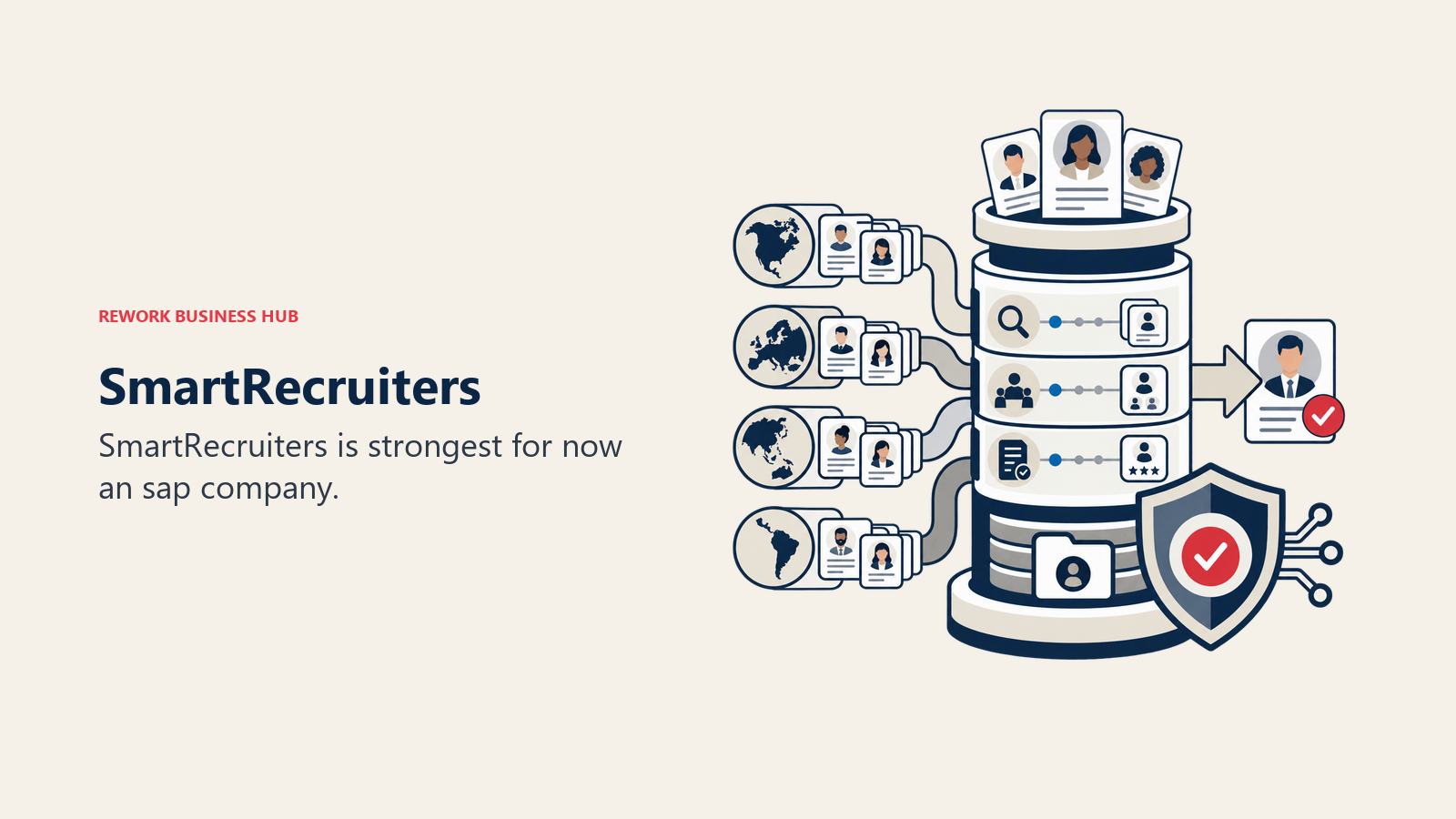
For enterprises evaluating Greenhouse's Expert tier against something with deeper AI-driven sourcing and SAP's implementation resources behind it, SmartRecruiters is the natural comparison. Pricing is enterprise, quote-only, and the sales process assumes a large TA org, not a five-person team.
| What you get | What you don't |
|---|---|
| AI-powered sourcing, matching, and conversational tools | Published pricing at any tier |
| Native path into SAP SuccessFactors | A lightweight buying process for smaller teams |
| CRM and ATS combined in one enterprise suite | A budget option for sub-200-employee companies |
| Backing and roadmap stability from SAP | Simplicity; built for scale, not fast setup |
Pricing: Custom quote, enterprise sales cycle.
Best for: Enterprises, especially SAP SuccessFactors customers, wanting AI-driven sourcing and one vendor relationship across HCM and recruiting. Not ideal for: Teams under a few hundred employees; the sales and implementation process is built for enterprise scale.
5. JazzHR: The Cheapest Real ATS Here
JazzHR, also an Employ Inc. brand alongside Lever and Jobvite, is the budget answer for small businesses that got a Greenhouse quote and audibly laughed. It publishes pricing across three flat annual tiers, priced per plan rather than per seat, no sales call needed: Hero at $1,000/year (3 job postings a month), Plus at $3,480/year, and Pro at $5,508/year.
The trade-off is depth. JazzHR covers the hiring workflow well but doesn't match Greenhouse's structured-hiring sophistication (deep scorecards, interview kits, DEI reporting), and Hero's 3-job cap means most growing teams outgrow it within a year. It also shares a parent company, and likely a shared product direction, with Lever.
| What you get | What you don't |
|---|---|
| Published, flat pricing with unlimited users | Greenhouse-depth scorecards and interview kits |
| A 21-day free trial, no sales call needed | Room to grow past 3 open jobs on the entry tier |
| Fast setup for small teams | Deep DEI or compliance reporting |
| 10,000+ companies already using it | Independence from Employ Inc.'s shared roadmap |
Pricing: $75-$420/month (Hero to Pro), billed annually; higher month-to-month.
Best for: Small businesses (under 50-100 employees) hiring occasionally that want a real ATS without an enterprise price tag. Not ideal for: Teams needing structured interview kits, DEI reporting, or more than a handful of open roles at once.
6. Rework: Hiring Inside the Same Platform as HR and Time Tracking
Rework is the one tool here that isn't trying to out-recruit Greenhouse. Its E-Hiring module (the ATS), plus Interview and Career, live inside the Rework People line, alongside HRIS, time and attendance, and timesheets. The pitch isn't deeper scorecards or a bigger sourcing database; it's that the person you just hired through E-Hiring becomes an HR record, an attendance profile, and a timesheet owner without anyone retyping their details into a second system.
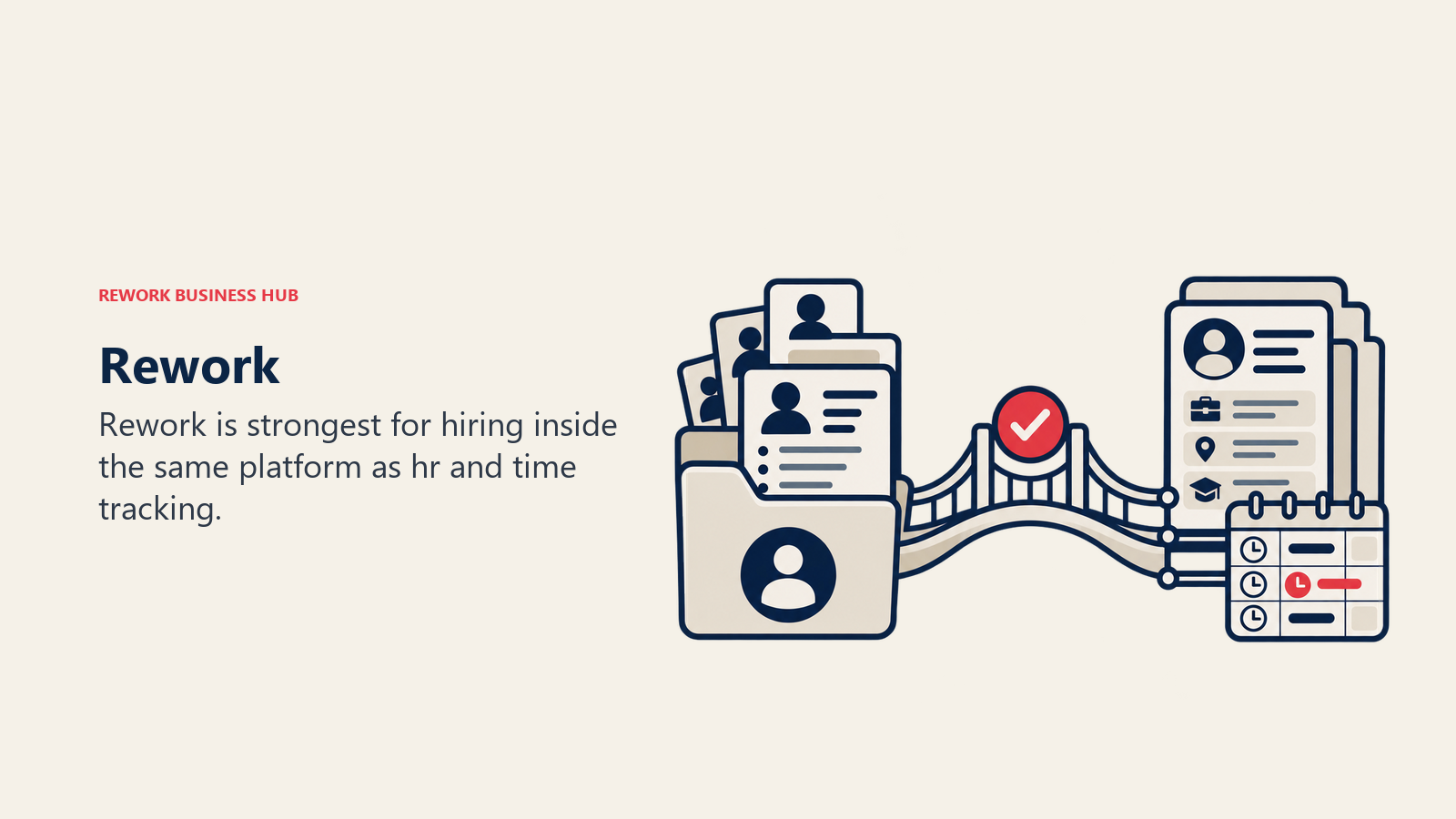
That's a different problem than most Greenhouse switchers are solving, worth being honest about upfront. If your complaint is Greenhouse's price, but hiring works fine standalone, Workable or JazzHR solve that more directly. Rework is the right look when the friction shows up after the offer: a new hire accepted in one tool, then manually re-entered into a separate HRIS, with start date and comp keyed in twice.
| What you get | What you don't |
|---|---|
| E-Hiring, Interview, and Career on the same platform as HRIS, attendance, and timesheets | A large third-party integration marketplace |
| New hires flow straight into HR records without re-entry | Greenhouse-level interview kit and scorecard depth |
| One vendor relationship for hiring, HR, and time tracking | Deep sourcing or talent-CRM tooling for agency recruiting |
| Mid-size team fit (roughly 20-500 employees) | A published, self-serve price |
Pricing: Rework People, including E-Hiring, Interview, and Career, is quoted per organization, not published as a flat rate. See rework.com/pricing. For the HR side on its own, the best HR software guide covers HRIS options too.
Best for: Mid-size teams (roughly 20-500 employees) whose real cost of leaving Greenhouse alone isn't the ATS bill, it's running hiring, HR, and time tracking as three disconnected logins. Not ideal for: High-volume agency recruiting, or teams that need Greenhouse-depth sourcing and scorecard sophistication first. Look earlier in this list at Ashby or SmartRecruiters instead.
7. Recruitee (Tellent): Collaborative Hiring for Hiring Managers
Recruitee rebranded in 2025: PSG Equity folded Recruitee, Javelo, and KiwiHR into a single Tellent brand, now marketed as Tellent Recruitee. The product is largely unchanged, still one of the friendlier tools here for getting hiring managers actively involved in scoring.
Pricing isn't published, and Recruitee shifted from per-user to headcount-based billing in 2024, with reported renewal increases around 5%. Third-party estimates put entry plans around $199 a month and mid-tier plans around $249 to $399, but you'll need a quote to confirm.
| What you get | What you don't |
|---|---|
| Strong hiring-manager collaboration tools | Published, self-serve pricing |
| Unlimited users on paid plans | A locked-in flat renewal rate |
| Now backed by Tellent's broader HR platform | Greenhouse-depth DEI or compliance reporting |
| Clean, approachable interface | Independent brand identity (now part of Tellent) |
Pricing: Custom quote; third-party estimates start around $199 a month, billed annually.
Best for: Mid-market teams that want hiring managers actively scoring candidates without a heavy admin lift. Not ideal for: Teams that want to see exact pricing before a sales conversation.
8. Breezy HR: Free to Start, Flat-Fee Pricing
Breezy HR is the ATS for a small team that wants to try before it buys. Bootstrap is free forever for one active job, and paid tiers use flat monthly pricing with unlimited users, a real advantage over Greenhouse or Lever if hiring managers touch the system occasionally.
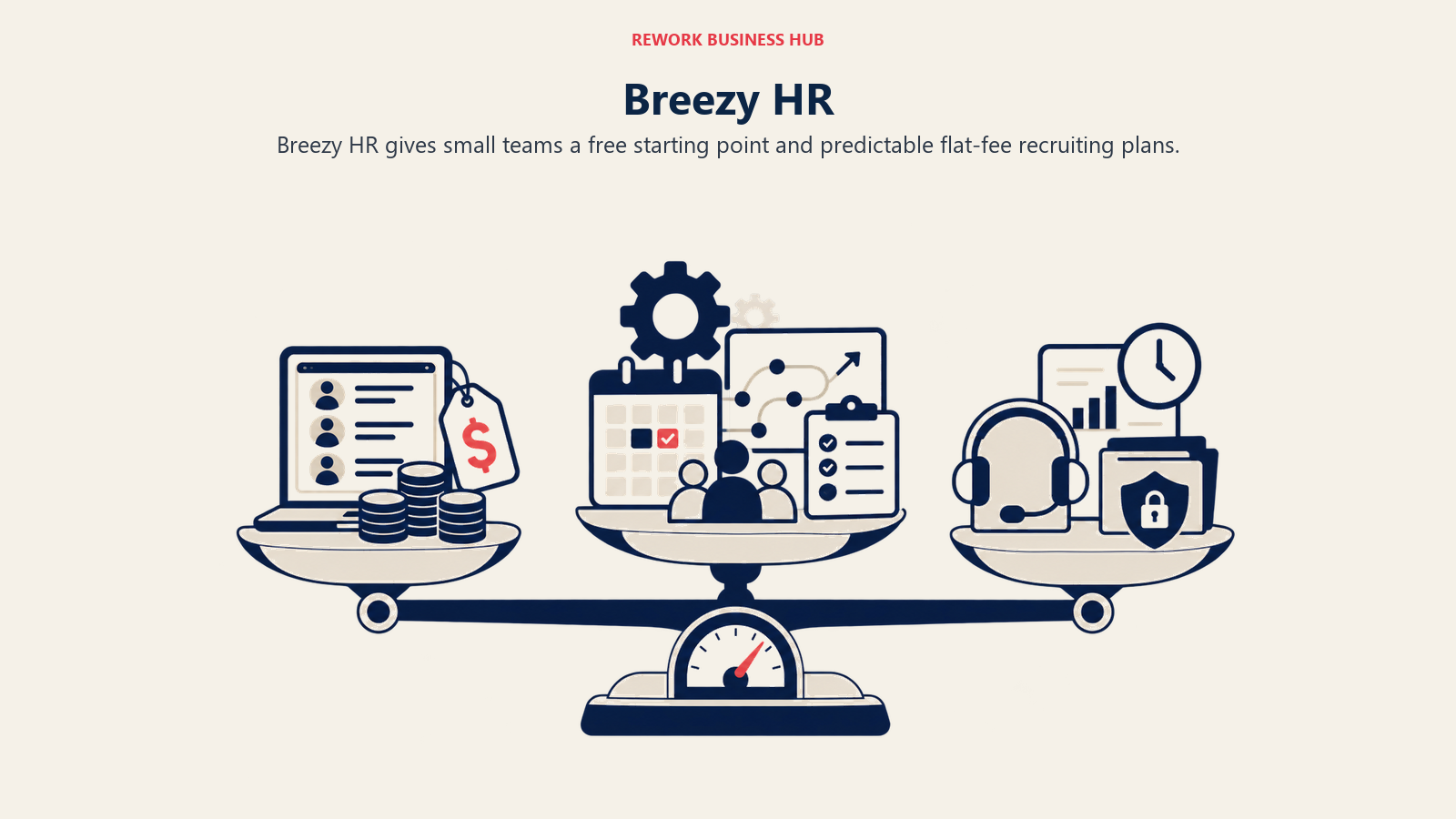
Growth ($273/month annualized) is where scorecards and eSignatures unlock, and Business ($439/month) is required for HRIS integrations and offer management, so the free and Startup ($157/month) tiers are thinner than they look. SMS ($41/month), onboarding ($49/month), and AI credits stack on top of whichever base plan you land on.
| What you get | What you don't |
|---|---|
| A genuinely usable free tier and flat monthly pricing | Interview scorecards on the entry tiers |
| Unlimited users at every paid tier | HRIS integrations below the Business tier |
| Fast setup for small teams | Deep structured-hiring depth |
| Month-to-month flexibility | A large integration ecosystem |
Pricing: Free (Bootstrap, 1 job) to $439/month (Business, annual); Pro is custom quote.
Best for: Small teams (under 25-50 employees) wanting to start free and pay flat, predictable pricing as they add hiring managers. Not ideal for: Teams needing scorecards or HRIS integrations without upgrading past the entry tiers.
9. Teamtailor: Employer Branding and Career Sites First
Teamtailor leads with the career site, not the pipeline board. Its builder produces career pages that look hand-coded rather than templated, and for companies where inbound applications drive hiring, that employer-branding depth is the actual reason to switch off Greenhouse's utilitarian candidate pages.
Pricing is custom quoted, scaling with company size on a job-slot model rather than per-seat billing, with contracts commonly running $6,000 to $15,000 a year for mid-market companies and averaging around $16,500 overall. Steady, predictable hiring volume gets the best value from that model; spiky, seasonal hiring gets expensive once you exceed your job slots.
| What you get | What you don't |
|---|---|
| Best-in-class career site and employer branding tools | AI-powered sourcing depth |
| Unlimited users, job-slot-based pricing | Published pricing |
| Strong fit for inbound-application-heavy hiring | Predictable costs during seasonal hiring spikes |
| Clean ATS workflow underneath the branding layer | Deep CRM or nurture-campaign tooling |
Pricing: Custom quote; typically $2,750-$72,000 a year depending on size.
Best for: Companies (50-400 employees) where the career site and employer brand are the primary hiring lever. Not ideal for: Teams that lead with active sourcing rather than inbound applications.
10. Pinpoint: Candidate-First Hiring with Blind Screening
Pinpoint starts from the candidate's side of the process, not the recruiter's. Branded career sites, a multilingual application experience, and an anonymized, blind-screening feature give hiring teams a practical DEI tool without a whole new methodology.
Pricing isn't published. Growth starts around $345 a month annual, Enterprise runs $1,200-plus, and typical all-in annual costs land between $4,000 and $15,000. Plans are priced in bands by total headcount rather than recruiter seats, with unlimited seats at every tier.
| What you get | What you don't |
|---|---|
| Best candidate-facing application experience on this list | A public rate card |
| Blind screening for practical DEI without a full methodology overhaul | A free trial |
| Unlimited seats at every plan | Monthly billing (annual contracts only) |
| Strong career site builder | API access below the Enterprise tier |
Pricing: Custom quote; roughly $345/month (Growth) to $1,200-plus/month (Enterprise), billed annually.
Best for: In-house hiring teams wanting a candidate-first application experience and a lightweight DEI tool. Not ideal for: Agency recruiters, or teams needing month-to-month billing flexibility.
11. Zoho Recruit: The Budget Ecosystem Play
Zoho Recruit is the value option if your company already runs on Zoho. It ships in two editions, Corporate HR and Staffing Agency, the agency edition unlocking far higher job limits at the same per-seat price.
Corporate HR Standard runs $25/user/month (10 active jobs) and jumps to Enterprise at $50/user/month (20 jobs); there's no middle tier the way Staffing Agency has one. A free tier covers up to 3 users. AI features through Zia are gated behind Professional, which only Staffing Agency offers.
| What you get | What you don't |
|---|---|
| Very affordable per-seat pricing, with a free tier | A middle pricing tier for Corporate HR |
| Deep integration with the rest of the Zoho suite | AI features (Zia) on the Standard tier |
| Both in-house and agency editions available | Greenhouse-depth structured interview kits |
| Fast setup, low learning curve for Zoho users | A modern, differentiated interface |
Pricing: Free (up to 3 users) to $50/user/month (Corporate HR Enterprise); Staffing Agency adds a $50/user/month Professional tier.
Best for: Budget-conscious teams already using Zoho apps, or staffing agencies wanting an affordable agency-specific edition. Not ideal for: Teams wanting Zia's AI features without the Professional tier, or that need Greenhouse-depth structured interviews.
12. iCIMS: The Enterprise Talent Cloud
iCIMS competes directly with Greenhouse's Expert tier for large enterprise accounts, and runs hiring for roughly a quarter of the Fortune 500 (WhatJobs, June 2026). The Talent Cloud bundles ATS, CRM, onboarding, and predictive analytics into one suite.
Mid-market contracts (200-1,000 employees) typically run $30,000 to $60,000 a year, and enterprise accounts (1,000-10,000 employees) run $60,000 to $120,000 or more. Implementation ($15,000-$25,000), SMS, and support push realistic year-one totals to 1.5 to 2 times the quoted base license, with renewal increases of up to 40% reported in 2024-2025.
| What you get | What you don't |
|---|---|
| Broadest enterprise suite: ATS, CRM, onboarding, and analytics | A budget-friendly entry point |
| Configuration depth for large, multi-business-unit orgs | Predictable year-one or renewal costs |
| Strong reporting on time-to-fill and source effectiveness | A fast, low-overhead implementation |
| Established enterprise market position | Fit for teams under a few hundred employees |
Pricing: Custom quote; $30,000-$120,000-plus a year depending on size and modules.
Best for: Large enterprises (1,000-plus employees) needing ATS, CRM, and onboarding on one Talent Cloud with deep configuration options. Not ideal for: Mid-size or small teams; both the price and implementation overhead are built for a much larger organization.
13. Bullhorn: Built for Staffing Agencies, Not In-House Teams
Bullhorn is worth naming specifically to rule it out for most Greenhouse switchers. It's the dominant ATS and CRM for staffing agencies placing candidates with external clients, a fundamentally different job than in-house hiring. If your team is a staffing agency, Bullhorn belongs on your list; if you're hiring for your own company, it doesn't.
Bullhorn publishes two prices, Starter at $99/user/month and Core at $165/user/month, but most agencies actually pay $150 to $250 a user a month once VMS, automation, and analytics add-ons are included, budgeting $250 to $350 all-in with 15 to 20% annual increases.
| What you get | What you don't |
|---|---|
| Purpose-built agency ATS and CRM workflows | Fit for in-house corporate hiring |
| Deep VMS and back-office integrations for temp staffing | A budget-friendly all-in price |
| Established dominance in the staffing and agency segment | Structured-hiring scorecards built for a single employer |
| Strong candidate database tooling for high-volume placements | Simple, flat pricing |
Pricing: $99-$165/user/month (Starter to Core), plus add-ons; most agencies pay $150-$350/user/month all-in.
Best for: Staffing and recruiting agencies placing candidates with external clients. Not ideal for: In-house corporate talent acquisition teams, which describes most readers comparing Greenhouse alternatives.
Why Teams Leave Greenhouse
Most teams that leave Greenhouse aren't rejecting structured hiring. They're rejecting what it costs to keep buying it at their size.
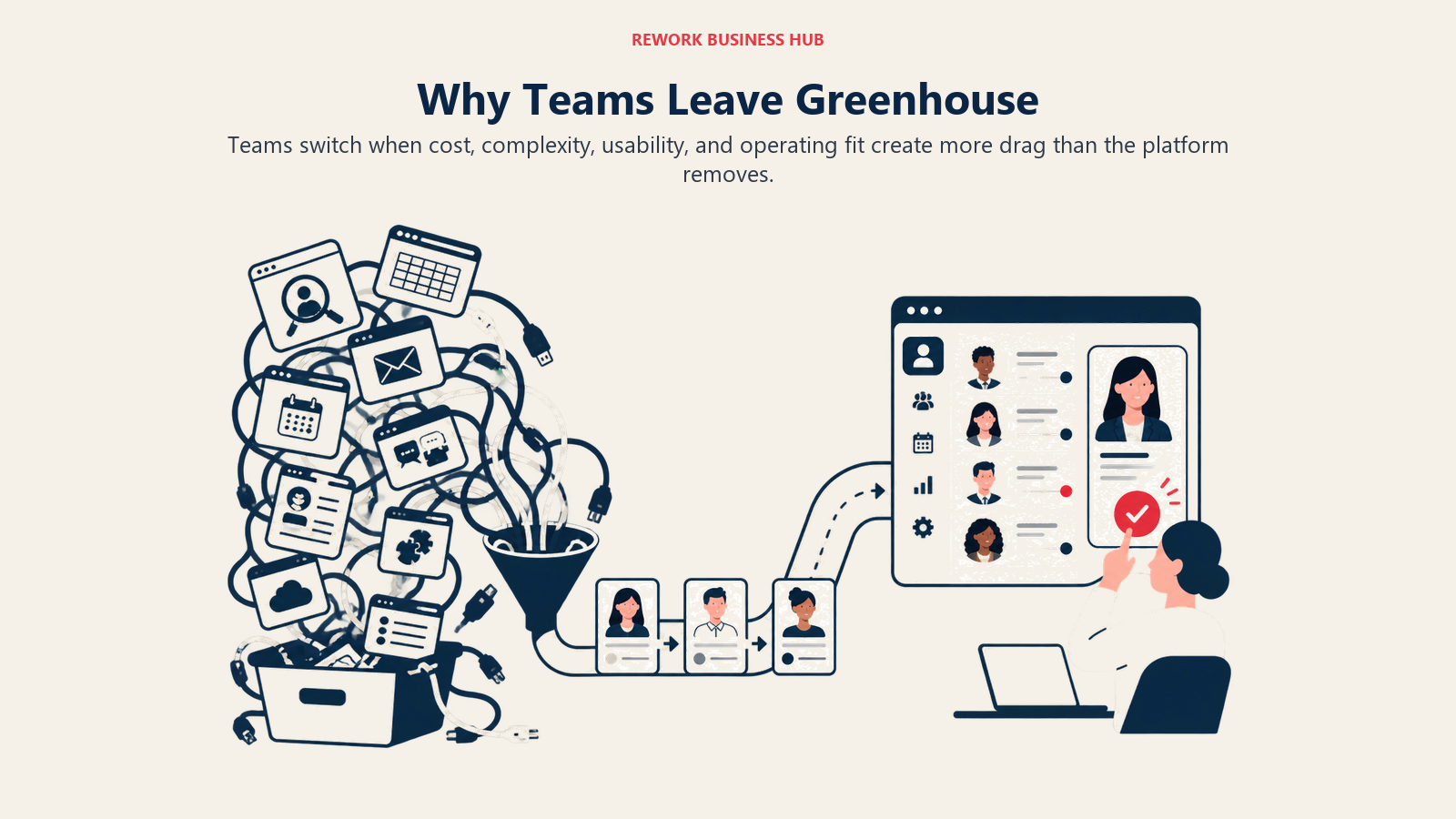
Structured hiring that genuinely works, priced for scale. Greenhouse's interview kits give every interviewer the questions, background, and a scorecard in one place, and that methodology is a real part of why G2 reviewers rate it 4.4 out of 5 across more than 1,800 reviews, with 94% rating it 4 or 5 stars (G2). It isn't just marketing: structured interviews with a fixed rubric predict job performance at roughly .51 validity versus .38 for unstructured interviews, per Schmidt and Hunter's landmark meta-analysis (via Pin). Greenhouse's 18% share of US enterprise job postings, second only to Workday, is real evidence big companies trust it. Past 150-200 employees with a dedicated TA function, a lot of that spend is earned.
Cost that doesn't scale down. Core commonly starts around $6,000 to $12,000 a year for small teams, and Plus climbs to $15,000 to $35,000 at mid-market headcounts, where a 40-person company hiring 20 people a year can pay $300 to $500 per hire just in ATS fees, on top of the $5,475 average cost per hire SHRM reports for 2025. A team auditing its full recruiter tech stack usually finds the renewal is one of several tools quietly compounding.
Tiered pricing with paid add-ons on top. Base tiers don't include everything a growing team eventually wants. Sourcing automation, a passive-candidate CRM, and DEI reporting (funnel tracking, bias alerts, EEO compliance) are separately priced add-ons, with DEI gated to Expert alone. A team that budgeted for "the ATS" often finds the features it wants live in a different line item.
Complexity beyond what a small team needs. Custom scorecards per role family, multi-stage approvals, and granular permissioning are genuinely valuable for a 300-person TA org running dozens of roles in parallel. For a 5-person team running 10-15 requisitions, that same depth means more setup and admin overhead per hire than the volume justifies, the pattern any recruiter tracking time-to-hire and cost-per-hire will recognize.
How to Choose: Decision Framework
Pick by the specific gap you're closing, not by brand familiarity. A team replacing Greenhouse for cost shouldn't make the same choice as one replacing it for enterprise depth or HR consolidation.
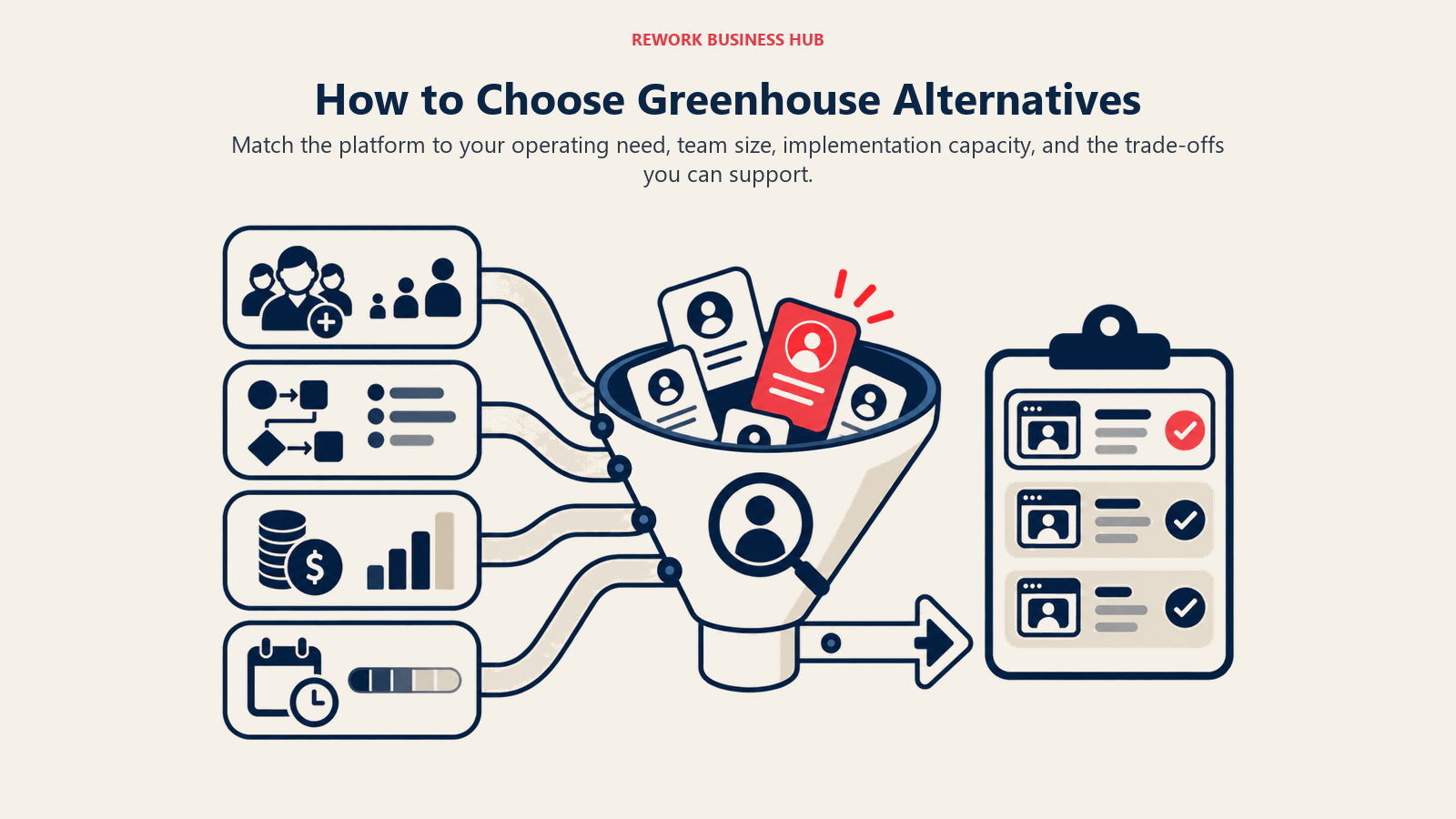
| If your team needs... | Best pick |
|---|---|
| A close, cheaper Greenhouse swap with published pricing | Workable |
| Recruiting CRM and nurture campaigns built into the ATS | Lever |
| Native analytics and an all-in-one sourcing stack | Ashby |
| Enterprise scale with SAP SuccessFactors already in place | SmartRecruiters |
| The cheapest real ATS with flat, published pricing | JazzHR |
| Hiring unified with HR, attendance, and timesheets | Rework |
| Hiring managers actively involved in scoring candidates | Recruitee (Tellent) |
| A free-to-start ATS with flat, predictable pricing | Breezy HR |
| Best-in-class career site and employer branding | Teamtailor |
| Candidate-first flow and blind screening for DEI | Pinpoint |
| A deep discount inside an existing Zoho ecosystem | Zoho Recruit |
| A full enterprise Talent Cloud with CRM and onboarding | iCIMS |
| Agency ATS and CRM for external placements | Bullhorn |
Frequently Asked Questions about Greenhouse Alternatives
What is the biggest reason teams switch away from Greenhouse?
Cost that doesn't scale down. Greenhouse prices in tiers by headcount, commonly $6,000 to $12,000 a year for small teams and $15,000 to $35,000 at mid-market size, then sells sourcing, CRM, and DEI reporting as separate add-ons. Teams that only need core structured hiring often pay for configuration depth they don't use.
How much does Greenhouse actually cost?
It doesn't publish pricing, but third-party research and G2 reviewer reports put Core around $6,000 to $12,000 a year for small teams, Plus around $15,000 to $35,000 for mid-market, and Pro at $40,000-plus for enterprise, with sourcing, CRM, and DEI add-ons priced separately.
Is Workable a good direct swap for Greenhouse?
Yes, for teams under a few hundred employees who want the same headcount-based model but with published pricing instead of a sales quote. It starts at $149 a month for up to 50 employees, though add-ons and reported 10 to 20% renewal increases push the real cost higher.
What's the difference between Lever and JazzHR if they're both owned by Employ Inc?
Lever is the mid-market pick with a built-in recruiting CRM, typically $12,000 or more a year, quote-only. JazzHR is the budget pick with flat, published pricing from $1,000 a year and a thinner feature set. Both are Employ Inc. brands alongside Jobvite, so expect a shared product direction over time.
Did SAP's acquisition of SmartRecruiters change anything for existing customers?
SAP completed the acquisition on September 11, 2025. SmartRecruiters still operates standalone, but SAP is actively integrating it with SuccessFactors. Companies already on SuccessFactors get a clearer native path; everyone else still faces an enterprise, quote-only sale.
Which Greenhouse alternative is cheapest?
JazzHR, at $1,000 a year (Hero, billed annually, capped at 3 job postings a month), is the cheapest published-price ATS here. Breezy HR is free for one job and starts at $157 a month once you need more. Both trade Greenhouse's structured-hiring depth for a much lower price.
Does Rework replace Greenhouse for hiring?
Depends what you're solving for. If deep sourcing or Greenhouse-level scorecard sophistication is the priority, Ashby or SmartRecruiters are closer matches. Rework's E-Hiring, Interview, and Career modules make more sense when hiring lives disconnected from HR, attendance, and timesheets after the offer is signed.
When does it make sense to stay on Greenhouse instead of switching?
Past roughly 150 to 200 employees, with a dedicated TA function running structured hiring across multiple teams, Greenhouse's interview kits and integration depth are usually worth the price. Below that size, the same depth turns into admin overhead a smaller team doesn't need.
What to Do Next
Pick two tools from the framework above, not brand recognition, and run both through a real requisition instead of a sandbox demo. Import an open role, have hiring managers score real candidates through each tool's evaluation flow, and time how long it takes to get from "candidate applies" to "interviewer has what they need." Most tools here offer a free trial or demo, so there's no reason to commit on a sales deck alone.
If cost at your current headcount is why you're looking past Greenhouse, start with Workable or JazzHR. If the real friction is what happens after the offer, when a new hire disappears into a second, disconnected HR system, start with Rework instead. See rework.com/pricing for a quote.

Principal Product Marketing Strategist
On this page
- Key Facts
- Quick Comparison Table
- 1. Workable: The Straightforward, Transparently Priced Swap
- 2. Lever: Recruiting CRM Built Into the ATS
- 3. Ashby: Native Analytics for High-Growth Teams
- 4. SmartRecruiters: Now an SAP Company
- 5. JazzHR: The Cheapest Real ATS Here
- 6. Rework: Hiring Inside the Same Platform as HR and Time Tracking
- 7. Recruitee (Tellent): Collaborative Hiring for Hiring Managers
- 8. Breezy HR: Free to Start, Flat-Fee Pricing
- 9. Teamtailor: Employer Branding and Career Sites First
- 10. Pinpoint: Candidate-First Hiring with Blind Screening
- 11. Zoho Recruit: The Budget Ecosystem Play
- 12. iCIMS: The Enterprise Talent Cloud
- 13. Bullhorn: Built for Staffing Agencies, Not In-House Teams
- Why Teams Leave Greenhouse
- How to Choose: Decision Framework
- What to Do Next