Best MailerLite Alternatives in 2026: 14 Email Marketing Tools for Growing Beyond the Free Tier
Turn this article into takeaways for your work.


Each assistant summarizes the article only for you and suggests best practices for your work.
MailerLite built its reputation on a clean builder and a free plan that felt generous next to Mailchimp. That reputation still drives a lot of signups, but the product behind it has changed. As of the current MailerLite pricing page, the Free plan covers 250 subscribers and 2,500 monthly emails with 2 user seats, not the 1,000 subscribers and 12,000 emails a lot of older reviews still quote. The Comfort plan starts at $12/month billed monthly ($10.80/month billed annually), and Power starts at $25/month billed monthly ($22.50/month billed annually) at the same up-to-500-subscriber tier, with unlimited monthly emails and unlimited seats. None of that makes MailerLite a bad tool. It still ships a fast drag-and-drop builder and website tools most competitors charge extra for. But once a list crosses a few hundred contacts, or once a team needs a real CRM, deeper automation, or ecommerce revenue attribution, the honest gaps show up: no native CRM, automation that stays basic below the Power tier, and segmentation that trails Klaviyo or Omnisend. The 14 tools below cover every direction a MailerLite user typically moves in: cheaper or more generous free tiers, creator-native monetization, small-business support, ecommerce attribution, and deeper mid-market automation.
If your bottleneck sits downstream of email entirely, in a sales pipeline full of leads nobody followed up with, that's a different fix than switching email tools. See our lead management library for that problem.
Key Facts
Key Facts: Email Marketing Effectiveness
- Email marketing returns $36 to $50 for every $1 spent for roughly a third of marketers, and 5% report returns above $50, according to Litmus's State of Email 2025 survey of nearly 500 marketing professionals.
- Automated flows generate close to 41% of total email revenue from just 5.3% of sends, with revenue per recipient nearly 18 times higher than one-off campaigns, per Klaviyo's 2026 email marketing benchmarks across more than 183,000 customers.
- About 75% of marketers plan on maintaining or increasing their email marketing investment in 2026, and 22% rank email as one of their top ROI-driving channels, according to HubSpot's 2026 Marketing Statistics.
- Segmented campaigns see click rates 100.95% higher and open rates 14.31% higher than non-segmented sends, according to Mailchimp's own analysis of segmented versus unsegmented sends.
- Across roughly 150,000 brands, automated emails made up just 2% of all sends in 2025 but drove 30% of revenue, earning 16 times more per send than scheduled campaigns, according to Omnisend's 2026 Ecommerce Marketing Report.
Quick Comparison Table
Use this table to narrow the field before you dig into individual vendor trade-offs.
| Tool | Best For | Starting Price | Key Strength | Key Limitation |
|---|---|---|---|---|
| Mailchimp | General-purpose teams already in the ecosystem | Free tier; paid from $13/mo | Huge template and integration library | Pricing climbs fast per contact tier |
| Sender | Budget-conscious teams wanting a bigger free tier | Free (2,500 subscribers); from $7/mo (annual) | Free plan covers 10x MailerLite's subscriber cap | Smaller ecosystem, thinner integrations |
| EmailOctopus | Ultra-budget senders comfortable with a simple builder | Free (2,500 subscribers); Pro from $9/mo (annual) | Built on Amazon SES, among the cheapest paid tiers | Fewer templates, lighter automation |
| Brevo | Teams wanting email, SMS, and chat without per-contact billing anxiety | Free (500 contacts); paid from $9/mo | Contact storage size doesn't drive the bill | Real automation gated behind Standard tier |
| Zoho Campaigns | Teams already running Zoho CRM or Zoho One | Free (2,000 contacts); paid from around $3/mo | Deep native integration with Zoho's suite | Feels dated outside the Zoho ecosystem |
| Kit (ConvertKit) | Creators monetizing an audience with paid newsletters | Free up to 10,000 subscribers; from $39/mo | Creator-native tools: paid newsletters, tipping | Thin CRM and B2B workflow depth |
| Beehiiv | Newsletter publishers wanting built-in monetization | Free (2,500 subscribers); from $43/mo | Native ad network and referral growth tools | Pricier than MailerLite past the free tier |
| Constant Contact | Small businesses wanting hands-on support | From $12/mo, no free plan | Strong phone and chat support, event tools | Automation and reporting depth is thin |
| GetResponse | Solo marketers wanting funnels, webinars, and email in one | 14-day trial only; from $19/mo | Bundles webinars, courses, and ecommerce tools | Dropped its permanent free plan in 2026 |
| Moosend | Budget automation buyers who don't need high volume | Paid from around $9/mo, 500 contacts (reported) | Unlimited sends on every paid tier | Now owned by Constant Contact; roadmap unclear |
| ActiveCampaign | Teams outgrowing MailerLite's automation ceiling | From $15/mo (1,000 contacts, annual) | Most powerful automation builder in the mid-market | No free tier; seats and add-ons add up fast |
| Omnisend | Ecommerce brands wanting email, SMS, and push together | Free (250 contacts); from $11.20/mo | Multi-channel automation built for online stores | Focus narrows fast outside ecommerce |
| Klaviyo | Ecommerce brands running revenue-attributed campaigns | Free up to 250 profiles; from $20/mo | Deep Shopify/WooCommerce revenue attribution | Billed on active profiles; costly at scale |
| Loops | Product-led SaaS teams wanting a developer-friendly sender | Free (1,000 contacts); from around $49/mo (reported) | Built for SaaS lifecycle email, React Email templates | Thin newsletter/marketing feature set |
1. Mailchimp: The Default Starting Point
Mailchimp's product philosophy has stayed the same since it launched: email marketing that doesn't require a developer. For a small business sending newsletters and simple drip sequences, that promise still holds, and the name recognition alone makes it easier to hire for or get help with than a niche tool like MailerLite.
That familiarity is the whole pitch. Per the Mailchimp pricing page, the Free plan covers up to 250 contacts and 500 sends a month, Essentials starts at $13/mo, Standard at $20/mo, and Premium at $350/mo at the 10,000-contact tier (all plans include a 15% discount for 12 months on 10,000+ contacts). That's a similar free-tier size to MailerLite's, but Mailchimp's automation and template library go deeper once you're on a paid plan. For teams weighing the two side by side, see our Mailchimp vs Brevo comparison for how the pricing model plays out at scale.
| What you get | What you don't |
|---|---|
| Huge library of templates, integrations, and tutorials | Bills for unsubscribed and duplicate contacts across audiences |
| Reasonably capable automation on Standard tier | Automation depth trails ActiveCampaign and Klaviyo |
| Strong brand recognition simplifies hiring and support | Premium tier jumps to $350/mo fast as lists grow |
| Built-in landing pages and basic CRM features | Not built for complex, behavior-triggered B2B nurture |
Pricing: Free tier (250 contacts, 500 sends/mo); Essentials from $13/mo; Standard from $20/mo; Premium from $350/mo (10,000 contacts)
Best for: General-purpose small and mid-size businesses that want one familiar, well-documented tool for newsletters and light automation
2. Sender: The Bigger Free Tier
Sender's whole pitch is built around undercutting MailerLite on the exact number MailerLite is known for. Where MailerLite's free plan tops out at 250 subscribers, Sender's free plan covers 2,500 subscribers and up to 15,000 emails a month, with no credit card required to start. For a solopreneur or early-stage store just getting a list off the ground, that difference alone can be the deciding factor.
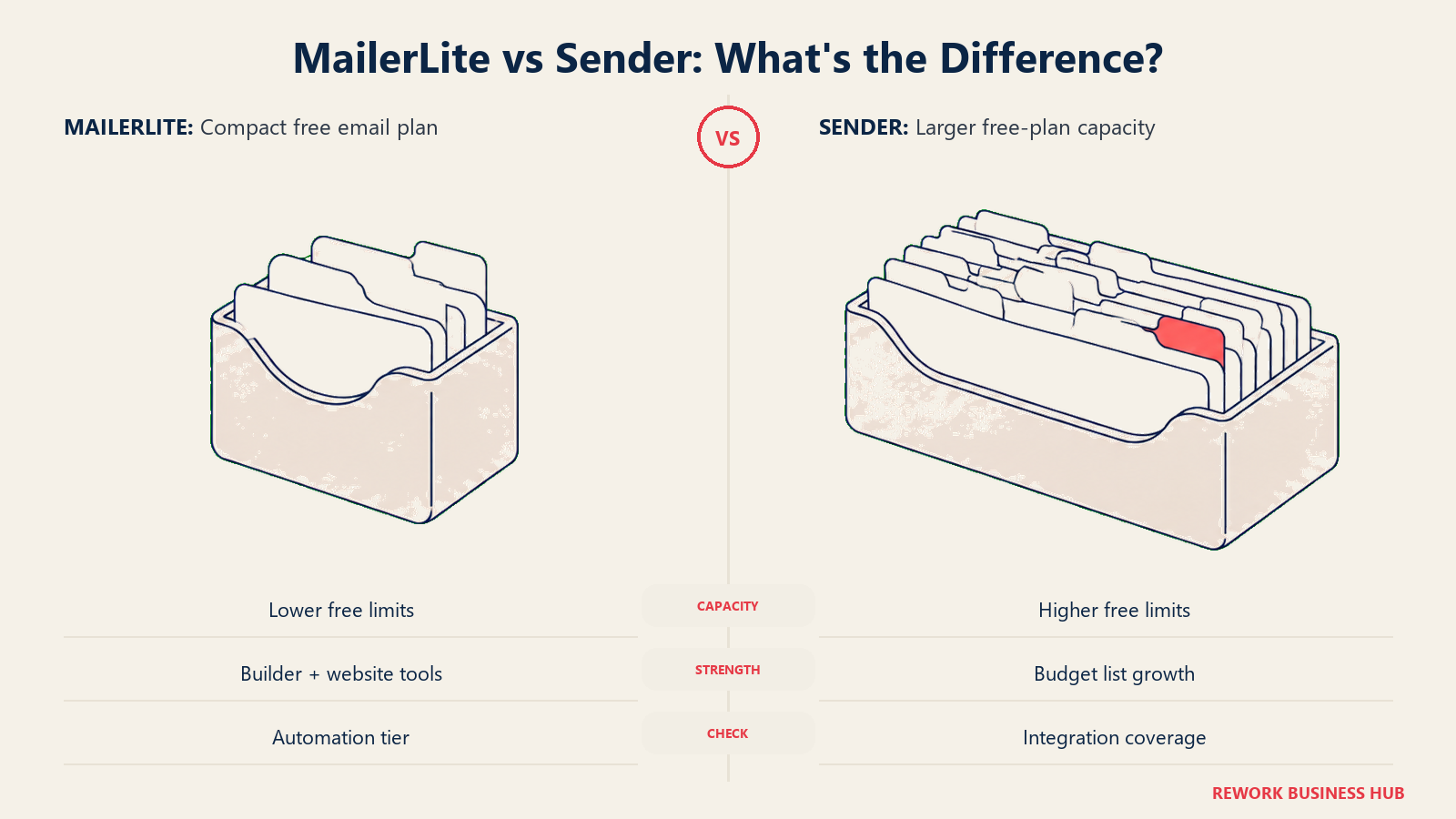
Per Sender's pricing page, the Standard plan runs $10/mo billed monthly or $7/mo billed annually ($84/year) at 1,000 subscribers with 12,000 emails included, and Professional runs $20/mo billed monthly or $14/mo billed annually ($168/year) at the same subscriber count with 24,000 emails, free SMS credits, and priority support. A pay-as-you-go option ($29 per 5,000 emails) suits occasional senders who don't want a subscription at all. The tradeoff is a smaller integration ecosystem and less brand recognition than MailerLite or Mailchimp.
| What you get | What you don't |
|---|---|
| Free plan covers 10x MailerLite's subscriber cap | Smaller app marketplace and integration library |
| SMS messaging bundled into paid plans | Less brand recognition; thinner community support |
| Role-based seats even on the Standard plan | Automation depth is basic compared to ActiveCampaign |
| Pay-as-you-go option for irregular senders | Newer platform with a shorter enterprise track record |
Pricing: Free (2,500 subscribers, 15,000 emails/mo); Standard $10/mo billed monthly or $7/mo billed annually (1,000 subscribers); Professional $20/mo billed monthly or $14/mo billed annually (1,000 subscribers); Enterprise custom
Best for: Solopreneurs and early-stage stores who want the most generous free tier in the category before committing to a paid plan
3. EmailOctopus: The Cheapest Path at Scale
EmailOctopus's product philosophy is simplicity plus infrastructure most competitors mark up heavily: the platform runs on Amazon SES under the hood, which is why it can undercut MailerLite and nearly everyone else on this list once a list grows past the free tier. The builder is deliberately basic, no visual funnel-building, no built-in webinars, just campaigns, a light automation editor, and forms.
Per EmailOctopus's pricing page, the Free plan covers 2,500 subscribers and 10,000 emails a month, and the Pro plan starts at $9/month when billed yearly (the site notes a $12 total annual savings versus paying monthly), with pricing scaling automatically as the list grows and custom pricing above 500,000 subscribers. The platform explicitly markets itself as roughly 60% cheaper than competitors at scale, and for a list that's mostly outgrown free tiers but doesn't need deep automation, that math is hard to beat.
| What you get | What you don't |
|---|---|
| Among the cheapest paid tiers in the category | Basic template library and design tools |
| Built on Amazon SES: reliable, cost-efficient sending | No visual automation builder comparable to MailerLite's |
| Automatic plan upgrades as your list grows | No landing pages or website builder included |
| Straightforward, transparent per-subscriber pricing | Smaller support team than larger competitors |
Pricing: Free (2,500 subscribers, 10,000 emails/mo); Pro from $9/mo billed annually, scaling with subscriber count
Best for: Budget-focused senders with a simple newsletter who want the lowest total cost at scale without built-in extras
4. Brevo: The Multi-Channel Bundle
Brevo (formerly Sendinblue) is built on a different pricing philosophy than MailerLite: the bill is driven by how many emails you send, not how many contacts you store. For a team sitting on a larger, mostly-inactive contact list who only emails a subset regularly, that math favors Brevo over MailerLite's per-subscriber tiers.
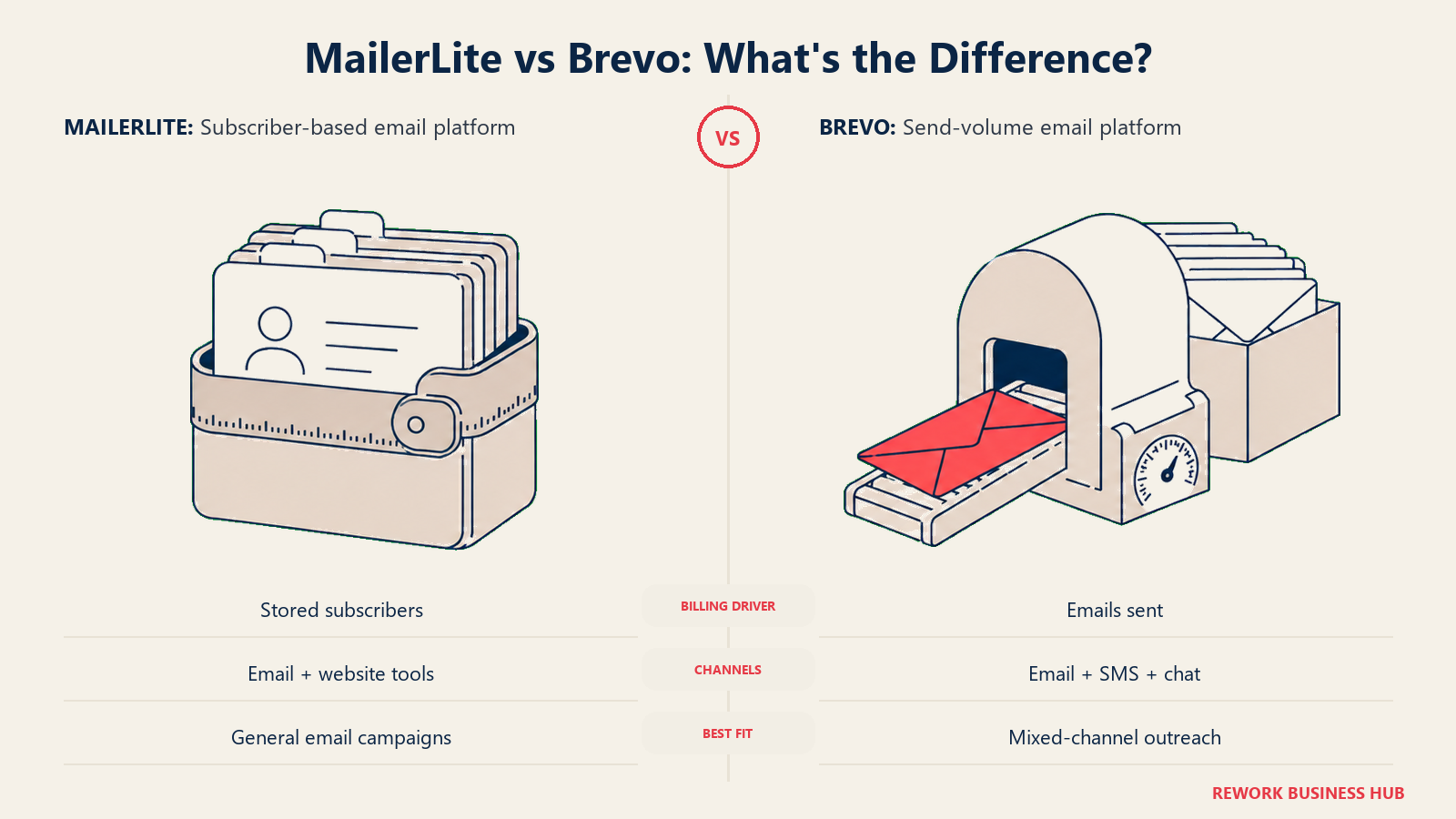
Beyond pricing, Brevo bundles email, SMS, live chat, and a CRM layer into one product. Per Brevo's pricing page, the Free plan covers up to 500 contacts and 5,000 emails a month, Starter runs $9/mo billed monthly or $8.08/mo billed annually, Standard runs $18/mo billed monthly or $16.17/mo billed annually, and Professional runs $499/mo billed monthly or $449.08/mo billed annually for up to 150,000 emails a month and 10 seats. If MailerLite's automation ceiling is the real issue, see our best Brevo alternatives guide for options at a similar price point with deeper workflow tools.
| What you get | What you don't |
|---|---|
| Contact storage size doesn't drive your bill | Real automation and A/B testing gated behind Standard tier |
| Email, SMS, and live chat in one product | Brevo branding stays visible unless you pay to remove it |
| Built-in CRM layer beyond what MailerLite offers | Automation depth still trails ActiveCampaign |
| Transactional email infrastructure built in | Professional tier is a steep jump from Standard |
Pricing: Free (500 contacts, 5,000 emails/mo); Starter $9/mo billed monthly or $8.08/mo billed annually; Standard $18/mo billed monthly or $16.17/mo billed annually; Professional $499/mo billed monthly or $449.08/mo billed annually (150,000 emails/mo, 10 seats)
Best for: Budget-conscious teams that want email, SMS, and chat without per-contact billing anxiety
5. Zoho Campaigns: The Zoho Ecosystem Play
Zoho Campaigns' product philosophy isn't to out-build MailerLite on email features, it's to be the email tool that's already sitting inside Zoho One or Zoho CRM. For a team already running Zoho for sales, support, or finance, adding Campaigns means contacts, deal stages, and email activity live in the same data model without a separate integration to maintain.
Per the Zoho Campaigns pricing page, the Forever Free plan covers up to 2,000 contacts, 6,000 emails a month, and 5 users. The Standard and Professional plans are priced through an interactive contact-count calculator rather than flat tier cards; at the entry 500-contact tier, third-party pricing trackers and Zoho's own comparison pages consistently put Standard at roughly $3-4/mo and Professional at roughly $5-6/mo, with a 25% discount for annual billing, though we'd recommend running the calculator yourself with your exact contact count before budgeting. Outside the Zoho ecosystem, the interface and automation builder feel noticeably dated next to MailerLite.
| What you get | What you don't |
|---|---|
| Native integration with Zoho CRM, Desk, and Zoho One | Interface and automation builder feel dated |
| Forever-free plan covers 2,000 contacts, 5 users | Little value without other Zoho products in the stack |
| Genuinely cheap entry pricing at low contact counts | Pricing calculator makes budgeting less transparent |
| Abandoned cart and basic workflow automation on Professional | Template library is thinner than MailerLite's |
Pricing: Free (2,000 contacts, 6,000 emails/mo, 5 users); Standard from roughly $3-4/mo (500 contacts); Professional from roughly $5-6/mo (500 contacts), both cheaper billed annually
Best for: Teams already invested in Zoho CRM or Zoho One who want email folded into the same contact record
6. Kit (formerly ConvertKit): Built for Creator Monetization
Kit, formerly ConvertKit, is built on the belief that a creator's email list is their most valuable asset and deserves monetization tools designed around that reality, not a small-business template library repurposed for newsletters. Paid newsletters, tip jars, subscriber scoring, and referral systems are first-class features here, which is a real gap in MailerLite's toolset for a creator trying to turn a list into revenue directly.
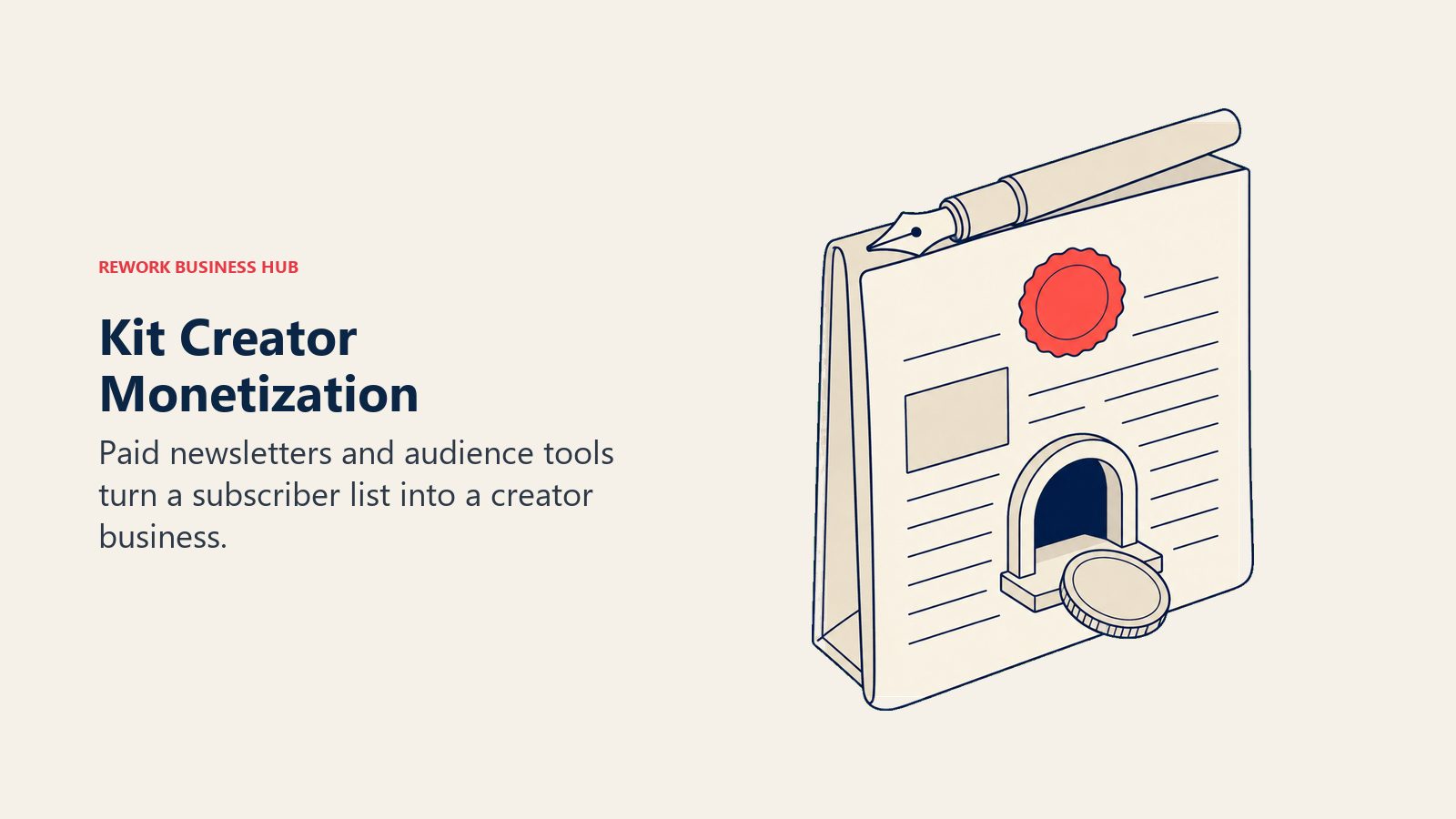
Per Kit's pricing page, the Free plan covers up to 10,000 subscribers with unlimited sends but caps automation at one basic sequence, well past MailerLite's 250-subscriber free ceiling. Creator starts at $39/mo at the 1,000-subscriber tier, and Creator Pro starts at $79/mo and adds subscriber scoring and advanced reporting. Pricing rose in a 2025 restructuring, which is worth factoring into a long-term budget if you're migrating from a cheaper tool. For a broader field of creator-focused alternatives, our best Kit (ConvertKit) alternatives guide covers 12 more options.
| What you get | What you don't |
|---|---|
| Creator-native monetization: paid newsletters, tipping | Thin CRM and B2B nurture capability |
| Free tier covers 10,000 subscribers, well past MailerLite's | Free plan carries Kit branding and one user only |
| Clean visual automation builder for sequences | 2025 price increase raised the cost floor noticeably |
| Free migration support above 5,000 subscribers | Not designed for ecommerce revenue attribution |
Pricing: Free up to 10,000 subscribers; Creator from $39/mo (1,000 subscribers); Creator Pro from $79/mo (1,000 subscribers)
Best for: Creators, newsletter writers, and course sellers who want monetization tools built around an audience, not a generic small-business template
7. Beehiiv: The Newsletter Growth Engine
Beehiiv's product philosophy treats a newsletter like a media business, not a marketing channel bolted onto a company website. Built-in referral programs, a native ad network that can pay publishers directly, and subscriber growth tools are baked into the core product, features MailerLite doesn't attempt to compete on.
Per Beehiiv's pricing page, the Launch plan is free for up to 2,500 subscribers, Scale runs $43/mo billed monthly or $517/year billed annually (saving $71/year), and Max runs $96/mo billed monthly or $1,151/year billed annually (saving $157/year), with Enterprise custom-priced above 100,000 subscribers. That's a real premium over MailerLite once you're past the free tier, but for a publisher whose business model is the newsletter itself, the built-in monetization tools can offset the higher price fast.
| What you get | What you don't |
|---|---|
| Native ad network can generate revenue from your list | Meaningfully pricier than MailerLite past the free tier |
| Built-in referral and subscriber growth program | Less suited to transactional or B2B lifecycle email |
| Free plan covers 2,500 subscribers with core features | Automation logic is lighter than ActiveCampaign's |
| Clean, modern writing and publishing interface | Smaller third-party integration library than Mailchimp |
Pricing: Launch/Free (2,500 subscribers); Scale $43/mo billed monthly or $517/year billed annually; Max $96/mo billed monthly or $1,151/year billed annually; Enterprise custom (100,000+ subscribers)
Best for: Newsletter publishers who want built-in monetization and growth tools instead of stitching them together
8. Constant Contact: Support-First Simplicity
Constant Contact's bet has stayed consistent for two decades: small business owners don't want to become email marketing experts, they want a tool that works, and a phone call to support when it doesn't. Event management, RSVP tracking, and social posting round out a product built for local businesses, nonprofits, and associations more than for a solo creator building an audience from scratch.
Per the Constant Contact pricing page, there's no free plan, only a trial. Lite starts at $12/mo billed monthly or $10.20/mo billed annually, Standard at $35/mo billed monthly or $29.75/mo billed annually, and Premium at $80/mo billed monthly or $68/mo billed annually, all priced at the 500-contact tier and scaling with list size. If MailerLite's automation ceiling and Constant Contact's lack of a free tier both feel wrong, see our best Constant Contact alternatives guide for 10 tools with deeper workflow tools.
| What you get | What you don't |
|---|---|
| Strong phone and chat support, US-based teams | No free plan at all, unlike MailerLite |
| Built-in event management and RSVP tools | Automation and reporting are thin versus ActiveCampaign |
| Simple interface, low learning curve | Pricing scales steeply with contact count |
| Reliable, long-standing deliverability reputation | Interface feels dated next to newer entrants |
Pricing: Lite $12/mo billed monthly or $10.20/mo billed annually; Standard $35/mo billed monthly or $29.75/mo billed annually; Premium $80/mo billed monthly or $68/mo billed annually (all at 500 contacts)
Best for: Small businesses, nonprofits, and associations that want a simple tool backed by responsive human support
9. GetResponse: The All-in-One Funnel Builder
GetResponse's product philosophy is consolidation: instead of buying email, webinar, landing page, and course tools separately, bundle them into one subscription. That approach appeals to a solo marketer or small team who doesn't want to stitch together five point tools to run a complete funnel, a step up from what MailerLite's website builder alone can do.
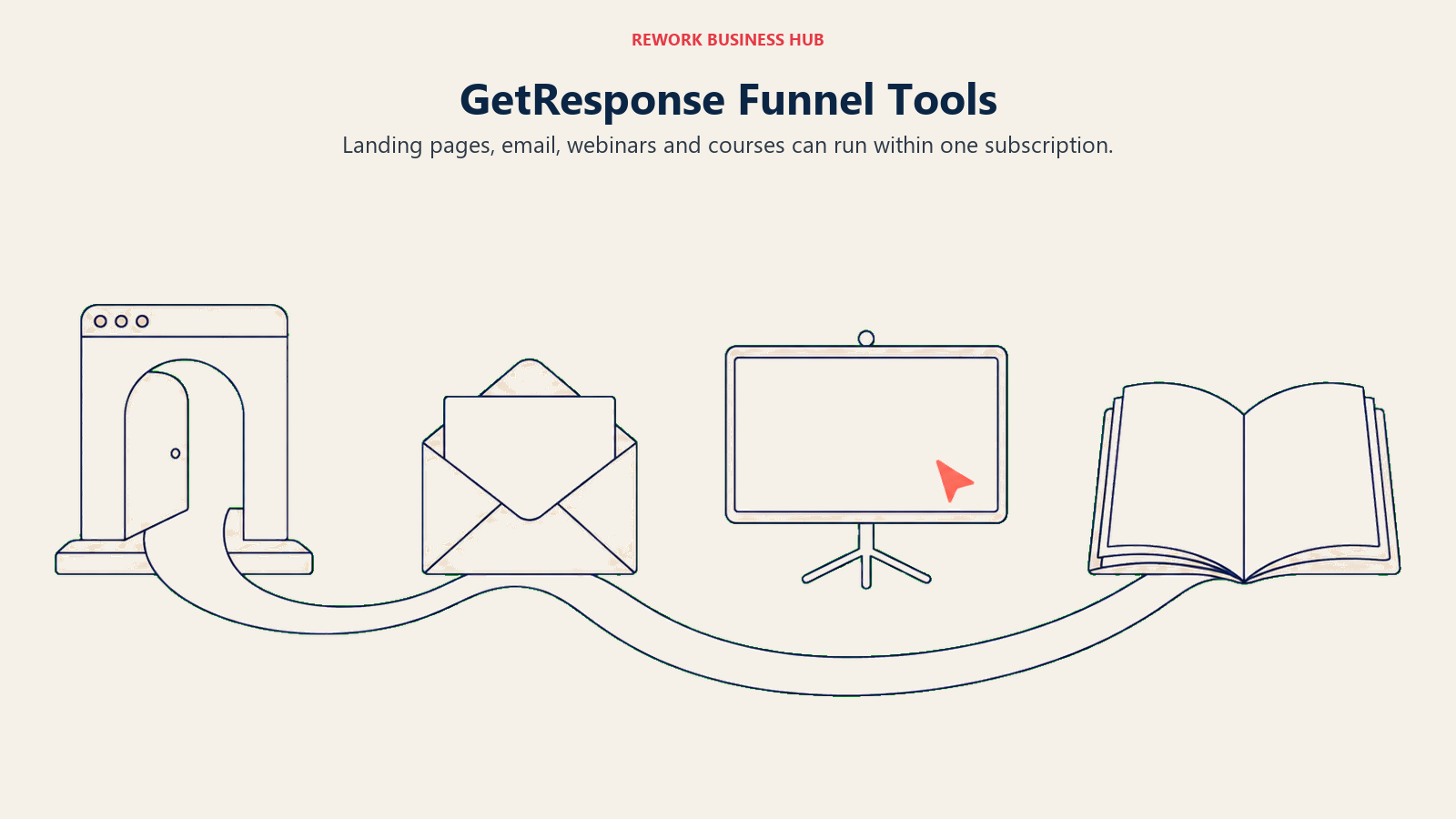
What changed in 2026: GetResponse dropped its permanent free plan. Per the GetResponse pricing page, new signups now get a 14-day free trial with full features, and after that trial ends you keep login access but lose premium functionality rather than falling back to a working free tier the way MailerLite's Free plan does. Once you're on a paid plan, Starter runs $19/mo billed monthly or $15.58/mo billed annually, Marketer runs $59/mo billed monthly or $48.38/mo billed annually (this is where the real automation engine unlocks), and Creator runs $69/mo billed monthly or $56.58/mo billed annually, all at the 1,000-contact tier, with Enterprise custom-priced. If that trial-only structure doesn't fit, the best GetResponse alternatives guide compares 12 similarly-priced tools.
| What you get | What you don't |
|---|---|
| Webinars, courses, and ecommerce tools bundled in | No permanent free plan as of 2026, unlike MailerLite |
| AI email generator and autoresponders on Starter | Real automation locked behind the pricier Marketer tier |
| Website and landing page builder included | Enterprise tier requires a custom quote |
| Solid 14-day trial for testing the full platform | Automation UI is less refined than ActiveCampaign's |
Pricing: 14-day free trial only (no permanent free plan); Starter $19/mo billed monthly or $15.58/mo billed annually; Marketer $59/mo billed monthly or $48.38/mo billed annually; Creator $69/mo billed monthly or $56.58/mo billed annually (1,000 contacts); Enterprise custom
Best for: Solo marketers and small teams who want email, webinars, landing pages, and courses in one subscription and don't need a permanent free tier
10. Moosend: Unlimited Sends on a Budget
Moosend's product philosophy is straightforward: charge by list size, not by how many emails you send, and include automation, landing pages, and transactional email on every paid tier rather than gating them behind an upsell. For a team that emails frequently but doesn't want per-send charges to punish them for it, that's a cleaner deal than several tools on this list.
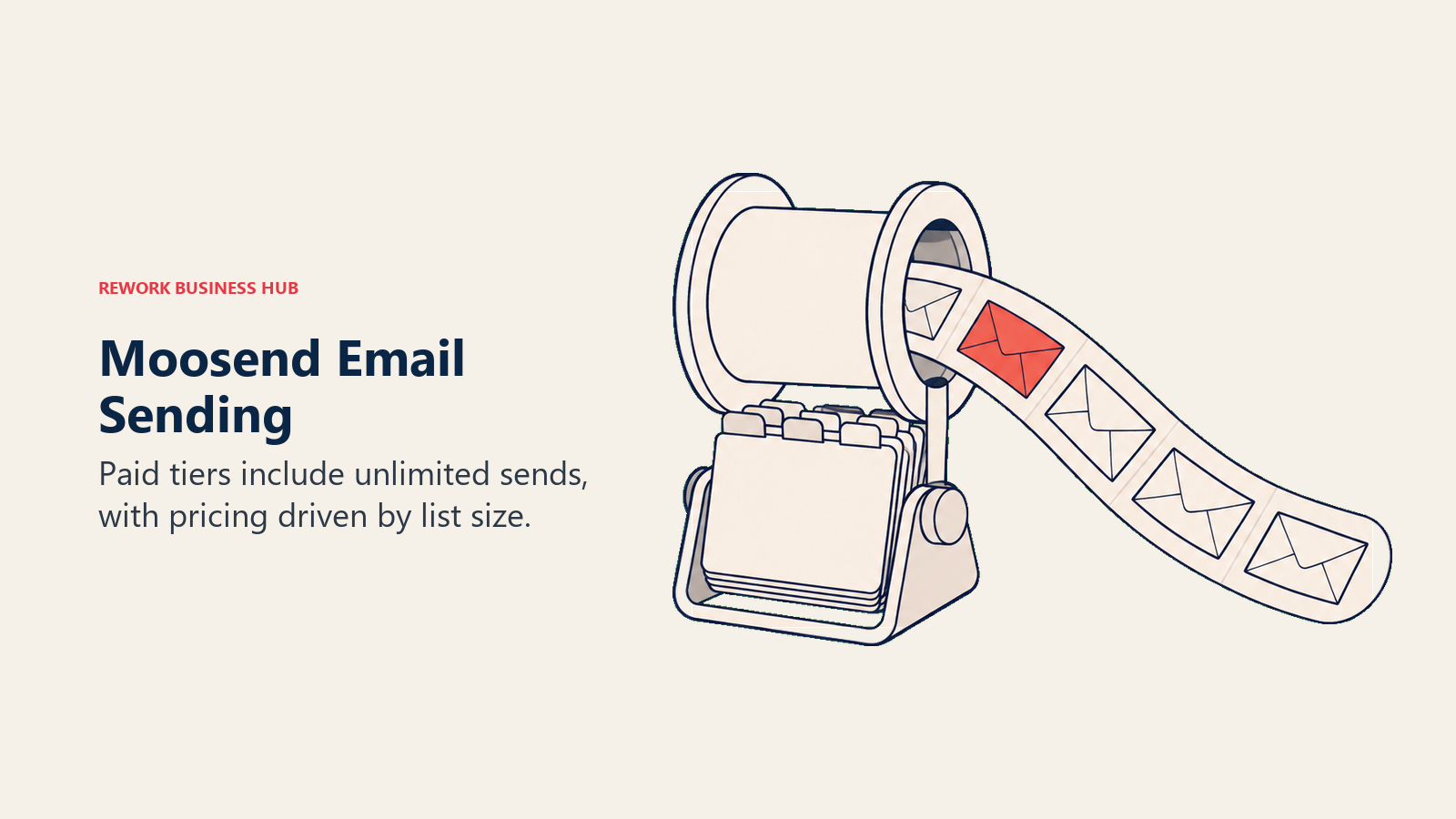
What changed in 2026: Moosend was acquired by Sitecore in 2021 and then, in a second ownership change, moved to Constant Contact in June 2025. It still runs as a standalone product with its own pricing, and no consolidation or feature changes have been announced, but the long-term roadmap under new ownership is genuinely unknown. Per Moosend's pricing page, the Pro plan is priced through an interactive contact-count calculator with unlimited campaigns and sends included at every tier; third-party pricing trackers consistently report roughly $9/mo at the 500-contact tier, cheaper still with the site's biannual (save 15%) or annual (save 20%) billing options, though we'd recommend confirming your exact tier on the live calculator.
| What you get | What you don't |
|---|---|
| Unlimited email sends on every paid tier | Now owned by Constant Contact; roadmap is unclear |
| Automation and landing pages included, not gated | Exact pricing requires the site's interactive calculator |
| Multiple discount tiers for longer billing commitments | Smaller brand and community than MailerLite |
| Transactional email available as an add-on | Support and integration depth trail larger competitors |
Pricing: Pro plan priced via interactive calculator; roughly $9/mo reported at 500 contacts, with 15-20% discounts for biannual or annual billing; Enterprise custom
Best for: High-frequency senders who want unlimited sends included in the base price rather than metered separately
11. ActiveCampaign: Deepest Mid-Market Automation
ActiveCampaign's bet is that automation, not campaign design, is where email marketing actually earns its keep. The visual automation builder supports branching logic, conditional content, predictive sending, and a built-in light CRM, all aimed at teams that have outgrown MailerLite's basic autoresponders but aren't ready for an enterprise marketing cloud.
That automation depth is the platform's clearest differentiator over MailerLite. Per the ActiveCampaign pricing page, Starter begins at $15/mo for 1,000 contacts on annual billing, with Plus at $49/mo, Pro at $79/mo, and Enterprise starting at $145/mo. There's no free tier, only a 14-day trial. Extra seats, SMS credits, and transactional email all add to the real cost. If the add-on costs are pushing your budget past what MailerLite would have charged, the best ActiveCampaign alternatives guide covers 11 tools with similar automation depth. For a direct look at how ActiveCampaign stacks up against a similarly budget-conscious competitor, see ActiveCampaign vs Brevo.
| What you get | What you don't |
|---|---|
| Most powerful visual automation builder in the mid-market | No free tier; 14-day trial only, unlike MailerLite |
| Built-in light CRM and sales automation | Extra seats, SMS, and transactional email add up quickly |
| Predictive sending and conditional content on Pro tier | UI complexity increases sharply as automations grow |
| 900+ integrations | Enterprise tier carries a one-time onboarding fee |
Pricing: Starter from $15/mo (1,000 contacts, annual); Plus $49/mo; Pro $79/mo; Enterprise from $145/mo
Best for: Growth-stage teams that want the deepest automation builder available without moving to an enterprise marketing cloud
12. Omnisend: Multi-Channel Automation for Online Stores
Omnisend's product philosophy is ecommerce-first: bundle email, SMS, and push notifications into workflows out of the box rather than as separate add-ons. A single automation, like a cart recovery flow, can fire across all three channels from one workflow builder, which appeals to a store that's outgrown MailerLite's more general-purpose automation.
Per the Omnisend pricing page, the Free plan covers 250 contacts, 500 emails, and 500 web push notifications a month, Standard runs $11.20/mo at 500 contacts with 6,000 emails included, and Pro runs $41.30/mo at 2,500 contacts with unlimited emails and SMS priced separately starting around $0.007 per message. Annual commitments (paid 3 months upfront) bring a 30% discount. If your brand has outgrown Omnisend's ecommerce-only focus, the best Omnisend alternatives guide covers 12 tools for broader use cases.
| What you get | What you don't |
|---|---|
| Email, SMS, and push in one workflow builder | Focus narrows fast for teams outside ecommerce |
| Free tier for testing multi-channel automation | SMS priced separately as a volume-based add-on |
| Purpose-built automation templates for online stores | Reporting depth trails Klaviyo for advanced attribution |
| Straightforward, transparent tier pricing | Pro tier's unlimited email sends still bound by fair-use policy |
Pricing: Free (250 contacts, 500 emails/mo); Standard $11.20/mo (500 contacts, 6,000 emails); Pro $41.30/mo (2,500 contacts, unlimited emails)
Best for: Ecommerce brands wanting email, SMS, and push automation combined in one workflow builder
13. Klaviyo: Ecommerce Revenue Attribution Leader
Klaviyo's product philosophy is that email and SMS should be measured the same way a paid ad channel is measured: by revenue generated, not open rate. Every campaign and flow ties back to actual purchase data pulled directly from Shopify, WooCommerce, and other ecommerce platforms, which is a level of attribution MailerLite's integrations don't attempt to match.
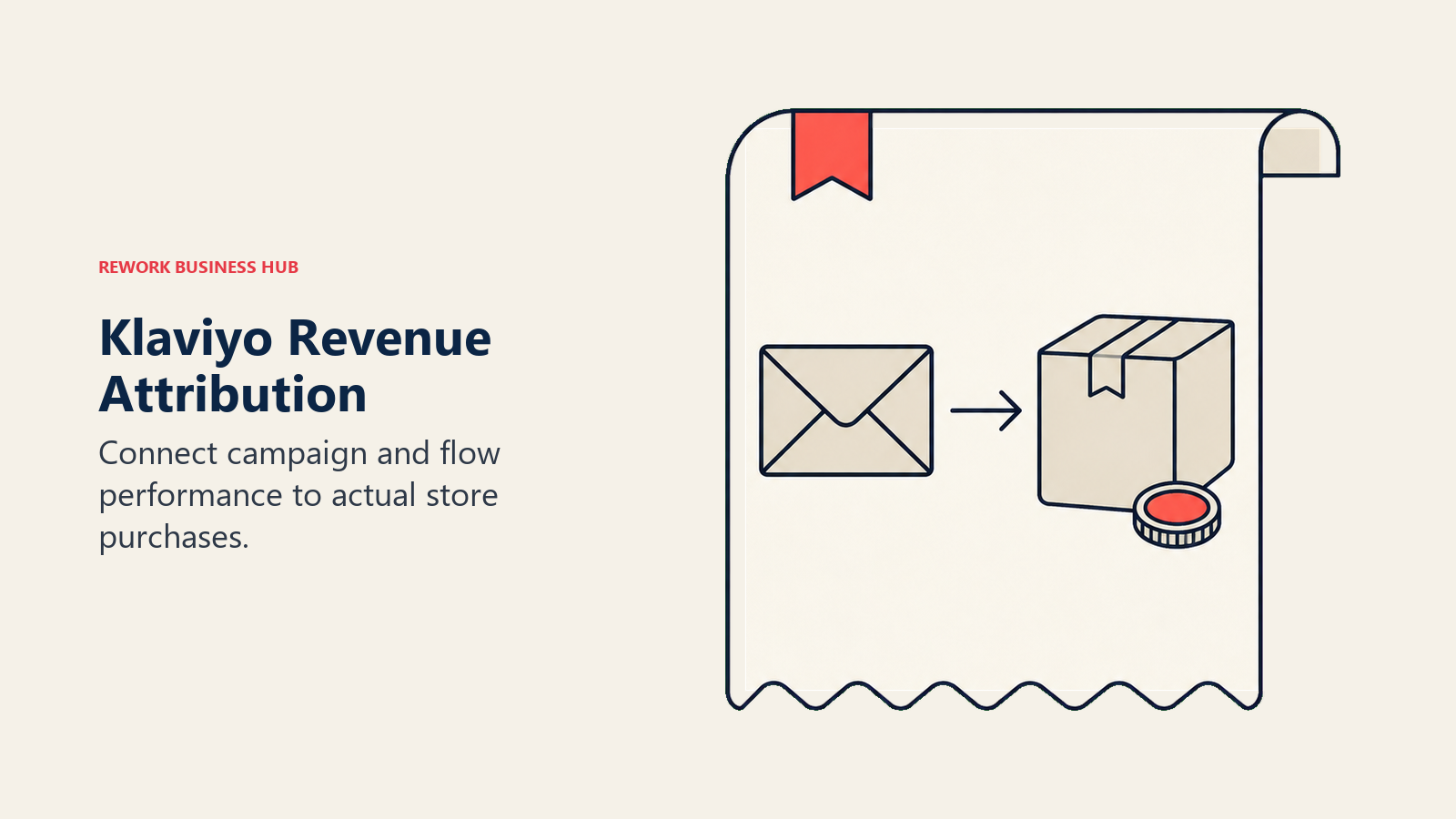
That revenue-first lens is why Klaviyo has become the default choice for DTC and ecommerce brands scaling past their first few thousand customers. According to the Klaviyo pricing page, the Free plan covers up to 250 active profiles and 500 email sends a month, close to MailerLite's free ceiling. The Email plan starts at $20/mo for 251-500 profiles, and Email + SMS starts at $35/mo at the same profile range, billed on active profiles rather than contacts stored. If Klaviyo's profile-based pricing is starting to sting at scale, see the best Klaviyo alternatives for ecommerce-focused options at different price points.
| What you get | What you don't |
|---|---|
| Deep native revenue attribution tied to store data | Billed on active profiles; costs climb fast with list growth |
| Best-in-class Shopify and WooCommerce integration | No annual discount on self-serve plans as of 2026 |
| Strong SMS + MMS integration alongside email | Weak fit outside ecommerce and DTC use cases |
| Predictive analytics (churn risk, lifetime value) | Steeper learning curve for flow-building than MailerLite |
Pricing: Free up to 250 active profiles (500 sends/mo); Email plan from $20/mo; Email + SMS from $35/mo (251-500 profiles), scaling with profile count
Best for: Ecommerce and DTC brands on Shopify or WooCommerce that want email and SMS tied directly to revenue data
14. Loops: The Developer-Friendly SaaS Sender
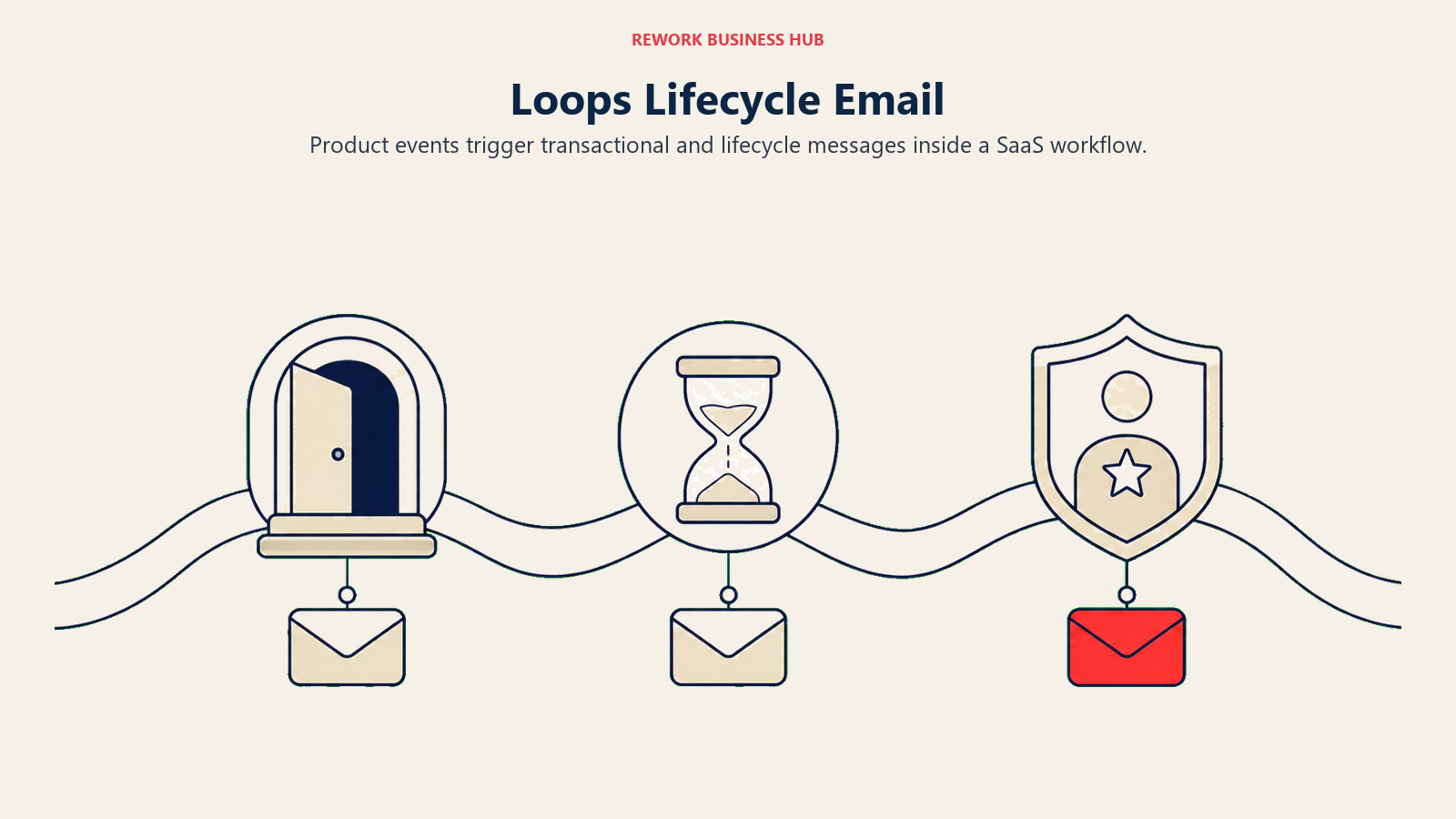
Loops's product philosophy is built for a different buyer than MailerLite entirely: a product-led SaaS team that wants transactional and lifecycle emails triggered by real product events (signup, trial expiration, upgrade), built with React Email templates a developer can version-control alongside the rest of the codebase. It's less a newsletter tool and more a lifecycle-messaging layer for a SaaS app.
Per Loops's pricing page, the Free plan covers up to 1,000 subscribed contacts and 4,000 sends a month with every feature included, no gated tiers, just a lower ceiling before you pay. Paid pricing scales with subscribed contacts through an interactive calculator rather than flat tier cards; multiple 2026 pricing trackers consistently report a Basic plan starting around $49/mo at 5,000 contacts, Pro around $149/mo at 20,000 contacts, and Scale around $399/mo at 100,000 contacts, with unlimited sends and no per-seat charges at every paid tier. Confirm your exact tier on the live calculator before budgeting, since Loops doesn't publish flat price cards.
| What you get | What you don't |
|---|---|
| Built for product-led SaaS lifecycle and transactional email | Thin newsletter and general marketing feature set |
| React Email templates a developer can version-control | Little value for a non-technical marketer or creator |
| Unlimited sends and no per-seat charges on paid plans | Exact pricing requires the site's interactive calculator |
| Transactional email included at no extra cost | Smaller template library than MailerLite or Mailchimp |
Pricing: Free (1,000 contacts, 4,000 sends/mo); Basic from roughly $49/mo (5,000 contacts, reported); Pro from roughly $149/mo (20,000 contacts, reported); Scale from roughly $399/mo (100,000 contacts, reported)
Best for: Product-led SaaS teams with engineering resources who want lifecycle and transactional email built into the developer workflow
Segment Fit Matrix
| Tool | Ecommerce | B2B / SaaS | Creator / Newsletter | SMB / Local | Enterprise |
|---|---|---|---|---|---|
| Mailchimp | Possible | Possible | Possible | Strong fit | - |
| Sender | Possible | - | Possible | Strong fit | - |
| EmailOctopus | - | Possible | Possible | Strong fit | - |
| Brevo | Possible | Possible | - | Strong fit | - |
| Zoho Campaigns | - | Strong fit | - | Strong fit | Possible |
| Kit (ConvertKit) | - | - | Strong fit | Possible | - |
| Beehiiv | - | - | Strong fit | Possible | - |
| Constant Contact | Possible | - | - | Strong fit | - |
| GetResponse | Possible | Possible | Possible | Strong fit | - |
| Moosend | Possible | Possible | - | Strong fit | - |
| ActiveCampaign | Possible | Strong fit | - | Strong fit | Possible |
| Omnisend | Strong fit | - | - | Possible | - |
| Klaviyo | Strong fit | - | Possible | Possible | - |
| Loops | - | Strong fit | - | - | Possible |
Sizing and Persona Table
| Tool | Ideal List / Company Size | Primary Buyer Persona |
|---|---|---|
| Mailchimp | Solo to 500 employees | Marketing Manager, Small Business Owner |
| Sender | Solo to 50 employees | Solopreneur, Early-Stage Founder |
| EmailOctopus | Solo to 100 employees | Budget-Conscious Marketer, Blogger |
| Brevo | 1-200 employees | Marketing Manager, Founder |
| Zoho Campaigns | 1-200 employees, existing Zoho users | Ops Manager, Zoho Admin |
| Kit (ConvertKit) | Solo creators to small teams | Newsletter Writer, Course Creator |
| Beehiiv | Solo publishers to small media teams | Newsletter Publisher, Media Founder |
| Constant Contact | 1-100 employees | Local Business Owner, Office Manager |
| GetResponse | 1-100 employees | Solo Marketer, Small Business Owner |
| Moosend | Solo to 50 employees | Budget-Focused Marketer |
| ActiveCampaign | 5-200 employees | Marketing Director, Growth Marketer |
| Omnisend | Ecommerce brands, 1-200 employees | Ecommerce Manager, DTC Founder |
| Klaviyo | Ecommerce brands, any team size | Ecommerce Manager, Head of Growth |
| Loops | SaaS teams, 5-100 employees | Product Marketer, Growth Engineer |
MailerLite Alternatives Buying Mistakes to Avoid
Most switching regrets trace back to a mismatched tool or a stale price assumption, not a broken feature. Here are the most common mistakes and what to do instead.
| Mistake | What It Looks Like | What to Do Instead |
|---|---|---|
| Chasing an old "generous free tier" reputation | Picking a tool based on a review quoting limits that no longer exist | Check the vendor's current pricing page before you sign up, not a review from last year |
| Confusing billed-monthly and billed-annually prices | Comparing one tool's annual-equivalent rate against another's monthly rate | Confirm which billing term a quoted price reflects before comparing two tools |
| Picking a creator tool for a B2B motion | Choosing Kit or Beehiiv when the real need is lead nurture and CRM sync | Match the tool to your sales motion, not the loudest creator-focused brand |
| Ignoring the real pricing driver | Comparing sticker price without checking if it's billed on contacts stored, active profiles, or emails sent | Read the fine print: Brevo bills sends, Klaviyo bills active profiles, MailerLite bills stored subscribers |
| Underestimating migration effort | Assuming a "free migration" offer means zero setup time on your end | Budget real hours for re-tagging segments and rebuilding automations |
| Trusting a third-party price without checking the vendor page | Copying a "starting at $X" figure from an old review or listicle | Fetch the vendor's own pricing page before you build a budget around it |
| Skipping the free trial or free tier | Committing to an annual plan before testing the actual automation builder | Test real automation flows with real data before signing an annual contract |
| Ignoring recent ownership changes | Not noticing a smaller vendor has changed hands and might shift direction | Check who owns the platform and how recently, especially for budget-tier tools |
How to Choose: Decision Framework
Use this table as your final filter. Match your situation to the right tool.
| If you need... | Pick... | Why |
|---|---|---|
| The biggest free tier before paying anything | Sender | Free plan covers 2,500 subscribers, 10x MailerLite's cap |
| The lowest cost per subscriber at scale | EmailOctopus | Built on Amazon SES; among the cheapest paid tiers available |
| Email, SMS, and chat without per-contact billing anxiety | Brevo | Bills on sends, not stored contacts |
| A tool that plugs directly into your CRM stack | Zoho Campaigns | Native fit with Zoho CRM and Zoho One |
| Creator monetization tools built around a newsletter | Kit (ConvertKit) | Paid newsletters, tipping, and subscriber scoring, not bolted on |
| A newsletter business model with built-in ad revenue | Beehiiv | Native ad network and referral growth tools |
| Hands-on human support for a small or local business | Constant Contact | Strong phone and chat support, built-in event management |
| Webinars, courses, and email bundled in one subscription | GetResponse | Consolidates funnel tools most competitors sell separately |
| Unlimited sends included in the base price | Moosend | Every paid tier includes unlimited campaigns and sends |
| The deepest automation builder in the mid-market | ActiveCampaign | Branching logic, predictive sending, and a light CRM built in |
| Multi-channel automation purpose-built for ecommerce | Omnisend | Email, SMS, and push in one workflow builder for online stores |
| Revenue-attributed email and SMS for an online store | Klaviyo | Deepest native ecommerce revenue attribution on the market |
| Lifecycle and transactional email built into a SaaS product | Loops | React Email templates and product-event triggers for developers |
Frequently Asked Questions about MailerLite Alternatives
What is the best MailerLite alternative in 2026?
There's no single best alternative for everyone. Sender and EmailOctopus beat MailerLite on free-tier size and raw cost, Kit and Beehiiv beat it on creator monetization, ActiveCampaign beats it on automation depth, and Klaviyo and Omnisend beat it on ecommerce revenue attribution. Pick based on which specific gap you're running into.
Does MailerLite still have a generous free plan?
Not as generous as its reputation suggests. As of MailerLite's current pricing page, the Free plan covers 250 subscribers and 2,500 monthly emails with 2 user seats, down from the 1,000 subscribers and 12,000 emails many older reviews still quote. Sender's free plan (2,500 subscribers) and Kit's free plan (10,000 subscribers) are both more generous today.
What is the cheapest MailerLite alternative?
EmailOctopus and Sender both undercut MailerLite's $12/mo entry price, with EmailOctopus starting at $9/mo billed annually and Sender at $7/mo billed annually ($84/year) at 1,000 subscribers. Zoho Campaigns and Moosend are also priced under $10/mo at low contact counts, though both require an interactive calculator to confirm your exact tier.
What's the best MailerLite alternative for creators and newsletter writers?
Kit (formerly ConvertKit) and Beehiiv are both built specifically for creators monetizing an audience, with paid newsletters, tipping, and referral tools MailerLite doesn't offer. Kit's free tier is larger at 10,000 subscribers; Beehiiv adds a native ad network for publishers who want to monetize through sponsorships.
What's the best MailerLite alternative for ecommerce?
Klaviyo and Omnisend are purpose-built for ecommerce, with native Shopify and WooCommerce integrations and revenue-attributed reporting that MailerLite's general-purpose integrations can't match. Klaviyo has the deeper analytics; Omnisend is typically cheaper at smaller list sizes and bundles SMS and push into the same workflow builder.
Why would a team leave MailerLite for ActiveCampaign?
Automation depth. MailerLite's automation stays fairly basic below its Power tier, while ActiveCampaign's visual builder supports branching logic, conditional content, and predictive sending, along with a built-in light CRM. The tradeoff is cost: ActiveCampaign has no free tier and starts at $15/mo versus MailerLite's $12/mo Comfort plan.
Is Moosend a safe long-term choice given the Constant Contact acquisition?
It's usable today with no announced feature or pricing changes, but the long-term roadmap under new ownership (Sitecore in 2021, then Constant Contact in June 2025) is genuinely unclear. If platform stability over the next few years matters more than price, weigh that risk against Moosend's low cost.
How much does a MailerLite alternative typically cost?
Entry pricing ranges from free (Sender, EmailOctopus, Kit, Beehiiv, Omnisend, Klaviyo, and Zoho Campaigns all offer usable free tiers) to MailerLite's own $12/mo Comfort plan. Mid-market automation platforms like ActiveCampaign and ecommerce specialists like Klaviyo typically run $15-$40/mo at small list sizes, and full funnel-builders like GetResponse or Constant Contact run $12-$80/mo depending on tier.
What to Do Next
Pick two alternatives, not twelve, before you touch a migration tool. If your list is under 1,000 subscribers and cost is the driver, test Sender and EmailOctopus's free tiers against MailerLite's Free plan side by side. If automation depth is the gap, run ActiveCampaign's 14-day trial with a real welcome sequence before you commit annually. Import a sample of your actual list, rebuild one real automation, and send one real campaign in the new tool before you migrate everything over, the tool your team will actually use consistently beats the one with the best free-tier reputation on a spec sheet.
If the real bottleneck isn't email at all but disconnected lead data between marketing and sales, that's a different problem than the one this list solves. It's worth mapping out your lead management process before you add another point tool to the stack.

Principal Product Marketing Strategist
On this page
- Key Facts
- Quick Comparison Table
- 1. Mailchimp: The Default Starting Point
- 2. Sender: The Bigger Free Tier
- 3. EmailOctopus: The Cheapest Path at Scale
- 4. Brevo: The Multi-Channel Bundle
- 5. Zoho Campaigns: The Zoho Ecosystem Play
- 6. Kit (formerly ConvertKit): Built for Creator Monetization
- 7. Beehiiv: The Newsletter Growth Engine
- 8. Constant Contact: Support-First Simplicity
- 9. GetResponse: The All-in-One Funnel Builder
- 10. Moosend: Unlimited Sends on a Budget
- 11. ActiveCampaign: Deepest Mid-Market Automation
- 12. Omnisend: Multi-Channel Automation for Online Stores
- 13. Klaviyo: Ecommerce Revenue Attribution Leader
- 14. Loops: The Developer-Friendly SaaS Sender
- Segment Fit Matrix
- Sizing and Persona Table
- MailerLite Alternatives Buying Mistakes to Avoid
- How to Choose: Decision Framework
- What to Do Next