Best ConvertKit Alternatives in 2026: 11 Tools for Creators and Growing Businesses
Turn this article into takeaways for your work.


Each assistant summarizes the article only for you and suggests best practices for your work.
ConvertKit earned its loyal following honestly. The platform rebranded as Kit in 2024, but the product philosophy stayed the same: simple tag-based subscriber management, reliable deliverability, and native monetization features (paid newsletters, tip jars, digital product sales) built for independent creators. For a solo blogger, course seller, or newsletter writer building an audience, it's still one of the most focused tools available.
But people leave. They leave when their subscriber list hits 5,000 and the September 2025 price increase pushes the Creator plan to $89/month for that tier. They leave when they realize Kit's email templates are minimal by design (intentionally plain-text-first, which limits branded campaigns). They leave when their Shopify store needs proper e-commerce segmentation, or when their sales team starts asking why leads aren't flowing into a CRM. And increasingly, they leave because they've grown from a solo creator into a business with a real team, real pipeline, and real ops complexity that Kit was never designed to handle. Here are 12 alternatives worth a hard look.
Quick Comparison Table
| Tool | Best For | Starting Price | Key Strength | Key Limitation |
|---|---|---|---|---|
| Beehiiv | Newsletter-first creators wanting growth and monetization tools | Free up to 2,500 subscribers; paid from $49/mo | 0% take on paid subscriptions; built-in ad network and referral program | Thin e-commerce and CRM depth; creator-narrow |
| MailerLite | Budget-conscious small teams wanting email and landing pages | Free up to 250 subscribers; paid from $12/mo | Clean UI, solid landing page builder | Limited automations; no native CRM |
| Mailchimp | Small teams wanting brand recognition and simple campaigns | Free up to 250 contacts; paid from $13/mo | Widest integration library; easiest onboarding | Expensive at scale; automation depth is shallow |
| Brevo | Teams needing email and SMS and chat on a tight budget | Free (300 emails/day); paid from $9/mo | Per-send pricing (not per-contact); true multi-channel | Automation builder thinner than Kit's at comparable price |
| Flodesk | Design-conscious creators prioritizing beautiful branded emails | From $25/mo (Lite, 1k subscribers) | Stunning email templates; clean drag-and-drop UX | No native CRM; automation depth limited; legacy flat-rate gone |
| GetResponse | Teams wanting email and webinars and landing pages in one tool | Free (2,500 sends/mo); paid from $19/mo | Webinar hosting built in; solid automation builder | Feels dated in UX; steeper learning curve than Kit |
| ActiveCampaign | Growth-stage teams needing deep behavioral automation and CRM | From $15/mo (Starter, 1k contacts) | Best-in-class multi-branch automation logic | Fragmented pricing tiers; CRM is architectural add-on, not native |
| Klaviyo | E-commerce brands running revenue-driven email and SMS flows | Free up to 250 contacts; email from $20/mo | Native Shopify/WooCommerce integration; per-flow revenue attribution | Expensive outside e-commerce; active-profile billing drives up cost fast |
| Substack | Writers monetizing newsletters with zero technical overhead | Free (Substack takes 10% of paid subscription revenue) | Frictionless publish-and-monetize; built-in discovery network | No list ownership portability; 10% take rate compounds at scale |
| HubSpot Marketing Hub | Mid-size teams wanting full inbound marketing suite and CRM | Free CRM; Marketing Hub Starter from $20/seat/mo | Full funnel in one platform: landing pages, ads, forms, attribution | Professional tier ($890/mo) is a significant budget commitment |
| Constant Contact | SMBs wanting straightforward email with phone support | From $12/mo (Lite, up to 500 contacts) | Phone support included; beginner-friendly; event management tools | Aggressive contact-based scaling; automation lags behind competitors |
1. Beehiiv: Newsletter-First Growth Platform
Beehiiv launched in 2021, built by former Morning Brew engineers who knew exactly what a high-growth newsletter operation needs. The product philosophy centers on audience ownership and monetization without platform tax. Where Substack takes 10% of paid subscription revenue, Beehiiv takes 0%. The Scale plan includes a built-in ad network (connecting newsletters to brand advertisers), a referral program called Boosts (where you pay or get paid per qualified subscriber), and paid subscriptions at your chosen price point.
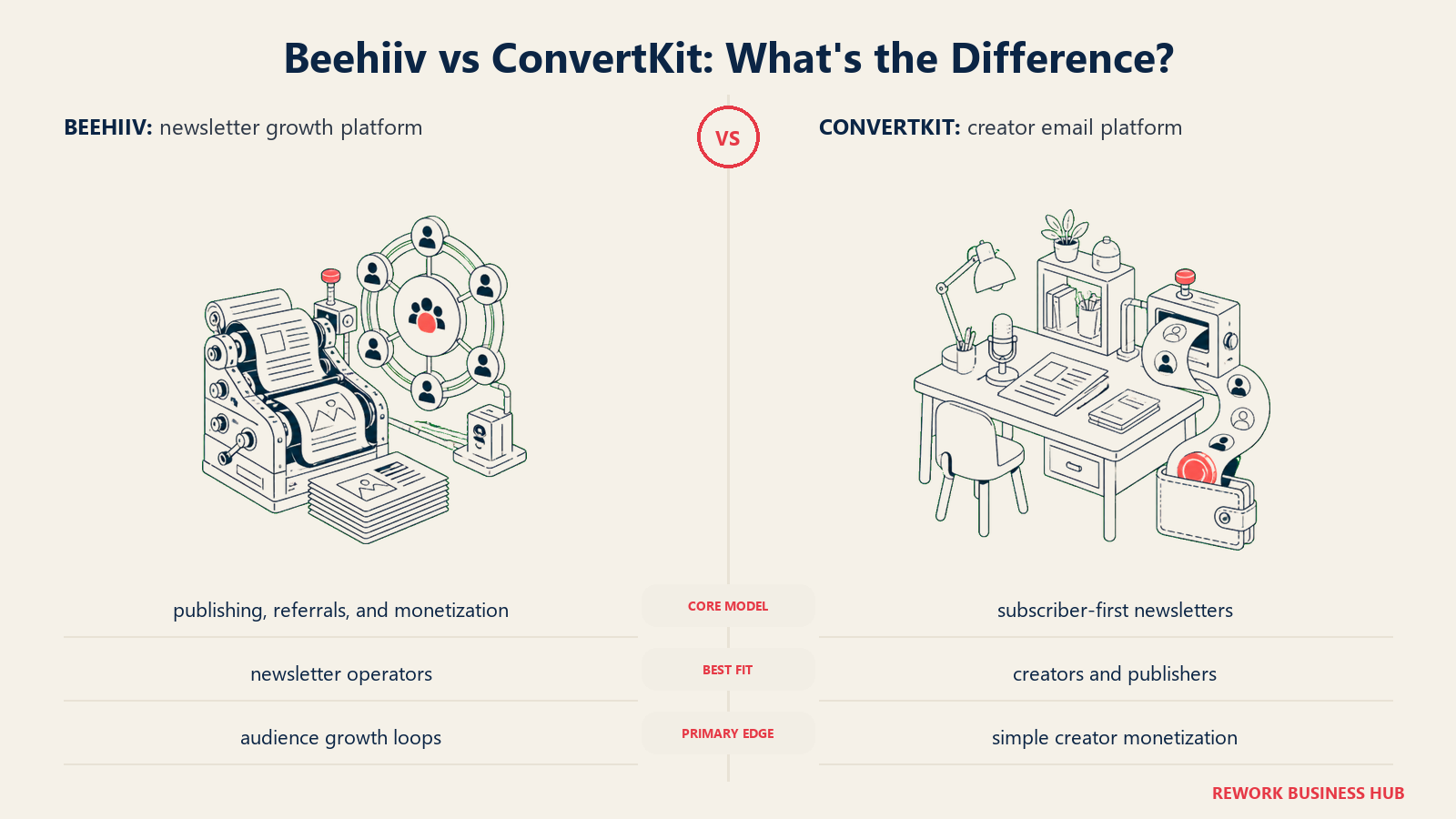
The ICP is a creator or media team serious about newsletter growth as a business. Beehiiv isn't for the person who just wants to send occasional email blasts to a small list. It's for the newsletter that wants to be a media property, with subscriber analytics, growth tools, content scheduling, and multiple publications managed under one roof.
Sizing fit: Beehiiv scales from a single writer (Launch free plan, up to 2,500 subscribers) to a multi-publication media team (Max plan, up to 10 publications per account, priority support). It's a team tool for creator teams, not a company-wide platform.
Stage fit: Best at growth stage, when you've validated your newsletter concept and are ready to invest in monetization infrastructure and subscriber acquisition.
| What you get | What you don't |
|---|---|
| 0% take on paid subscription revenue | A CRM or sales pipeline |
| Built-in ad network and referral (Boosts) program | E-commerce or product checkout capabilities |
| Multi-publication management (Max plan) | Deep behavioral automation |
| Subscriber segmentation and A/B testing | Phone or live chat support on entry plans |
Pricing: Free up to 2,500 subscribers (Launch plan). Scale plan from $49/month (or $43/month billed annually, 1,000 subscribers). Max plan from $109/month. See beehiiv.com/pricing.
Best for: Newsletter-first creators and small media teams wanting monetization tools (paid subs, ads, referrals) without giving up a revenue cut.
2. MailerLite: Clean, Affordable Email for Small Teams
MailerLite's product vision is simplicity at a fair price. The platform covers email campaigns, automation sequences, landing pages, pop-ups, and a basic website builder without charging you for features you don't use. The UI is one of the cleanest in this category. MailerLite's design team clearly prioritizes the experience of a non-technical marketing manager over the power user who wants 15 automation branch options.
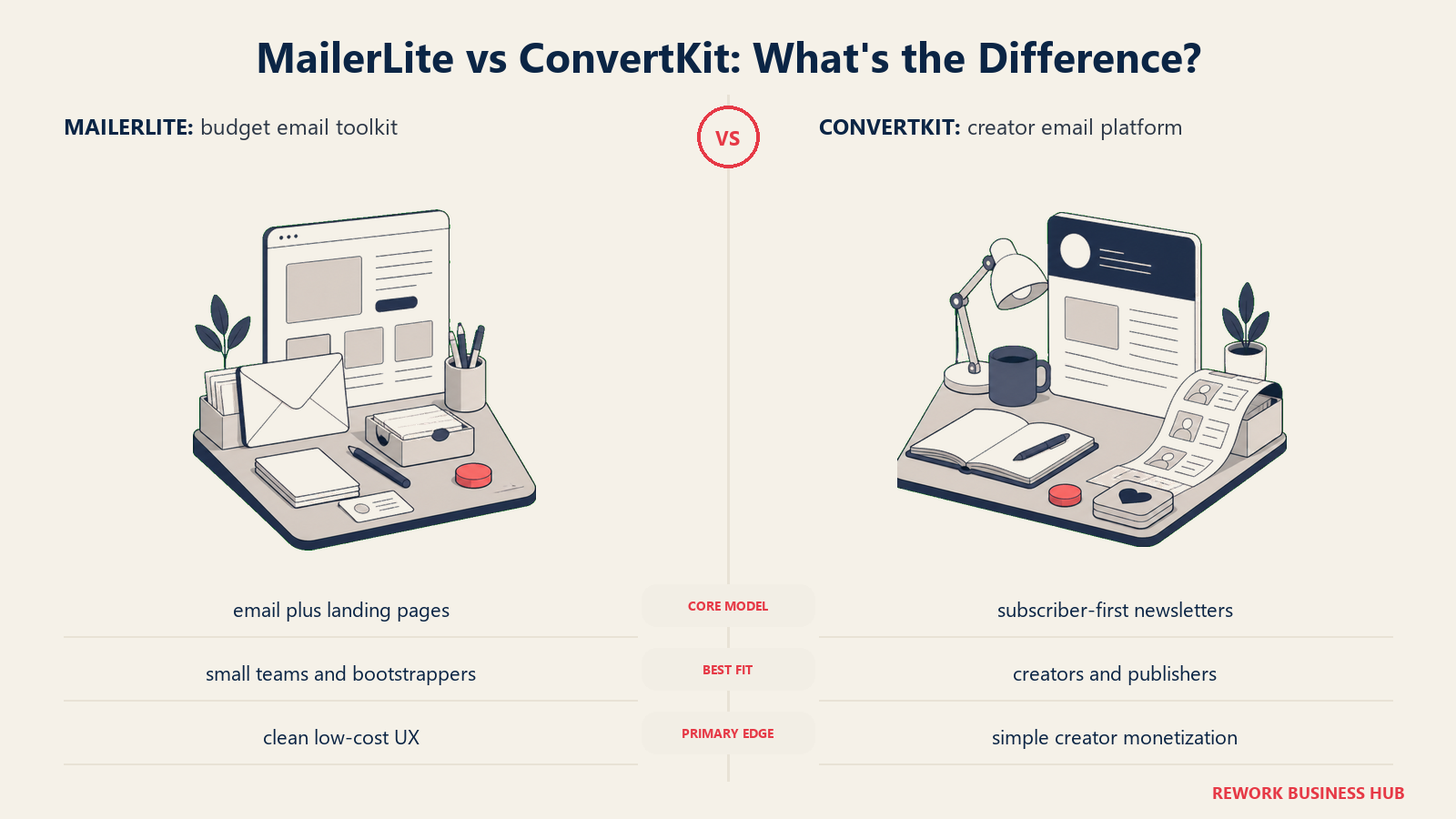
The ICP is a small business owner, blogger, or course creator with a list under 50,000 who wants a professional email setup without the learning curve of ActiveCampaign or the price of HubSpot. It's a marketing-only tool, with no native CRM, no sales pipeline, and no multi-channel inbox.
Sizing fit: Strongest for solo users and teams of 1-10. The Comfort plan works for SMBs up to about 25 people. At 50+ employees, you'll likely outgrow MailerLite's automation depth and need something more powerful. For teams that find even MailerLite limiting, the best Mailchimp alternatives guide covers a broader set of entry-to-mid tier options.
Stage fit: Best for early-stage businesses establishing their email marketing foundation, or bootstrapped teams that need a solid tool without enterprise complexity.
Note: MailerLite's free plan now covers 250 subscribers, down from the 1,000-subscriber free tier many older reviews still quote. New signups should account for that when budgeting.
| What you get | What you don't |
|---|---|
| Clean, beginner-friendly UI | Native CRM or sales pipeline |
| Landing pages and pop-ups included | Advanced behavioral automation |
| Competitive pricing at every contact tier | Deep integrations compared to ActiveCampaign or HubSpot |
| Good deliverability track record | Phone support |
Pricing: Free up to 250 subscribers (2,500 emails/mo). Comfort from $12/month (500 subscribers). Power from $25/month (500 subscribers, unlimited emails). See mailerlite.com/pricing.
Best for: Bootstrapped small businesses and individual creators who want solid email fundamentals without paying for features they won't use.
3. Mailchimp: The Default Choice for Small Businesses
Mailchimp's methodology is "start simple, grow into complexity." It's the most recognized name in email marketing for a reason: the onboarding is genuinely accessible for non-technical users, the integration library (300+ apps) is the widest in this list, and the brand carries a legitimacy that matters to some buyers. Intuit's 2021 acquisition brought more resources but also more aggressive pricing restructuring.
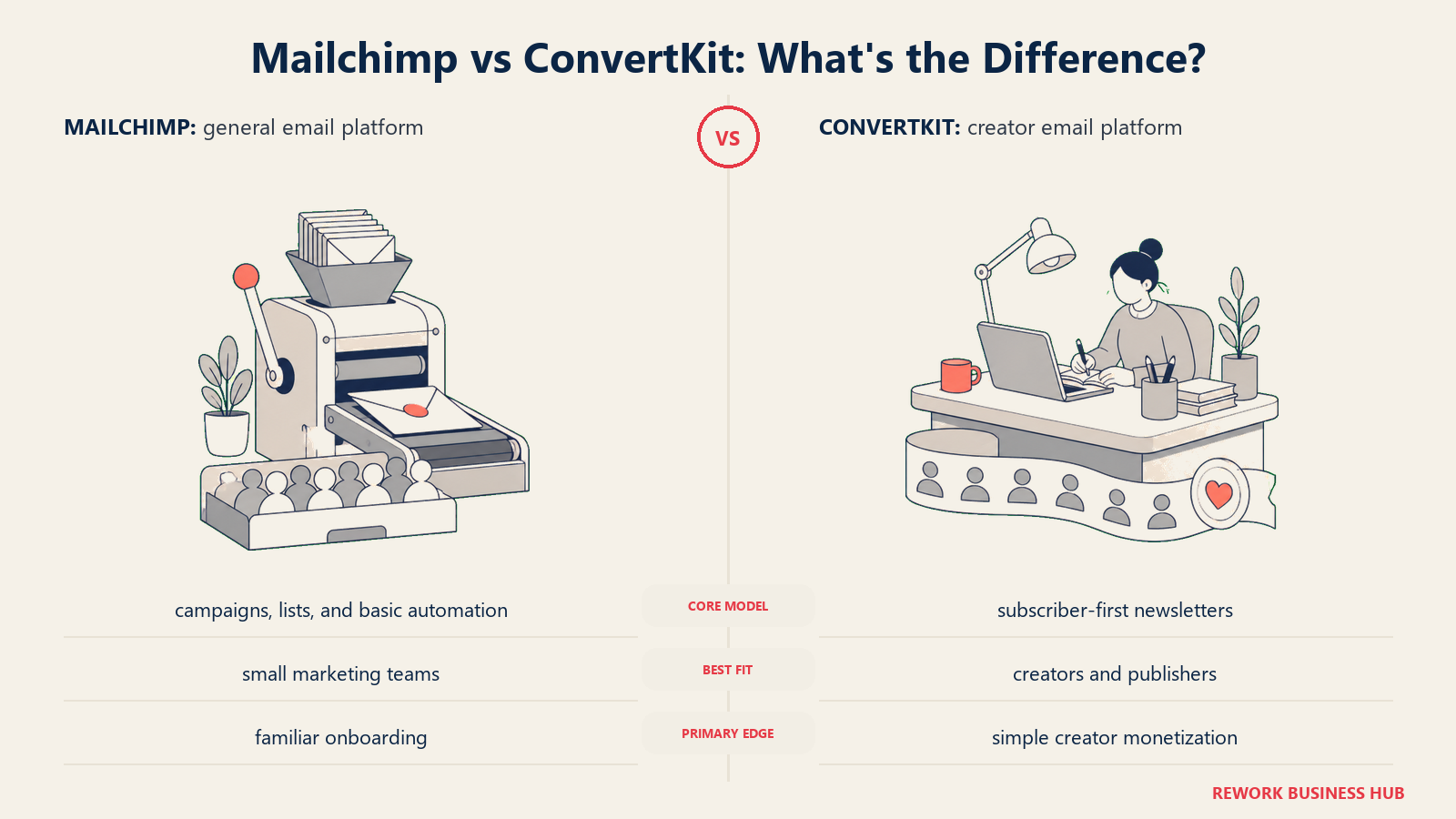
The ICP is a small business owner who wants email marketing to "just work" and isn't evaluating email-to-CRM data flow, behavioral automation depth, or deliverability benchmarks. For teams already looking at broader ActiveCampaign-grade automation, the best ActiveCampaign alternatives guide covers the overlap.
Sizing fit: Best for 1-50 employees. At larger lists, Mailchimp's contact-based pricing becomes one of the most expensive options in this category. The January 2026 change cut the free plan from 500 contacts to 250, a notable reduction.
Stage fit: Best for early-stage businesses and nonprofits just getting started with email. The platform rarely makes sense as a long-term choice for fast-growing teams because the automation depth doesn't scale with the price.
| What you get | What you don't |
|---|---|
| Widest integration library in this list | Deep multi-branch automation logic |
| Easiest onboarding experience | Value for money at high contact counts |
| Built-in A/B testing across most plans | Native CRM or sales pipeline |
| Strong brand recognition (matters for agency work) | Per-contact pricing that's predictable at scale |
Pricing: Free up to 250 contacts (500 emails/month). Essentials from $13/month (500 contacts). Standard from $20/month (500 contacts). Premium from $350/month (10,000 contacts). See mailchimp.com/pricing.
Best for: Non-technical small business owners who prioritize ease of use and integration breadth over automation depth.
4. Brevo: Multi-Channel Email at Per-Send Pricing
Brevo (formerly Sendinblue) made a deliberate choice to price on email volume, not contact list size. Where most competitors charge you more as your list grows, Brevo charges you based on how many emails you send per month. For businesses with large contact databases but lower send frequency, this is a material cost advantage. A company with 100,000 contacts sending a monthly newsletter pays far less on Brevo than on Mailchimp or Kit.
The product philosophy is multi-channel first. Brevo combines email, SMS, WhatsApp, and live chat in one platform at entry-level prices that competitors charge for email alone. The automation builder is functional but thinner than ActiveCampaign's. Complex multi-branch logic is manageable but not as polished. For teams comparing Brevo specifically, the best Brevo alternatives guide digs into where its strengths and edges show.
Sizing fit: Works well from solo users through mid-market teams (up to 200 employees). Brevo's marketing automation ceiling is lower than platforms like ActiveCampaign or HubSpot, so teams with complex multi-touch sequences may hit limitations.
Stage fit: Excellent for early-stage to growth teams needing multi-channel reach without per-contact billing pressure.
| What you get | What you don't |
|---|---|
| Per-send pricing (not per-contact) | ActiveCampaign-grade automation logic |
| Email, SMS, WhatsApp, and live chat in one plan | Native CRM for sales pipeline management |
| Free tier supports 100,000 stored contacts | Strong design templates |
| Competitive pricing at high contact volumes | Deep e-commerce integrations |
Pricing: Free plan (300 emails/day, unlimited contacts). Starter from $9/month (5,000 sends/month). Standard from $18/month. See brevo.com/pricing.
Best for: Budget-conscious teams with large contact databases and lower send frequency, or businesses needing SMS and email in one tool without per-contact pricing.
5. Flodesk: Beautiful Emails for Design-Driven Creators
Flodesk built its reputation on one thing: email templates that look like they came from a boutique design studio. Where ConvertKit is intentionally minimalist (plain text by default, better deliverability by design), Flodesk is maximalist on aesthetics. Full-bleed images, custom brand colors, editorial layouts: the kind of emails that photographers, interior designers, fashion brands, and lifestyle creators actually want to send.
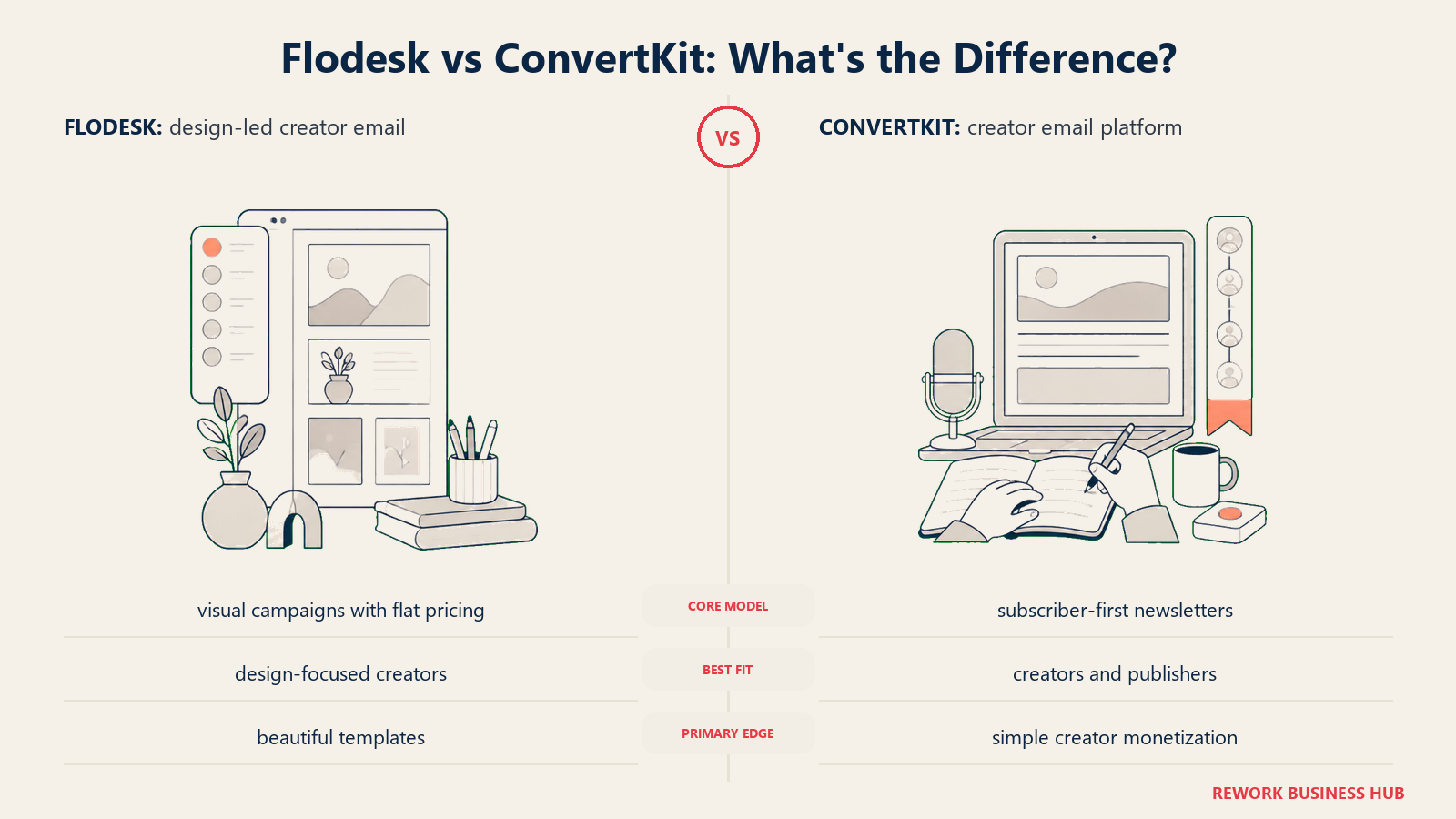
The product philosophy is "beautiful email without a designer." The drag-and-drop editor keeps aesthetic controls simple and consistent, applying your brand palette globally rather than requiring per-email redesign work. There's no CRM, no sales pipeline, no behavioral automation depth. This is a broadcast email tool with strong visual DNA.
Important 2026 context: Flodesk retired its famous flat-rate unlimited plan for new subscribers on December 2, 2025. Existing legacy users keep their unlimited plan, but new signups now face contact-tier pricing similar to competitors.
Sizing fit: Best for solo creators and small teams of 1-10 where aesthetics matter and automation complexity is low. Not designed for B2B sales teams, marketing ops, or companies managing multi-touch nurture sequences.
Stage fit: Best for early-stage creators building brand presence. The tool rarely scales gracefully past the point where businesses need automation sophistication.
| What you get | What you don't |
|---|---|
| Best-in-class email template aesthetics | Deep behavioral automation |
| Consistent brand application across all templates | Native CRM or lead management |
| Clean, low-friction drag-and-drop editor | Competitive pricing for new signups at large list sizes |
| E-commerce checkout features (Everything plan) | Integration breadth of Mailchimp or ActiveCampaign |
Pricing: Lite from $25/month (1,000 subscribers). Pro from $31/month (1,000 subscribers). Everything plan from $54/month (includes e-commerce checkout, sales pages). See flodesk.com/pricing.
Best for: Design-driven creators, photographers, boutique brands, and lifestyle businesses where beautiful emails are a brand differentiator.
6. GetResponse: Email and Webinars and Automation in One Platform
GetResponse's differentiating bet is that webinars belong inside your email marketing platform. If you're selling courses, running product demos, hosting virtual events, or building an audience through live content, GetResponse is the only tool in this list that combines email automation, landing pages, and webinar hosting without a third-party integration. That's a genuine structural advantage for a specific ICP.
The product philosophy is breadth over depth in any single area. GetResponse's automation builder is solid (multi-step sequences, behavioral triggers, scoring, tagging) and meaningfully more capable than Kit's, but it doesn't match ActiveCampaign's multi-branch logic at the Pro level. The platform has been around since 1998 and the UI reflects some of that history, though the company has invested in modernization.
Sizing fit: Works from solo operators to teams of about 100. The Creator plan (from $69/month) is explicitly targeted at course creators and content entrepreneurs.
Stage fit: Best for early-to-growth stage businesses building their audience through live events, webinars, or course funnels.
| What you get | What you don't |
|---|---|
| Webinar hosting built into the platform | A modern UX comparable to MailerLite or Flodesk |
| Solid multi-step automation with behavioral triggers | ActiveCampaign-grade automation branching |
| Landing page builder with conversion optimization tools | Native CRM or sales pipeline |
| Course monetization tools (Creator plan) | Deep e-commerce revenue attribution |
Pricing: Free plan (2,500 sends/month). Starter from $19/month (1,000 contacts). Marketer from $59/month. Creator from $69/month. See getresponse.com/pricing.
Best for: Course creators and event-driven marketers who want email, landing pages, and webinars under one roof without a separate tool for each.
7. ActiveCampaign: Deep Behavioral Automation for Growth Teams
ActiveCampaign is what you move to when you've outgrown Kit's automation capabilities and need multi-branch if-then logic, goal tracking, split-testing of sequences, and CRM-triggered actions in one platform. The visual automation builder is genuinely best-in-class in the mid-market. For anyone comparing this tool head to head, the best ActiveCampaign alternatives guide covers its full competitive context.
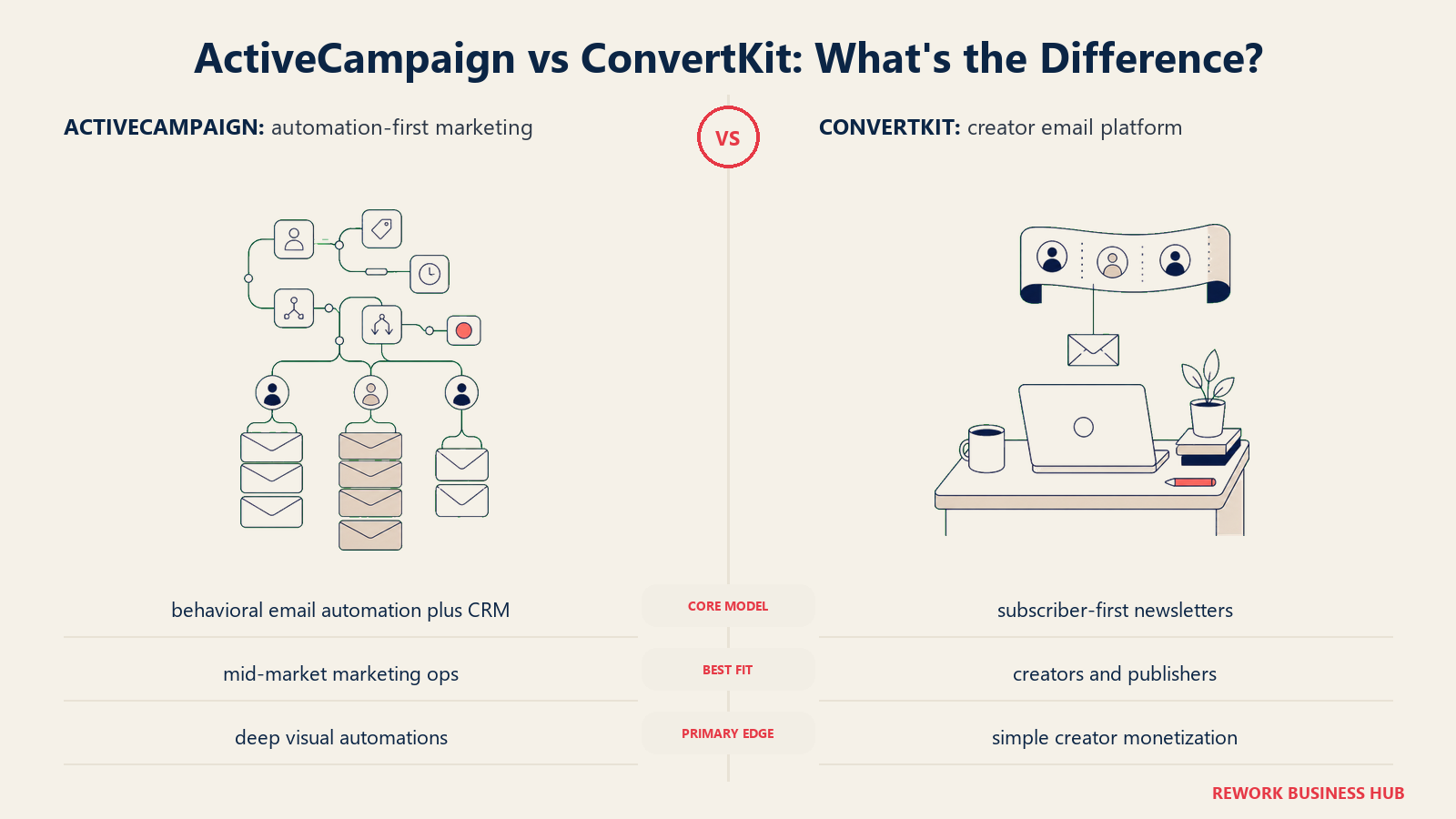
The product philosophy is "behavior-driven marketing automation with a CRM alongside it." The CRM (Deals) is functional but architecturally bolted on, meaning sales-to-marketing data sharing still requires configuration work compared to a native unified platform.
Pricing went through significant restructuring in 2025. The current Starter plan ($15/month for 1,000 contacts) is accessible, but the features that make ActiveCampaign worth choosing (advanced automation, CRM, splits, custom reporting) live on Plus and Pro tiers, where the cost increases sharply.
Sizing fit: Best for growth-stage teams of 10-200 where a dedicated marketing operations person manages the automation. Solo users often find it overpowered.
Stage fit: Sweet spot at growth stage, when you need automation sophistication to support a real sales and marketing function.
| What you get | What you don't |
|---|---|
| Best-in-class multi-branch automation builder | Native unified CRM and email architecture |
| 900+ integrations | Simple, predictable pricing |
| Lead scoring and behavioral segmentation | Strong deliverability reputation (has slipped post-acquisition) |
| Multi-step conditional logic at reasonable price tiers | Creator-focused newsletter tools |
Pricing: Starter from $15/month (1,000 contacts). Plus from $49/month. Pro from $79/month. See activecampaign.com/pricing.
Best for: Growth-stage marketing teams that need automation sophistication and are willing to invest time in setup and management.
8. Klaviyo: E-Commerce Revenue Attribution
Klaviyo does one thing better than any tool in this list: it connects your email and SMS to your Shopify or WooCommerce store and shows you exactly how much revenue each flow generates. The per-flow revenue attribution is native, not an approximation. If you're running a DTC brand and you want to see that your abandoned cart sequence returned $14,230 this month while your welcome series returned $8,910, Klaviyo is the clearest view into that. For context on where Klaviyo's pricing model pushes teams to alternatives, the best Klaviyo alternatives guide is worth reading.
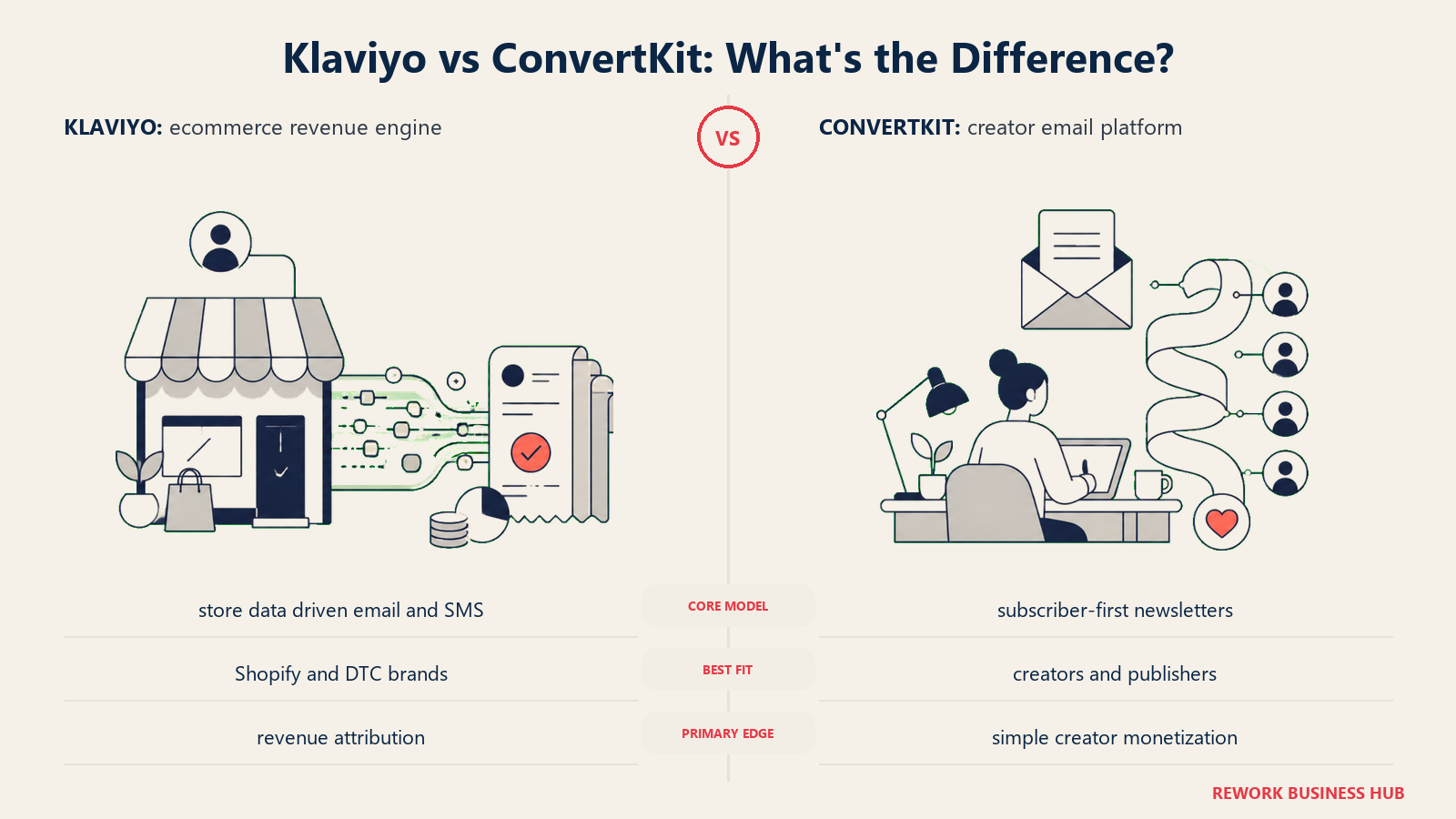
The product philosophy is "email and SMS as a revenue channel, not a broadcast channel." Klaviyo's segmentation depth (recency, frequency, monetary value, product purchase behavior, predictive lifetime value) is designed for e-commerce segmentation specifically, not general B2B or creator use cases.
Important 2026 context: Klaviyo moved to active-profile billing in February 2025. This raised costs for many businesses and made list hygiene (regularly suppressing inactive contacts) a non-negotiable operational task.
Sizing fit: Scales from small DTC brands (5 people) through mid-market e-commerce (500 employees). Outside e-commerce, it's rarely the right fit.
| What you get | What you don't |
|---|---|
| Native Shopify/WooCommerce revenue attribution per flow | Value outside e-commerce context |
| SMS and email in one platform | Flat-rate pricing at high contact volumes |
| Deep e-commerce segmentation (RFM, predictive LTV) | Simple onboarding (complex platform) |
| Strong deliverability for e-commerce senders | Creator-friendly newsletter tools |
Pricing: Free up to 250 active profiles. Email plan from $20/month (251-500 profiles). Email and SMS from $35/month. See klaviyo.com/pricing.
Best for: DTC and e-commerce brands on Shopify or WooCommerce that want per-flow revenue attribution and deep behavioral segmentation.
9. Substack: Zero Friction Publishing and Monetization
Substack's product vision is the simplest possible path from "I want to write a newsletter" to "I want to charge readers for it." There's no automation to configure, no landing page to build, no payment processor to integrate. You write, you publish, paid subscribers pay you, Substack takes 10%. That 10% cut plus Stripe's roughly 2.9% processing fee means you keep about 84% of paid subscription revenue.
The platform has grown significantly: Substack crossed 8.4 million paid subscriptions in Q1 2026. The built-in discovery network (Notes, recommendations, the Substack app) is a genuine audience growth channel that Kit doesn't provide natively.
But there's a ceiling. You don't own your list the same way you do on a self-hosted ESP. Moving subscribers off Substack to another platform is possible but not seamless. The 10% take rate compounds as your paid subscriber base grows, eventually making the math less attractive than a tool with flat-rate pricing. And there's essentially no marketing automation, CRM, or e-commerce depth.
Sizing fit: Best for solo writers and individual-creator teams. Not designed for multi-person marketing teams or businesses with sales pipeline complexity.
| What you get | What you don't |
|---|---|
| Frictionless publish-and-monetize in one step | List ownership portability equivalent to a self-hosted ESP |
| Built-in discovery network (Notes, recommendations, app) | 0% platform revenue cut |
| Zero technical setup or maintenance overhead | Marketing automation or behavioral segmentation |
| Comment sections and community features | E-commerce or CRM capabilities |
Pricing: Free to publish. Substack takes 10% of paid subscription revenue (plus roughly 2.9% and $0.30 Stripe processing per transaction). No fixed monthly fee. See substack.com.
Best for: Individual writers and journalists who want the simplest possible path to a paid newsletter with discovery built in, and don't need list portability or automation complexity.
10. HubSpot Marketing Hub: Full Inbound Marketing Suite
HubSpot's methodology is "inbound done in one place." The Starter tier ($20/seat/month) makes sense for small teams needing email, landing pages, and forms with the CRM already included. The Professional tier ($890/month for 3 seats) is where HubSpot becomes the most complete platform in this list, combining email automation, landing pages, ad management, blog, forms, SEO tools, and CRM attribution in a single environment.
The tradeoff is cost. The Professional tier's $890/month floor (plus a $3,000 one-time onboarding fee) is a significant commitment for teams that don't need the full suite. HubSpot is best when you need marketing, sales, and service data on the same contact record without integration work. For teams currently using GoHighLevel-style all-in-one platforms, the best GoHighLevel alternatives guide shows how HubSpot compares in practice.
Sizing fit: The free CRM works for any size. Starter makes sense for 5-50 person teams. Professional is the sweet spot for 50-500 people with a dedicated marketing function and budget to match.
| What you get | What you don't |
|---|---|
| Full inbound stack: email, landing pages, ads, forms, blog, CRM | Simple, flat pricing that stays predictable |
| Native marketing-to-sales attribution without integration | ActiveCampaign-level multi-branch automation depth |
| Strong onboarding ecosystem (Academy, certified partners) | A lean, focused specialist tool |
| Starter tier accessible at $20/seat/month | Flexibility to mix with best-of-breed point solutions |
Pricing: Free CRM. Marketing Hub Starter from $20/seat/month. Professional from $890/month (3 seats, plus $3,000 onboarding). See hubspot.com/pricing/marketing.
Best for: Growth-to-mid-market teams (50-500 employees) with a dedicated marketing function that want the full inbound stack on one contact record.
11. Constant Contact: Straightforward Email for SMBs
Constant Contact has served small businesses since 1995 and the product reflects that heritage: reliable, well-documented, with phone support included at a time when most competitors have moved to chat-only. If you're running a nonprofit, a local business, an association, or an event-driven organization and you value being able to call someone when something breaks, Constant Contact is one of the few tools that still offers that. For readers comparing this tool against its nearest neighbors, the best Constant Contact alternatives guide covers the full picture.
The product philosophy is accessibility for non-technical users. The event management tools (registration pages, ticketing, attendee management) are a genuine differentiator for event-driven organizations that other tools in this list don't match natively.
Sizing fit: Best for 1-100 employee SMBs. The contact-based pricing scales aggressively (500 to 1,000 contacts on Lite jumps from $12 to $50 per month), so larger lists erode the value quickly.
Stage fit: Early-stage to established SMBs that prioritize support quality and ease of use over automation sophistication.
| What you get | What you don't |
|---|---|
| Phone support included (rare in this market) | Automation sophistication comparable to ActiveCampaign |
| Event management tools built in | Competitive pricing at larger contact volumes |
| Beginner-friendly editor and templates | Modern UI design |
| Nonprofit discount (30% off annual) | Deep integration library |
Pricing: Lite from $12/month (up to 500 contacts). Standard from $35/month. Premium from $80/month. Annual billing saves 15%. See constantcontact.com/pricing.
Best for: SMBs, nonprofits, and event-driven organizations that want reliable email, phone support, and event tools without automation complexity.
Stage Fit Matrix
| Tool | Startup (1-10) | Growth Stage (10-100) | Mid-Market (100-500) | Enterprise (500+) |
|---|---|---|---|---|
| Beehiiv | Strong fit (creators) | Good fit (newsletters) | Limited (creator-narrow) | Not designed for it |
| MailerLite | Strong fit | Works | Limited automation | Not designed for it |
| Mailchimp | Strong fit | Works (watch pricing) | Expensive at scale | Not designed for it |
| Brevo | Good fit | Good fit | Works | Limited depth |
| Flodesk | Strong fit (design-led) | Works (creators) | Not ideal | Not designed for it |
| GetResponse | Good fit | Good fit | Works | Limited |
| ActiveCampaign | Works | Strong fit | Good fit | Available, not preferred |
| Klaviyo | Works (e-com) | Strong fit (e-com) | Good fit (e-com) | Works |
| Substack | Strong fit (solo) | Limited | Not designed for it | Not designed for it |
| HubSpot | Free tier only | Good fit | Strong fit | Enterprise tier available |
| Constant Contact | Strong fit | Works | Expensive at scale | Not designed for it |
Sizing and Buyer Persona Table
| Tool | Typical Company Size | Who Buys It |
|---|---|---|
| Beehiiv | 1-20 (creator teams) | Newsletter Creator, Media Founder, Independent Writer |
| MailerLite | 1-100 employees | Small Business Owner, Blogger, Course Creator |
| Mailchimp | 1-100 employees | Marketing Manager, Small Business Owner, Agency |
| Brevo | 1-200 employees | Marketing Manager, Growth Marketer, E-commerce Owner |
| Flodesk | 1-20 (creator/brand) | Photographer, Boutique Brand Owner, Lifestyle Creator |
| GetResponse | 5-500 employees | Marketing Director, Solopreneur, Course Creator |
| ActiveCampaign | 10-500 employees | Marketing Ops, Growth Marketer, Revenue Operations |
| Klaviyo | 5-500 employees | E-commerce Owner, DTC Brand CMO, Email Marketer |
| Substack | 1-5 (individual) | Writer, Journalist, Independent Creator |
| HubSpot | 20-1,000 employees | CMO, Marketing Ops, RevOps, Sales Director |
| Constant Contact | 1-100 employees | Small Business Owner, Nonprofit Director, Event Manager |
Decision Framework: Which Tool Fits Your Situation
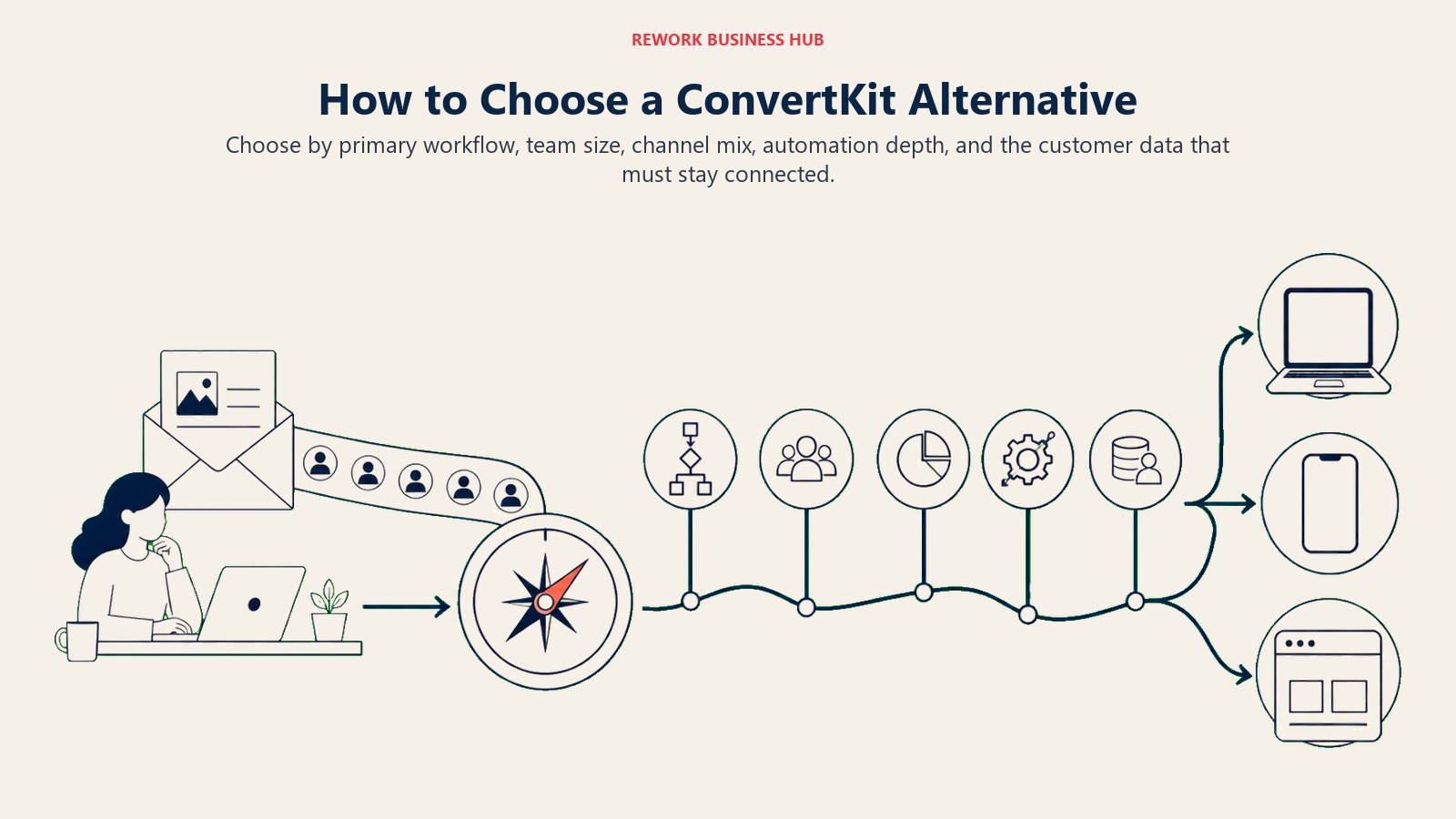
Use these criteria to narrow the field by workflow, team size, channel mix, automation depth, and connected customer data.
| If you need this | Pick this tool |
|---|---|
| Newsletter monetization (paid subs, ads, referrals) with 0% platform take | Beehiiv |
| Cheapest credible email tool with landing pages | MailerLite |
| Email and SMS multi-channel without per-contact pricing | Brevo |
| Beautiful branded templates for a design-driven brand | Flodesk |
| Webinar hosting and email and landing pages in one tool | GetResponse |
| Best-in-class behavioral automation for a growth-stage marketing team | ActiveCampaign |
| E-commerce revenue attribution (Shopify/WooCommerce) | Klaviyo |
| Frictionless publish-and-monetize with zero technical setup | Substack |
| Full inbound marketing suite with CRM attribution | HubSpot Marketing Hub |
| Reliable email with phone support for an SMB or nonprofit | Constant Contact |
| Widest integration library with brand recognition | Mailchimp |
What to Do Next
Narrow your shortlist to two tools, then run each on a real use case for two weeks. If you're still doing creator-style broadcast email and your list is under 10,000, Beehiiv or MailerLite will serve you well at a lower price than Kit's current Creator plan. If your business has added a sales team, a pipeline, and leads that need to flow from marketing to sales without manual CSV exports, look at HubSpot Marketing Hub, which pairs a full inbound marketing suite with a CRM instead of treating email as the whole job.
The tools that look cheapest at signup often cost the most at 5,000 subscribers. Run the actual math at your current list size and the size you expect to be in 12 months. Then compare that against what each tool's automation depth can actually support at that scale.

Principal Product Marketing Strategist
On this page
- Quick Comparison Table
- 1. Beehiiv: Newsletter-First Growth Platform
- 2. MailerLite: Clean, Affordable Email for Small Teams
- 3. Mailchimp: The Default Choice for Small Businesses
- 4. Brevo: Multi-Channel Email at Per-Send Pricing
- 5. Flodesk: Beautiful Emails for Design-Driven Creators
- 6. GetResponse: Email and Webinars and Automation in One Platform
- 7. ActiveCampaign: Deep Behavioral Automation for Growth Teams
- 8. Klaviyo: E-Commerce Revenue Attribution
- 9. Substack: Zero Friction Publishing and Monetization
- 10. HubSpot Marketing Hub: Full Inbound Marketing Suite
- 11. Constant Contact: Straightforward Email for SMBs
- Stage Fit Matrix
- Sizing and Buyer Persona Table
- Decision Framework: Which Tool Fits Your Situation
- What to Do Next