Laserfiche vs DocuWare: Which Document Management Platform Fits Your Team Better in 2026?
Turn this article into takeaways for your work.


Each assistant summarizes the article only for you and suggests best practices for your work.
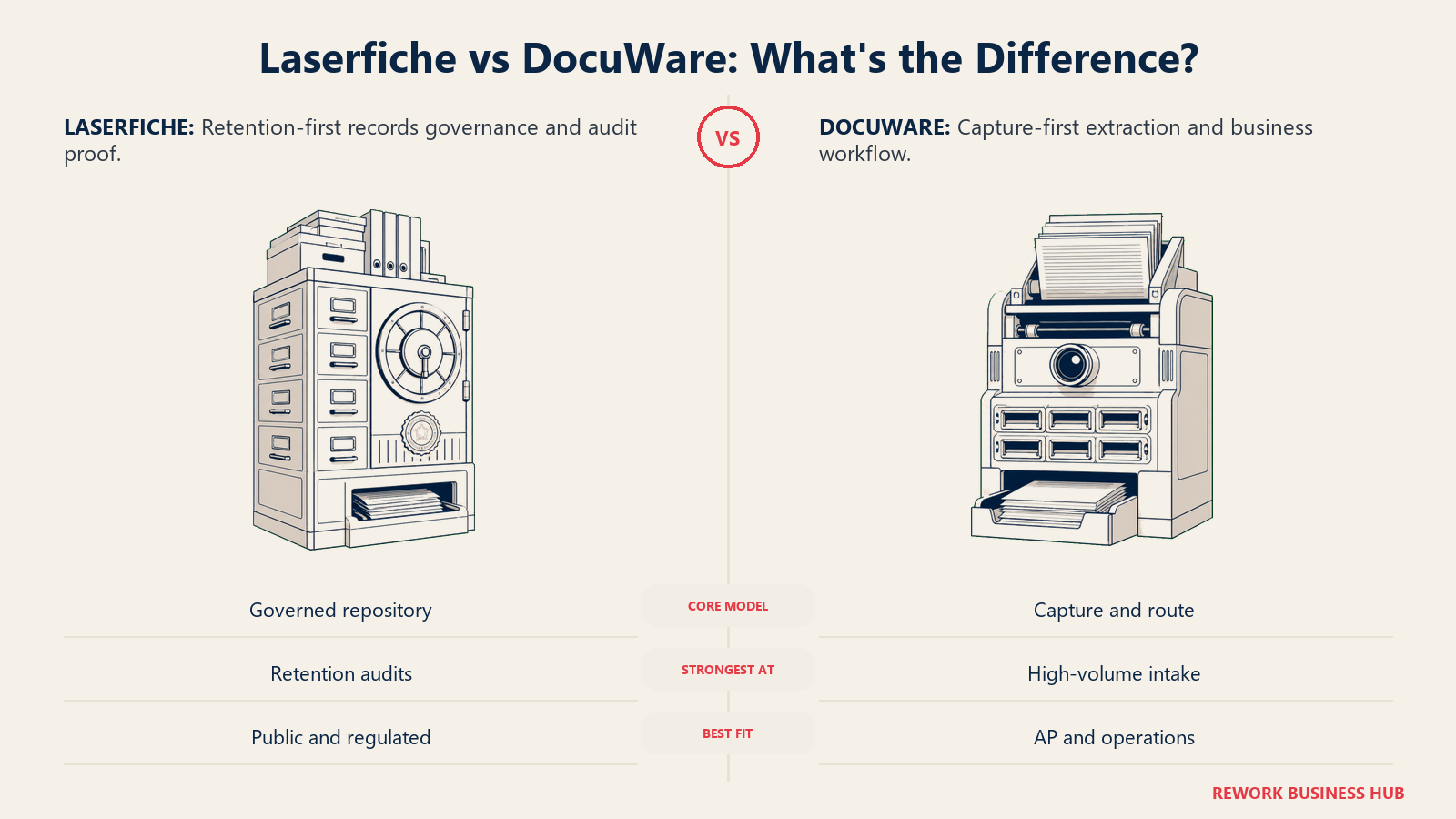
These two platforms built their reputations from opposite ends of the same document problem. Laserfiche grew up in the world that gets audited: local government, courts, K-12 and higher education, healthcare, places where the real question isn't just "can we find this file" but "can we prove we kept it for the legally required number of years, then defensibly destroyed it." Records retention, formal classification, and compliance sit at the center of the product, not bolted on afterward. DocuWare grew up at the other end of the pipeline: the moment a paper invoice or a scanned PDF lands on someone's desk. Scan it, OCR it, index it, and route it through approval, with its deepest reported strength in accounts payable and invoice processing. It stores documents in what it calls file cabinets, organized by index fields, a digital version of the filing cabinet it replaced.
If you're a records manager, IT director, compliance officer, or ops lead comparing these two for 2026, the decision usually comes down to which end of the problem is actually costing you money and risk: getting audited on how long you kept a record and why, or drowning in manual data entry on high-volume document intake. Here's the honest breakdown, including a real correction worth knowing before you compare quotes: Laserfiche now publishes self-serve pricing, and most comparison content on the web still describes it as quote-only with a "$53 Starter" tier that was never a published price.
TL;DR
| Laserfiche | DocuWare | |
|---|---|---|
| What it actually is | Records-and-retention-first, built for organizations formally audited on how long they kept something and why | Capture-and-process-first, built around scanning, OCR, and workflow |
| Core organizing concept | A managed repository with formal records classification and retention schedules | File cabinets, document trays, index fields |
| Strongest at | Records Lifecycle Management, public-sector/education/healthcare compliance, defensible retention | Intelligent Document Processing, invoice/AP automation, e-forms |
| AI | Laserfiche AI Agents, AI-powered data extraction and classification, metered in AI Units | Intelligent Document Processing (IDP), zero-shot GenAI extraction |
| Microsoft 365 fit | Native Outlook add-in and Office 365 co-authoring from Professional up | Native Teams app and Outlook add-ins, included with every Cloud license |
| Deployment | Cloud (three published tiers) plus self-hosted Laserfiche 12 | Cloud, on-premises, and hybrid all still sold |
| Pricing | Published: $73-$93/user/mo billed annually, Business+ at $42/user/mo past 500 seats | Quote-only; named-user licensing, sliding per-user scale plus workflow licenses |
| Best for | Formal records retention, audit-heavy compliance, public sector/education/healthcare | High-volume capture and AP processing |
Who Each Platform Is Actually Built For
Both vendors sell into organizations with real document volume, but the trigger that starts the buying process comes from opposite directions.
Laserfiche's natural buyer is a records manager, compliance officer, or IT director at a government agency, court, school district, or healthcare system who has to answer, in writing, how long a category of record must be kept and prove it was disposed of correctly when the schedule expired. The pain isn't "we can't find things," it's "we can't prove we're compliant if we get audited." DocuWare's natural buyer is an operations, finance, or AP lead drowning in paper or PDF intake: invoices, purchase orders, HR onboarding packets. The pain is "we spend too many hours keying data by hand," and the fix is capture plus a workflow that routes the result to the right approver.
| Laserfiche | DocuWare | |
|---|---|---|
| Natural buying trigger | An audit, a records schedule gap, or a compliance mandate that a shared drive can't satisfy | Manual data entry and paper intake eating staff hours, especially in AP |
| Team maturity assumed | Willing to define formal record types and retention schedules up front | Wants a fast, structured way to capture and route documents |
| Primary champion | Records manager, compliance officer, or IT director | Operations manager, finance/AP lead, or office manager |
| Where it shows up most | Public records requests, litigation holds, regulatory audits, permit and case files | Accounts payable, HR files, contracts intake, purchasing |
| Reported industry strength | Local and state government, courts, K-12/higher ed, healthcare | AP automation, invoice-heavy back-office functions |
Laserfiche was named a Leader for the second consecutive time in the 2026 Gartner Magic Quadrant for Document Management, receiving the highest overall rating among 16 vendors in Gartner Peer Insights at 4.7 out of 5.0 based on over 1,300 reviews as of April 30, 2026, per Laserfiche's own press release, a data point consistent with its long-standing pedigree in records-heavy public sector accounts.
| Laserfiche | DocuWare | |
|---|---|---|
| Company structure | Privately held, employee-owned, founded 1987 | Ricoh subsidiary since 2019, operates with its own leadership and partner network |
| Analyst recognition | Named a Leader, 2026 Gartner Magic Quadrant for Document Management (second consecutive time) | Not covered in the same Magic Quadrant category by these vendor materials |
| Deployment history | Long track record in on-premises government and healthcare accounts moving to cloud | Cloud-first growth alongside a maintained on-premises line |
| Sold through | Network of Laserfiche Solution Providers | Authorized partners and resellers |
| Where the industry sees it strongest | Regulated, audit-heavy, records-classification-driven environments | High-volume, repeatable capture and routing environments |
Neither direction is wrong. It's the difference between a platform built to prove a record was kept correctly, and one built to move a document from inbox to approval as fast as possible.
Key Facts
- Laserfiche was named a Leader for the second consecutive time in the 2026 Gartner Magic Quadrant for Document Management, with the highest overall rating among 16 vendors in Gartner Peer Insights (4.7/5.0, 1,300+ reviews as of April 30, 2026), per Laserfiche's own press release.
- Employees spend an average of 1.8 hours a day, roughly 20 percent of the workweek, searching for and gathering information rather than doing the work itself, according to McKinsey's research on the social economy.
- The average manually processed invoice costs $9.40, versus $2.78 for best-in-class AP teams, according to Ardent Partners' 2025 Accounts Payable Metrics That Matter report, per WEX's summary of the findings.
- 78 percent of enterprises now report being operational with AI in intelligent document processing, while 61 percent of business processes still involve paper somewhere in the chain, according to AIIM's Market Momentum Index: IDP Survey 2025.
- The global document management system market is valued at $9.74 billion in 2026 and is projected to reach $29.78 billion by 2034, a 15 percent CAGR, according to Fortune Business Insights.
The Underlying Model: Records Classification vs File Cabinets and Capture
This is the structural difference that explains almost everything else in this comparison.
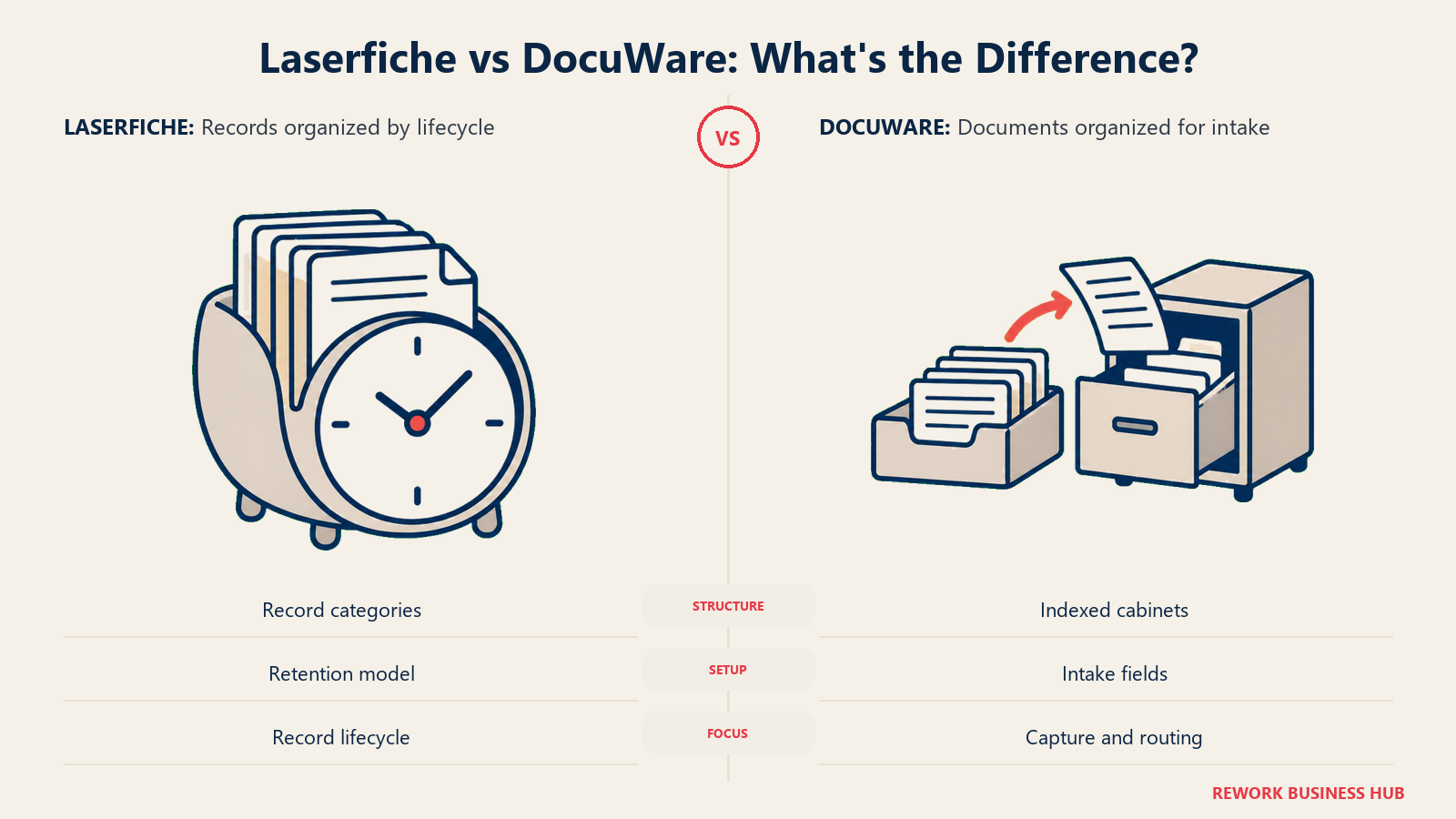
Laserfiche's model treats a document as a record first: every item gets classified into a record type and, on the Business tier and above, a retention schedule that governs how long it must be kept and what happens when that period ends. The repository is organized around that classification rather than a folder tree a user browses by hand, and the pricing tiers themselves are built around record-governance capacity, more repositories, more AI-assisted extraction, tighter access controls, as the tier goes up.
DocuWare's core metaphor mirrors the physical office it replaced. Documents pass through a document tray, the digital version of an inbox, get indexed with metadata, and are stored in a file cabinet, DocuWare's term for a defined repository with its own index fields. It's metadata-assisted filing organized around named cabinets per document type (invoices, HR files, contracts), not a records-classification model with formal disposition schedules baked into the license.
| Laserfiche | DocuWare | |
|---|---|---|
| Core structure | Records classified by type, with formal retention/disposition schedules (Business tier and up) | File cabinets with defined index fields, by document type |
| Where a document "lives" | In a records category governed by a retention rule | In a specific cabinet, indexed by its fields |
| Setup mental model | Define record types and retention schedules, then classify as documents enter | Design a cabinet per document type, define index fields |
| Best fit for | Organizations that must prove compliant retention and disposition | Clear intake channels (invoices, HR files, contracts) |
| Where the model shows up in pricing | Record-governance depth scales with tier (repositories, RLM, security controls) | Feature set is constant; user count and storage scale with tier |
Capture, OCR, and Intelligent Document Processing Depth
DocuWare's capture strength is the more deliberately marketed of the two, but Laserfiche's AI-assisted extraction is a real, tier-scaled feature, not an afterthought.
Laserfiche's AI-powered data extraction and classification, delivered through Laserfiche AI Agents, is included starting at the Professional tier and metered in what the vendor calls AI Units: 1,000 per year on Professional, 50,000 per year on Business, and 250,000 per year on Business+. That's a usage-capped model rather than an unlimited one, worth confirming against your expected document volume before you commit to a tier.
DocuWare's Intelligent Document Processing module uses GenAI extraction the company calls zero-shot, pulling structured data from a document type it hasn't specifically trained on. Intelligent Indexing, the more established engine underneath it, learns from prior indexing behavior to auto-populate fields, and DocuWare also ships dedicated e-invoicing automation, a named line the company builds specifically for accounts payable.
| Capability | Laserfiche | DocuWare |
|---|---|---|
| OCR and data extraction | AI Agents, AI-powered data extraction and classification | Intelligent Document Processing, GenAI zero-shot extraction |
| Dedicated invoice/AP automation | Not a named product line | Yes, a named e-invoicing solution |
| AI usage model | Metered in AI Units, scales by tier (1,000 to 250,000/year) | Included, no separate usage cap named |
| API access ceiling | 50,000 calls/month (Professional) up to 500,000/month (Business+) | Not separately metered or published |
| Best fit | Mixed record types needing consistent classification at scale | High-volume, repeatable document types, especially invoices |
Records Retention, Compliance, and Audit Depth
This is Laserfiche's home turf, and the pricing structure reflects it plainly: retention and governance depth is what you're actually paying to move up a tier for.
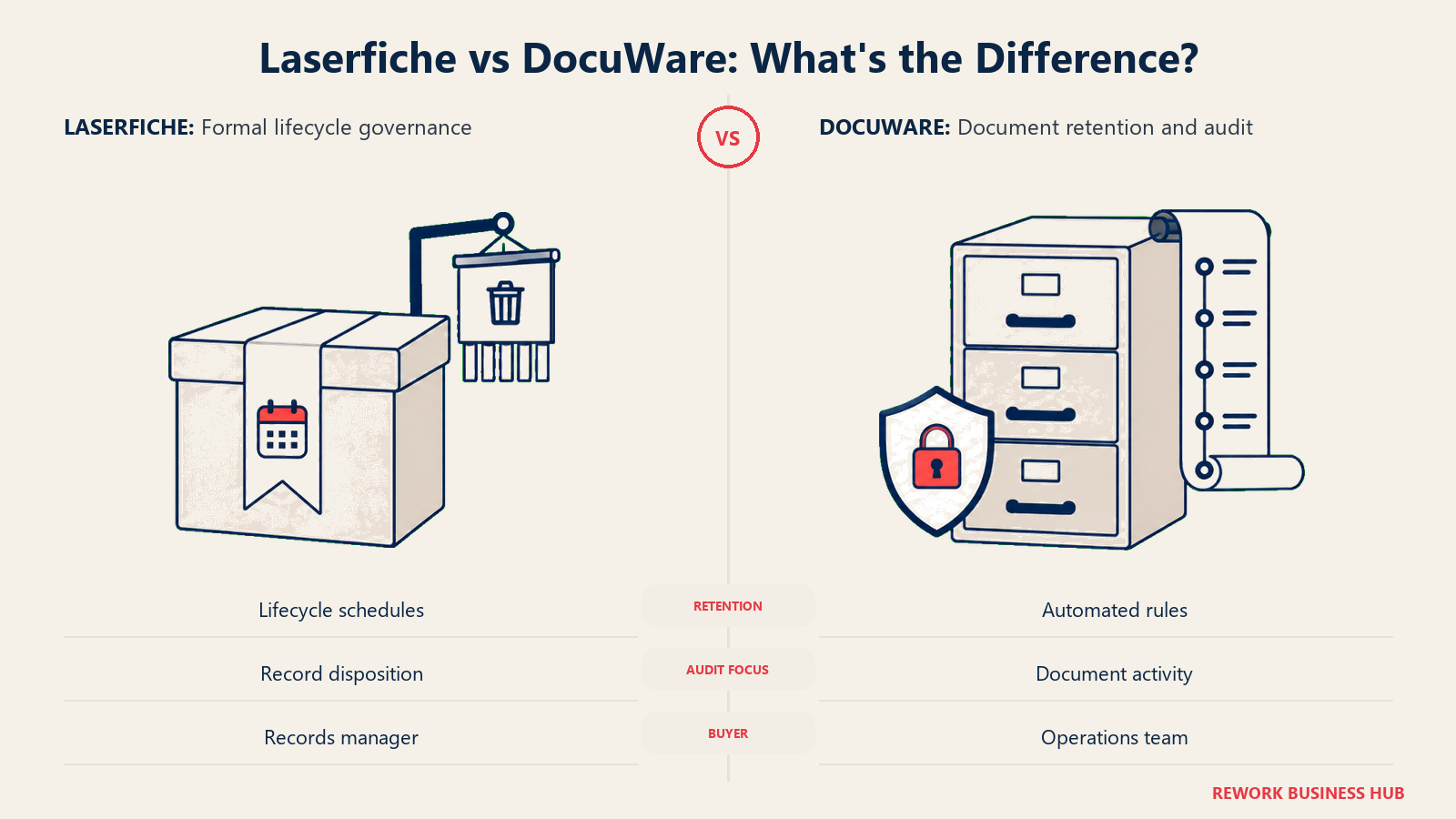
Laserfiche's Records Lifecycle Management ships starting on the Business tier ($93/user/mo, 25-user minimum), covering formal retention schedules and disposition. The Professional tier already includes SOC 2 Type 2+, HIPAA, ISO 27001, granular role-based access control, and audit logging as entry-level inclusions, not premium add-ons. Business+, the 500-user volume tier, adds CJIS requirements and GovRAMP verified status, though the vendor states GovRAMP verification is "starting Q3 2026," which is forward-looking rather than live today, worth flagging plainly rather than treating as a current capability.
DocuWare supports HIPAA, SOX, GDPR, and NIST-aligned controls out of the box, with automatic audit trails logging every upload, version change, approval, annotation, and routing decision in real time. Retention rules can be automated, and Cloud documents are stored with AES-256 encryption. That's solid, general-purpose security and retention aimed at broad regulatory coverage rather than a records-classification specialty.
| Laserfiche | DocuWare | |
|---|---|---|
| Formal records retention/disposition module | Records Lifecycle Management, Business tier and up ($93/user/mo, 25-user minimum) | Automated retention rules available on Cloud |
| Entry-tier security certifications | SOC 2 Type 2+, HIPAA, ISO 27001 (Professional, $73/user/mo) | HIPAA, SOX, GDPR, NIST-aligned |
| Public sector/CJIS-specific coverage | CJIS requirements and GovRAMP verified, starting Q3 2026 (Business+ only) | Not a named specialty |
| Audit trail | Granular RBAC plus audit logging from Professional up | Automatic, logs every document interaction in real time |
| Industry pedigree | Public sector, courts, K-12/higher ed, healthcare | General cross-industry, strongest in AP/finance back-office |
| Where retention sits in the pricing tier | A paid upgrade, gated at Business and above | Included at every published Cloud tier |
If your organization is formally audited on document retention, this is the section to read twice. A quality management or SOP framework helps define what those retention categories should be in the first place; see our guide to what process documentation actually requires and, for regulated manufacturing or services teams, our practical ISO 9001 guide.
Workflow, Forms, and Business Process Automation
Both vendors ship real BPM, not a simple approval chain bolted onto a file store, and both include it at the entry tier rather than gating it behind a premium plan.
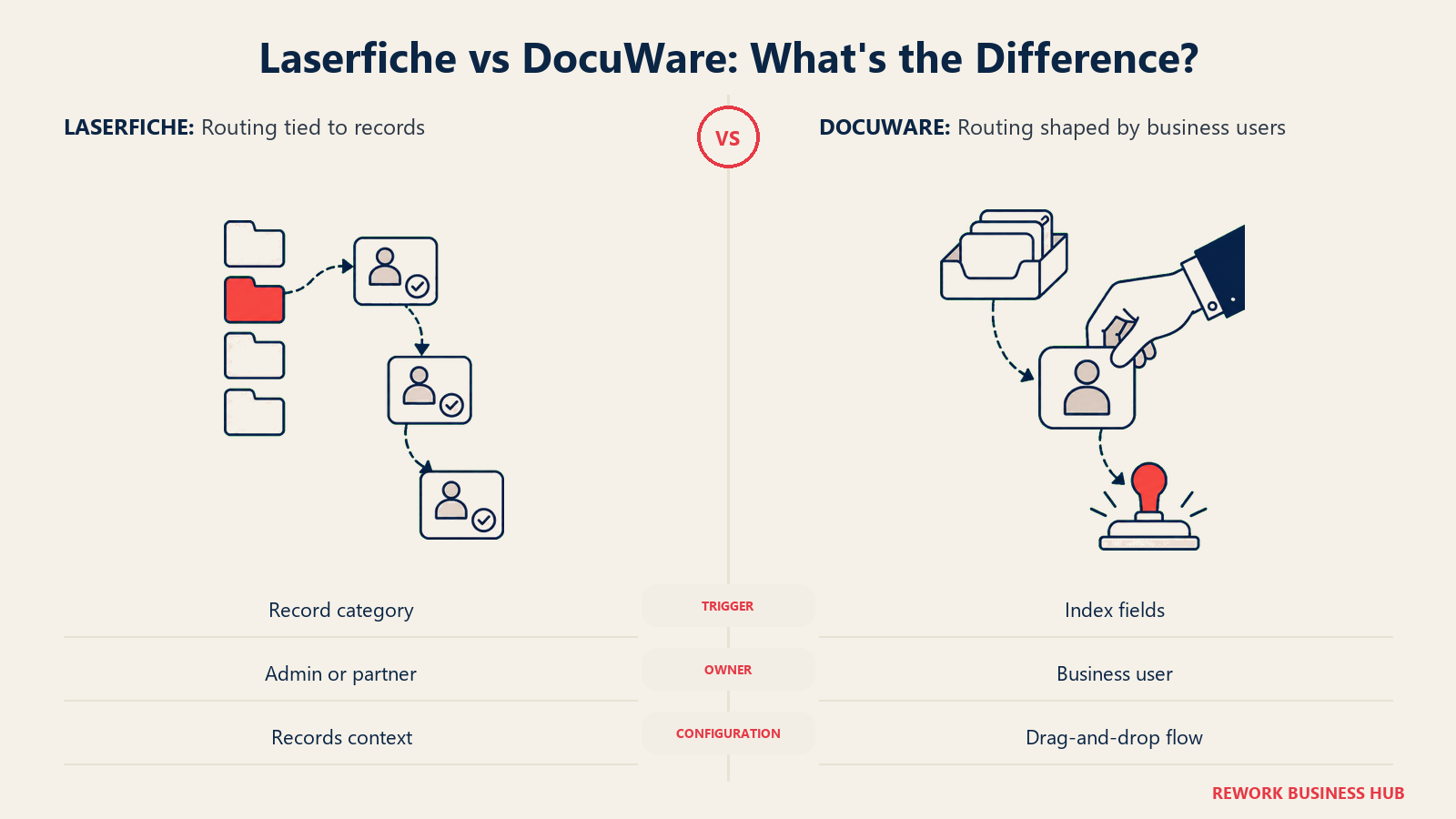
DocuWare's Workflow Manager uses a drag-and-drop canvas the company markets explicitly as requiring no programming, where a business user maps process steps and connects them with decision points and rules. It's built so an ops or AP lead, not IT, adjusts routing without filing a ticket.
Laserfiche's workflow automation and custom forms are named line items starting at the Professional tier, tied into the same repository that handles records classification, so a routing rule can trigger off a document's retention category as naturally as its file type. Laserfiche doesn't publish the same "no-code, drag-and-drop for business users" language DocuWare uses for Workflow Manager; its process configuration has historically leaned toward administrators and Laserfiche Solution Providers setting up the system on a customer's behalf, consistent with its heavier reliance on partner-led implementation.
| Laserfiche | DocuWare | |
|---|---|---|
| Included at entry tier | Yes, from Professional ($73/user/mo) | Yes, on every Cloud plan |
| Builder audience | Historically admin/solution-provider configured | Business user, no-code drag-and-drop (Workflow Manager) |
| Forms | Custom forms, Professional and up | E-forms, part of the core capture and workflow set |
| Ties routing logic into | Records classification and retention category | Index fields and file cabinet structure |
| Best fit | Teams comfortable letting IT or a partner own process logic | Ops staff who want to self-serve routing changes |
Microsoft 365 and Teams Integration
Both platforms take Microsoft 365 seriously, but the specific strengths differ.
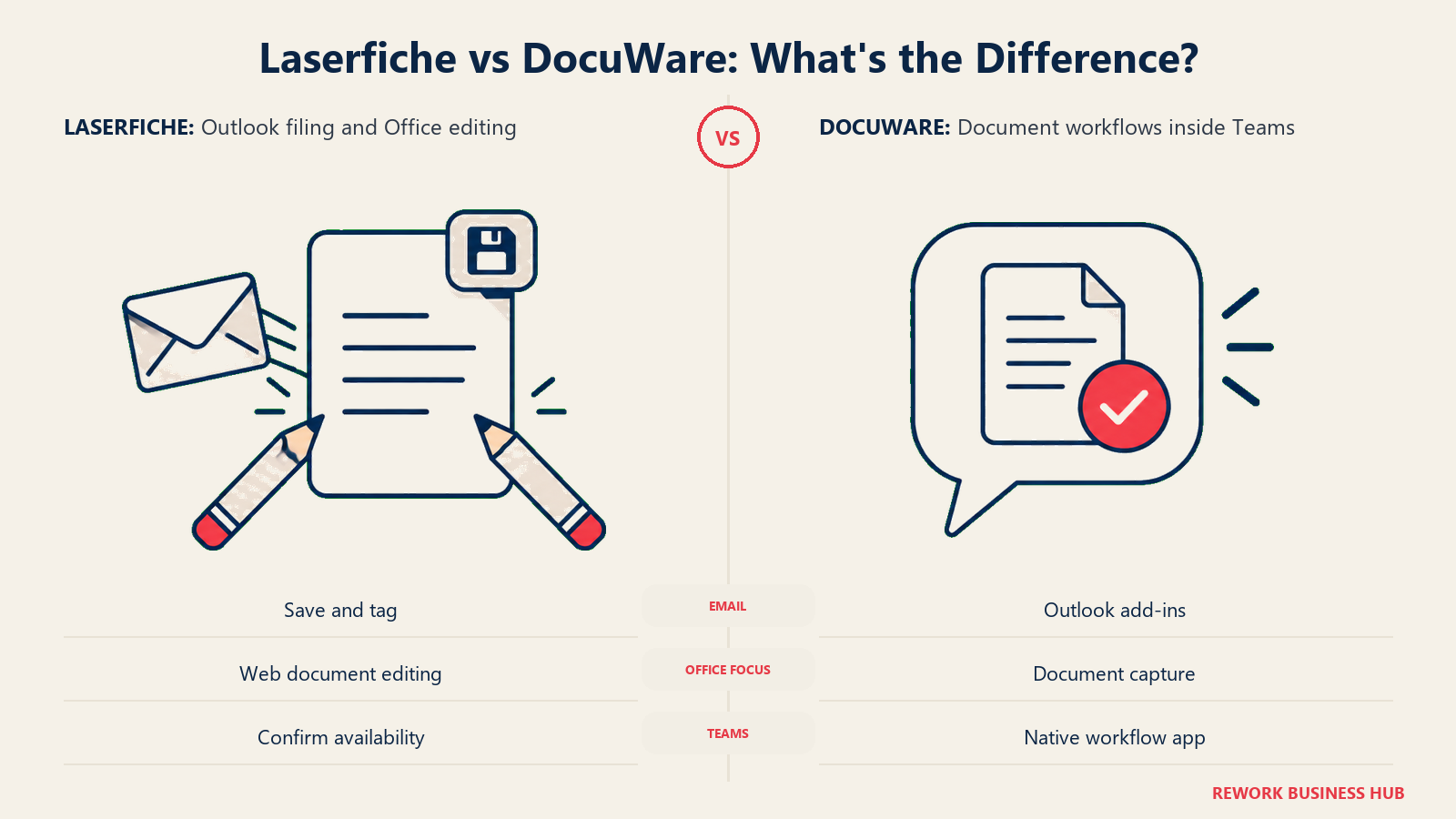
Laserfiche ships an Outlook add-in included for all Cloud customers, with save-on-send functionality to automatically file emails and attachments upon sending, plus metadata tagging directly from Outlook, per Laserfiche's own documentation. It also offers native web-based editing of Office documents directly from the Laserfiche viewer, available out of the box for Office 365 ProPlus and higher, per Laserfiche's integration documentation, with "native Microsoft 365 collaboration" listed as a Professional-tier inclusion. A dedicated, confirmed native Teams app is not among the capabilities the vendor names.
DocuWare ships a Teams app included with every Cloud license: documents shared in a Teams channel get stored centrally in DocuWare, and DocuWare workflows can be viewed and completed directly inside Teams. Outlook integration comes via two add-ins, a desktop MAPI-based one and a newer web-based one that also works on Mac and in browsers.
| Laserfiche | DocuWare | |
|---|---|---|
| Outlook | Add-in included for all Cloud customers; save-on-send filing, metadata tagging from Outlook | Two add-ins: desktop MAPI-based and newer web-based |
| Word/Excel/PowerPoint co-authoring | Native web editing via Office 365 integration, no extra config for ProPlus+ | Not a named strength |
| Teams | Not a confirmed native integration | Native Teams app included with every Cloud license |
| SharePoint | Not a core integration point | Not a core integration point |
| Included at | Professional and up | Every Cloud license |
AI Features and Current Naming
Both companies have shipped named AI layers rather than a generic "AI-powered" bullet, and the usage model behind each is worth understanding before you assume "included" means "unlimited."
Laserfiche's AI runs through Laserfiche AI Agents and AI-powered data extraction and classification, metered by AI Units that scale with the tier: 1,000 per year on Professional, 50,000 per year on Business, 250,000 per year on Business+. API calls scale alongside it, from 50,000 per month on Professional to 500,000 per month on Business+.
DocuWare's AI lives inside Intelligent Document Processing, combining GenAI extraction the company calls zero-shot with the longer-standing Intelligent Indexing engine that learns from historical patterns. It's bundled into the core platform, included on every Cloud plan rather than sold or metered as a separate AI tier.
| Laserfiche | DocuWare | |
|---|---|---|
| Current AI name | Laserfiche AI Agents, AI-powered data extraction and classification | Intelligent Document Processing (IDP), zero-shot GenAI extraction |
| Usage model | Metered in AI Units, scales by tier | Included, no separate usage cap named |
| Entry-tier capacity | 1,000 AI Units/year (Professional) | Full IDP feature set |
| Top-tier capacity | 250,000 AI Units/year, 500,000 API calls/month (Business+) | Same engine, no separate AI tier |
Deployment Options and Data Residency
Neither company has walked away from a non-cloud option, worth confirming directly since it's a common assumption to get wrong as vendors push cloud-first messaging.
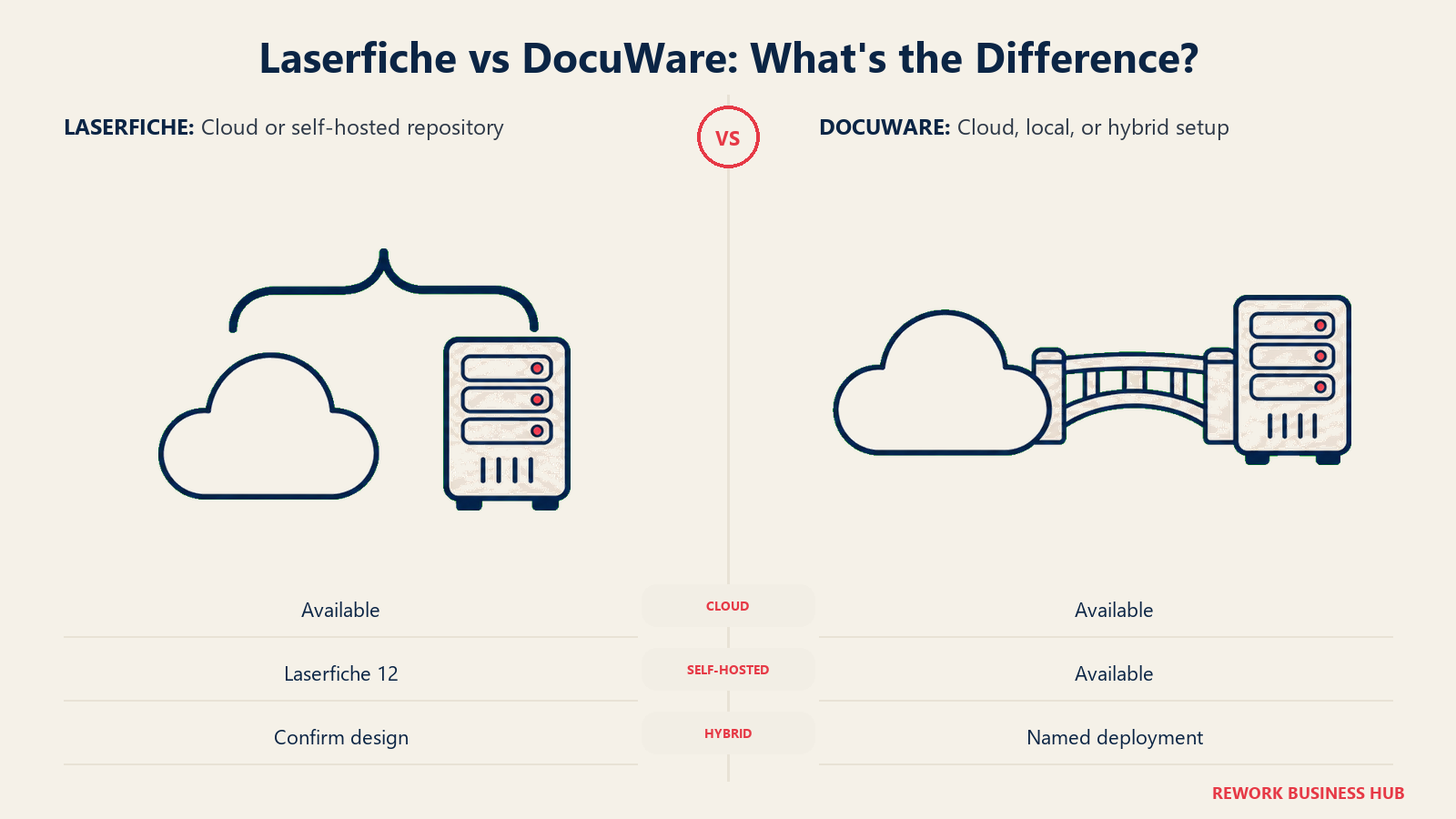
Laserfiche sells three published Cloud tiers, an unpriced Cloud Starter aimed at individuals and small teams, and self-hosted Laserfiche 12 for organizations that need to keep the repository on their own infrastructure. Storage is a per-user allocation, 100GB per user, on Professional and Business, switching to a 30TB per-account pool on Business+.
DocuWare sells Cloud, on-premises, and hybrid deployments side by side. Cloud customers choose a data center region, EU or US, with documents mirrored across data centers in that region plus a backup at a second location, and stored with AES-256 encryption.
| Laserfiche | DocuWare | |
|---|---|---|
| Cloud | Yes, three published tiers (Professional, Business, Business+) plus unpriced Cloud Starter | Yes, DocuWare Cloud |
| Self-hosted | Yes, Laserfiche 12, quote-only | Yes, still actively sold and developed |
| Hybrid | Not marketed as a named deployment option the way DocuWare positions it | Yes, cloud and on-premises together |
| Data residency | Not separately published per tier | Choice of EU or US data center region |
| Storage model | Per-user allocation (100GB/user) on Professional/Business; 30TB per-account pool on Business+ | Not separately published |
Implementation Timeline and Effort
DocuWare markets a fast preconfigured path for a narrow use case; Laserfiche's timeline is shaped more by how much records-governance work happens up front.
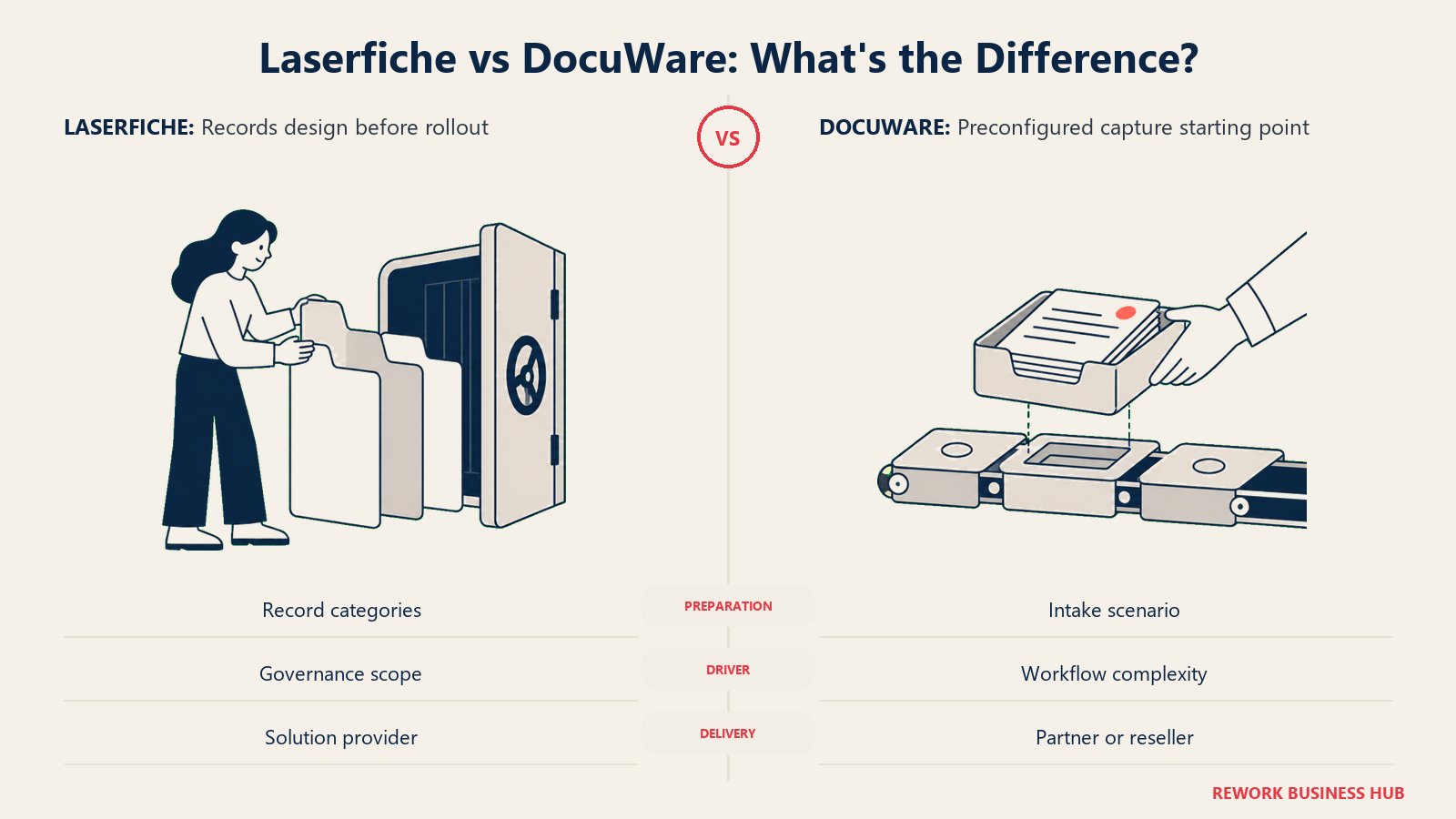
DocuWare offers preconfigured solutions, invoice processing in particular, the company says can deploy in three days or less including user training for a straightforward case. Reported timelines run longer for broader rollouts: a published case study cites an average of eight weeks per country organization across a multi-country deployment, and aggregated reviewer data puts average implementation at roughly three months (reported).
Laserfiche doesn't publish an equivalent standard timeline. In practice, deployments in public sector and healthcare accounts more often run through a Solution-Provider-led scoping process, defining record types, retention schedules, and security or compliance requirements (SOC 2, HIPAA, CJIS) before go-live, work that extends the front end of the timeline but is precisely what the Records Lifecycle Management tier is built to support.
| Laserfiche | DocuWare | |
|---|---|---|
| Vendor-stated fast path | Not published | 3 days or less for preconfigured invoice processing, including training (vendor-stated) |
| Typical driver of timeline | Defining record types, retention schedules, and compliance requirements up front | Document volume and workflow complexity |
| Reported typical rollout | Not separately published; public-sector/compliance scoping often extends the front end | Roughly 8 weeks per site for a multi-country rollout (reported, case study); around 3 months average (reported, aggregated reviewer data) |
| Delivery model | Primarily through Laserfiche Solution Providers | Authorized partners and resellers |
Support and Partner Model
Both vendors route most of the relationship through a channel partner rather than selling and supporting everything direct.
| Laserfiche | DocuWare | |
|---|---|---|
| Primary delivery model | Network of Laserfiche Solution Providers (authorized resellers/integrators) | Authorized partners and resellers |
| Where support SLA detail lives | Not broken out on the public pricing page; typically set with the Solution Provider or Laserfiche directly | Not broken out on the public pricing page; quoted with the deal |
| Professional services | Explicitly excluded from list price ("Pricing excludes professional services and implementation fees") | Not separately itemized on the public FAQ |
| Best fit | Buyers comfortable working through a local integrator for setup and ongoing administration | Buyers comfortable working through a reseller for licensing and rollout |
Pricing Structure: The Real Correction in This Comparison
This is where a lot of comparison content online, including some of our own older pages, gets Laserfiche wrong, so it's worth walking through carefully.
Laserfiche now publishes self-serve pricing on its own pricing page. Three named tiers exist with real dollar figures attached:
| Tier | Price | Minimum | Storage | Notable inclusions |
|---|---|---|---|---|
| Professional | $73/user/month billed annually ($875/user/year) | Starts at 5 users | 100GB per user | 1 repository, 1,000 AI Units/year, 50,000 API calls/month, workflow automation, custom forms, AI Agents, native Microsoft 365 collaboration, SOC 2 Type 2+, HIPAA, ISO 27001 |
| Business | $93/user/month billed annually ($1,115/user/year) | Starts at 25 users | 100GB per user | 3 repositories, 50,000 AI Units/year, 150,000 API calls/month, plus Records Lifecycle Management, SSO/MFA/SCIM, public-facing hosted content portals |
| Business+ | $42/user/month billed annually ($500/user/year) | Starts at 500 users | 30TB per account | 3 repositories, 250,000 AI Units/year, 500,000 API calls/month, plus repository replication, multi-region failover, expanded security monitoring, CJIS requirements and GovRAMP verified starting Q3 2026 |
Cloud Starter and self-hosted Laserfiche 12 remain on the page as named plans with no published price. The page also states plainly that pricing excludes professional services and implementation fees. Business+ is not a stripped-down plan, it's cheaper per seat because it's a 500-seat volume tier: an organization buying past that threshold gets the lowest per-user rate on the page along with the deepest infrastructure resilience, not fewer features.
DocuWare still publishes no dollar pricing. Its main pricing page routes to a demo or reseller request rather than a price list. The only vendor-published detail sits on a regional FAQ page, in GBP:
| DocuWare | |
|---|---|
| Cloud, general range | Roughly £10 to £60 per user per month depending on configuration |
| Named Client Licenses | Slide from about £57 down to £20 per user per month as user count rises |
| Workflow User Licenses | Sold in packs of 5 at £46/month per pack (about £9.20/license), for task-only users who complete forms and read |
| Feature gating by tier | None; every DocuWare Cloud plan includes the complete feature set |
| Storage and users | "Flexibly extended at any time" rather than locked to a fixed plan |
The much-cited "Cloud 4 / Cloud 15 / Cloud 40 / Cloud 100" tier names circulate on reseller sites, but couldn't be confirmed on a current DocuWare-owned page, so treat that naming as reported, not vendor-confirmed. No USD figure should be attached to DocuWare; converting the GBP range would imply a precision the vendor itself hasn't published.
| Laserfiche | DocuWare | |
|---|---|---|
| Published price list | Yes, three tiers with real dollar figures | None on the main pricing page |
| Entry-tier price | $73/user/mo billed annually, 5-user minimum | Not published; regional FAQ cites roughly £10-£60/user/mo |
| Volume tier | Business+ at $42/user/mo, 500-user minimum, cheaper per seat by design | Named Client Licenses slide toward £20/user/mo as user count rises |
| Task-only/limited license | Not published as a separate tier | Workflow User Licenses, packs of 5 at £46/mo/pack |
| Feature gating by tier | Yes, AI Units, API calls, repositories, RLM, and SSO/MFA/SCIM scale by tier | No, full feature set on every Cloud plan |
| Fees excluded from list price | Professional services and implementation | Not separately stated |
Cost at 50, 250, and 1,000 Seats
Laserfiche's published rates let you do real math. DocuWare's don't, and it would be dishonest to pretend otherwise.
| Seats | Laserfiche | DocuWare |
|---|---|---|
| 50 | Professional: 50 x $73 x 12 = $43,800/year. If SSO/MFA/SCIM or Records Lifecycle Management is needed, Business: 50 x $93 x 12 = $55,800/year | Quote-only. Vendor-published range: roughly £10-£60/user/month |
| 250 | Business: 250 x $93 x 12 = $279,000/year (most organizations at this size want SSO/SCIM and RLM); Professional-only alternative: 250 x $73 x 12 = $219,000/year | Quote-only. Named Client Licenses slide lower per seat as user count rises, but no fixed total is published |
| 1,000 | Business+: 1,000 x $42 x 12 = $504,000/year, crossing the 500-user minimum and landing far cheaper per seat than staying on Business, which would run 1,000 x $93 x 12 = $1,116,000/year | Quote-only. No vendor-published total exists at this scale |
DocuWare's own FAQ describes storage and user counts as flexibly extended rather than fixed to a plan, which is exactly why a responsible seat-count table can't put a dollar figure next to it. Get a DocuWare quote against your real named-user count and document volume before comparing it to Laserfiche's published rate; a Laserfiche quote at any of these seat counts should land close to the math above, plus whatever professional services and implementation work your rollout needs, since the published price explicitly excludes both.
When Laserfiche Is the Right Call
- Your organization gets formally audited on records retention: a public records request, a litigation hold, or a compliance review that requires proving a document was kept for the right number of years and disposed of correctly
- You operate in local or state government, courts, K-12/higher ed, or healthcare, industries where Laserfiche's pedigree and Records Lifecycle Management are built specifically for your governance model
- You want published, self-serve pricing you can budget against today rather than starting every conversation with a sales call
- CJIS or GovRAMP-adjacent security requirements are on your roadmap, and you're comfortable with GovRAMP verification landing on Business+ starting Q3 2026 rather than being available now
- You'd rather work with a Solution Provider who scopes record types and retention schedules up front than move fast with a preconfigured template
If Laserfiche's fit is close but not quite right, see our best Laserfiche alternatives roundup or the three-way Egnyte vs Laserfiche vs OpenText Content Cloud comparison.
When DocuWare Is the Right Call
- High-volume, repeatable document intake (invoices, POs, HR files) is the daily pain, and AP or back-office processing time is the metric you're trying to move
- You want a business user, not IT, building and adjusting workflow routing on a drag-and-drop canvas without a ticket
- You'd rather every plan ship the full feature set than negotiate which module is included at which tier
- You need on-premises or hybrid with active, ongoing feature investment, not a cloud-only roadmap
- Native Teams integration matters more to your rollout than deep records-classification tooling
If DocuWare's fit is close but not quite right, see our best DocuWare alternatives roundup, or the related head-to-head against a more metadata-first platform in DocuWare vs M-Files.
If Neither Fits: Documents Living on the Same Record as the Customer and the Deal
Worth naming honestly: Laserfiche and DocuWare are both built for teams whose records governance, capture volume, or compliance requirements deserve a dedicated platform. If formal records retention is the whole job, or capture volume is genuinely high, neither is a category to replace with a bundled feature elsewhere.
But if the real frustration is smaller than that, official documents and records sitting apart from the CRM record, the deal, or the project they actually belong to, that's a different shape of problem. Rework's E-Office module keeps official documents and records on the same platform as the CRM, projects, contracts, tasks, and the People app, so a document sits on the same record as the customer, deal, or process it belongs to, instead of living in a separate system you cross-reference by hand. It is not a substitute for either platform here if formal records retention, regulated quality management, or high-volume capture is the whole job, and that specialization isn't something to give up for a bundled feature. But if documents are one part of a broader operations record you'd rather keep unified, it's worth a look. Rework's E-Office module is not publicly priced; pricing is quoted per organization, see rework.com/pricing for current details.
Decision Framework
Start with the operating problem your team must solve, then choose the platform whose native model fits it.
| If you are... | Pick |
|---|---|
| Formally audited on records retention, in government, courts, education, or healthcare | Laserfiche |
| Drowning in manual invoice or form data entry and want fast AP automation | DocuWare |
| Budgeting today and want published, self-serve pricing instead of starting with a sales call | Laserfiche |
| Running high document volume through a repeatable, business-user-buildable workflow | DocuWare |
| Needing on-premises with active feature investment alongside cloud | DocuWare, though Laserfiche 12 remains a quote-only self-hosted option |
| Scaling past 500 seats and want the lowest published per-seat rate with the deepest infrastructure resilience | Laserfiche (Business+) |
| Looking for documents to live on the same record as the customer and the deal, not a standalone DMS | Rework (see rework.com/pricing) |
| Comparing more of the category before narrowing down | See our full document management software roundup |
The verdict: if the pain is proving compliant records retention, especially in government, education, or healthcare, Laserfiche's records-classification model and now-published pricing make it the more straightforward starting point. If the pain is capture volume and getting documents routed and approved fast, especially in AP, DocuWare's capture-first design and included-everywhere feature set is the more direct fix. These are genuinely different first problems, not two flavors of the same thing, and the pricing transparency gap between them, real today, is itself a reason to get a DocuWare quote early rather than assume it will land near Laserfiche's published numbers.
What to Do Next
- Name your actual pain before you name a vendor. "We get audited on how long we kept this" is Laserfiche-shaped. "We key in too much data by hand" is DocuWare-shaped.
- Price Laserfiche yourself first. At $73-$93/user/month billed annually, with real seat minimums (5 for Professional, 25 for Business, 500 for Business+), you can build a defensible budget number before a single sales call.
- Ask DocuWare for a quote against your real named-user count and document volume, and confirm in writing that Workflow Manager, Intelligent Indexing, and Forms are included at the plan you're quoted, not add-ons.
- Confirm which Laserfiche tier includes Records Lifecycle Management if compliance is the driver; it's a Business-tier feature, not included on Professional.
- If you're not sure a dedicated DMS is the right category yet, see our best document management software roundup, or the two shortlists: best Laserfiche alternatives and best DocuWare alternatives.
Frequently Asked Questions about Laserfiche vs DocuWare
Is Laserfiche or DocuWare cheaper?
Laserfiche is the more transparent of the two as of this update: it publishes self-serve rates of $73-$93 per user per month billed annually, with a $42 per user per month volume tier past 500 users. DocuWare publishes no dollar pricing on its main page; the only vendor-published detail is a regional FAQ citing roughly £10 to £60 per user per month depending on configuration. Get a DocuWare quote against your real user count and document volume before assuming it lands near Laserfiche's published numbers.
Does Laserfiche still not publish pricing?
That's outdated. As of this update, Laserfiche's own pricing page lists three named Cloud tiers with real dollar figures: Professional at $73/user/month, Business at $93/user/month, and Business+ at $42/user/month for deployments past 500 users. Cloud Starter and self-hosted Laserfiche 12 remain quote-only.
What is Laserfiche Business+, and is it a downgrade from Business?
No. Business+ requires a 500-user minimum and is priced lower per seat, $42/user/month versus $93 on Business, because it's a volume tier, not a stripped-down plan. It adds repository replication, multi-region failover, expanded security monitoring, and CJIS requirements with GovRAMP verification starting Q3 2026.
Which platform is better for regulated, audit-heavy compliance?
Laserfiche, for organizations that need formal records retention and disposition proof. Records Lifecycle Management ships from the Business tier up, and Laserfiche's pedigree in government, courts, education, and healthcare reflects that focus. DocuWare covers HIPAA, SOX, GDPR, and NIST-aligned controls well but doesn't market the same records-classification depth.
Which platform is better for high-volume invoice or AP processing?
DocuWare. Its Intelligent Document Processing module and dedicated e-invoicing automation are purpose-built for high-volume capture, and the full feature set ships on every Cloud plan. Laserfiche's AI-powered extraction is real but metered in AI Units per year and isn't marketed as a dedicated AP product.
Related Resources:
- Best Document Management Software in 2026
- Best Laserfiche Alternatives in 2026
- Best DocuWare Alternatives in 2026
- Best M-Files Alternatives in 2026
- Best SharePoint Alternatives in 2026
- Best Egnyte Alternatives in 2026
- DocuWare vs M-Files
- Egnyte vs Laserfiche vs OpenText Content Cloud
- What Is Process Documentation?
- ISO 9001: A Practical Guide

Principal Product Marketing Strategist
On this page
- TL;DR
- Who Each Platform Is Actually Built For
- Key Facts
- The Underlying Model: Records Classification vs File Cabinets and Capture
- Capture, OCR, and Intelligent Document Processing Depth
- Records Retention, Compliance, and Audit Depth
- Workflow, Forms, and Business Process Automation
- Microsoft 365 and Teams Integration
- AI Features and Current Naming
- Deployment Options and Data Residency
- Implementation Timeline and Effort
- Support and Partner Model
- Pricing Structure: The Real Correction in This Comparison
- Cost at 50, 250, and 1,000 Seats
- When Laserfiche Is the Right Call
- When DocuWare Is the Right Call
- If Neither Fits: Documents Living on the Same Record as the Customer and the Deal
- Decision Framework
- What to Do Next