Egnyte vs Laserfiche vs OpenText Content Cloud: Which Document Management Platform Actually Fits Your Company in 2026?
Turn this article into takeaways for your work.


Each assistant summarizes the article only for you and suggests best practices for your work.
These three get found under the same search term, "document management software," and almost nothing else about them is the same. Egnyte is a hybrid content platform built to keep files where they already sit, on a local file server or in the cloud, while layering governance, classification, and access control on top. Laserfiche is a records and process platform: the product you buy when the real requirement is a retention schedule, a legal hold, and an audit trail that survives an external audit, not just somewhere to park PDFs. OpenText Content Cloud is an enterprise information-management estate, built to sit underneath SAP, Salesforce, and Microsoft 365 across an entire multinational organization, priced and implemented like the enterprise software it is.
If you're an IT director, records manager, compliance officer, or COO evaluating this trio for 2026, the fastest way to a wrong decision is comparing them on features. Compare them on the actual reason each one exists instead: data control over a hybrid file estate, retention and process discipline in a regulated back office, or governed content spanning a genuinely large, multi-system enterprise. Here's the honest breakdown, with real pricing structure where each vendor publishes one, and a plain "(reported)" label wherever a number comes from a third party rather than the vendor itself.
TL;DR
| Egnyte | Laserfiche | OpenText Content Cloud | |
|---|---|---|---|
| What it actually is | Hybrid content platform: on-prem and cloud storage with governance layered on top | Records- and process-first: retention schedules, legal hold, and workflow built around every document | Enterprise information-management estate spanning SAP, Salesforce, and Microsoft 365 |
| Natural buyer | IT/ops lead at a regulated mid-market firm with an existing on-prem file estate | Records manager, compliance officer, or IT director at a government, education, or financial-services org | Enterprise ECM admin at a 1,000-plus employee, often multinational, organization |
| Company size sweet spot | Roughly 100 to 2,000 employees | Any size, if formally audited on records retention | Roughly 1,000 to 50,000-plus employees |
| Deployment | Cloud, on-premises, and hybrid, with published data residency in several regions | Cloud (AWS-hosted) or self-hosted (Rio, Avante) | Cloud-native on Azure, on-premises, or hybrid |
| Pricing | Published: $22 to $48/user/month, tiered by governance depth | Published: $73 to $93/user/month Cloud, plus a $42 volume tier from 500 users | Quote-only; named Express (X1) and Premium (X2) tiers, no published dollar figures |
| Strongest at | Governance and data control across a hybrid file estate, especially construction, life sciences, professional services | Retention schedules, legal hold, and workflow automation for regulated back offices | Deep SAP/Microsoft integration and jurisdiction-spanning compliance (DoD 5015.2, FedRAMP, GxP) |
| Wrong fit for | A team that just needs shared-drive-style storage with no compliance mandate | A team with no formal records-retention requirement | Anyone below roughly 1,000 employees, or without a dedicated ECM admin function |
What Each Platform Is Actually Built For
All three call themselves document management software. Only one of them is actually trying to replace your file server.
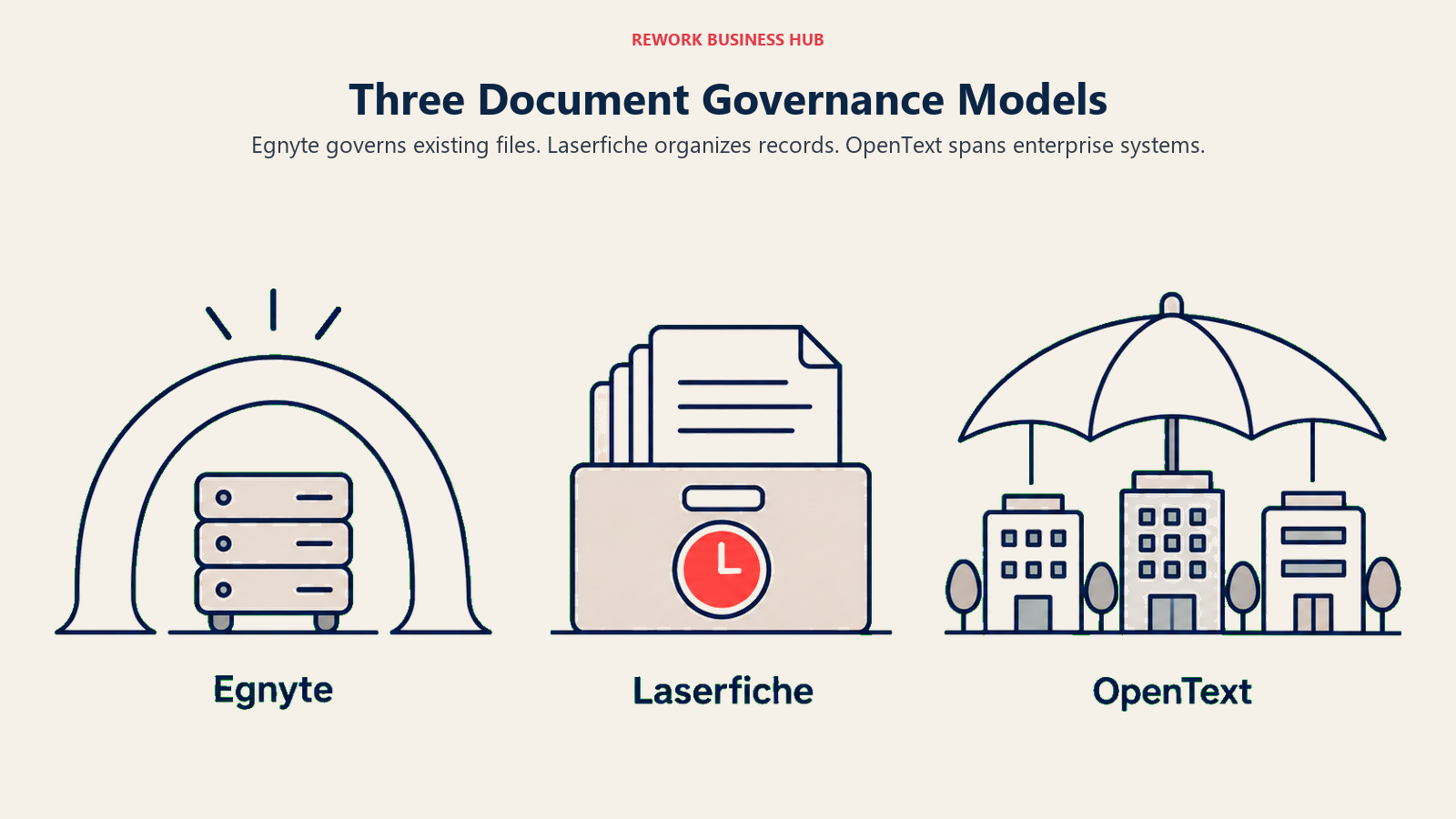
Egnyte's core bet is that most mid-market companies don't want to move a decade of files off their existing storage just to get governance. Its hybrid architecture connects to on-premises file servers and NAS devices as easily as it connects to cloud storage, indexing, classifying, and governing content wherever it physically lives. That's a genuinely different starting point from a pure cloud-storage vendor, which assumes everything moves into its silo. Egnyte's strongest, most repeated case is in construction, life sciences, and professional services: industries with real regulatory exposure (GDPR, financial and clinical data handling) and, often, an existing on-premises estate (CAD files, point clouds, lab data) nobody wants to fully migrate.
Laserfiche's product isn't really storage. It's the workflow and records management layer wrapped around storage: retention schedules that apply automatically by record type, legal holds that survive litigation, and business process automation that moves a document through defined states instead of just filing it. Laserfiche has sold into government, education, and financial services since 1987, and that heritage shows. The platform assumes an organization needs to prove, on demand, how long a record was kept, who could see it, and why it was eventually destroyed.
OpenText Content Cloud is a different order of scale entirely. Built on the Documentum and Extended ECM lineages OpenText has consolidated over the past decade (including additional records-management technology folded in through its 2023 acquisition of Micro Focus), it's designed to be the one governed content layer sitting underneath SAP, Salesforce, Microsoft Dynamics 365, and Microsoft 365 at once, enforcing retention and access policy centrally across all of them. That depth is real, and so is the price and implementation lift that comes with it.
If what you actually need is metadata-first document retrieval without folders, or workflow automation built specifically around invoice and form processing, that's a different pair of tools entirely. See DocuWare vs M-Files for that comparison.
| Egnyte | Laserfiche | OpenText Content Cloud | |
|---|---|---|---|
| Core organizing idea | Governance and access control layered onto files wherever they live | Retention schedules and workflow states applied to every record, by type | One governed content layer spanning multiple enterprise systems at once |
| Natural buying trigger | An existing file estate with real compliance exposure and no appetite for a full migration | An audit, a records-retention mandate, or an inconsistent legal-hold process | A multi-entity enterprise needing content governance enforced across SAP, Salesforce, and M365 together |
| Primary champion | IT director or COO at a regulated mid-market firm | Records manager, compliance officer, or quality manager | Enterprise ECM admin, usually reporting into IT or legal |
| Where it shows up most | Construction, life sciences, professional services, financial services | Government, education, healthcare, financial services | Large regulated enterprises: pharma, financial services, government, manufacturing |
| What it's not trying to be | A records-retention specialist or a multi-system enterprise estate | A hybrid on-prem file bridge or a multi-system enterprise estate | A quick, low-admin deployment for a mid-market team |
Before You Compare Features: Is This Even the Right Category?
Be blunt here: none of these three is a rational buy for a team whose real problem is "we have a shared drive and nobody can find anything." That's true even though Egnyte's entry pricing looks approachable next to Laserfiche or OpenText.
If your company runs roughly 80 to 150 people, has no formal records-retention mandate (you're not in government, healthcare, financial services, or life sciences, and nobody has ever demanded a legal hold from you), and the actual pain is finding the current version of a file, you're on the wrong page. Egnyte's entry tier is priced within reach, but you'd be paying for governance machinery (classification policies, legal hold, content lifecycle rules) you don't need yet. Laserfiche and OpenText aren't built for you at all; their entire product logic assumes a records-management function that a team this size and this unregulated usually doesn't have.
| Your situation | Right category |
|---|---|
| Shared drive chaos, no compliance mandate, under roughly 150 employees | See our SharePoint alternatives or Box alternatives roundups |
| Regulated mid-market firm with an existing on-prem file estate you don't want to fully migrate | Egnyte |
| Formal records-retention mandate (government, education, healthcare, financial services), any company size | Laserfiche |
| Multinational enterprise (1,000-plus employees) running SAP, Salesforce, and Microsoft 365 together | OpenText Content Cloud |
| Workflow and approval automation is the real gap, not storage or retention | See Best Workflow Automation Software |
| Contract negotiation and renewal is the actual bottleneck | See Best Contract Management Software |
Key Facts
- Employees spend an average of 1.8 hours a day, roughly 20 percent of the workweek, searching for and gathering information rather than doing the work itself, according to McKinsey's research on the social economy.
- 54 percent of critical business content still lives outside a formal content management system, according to AIIM.
- The global document management system market is valued at $9.74 billion in 2026 and is projected to reach $29.78 billion by 2034, a 15 percent CAGR, according to Fortune Business Insights.
- Laserfiche was named a Leader in the 2026 Gartner Magic Quadrant for Document Management, its second consecutive year in that position, per Laserfiche's own announcement.
- The global average cost of a data breach was $4.44 million in 2025, a reminder that who can access which document matters as much as where it's stored, according to IBM.
Decision by Business Goal
| Your goal | Best fit |
|---|---|
| Stop paying to migrate files every time you change document tools | Egnyte (hybrid architecture keeps content where it already lives) |
| Prove to an auditor exactly how long a record was kept and who saw it | Laserfiche |
| Get board-ready governance across every business unit without a patchwork of tools | OpenText Content Cloud |
| Get ransomware and suspicious-login detection built into the document layer, not bolted on | Egnyte |
| Make documents trigger the next workflow step automatically, not just sit in a folder | Laserfiche |
| Get one content layer that SAP, Salesforce, and Microsoft 365 all read from | OpenText Content Cloud |
| Scale from 100 to 1,000 employees without re-platforming the document layer | Egnyte, up to its storage-pricing ceiling; Laserfiche or OpenText past that |
Team and Role Fit
| Team/role | Egnyte | Laserfiche | OpenText Content Cloud |
|---|---|---|---|
| IT/systems administration | Manages hybrid sync, storage tiers, and classification policies | Manages the Admin Console: retention schedules, workflows, security | Owns a genuinely enterprise-scale ECM admin function, usually a dedicated role |
| Compliance/records management | Content classification (PCI-DSS, GDPR templates) and legal hold | The platform's primary reason to exist: retention schedules, disposition, audit trail | Deepest bench: DoD 5015.2, FedRAMP, GxP-aligned records governance |
| Operations/project teams | Day-to-day file access across on-prem and cloud, light retraining if migrating from a file server | Adopts a new records/workflow model, a real onboarding curve | Works mostly through SAP, Salesforce, or M365, rarely touches OpenText directly |
| Legal | Legal hold on classified content | Legal hold plus an immutable, timestamped audit trail | Legal hold on Microsoft 365 content without moving it; supports 1,000-plus retention schedules |
| Executive/board reporting | Governance dashboards scoped to a single mid-market org | Audit-ready reporting for a single regulated entity | Governance reporting across many business units and jurisdictions at once |
Migrating an Existing File Estate With Permissions Intact
This is where the three genuinely diverge, and it's exactly the part a demo skips.
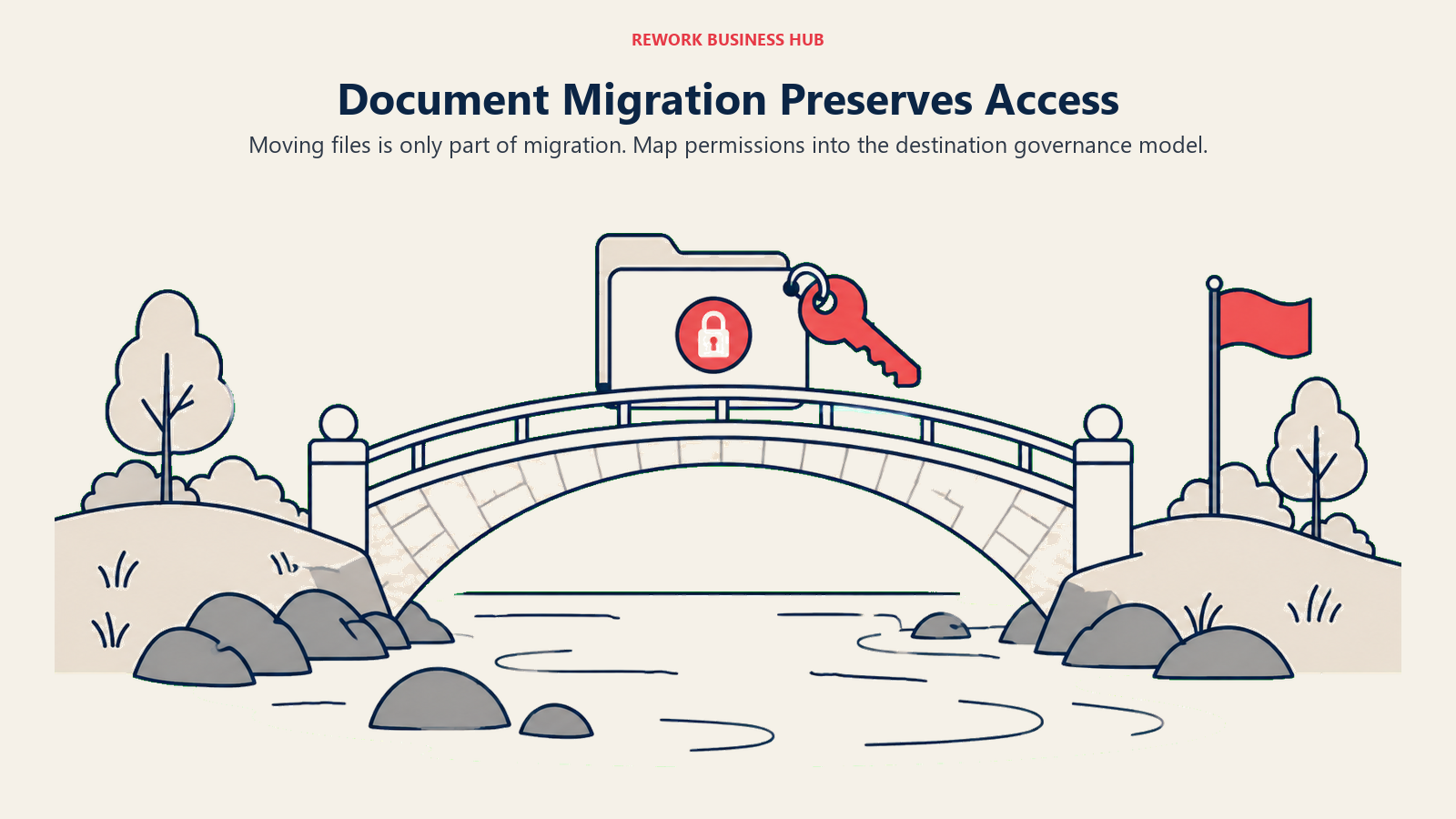
Egnyte is built around not doing a full migration at all. Its hybrid connectors attach to existing file servers and NAS storage directly, so content can stay physically where it is while Egnyte layers indexing, classification, and access governance on top. That's the actual pitch: less "move everything into a new silo," more "govern what you already have." Existing permission structures still need to be reconciled into Egnyte's own access model, and that reconciliation is real work, but it's incremental rather than a rip-and-replace.
Laserfiche takes the opposite approach by design. Because the whole value of the platform is its retention-schedule and workflow model, documents get imported into Laserfiche's own structure, record series, metadata templates, and security rights, rather than inheriting a source system's folder tree and permissions automatically. That's more implementation work up front, and it's also why a completed Laserfiche migration tends to be more thoroughly governed afterward than a straight lift-and-shift would be.
OpenText carries the highest migration complexity of the three, almost by definition. A Content Cloud deployment spanning SAP, Salesforce, and Microsoft 365 has to reconcile permission models across every one of those source systems into one governed layer, which is precisely why OpenText implementations lean on a systems-integrator engagement rather than a self-service import tool.
| Egnyte | Laserfiche | OpenText Content Cloud | |
|---|---|---|---|
| Migration approach | Connect to existing storage in place; minimal wholesale data movement | Import into Laserfiche's own record-series and metadata model | Multi-system content and permission reconciliation across SAP, Salesforce, M365 |
| Permissions | Reconciled into Egnyte's access model during connection | Rebuilt in Laserfiche's own rights and marksets model | Mapped and unified across every connected source system |
| Typical delivery | Self-serve to partner-assisted | Partner-assisted for real records structures | Systems-integrator-led, almost always |
| Best case | An on-prem estate you want governed, not moved | A folder structure you're willing to replace with something more disciplined | A genuinely multi-system permission model that needs one source of truth |
Search That Actually Works: OCR and Scanned Documents
A DMS that can't find text inside a scanned PDF is just an expensive folder. All three claim OCR. The depth differs.
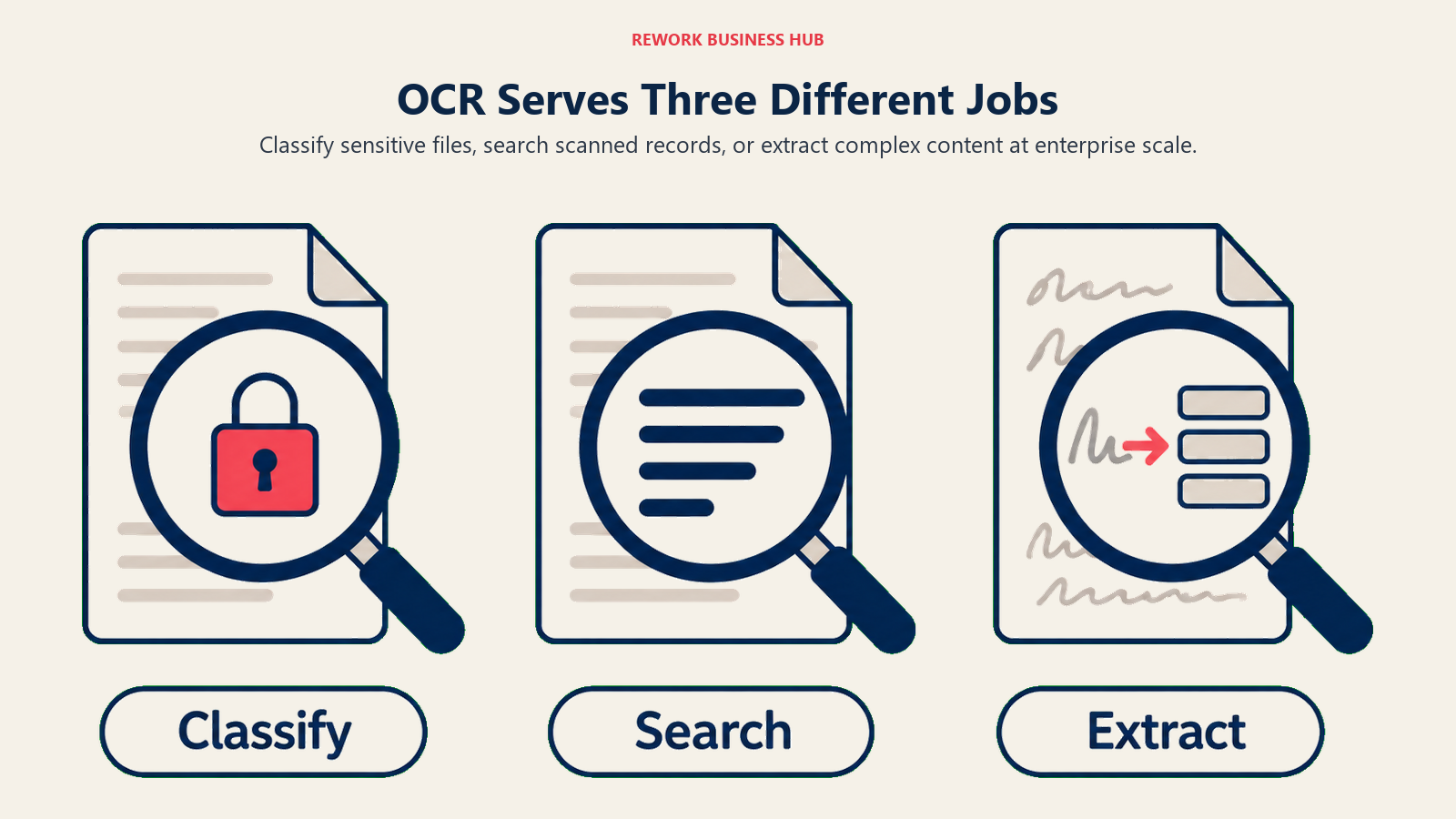
Egnyte's OCR runs through its Secure & Govern module, and it's built for classification more than for full-text retrieval: it extracts text from images, scanned pages, and PDFs specifically to identify sensitive-content types (PCI, GDPR-covered personal data) and apply the right policy automatically, per Egnyte's own OCR page. That's real OCR, but the job it's doing is figuring out what kind of document this is and what policy applies, not primarily letting you search inside every scanned page.
Laserfiche's capture stack is the most search-native of the three. Intelligent indexing and OCR convert scanned images into full-text-searchable content as a core, expected part of the platform, alongside barcode recognition for high-volume scanning, so a decade of scanned paper records genuinely becomes searchable, not just stored.
OpenText's capture depth is the deepest, and it's also the one sold as its own product: Intelligent Capture, covering 120-plus languages and locales, combines standard OCR with machine-learning extraction. Its separately licensed Advanced Cloud OCR add-on specifically improves accuracy on handwriting, cursive text, and documents photographed on a phone, not just clean scans. That power comes at a real cost: it's licensed and configured as an addition to Content Cloud, not a feature every deployment gets by default.
| Egnyte | Laserfiche | OpenText Content Cloud | |
|---|---|---|---|
| OCR purpose | Classification and policy application on scanned/image content | Full-text searchability of scanned documents, core to the platform | Enterprise-grade capture, including handwriting and low-quality scans |
| Included or add-on | Included as part of Secure & Govern | Included, part of Intelligent Data Capture | Intelligent Capture is a separately licensed product |
| Language/locale depth | Not separately published | Not separately published | 120-plus languages and locales (vendor-stated) |
| Best fit | Knowing what a scanned document is and applying policy | Searching a large volume of scanned paper records by content | High-volume, multi-language, or handwriting-heavy capture at enterprise scale |
Records Retention and Legal Hold
This is the section that separates a DMS from a records system, and it's where Laserfiche and OpenText pull well ahead of Egnyte, by design.
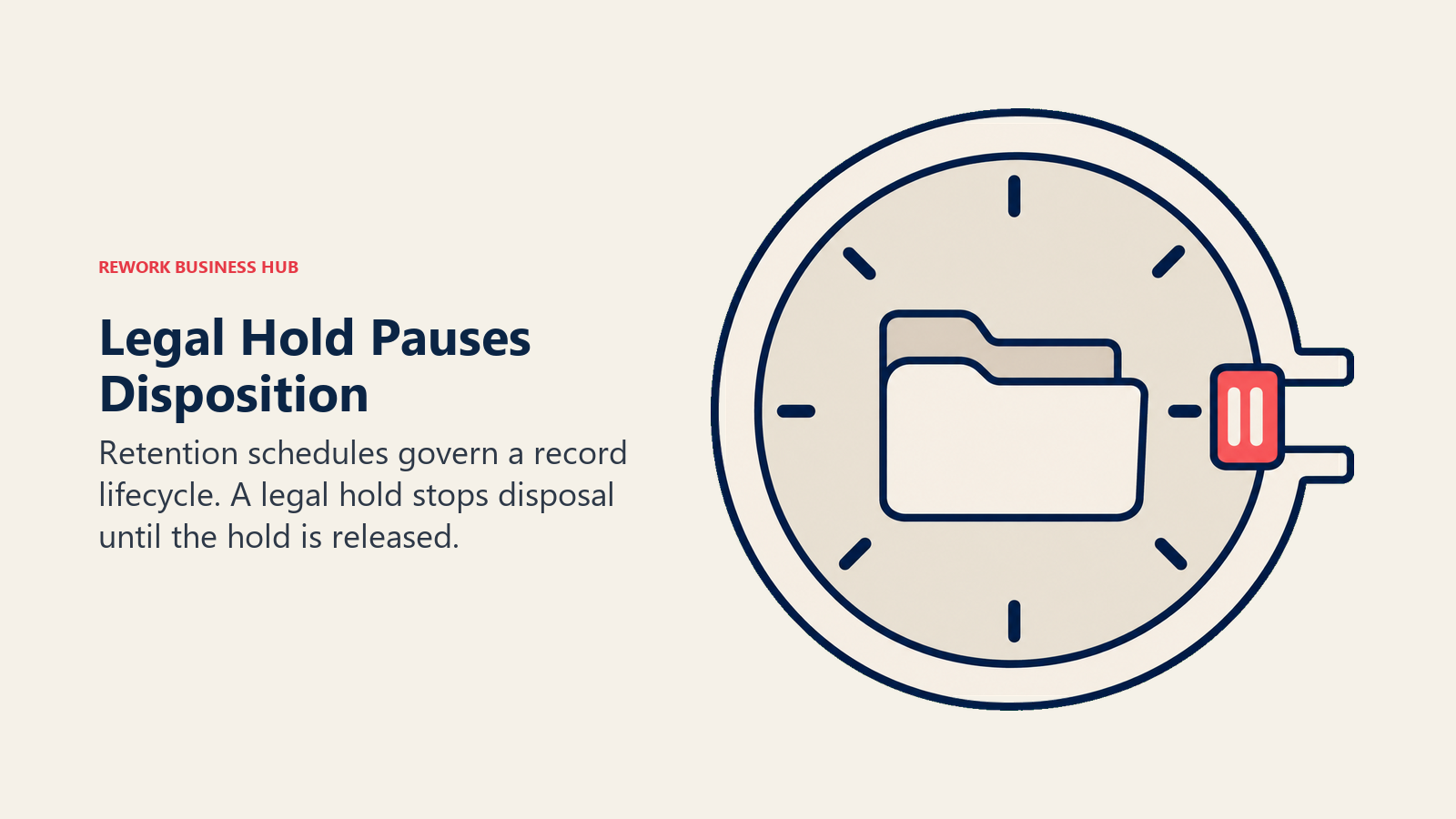
Egnyte supports retention policies (preventing deletion or purging for a defined period, based on file location or classification) and legal holds that lock down classified content for the duration of a matter. That's real governance, and it's enough for a mid-market firm's general compliance needs, but it isn't a dedicated records-management discipline the way the other two are.
Laserfiche treats records management as its core identity, not a feature. Retention schedules are defined per record series in the Admin Console and applied automatically as records move through defined lifecycle stages, active, then retention, then disposition, with legal holds pausing that process and immutable, timestamped audit trails documenting every step for an external auditor.
OpenText goes furthest into formal, certified records management. Its records-management line carries DoD 5015.2 certification (the US government's own standard for electronic records-management software), supports more than 1,000 retention schedules, and can place Microsoft 365 content on legal hold without moving it out of Teams, Outlook, or SharePoint. Additional certifications, FedRAMP, Protected B (Canadian government), IRAP (Australian government), and GxP (life sciences), extend that depth into specific regulatory jurisdictions Laserfiche doesn't specifically target.
Pair whichever platform survives this framework against your own documented retention policy, not a vendor default; our standard operating procedure guide covers how to write that policy before you configure a single schedule. Quality-driven teams should also see our ISO 9001 guide if formal quality-management documentation, not just general records retention, is the actual requirement.
| Egnyte | Laserfiche | OpenText Content Cloud | |
|---|---|---|---|
| Retention model | Policy-based, by location or classification | Formal retention schedules by record series, lifecycle-staged | 1,000-plus retention schedules, aligned to national archive standards |
| Legal hold | Yes, on classified content | Yes, pauses the retention lifecycle | Yes, including on M365 content without moving it |
| Named certifications | GDPR-focused compliance tooling | Deep public-sector and regulated-industry track record, no single named certification standing out | DoD 5015.2, FedRAMP, Protected B, IRAP, GxP |
| Audit trail | Standard activity logging | Immutable, timestamped, built for external audit | Enterprise-grade, spanning every connected system |
| Best fit | General compliance for a regulated mid-market firm | An organization formally audited on retention and disposition | Multi-jurisdiction regulatory requirements at enterprise scale |
Deployment: On-Prem vs Cloud, and Data Residency
Cloud-only claims don't survive contact with any of these three. All three still sell on-premises or self-hosted deployment, worth confirming directly since it's an easy assumption to get wrong.
Egnyte sells cloud, on-premises, and hybrid side by side, and hybrid is arguably its actual product, not just an option. On data residency, Egnyte publishes real regional choices: a dedicated EU data center where customer data doesn't leave the EU, a US-hosted option with configurable storage tenants in Canada or Australia, and expanded regional infrastructure covering the UAE, Saudi Arabia, and Qatar. It also supports customer-chosen third-party object stores (AWS, Azure, Google Cloud) for teams that want to control the underlying storage layer directly. That's a genuinely broad data-residency story for a company this size.
Laserfiche offers Laserfiche Cloud, hosted on AWS, or self-hosted deployment through two editions: Rio, the full platform with unlimited database licenses, built for large organizations, and Avante, a leaner edition licensed per server, for smaller deployments. Laserfiche doesn't publish specific customer-selectable regional data-residency options for Cloud the way Egnyte does. A buyer with a hard data-residency requirement should confirm the current regional hosting options directly with Laserfiche rather than assume a default region applies.
OpenText sells cloud-native deployment on Microsoft Azure (pitched explicitly as a way to convert existing on-premises maintenance spend into cloud consumption), traditional on-premises given the Documentum and Extended ECM lineage this runs on, and hybrid. As a global enterprise vendor with a large existing Azure and data-center footprint, regional deployment is realistically available, but specific regions and residency terms are a quote-and-contract conversation, not a published self-serve menu, consistent with the rest of its pricing and packaging.
| Egnyte | Laserfiche | OpenText Content Cloud | |
|---|---|---|---|
| Cloud | Yes | Yes, Laserfiche Cloud (AWS) | Yes, cloud-native on Azure |
| On-premises | Yes, actively sold | Yes, Rio (large org) or Avante (smaller, single-server) | Yes, Documentum/Extended ECM lineage |
| Hybrid | Yes, arguably the core product | Not a named hybrid product; choose cloud or self-hosted | Yes |
| Published regional data residency | EU and US, with Canada, Australia, UAE, Saudi Arabia, and Qatar options | Not published; confirm directly | Not published; contract-negotiated |
| Third-party object store support | Yes: AWS, Azure, Google Cloud | Not published | Not applicable (Azure-native) |
Pricing at 50, 250, and 1,000 Users
None of the three hands over a full rate card, and the ranking changes meaningfully with scale, which is the most useful thing this section can show you.
Egnyte publishes real numbers. Business runs $22/user/month (annual), but it caps out at 100 users, so it only covers the low end of this range. Enterprise Lite ($39/user/month) and Elite ($48/user/month, Egnyte's "most popular" tier, adding AI Assistant, AI Search, AI Workflow, and e-signature) both remove the user cap, per Egnyte's own pricing page. The catch that doesn't show up in a demo: storage stays capped at 100GB (Business) or 150GB (every tier above it), pooled across the whole organization, regardless of whether you have 50 users or 1,000. Egnyte doesn't publish an overage rate; expect a negotiated number once you're past the included allocation, which, at real document volumes, most Enterprise Lite and Elite accounts will be. If e-signature alone is the gap you're filling, see Best E-Signature Software for a narrower comparison before paying for a full governance tier.
| Users | Tier | List price | Approx. annual cost |
|---|---|---|---|
| 50 | Business (fits under the 100-user cap) | $22/user/month | $13,200/year, before any storage overage |
| 50 | Enterprise Lite, if governance features are required | $39/user/month | $23,400/year |
| 250 | Enterprise Lite (Business's 100-user cap is exceeded) | $39/user/month | $117,000/year |
| 250 | Elite | $48/user/month | $144,000/year |
| 1,000 | Enterprise Lite | $39/user/month | $468,000/year |
| 1,000 | Elite | $48/user/month | $576,000/year |
Storage overage isn't included in any figure above, and Egnyte's own pricing page notes multi-year discounts are available without stating the discount schedule. Treat this table as a ceiling to negotiate against, not a final quote.
Laserfiche publishes its cloud pricing across three named tiers, each with a seat minimum that matters as much as the rate: Professional at $73/user/month billed annually starting at 5 users, Business at $93/user/month billed annually starting at 25 users, and Business+ at $42/user/month billed annually starting at 500 users. Cloud Starter and self-hosted Laserfiche 12 carry no published price, and the page states that pricing excludes professional services and implementation fees. (Laserfiche)
| Users | Tier | Published price | Approx. annual cost |
|---|---|---|---|
| 50 | Professional | $73/user/month | $43,800/year |
| 50 | Business | $93/user/month | $55,800/year |
| 250 | Professional | $73/user/month | $219,000/year |
| 250 | Business | $93/user/month | $279,000/year |
| 1,000 | Business | $93/user/month | $1,116,000/year |
| 1,000 | Business+ (available from 500 users) | $42/user/month | $504,000/year |
The jump from Business to Business+ is the number most buyers miss. Past 500 seats Laserfiche stops charging a premium for scale and starts discounting it, so a 1,000-seat organization that budgets off the Business rate overstates its own cost by roughly $600,000 a year. Self-hosted Laserfiche 12 is the other path at that size and carries no published price. Get a real quote either way before assuming a list rate holds.
OpenText publishes no dollar figures anywhere, only two named tiers, Express (X1) and Premium (X2). Reported total first-year cost for a mid-size enterprise (500 to 2,000 employees) runs $150,000 to $600,000 including licenses, implementation, and first-year maintenance, scaling past $1 million for complex, multi-suite deployments (reported). Worth naming plainly: OpenText doesn't really sell into 50-seat or 250-seat organizations at all; its economics only start to make sense at four-figure headcounts.
| Users | Fit | Reported first-year cost |
|---|---|---|
| 50 | Not a realistic OpenText buyer | Not applicable |
| 250 | Not a realistic OpenText buyer | Not applicable |
| 1,000 | Within the reported mid-size enterprise range | Roughly $150,000 to $600,000-plus (reported), an illustrative band of roughly $75 to $1,200 per user in year one depending on headcount and scope |
The pattern that matters more than any single number: Egnyte's cost swings on storage overage as much as seat count, since the feature set is stable per tier but the storage pool never grows with headcount. Laserfiche's reported per-seat Cloud pricing scales in a straight line until it doesn't, at which point self-hosted Rio becomes the real alternative. OpenText doesn't have a per-seat number to scale at all; its pricing model assumes a quote-and-negotiate enterprise sale from the first conversation. Get all three vendors to quote against your real headcount and storage volume, not the numbers above, before deciding.
Implementation and Change Management
Egnyte implementation scales with how much you're connecting rather than how many users you have. Attaching existing file servers through hybrid connectors and reconciling permissions is real work, but it's incremental, and Egnyte's tiers are self-serve enough that many mid-market teams start without a dedicated implementation partner, adding one for governance and classification configuration if needed.
Laserfiche implementation becomes a genuine project once retention schedules, record series, and workflows enter the picture, exactly the parts that make the platform worth buying in the first place. That work typically involves a Laserfiche solution provider, and change management for end users centers on learning the platform's records-and-workflow model instead of a familiar folder tree.
OpenText carries the heaviest implementation load of the three by a wide margin. A Content Cloud rollout spanning SAP, Salesforce, and Microsoft 365 is a systems-integrator-led project on the scale of any other enterprise software deployment, with governance policy, retention schedules, and permission models all needing to be designed and tested before go-live.
| Egnyte | Laserfiche | OpenText Content Cloud | |
|---|---|---|---|
| Typical delivery model | Self-serve to partner-assisted | Solution-provider-led for real deployments | Systems-integrator-led, standard practice |
| What drives the timeline | Number of storage connections and classification policies | Number of record series, retention schedules, and workflows | Number of connected systems (SAP, Salesforce, M365) and business units |
| End-user change management | Low, if migrating from a familiar file server | Moderate to high, a new records/workflow model to learn | High for the admin team; mostly invisible to end users day to day |
| Who owns it after go-live | IT/ops, often part-time | A named records manager or compliance lead | A dedicated ECM admin function |
Risk and Governance
Vendor stability. Egnyte remains independent and privately held. In February 2025 it took a majority growth investment from GI Partners and TA Associates rather than pursuing the IPO it had previously discussed, with founders and existing investors keeping a meaningful stake (reported). Laserfiche has been privately owned since its 1987 founding and has stayed out of the acquisition cycle that's consolidated much of this category. OpenText is the acquirer here, not a target: a public company (NASDAQ and TSX: OTEX) that built its current Content Cloud lineup by consolidating Documentum and, through its 2023 Micro Focus acquisition, additional records-management technology into one branded portfolio. None of the three shows the shutdown or distress risk that's turned up elsewhere in this category.
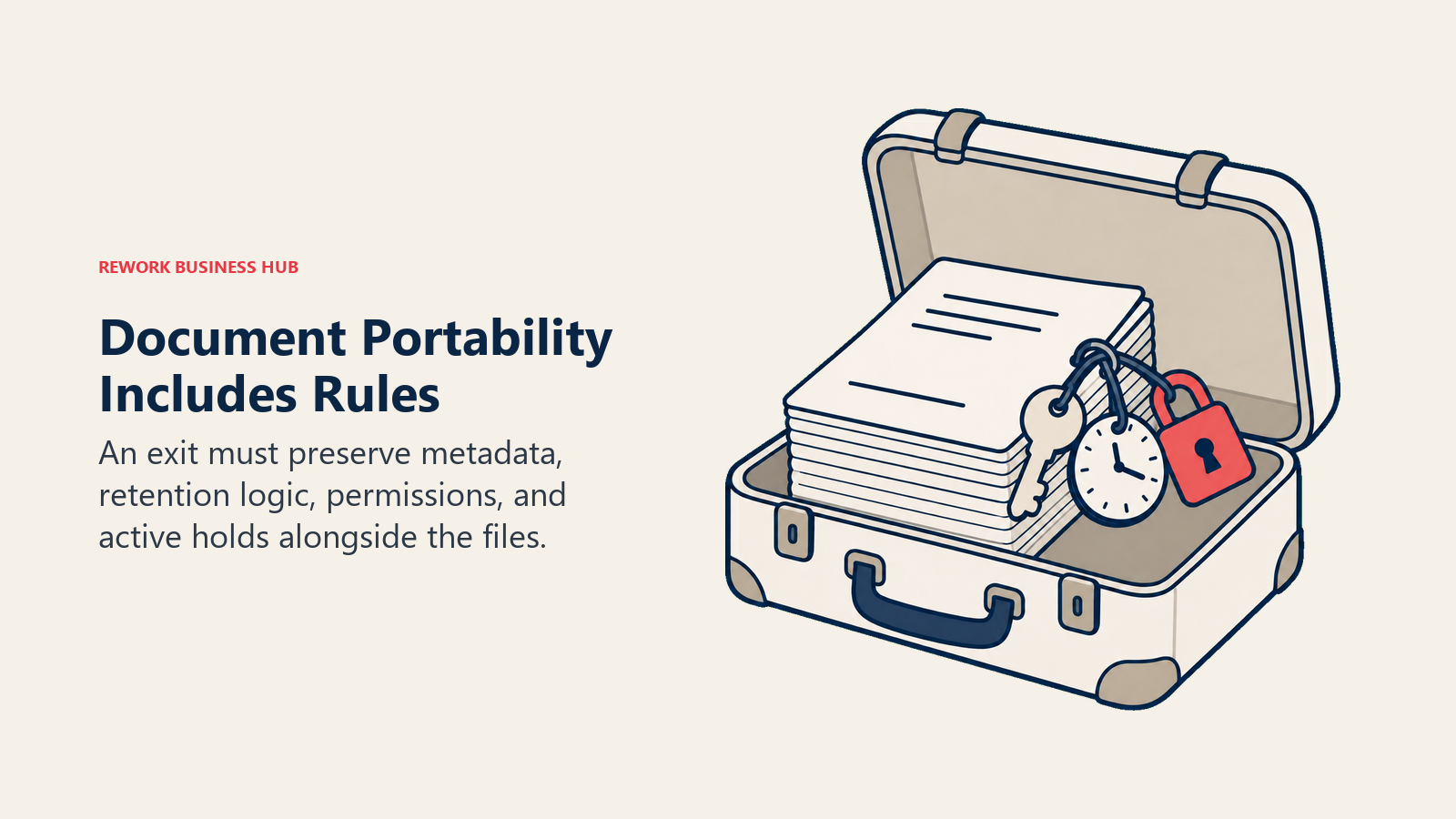
What an exit looks like after a decade of records. This is the question a demo never answers, and it matters more the longer you stay. With Egnyte, content can remain on your own file servers under a hybrid deployment, so the authoritative copy may already sit in storage you control, with Egnyte as the governance layer rather than the sole custodian, though a pure-cloud deployment still means a real bulk export. With Laserfiche, the documents export, but the metadata, record series, and retention-schedule logic built around them are specific to Laserfiche's model and don't transfer to another platform without real reimplementation on the receiving end. With OpenText, exit is the highest-stakes of the three: content is often embedded in and referenced by SAP, Salesforce, or Microsoft 365 workflows, and any record under active legal hold has to keep its compliance state intact through the move, which in practice makes an OpenText exit a systems-integrator project of its own.
| Egnyte | Laserfiche | OpenText Content Cloud | |
|---|---|---|---|
| Ownership/stability | Private, PE-backed since February 2025, independent | Private, founder-independent since 1987 | Public (NASDAQ/TSX: OTEX), acquisitive |
| Recent third-party recognition | None noted | 2026 Gartner Magic Quadrant Leader, second consecutive year | Long-standing enterprise ECM presence |
| Exit complexity | Lower for hybrid deployments; content may already sit in your own storage | Moderate to high; metadata and retention model don't transfer automatically | Highest; multi-system embedding and active legal holds must survive the move |
| Practical exit path | Bulk export plus storage reconnection | Bulk export plus records reimplementation elsewhere | Systems-integrator-led migration project |
Before you migrate a decade of files into any of these three, get your own process documentation in order first, so retention rules match how the business actually runs rather than how the vendor assumes it does.
When Egnyte Is the Right Call
- You have a real on-premises file estate (a file server, NAS, or regional office storage) and want governance layered on top of it, not a full migration into a new cloud silo
- You operate in construction, life sciences, professional services, or another regulated mid-market industry where GDPR, PCI, or clinical-data handling genuinely applies
- You need ransomware detection and suspicious-login alerting built into the document layer itself, not a separate security product
- Data residency matters and you want a vendor that already publishes real regional options (EU, US, UAE, Canada, Australia) rather than a quote-only promise
When Laserfiche Is the Right Call
- You're formally audited on records retention, whether that's a public-sector records-retention schedule, a healthcare compliance requirement, or a financial-services examination
- Your real problem is process, not storage: documents need to move through defined workflow states with a legal hold that can pause the clock
- You want deep, native OCR and full-text search across a genuinely large volume of historical scanned paper records
- You're comfortable choosing between Laserfiche Cloud and a self-hosted deployment (Rio or Avante) based on where your records need to physically live
When OpenText Content Cloud Is the Right Call
- You're a multinational enterprise, generally 1,000 or more employees, running SAP, Salesforce, or Microsoft Dynamics 365, and need one governed content layer underneath all of them
- Your compliance requirements span multiple jurisdictions at once (US federal, Canadian, Australian, life-sciences GxP) and you need certifications like DoD 5015.2 and FedRAMP as a baseline, not a stretch goal
- You already have, or are budgeting for, a dedicated ECM admin function and a systems-integrator relationship, since this isn't a self-serve rollout
- You want Microsoft 365 Copilot answering from governed, permission-aware content, including records Copilot can't reach on its own, through OpenText's Content Aviator layer
Decision Framework
| If you are... | Pick |
|---|---|
| Governing an existing on-prem file estate without a full migration | Egnyte |
| Wanting published, self-serve pricing with real regional data-residency options | Egnyte |
| Formally audited on records retention and legal hold | Laserfiche |
| Running deep OCR and full-text search across a large volume of historical scans | Laserfiche |
| A multinational enterprise needing one governed layer under SAP, Salesforce, and Microsoft 365 | OpenText Content Cloud |
| Required to meet DoD 5015.2, FedRAMP, or GxP-grade certifications | OpenText Content Cloud |
| Under about 150 employees with no formal compliance mandate | None of these three; see Best SharePoint Alternatives or Best Box Alternatives |
| Still narrowing down the wider category | See our full document management software roundup |
The verdict: these three rarely compete for the same deal. If it comes down to Egnyte versus Laserfiche, the real question is whether your problem is governing files you already have (Egnyte) or proving a retention schedule to an auditor (Laserfiche). If OpenText is in the conversation at all, company size and existing SAP or Microsoft investment already answered the question before pricing did.
What to Do Next
- Name your actual constraint before you name a vendor. "We have files on three file servers and a compliance audit coming" is Egnyte-shaped. "We need to prove a seven-year retention schedule" is Laserfiche-shaped. "We need one governed layer under SAP and M365 across a dozen subsidiaries" is OpenText-shaped.
- Ask Egnyte for a quote against your real storage volume, not just your headcount. The 100GB or 150GB pooled storage allocation is the number most likely to surprise you later; get the overage rate in writing.
- Ask Laserfiche which published tier your headcount actually lands in. The seat minimums (5, 25, and 500) decide the rate, and crossing 500 users moves you to Business+ at $42/user/month, less than half the Business rate. Ask for self-hosted Laserfiche 12 economics in the same conversation.
- Don't start an OpenText conversation without a systems-integrator partner already in mind. Implementation cost and timeline depend on that relationship as much as on the software itself.
- If none of these three fits your actual company size or compliance burden, see our best document management software roundup for the wider field, including tools built for teams without a formal records mandate. To go deeper on one of the two here that a mid-size team realistically shortlists, see Best Egnyte Alternatives and Best Laserfiche Alternatives.
Frequently Asked Questions about Egnyte vs Laserfiche vs OpenText Content Cloud
Which is cheapest: Egnyte, Laserfiche, or OpenText Content Cloud?
Egnyte has the lowest entry price, from $22/user/month, though its pooled storage allocation (100 to 150GB regardless of headcount) means real cost often comes from storage overage rather than the sticker price. Laserfiche publishes Cloud pricing too, at $73/user/month (Professional, 5-user minimum) and $93/user/month (Business, 25-user minimum), dropping to $42/user/month on Business+ from 500 users. OpenText publishes no pricing at all and doesn't realistically sell into small or mid-size teams in the first place.
Is Egnyte a good fit for a company with around 80 employees?
Only if there's a real compliance driver, such as GDPR, PCI, or similar regulatory exposure, or an existing on-premises file estate you want governed rather than migrated. If the problem is simply finding files on a shared drive, a general cloud content tool is the cheaper, faster fix. See our SharePoint and Box alternatives roundups instead.
Can Laserfiche run entirely on-premises, or is it cloud-only now?
Both remain real options. Laserfiche Cloud runs on AWS, and self-hosted deployment is still sold through two editions: Rio, built for large organizations with unlimited database licenses, and Avante, a leaner, single-server edition for smaller deployments.
Does OpenText Content Cloud replace SharePoint, or does it work alongside it?
Alongside it. OpenText unifies content from Microsoft Teams, Outlook, SharePoint, and OneDrive under one governed layer with consistent classification and retention, and its Content Aviator AI can feed Microsoft 365 Copilot permission-aware answers grounded in that governed content, rather than replacing the Microsoft 365 stack itself.
Which of the three actually searches inside scanned documents?
All three offer OCR, but the depth differs. Laserfiche's intelligent indexing and OCR make full-text search across scanned paper records a core, expected capability. OpenText's Intelligent Capture is the most powerful, covering 120-plus languages and an Advanced Cloud OCR add-on tuned for handwriting, but it's a separately licensed product. Egnyte's OCR is built primarily for classifying scanned content into the right governance policy, not for general full-text retrieval.
What happens to a decade of records if we switch platforms later?
It depends which one you're leaving. Egnyte's hybrid model can mean the authoritative files already sit in storage you control, which softens the exit. Laserfiche's records export, but the retention-schedule and metadata model built around them has to be reimplemented elsewhere. OpenText is the highest-stakes exit of the three, since content is often embedded across SAP, Salesforce, or Microsoft 365, and any record under active legal hold has to keep its compliance state intact through the move.

Principal Product Marketing Strategist
On this page
- TL;DR
- What Each Platform Is Actually Built For
- Before You Compare Features: Is This Even the Right Category?
- Key Facts
- Decision by Business Goal
- Team and Role Fit
- Migrating an Existing File Estate With Permissions Intact
- Search That Actually Works: OCR and Scanned Documents
- Records Retention and Legal Hold
- Deployment: On-Prem vs Cloud, and Data Residency
- Pricing at 50, 250, and 1,000 Users
- Implementation and Change Management
- Risk and Governance
- When Egnyte Is the Right Call
- When Laserfiche Is the Right Call
- When OpenText Content Cloud Is the Right Call
- Decision Framework
- What to Do Next