Segment vs RudderStack: Which Customer Data Platform Fits Your Team in 2026?
Turn this article into takeaways for your work.


Each assistant summarizes the article only for you and suggests best practices for your work.
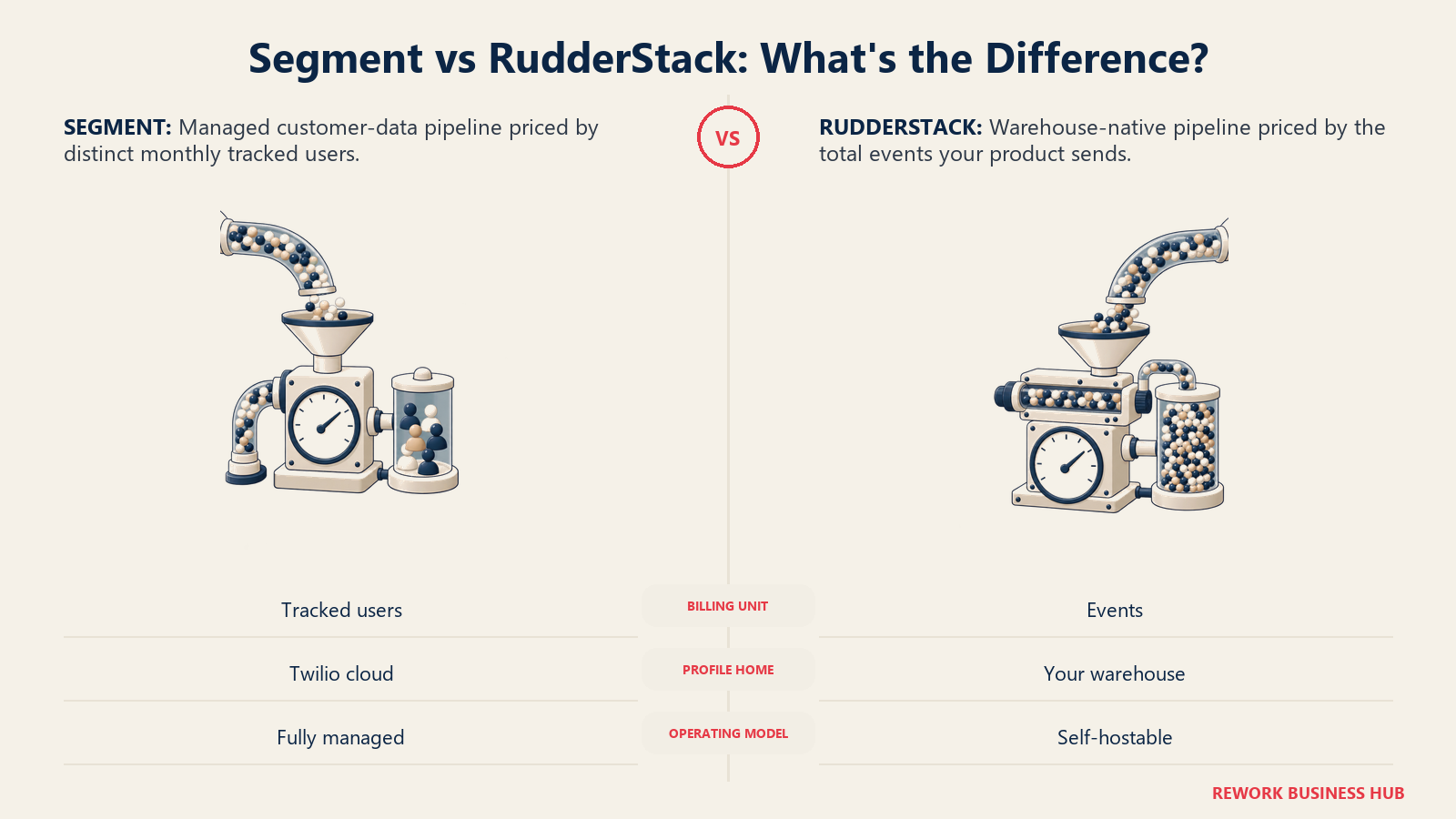
If you're a data engineering lead, a growth or RevOps leader, or the person who owns the event pipeline feeding your warehouse, Twilio Segment and RudderStack are almost certainly the two names on your shortlist. Both collect events from your product and site, route them to hundreds of destinations, and sit at the center of how your company defines a customer. That's where the resemblance gets complicated: Segment charges by monthly tracked users (MTUs), RudderStack charges by events, and those are not the same unit. Comparing a "starting price" on each vendor's homepage tells you almost nothing about what your team would actually pay.
This comparison does the unit conversion for you, then goes past pricing into the part that matters more for a data team: where your customer profiles actually live. RudderStack's core pitch is warehouse-native, your raw events land in your own Snowflake, BigQuery, Redshift, or Databricks instance as the system of record. Segment's Connections product routes events the same way, but its identity and profile layer, Unify, computes and stores that logic on Twilio's infrastructure unless you build your own warehouse sync on top. Neither approach is wrong. They imply different engineering effort, different vendor lock-in, and different answers to "who owns this data."
We'll also hand-check the claim that follows RudderStack into almost every comparison: that it's "the open-source Segment." It isn't, not in the OSI sense, and that distinction matters if your legal or security team is signing off on a self-hosted deployment.
TL;DR
| Twilio Segment (Connections) | RudderStack | |
|---|---|---|
| Pricing unit | Monthly tracked users (MTUs) | Events per month |
| Free tier | 1,000 visitors/mo, 2 sources, 500,000 Reverse ETL records/mo | 250,000 events/mo, 16 SDK sources, 200+ destinations, forever free |
| Entry paid tier | Team: starts at $120/month, 10,000 visitors/mo, unlimited sources | Growth: $265/month, 1,000,000 events/mo, scales to 25M+ |
| Enterprise tier | Business: custom pricing, contact sales | Enterprise: custom pricing, 5-minute warehouse sync, unlimited transformations |
| Identity resolution | Unify (contact-sales add-on), computed on Twilio's infrastructure | Profiles, warehouse-native, computed as SQL inside your own warehouse |
| Data storage model | Vendor-hosted profile store, with warehouse destinations available | Warehouse-native by default, your warehouse is the system of record |
| Self-hosting | Not available, SaaS only | Yes, source-available under Elastic License 2.0 (not OSI open source) |
| Transformations language | JavaScript (Destination Functions) | JavaScript, with Python on Enterprise |
| Best for | Teams that want a fully managed pipeline and a mature destination catalog | Teams that already run a warehouse and want events landing there directly |
Key Facts
- The customer data platform market is projected to grow from $7.34 billion in 2026 to $14.04 billion by 2031, a 13.8% CAGR, according to MarketsandMarkets (PR Newswire).
- Composable, warehouse-native CDP vendors grew employment 7.8% in the second half of 2025, nearly six times the 1.3% industry-wide average, per the CDP Institute's January 2026 update (CDP Institute).
- Enterprise data teams spend 53% of engineering capacity maintaining and troubleshooting existing data pipelines rather than building new capability, per Fivetran's 2026 enterprise data infrastructure benchmark of 500 senior data and technology leaders (Fivetran).
- As of January 2026, 19 US states have enacted comprehensive consumer privacy laws, with Indiana, Kentucky, and Rhode Island's laws taking effect January 1, 2026 alone, according to the IAPP (IAPP).
Who Each Platform Is Really For
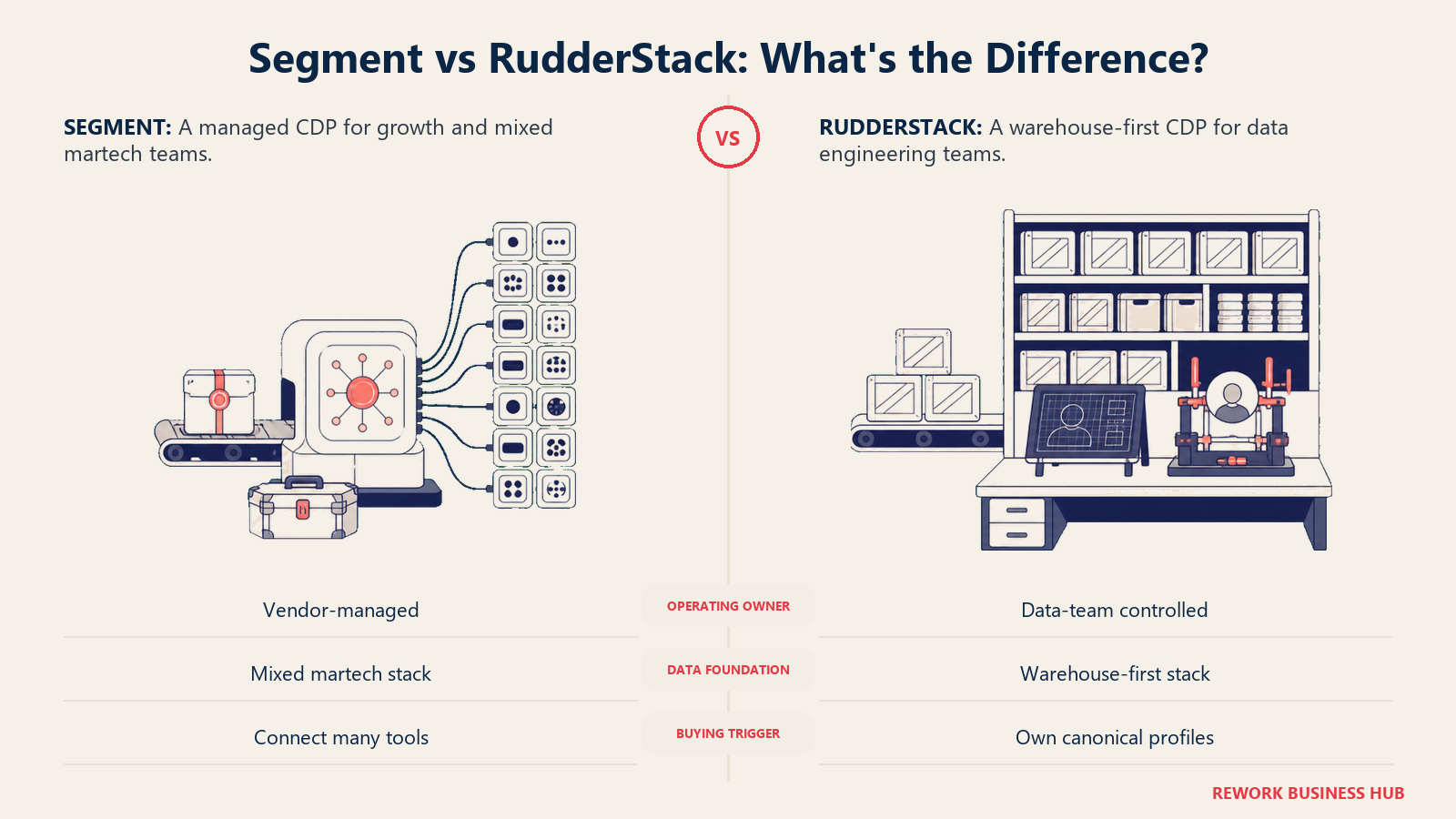
Both tools do the same basic job, collect an event once and fan it out everywhere it needs to go, but they attract different buyers. Segment's buyer wants a managed pipeline with the deepest destination catalog in the category and is willing to pay a vendor to own the operational burden. RudderStack's buyer already has, or is actively building, a warehouse-first data stack and wants the CDP to be a thin, inspectable layer on top of it rather than a second source of truth.
| Twilio Segment | RudderStack | |
|---|---|---|
| Primary buyer | Growth, marketing ops, and product teams wanting a managed event router | Data engineering teams standardizing on a warehouse-first stack |
| Company already runs on | A mixed martech stack, wants one vendor to own routing and identity | Snowflake, BigQuery, Redshift, or Databricks as the data backbone |
| Where it's strongest | Broadest destination catalog (700+), longest track record in the category | Warehouse-native profiles, self-hosting option, event-level cost control |
| Buying trigger | "We need one pipeline into 20+ tools without building or maintaining connectors ourselves" | "We already pay for a warehouse and don't want a second copy of customer data living elsewhere" |
| Team most likely to champion it | Marketing ops or growth engineering | Data engineering or analytics engineering |
Event Collection and SDK Coverage
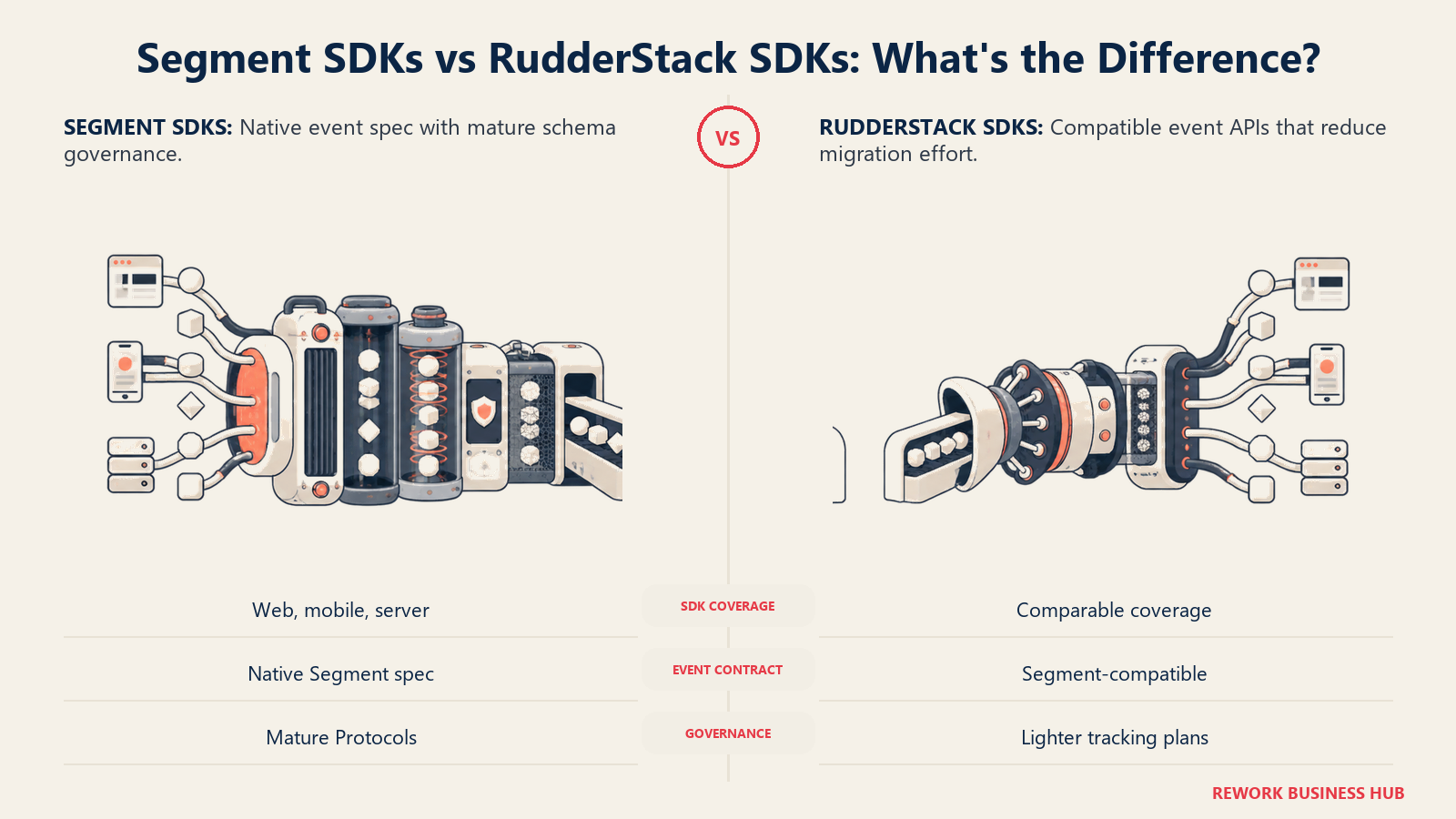
Both platforms collect the same shape of event: track, identify, page, screen, group, and alias calls, sent from web, mobile, and server-side libraries. RudderStack built its SDKs to be Segment-API-compatible by design, so a team migrating between the two can often swap the SDK initialization without rewriting instrumentation, a real practical advantage if you're evaluating a switch rather than a greenfield build.
| Twilio Segment | RudderStack | |
|---|---|---|
| Web SDK | Analytics.js | JS SDK, Segment-API-compatible |
| Mobile SDKs | iOS, Android, React Native, Flutter | iOS, Android, React Native, Flutter |
| Server-side libraries | Node.js, Python, Java, Go, PHP, Ruby, .NET | Node.js, Python, Java, Go, PHP, Ruby, .NET |
| Sources included, Free tier | 2 sources | 16 SDK sources |
| Sources included, entry paid tier | Unlimited sources on Team | Unlimited sources on Growth |
| Schema governance | Protocols: tracking plans, schema violations can block bad events | Tracking plan validation available, less mature than Protocols |
| Migration friction from the other tool | N/A | Low, by design, given API compatibility |
Destination and Connector Catalogs
Segment's catalog is the deeper one, a byproduct of being the older, more widely adopted product in the category. RudderStack has closed a meaningful amount of that gap, particularly on warehouse and reverse ETL destinations, but it's still the smaller of the two catalogs.
| Twilio Segment | RudderStack | |
|---|---|---|
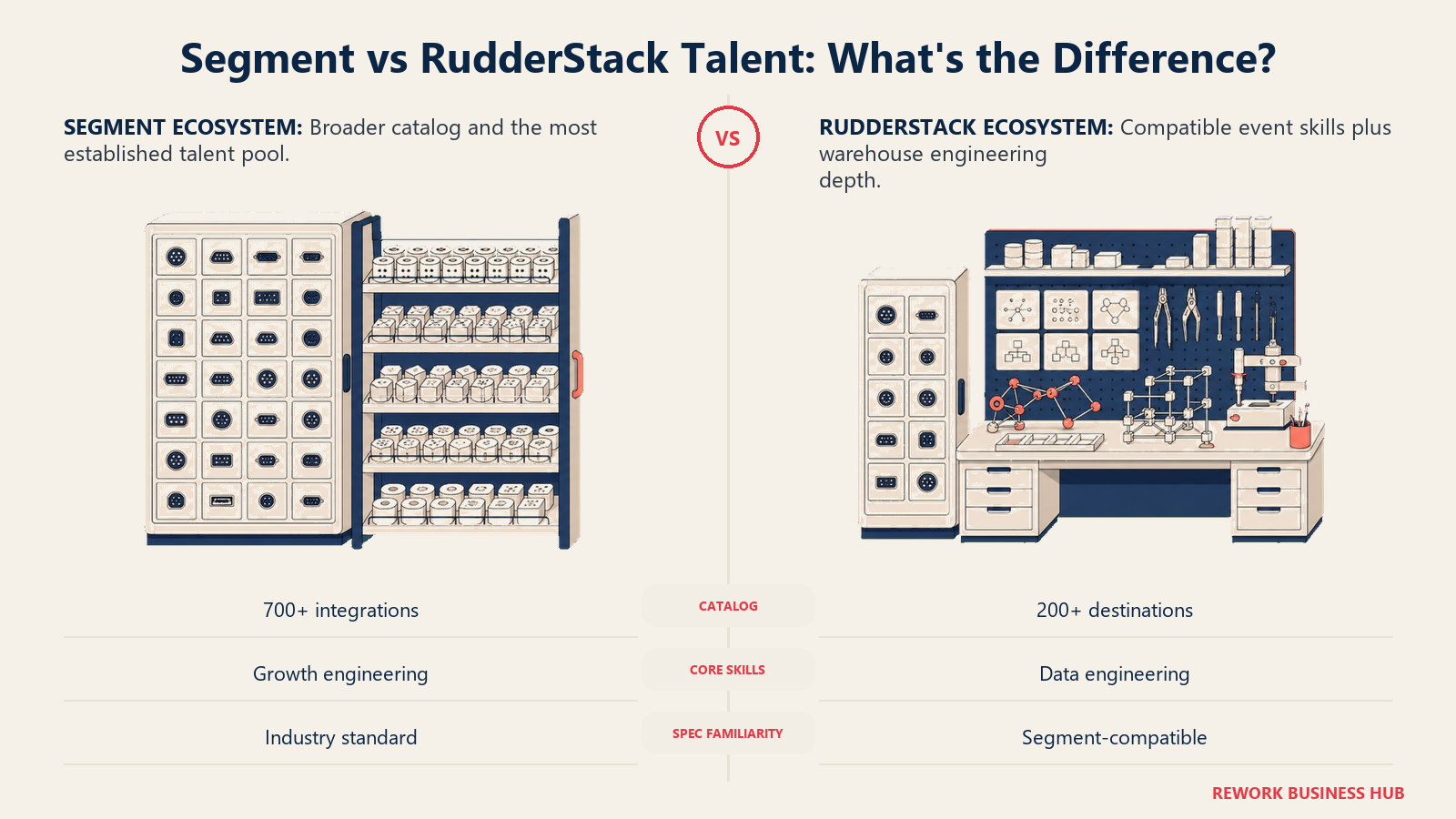
| Total integrations/destinations | 700+ | 200+ cloud destinations |
| Warehouse destinations | Snowflake, BigQuery, Redshift, Databricks, and others | Snowflake, BigQuery, Redshift, Databricks, and others |
| Ad and marketing platform depth | Broadest in the category, long incumbency advantage | Strong coverage of the common platforms, thinner on long-tail niche tools |
| Where the gap shows up most | Rarely a blocker for mainstream martech stacks | Long-tail, industry-specific, or newer SaaS destinations |
Warehouse-Native vs Vendor-Stored Profiles
This is the structural difference behind almost everything else in this comparison. Segment's Connections product routes your raw events to destinations in real time, and you can absolutely point one of those destinations at your own warehouse. But the identity resolution and profile logic that makes Segment a CDP, not just a router, Unify, runs on Twilio's infrastructure. Your unified customer profile lives there unless you build a separate sync to pull it into your own environment.
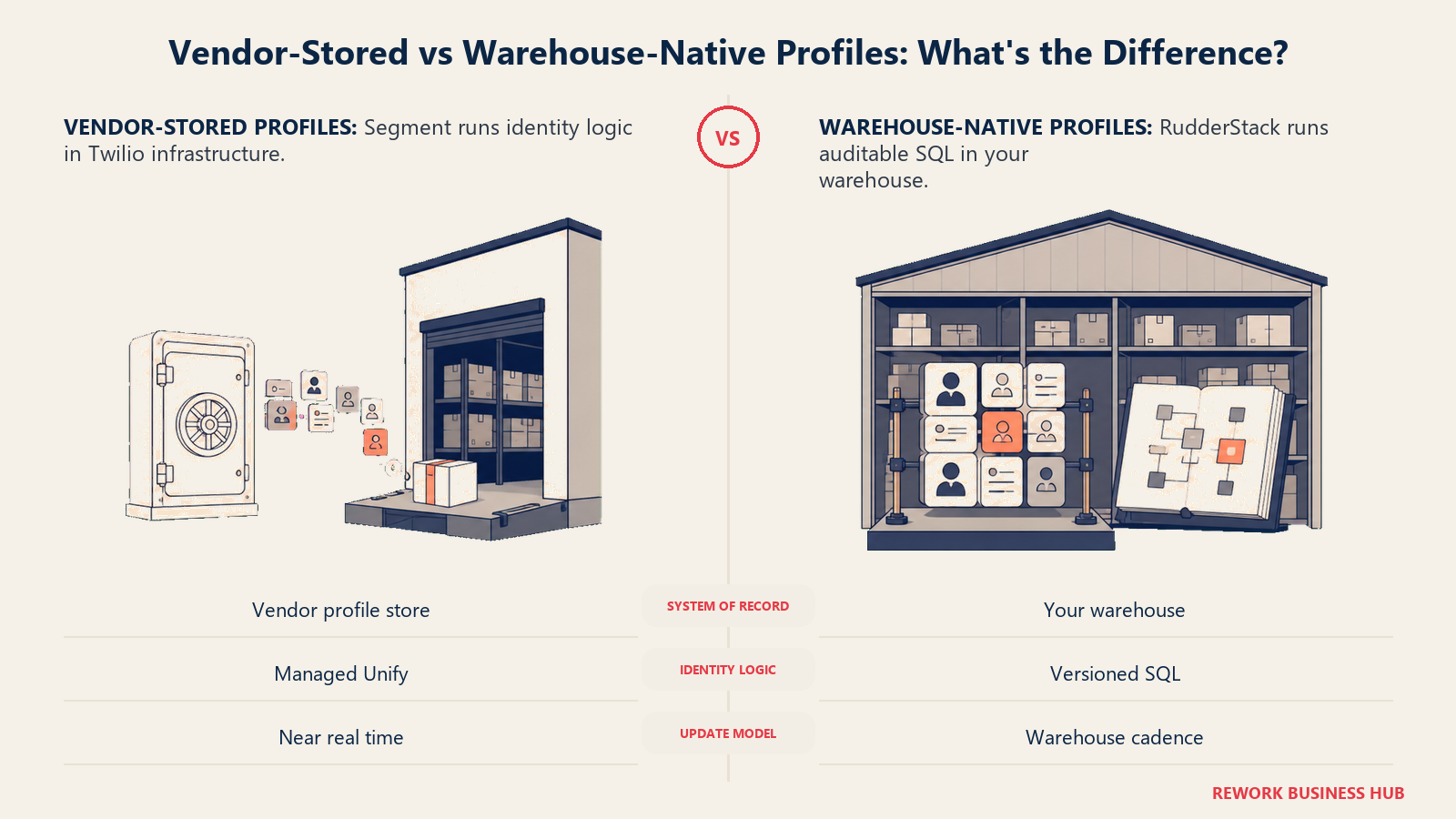
RudderStack inverts that by default. Raw events land directly in your warehouse as the system of record, and RudderStack's Profiles feature computes identity resolution and unified customer models as versioned SQL logic that executes inside your warehouse, not inside RudderStack's own database. You can read, audit, and test the exact query that produced a given profile.
| Twilio Segment | RudderStack | |
|---|---|---|
| Where raw events land by default | Twilio Segment's infrastructure, then fanned out to destinations | Your own warehouse or lakehouse, as the system of record |
| Where identity resolution runs | On Twilio's infrastructure (Unify) | Inside your warehouse, as auditable SQL (Profiles) |
| Profile data portability | Requires a warehouse destination sync to get a full copy out | Native; the warehouse already holds the canonical data |
| Resolution speed | Near real-time, computed on Twilio's servers | Runs on your warehouse's compute and sync cadence, not millisecond-real-time |
| Auditability of the identity logic | Managed inside Segment's product, less inspectable | Fully inspectable, versionable SQL models you control |
If your team is deciding how deep to invest in warehouse-native tooling in general, our best AI tools for data analysis roundup covers what typically sits downstream of either pipeline once the data lands.
Reverse ETL
Both platforms sync data back out of storage into operational tools, so a sales rep sees a lead score in the CRM instead of an analyst pulling it manually. The mechanics differ with the storage model above: Segment syncs from its own store, RudderStack syncs from your warehouse.
| Twilio Segment | RudderStack | |
|---|---|---|
| Free tier Reverse ETL | 500,000 records/month | Not published as a separate line item on the Free tier |
| Entry paid tier Reverse ETL | 1,000,000 Reverse ETL records/month (Team) | 25 reverse ETL connections included (Growth) |
| Sync source | Segment's own data store | Your own warehouse, syncing back out |
| Fastest sync cadence stated | Not published as a flat figure | As fast as 5 minutes (Enterprise) |
| Typical destination | CRM, ad platforms, support tools, Slack | Same category of destinations, synced from warehouse tables |
For teams whose reverse ETL destination is the sales CRM itself, our best CRM software guide is a useful companion read for what the receiving end of that sync actually needs to support.
Transformations: What Language Do You Actually Write?
Both platforms let you reshape, filter, mask, or enrich an event in flight before it reaches a destination, and both expose that as code, not a no-code rules builder.
| Twilio Segment | RudderStack | |
|---|---|---|
| Transformation language | JavaScript (Destination Functions) | JavaScript on all tiers, Python added on Enterprise |
| Where it runs | In-flight, per destination, on Segment's infrastructure | In-flight, attached to a destination connection |
| Included on Free tier | Not applicable, Functions require a paid plan | 5 transformations included |
| Best for | Teams comfortable standardizing on JavaScript | Teams that want Python for heavier data-shaping logic, on Enterprise |
Identity Resolution
Identity resolution is the feature that turns a pile of anonymous and known events into one customer record, and it's priced and architected differently on each side.
| Twilio Segment: Unify | RudderStack: Profiles | |
|---|---|---|
| Pricing | Contact-sales, sits above Connections | Included conceptually in the warehouse-native model, priced as part of Growth/Enterprise usage |
| Where logic executes | Twilio's infrastructure | Your warehouse, as SQL |
| Update cadence | Near real-time | Batch or scheduled, tied to your warehouse sync cadence |
| What you can inspect | Segment's UI and documented merge rules | The literal SQL query that produced the merge |
| Companion product | Engage, for activation and marketing on top of Unify | Reverse ETL, to push resolved profiles back out |
Privacy, Consent, and Data Residency
Privacy regulation is not slowing down, and a growing share of the US alone now requires it. As of January 2026, 19 US states have comprehensive consumer privacy laws in effect, with three, Indiana, Kentucky, and Rhode Island, starting January 1, 2026 alone (IAPP). Where and how your customer data physically sits matters more each year, not less.
| Twilio Segment | RudderStack | |
|---|---|---|
| EU data residency | Available via a dedicated EU workspace; requires enabling through your account executive | Native by design if you choose an EU-region warehouse; self-hosting adds full control |
| Default hosting region | US, unless EU workspace is enabled | Wherever your warehouse or self-hosted deployment lives |
| Consent management tooling | Built into Protocols and the Privacy Portal, including deletion and suppression | Consent enforcement typically lives in your own warehouse logic or a dedicated CMP integration |
| Data residency control mechanism | Vendor-managed region selection | Direct, since raw data never leaves your chosen cloud region by default |
Self-Hosting and Licensing
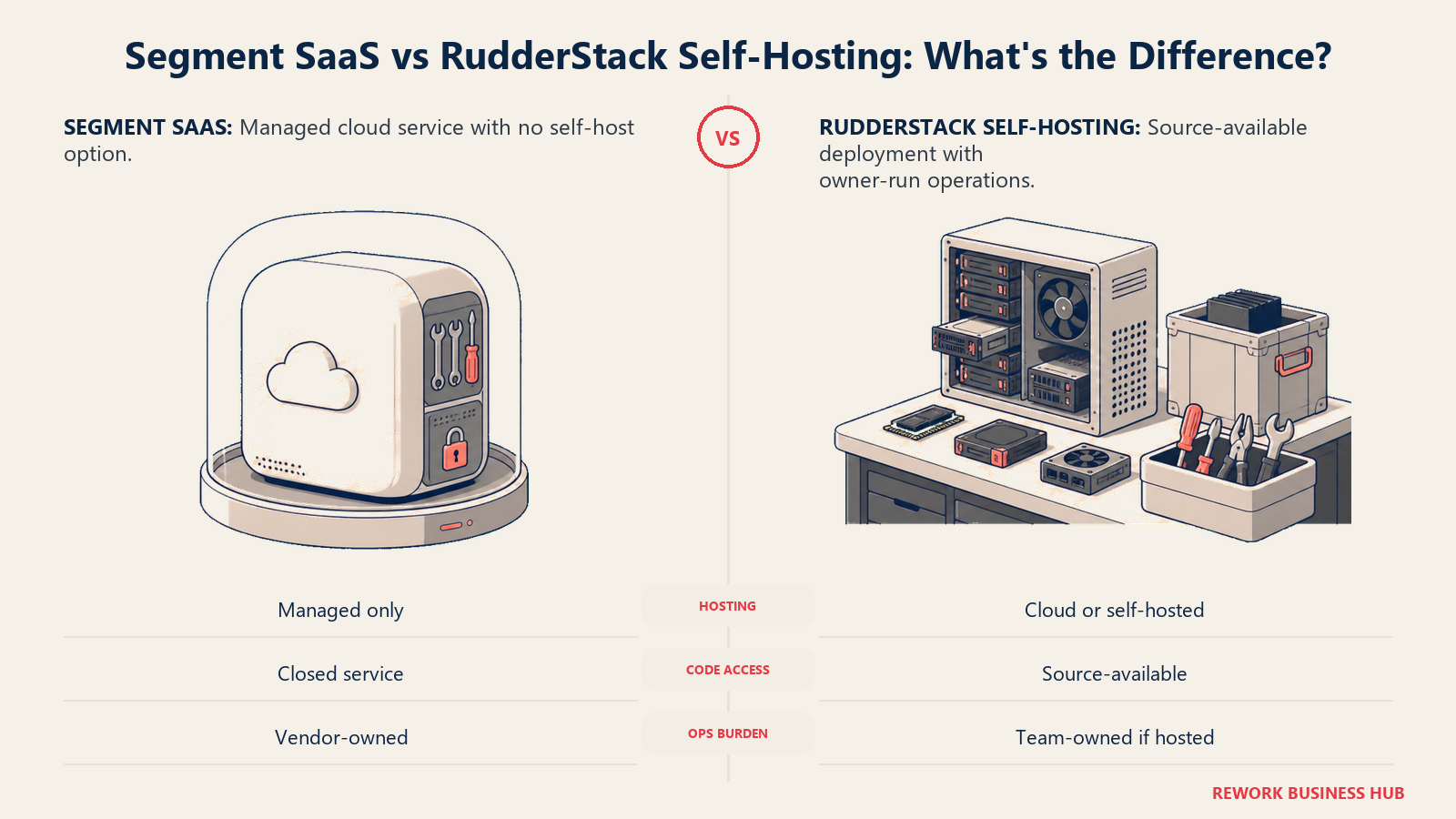
This is the single claim about RudderStack most likely to be stated wrong, so it's worth being precise about it. RudderStack's reputation as "the open-source Segment" is not accurate in the OSI sense. The self-hosted code is source-available under the Elastic License 2.0, a license that restricts, among other things, offering the software as a competing hosted service. It is not Apache 2.0 or MIT, and it is not free of usage restrictions the way OSI-approved open source is. Segment has no self-hosting option at all; it is SaaS only.
| Twilio Segment | RudderStack | |
|---|---|---|
| Self-hosting available | No, managed SaaS only | Yes, via Docker, Kubernetes, or Helm charts on GitHub |
| License for self-hosted code | Not applicable | Elastic License 2.0 (source-available, not OSI open source) |
| Free tier ceiling | 1,000 visitors/mo on managed cloud | 250,000 events/month on managed cloud, self-hosting removes that usage cap but adds infrastructure work |
| What self-hosting actually buys you | Not applicable | Full data control and no per-event billing, at the cost of running and upgrading the stack yourself |
| Support model for self-hosted deployments | Not applicable | Community support on the open-core tier, dedicated support on Enterprise |
Real Cost at Three Volumes
Here's the honest complication: Segment prices on monthly tracked users, RudderStack prices on events, and there's no vendor-published exchange rate between the two. A "tracked user" fires many events (page views, clicks, identify calls) over a month, so the ratio depends entirely on how heavily your product is instrumented.
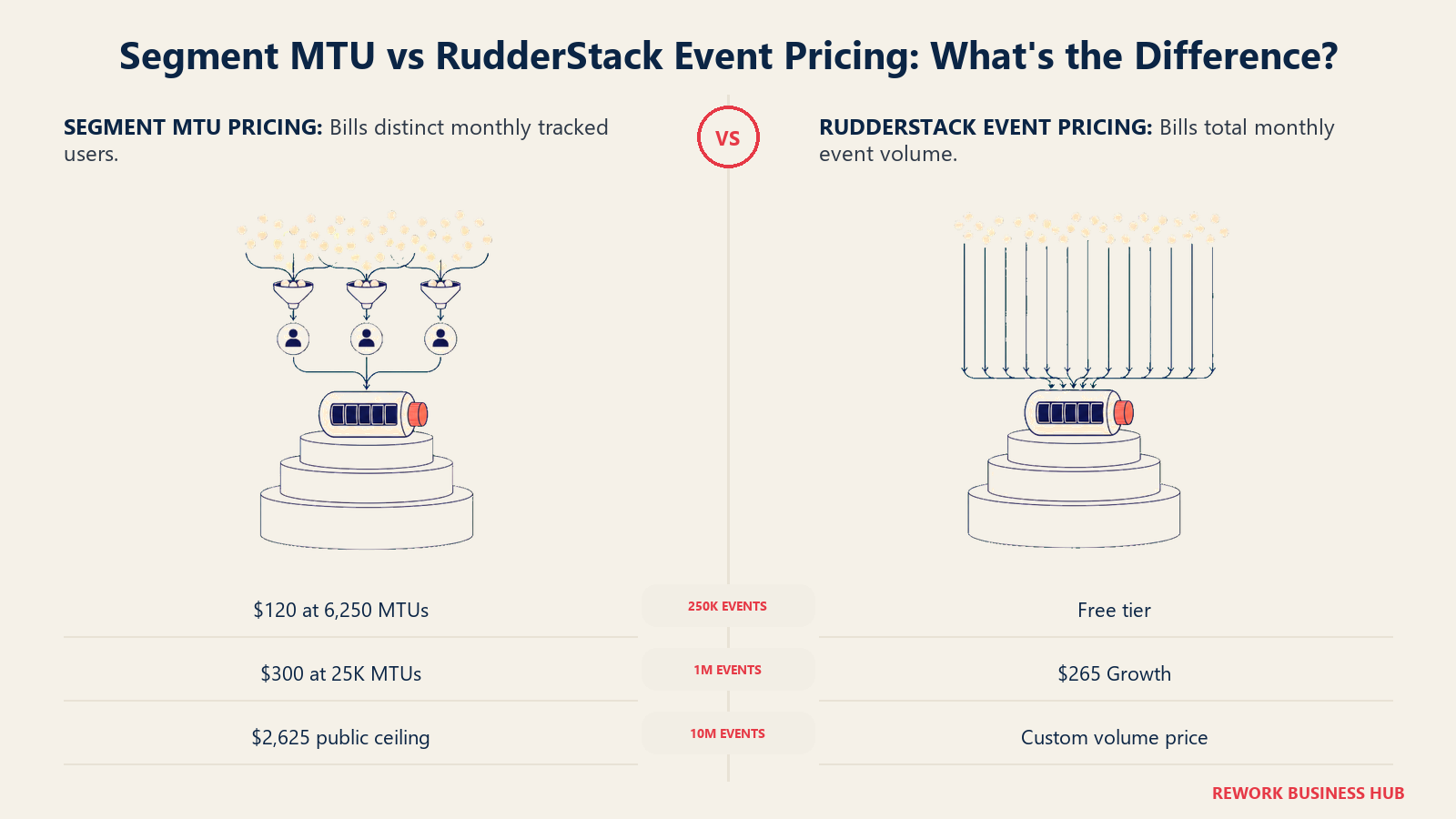
For this comparison, we're using an assumption of 40 events per tracked user per month, a reasonable midpoint for a moderately instrumented B2B SaaS product combining page views, track calls, and identify calls. If your product fires far more or fewer events per user, the math below scales linearly, recalculate with your own analytics before budgeting.
Segment's Team tier includes 10,000 visitors/month at the $120/month base rate, then bills overage in bands: $12 per 1,000 MTUs from 10,000 to 25,000, $11 per 1,000 from 25,000 to 100,000, and $10 per 1,000 above 100,000. All Segment figures below are monthly-billed; Segment states annual billing saves up to 20%. RudderStack's Growth tier is quoted at $265/month for 1,000,000 events, with annual billing saving 15%; RudderStack's published pricing page does not render a flat rate for volumes above 1M as static text (it's an interactive slider up to 25M+), so we mark that cell "contact sales / use RudderStack's calculator" rather than guess a number.
| Volume | RudderStack tier and price | Assumed Segment MTUs (at 40 events/MTU) | Segment tier and price (monthly-billed) |
|---|---|---|---|
| 250,000 events/month | Free: $0/month | 6,250 MTUs | Team: $120/month (base covers up to 10,000 MTUs, no overage) |
| 1,000,000 events/month | Growth: $265/month | 25,000 MTUs | Team: $120 base + $180 overage (15,000 MTUs over 10,000 at $12/1,000) = $300/month |
| 10,000,000 events/month | Growth tier, exact rate not published as static text; contact sales or use RudderStack's own volume calculator | 250,000 MTUs | Team: $120 base + $2,505 overage (across all three bands) = $2,625/month, calculated strictly from Twilio's own published overage formula |
Two honest caveats belong next to that last row. At 250,000 MTUs, Twilio would very likely move a real account onto a custom Business agreement rather than leave it on Team's published per-1,000 overage rate, so treat $2,625/month as a ceiling built from public numbers, not a quote you'd actually receive. And RudderStack's own Enterprise tier, custom-priced, is the realistic landing spot at 10M+ events/month too; the Growth-tier comparison above is meant to show the shape of the two pricing models, not a number either vendor would actually invoice you at that scale.
What the table does make clear at the low and middle volumes: RudderStack's flat, published per-tier rate is easier to forecast against a growing product, while Segment's MTU-plus-overage model means your bill moves with how many distinct people you track, not how chatty your instrumentation is. A product with light per-user event volume but a huge user base will find Segment's MTU pricing more favorable than this table's 40-events-per-MTU assumption suggests; a product with heavy per-user instrumentation and a smaller user base will find the reverse.
Engineering Effort and Time to Value
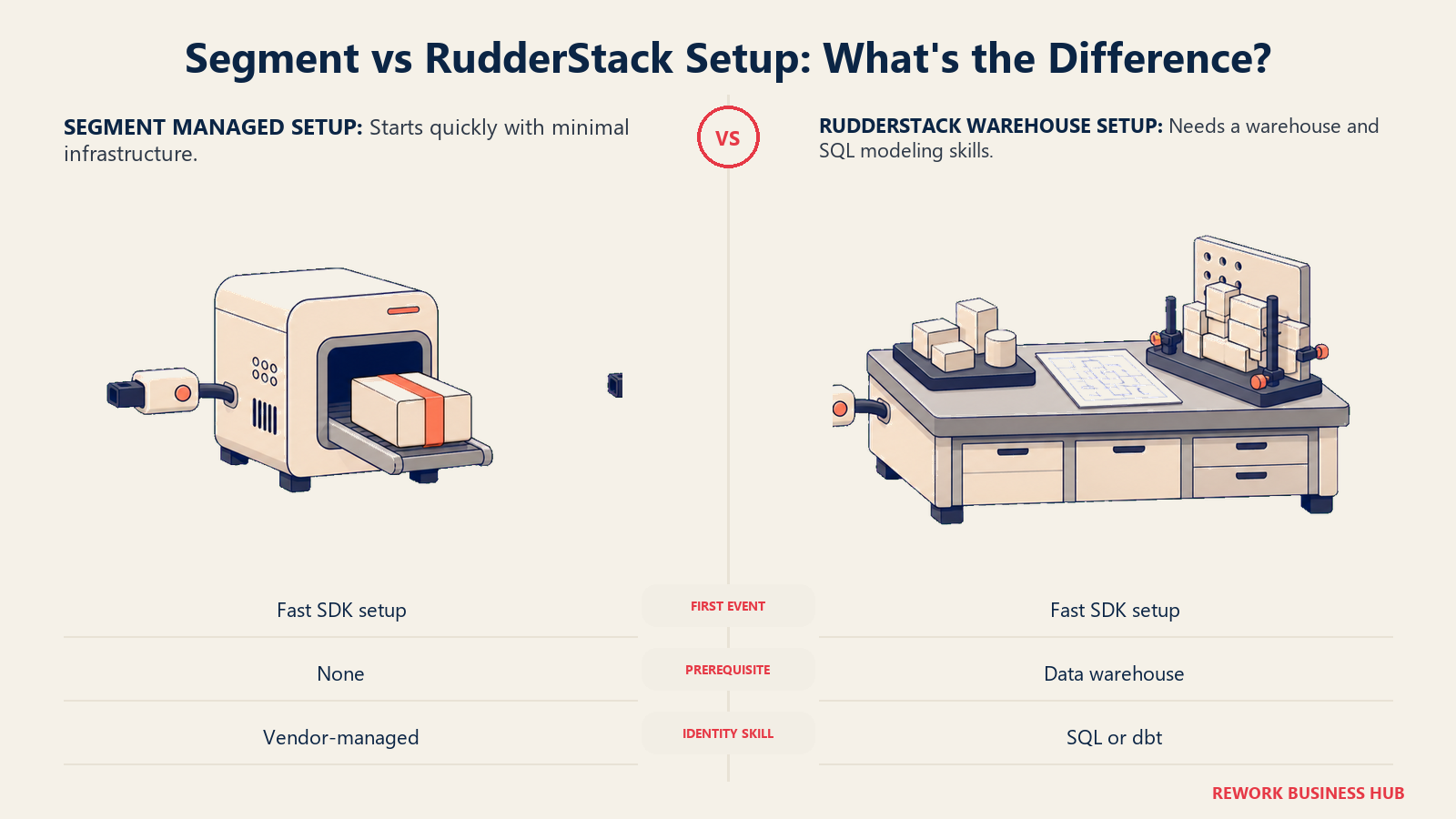
The pricing model mirrors a real engineering trade-off. Segment's managed approach gets a team to a working pipeline fast, with minimal infrastructure to stand up, which matters if you don't yet have a mature warehouse. RudderStack's warehouse-native model assumes you already have, or are willing to build, that warehouse and the SQL or dbt-style modeling skill to use Profiles well.
That upfront investment buys something real. Fivetran's 2026 benchmark of 500 senior data and technology leaders found enterprise teams spend 53% of engineering capacity maintaining existing pipelines rather than building new capability (Fivetran). A vendor-hosted profile store you can't fully inspect adds exactly the kind of opaque dependency that makes that maintenance burden worse over time; a warehouse-native model where the identity logic is a SQL file in your own repo is easier to debug when something breaks at 2am.
| Twilio Segment | RudderStack | |
|---|---|---|
| Time to first event flowing | Fast, SDK install plus a destination connection | Fast, comparable SDK install given API compatibility |
| Prerequisite infrastructure | None, fully managed | A warehouse (Snowflake, BigQuery, Redshift, or Databricks), or willingness to build one |
| Skill needed to use identity resolution well | Minimal, Unify's logic is managed for you | SQL or dbt-style modeling literacy to get value from Profiles |
| Ongoing operational burden, managed cloud tier | Low, Twilio owns the infrastructure | Low, comparable to Segment if you stay on RudderStack Cloud |
| Ongoing operational burden, self-hosted | Not applicable | Real, Kubernetes/Docker operations and upgrade cycles become your team's job |
Ecosystem and Hiring Pool
Segment, founded in 2011 and acquired by Twilio in 2020, has the longer track record and the wider talent pool: "the Segment spec" (track, identify, page, screen, group, alias) is close to an industry-standard vocabulary that analytics engineers already know coming in. RudderStack, founded in 2019, built its SDKs to be compatible with that same spec on purpose, so hiring overlap with Segment-trained talent is high, and it draws additional strength from data engineers already comfortable with a warehouse-first stack, dbt, and SQL-based modeling.
| Twilio Segment | RudderStack | |
|---|---|---|
| Founded | 2011, acquired by Twilio in 2020 | 2019 |
| Talent pool breadth | Widest in the category, "the Segment spec" is broadly known | Strong overlap with Segment-trained talent, plus data engineers fluent in SQL/dbt |
| Community | Large, long-running docs and partner ecosystem | Active GitHub community, given the source-available codebase |
| Where hiring tends to be easier | Marketing ops and growth engineering roles | Data and analytics engineering roles already warehouse-native |
For the marketing-layer tools that often sit downstream of either pipeline, our best Customer.io alternatives roundup covers the activation side of the stack.
Startup (20 People) vs Enterprise (500 People) Fit
Team size changes which trade-offs actually bite.
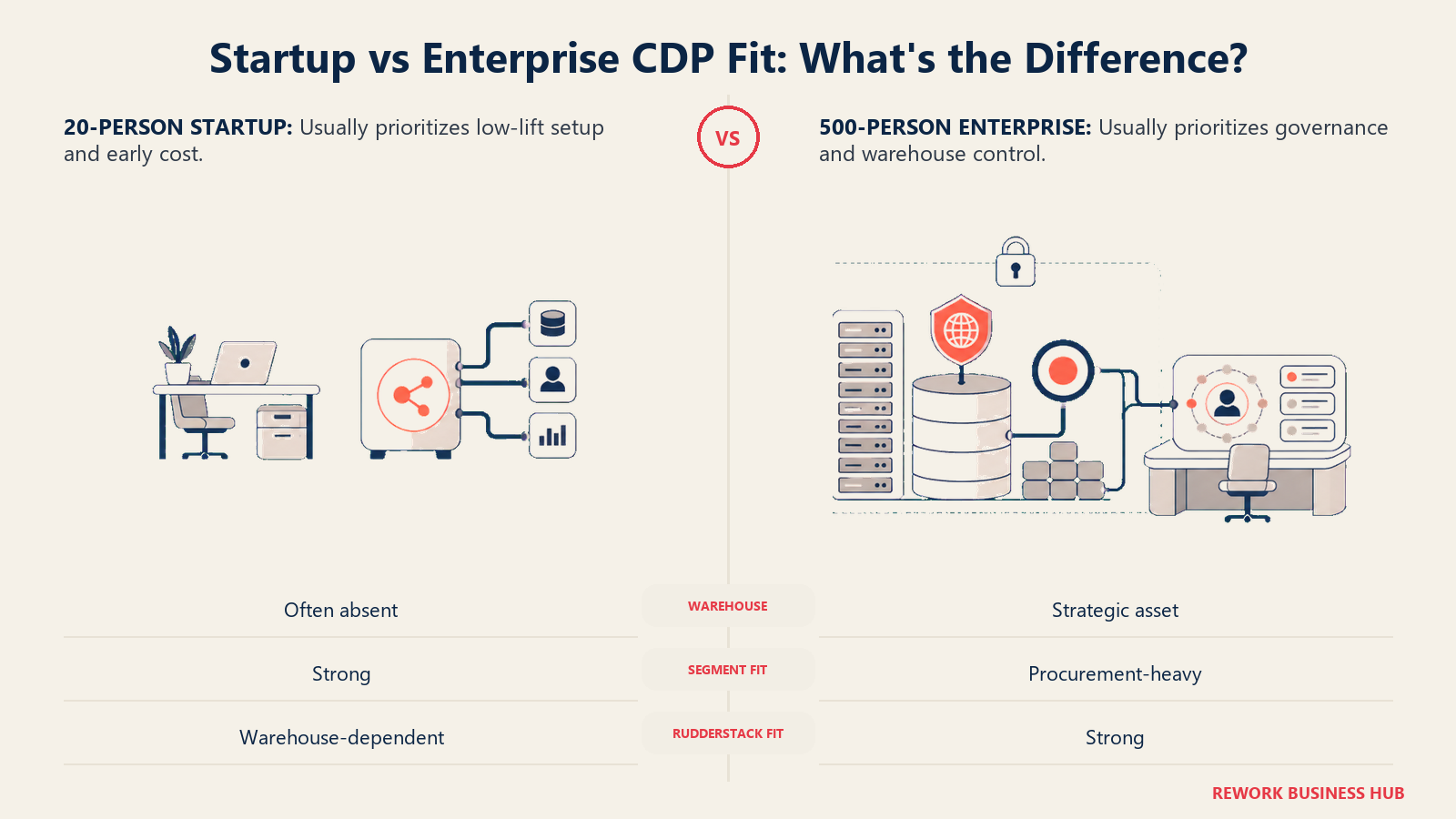
| 20-person startup | 500-person enterprise | |
|---|---|---|
| Warehouse maturity | Often not built yet, or very lightweight | Usually already a strategic asset with a dedicated team |
| Segment fit | Strong: Free or low Team tier gets a working pipeline with zero infrastructure lift | Workable, but Unify's contact-sales pricing and vendor-hosted profiles need real procurement and security review |
| RudderStack fit | Workable on Free/Growth if the team already leans warehouse-first; adds friction if there's no warehouse yet | Strong: Profiles' auditable SQL and self-hosting option answer governance and data-residency questions enterprise security teams ask by default |
| Where cost pressure shows up first | MTU overage or event volume, both still modest at this scale | Identity resolution licensing (Segment) vs warehouse compute costs (RudderStack) |
| Where governance pressure shows up first | Rarely a blocker yet | Frequently the deciding factor, especially with 19+ US states now imposing consumer privacy obligations |
When Segment Is the Right Call
- You want the broadest destination catalog without maintaining it yourself. 700+ integrations is still the deepest catalog in the category, and Twilio owns keeping every one of them working.
- You don't have a mature warehouse yet, and don't want to build one just to stand up a CDP. Segment's fully managed model gets a pipeline running with zero infrastructure investment.
- Your team is more comfortable with a managed identity resolution product than owning SQL models. Unify handles the merge logic for you, at the cost of it running on Twilio's side.
- A large read-only or moderately-instrumented user base fits Segment's MTU model better than a heavy per-event bill. If your product doesn't fire many events per user, MTU-based pricing can undercut a per-event model.
When RudderStack Is the Right Call
- You already run, or are committed to running, a data warehouse. Snowflake, BigQuery, Redshift, or Databricks teams get a CDP that reinforces the warehouse as the single source of truth instead of competing with it.
- Data residency, auditability, or security review requires inspecting the actual logic, not trusting a vendor's black box. Warehouse-native Profiles gives you the literal SQL; self-hosting under Elastic License 2.0 gives you full deployment control.
- Your product fires a high volume of events per user, and MTU-based pricing would cost more than event-based pricing. Heavily instrumented products often land better on RudderStack's flat per-tier event pricing.
- You want the option to self-host without switching vendors later. RudderStack is the only one of the two with a self-hosting path at all, even if you start on the managed cloud tier.
Decision Framework
| If this is true for you | Pick |
|---|---|
| No mature warehouse yet, want a pipeline running today | Segment |
| Already warehouse-first (Snowflake, BigQuery, Redshift, Databricks) | RudderStack |
| Need the deepest destination catalog available | Segment |
| Security or legal requires inspectable, auditable identity logic | RudderStack |
| Product is lightly instrumented per user, large user base | Segment, MTU pricing likely favors you |
| Product is heavily instrumented per user | RudderStack, event pricing likely favors you |
| Self-hosting is a hard requirement | RudderStack, Segment has no self-hosting option |
| Want the broadest possible shortlist, not just these two | See our best customer data platforms 2026 hub |
What to Do Next
- Pull your own event-to-user ratio before trusting any vendor's pricing calculator. The 40-events-per-MTU assumption in this article is a starting point, not your number. Query your own analytics for actual events fired per tracked user over a real month.
- Confirm whether your warehouse is a strategic asset or a future project. That single fact does more to determine fit than any feature checklist.
- Get a real quote for identity resolution, not just the base pipeline. Segment's Unify and RudderStack's Enterprise Profiles are both priced outside the numbers on the public pricing page; a base-tier comparison alone will understate your real cost if identity resolution is a requirement.
- If neither fits, widen the shortlist. Our best RudderStack alternatives, best Hightouch alternatives, best Tealium alternatives, and best Salesforce Data Cloud alternatives roundups cover the rest of the category, and our best Segment alternatives roundup is a useful companion if Segment specifically isn't landing. For the marketing-layer tools downstream of either pipeline, see our best Klaviyo alternatives roundup, and for what typically sits on top of the warehouse once the data lands, our best business intelligence tools guide and our Power BI vs Tableau comparison are worth a look.
Frequently Asked Questions about Segment vs RudderStack
Is RudderStack actually open source?
Not in the OSI sense. RudderStack's self-hosted code is source-available under the Elastic License 2.0, which restricts offering the software as a competing hosted service. It is not Apache 2.0 or MIT. Segment has no self-hosting option at all and is SaaS only.
How do I compare Segment's MTU pricing to RudderStack's event pricing?
There's no vendor-published exchange rate between tracked users and events, since it depends on how many events your product fires per user each month. Pull your own analytics to find your real ratio, then apply Segment's per-1,000-MTU overage bands or RudderStack's per-tier event pricing to that number rather than trusting a generic assumption.
What's RudderStack's free tier actually capped at?
250,000 events per month, forever free, with 16 SDK sources and 200+ cloud destinations included. That's a hard ceiling on the managed cloud tier; self-hosting removes the event cap but adds infrastructure work.
Does Segment support warehouse-native architecture like RudderStack?
Segment can sync events to a warehouse destination, but the core identity resolution product, Unify, computes and stores unified profiles on Twilio's own infrastructure by default. RudderStack's Profiles feature runs that logic as SQL inside your warehouse instead, so the two aren't equivalent even when both point at the same warehouse.
Which platform is cheaper at a typical mid-market volume?
It depends entirely on your events-per-user ratio. Using a 40-events-per-tracked-user assumption, RudderStack's flat $265/month Growth tier at 1,000,000 events works out cheaper than Segment's Team tier plus overage at the equivalent 25,000 MTUs ($300/month), but a product with a much higher or lower events-per-user ratio can flip that comparison either way.
Do I need a data warehouse to use RudderStack?
Not strictly, RudderStack can route events to non-warehouse destinations without one. But its core differentiator, warehouse-native Profiles and identity resolution, only delivers its real value once you have a warehouse for that SQL logic to run against.
Is Twilio Segment the same product as segment.com?
Yes. Segment.com's pricing page now redirects to twilio.com, and the product is officially Twilio Segment. The Connections product (event pipeline and destinations) is priced separately from the CDP layer, Unify and Engage, which is contact-sales only.

Principal Product Marketing Strategist
On this page
- TL;DR
- Key Facts
- Who Each Platform Is Really For
- Event Collection and SDK Coverage
- Destination and Connector Catalogs
- Warehouse-Native vs Vendor-Stored Profiles
- Reverse ETL
- Transformations: What Language Do You Actually Write?
- Identity Resolution
- Privacy, Consent, and Data Residency
- Self-Hosting and Licensing
- Real Cost at Three Volumes
- Engineering Effort and Time to Value
- Ecosystem and Hiring Pool
- Startup (20 People) vs Enterprise (500 People) Fit
- When Segment Is the Right Call
- When RudderStack Is the Right Call
- Decision Framework
- What to Do Next