Best Hightouch Alternatives in 2026: 12 Reverse ETL and Composable CDP Tools
Turn this article into takeaways for your work.


Each assistant summarizes the article only for you and suggests best practices for your work.
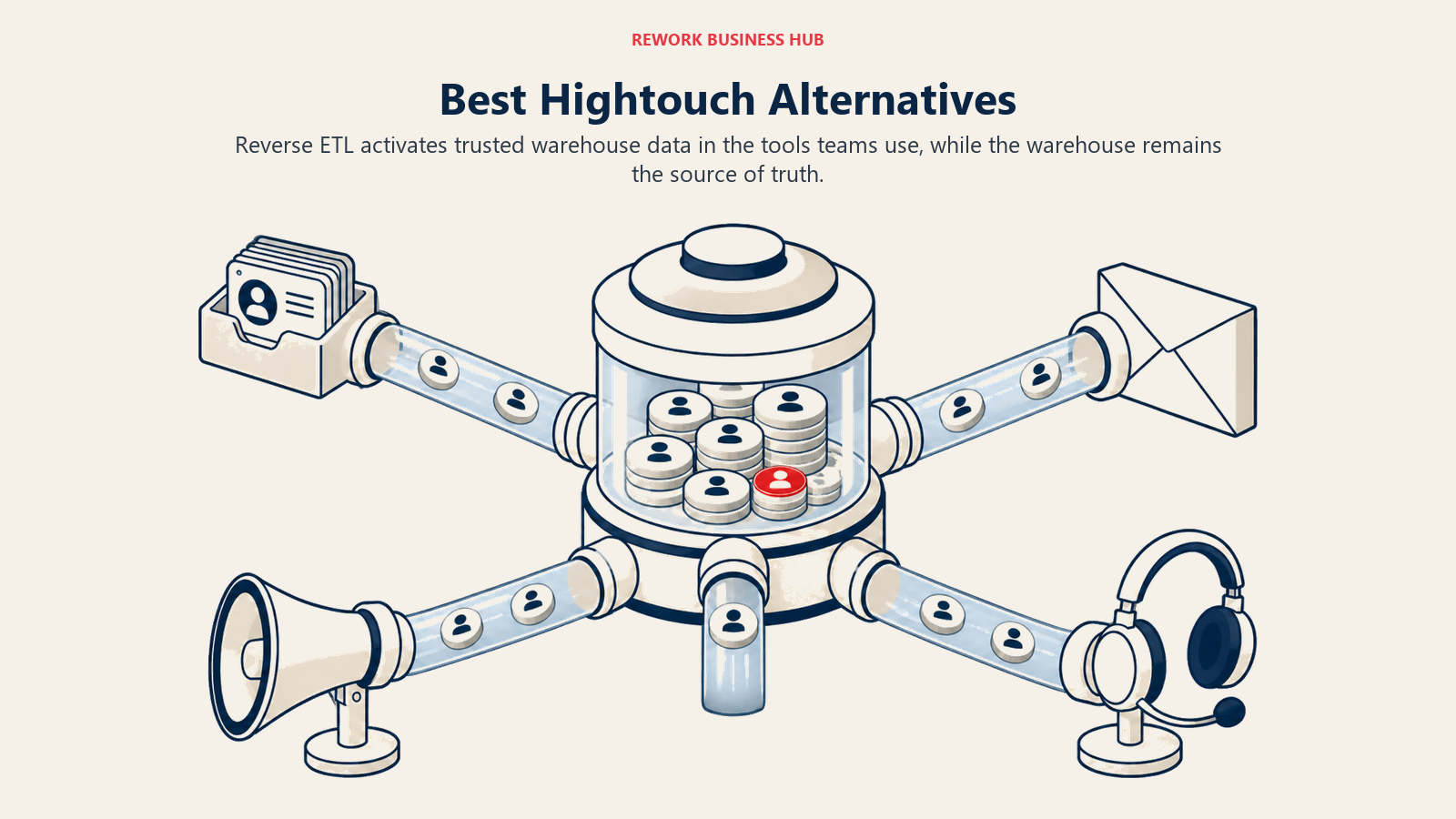
Hightouch built its reputation as the reverse ETL company, the tool that turned "keep the warehouse as the source of truth, activate everywhere" into a mainstream pattern instead of a niche one. That reputation is earned. Hightouch was named a Leader in Gartner's Magic Quadrant for Customer Data Platforms in its first appearance in the report, its free Basic Reverse ETL tier ships unlimited destinations and unlimited user seats, and its newer AI Decisioning and Ad Studio lines extend the same warehouse-native model into campaign optimization. For a data team already living in Snowflake, BigQuery, or Databricks that wants clean data synced straight into Salesforce, HubSpot, or a dozen ad platforms, Hightouch is still one of the strongest defaults on the market.
But Hightouch's own pricing page tells the rest of the story. Past the free tier, both the Composable CDP and the newer Agentic Marketing Platform are usage-based with no published rate card, so budgeting means a sales call, not a calculator. The free tier caps out at two active syncs, workable for a proof of concept, not real production pipelines. And the widely repeated "$350 a month Starter" plan is gone from the vendor's own page as of August 2026, even though third-party sites still print it as current. None of that makes Hightouch a bad tool. It means real shoppers land on the edges of the category instead: pure reverse ETL tools that publish real prices, composable CDPs that add identity resolution on the warehouse pattern, and packaged CDPs for teams that don't want to run a warehouse-native stack themselves. This guide covers 12 of them, split across those three shapes, with pricing. Start with our customer data platforms roundup if you haven't settled on reverse ETL as the right category yet.
What Changed in This Category in 2026
Four names on this list changed shape in the past eighteen months. Census was acquired by Fivetran (May 1, 2025) and ships as Fivetran Activations now. Salesforce Data Cloud was renamed Salesforce Data 360 at Dreamforce on October 14, 2025. Treasure Data rebranded to Treasure AI in April 2026. And Hightouch dropped its published "$350/month Starter" tier, replacing the free tier's soft limits with a hard cap of two active syncs. If any of these four show up under an old name, treat that as a sign the source is stale.
Key Facts
- Composable and warehouse-native CDP vendors posted 7.8% organic employment growth in the second half of 2025, nearly six times the 1.3% industry average, and more than one in four CDPs now supports a warehouse-native architecture (CDP Institute, via CDP.com's 2026 CDP Industry Statistics).
- 57% of data teams reported increased warehouse and compute spend in early 2026, versus just 13% reporting a decrease, evidence that "keep data in the warehouse and activate it" keeps winning budget (dbt Labs, 2026 State of Analytics Engineering Report).
- Salesforce's Data 360 platform ingested 32 trillion records in fiscal Q3 2026, up 119% year over year, including 15 trillion through Zero Copy integration, a marker of how fast packaged CDPs are absorbing the pattern reverse ETL popularized (Salesforce FY26 Q3 earnings, via Investing News Network).
- Effective personalization can cut customer acquisition costs by up to 50% and lift revenue 5 to 15%, the business case every vendor on this list is ultimately selling against (McKinsey, "The Value of Getting Personalization Right or Wrong Is Multiplying").
- The data pipeline tools market, which includes reverse ETL, is projected to grow from $12.1 billion in 2026 to $48.3 billion by 2030, a roughly 26.8% CAGR (Grand View Research, Data Pipeline Tools Market).
Quick Comparison Table
| Tool | Category | Best For | Pricing Model | Key Strength | Key Limitation |
|---|---|---|---|---|---|
| Fivetran Activations | Pure reverse ETL | Teams already on Fivetran | Free tier; usage-based per MAR | One bill for ingestion and activation | Census's identity is gone; MAR pricing is opaque |
| RudderStack | Pure reverse ETL, event pipeline | Source-available control | Free (250K events/mo); from $265/mo | Self-hostable under Elastic License 2.0 | Not OSI open source; free tier capped at 250K events |
| Jitsu | Pure reverse ETL | Real open source on a budget | Free (200K events/mo); $99/mo | Genuinely MIT-licensed, self-hostable | Smaller destination catalog than rivals |
| Twilio Segment | Composable CDP, reverse ETL | The category's original CDP | Free (500K RETL records/mo); from $120/mo | 700+ integrations, deep pipeline maturity | CDP layer (Unify/Engage) is quote-only |
| GrowthLoop | Composable CDP | Marketer-led activation | No published price, contact sales | Built for self-serve campaign building | No self-serve tier or published pricing |
| Amperity | Composable/lakehouse CDP | Enterprise identity resolution | No published price, "Amps" consumption | Best-in-class identity resolution at scale | No freemium tier or self-serve trial |
| Snowplow | Warehouse-native behavioral data | Creating first-party data, not moving it | No published price; 14-day $0 trial | Owns data at the point of collection | Source-available under SLULA, not OSI |
| Salesforce Data 360 | Packaged CDP | Salesforce-native enterprises | $500 per 100k Flex Credits, or $240 per 1k profiles/year | Zero Copy integration across Salesforce | Pricing opaque outside an account team |
| Lytics (now Contentstack) | Packaged CDP | Existing customers migrating | No longer published; pricing page 404s | Lives on inside Contentstack AXP | Standalone site retires 30 September 2026 |
| Tealium | Packaged CDP, tag management | Consolidating tags and customer data | No published price at all | Two decades of tag-management depth | Zero pricing transparency |
| Treasure AI | Packaged CDP, agentic layer | A "no compute" cost model | No published price, profile/behavior-tiered | Charges for profiles, not compute | Mid-rebrand from CDP to agentic platform |
| Klaviyo Data Platform | Packaged CDP in a marketing CRM | Ecommerce brands on Klaviyo | Free (250 profiles); from about $45/mo | CDP bundled into campaign tools already used | Not built for B2B outside ecommerce |
Reverse ETL vs. Composable CDP vs. Packaged CDP
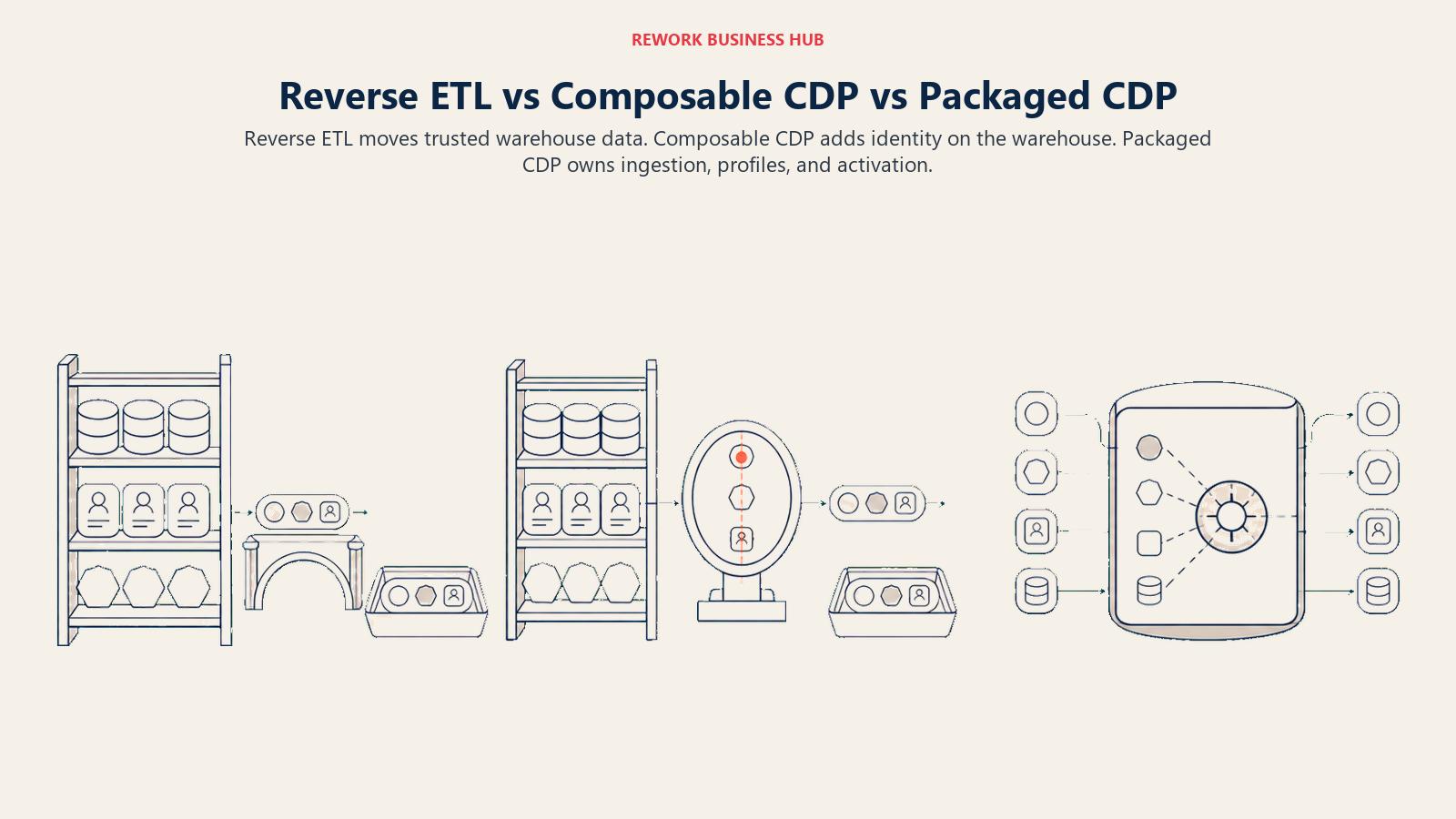
Before the tool-by-tool breakdown, it's worth being precise about what these three shapes do, because a lot of Hightouch shoppers assume they need reverse ETL when what they actually need is a CDP, and the wrong pick means redoing the evaluation in a year.
| Category | What it does | You need this if... |
|---|---|---|
| Pure reverse ETL | Syncs modeled tables from the warehouse into your CRM, ad platforms, and other operational tools. No identity resolution, no profile store. | Your warehouse already has clean, deduplicated data, and you just need it in the tools your team opens every day. |
| Composable / warehouse-native CDP | Adds identity resolution and audience building on top of warehouse data, without copying it into a proprietary store. | You need unified profiles built from warehouse data, but want governance to stay inside the warehouse. |
| Packaged CDP | Ingests, stores, and unifies customer data inside the vendor's own platform, then activates it from there. | You don't have a mature warehouse or a data team, and want one vendor to own ingestion, identity, and activation. |
Do You Actually Need Reverse ETL, or Just a CDP?
Here's the honest diagnostic before you book a demo: can you already answer "who are our top 100 customers by lifetime value" against your own warehouse? If yes, what's missing is activation, getting that answer into the tools your team touches daily. That's a reverse ETL problem: Fivetran Activations, RudderStack, or Jitsu solve it without making you buy identity resolution you don't need.
If the honest answer is "we'd have to join six tables and still wouldn't trust the result," your problem is identity and unification: deciding that the person who emailed support and the account that signed a contract are the same customer. That's a CDP problem, solved either by a composable CDP on your warehouse (Twilio Segment, GrowthLoop, Amperity) or a packaged CDP that handles ingestion and identity itself (Salesforce Data 360, Lytics, Tealium, Treasure AI, Klaviyo). Buying reverse ETL to solve an identity problem just moves badly joined data faster. Try our business intelligence tools roundup if you don't even have a warehouse team that could run that query.
Pure Reverse ETL Alternatives
These three do less than a full CDP by design: no identity resolution, no proprietary profile store, just clean warehouse data synced into the tools your team already uses. They're the closest swap for Hightouch's free Basic Reverse ETL tier.
1. Fivetran Activations (formerly Census) - Reverse ETL Folded Into a Bigger Ingestion Platform
Census was one of Hightouch's most direct competitors for years, matching it feature for feature on warehouse-native syncs. That changed in May 2025, when Fivetran acquired Census and folded it into its broader ELT platform as "Activations": ingestion and activation billed under one Monthly Active Rows (MAR) meter, from a single vendor. The Free plan covers 500,000 Connections MAR and 3,500 Activations MAR a month, enough to prototype before committing to a paid, usage-based rate.
| Pros | Cons |
|---|---|
| One platform and one bill for both ingestion and activation | Census's independent product identity and roadmap are gone |
| Backed by Fivetran's much larger connector and reliability investment | No published per-MAR rate; real cost requires a sales conversation |
Pricing: Free (500K Connections MAR/mo, 3,500 Activations MAR/mo). Paid tiers usage-based per MAR, no published rate, up to 22% off annual.
Best for: A team already running Fivetran for ingestion that wants activation on the same bill.
2. RudderStack - Source-Available Reverse ETL and Event Pipeline
RudderStack pitches itself as a Segment-and-Hightouch hybrid: it collects and routes events like a CDP pipeline, then syncs warehouse tables back out through reverse ETL, all from one product. Worth flagging, because it's widely misreported: the self-hosted code runs under the Elastic License 2.0, source-available, not OSI open source, and the free tier is capped at 250,000 events a month, not unlimited. Growth starts at $265/month for 1 million events, scaling through tiers to 25M+.
| Pros | Cons |
|---|---|
| Combines event pipeline and reverse ETL in one tool | Source-available under Elastic License 2.0, not true open source |
| Real published pricing from $0 through $265/month | Free tier's 250K event cap is easy to outgrow within a quarter |
Pricing: Free ($0, 250K events/mo). Growth from $265/month (1M events/mo, tiers to 25M+), 25 RETL connections included. Enterprise custom.
Best for: A team that wants event collection and reverse ETL from one vendor and is fine with source-available code. See Segment vs. RudderStack or the RudderStack alternatives guide for more depth.
3. Jitsu - Real Open Source, Real Free Tier
Jitsu is the one tool on this list where "open source" isn't a licensing footnote, it's the whole pitch. The self-hosted core ships under the MIT license, genuinely permissive, no source-available asterisk. For a team that wants to avoid lock-in on the activation layer or wants to audit and modify the code, Jitsu is the most straightforward answer here. Free covers unlimited captured events, 200,000 active events a month, and unlimited connectors with one daily sync. Business runs $99 a month for 2 million active events with hourly sync.
| Pros | Cons |
|---|---|
| Genuinely MIT-licensed, the most permissive license on this list | Smaller destination catalog than Hightouch, Fivetran, or RudderStack |
| Lowest real paid entry price among reverse ETL tools here, at $99/month | Free tier's one-daily-sync cadence is slow for time-sensitive activation |
Pricing: Free ($0, unlimited captured events, 200K active events/mo, 1 daily sync). Business $99/month (2M active events/mo, hourly sync). Enterprise custom (1-minute syncs).
Best for: A small, technical team that wants a genuinely open-source reverse ETL tool and doesn't need same-hour sync frequency on the entry tier.
Composable and Warehouse-Native CDP Alternatives
These four add identity resolution and audience building on top of the warehouse pattern, closer to Hightouch's own Composable CDP line than to its free reverse ETL tier.
4. Twilio Segment - The Category's Original CDP, Now With Reverse ETL Built In
Segment popularized the CDP event pipeline before "reverse ETL" was a phrase anyone used, and Twilio's ownership since 2023 hasn't changed that core identity (segment.com/pricing now redirects to twilio.com; it's officially Twilio Segment). Connections includes reverse ETL directly, while a separate Unify and Engage layer handles identity resolution as its own CDP, priced separately with no published rate. Free covers 1,000 visitors, 2 sources, and 500,000 Reverse ETL records a month, with 700+ integrations, the deepest catalog here.
| Pros | Cons |
|---|---|
| 700+ integrations, the broadest destination catalog on this list | The CDP layer (Unify/Engage) is priced separately and only via sales |
| Free tier includes real reverse ETL capacity (500K records/mo), not just events | MTU overage tiers on Team can get expensive at real scale |
Pricing: Free (1,000 visitors/mo, 2 sources, 500K RETL records/mo). Team from $120/month (10,000 visitors/mo, unlimited sources, 1M RETL records). Business custom. CDP layer (Unify/Engage) contact sales.
Best for: A team that wants the deepest integration catalog available and is fine buying event pipeline and CDP identity as separately priced products. Our Segment alternatives guide covers that field if Segment itself is the incumbent.
5. GrowthLoop - Composable CDP Built for Marketer-Led Activation
GrowthLoop's whole design center is the marketer, not the data engineer. It sits on top of your existing warehouse (Snowflake, BigQuery, Databricks) and gives marketing teams a self-serve interface for building audiences and launching campaigns, without an engineer writing the query every time a segment changes, a different audience than Hightouch's more engineering-led model. Pricing is undisclosed: three tiers by customer-record volume, Basic (up to 1,000,000), Growth (up to 10,000,000), and Enterprise (10,000,000+), all routing to "Contact Us."
| Pros | Cons |
|---|---|
| Purpose-built for marketing teams to self-serve audience building | Zero published pricing at any tier, every evaluation starts with sales |
| Warehouse-native architecture keeps governance where your data already lives | Less name recognition and integration breadth than Segment or Hightouch |
Pricing: No published pricing. Basic (up to 1M customer records), Growth (up to 10M), Enterprise (10M+), all contact sales.
Best for: A marketing team that wants to build and launch audiences against warehouse data themselves, without routing every segment change through a data engineer.
6. Amperity - Enterprise Identity Resolution on Your Lakehouse
Amperity solves a narrower, harder problem than most of this list: enterprise-grade identity resolution at the scale retail, hospitality, and travel brands need, matching the same customer across dozens of loyalty programs and touchpoints. Rather than reverse ETL syncs, its Lakehouse CDP shares unified profiles directly into Databricks and Snowflake through Delta Sharing and Iceberg tables, a different mechanism than the sync-based tools elsewhere on this list. There's no published pricing, no freemium tier, and no self-serve trial; cost is consumption-based, measured in "Amps."
| Pros | Cons |
|---|---|
| Best-in-class identity resolution built for enterprise retail and hospitality scale | No freemium tier or self-serve trial at all |
| Delta Sharing/Iceberg-based activation avoids duplicate data copies entirely | Consumption-based "Amps" pricing is hard to estimate before onboarding |
Pricing: No published pricing, no freemium tier. Consumption-based, priced in "Amps," quote only.
Best for: An enterprise retail, hospitality, or travel brand whose core problem is identity resolution across many disconnected customer touchpoints, not simple data movement.
7. Snowplow - Creating First-Party Data, Not Just Moving It
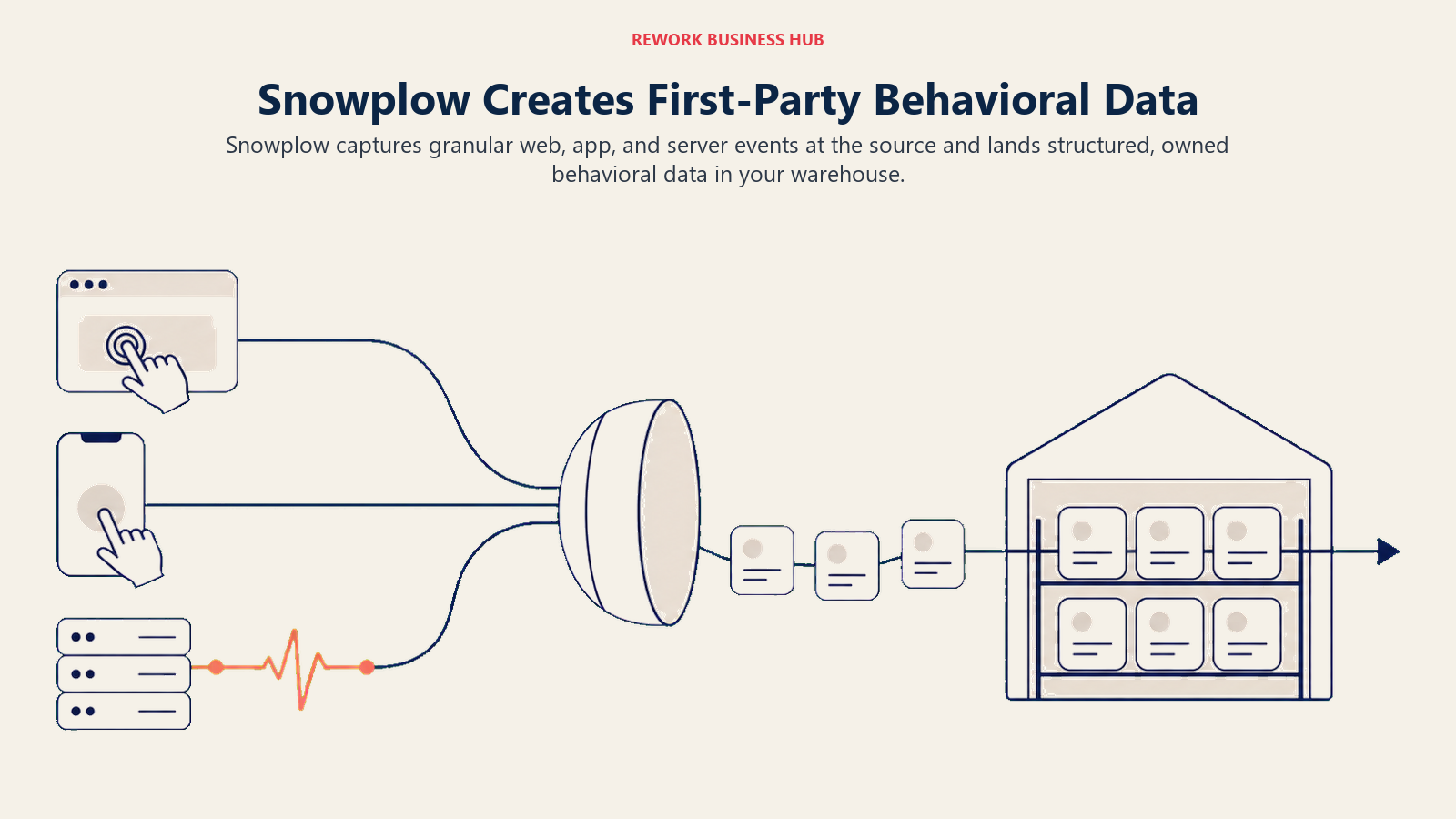
Snowplow solves a genuinely different problem than the rest of this list. Every other tool here activates data that already exists. Snowplow creates it: a behavioral data collection pipeline that captures granular, first-party event data at the point of interaction (web, app, server-side) and lands it directly in your warehouse as structured, owned data, rather than relying on a third-party SDK's interpretation. There's no published pricing anywhere; a 14-day free trial runs at $0, and both the Self-Hosted Pipeline and managed Snowplow Platform are quote-only beyond that. One licensing detail worth getting right: the self-hosted core runs under the Snowplow Limited Use License Agreement (SLULA 1.1), which restricts non-commercial use, not the Apache 2.0 license it's still sometimes described as.
| Pros | Cons |
|---|---|
| Captures owned, granular first-party behavioral data at the source | Solves a data-creation problem, not a data-activation problem like the rest of this list |
| 14-day $0 trial with no card required lowers the bar to evaluate | Self-hosted core is SLULA-licensed, not Apache 2.0, despite the reputation |
Pricing: No published pricing. 14-day free trial at $0, no card. Self-Hosted Pipeline and Snowplow Platform both quote-only.
Best for: An engineering-led team whose real gap is owning clean, first-party event data at the source. Our Looker alternatives guide covers the analytics layer that typically sits on top.
Packaged CDP Alternatives
These five ingest, store, and unify data inside the vendor's own platform rather than treating the warehouse as the source of truth, the right shape for a team without a data engineering function to maintain one.
8. Salesforce Data 360 (formerly Data Cloud) - The Enterprise Default If You're Already on Salesforce
Salesforce renamed Data Cloud to Data 360 at Dreamforce on October 14, 2025, though the underlying license and data model carried over unchanged. For an enterprise already on Sales Cloud, Service Cloud, or Marketing Cloud, the pitch is Zero Copy access without duplicating data, feeding directly into Agentforce's AI agents. Salesforce reported Data 360 ingested 32 trillion records in fiscal Q3 2026, up 119% year over year. Salesforce publishes real rates: $500 per 100,000 Flex Credits, or $240 per 1,000 profiles per year on the newer profile-based model, with Enterprise Profiles at $420 per 1,000 per year.
| Pros | Cons |
|---|---|
| Zero Copy integration keeps data connected across the whole Salesforce stack | Pricing is entirely opaque outside a direct Salesforce sales conversation |
| 32 trillion records ingested in a single quarter shows real production scale | Value concentrates heavily inside the Salesforce ecosystem specifically |
Pricing: Published. $500 per 100,000 Flex Credits on the consumption model, or $240 per 1,000 profiles per year (Enterprise Profiles $420 per 1,000 per year) on the profile model. Salesforce marks the page subject to change.
Best for: An enterprise already standardized on Salesforce that wants data unified inside the ecosystem powering its CRM and AI agents. See the Salesforce Data Cloud alternatives guide if Data 360 is the incumbent.
9. Lytics (now Contentstack) - Being Retired as a Standalone CDP
Lytics used to earn its spot on transparency, publishing real tiers where Amperity, Tealium and GrowthLoop route you to a sales call. Treat it as a warning now rather than a shortlist candidate, because plenty of comparison content still recommends it on pricing that no longer exists. Contentstack acquired Lytics, and lytics.com now carries one notice: "Lytics has moved to Contentstack. This site will be retired on September 30th, 2026." Lytics already has no public pricing page. The technology ships on as Lytics CDP inside Contentstack AXP, but the published, self-serve credit pricing it was known for is gone, and Contentstack publishes no rate for it. The platform itself still focuses on AI-assisted audience building and predictive scoring over a fairly traditional ingestion model, so the capability is intact; only the self-serve entry point is gone.
| Pros | Cons |
|---|---|
| Real published starting price ($500/mo), unusual for a packaged CDP | Credit consumption climbs fast for high-event-volume teams |
| Genuinely free Developer tier for evaluation, not a time-limited trial | Smaller integration ecosystem than Segment, Tealium, or Salesforce |
Pricing: Developer free forever (2M credits/mo, up to 10 domains). Growth from $500/month (5M credits/mo, unlimited domains, +$500 per additional 10M credits). Enterprise custom (10M+ credits).
Best for: A mid-market team that wants a packaged CDP with a real, budgetable starting price instead of a sales-gated quote.
10. Tealium - Two Decades of Tag Management Plus Customer Data
Tealium predates most of this list by a decade or more, built as an enterprise tag management system before adding AudienceStream, its customer-data layer. For an enterprise managing dozens of tags across multiple teams, the pitch is consolidation: one vendor owning both the tag layer and the data layer that depends on it. Pricing transparency is essentially nonexistent: tealium.com/pricing 301-redirects to a stray image asset, and no other page publishes a number. Any figure elsewhere is third-party, never vendor-confirmed.
| Pros | Cons |
|---|---|
| Two decades of tag-management depth most CDP-only vendors can't match | Zero pricing transparency, not even an indicative range on the vendor's site |
| Consolidates tag management and customer data under a single vendor | Real-time CDP capabilities are a newer addition layered onto an older core |
Pricing: No published pricing at all. Contact sales for a quote.
Best for: A large enterprise with real tag-management complexity that wants one vendor to own both tags and customer data. See the Tealium alternatives guide if Tealium is the incumbent.
11. Treasure AI (formerly Treasure Data) - A CDP Repositioning as an Agentic Platform
Treasure Data rebranded to Treasure AI in April 2026, framed as moving from customer data platform to agentic experience platform, though the product still functions as an enterprise CDP for teams evaluating it as a Hightouch alternative. Its distinctive claim is a "no compute" philosophy: pay for the volume of profiles and behaviors you manage, not query volume or processing power. There's no published pricing; three lines instead, the Intelligent Customer Data Platform (annual subscription, tiered on profiles/behaviors), Treasure AI Suites (fixed license plus consumption credits), and Treasure AI Studio (usage credits).
| Pros | Cons |
|---|---|
| "No compute" model charges for profiles and behaviors, not query volume | Mid-cycle rebrand from CDP to "agentic experience platform" adds friction |
| Long enterprise track record predating most composable CDP competitors | No published pricing anywhere, across any of its three product lines |
Pricing: No published pricing. Intelligent Customer Data Platform (annual subscription, tiered on profiles/behaviors), Treasure AI Suites (fixed annual license plus consumption credits), Treasure AI Studio (usage credits).
Best for: An enterprise that wants predictable, volume-based CDP pricing decoupled from compute cost and doesn't mind evaluating a platform mid-rebrand.
12. Klaviyo Data Platform - CDP Layer Inside a B2C Marketing CRM
Klaviyo took a different path into the CDP category: rather than building or buying a standalone platform, it layered a CDP directly inside the marketing CRM ecommerce and B2C brands already run email and SMS campaigns through, sold as "Klaviyo Data Platform" and "Advanced Klaviyo Data Platform," with no separate activation step required. The Free plan covers up to 250 active profiles, 500 email sends, and $5 of mobile messages a month; paid pricing scales by active profile count per module, with a representative starter configuration totaling about $45/month.
| Pros | Cons |
|---|---|
| CDP layer is bundled directly into campaign tools teams already use daily | Built specifically for ecommerce and B2C, a poor fit for B2B customer data |
| Genuinely free entry tier makes evaluation frictionless for small stores | Module-based pricing gets complex fast once you add Data + Analytics and Service |
Pricing: Free (up to 250 active profiles, 500 email sends/mo). Paid pricing scales by active profiles, configured per module; a representative starter configuration totals about $45/month.
Best for: An ecommerce or B2C brand already on Klaviyo for email and SMS that wants unified customer data feeding those campaigns. See the Klaviyo alternatives guide if the broader platform isn't the right fit.
Switching Away From Hightouch: What Actually Changes
The real cost of switching shows up in two places beyond the license fee. The first is re-mapping your model layer, not migrating data: warehouse tables don't move when you switch tools, but the sync logic that turns raw tables into "the record my CRM needs" does, and that rebuild takes real time if your Hightouch models have years of undocumented logic. The second is destination re-authentication: every integration needs re-verified field mappings before you can trust a sync, invisible in a demo and very visible during rollout, so plan a parallel run against a sandbox before cutting over production traffic.
Underneath both is the question this guide keeps returning to: do you need a CDP's identity resolution or just reverse ETL's data movement? Buying more platform than you need adds cost without solving a real problem. Our AI tools for data analysis roundup is a useful next stop if your real question is what happens after activation, and our CRM software roundup is worth a look if the actual gap is upstream, in the CRM receiving the synced data.
Sizing and Stage Fit
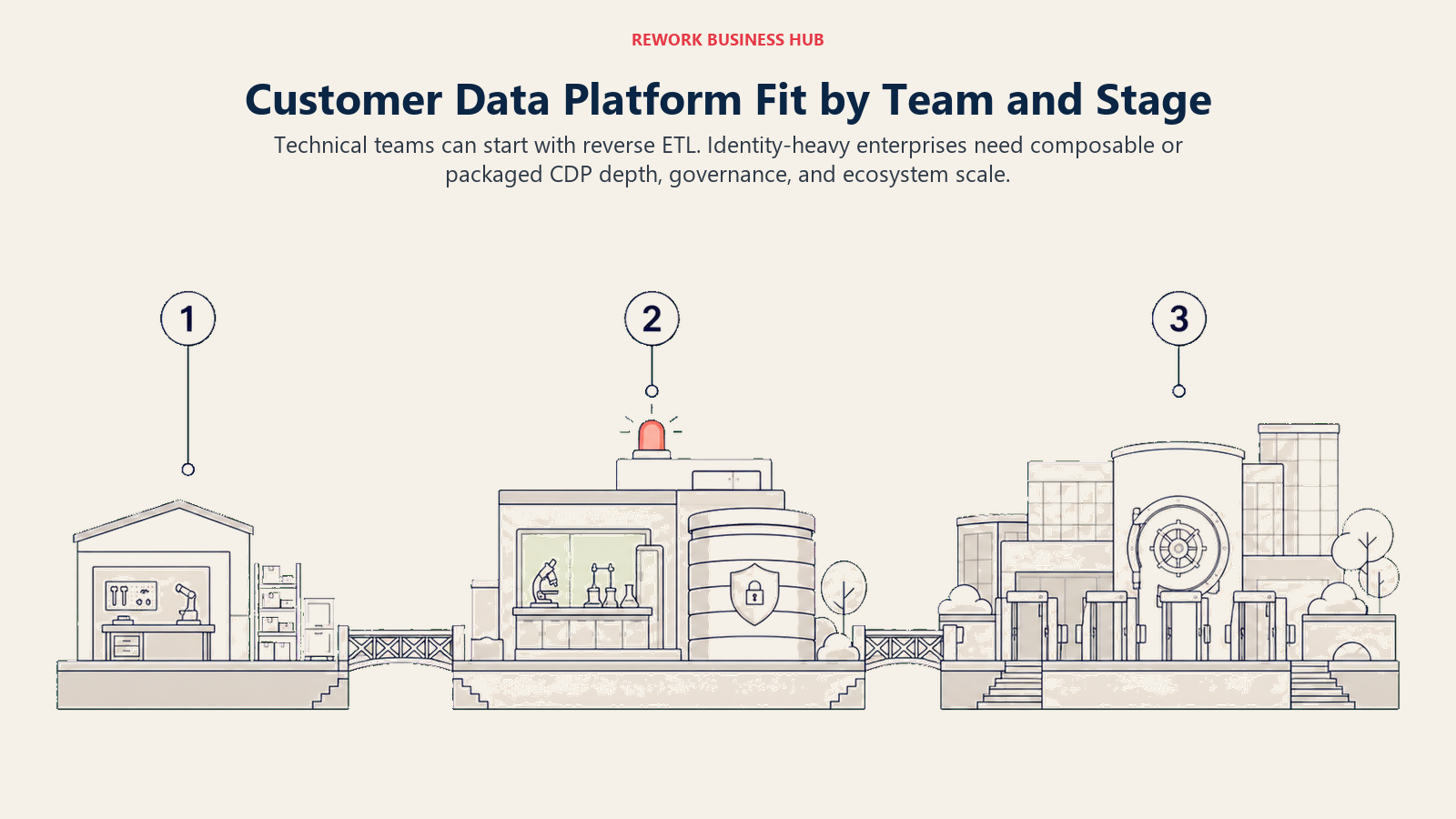
Team capacity and architecture maturity narrow this market quickly. Match the platform to the data practice you can operate today, not the one you hope to build later.
| Tool | Team Size Fit | Stage Fit |
|---|---|---|
| Fivetran Activations | 10 to 2,000+ | Already on Fivetran, adding activation |
| RudderStack | 10 to 1,000 | Wants pipeline and reverse ETL from one vendor |
| Jitsu | 5 to 200 | Technical team prioritizing open source over breadth |
| Twilio Segment | 50 to 5,000+ | Established practice needing deep integration coverage |
| GrowthLoop | 50 to 2,000 | Marketers self-serving audiences on the warehouse |
| Amperity | 500 to 10,000+ | Enterprise retail/hospitality with complex identity needs |
| Snowplow | 50 to 5,000+ | Engineering-led team building data infrastructure |
| Salesforce Data 360 | 200 to 10,000+ | Already standardized on Salesforce |
| Lytics (now Contentstack) | 20 to 500 | Existing customers planning a migration |
| Tealium | 500 to 10,000+ | Enterprise with tag-management complexity |
| Treasure AI | 500 to 10,000+ | Enterprise wanting compute-decoupled pricing |
| Klaviyo Data Platform | 1 to 200 | Ecommerce/B2C brand already on Klaviyo |
How to Choose: Decision Framework
Begin with the missing data job before naming a vendor. Activation, identity resolution, source collection, and packaged ownership lead to different shortlists.
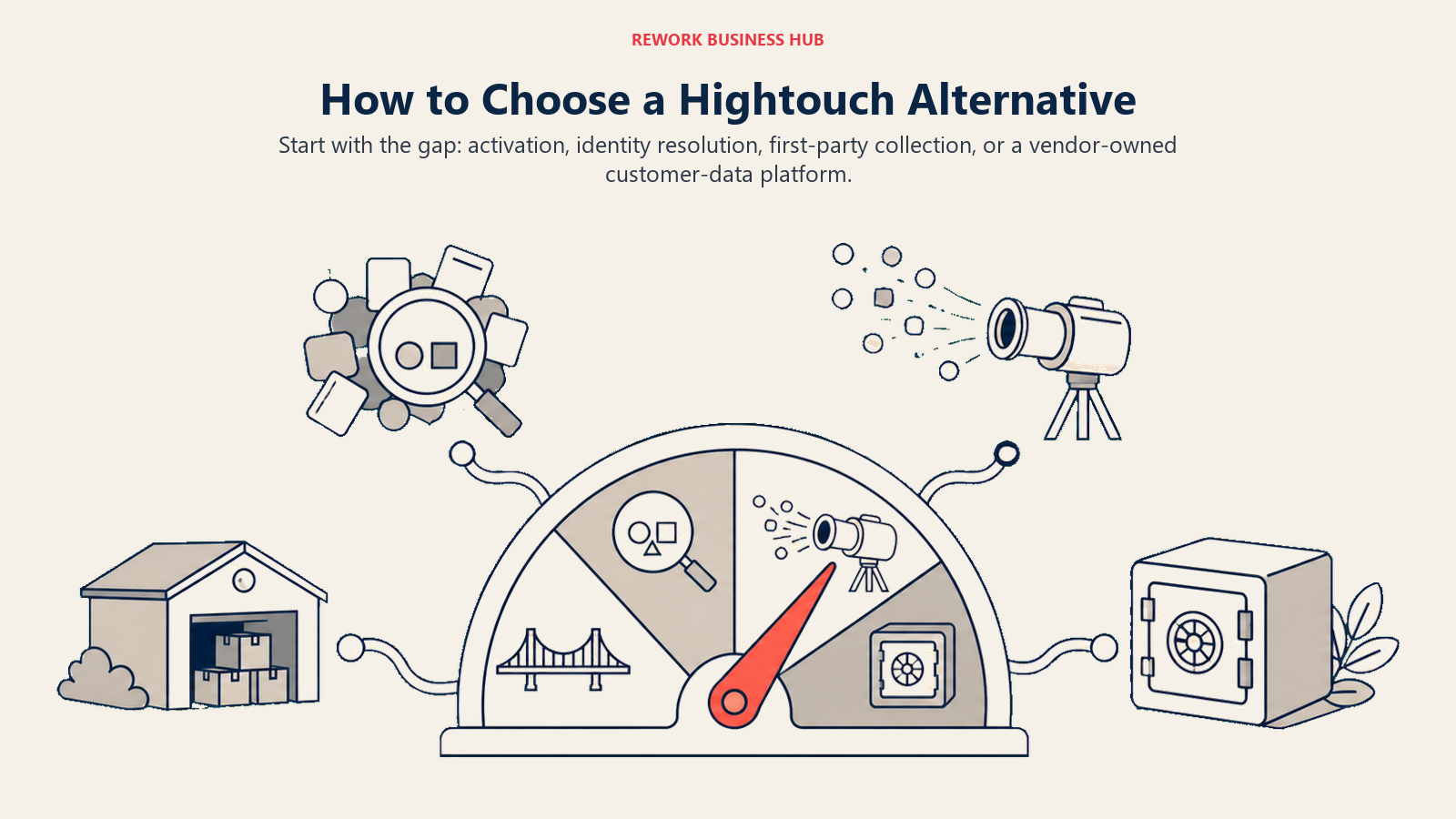
| If your situation is... | Look at |
|---|---|
| You just need warehouse data in your CRM, nothing fancier | Fivetran Activations, RudderStack, or Jitsu |
| You want the deepest integration catalog available | Twilio Segment |
| Your team is marketers who need to self-serve audiences | GrowthLoop |
| You're solving enterprise identity resolution, not simple syncing | Amperity |
| Your real gap is owning first-party data at the source | Snowplow |
| You're already deep in the Salesforce ecosystem | Salesforce Data 360 |
| You want a packaged CDP with a real starting price | Klaviyo Data Platform |
| You have serious tag-management sprawl to consolidate | Tealium |
| You want pricing decoupled from compute cost | Treasure AI |
| You're an ecommerce brand already running Klaviyo | Klaviyo Data Platform |
| You don't have a team to maintain a warehouse-native stack | Any packaged CDP: Data 360, Tealium, Treasure AI, or Klaviyo |
Frequently Asked Questions about Hightouch Alternatives
What is the real difference between reverse ETL and a composable CDP?
Reverse ETL syncs modeled warehouse tables into tools like a CRM, with no identity resolution. A composable CDP adds identity resolution and audience building on top of that same data. Clean, deduplicated warehouse data needs reverse ETL alone; unifying records across systems first needs the CDP layer too.
How much does Hightouch actually cost in 2026?
Hightouch publishes no paid prices as of August 2026. The free Basic Reverse ETL tier is capped at two active syncs. The Composable CDP and Agentic Marketing Platform are usage-based with no rate card, and the commonly cited "$350/month Starter" plan is no longer on the vendor's page.
Which Hightouch alternative has the cheapest real starting price?
Jitsu's Business tier, $99 a month for 2 million active events, is the lowest published paid price in this guide. RudderStack starts at $265 a month. GrowthLoop, Amperity, Tealium, and Treasure AI publish no starting price at all.
Is RudderStack actually open source?
Not strictly. Its self-hosted code runs under the Elastic License 2.0, source-available rather than OSI-approved like Jitsu's MIT core. Its free tier is also capped at 250,000 events a month, not unlimited.
What happened to Census, and is it still an option?
Census was acquired by Fivetran (May 1, 2025) and now operates as Fivetran Activations, priced on Fivetran's usage-based Monthly Active Rows model instead of its old flat plans.
Do I need reverse ETL if I already have a CDP?
Usually not as a separate purchase. Most composable and packaged CDPs, including Twilio Segment, Salesforce Data 360, and Tealium, already include activation. Standalone tools make sense when you don't want a full identity-resolution layer.
Which alternative is best for a team without a data warehouse or data engineering function?
A packaged CDP that handles ingestion and identity itself fits better than a warehouse-native option. Salesforce Data 360, Tealium, Treasure AI, and Klaviyo Data Platform all unify data inside their own platforms.
Which tool is the best fit for an ecommerce or B2C brand?
Klaviyo Data Platform, purpose-built for that audience, bundles unified profiles into the same email and SMS tools ecommerce brands already use. Its free 250-profile tier makes it the easiest entry point here to try.
For the head-to-head most Hightouch shoppers run next, and the acquisition that reshaped it, see Hightouch vs Census.
What to Do Next
Match your situation to a row in the decision framework above, then narrow to two finalists rather than evaluating all 12. Request real numbers for your actual event or record volume immediately; more than half the tools here require a sales call to get any price, and the number you get back depends more on your usage pattern than on anything published.
Before signing anything, run one real sync end to end in each finalist: pick a single warehouse table, connect it to one real destination, and time how long setup actually takes your own team, not a vendor's solutions engineer. That single test surfaces friction no comparison table can fully capture, and it will tell you faster than any demo whether the tool fits how your team works.
Camellia writes about business intelligence and data activation tooling for B2B teams.

Principal Product Marketing Strategist
On this page
- What Changed in This Category in 2026
- Key Facts
- Quick Comparison Table
- Reverse ETL vs. Composable CDP vs. Packaged CDP
- Do You Actually Need Reverse ETL, or Just a CDP?
- Pure Reverse ETL Alternatives
- 1. Fivetran Activations (formerly Census) - Reverse ETL Folded Into a Bigger Ingestion Platform
- 2. RudderStack - Source-Available Reverse ETL and Event Pipeline
- 3. Jitsu - Real Open Source, Real Free Tier
- Composable and Warehouse-Native CDP Alternatives
- 4. Twilio Segment - The Category's Original CDP, Now With Reverse ETL Built In
- 5. GrowthLoop - Composable CDP Built for Marketer-Led Activation
- 6. Amperity - Enterprise Identity Resolution on Your Lakehouse
- 7. Snowplow - Creating First-Party Data, Not Just Moving It
- Packaged CDP Alternatives
- 8. Salesforce Data 360 (formerly Data Cloud) - The Enterprise Default If You're Already on Salesforce
- 9. Lytics (now Contentstack) - Being Retired as a Standalone CDP
- 10. Tealium - Two Decades of Tag Management Plus Customer Data
- 11. Treasure AI (formerly Treasure Data) - A CDP Repositioning as an Agentic Platform
- 12. Klaviyo Data Platform - CDP Layer Inside a B2C Marketing CRM
- Switching Away From Hightouch: What Actually Changes
- Sizing and Stage Fit
- How to Choose: Decision Framework
- What to Do Next