Best Tealium Alternatives in 2026: 12 CDPs for Enterprise Data Teams
Turn this article into takeaways for your work.


Each assistant summarizes the article only for you and suggests best practices for your work.
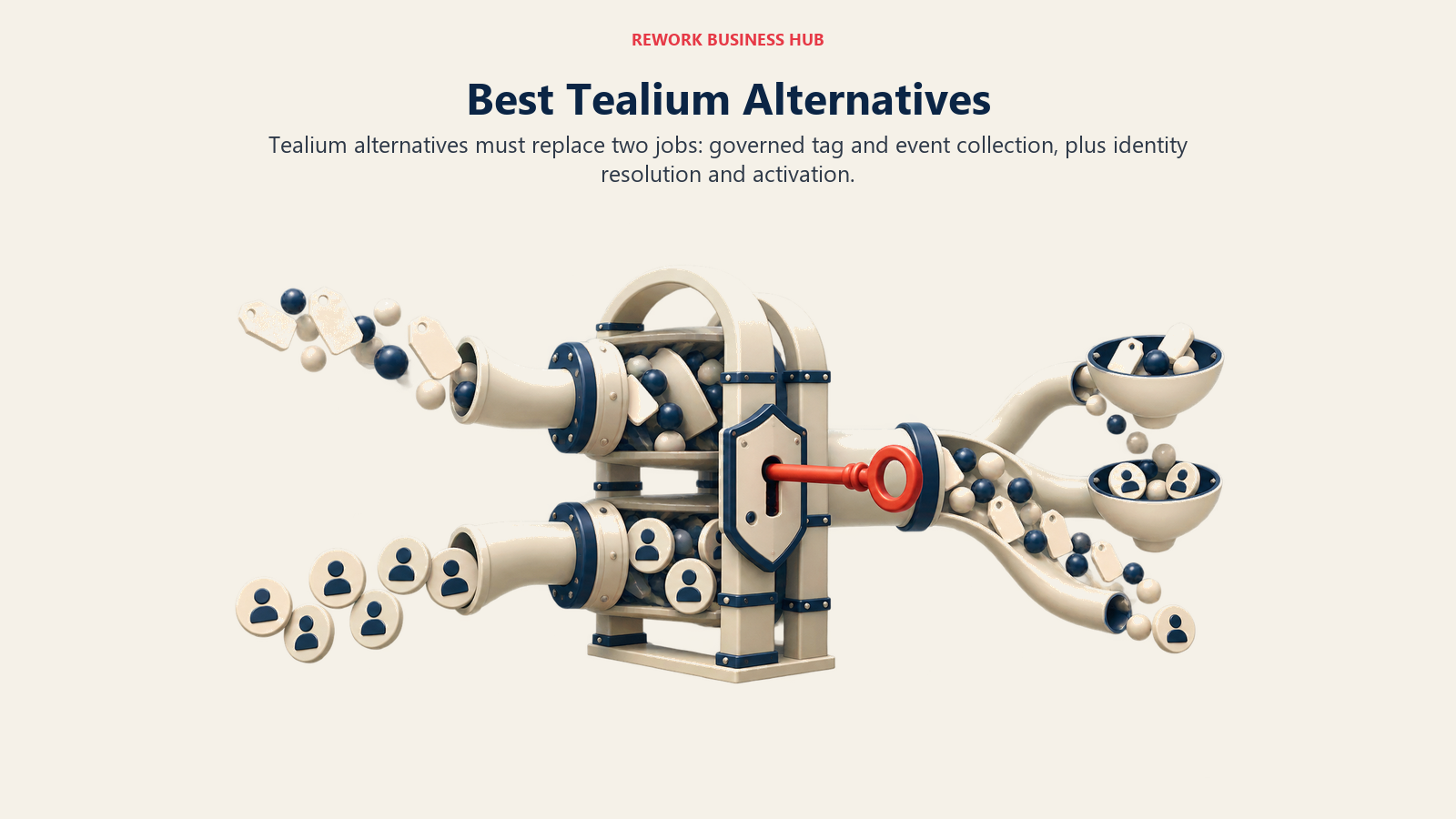
Twilio Segment is the best Tealium alternative for teams that want the broadest connector ecosystem and a warehouse-native path via Reverse ETL, Adobe Real-Time CDP is the closest match if what you actually need replaced is both Tealium's tag management and its CDP in one Adobe contract, and Salesforce Data 360 is the strongest pick for teams already living inside Salesforce's CRM and Agentforce ecosystem. Every tool below is evaluated on whether it replaces Tealium's core jobs (data collection, identity resolution, and activation) and whether it also replaces Tealium iQ, Tealium's tag management layer, since most Tealium shoppers are quietly replacing two products at once. Pricing comes from each vendor's own pricing page, or is explicitly labeled (reported) where nobody publishes one.
Tealium earned its enterprise reputation honestly: Tealium iQ remains one of the more mature tag management systems on the market, EventStream handles server-side event collection well, and the platform's consent and governance tooling is built for regulated industries that need an audit trail on every data flow. It also markets one of the category's largest turnkey connector catalogs, which matters when you're integrating dozens of downstream martech and adtech tools. None of that is in question here. What's in question is what happens next: no published pricing anywhere on Tealium's site, an enterprise-only sales motion with no self-serve entry point, an implementation that typically needs a dedicated specialist to run, and a growing number of data teams who'd rather define customer profiles once in their own warehouse than copy them into a vendor-owned store. If you haven't narrowed the category yet, start with our customer data platform roundup; if Tealium specifically is the incumbent you're evaluating against, keep reading.
Key Facts
- Google's 2026 Magic Quadrant for Customer Data Platforms moved Tealium from Leader to Challenger, citing slowing market velocity and customer acquisition, while Salesforce remained the sole Leader (Gartner Magic Quadrant coverage via CX Today).
- 68% of surveyed organizations report a deployed customer data platform and 57% report a unified customer database for the first time, per CDP Institute's member survey of 400+ respondents (CDP Institute).
- European regulators issued roughly €1.2 billion in GDPR fines in 2025, and data protection authorities now receive an average of 443 personal data breach notifications a day, a 22% year-over-year increase (DLA Piper GDPR Fines and Data Breach Survey, via The Register).
- 98% of marketers say they hit barriers to personalization, and data issues are the most common culprit, per Salesforce's State of Marketing report (Salesforce).
- The global CDP software market is projected to grow from $4.07 billion in 2026 to $17.03 billion by 2034, a 19.6% CAGR (Fortune Business Insights).
Quick Comparison Table
| Tool | Best For | Starting Price | Key Strength | Key Limitation |
|---|---|---|---|---|
| Twilio Segment | Teams wanting the widest connector library plus a warehouse-native Reverse ETL path | Free: 1,000 visitors/mo. Team: from $120/mo, 10,000 visitors/mo | 700+ integrations, mature CDP with a genuine free tier | Full Unify/Engage CDP tier is quote-only, no published price |
| Adobe Real-Time CDP | Enterprise teams that want tag management and CDP replaced under one Adobe contract | No published price, sold in Prime and Ultimate packages by profile volume | Adobe Experience Platform Tags (its TMS) ships free with the platform | No published pricing anywhere, quote-only sales cycle |
| Salesforce Data 360 | Teams standardized on Salesforce CRM and Agentforce | $500 per 100k Flex Credits, or $240 per 1k profiles/year | Deepest native tie to Sales Cloud, Service Cloud, and Agentforce | Credit consumption is genuinely hard to forecast before a contract |
| Treasure AI | Teams that want Tealium's profile-and-behavior pricing philosophy without per-query compute costs | No published price, annual subscription tiered on profiles and behaviors | "No compute" pricing model, pay for data not query volume | Rebranded from Treasure Data in April 2026, mid-migration positioning |
| mParticle | Mobile-first and omnichannel consumer brands, now part of Rokt | No published price | Deep mobile SDK coverage across iOS, Android, and web | Now sold inside Rokt, no self-serve or published pricing |
| BlueConic | Marketing-owned CDPs that want a no-code segmentation UI | No published price, demo or quote only | Business-user-friendly interface, minimal engineering dependency | No free tier, no transparent pricing for budgeting |
| Amperity | Retail, hospitality, and travel brands needing identity resolution at scale | No published price, consumption-based ("Amps") | Lakehouse-native profile sharing into Snowflake and Databricks | No self-serve trial, sales-led from the first conversation |
| Lytics (now Contentstack) | Existing customers planning a migration | No longer published; pricing page 404s | Lives on as Lytics CDP inside Contentstack AXP | Standalone site retires 30 September 2026 |
| RudderStack | Engineering-led teams wanting a source-available, warehouse-native event pipeline | Free: 250K events/mo. Growth: $265/mo for 1M events/mo | Source-available (Elastic License 2.0) with self-hosting option | Not OSI open source, and the free tier caps out fast for high-volume teams |
| Hightouch | Warehouse-native teams that want activation without copying data into a new store | No published paid price, usage-based; free Basic Reverse ETL tier | Composable CDP that queries your existing warehouse directly | No client-side event or tag collection of its own |
| Snowplow | Teams that want to own their raw behavioral event pipeline end to end | No published price, 14-day free trial, self-hosted or managed | Full ownership of first-party event data, SLULA 1.1 licensed | No published pricing, and the license restricts non-commercial self-hosting |
| Klaviyo Data Platform | Ecommerce and DTC brands already running Klaviyo as their CRM/ESP | Free: up to 250 profiles. Paid: scales by active profiles, from about $45/mo | CDP layer built into a marketing suite you may already own | Scoped to Klaviyo's own ecosystem, not a general-purpose enterprise CDP |
The Trap in This Switch: Tag Management and CDP Are Two Jobs
Most Tealium evaluations start from the wrong question. Buyers ask "what replaces AudienceStream" (Tealium's CDP and segmentation layer) and forget that Tealium iQ, the tag management system underneath it, is a second product doing a second job: deploying and governing every marketing and analytics tag on your site, with consent rules attached to each one. Swap out the CDP half and keep running Tealium iQ for tags, and you haven't actually left Tealium. Swap out both without a plan for tag governance, and your consent posture quietly breaks the week you cut over.
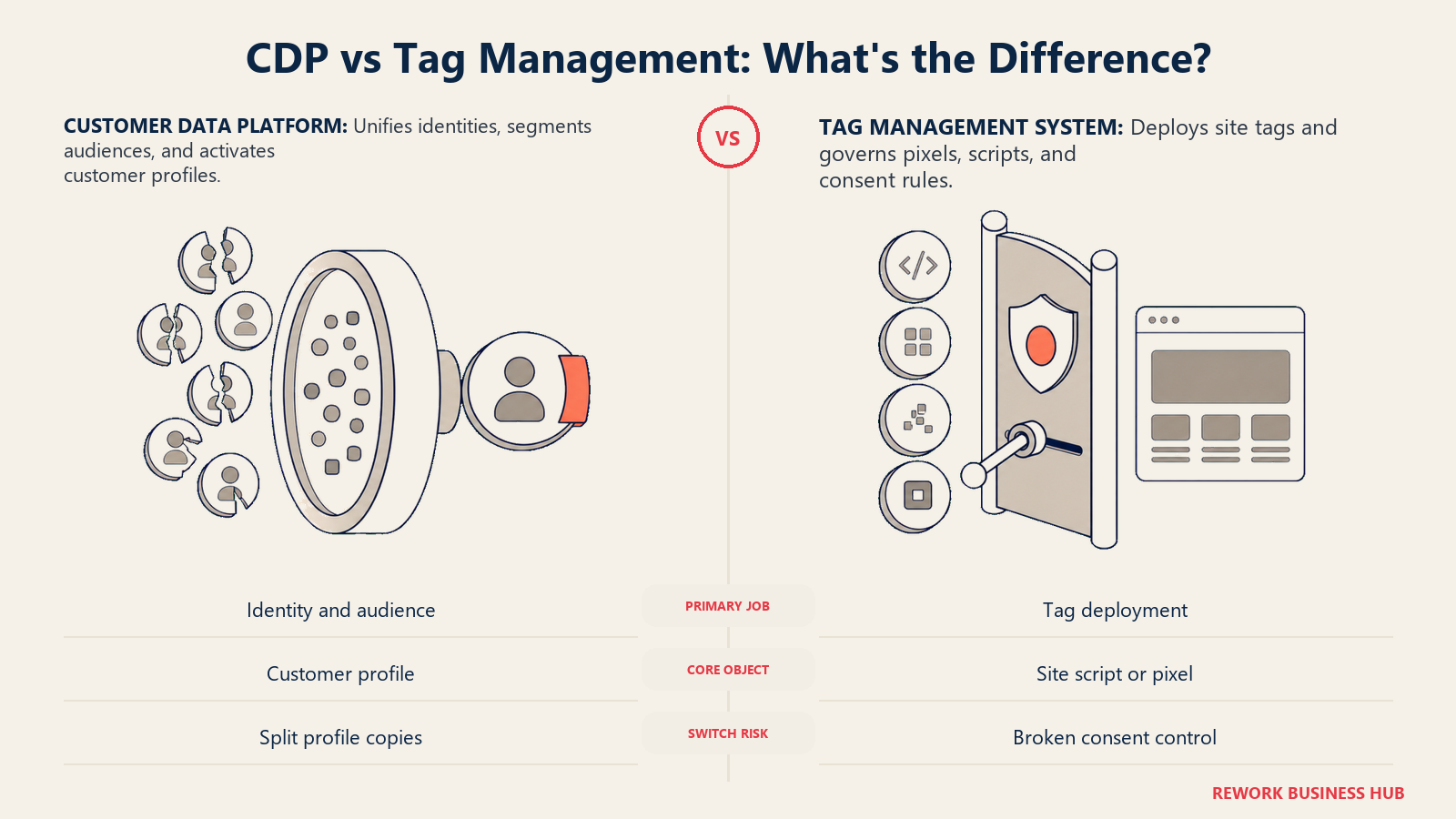
Only one tool on this list genuinely replaces both jobs under one contract: Adobe, through Real-Time CDP plus Adobe Experience Platform Tags (Adobe's tag manager, free for Experience Cloud customers, formerly known as Adobe Launch and before that Dynamic Tag Management). Everyone else on this list is a CDP, full stop. That's not a knock on them, but it does mean you're either keeping a lightweight tag manager like Google Tag Manager running alongside your new CDP, or you're consolidating tag deployment into whatever your engineering team already owns (a first-party Web SDK, server-side collection, or a CI/CD-managed tracking layer). Plan for that conversation before you sign anything.
| Alternative | Replaces the CDP Job | Replaces the Tag Management Job | What You'll Still Need |
|---|---|---|---|
| Twilio Segment | Yes | No, client-side SDKs aren't a governance UI | A separate TMS if you still deploy third-party marketing pixels |
| Adobe Real-Time CDP | Yes | Yes, via Adobe Experience Platform Tags | Nothing extra for tags specifically, both ship under Adobe Experience Cloud |
| Salesforce Data 360 | Yes | No | A separate TMS |
| Treasure AI | Yes | No | A separate TMS |
| mParticle | Yes | Partial, SDK-based collection without a visual governance UI | A dedicated consent and tag governance layer |
| BlueConic | Yes | No | A separate TMS |
| Amperity | Yes | No | A separate TMS |
| Lytics (now Contentstack) | Yes | No | A separate TMS |
| RudderStack | Yes | No | A separate TMS |
| Hightouch | Yes, activation from your warehouse | No, and no raw event collection either | An existing collection layer plus a separate TMS |
| Snowplow | Yes, behavioral data infrastructure | No | A separate TMS |
| Klaviyo Data Platform | Partial, scoped to Klaviyo's own suite | No | A separate TMS, and this only covers data inside Klaviyo |
Why Teams Shop for a Tealium Alternative
Four reasons come up in almost every conversation, and none of them are really about Tealium being bad at its job.
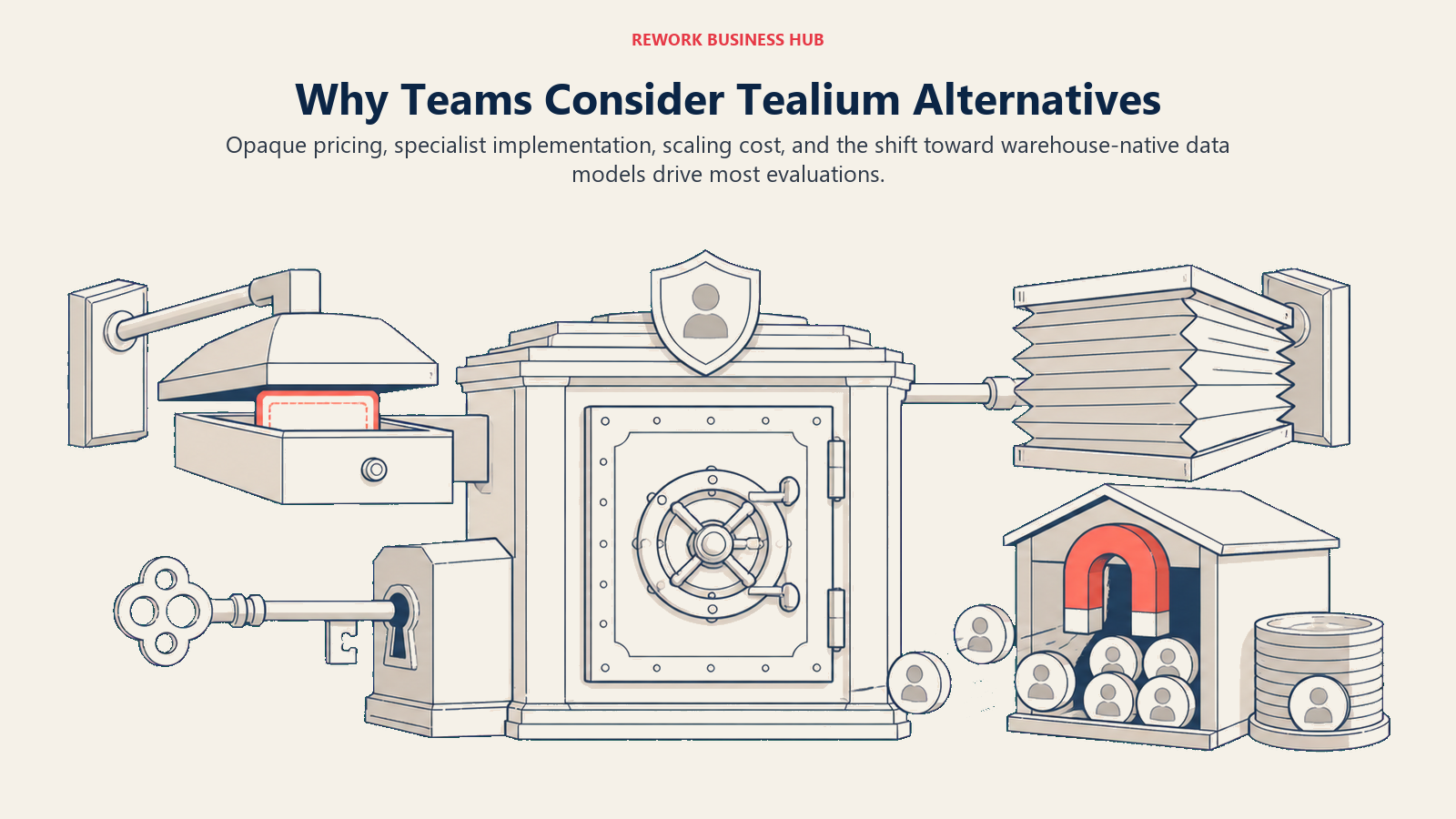
No published pricing, and no self-serve entry point. Tealium's pricing page redirects to a stray image asset with no numbers on it, and there's no way to start a trial and see a bill. Every deal starts with a sales call, which is normal for enterprise software but frustrating for a team that just wants to budget a pilot before committing a quarter to procurement.
Implementation weight and specialist skills. Tealium iQ's extension framework and AudienceStream's visitor profiles are genuinely powerful, but standing up governance rules, data layers, and audience logic correctly usually needs someone who has done it before. That's a real cost on top of the license, and it's the same complaint LookML draws in the BI world: power that comes wrapped in a learning curve.
Cost at scale. None of this is published, so it shows up as sticker shock during renewal instead of during evaluation. Teams that grew into Tealium's Enterprise tier a few years ago are often the ones now shopping hardest for alternatives, not because the platform stopped working, but because the invoice grew faster than the budget did.
The pull toward warehouse-native architecture. Tealium, like most classic CDPs, copies your customer profile into its own store. A growing share of data teams would rather define identity and segmentation once, inside Snowflake, Databricks, or BigQuery, and activate from there with a tool like Hightouch, RudderStack, or Snowplow instead of maintaining two copies of the truth. That shift is also visible in Gartner's 2026 Magic Quadrant, where Tealium dropped from Leader to Challenger on slowing market momentum while newer, more warehouse-friendly entrants like Hightouch joined the Leaders quadrant for the first time.
If your organization is data-mature enough to run identity resolution in the warehouse itself, our BI tools roundup is a useful next stop once the CDP layer is settled, since the two decisions (where customer identity lives, and how you visualize it) increasingly get made together.
1. Twilio Segment - The Broadest Connector Library, With a Real Free Tier
Segment (formally Twilio Segment) remains the default answer to "what's like Tealium but easier to start with." Segment Connections, the data collection and routing layer, has a genuine $0/month free tier: 1,000 visitors a month, 2 sources, and 500,000 Reverse ETL records, with 700+ integrations available from day one. The Team plan starts at $120/month for 10,000 visitors, unlimited sources, and 1,000,000 Reverse ETL records, with volume overages billed per 1,000 monthly tracked users above that. The full Unify and Engage CDP layer (identity resolution and audience activation, the parts that most directly compete with Tealium's AudienceStream) is Business-tier and quote-only.
Segment doesn't ship a visual tag manager, so teams replacing Tealium iQ alongside AudienceStream will still run something like Google Tag Manager for third-party pixels. What it does well is being the tool most engineers have already touched, with a track/identify API that's close to an industry standard and a Reverse ETL product that lets warehouse-first teams activate data without duplicating collection.
| Pros | Cons |
|---|---|
| Genuine free tier and transparent Team pricing, unlike Tealium | Business tier (full CDP) has no published price |
| 700+ pre-built integrations, one of the largest catalogs in the category | No tag management layer of its own |
| Reverse ETL supports a warehouse-native activation pattern | MTU overage pricing needs modeling before you commit to a volume tier |
Best for: Teams that want the most widely adopted data collection layer with a free tier to prototype on before a paid commitment.
Sizing fit: Scales from a single-source startup on the free tier up through enterprise Business contracts.
Stage fit: A strong first stop for any team migrating off Tealium that wants to test integrations before negotiating a full CDP contract.
If Segment itself, not Tealium, is the tool you're evaluating alternatives to, our dedicated Segment alternatives guide covers that shortlist directly.
2. Adobe Real-Time CDP - Tag Management and CDP, One Contract
Adobe is the only alternative on this list that genuinely replaces both halves of a Tealium contract. Real-Time CDP handles identity resolution and audience activation across the B2C, B2B, and B2P editions, each sold in Prime and Ultimate packages priced on profile volume, and Adobe Experience Platform Tags (the product most people still call Adobe Launch, and before that Dynamic Tag Management) handles tag deployment and governance at no additional charge for Experience Cloud customers. That pairing is the closest architectural match to what Tealium itself sells: one vendor, one data layer, one tag layer.
The tradeoff is that neither product publishes a price. Every deal is a sales conversation, and the platform is genuinely built for large marketing organizations already investing in the broader Adobe Experience Cloud, not a team looking for a fast, self-serve pilot.
| Pros | Cons |
|---|---|
| Only alternative here that replaces both tag management and CDP under one vendor | No published pricing at either product |
| Adobe Experience Platform Tags ships free with Experience Cloud | Full value requires buying into the broader Adobe ecosystem |
| Profile, B2C, B2B, and B2P editions match different data models | Implementation weight is comparable to or heavier than Tealium's |
Best for: Enterprise marketing organizations that want one vendor covering both the tag layer and the CDP layer, the same architecture Tealium itself sells.
Sizing fit: Built for large enterprise deployments; profile-volume pricing means cost scales with audience size, not headcount.
Stage fit: A fit once a company is already standardized on, or seriously evaluating, the broader Adobe Experience Cloud.
3. Salesforce Data 360 - Deepest Tie to Salesforce CRM and Agentforce
Salesforce Data 360, renamed from Data Cloud at Dreamforce in October 2025 under the Agentforce 360 umbrella, is the strongest pick for any team whose sales, service, and marketing stack already runs on Salesforce. Salesforce publishes its rates, at $500 per 100k Flex Credits or $240 per 1k profiles per year, and it posted 141% year-over-year growth in paying Data 360 customers as of fiscal Q3 2026, the kind of momentum that kept Salesforce in the Leaders quadrant of Gartner's 2026 Magic Quadrant for Customer Data Platforms alongside new entrants Oracle, Uniphore and Hightouch.
What you're buying is less a standalone CDP and more a data layer that feeds directly into Sales Cloud, Service Cloud, Marketing Cloud, and Agentforce's AI agents, which matters if your CDP's real job is powering agent-driven personalization rather than sitting independently. The credit-based pricing is the most common complaint from existing customers: usage is genuinely hard to forecast before you've run a full billing cycle.
| Pros | Cons |
|---|---|
| Deepest native integration with Salesforce CRM and Agentforce agents | Published rates, but credit consumption is still hard to forecast |
| Sole Leader in Gartner's 2026 Magic Quadrant for CDPs | Full value depends on already running the Salesforce ecosystem |
| Strong growth trajectory signals ongoing platform investment | No tag management layer of its own |
Best for: Organizations already running Salesforce CRM that want their customer data layer to feed Agentforce agents directly.
Sizing fit: Enterprise-first; consumption pricing means cost tracks data volume and activation frequency, not seat count.
Stage fit: Strongest for companies that have already made Salesforce their CRM system of record and want the data layer to match.
If Salesforce Data 360 is itself the incumbent you're shopping alternatives to, see our dedicated Salesforce Data Cloud alternatives guide, and if the CRM underneath it is the real decision, our Salesforce alternatives roundup covers that separately.
4. Treasure AI - Profile-and-Behavior Pricing, No Compute Charges
Treasure Data rebranded to Treasure AI in April 2026 and repositioned itself from a straightforward CDP to what it calls an agentic experience platform, but the pricing philosophy that made it a Tealium peer is intact: you pay for profiles and behaviors under an annual subscription, not for query volume or compute, which the vendor markets as a "no compute" model. Three lines make up the current lineup: the Intelligent Customer Data Platform (the core iCDP, tiered on profiles and behaviors), Treasure AI Suites (a fixed annual license per suite plus consumption credits), and Treasure AI Studio (usage credits for the newer agentic tooling). None of it is published.
For a team that liked Tealium's enterprise governance posture but wants pricing that doesn't punish high query volume, Treasure AI is the closest philosophical match on this list, with the caveat that you're evaluating a platform mid-repositioning rather than a settled product.
| Pros | Cons |
|---|---|
| "No compute" pricing model avoids penalizing high query volume | No published pricing at any tier |
| Three-tier lineup separates core CDP from newer agentic tooling | Recent rebrand means positioning is still shifting |
| Enterprise governance heritage comparable to Tealium's own | No self-serve trial or free tier |
Best for: Enterprise teams that valued Tealium's profile-based pricing logic and want to avoid compute-based cost surprises.
Sizing fit: Enterprise-first, built for large behavioral data volumes.
Stage fit: A fit for companies with an established data team evaluating a peer-to-peer enterprise CDP swap, not a first CDP purchase.
5. mParticle - Mobile-First Coverage, Now Inside Rokt
mParticle built its reputation on deep mobile SDK coverage (iOS, Android, and web) at a time when most CDPs were web-first, and that mobile depth is still the reason omnichannel consumer brands shortlist it. The company is now part of Rokt, the e-commerce technology group, following an acquisition, and mParticle does not publish prices on its site.
Data collection runs through mParticle's own SDKs rather than a visual tag manager, so teams replacing Tealium iQ's governance UI alongside AudienceStream will need a separate consent and tag layer. The core strength here is genuinely mobile app event tracking done well, which several web-first CDPs on this list still treat as a secondary use case.
| Pros | Cons |
|---|---|
| Strong native mobile SDK coverage across iOS and Android | No published pricing |
| Now backed by Rokt's e-commerce technology and reach | No self-serve or transparent budgeting path |
| Established real-time data collection infrastructure | No visual tag management layer, SDK-based only |
Best for: Mobile-first and omnichannel consumer brands where app event tracking is as important as web tracking.
Sizing fit: Mid-market to enterprise consumer brands with meaningful native app traffic.
Stage fit: A fit once mobile app engagement is a primary channel, not an afterthought to web.
6. BlueConic - A No-Code CDP Marketing Teams Can Run Themselves
BlueConic's pitch is squarely aimed at marketing teams tired of waiting on engineering for every new segment: a no-code interface for building audiences, managing consent, and orchestrating activation, without needing to write a query or file a ticket. Pricing isn't published; every engagement starts with a demo or a quote.
That marketing-owned positioning is the clearest differentiator against Tealium, whose AudienceStream setup typically leans more heavily on technical implementation. If your organization's real bottleneck with Tealium was needing an engineer for routine segmentation work, BlueConic is worth a serious look. It doesn't include a tag management layer, so the same caveat from the trap table above applies here too.
| Pros | Cons |
|---|---|
| No-code segmentation UI reduces dependency on engineering | No published pricing anywhere |
| Built specifically for marketing-team ownership | No free tier or self-serve trial |
| Strong consent and preference management tooling | No tag management layer of its own |
Best for: Marketing organizations that want to own segmentation and activation without routing every change through a data team.
Sizing fit: Mid-market to enterprise marketing teams, typically 200 or more employees.
Stage fit: A fit once marketing has outgrown spreadsheet segmentation but doesn't want engineering as a permanent dependency.
7. Amperity - Identity Resolution for Retail and Hospitality at Scale
Amperity's core differentiator is identity resolution quality at scale, matching customer records across channels, devices, and loyalty systems for large retail, hospitality, and travel brands where a single customer might show up under a dozen different identifiers. Pricing is entirely consumption-based, measured in what the company calls "Amps," with no published rate card and no self-serve trial; every relationship starts sales-led.
Architecturally, Amperity leans warehouse-native through its Lakehouse CDP and Amperity Bridge, sharing unified profiles into Databricks and Snowflake via Delta Sharing, Snowflake Secure Data Sharing, and Iceberg tables instead of a traditional Reverse ETL pipeline. That's a meaningfully different integration pattern than Tealium's own architecture, worth understanding before you assume migration will be a like-for-like swap.
| Pros | Cons |
|---|---|
| Identity resolution quality is a genuine differentiator at retail scale | No published pricing, no self-serve trial |
| Lakehouse-native sharing into Snowflake and Databricks avoids data duplication | Consumption-based Amps pricing is hard to estimate up front |
| Built specifically for retail, hospitality, and travel data complexity | Overkill for teams outside those verticals |
Best for: Retail, hospitality, and travel brands with complex, multi-channel identity resolution needs.
Sizing fit: Enterprise, typically brands with meaningful loyalty program and multi-channel transaction volume.
Stage fit: A fit once identity resolution accuracy, not just data collection, is the primary technical problem.
8. Lytics (now Contentstack) - Being Retired as a Standalone CDP
Lytics was the rare enterprise-adjacent CDP that actually published numbers. It is not any more. Contentstack acquired Lytics, and lytics.com now carries one notice: "Lytics has moved to Contentstack. This site will be retired on September 30th, 2026." Its pricing page is already gone. The technology ships on as Lytics CDP inside Contentstack AXP, but the published, self-serve credit pricing it was known for is gone, and Contentstack publishes no rate for it.
That matters for anyone reading an older Tealium comparison, because the free tier that made Lytics an easy prototyping option is no longer available to new teams. If a real free tier to prototype personalization logic on is what you came for, RudderStack and Twilio Segment are the two on this list that still offer one.
| Pros | Cons |
|---|---|
| Genuinely free Developer tier with a real usage allowance | Enterprise scale still routes to a custom quote |
| Published, predictable credit-based pricing at every published tier | Smaller connector ecosystem than the larger enterprise incumbents |
| Credit model (1 credit per event, mostly) is easy to estimate | Less governance depth than Tealium or Adobe at the top end |
Best for: Mid-market teams that want transparent, credit-based pricing they can model before signing anything.
Sizing fit: Best from small teams on the free tier through mid-market Growth customers; largest enterprises typically need the custom tier.
Stage fit: A strong fit for a team's first real CDP purchase, where budget predictability matters as much as feature depth.
9. RudderStack - Source-Available and Warehouse-Native
RudderStack is the most direct warehouse-native answer on this list: event collection and routing that treats your Snowflake, Databricks, or BigQuery warehouse as the source of truth rather than a downstream destination. The free tier covers 250,000 events a month, 16 SDK sources, 200-plus cloud destinations, and 5 transformations, with no seat limits. Growth starts at $265/month for 1 million events a month, scaling in tiers up to 25 million-plus, with 15% off on annual billing and a 30-day free trial; Enterprise adds custom pricing with 5-minute warehouse sync and unlimited transformations.
One correction worth making plainly: RudderStack's self-hosted code is licensed under Elastic License 2.0, which is source-available, not OSI-approved open source. It's a meaningful distinction if your procurement or security team has a policy specifically about open-source licensing, and it's worth confirming before anyone on your team describes it that way internally.
| Pros | Cons |
|---|---|
| Genuinely warehouse-native architecture, no forced data duplication | Source-available (Elastic License 2.0), not OSI open source |
| Free tier with no seat caps, useful for evaluation | Free tier's 250K events/month ceiling is reached quickly at scale |
| Transparent, published pricing through the Growth tier | Enterprise tier still requires a custom quote |
Best for: Engineering-led teams that want to keep the warehouse as the single source of truth rather than copying data into a vendor store.
Sizing fit: Scales from a free-tier startup through Enterprise; the Growth tier comfortably covers most mid-market volumes.
Stage fit: A strong fit for any team migrating off Tealium specifically because they want warehouse-first architecture instead of a vendor-owned profile store.
If RudderStack itself is the tool you're comparing alternatives against, our RudderStack alternatives guide goes deeper on that shortlist, and if you're deciding between RudderStack and Segment specifically, Segment vs. RudderStack covers that head-to-head directly.
10. Hightouch - Activation Without Copying Your Data
Hightouch's whole architecture assumes you already have data collection solved (through Segment, RudderStack, Snowplow, or your own first-party pipeline) and focuses purely on what happens next: building audiences and syncing them to downstream tools directly from your warehouse, no data duplication required. Pricing has no published paid rate; the lineup is the Agentic Marketing Platform (usage-based), the Composable CDP (usage-based, unlimited user seats), and a free Basic Reverse ETL tier covering up to 2 active syncs with unlimited destinations and unlimited user seats.
That "unlimited seats" detail matters against Tealium's typical per-user or per-node licensing: Hightouch's cost scales with data volume and sync frequency, not with how many people on your team need access. It also means Hightouch genuinely does not replace Tealium's collection layer (EventStream) at all, only the activation and audience-building half.
| Pros | Cons |
|---|---|
| Free Reverse ETL tier with unlimited destinations and user seats | No published paid pricing, usage-based only |
| Unlimited seats means cost doesn't scale with team headcount | No client-side event or tag collection of its own |
| Gartner named Hightouch a Leader in the 2026 CDP Magic Quadrant, a first-time entrant in that quadrant | Requires an existing, working data collection layer to be useful |
Best for: Warehouse-native teams that have already solved data collection and just need governed activation on top of it.
Sizing fit: Works from small teams on the free tier through enterprise usage-based contracts.
Stage fit: A fit once your organization already trusts its warehouse as the source of truth and just needs to activate from it.
If Hightouch itself is the incumbent you're evaluating alternatives to, see our dedicated Hightouch alternatives guide for that shortlist. And if the underlying question is really about connecting systems generally rather than customer data specifically, our Workato alternatives guide covers the broader iPaaS category.
11. Snowplow - Own Your Raw Behavioral Event Data
Snowplow is the deepest warehouse-native option on this list, aimed at teams that want to own their raw, granular behavioral event data end to end rather than rely on any vendor's pre-aggregated model. Pricing isn't published for either Self-Hosted Pipeline or the managed Snowplow Platform; there's a 14-day free trial at no cost with no card required. The self-hosted option is licensed under SLULA 1.1 (the Snowplow Limited Use License Agreement), which restricts non-commercial use, and the paid managed offering exists specifically to remove that restriction.
This is the option for teams with real data engineering capacity who want maximum control over event schema and data quality, at the cost of doing more of the implementation work themselves than any other tool here.
| Pros | Cons |
|---|---|
| Full ownership of raw, granular first-party event data | No published pricing at either tier |
| 14-day free trial with no card required | SLULA 1.1 license restricts non-commercial self-hosted use |
| Built for teams that want schema-level control over event quality | Heaviest implementation lift of any tool on this list |
Best for: Data engineering teams that want granular control over their own raw behavioral event pipeline.
Sizing fit: Best for organizations with dedicated data engineering resources, typically mid-market to enterprise.
Stage fit: A fit once event data quality and schema governance matter more than time-to-first-dashboard.
12. Klaviyo Data Platform - A CDP Layer, Scoped to Klaviyo's Own Suite
Klaviyo Data Platform and Advanced Klaviyo Data Platform are Klaviyo's answer to unifying customer data, but they're built as the data layer underneath Klaviyo's own marketing suite (email, SMS, and its broader B2C CRM), not as a general-purpose enterprise CDP you'd point at a dozen unrelated systems the way you would Tealium. The free tier covers up to 250 active profiles, 500 email sends a month, and $5 of mobile messages a month; paid pricing scales by active profiles and is configured per module (Marketing, Data + Analytics, Service, Composer, Customer Agent), with a starter configuration on Klaviyo's own pricing page totaling around $45/month.
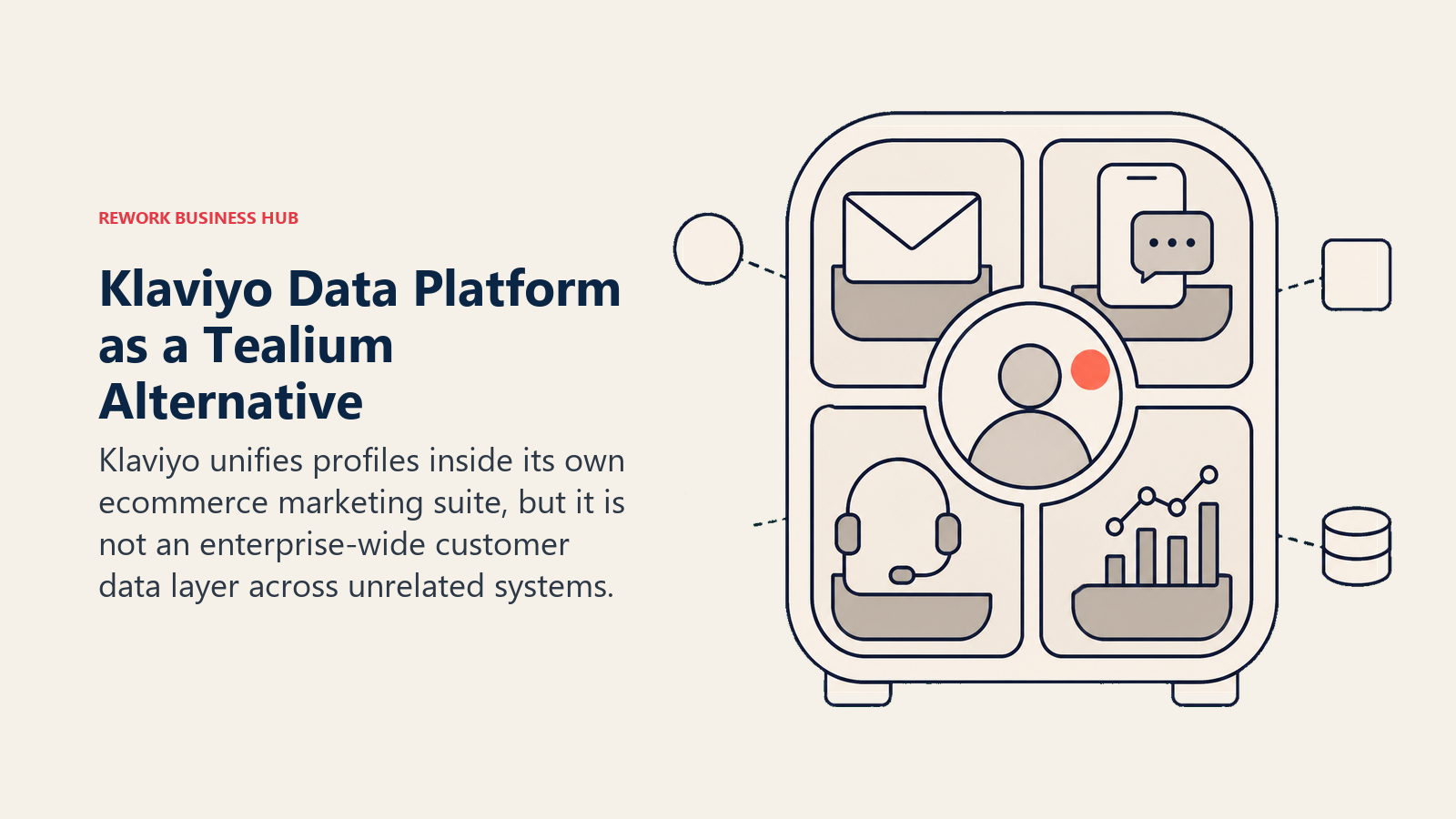
For an ecommerce or DTC brand that already runs Klaviyo as its primary CRM, this is a genuinely useful consolidation. For an enterprise team replacing Tealium across a dozen systems well beyond marketing, it's the wrong tool: the data model is scoped to Klaviyo's ecosystem, not built to be your organization's single source of customer truth.
| Pros | Cons |
|---|---|
| CDP layer built directly into a marketing suite many ecommerce brands already run | Scoped to Klaviyo's own ecosystem, not general-purpose |
| Transparent, published pricing by active profile count | Not a realistic replacement for enterprise-wide Tealium deployments |
| Free tier available up to 250 active profiles | Per-module configuration adds pricing complexity as you scale |
Best for: Ecommerce and DTC brands already using Klaviyo as their primary marketing CRM who want unified profiles without adding a separate vendor.
Sizing fit: Best under roughly 200 employees, scoped to single-brand ecommerce operations.
Stage fit: A fit for brands whose customer data needs are genuinely centered on marketing and messaging, not enterprise-wide data governance.
If Klaviyo itself is the platform you're evaluating alternatives to, our Klaviyo alternatives guide covers that shortlist, and our email marketing software roundup is a useful next stop if the real gap is messaging rather than unified customer data.
Sizing and Persona Fit
| Headcount | Best fit | Why | Watch out for |
|---|---|---|---|
| Under 200 | Klaviyo Data Platform, RudderStack (free tier), Twilio Segment (free tier) | Free or low-cost tiers with real usage allowances to prototype on | Klaviyo only fits if you're already ecommerce-native |
| 200 to 1,000 | Twilio Segment, BlueConic, RudderStack (Growth) | Sized for a first real enterprise CDP without the heaviest implementation lift | BlueConic and Segment's full CDP tiers both go quote-only fast |
| 1,000 to 5,000 | Adobe Real-Time CDP, Salesforce Data 360, mParticle, Treasure AI | Where governance, consent, and omnichannel identity all matter at once | All four require a genuine sales cycle, no self-serve pilot |
| 5,000-plus, or complex identity resolution | Amperity, Snowplow, Hightouch | Built for the heaviest data volume and the most granular control | Each assumes real in-house data engineering capacity |
| Persona | What they optimize for | Strongest picks |
|---|---|---|
| Data engineer who wants the warehouse as the source of truth | Avoid duplicating identity into a vendor's store | RudderStack, Snowplow, Hightouch |
| Marketing team replacing Tealium AND its tag manager | One vendor for both jobs | Adobe Real-Time CDP |
| Team already standardized on Salesforce CRM | Native tie into Sales Cloud, Service Cloud, Agentforce | Salesforce Data 360 |
| Retail or hospitality brand with complex identity resolution | Match customers across many identifiers accurately | Amperity |
| Marketing team tired of waiting on engineering for segments | No-code audience building | BlueConic |
| Ecommerce brand that wants one less vendor | CDP layer inside an existing marketing suite | Klaviyo Data Platform |
AI-driven activation is increasingly part of this decision too, since several of these platforms now feed audiences directly into generative and agentic marketing tools rather than just static segment exports; our AI marketing tools roundup is worth a look once you've settled on where identity lives.
How to Choose: Decision Framework
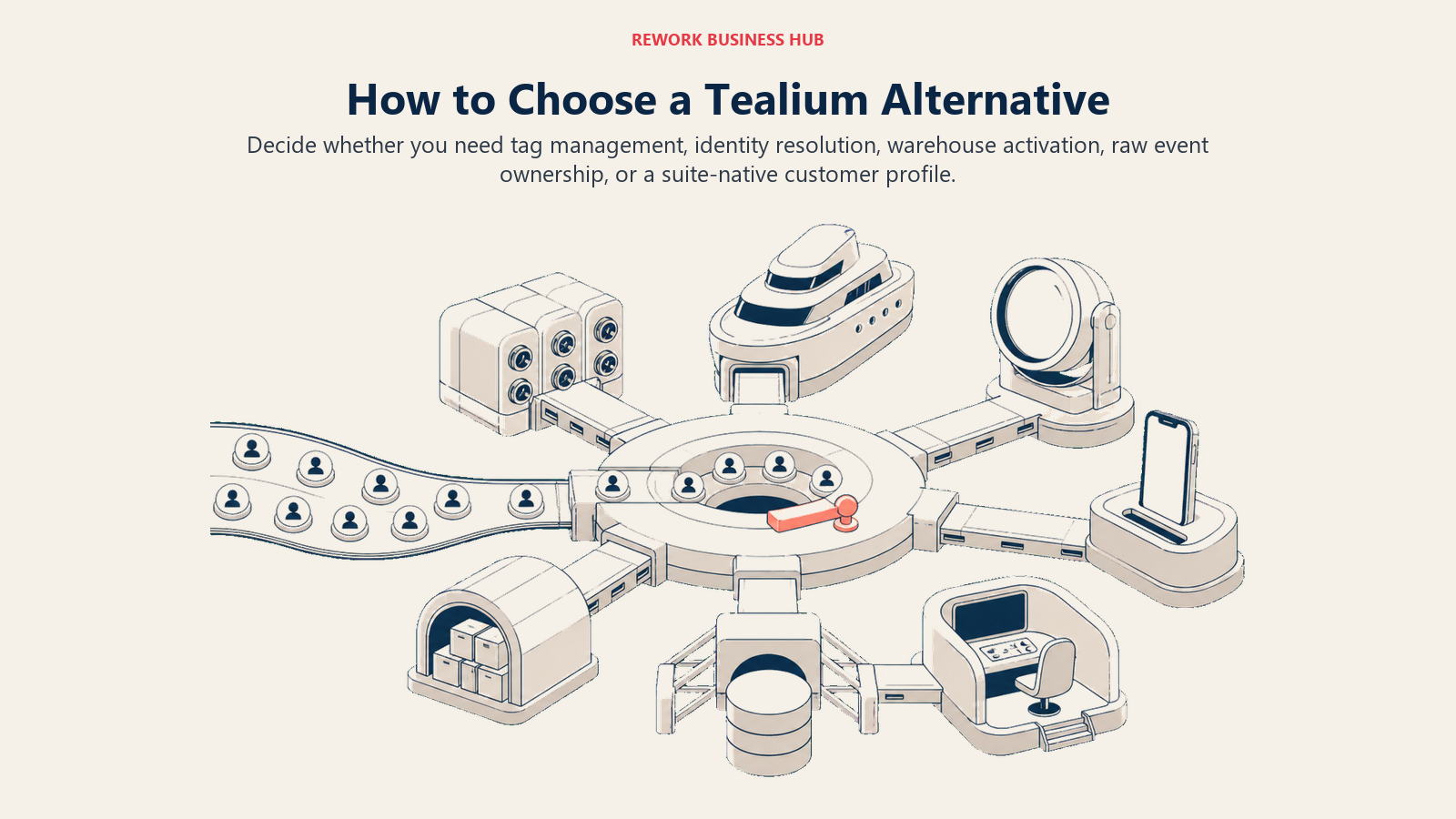
Choose a Tealium alternative by identifying the job you need to replace first: data collection, identity resolution, activation, tag governance, or warehouse-native control.
| If you need... | Choose |
|---|---|
| The widest connector library with a genuine free tier to start on | Twilio Segment |
| Tag management and CDP replaced under one vendor contract | Adobe Real-Time CDP |
| Deep native integration with Salesforce CRM and Agentforce | Salesforce Data 360 |
| Tealium's profile-based pricing philosophy without compute charges | Treasure AI |
| Strong mobile app event tracking alongside web | mParticle |
| A no-code CDP marketing teams can run without engineering | BlueConic |
| Identity resolution at scale for retail, hospitality, or travel | Amperity |
| A real free tier to prototype on | RudderStack |
| A source-available, warehouse-native event pipeline | RudderStack |
| Activation from your warehouse without duplicating data | Hightouch |
| Full ownership of raw, granular behavioral event data | Snowplow |
| A CDP layer already built into your ecommerce marketing suite | Klaviyo Data Platform |
Frequently Asked Questions about Tealium Alternatives
How much does Tealium cost?
Tealium publishes no pricing anywhere on its site. tealium.com/pricing/ redirects to a stray image asset with no numbers, and the platform page shows no figures either. Every deal starts with a sales conversation, and any number you see elsewhere should be treated as third-party reported, not vendor-confirmed.
What's the cheapest Tealium alternative with fully published pricing?
RudderStack's free tier covers 250,000 events a month with no cost, and Twilio Segment's free tier covers 1,000 monthly visitors across 700+ integrations. Among paid tiers with transparent published numbers, RudderStack's Growth plan at $265/month for 1 million events is one of the most predictable on this list.
Which Tealium alternative also replaces tag management, not just the CDP?
Only Adobe genuinely covers both jobs under one contract: Real-Time CDP for identity resolution and activation, and Adobe Experience Platform Tags (formerly Adobe Launch) for tag deployment and governance, included free with Experience Cloud. Every other alternative on this list requires keeping or adding a separate tag manager, commonly Google Tag Manager.
Is RudderStack open source?
Not in the OSI sense. RudderStack's self-hosted code is licensed under Elastic License 2.0, which is source-available rather than a permissive open-source license. It can still be self-hosted, but the licensing distinction matters if your procurement process specifically requires OSI-approved open source.
What's the difference between a warehouse-native CDP and a traditional CDP like Tealium?
A traditional CDP like Tealium's AudienceStream copies your customer profile data into its own store, then activates from that copy. A warehouse-native tool like RudderStack, Snowplow, or Hightouch instead treats your existing Snowflake, Databricks, or BigQuery warehouse as the single source of truth and activates directly from it, avoiding a second copy of customer identity that needs to be kept in sync.
Why did Tealium drop in Gartner's 2026 Magic Quadrant for Customer Data Platforms?
Gartner moved Tealium from Leader to Challenger in its 2026 Magic Quadrant, citing slowing market velocity and diminished customer acquisition, according to coverage of the report. Salesforce remained the sole Leader, and newer, more warehouse-friendly entrants including Hightouch, Oracle, and Uniphore joined the Leaders quadrant for the first time that year.
Do any of these alternatives avoid a sales-led, quote-only buying process?
Twilio Segment and RudderStack both have genuine self-serve free tiers and published paid pricing you can start on without a sales call. Klaviyo Data Platform also publishes pricing, though it's scoped specifically to Klaviyo's own marketing suite rather than general-purpose enterprise data collection.
Which alternative fits a team that's already standardized on Salesforce?
Salesforce Data 360 (renamed from Data Cloud in October 2025) is the clearest fit, since it feeds directly into Sales Cloud, Service Cloud, Marketing Cloud, and Agentforce's AI agents without a separate integration layer. It posted 141% year-over-year growth in paying customers as of fiscal Q3 2026, and Salesforce publishes its rates at $500 per 100k Flex Credits or $240 per 1k profiles per year.
What to Do Next
Before you shortlist anything, answer one question honestly: are you replacing Tealium's CDP, its tag management, or both? That single answer eliminates half this list immediately. If it's both, Adobe is your only one-vendor match; if it's CDP only, pick two candidates from the decision framework above, one warehouse-native and one that copies data into its own store, and run the same identity resolution test on both using a real slice of your customer data (not a demo dataset). Whichever tool reconciles a messy multi-source customer record correctly, and whichever one your data team can actually operate without a specialist on retainer, tells you more about the real switching cost than any pricing page will.
Camellia writes about customer data platforms and enterprise martech for B2B teams.

Principal Product Marketing Strategist
On this page
- Key Facts
- Quick Comparison Table
- The Trap in This Switch: Tag Management and CDP Are Two Jobs
- Why Teams Shop for a Tealium Alternative
- 1. Twilio Segment - The Broadest Connector Library, With a Real Free Tier
- 2. Adobe Real-Time CDP - Tag Management and CDP, One Contract
- 3. Salesforce Data 360 - Deepest Tie to Salesforce CRM and Agentforce
- 4. Treasure AI - Profile-and-Behavior Pricing, No Compute Charges
- 5. mParticle - Mobile-First Coverage, Now Inside Rokt
- 6. BlueConic - A No-Code CDP Marketing Teams Can Run Themselves
- 7. Amperity - Identity Resolution for Retail and Hospitality at Scale
- 8. Lytics (now Contentstack) - Being Retired as a Standalone CDP
- 9. RudderStack - Source-Available and Warehouse-Native
- 10. Hightouch - Activation Without Copying Your Data
- 11. Snowplow - Own Your Raw Behavioral Event Data
- 12. Klaviyo Data Platform - A CDP Layer, Scoped to Klaviyo's Own Suite
- Sizing and Persona Fit
- How to Choose: Decision Framework
- What to Do Next