Best Segment Alternatives in 2026: 10 Customer Data Platforms for Growth and Analytics Teams
Turn this article into takeaways for your work.


Each assistant summarizes the article only for you and suggests best practices for your work.
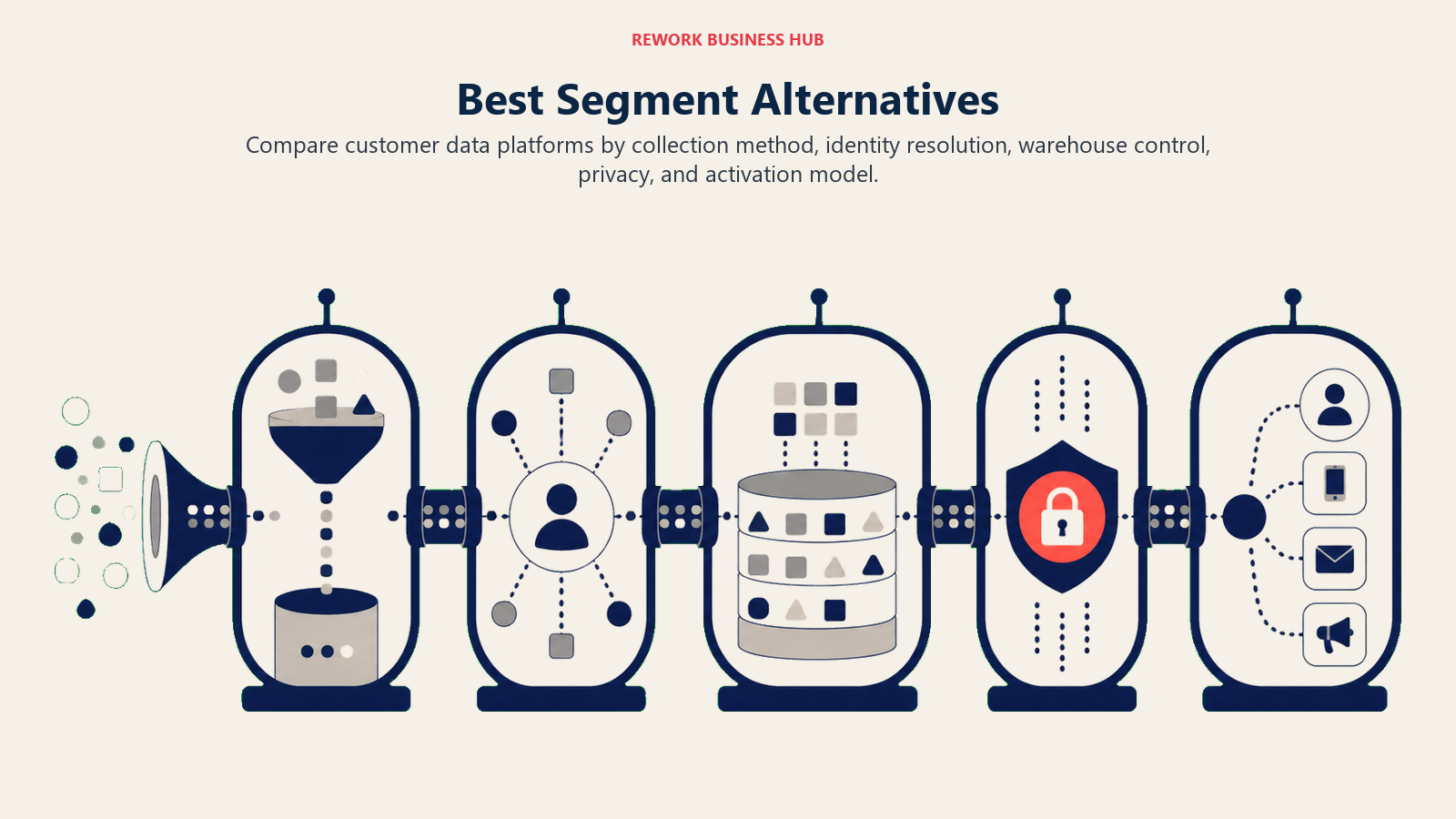
The best Segment alternatives in 2026 are RudderStack and Snowplow for open-source warehouse-native control, mParticle for enterprise mobile identity, Hightouch and Census for reverse ETL, Freshpaint for HIPAA compliance, and Jitsu for lightweight low-cost event collection. The right pick depends on your team size, data stack, and the specific Segment limitation you are escaping.
Segment built the customer data infrastructure playbook. Collect events, route them to destinations, keep your stack clean. For years it was the default answer for any growth or data team building an event pipeline.
Then Twilio acquired it. Pricing shifted toward MTU-based models that get expensive fast. Transformation capabilities stayed limited. You still need a warehouse for anything beyond basic filtering. And teams that scaled discovered the gap between what Segment promises and what it delivers at 100M+ events per month. If you're re-evaluating your CDP or starting fresh, these are the 10 tools worth looking at seriously in 2026.
Teams doing data enrichment alongside event tracking may also want to look at lead enrichment automation for a walkthrough of how enrichment fits into a broader data pipeline. And for analytics platform comparisons specifically, best Amplitude alternatives and best Mixpanel alternatives cover the downstream destination layer where Segment routes data.
Quick Comparison Table
| Tool | Best For | Starting Price | Key Strength | Key Limitation |
|---|---|---|---|---|
| RudderStack | Engineering-led teams wanting open-source control | Free (open-source) / $750/mo cloud | Full data control, warehouse-native | Requires engineering to operate |
| mParticle | Mobile-first enterprise apps | Custom (enterprise) | Identity resolution, mobile SDKs | Expensive for SMBs, complex setup |
| Freshpaint | Healthcare and regulated industries | From $500/mo | HIPAA compliance, no-code tracking | Narrow ICP, less flexible for non-regulated |
| Jitsu | Lightweight, self-hosted event collection | Free (open-source) / $20/mo cloud | Simple setup, warehouse-first | Limited destination library |
| Hightouch | Reverse ETL: warehouse to SaaS tools | Free tier / from $350/mo | Syncing warehouse data to CRMs and ads | Doesn't collect events (not a traditional CDP) |
| Census | Reverse ETL for data teams | Free tier / from $300/mo | dbt integration, data modeling | Same reverse ETL caveat: not an event collector |
| Lytics | Behavioral personalization and ML scoring | Custom | Real-time audience building, ML predictions | Less transparent pricing, steeper learning curve |
| Tealium | Enterprise tag management + CDP | Custom (enterprise) | Deep enterprise integrations, governance | High cost, complex implementation |
| Snowplow | Open-source behavioral data platform | Free (open-source) / $2,000+/mo cloud | Rich event schema, full data ownership | Significant infrastructure overhead |
| MetaRouter | Server-side event routing for compliance | Custom | Cookieless, server-side, privacy-first | Premium pricing, enterprise focus |
Stage Fit Matrix
| Tool | Startup (1-20) | Growth (20-200) | Mid-Market (200-1,000) | Enterprise (1,000+) |
|---|---|---|---|---|
| RudderStack | Good (open-source) | Strong | Strong | Strong |
| mParticle | Too complex | Possible | Good | Best fit |
| Freshpaint | Possible | Good | Good | Limited |
| Jitsu | Best fit | Good | Possible | Not typical |
| Hightouch | Possible | Good | Strong | Strong |
| Census | Possible | Good | Strong | Strong |
| Lytics | Too expensive | Possible | Good | Good |
| Tealium | No | No | Possible | Best fit |
| Snowplow | Self-host only | Good (self-host) | Strong | Strong |
| MetaRouter | No | Possible | Good | Best fit |
Sizing and Buyer Persona Table
| Tool | Team Size Sweet Spot | Primary Buyer | Secondary Buyer |
|---|---|---|---|
| RudderStack | 5-500 engineers | Data Engineer | VP Engineering |
| mParticle | 50-5,000 | Mobile Product Manager | VP Data |
| Freshpaint | 20-500 (healthcare) | Growth Marketer | Compliance Officer |
| Jitsu | 1-50 | Solo developer / Data Engineer | Founder |
| Hightouch | 20-5,000 | Data Engineer / Analytics Engineer | Marketing Ops |
| Census | 20-5,000 | Analytics Engineer | RevOps |
| Lytics | 100-2,000 | Marketing Data Analyst | Digital Marketing Director |
| Tealium | 500-50,000 | Digital Analytics Manager | Enterprise Architect |
| Snowplow | 10-10,000 | Data Engineer | VP Data |
| MetaRouter | 100-10,000 | Engineering / Privacy Officer | VP Marketing |
1. RudderStack: open-source CDP with warehouse-native architecture
RudderStack was built as a direct Segment replacement. The philosophy is straightforward: your event data should live in your warehouse, not in a vendor's proprietary store. RudderStack routes events to your data warehouse first, then syncs to destinations. That's the opposite of Segment's approach where Twilio holds your data and charges you to access it.
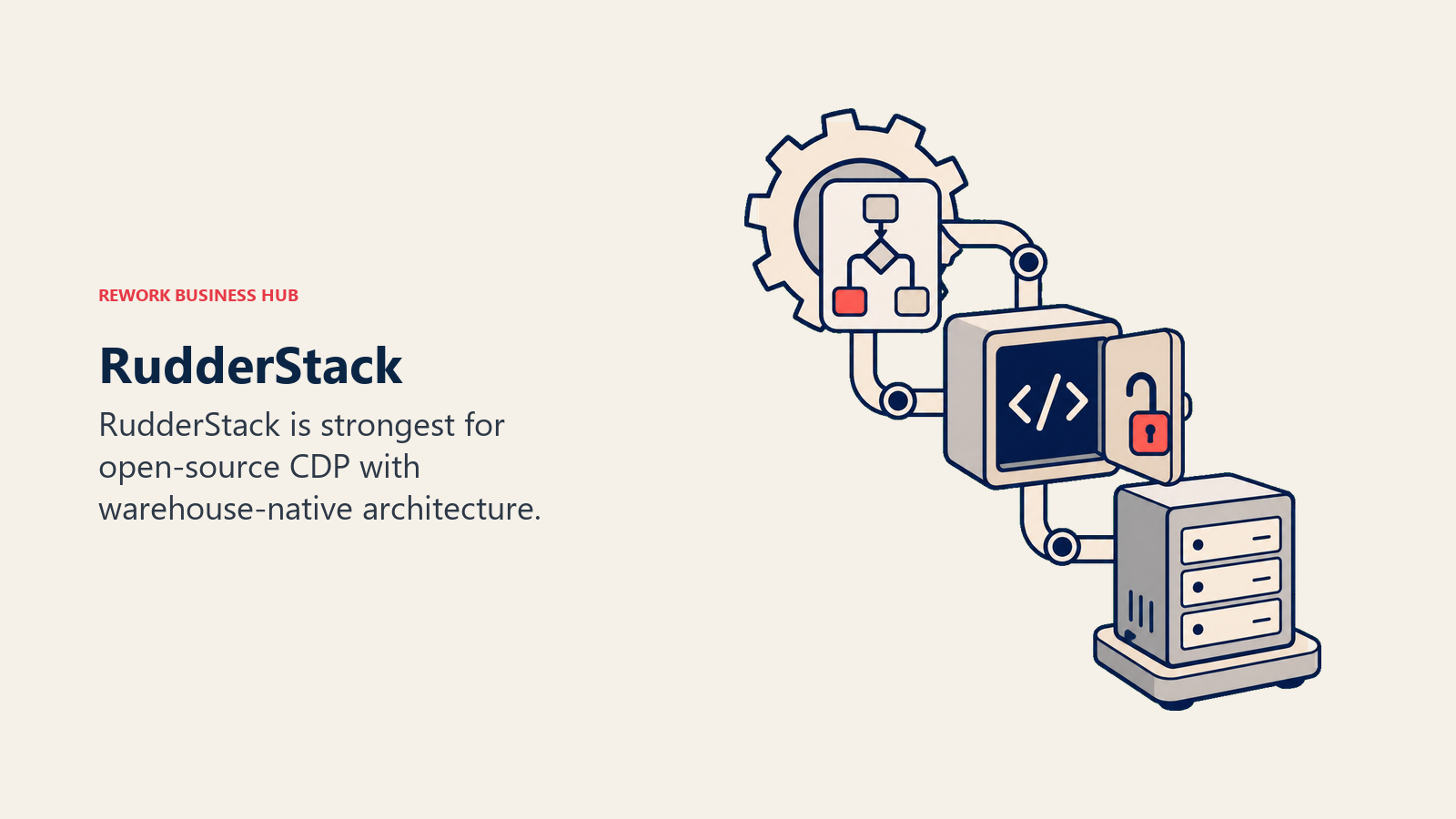
The product vision is "data infrastructure you own." That means full source code access on the open-source tier, self-hosting option, and pricing based on events rather than MTUs (monthly tracked users), which is more predictable for high-volume teams. See RudderStack's pricing before modeling costs at scale; the event-based model is genuinely different from Segment's MTU billing.
RudderStack targets engineering-led data teams at growth-stage and mid-market companies. It's not a no-code tool. You need engineers to set up sources, configure destinations, and maintain the pipeline. But if your team has that capacity, you get genuine control: custom transformations in JavaScript, warehouse syncs, and no vendor lock-in.
| Strengths | Limitations |
|---|---|
| Full open-source, self-hostable | Requires engineering to operate effectively |
| Warehouse-native data model | Open-source version needs your own infra |
| JavaScript transformations built-in | Fewer out-of-box destination connectors vs Segment |
| Predictable event-based pricing | No native identity resolution (need separate tool) |
| Active open-source community | Support quality varies on free tier |
Pricing: Free open-source. Cloud starts at $750/month. Enterprise custom.
Best for: Engineering teams that want Segment's functionality without Segment's data lock-in.
2. mParticle: enterprise mobile CDP with best-in-class identity resolution
mParticle started as a mobile data platform and grew into a full enterprise CDP. The core insight: mobile apps generate fragmented identity data (device IDs, push tokens, anonymous sessions) that most CDPs handle poorly. mParticle built its identity graph specifically around that problem.
The product is genuinely enterprise-grade. Identity resolution stitches together cross-device, cross-channel user profiles using mParticle's IDSync framework. Real-time audience segmentation lets marketing and product teams build cohorts without waiting for a data warehouse query. The destination library covers 300+ integrations.
mParticle's target customer is a mid-market to enterprise company with a significant mobile app surface (think media companies, fintech, consumer subscription). B2B SaaS teams with desktop-heavy products get less value from mParticle's mobile strengths. Implementation is complex. Plan 4-8 weeks for a full deployment. Pricing is custom and enterprise-tier; most customers spend $50,000+ annually.
| Strengths | Limitations |
|---|---|
| Industry-leading identity resolution | Enterprise pricing, not SMB-friendly |
| Native mobile SDK quality | Long implementation timeline |
| Real-time audience streaming | Complexity can overwhelm smaller teams |
| 300+ destination connectors | Less compelling for desktop-only products |
| GDPR/CCPA consent management built-in | Support can be slow on non-enterprise plans |
Pricing: Custom enterprise. Expect $50,000-$200,000+ annually depending on volume.
Best for: Enterprise mobile-first companies needing real identity resolution across devices.
3. Freshpaint: HIPAA-compliant event tracking for healthcare and regulated industries
Freshpaint exists because healthcare companies can't use standard analytics tools. Segment, Mixpanel, and Google Analytics all transmit data in ways that potentially expose protected health information (PHI) to third parties, which is a HIPAA violation. Freshpaint's entire architecture is built around that constraint.
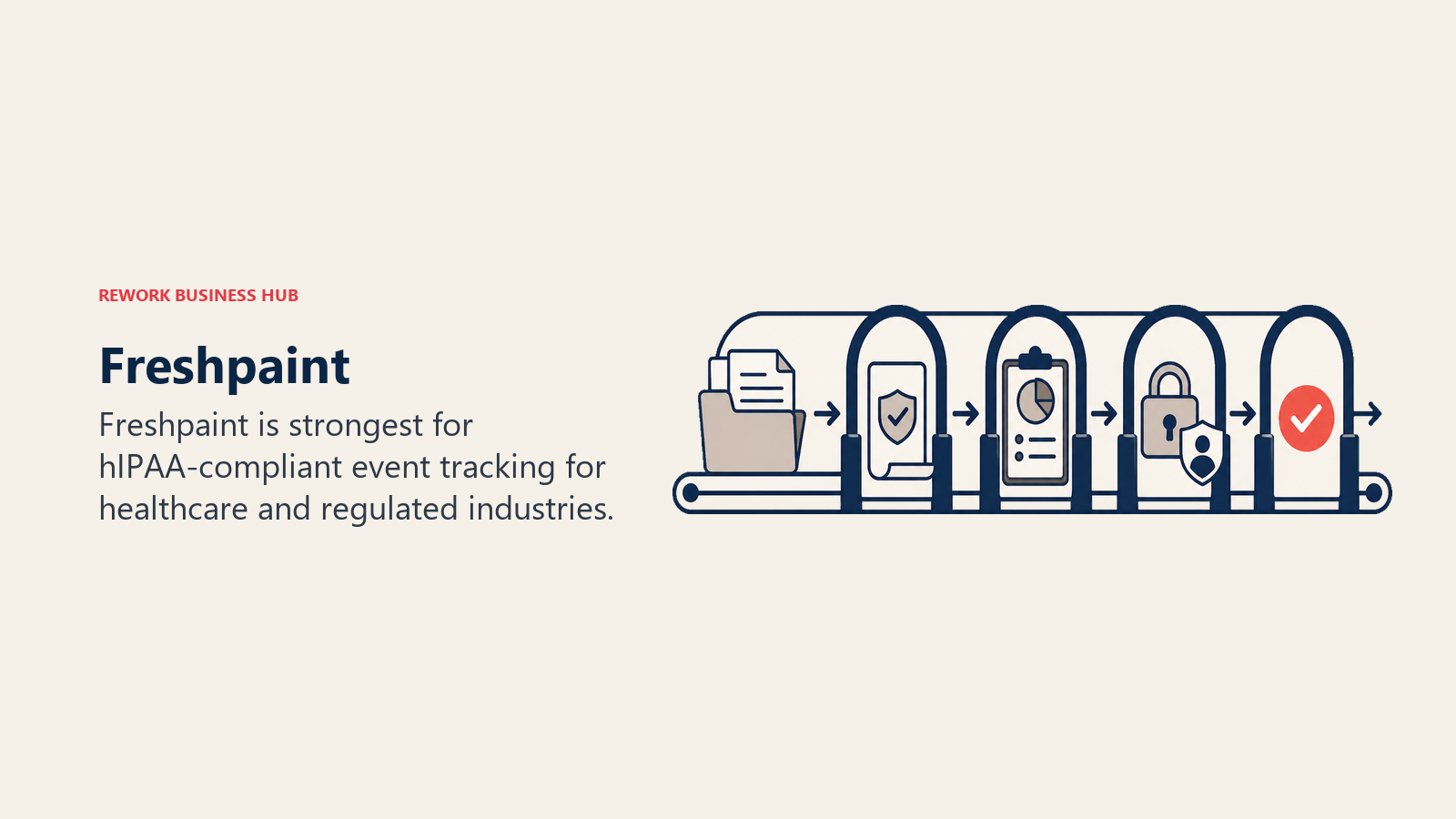
The product approach: intercept events before they hit any analytics destination, strip or mask PHI, then forward clean data to your downstream tools. No data leaves Freshpaint's HIPAA-compliant infrastructure without going through the privacy filter first. This lets healthcare teams use the same tools (Mixpanel, Salesforce, HubSpot) that non-regulated companies use, without the compliance risk. See Freshpaint's product overview for how the privacy layer integrates with your existing stack.
Beyond compliance infrastructure, Freshpaint also offers no-code event tracking that doesn't require engineering for every new tracking point. That's valuable for growth teams who can't wait in the engineering backlog.
| Strengths | Limitations |
|---|---|
| HIPAA BAA included | Narrow ICP outside healthcare |
| No-code tracking implementation | More expensive than general-purpose tools |
| Works with your existing analytics stack | Limited transformation capabilities |
| Privacy-first architecture | Dependent on downstream tool quality |
| Quick setup for healthcare teams | Smaller destination library than Segment |
Pricing: Starts around $500/month. Scales with event volume. Enterprise plans custom.
Best for: Digital health, telehealth, and regulated industries that need HIPAA-compliant analytics pipelines.
4. Jitsu: lightweight open-source event collection with warehouse-first design
Jitsu is what you use when Segment is overkill. The philosophy is minimalist: collect events from any source, write them to your data warehouse, keep the setup simple enough that one engineer can run it. No MTU pricing. No per-seat fees. No vendor storing your data.
The open-source version is genuinely usable by a small team. The cloud version starts at $20/month, cheap enough that a solo founder can afford it. Jitsu's destination library is smaller than Segment's, but the warehouse-first design means you're expected to do downstream transformations in dbt or SQL rather than relying on Jitsu's transformation layer. Check Jitsu's GitHub to assess community activity and connector coverage before committing.
Where Jitsu falls short: if you need 200+ destination connectors, real-time audience segmentation, or enterprise governance features, you'll hit its limits quickly. It's a tool that does one thing well rather than a full CDP platform.
| Strengths | Limitations |
|---|---|
| Truly open-source, self-hostable | Smaller destination library |
| Extremely affordable cloud tier | No native audience segmentation |
| Simple warehouse-first design | Limited transformation capabilities |
| No MTU or per-seat pricing | Smaller community than RudderStack |
| Fast setup (hours, not weeks) | Not built for enterprise governance |
Pricing: Free open-source. Cloud from $20/month. Higher volume tiers available.
Best for: Startups and small teams wanting simple, affordable event collection with full data ownership.
5. Hightouch: reverse ETL that syncs your warehouse to every SaaS tool
Hightouch solves a different problem than traditional CDPs. Instead of collecting events and routing them to a warehouse, Hightouch takes data that already lives in your warehouse and syncs it to your operational tools: CRMs, ad platforms, email tools, and customer success software.
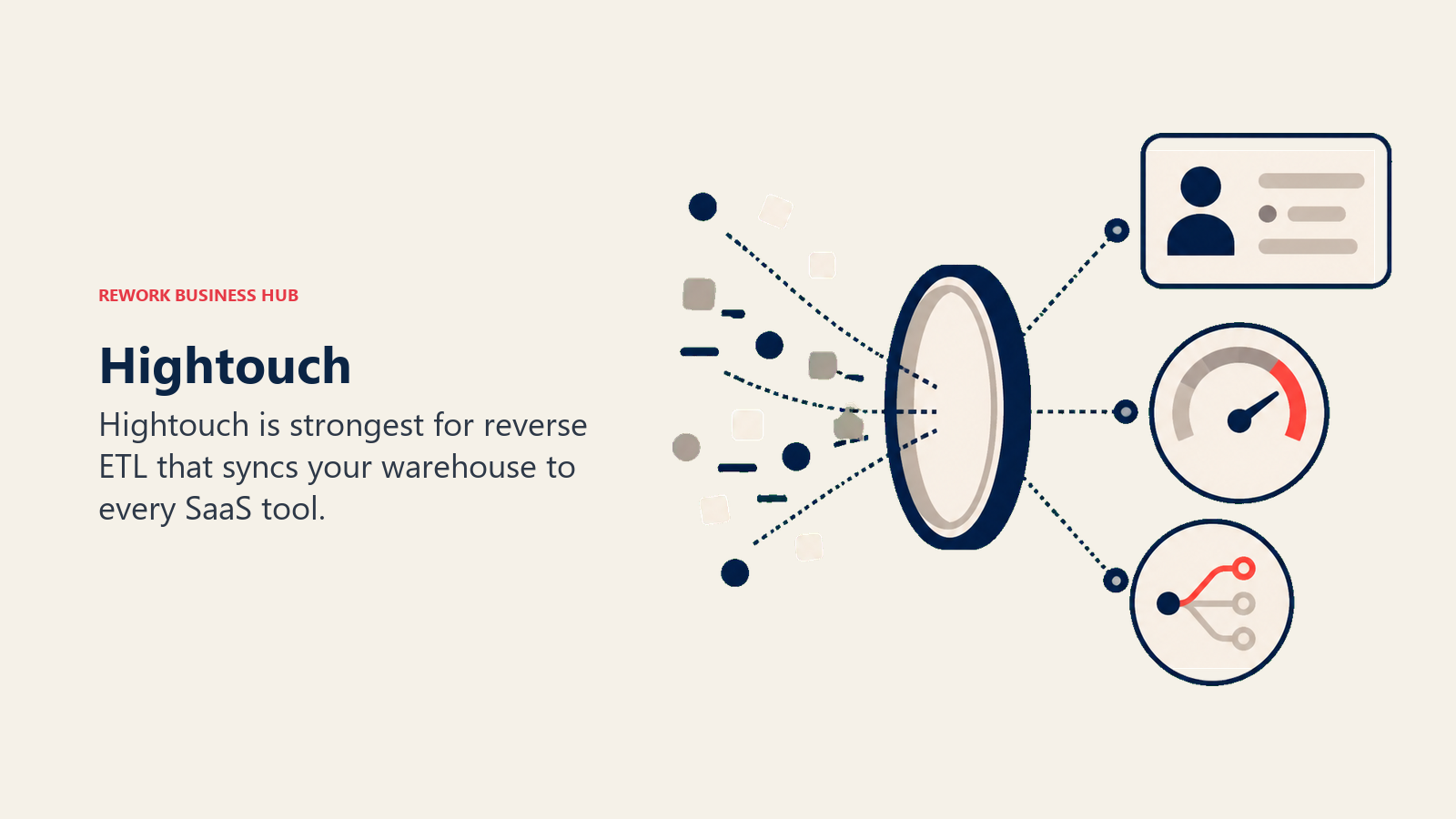
The product vision is "your warehouse as the source of truth for everything." If your data team already has clean, modeled customer data in Snowflake or BigQuery, Hightouch connects that directly to Salesforce, HubSpot, Intercom, Facebook Ads, and 200+ other destinations. No more CSV exports. No more manual field mappings. No more stale data in your CRM because nobody ran the sync job. For RevOps teams, this pairs naturally with deduplication across multichannel leads. Clean warehouse data synced to CRM means your dedup logic runs on good inputs.
Important caveat: Hightouch is not a Segment replacement in the traditional sense. It doesn't collect events. If you need event collection, pair it with a collection tool (RudderStack, Jitsu, or Snowplow) feeding your warehouse, then use Hightouch for the outbound sync. Together they're more capable than Segment alone. See Hightouch's pricing. The free tier is usable for smaller data teams.
| Strengths | Limitations |
|---|---|
| 200+ destination connectors | Doesn't collect events (warehouse required) |
| dbt-native, works with existing models | Requires existing warehouse investment |
| Real-time and scheduled sync options | Can get expensive at high sync frequency |
| Visual audience builder for non-technical users | Some destinations have sync limitations |
| Solid free tier for small teams | Best value only with mature data stack |
Pricing: Free tier available. Paid from $350/month. Enterprise custom.
Best for: Data teams that want to operationalize warehouse data in CRMs, ad platforms, and customer tools.
6. Census: reverse ETL with deep dbt integration for analytics engineers
Census and Hightouch occupy the same category but come at it differently. Where Hightouch emphasizes breadth of connectors and ease of use for marketers, Census is built for analytics engineers and data teams that live in dbt.
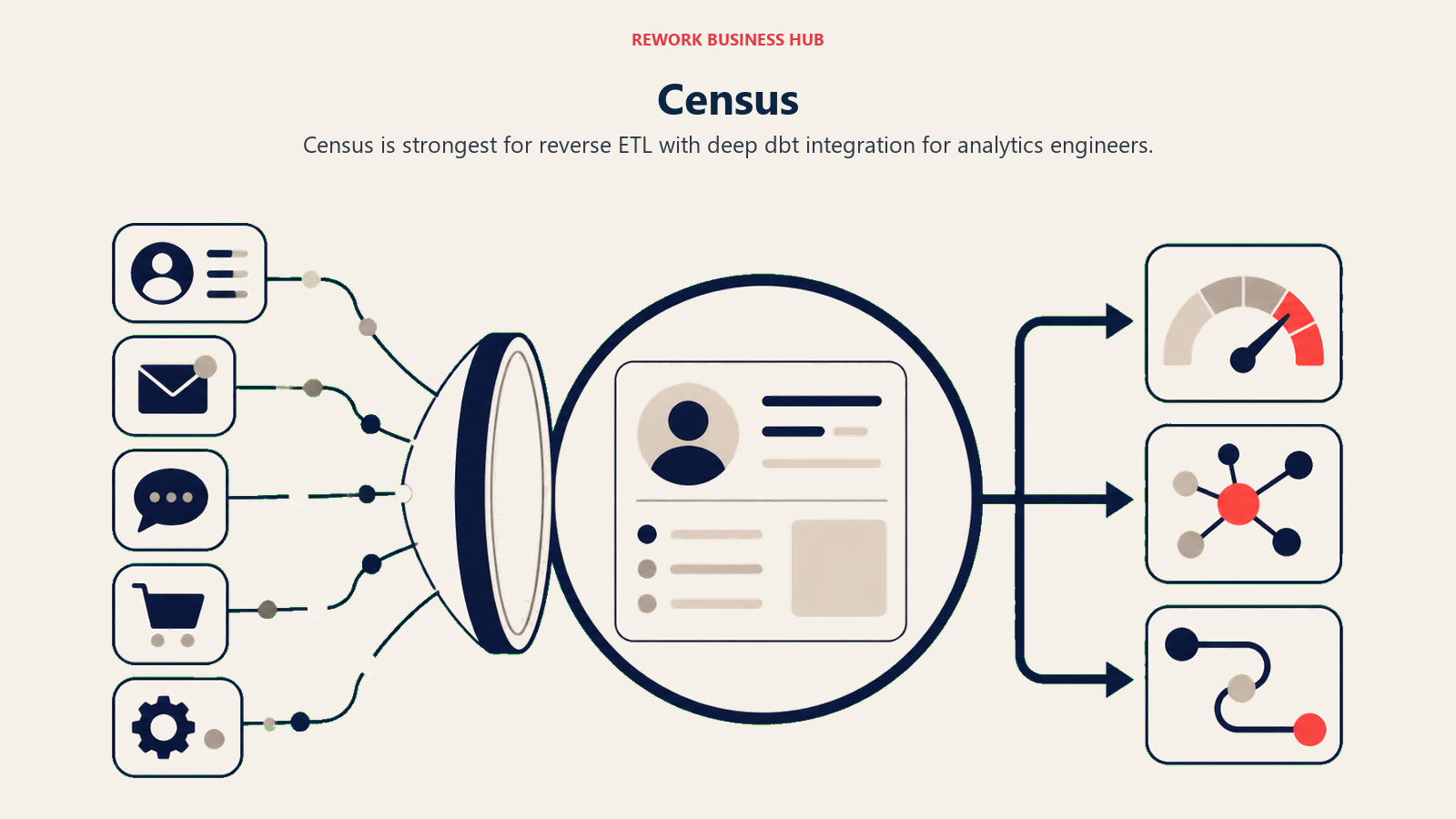
The philosophy: your dbt models are already the canonical definition of your business entities. Census treats dbt as first-class: you define syncs directly against your dbt models, sync run statuses appear in dbt metadata, and the whole workflow feels like an extension of the dbt ecosystem rather than a separate tool.
Census targets companies with mature analytics engineering practices. If you have a dedicated data team, use dbt for transformation, and want tighter control over sync logic, Census often fits better than Hightouch. If your marketing team needs to build audiences without SQL, Hightouch's visual builder is better. See Census's pricing. Paid tiers start at $300/month.
| Strengths | Limitations |
|---|---|
| First-class dbt integration | Doesn't collect events |
| Strong for analytics engineering workflows | Requires warehouse infrastructure |
| 200+ destination connectors | Less friendly for non-technical marketers |
| Observability features for sync monitoring | Enterprise features require higher tiers |
| Solid API for custom automation | Smaller brand awareness than Hightouch |
Pricing: Free tier available. Paid from $300/month. Enterprise custom.
Best for: Analytics engineering teams using dbt who want clean reverse ETL without rebuilding their workflow.
7. Lytics: behavioral CDP with ML-powered audience scoring
Lytics takes a more opinionated approach to the CDP category. Rather than positioning as a data router, Lytics is built around behavioral intelligence: predicting which users are likely to convert, churn, or engage based on their action patterns.
The product vision is "a CDP that acts, not just stores." Lytics ingests behavioral data, builds user profiles, runs ML models to generate propensity scores (likelihood to buy, likelihood to churn), and makes those scores available in real-time to downstream tools. Marketing teams can build audiences based on predicted behavior rather than just historical segments.
Lytics targets mid-market and enterprise B2C companies with enough behavioral data to make the ML models meaningful: media companies, ecommerce, digital subscription businesses. It's less relevant for early-stage companies without sufficient data volume. Pricing is custom and tends toward the higher end, which puts it out of reach for many growth-stage companies.
| Strengths | Limitations |
|---|---|
| Real-time ML propensity scoring | Less transparent pricing |
| Self-serve audience builder | Needs substantial data volume for ML value |
| Content affinity modeling | Less compelling for B2B SaaS use cases |
| Good real-time activation speed | Implementation complexity is medium-high |
| Strong personalization use cases | Smaller integration library vs Segment |
Pricing: Custom. Typically $30,000-$100,000+ annually for meaningful tiers.
Best for: B2C companies with rich behavioral data who want ML-driven audience scoring built into their CDP.
8. Tealium: enterprise tag management and CDP for large digital teams
Tealium has been in the enterprise data collection space longer than almost anyone. It started as a tag management system (TMS) and evolved into a full CDP over the last decade. That history shows in the product: deep integration with enterprise web analytics, mature governance controls, and a compliance story built for legal and IT sign-off at Fortune 500 companies.
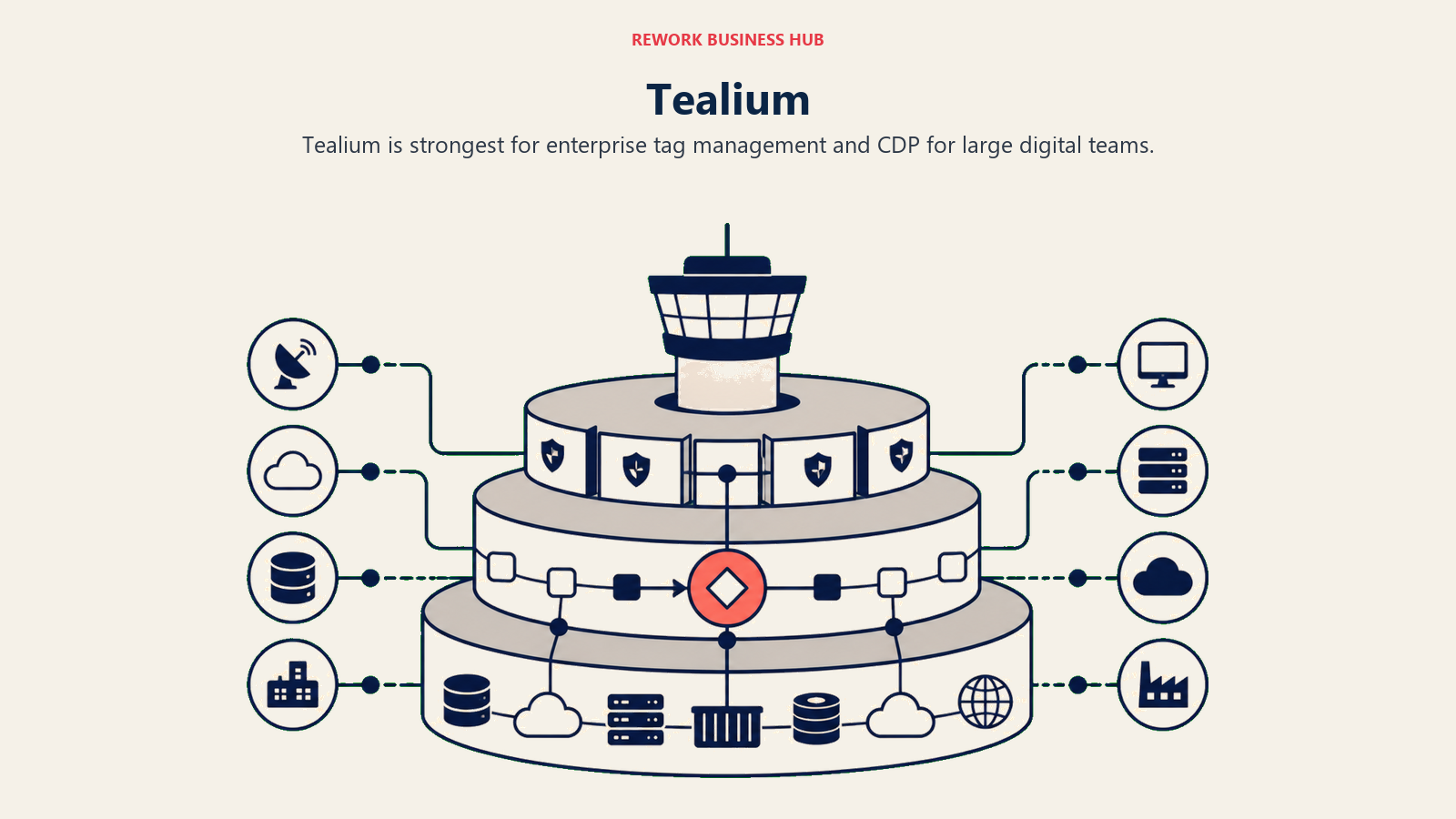
The product philosophy is enterprise-grade reliability and governance. Tealium iQ handles client-side tag management. Tealium AudienceStream handles real-time profile building. Tealium DataAccess handles data layer access. Together they form a CDP suite that large organizations can implement without running custom infrastructure.
Tealium's target customer is a large enterprise with complex digital properties, multiple brands, and a team dedicated to analytics governance. Think large retailers, financial institutions, and global media companies. Implementation typically takes months and requires a Tealium partner or significant in-house expertise.
| Strengths | Limitations |
|---|---|
| Mature enterprise governance and compliance | Very expensive (enterprise-only pricing) |
| Strong tag management layer | Long implementation timelines |
| Real-time audience streaming | Overkill for companies under $50M revenue |
| 1,300+ vendor integrations | Interface can feel dated |
| Proven at massive scale | Requires dedicated implementation resources |
Pricing: Custom enterprise. Most customers spend $100,000+ annually.
Best for: Large enterprises with complex digital properties, dedicated analytics teams, and hard compliance requirements.
9. Snowplow: open-source behavioral data platform for full schema control
Snowplow is the CDP for teams that want to own their behavioral data model completely. The philosophy is "your data, your schema, your warehouse." Snowplow doesn't ship with an opinionated event schema. You define exactly what gets tracked, what the fields mean, and how data is structured in your warehouse.
That flexibility is the point. Segment and most CDPs impose a schema on your data. Snowplow gives you a schema registry where you define every event type, every property, and every validation rule. Your data is cleaner, more consistent, and genuinely owned by your team rather than shaped by a vendor's data model.
Snowplow targets engineering and data teams at growth-stage and mid-market companies who care deeply about data quality. Gaming companies, marketplaces, and companies with complex event taxonomies are natural fits. The open-source version requires meaningful DevOps work to operate. Check Snowplow's BDP pricing. The cloud product abstracts self-hosting away but starts around $2,000/month.
| Strengths | Limitations |
|---|---|
| Full schema ownership and control | Significant infrastructure overhead (self-hosted) |
| Extremely high data quality | Cloud version is expensive |
| Warehouse-native, no data lock-in | Steeper learning curve |
| Rich event validation built-in | No built-in destination connectors |
| Strong open-source community | Requires dedicated data engineering |
Pricing: Free open-source (self-hosted infra costs apply). Snowplow BDP from ~$2,000/month. Enterprise custom.
Best for: Data engineering teams that want full control over behavioral event schemas with zero vendor data lock-in.
10. MetaRouter: server-side event routing for privacy-first and cookieless stacks
MetaRouter is built around the constraint that client-side tracking is breaking. Browser privacy changes (ITP, ETP), ad blockers, and cookie consent requirements mean that client-side JavaScript analytics increasingly misses 30-50% of events. MetaRouter's answer: move everything server-side.
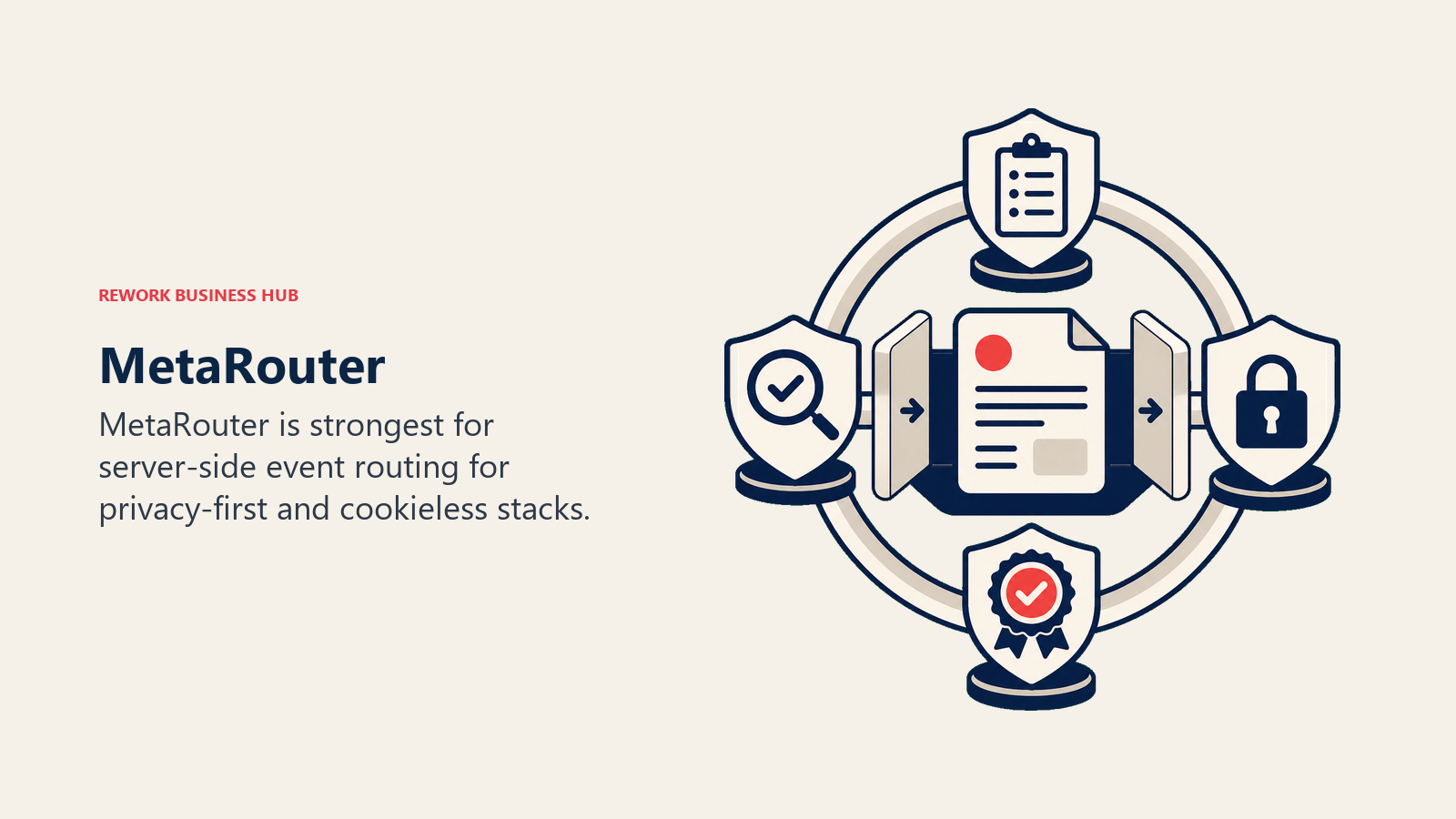
The product vision is server-side event collection and routing that works independently of browser behavior. Events are captured server-side, enriched, and routed to destinations without touching the browser's cookie jar. For teams dealing with high ad blocker rates (tech-forward audiences) or strict GDPR requirements in Europe, this architecture preserves data collection that client-side tools miss entirely.
MetaRouter targets mid-market and enterprise companies in industries where data accuracy matters at the revenue level: performance marketing teams spending significant ad budgets, companies in privacy-sensitive markets, and organizations where EU compliance is non-negotiable. The tool is not cheap and not for early-stage companies.
| Strengths | Limitations |
|---|---|
| Server-side architecture bypasses ad blockers | Premium pricing, not SMB-accessible |
| Cookieless tracking by design | Requires server-side implementation changes |
| Strong ad platform Conversions API integrations | Enterprise focus limits smaller team use |
| Privacy-first data handling | Smaller destination library than full CDPs |
| Accurate data in high-blocker environments | Less community content and resources |
Pricing: Custom enterprise pricing. Most customers in $24,000-$120,000+ annual range.
Best for: Performance marketing teams and enterprises needing accurate server-side tracking where client-side tools fail due to privacy changes.
Decision Framework
| If you need... | Pick... |
|---|---|
| Open-source, full data control, Segment replacement | RudderStack |
| HIPAA compliance for healthcare analytics | Freshpaint |
| Mobile-first enterprise with identity resolution | mParticle |
| Simple, cheap event collection for early stage | Jitsu |
| Sync warehouse data to CRMs and ad platforms (dbt user) | Census |
| Sync warehouse data to SaaS tools (marketer-friendly) | Hightouch |
| ML-driven audience scoring and behavioral prediction | Lytics |
| Enterprise tag management + CDP with governance | Tealium |
| Full behavioral schema ownership, no vendor lock-in | Snowplow |
| Server-side tracking for cookieless / privacy compliance | MetaRouter |
Why Teams Leave Segment
Before picking an alternative, it's worth naming the specific Segment pain points these tools address:
| Segment Pain Point | Which Alternatives Address It |
|---|---|
| Twilio ownership changed pricing direction | RudderStack, Jitsu, Snowplow (open-source control) |
| MTU pricing gets expensive at scale | RudderStack (event-based), Jitsu (flat), Snowplow (self-hosted) |
| Limited transformation without a warehouse | Hightouch, Census (warehouse-native by design) |
| Data lives in Segment, not your warehouse | Any warehouse-native tool (RudderStack, Snowplow, Jitsu) |
| Can't handle HIPAA compliance | Freshpaint |
| Client-side tracking gaps (ad blockers, privacy) | MetaRouter |
| Need real-time ML scoring on user behavior | Lytics |
| Enterprise governance requirements | Tealium |
What to Do Next
Don't evaluate all ten tools simultaneously. Pick your top two based on the decision framework above, run a two-week pilot with real production events, and measure against the specific Segment limitation you're trying to solve. Most of these tools have free tiers or free trials. The data you collect in two weeks tells you more than any feature comparison.
For warehouse-native teams evaluating open-source options, RudderStack and Snowplow both have active communities where you can get implementation questions answered before committing to anything.
Segment Alternatives FAQ
What is the best open-source Segment alternative?
RudderStack is the closest open-source drop-in replacement, with warehouse-native architecture, JavaScript transformations, and event-based pricing instead of MTU billing. Snowplow is the stronger choice if you want full control over your behavioral event schema, and Jitsu is the simplest option for a small team that just needs cheap event collection.
Why are teams leaving Segment in 2026?
The most common reasons are MTU-based pricing that gets expensive at scale after the Twilio acquisition, limited transformation without a separate warehouse, data living in Segment rather than your own warehouse, and no native HIPAA support. Each pain point maps to a different alternative on this list.
Are Hightouch and Census real Segment replacements?
Not on their own. Hightouch and Census are reverse ETL tools that sync warehouse data out to SaaS tools, but they do not collect events. To replace Segment fully, pair one of them with a collection tool like RudderStack, Jitsu, or Snowplow feeding your warehouse.
Which Segment alternative is best for healthcare or regulated data?
Freshpaint is purpose-built for HIPAA compliance. It intercepts events, strips or masks protected health information, then forwards clean data to your existing analytics stack, so healthcare teams can use the same downstream tools as everyone else without the compliance risk.
How should I evaluate Segment alternatives?
Pick your top two based on team size and data stack, run a two-week pilot with real production events, and measure against the specific Segment limitation you are solving. Most of these tools have free tiers or trials, so two weeks of live data tells you more than any feature matrix.
Related reading:
- Best Twilio alternatives in 2026: Twilio's acquisition of Segment affects both products; this covers the communications side
- Lead enrichment automation
- Deduping multichannel leads
- True cost of software sprawl

Principal Product Marketing Strategist
On this page
- Quick Comparison Table
- Stage Fit Matrix
- Sizing and Buyer Persona Table
- 1. RudderStack: open-source CDP with warehouse-native architecture
- 2. mParticle: enterprise mobile CDP with best-in-class identity resolution
- 3. Freshpaint: HIPAA-compliant event tracking for healthcare and regulated industries
- 4. Jitsu: lightweight open-source event collection with warehouse-first design
- 5. Hightouch: reverse ETL that syncs your warehouse to every SaaS tool
- 6. Census: reverse ETL with deep dbt integration for analytics engineers
- 7. Lytics: behavioral CDP with ML-powered audience scoring
- 8. Tealium: enterprise tag management and CDP for large digital teams
- 9. Snowplow: open-source behavioral data platform for full schema control
- 10. MetaRouter: server-side event routing for privacy-first and cookieless stacks
- Decision Framework
- Why Teams Leave Segment
- What to Do Next