Best Customer Data Platforms (CDPs) in 2026: 15 Tools for Unifying Customer Records
Turn this article into takeaways for your work.


Each assistant summarizes the article only for you and suggests best practices for your work.
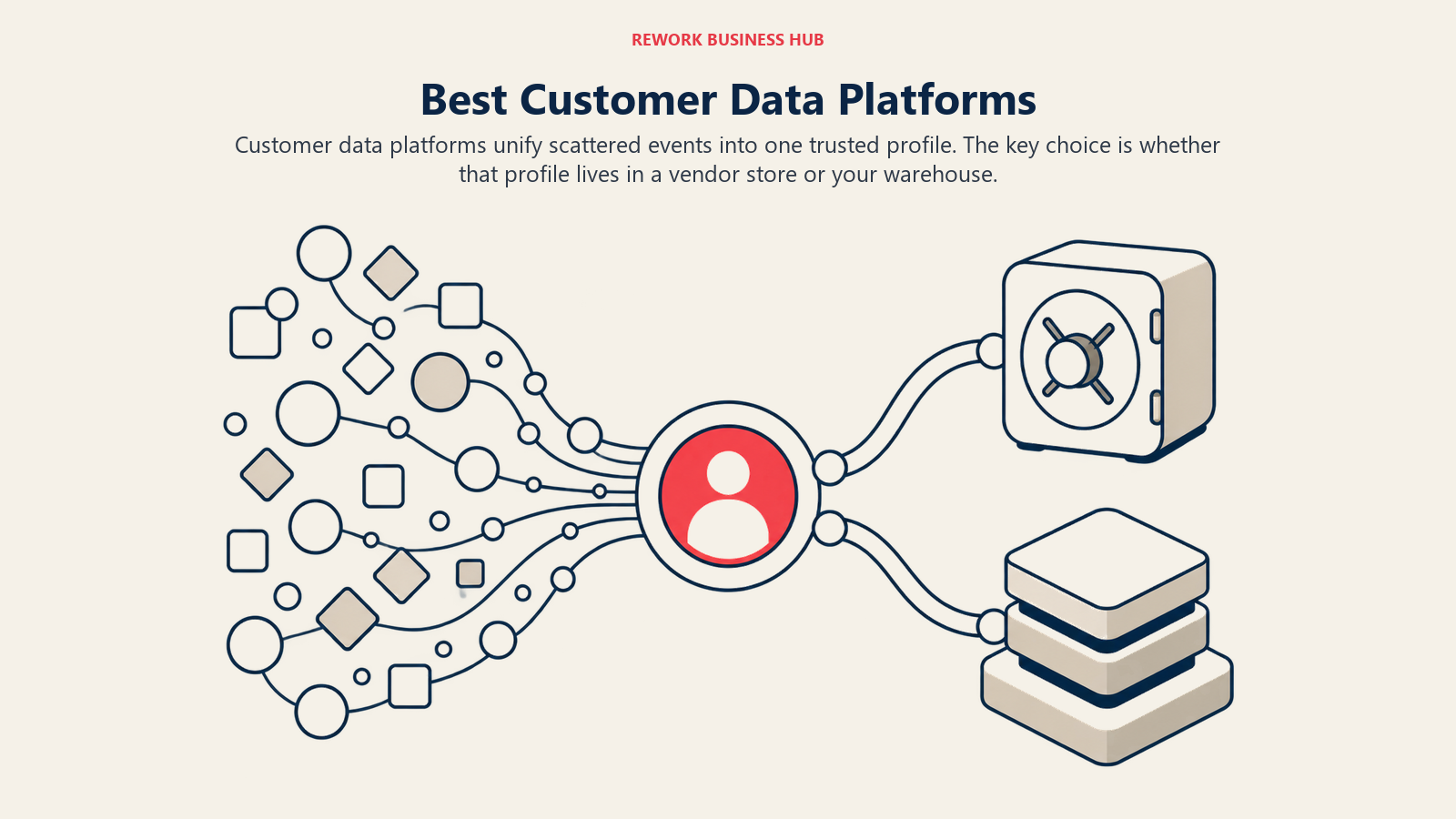
The best customer data platform in 2026 depends on one question most shortlists skip: do you want the CDP to hold its own copy of the unified customer profile, or do you want it to read and write directly against the warehouse you already pay for? Twilio Segment, Adobe Real-Time CDP, Salesforce Data 360 and Tealium lead the packaged camp, where the CDP itself is the system of record for the merged profile. Hightouch, RudderStack, Fivetran Activations, Snowplow and Jitsu lead the composable camp, where Snowflake, BigQuery or Databricks stays the system of record and the CDP layer only resolves identity and activates what's already there.
This guide ranks 15 platforms for CDOs, VPs of Data, CIOs, RevOps and marketing-ops leaders evaluating a CDP anywhere from a 50-person company to a multi-thousand-seat enterprise: identity resolution depth, activation reach, governance, engineering lift and total cost once usage-based pricing is actually modeled out. If you already know which incumbent you're replacing, the sibling RudderStack alternatives, Tealium alternatives, Hightouch alternatives, Salesforce Data Cloud alternatives, Adobe Real-Time CDP alternatives and Amperity alternatives guides go deeper on that single switch. The head-to-heads take the most-searched match-ups directly: Segment vs RudderStack, Salesforce Data Cloud vs Adobe Real-Time CDP and Hightouch vs Census.
Key Facts
- CDP Institute's January 2026 industry update tracks 208 active CDP vendors, a sign of just how fragmented this category still is, per CDP.com's 2026 industry statistics roundup.
- Gartner predicts 80% of net-new enterprise CDP deployments will be embedded in or composable with a broader data platform by 2030, rather than sold as a stand-alone product, per Gartner's First Take analysis of Databricks CustomerLake.
- Only 31% of marketers say they're fully satisfied with their organization's ability to unify customer data, per Salesforce's State of Marketing report, 10th edition.
- Consumers spend 54% more on brands that personalize their experience, yet just 16% of brands strongly agree they have the customer data to do it, per Twilio's State of Customer Engagement Report.
- The global CDP market is projected to grow from $9.72 billion in 2025 to $37.11 billion by 2030, a 30.7% compound annual growth rate, per MarketsandMarkets.
What Actually Changed in This Category in 2026
Five names on this list aren't the names you'd have written down a year ago. Consolidation, not new feature launches, is the real story in CDP right now.
| Change | What happened | What it means for your shortlist |
|---|---|---|
| Census became Fivetran Activations | Fivetran acquired Census in a deal announced May 1, 2025. The product now ships as Fivetran Activations, priced on Connections and Activations MAR (monthly active rows) instead of a flat plan | If you remember Census's old flat monthly tier, it's gone. Budget on MAR usage, and expect the same billing relationship as the rest of your Fivetran data movement |
| mParticle joined Rokt | mParticle is now part of Rokt, the ecommerce transaction network, and no longer publishes standalone pricing | Evaluating mParticle now means evaluating it as part of Rokt's wider commerce stack, not a standalone CDP purchase |
| ActionIQ was acquired by Uniphore | ActionIQ is now sold as Uniphore's composable CDP inside its Marketing AI product line | An ActionIQ conversation is now a Uniphore conversation. The standalone brand and its old pricing model don't exist independently anymore |
| Salesforce Data Cloud became Data 360 | Salesforce renamed Data Cloud to Data 360 at Dreamforce on October 14, 2025, folding it under the Agentforce 360 umbrella | Same license and data model, new name. Don't let an old RFP, contract or internal doc still say "Data Cloud" when you scope this |
| Treasure Data became Treasure AI | Treasure Data rebranded to Treasure AI in April 2026, repositioning from a customer data platform to what it calls an agentic experience platform | The vendor now frames itself around AI agents acting on unified profiles, not just storing them. Ask specifically what that adds before paying for it |
The pattern underneath all five: standalone CDP vendors keep getting absorbed into bigger data-movement or commerce platforms, which is exactly the shift Gartner's 80%-by-2030 composable prediction describes. A CDP decision made this quarter should assume today's vendor logo might report to a different parent company by your next renewal.
Packaged vs Composable: The Real Fault Line
Every CDP on this list falls into one of two architectures, and that split matters more than almost any feature checkbox on a vendor's homepage.
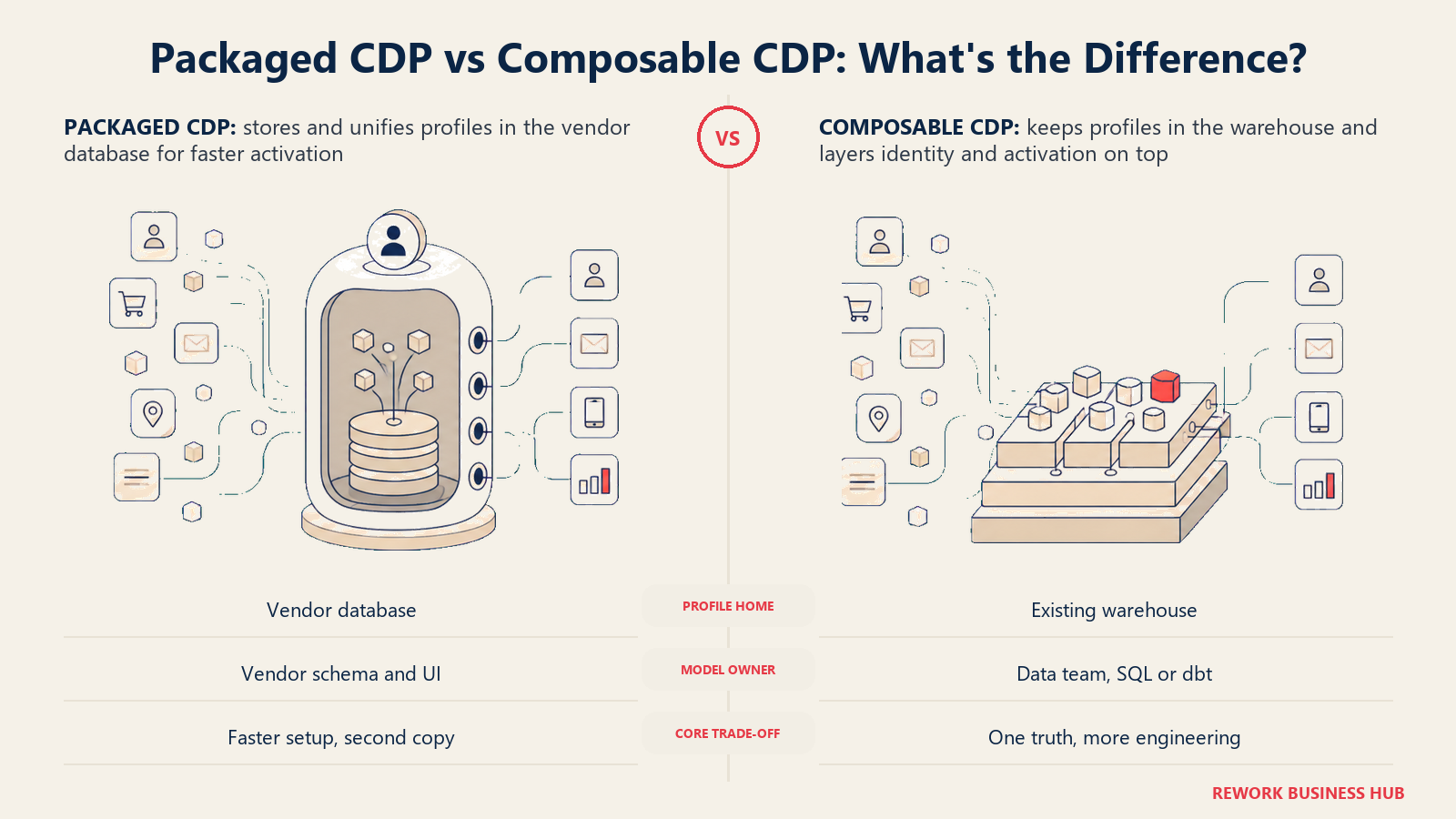
A packaged CDP stores its own copy of the unified customer profile. It ingests data from your sources, resolves identity, and holds the merged record inside the vendor's own database. Twilio Segment's Unify and Engage products, Adobe Real-Time CDP, Salesforce Data 360, Tealium, Treasure AI, Amperity, mParticle, BlueConic, Lytics and the Klaviyo Data Platform all work this way. You get a purpose-built profile store and, usually, a more mature activation UI, at the cost of a second copy of customer data to govern and keep in sync with the warehouse.
A composable, warehouse-native CDP leaves the unified profile in Snowflake, BigQuery or Databricks, the warehouse you already pay for and already govern, and layers identity resolution, audience building and activation on top without duplicating the data. Hightouch, RudderStack, Fivetran Activations, Snowplow and Jitsu lead this camp. You avoid standing up a second source of truth, but the modeling work a packaged CDP's UI would otherwise hide now has to happen in your warehouse, usually with a data engineer involved.
| Packaged CDP | Composable / warehouse-native CDP | |
|---|---|---|
| Where the unified profile lives | Inside the vendor's own database | In your Snowflake, BigQuery or Databricks warehouse |
| Who owns the data model | The vendor's schema and UI | Your data team, typically in SQL or dbt |
| Fastest fit | Marketing teams without dedicated data engineering support | Data teams with a warehouse and modeling discipline already in place |
| Governance | One vendor's security and compliance posture to vet | Inherits your existing warehouse governance |
| Vendors on this list | Twilio Segment (Unify/Engage), Adobe Real-Time CDP, Salesforce Data 360, Tealium, Treasure AI, Amperity, mParticle, BlueConic, Lytics, Klaviyo Data Platform | Hightouch, RudderStack, Fivetran Activations, Snowplow, Jitsu |
Neither model is universally right. A marketing-led team with no data engineering bench usually gets to value faster with a packaged CDP. A data team that already has a well-modeled warehouse and wants a single source of truth usually gets more durable value from a composable one, and per Gartner's prediction above, that's where net-new enterprise deployments are already heading.
Quick Comparison Table
| Tool | Best For | Starting Price | Key Strength | Key Limitation |
|---|---|---|---|---|
| Twilio Segment | One data pipeline plus identity resolution | Free (1K visitors/mo); Team from $120/month | 700+ integrations, mature Reverse ETL | Unify/Engage CDP layer is quote-only |
| Adobe Real-Time CDP | Enterprises on Adobe Experience Cloud | No published price, quoted on profile volume | Deep tie-in with Journey Optimizer and Target | Zero pricing transparency, needs a sales call |
| Salesforce Data 360 | Salesforce orgs feeding Agentforce AI agents | $500 per 100k Flex Credits, or $240 per 1k profiles/year | Same model now powers Agentforce agents directly | Pricing needs a rep; not self-serve |
| Tealium | Enterprises wanting CDP tied to tag management | No published price at all | Long track record in tag management plus real-time CDP | Publishes literally nothing, not even a range |
| Treasure AI | Enterprises wanting profile-priced CDP, no compute charges | No published price; tiered on profiles and behaviors | "No compute" model avoids surprise query bills | Agentic-AI repositioning complicates scoping it |
| Amperity | Retail/hospitality needing lakehouse-scale identity resolution | No published price, no trial, consumption-based ("Amps") | Shares profiles into Databricks/Snowflake, no reverse ETL | No self-serve path, full sales cycle required |
| mParticle (Rokt) | Mobile/app-first companies needing real-time infrastructure | No published price | Real-time collection, backed by Rokt's commerce network | No standalone pricing since the Rokt acquisition |
| BlueConic | Marketing-led teams building first-party audiences | No published price, demo or quote only | Marketers self-serve audience building, not just IT | Zero pricing transparency before a sales call |
| Hightouch | Activating data straight from the warehouse | Usage-based; free Basic Reverse ETL tier (2 syncs, unlimited seats) | Composable CDP plus a newer agentic marketing layer | No published starting price, usage-based only |
| RudderStack | Self-hostable customer data pipeline | Free: 250K events/month; Growth $265/month for 1M | Source-available (Elastic License 2.0) | Not OSI open source; free tier caps at 250K events |
| Fivetran Activations | Fivetran users wanting activation bundled in | Free: 500K Connections MAR/mo, 3,500 Activations MAR/mo | One platform, one bill for movement plus activation | Usage-based on MAR, no published per-unit rate |
| Snowplow | Full ownership of event-level behavioral data | No published price, 14-day free trial at $0 | Fully composable, no vendor-owned profile store | Community edition is SLULA 1.1, not Apache |
| Lytics (now Contentstack) | Existing customers planning a migration | No longer published; pricing page 404s | Lives on as Lytics CDP inside Contentstack AXP | Standalone site retires 30 September 2026 |
| Klaviyo Data Platform | Ecommerce CDP bundled into email/SMS marketing | Free up to 250 profiles; starter config near $45/month | CDP ships inside a B2C platform teams already use | Built for ecommerce, not a general-purpose CDP |
| Jitsu | Genuinely open-source, self-hosted event collection | Free: unlimited events, 200K active events/mo; $99/mo for 2M | True MIT open source, no licensing asterisk | Smaller ecosystem than the legacy vendors |
Stage Fit Matrix
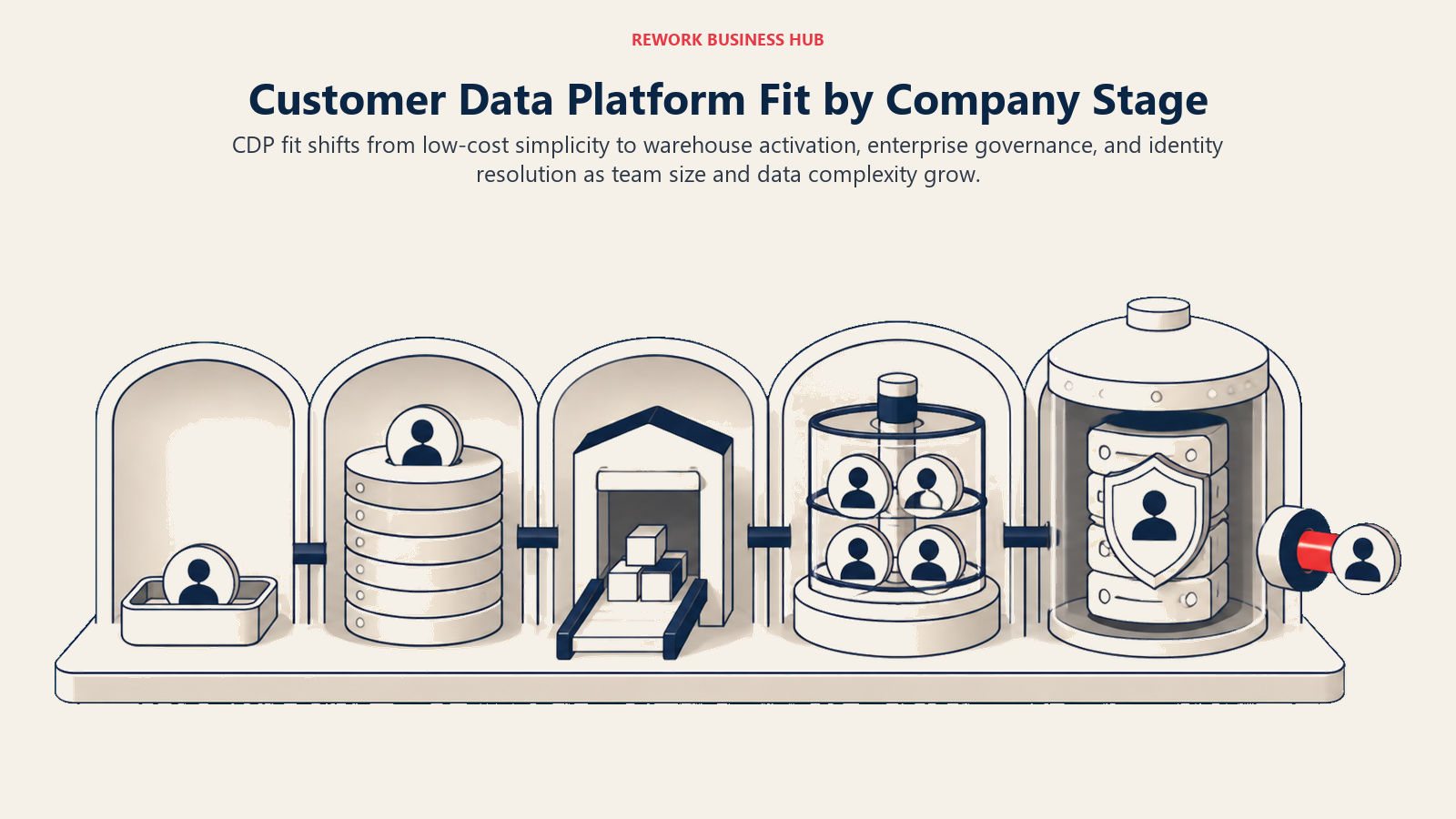
Company stage changes the CDP job, from low-cost profile unification to warehouse activation, enterprise governance, and identity resolution across multiple clouds.
| Company stage | What the CDP decision actually means here | Best fits |
|---|---|---|
| Under 50 people, no dedicated data team | One tool to unify a handful of sources for marketing; budget matters more than modeling depth | Klaviyo Data Platform, Jitsu, RudderStack free tier |
| 50 to 200 people, first data or RevOps hire | Someone finally owns the stack, but engineering bandwidth is still scarce | Hightouch, RudderStack, Klaviyo Data Platform |
| 200 to 1,000 people, warehouse already in place | A modeled warehouse exists; the real question becomes packaged vs composable activation | Fivetran Activations, Snowplow, Twilio Segment |
| 1,000 to 5,000 people | Multiple business units, and governance plus identity resolution both start to matter | Tealium, mParticle, BlueConic |
| 5,000+ people, enterprise, multiple clouds | Deep enterprise governance, identity resolution at scale, and AI-agent integration | Adobe Real-Time CDP, Salesforce Data 360, Amperity, Treasure AI |
Sizing and Persona Table
| Who owns the CDP decision | Their real problem | What to evaluate | What to skip |
|---|---|---|---|
| RevOps or marketing-ops lead, no dedicated data engineer | Needs unified customer profiles live without waiting on an engineering queue | Klaviyo Data Platform, BlueConic | Composable tools that assume a warehouse is already modeled |
| First data or analytics hire, warehouse just stood up | Doesn't want a second copy of customer data to reconcile against the warehouse | Hightouch, RudderStack, Fivetran Activations | Packaged CDPs that lock the profile inside a vendor-owned store |
| CDO or VP of Data, enterprise, multiple clouds | Needs governed identity resolution across web, mobile, offline and partner data | Adobe Real-Time CDP, Salesforce Data 360, Amperity, Tealium | Point tools with no cross-channel identity graph |
| CIO evaluating vendor consolidation risk | Just watched Census, mParticle and ActionIQ all change ownership in about a year | Any vendor here, but weigh contractual protections and data portability terms specifically | Assuming any vendor's current ownership structure is permanent |
| Engineering lead who wants to own the data model | Doesn't want a vendor's schema dictating how "customer" gets defined | Snowplow, Jitsu, RudderStack | Any packaged CDP with a fixed, vendor-defined profile schema |
1. Twilio Segment
Segment now carries its parent's name directly: Twilio Segment. Connections is the customer data pipeline, collecting events from web, mobile and server sources and routing them to 700+ destinations, with Reverse ETL built in. Unify and Engage sit on top as the actual CDP layer, resolving identity and building audiences. Connections Free runs $0/month (1,000 visitors, 2 sources, 500K Reverse ETL records). Team starts at $120/month (10,000 visitors, unlimited sources, 1M Reverse ETL records, public API), up to 20% off annually; MTU overage runs $12/1K (10K-25K), $11/1K (25K-100K), $10/1K (100K+). Business is custom. Unify and Engage are contact-sales only, no published price, and segment.com/pricing now redirects straight to twilio.com. If you're weighing Segment purely as a data pipeline against other options, see best Segment alternatives.
| Pros | Cons |
|---|---|
| 700+ integrations, mature, widely adopted pipeline | The actual CDP layer (Unify/Engage) has no published price |
| Reverse ETL included even on Team | MTU overage climbs fast past 25K |
| Deep bench of customers and integration partners | Connections and CDP pricing sit on two different pages |
| Backed by Twilio's broader infrastructure | Best identity features gated behind a sales call |
Best for: Teams that want one widely adopted pipeline with mature Reverse ETL, prepared to run a separate sales process for Unify/Engage.
2. Adobe Real-Time CDP
Adobe Real-Time CDP is built for one buyer: a company already running Adobe Experience Platform, Journey Optimizer or Target that wants a unified profile feeding directly into that stack. It ships in three editions, B2C, B2B and B2P, each in Prime and Ultimate packages, priced on profile volume. Adobe publishes no prices anywhere; every deal runs through a sales conversation driven by edition, tier and profile volume.
| Pros | Cons |
|---|---|
| Deepest native tie-in with Journey Optimizer and Target | Zero pricing transparency, not even a range |
| Six editions (B2C/B2B/B2P x Prime/Ultimate) match different buyers | Profile-volume pricing is hard to estimate without sales |
| Enterprise-grade identity resolution and governance | Value tightly coupled to running the wider Adobe stack |
| Long track record inside large marketing orgs | Long implementation and sales cycles |
Best for: Enterprises already standardized on Adobe Experience Cloud that want the CDP feeding Journey Optimizer and Target natively. If Adobe is the incumbent you are trying to replace, the Adobe Real-Time CDP alternatives guide covers the exits in depth.
3. Salesforce Data 360
Salesforce renamed Data Cloud to Data 360 at Dreamforce on October 14, 2025, under the Agentforce 360 umbrella. License, integrations and data model didn't change; the positioning did, now framed as the layer feeding Salesforce's Agentforce AI agents. Salesforce publishes real rates for it: $500 per 100,000 Flex Credits, or, on the newer profile-based model, $240 per 1,000 profiles per year and $420 per 1,000 Enterprise Profiles per year. That makes Data 360 one of the few enterprise CDPs you can budget before a sales call, though Salesforce marks the page subject to change and consumption still moves the final bill. If the CRM itself, not just the data layer, is what's actually up for evaluation, see best Salesforce alternatives.
| Pros | Cons |
|---|---|
| Same data model now powers Agentforce AI agents directly | Pricing opaque even by CDP standards |
| Native to Salesforce CRM, no separate sync layer | Consumption-credit math is hard to forecast without a rep |
| Backed by Salesforce's enterprise support and partners | Full value assumes commitment to the Salesforce platform |
| Heavy AI-agent roadmap investment under Agentforce 360 | Older docs and case studies may still say "Data Cloud" |
Best for: Salesforce-native organizations that want unified data feeding Agentforce AI agents without a separate integration layer. For the enterprise-suite decision most teams actually face, see Salesforce Data Cloud vs Adobe Real-Time CDP.
4. Tealium
Tealium built its reputation on universal tag management before extending into a full real-time customer data hub, and companies often adopt the CDP because they already trust Tealium's tag layer for collection. It's the most opaque vendor on this list on pricing: Tealium publishes no figures, so expect a custom quote.
| Pros | Cons |
|---|---|
| Long track record in real-time tag management plus CDP | Publishes nothing on pricing, not even a range |
| Data collection and CDP layer share one pipeline | The pricing page itself is broken |
| Strong reputation for enterprise-scale event streaming | No self-serve trial or entry point |
| Enterprise integration ecosystem built over a decade-plus | Budgeting needs a full sales cycle |
Best for: Enterprises that already rely on Tealium for tag management and want the CDP built on that same collection pipeline.
5. Treasure AI
Treasure Data rebranded to Treasure AI in April 2026, repositioning from a CDP to what it calls an agentic experience platform, framing unified profiles as the substrate AI agents act on. No published prices, but the model is specific: the Intelligent Customer Data Platform is an annual subscription tiered on profiles and behaviors, Treasure AI Suites add a fixed annual license plus consumption credits, and Treasure AI Studio runs on usage credits, a "no compute" model that charges for data unified, not queries run.
| Pros | Cons |
|---|---|
| "No compute" pricing avoids surprise query-cost bills | No published price anywhere, every tier needs sales |
| Profile-and-behavior pricing is predictable | 2026 AI repositioning complicates scoping it as a plain CDP |
| Three product lines match different buyer shapes | Newer brand means less market familiarity |
| Long operating history as Treasure Data pre-rebrand | Evaluating the AI-agent layer adds scope to the buy |
Best for: Enterprises that want CDP pricing tied to data volume rather than compute, open to the newer agentic-AI layer.
6. Amperity
Amperity built its name on identity resolution at genuine enterprise scale, particularly retail and hospitality, where one customer shows up across dozens of loyalty, POS, ecommerce and call-center systems under slightly different names. Its Lakehouse CDP and Amperity Bridge share unified profiles directly into Databricks and Snowflake through Delta Sharing, Snowflake Secure Data Sharing and Iceberg tables, skipping the reverse ETL step most packaged CDPs rely on. No published prices, no freemium tier, no self-serve trial; pricing runs entirely on a consumption basis the vendor calls "Amps."
| Pros | Cons |
|---|---|
| Identity resolution built for messy, high-volume retail data | No published price, no free trial, no self-serve path |
| Shares profiles into Databricks/Snowflake, no reverse ETL step | "Amps" pricing is opaque until a rep models it |
| Strong reputation in retail and hospitality specifically | Full sales cycle required before any number appears |
| Native lakehouse-sharing fits teams already on Databricks/Snowflake | Less useful outside data-heavy, high-volume industries |
Best for: Retail and hospitality enterprises needing identity resolution at lakehouse scale, already on Databricks or Snowflake. Teams priced out of that commitment should start with the Amperity alternatives guide.
7. mParticle (Rokt)
mParticle built its reputation as customer data infrastructure for mobile and app-first companies, collecting real-time events from web, mobile and server sources into a governed profile. That capability hasn't changed, but the company has: mParticle is now part of Rokt, the ecommerce transaction network, and publishes no standalone pricing. Evaluating it today means evaluating it as part of Rokt's broader commerce and audience network, not an isolated CDP line item.
| Pros | Cons |
|---|---|
| Strong, mature real-time mobile, web and server-side collection | No standalone pricing since the Rokt acquisition |
| Now backed by Rokt's ecommerce network and audience reach | Evaluation scope expands beyond a pure CDP decision |
| Established governance for app-heavy companies | Less clarity on roadmap independence post-acquisition |
| Long track record with mobile-first, app-first brands | Buyers wanting just a CDP may find the pitch mismatched |
Best for: Mobile and app-first companies comfortable evaluating mParticle as part of Rokt's wider commerce network.
8. BlueConic
BlueConic's pitch is aimed at marketers, not IT: a first-party data and audience-building platform so a marketing team can build and activate segments without filing an engineering ticket for every new audience. That self-serve orientation is its clearest differentiator against engineering-heavy packaged CDPs. No pricing is published; the site offers a demo or quote request only.
| Pros | Cons |
|---|---|
| Built for marketers to self-serve audience building | Zero pricing transparency, not even a starting figure |
| First-party focus fits privacy-conscious, post-cookie marketing | No self-serve trial to size fit before a sales call |
| Simpler learning curve than most packaged CDPs | Less identity-resolution depth than Adobe or Amperity |
| Marketing-led positioning reduces data-team dependency | Smaller footprint and brand recognition than larger vendors |
Best for: Marketing-led teams that want to build and activate first-party audiences directly, without routing changes through engineering.
9. Hightouch
Hightouch popularized Reverse ETL and has extended that into a full composable CDP: identity resolution, audience building and activation all run against your existing warehouse instead of a separate profile store. In 2026 it layered an Agentic Marketing Platform on top. Both paid lines, Agentic Marketing Platform and Composable CDP, are usage-based with no published figures; the Composable CDP includes unlimited seats regardless of tier. The free Basic Reverse ETL tier covers up to 2 active syncs, unlimited destinations and unlimited seats. Teams evaluating Hightouch alongside broader workflow-automation platforms may also want best Workato alternatives.
| Pros | Cons |
|---|---|
| Composable CDP activates from the warehouse, no data duplication | No published starting price, usage-based only |
| Unlimited user seats even on paid tiers | Newer Agentic Marketing layer less proven than core Reverse ETL |
| Genuinely useful free Basic Reverse ETL tier | Full value assumes a reasonably well-modeled warehouse |
| Strong reputation as the category's Reverse ETL pioneer | Usage-based pricing makes budgeting harder than flat per-seat |
Best for: Data teams that want a composable CDP activating straight from the warehouse, with room to grow into agentic marketing. For the activation-layer match-up specifically, see Hightouch vs Census.
10. RudderStack
RudderStack markets itself as the source-available alternative to Twilio Segment, and the free tier backs that up: 250,000 events/month, 16 SDK sources, 200+ destinations, 5 transformations, no card required. Growth starts at $265/month for 1M events, tiers to 25M+, 15% off annually, unlimited team members, 25 reverse ETL connections; Enterprise is custom with 5-minute warehouse sync and unlimited transformations. One correction: RudderStack's self-hosted code runs under Elastic License 2.0, source-available, not OSI-approved open source. Calling it "open source" without that qualifier overstates the license.
| Pros | Cons |
|---|---|
| Source-available (Elastic License 2.0) self-hosting, unusual here | Not OSI open source despite the reputation |
| Free tier covers real usage at 250K events/month, no card | Free tier caps at 250K events, not unlimited |
| Unlimited team members even on paid Growth | Enterprise features (5-min sync) are Enterprise-only |
| Clear, published per-event pricing rare at this depth | Growth's event-based pricing climbs fast at high traffic |
Best for: Engineering-led teams that want a self-hostable, Segment-compatible pipeline with transparent, published pricing.
11. Fivetran Activations
Census was one of the earliest Reverse ETL vendors. Fivetran acquired it (announced May 1, 2025) and folded activation directly into its existing data-movement platform; the product now ships as Fivetran Activations, billed and operated alongside the same tool that already moves your source data. The free tier covers 500,000 Connections MAR (monthly active rows), 3,500 Activations MAR and 5,000 monthly model runs. Standard, Enterprise and Business Critical price on usage per MAR, with a $5 base charge shown for connections in the 1-1M MAR band and no single published rate above that; annual contracts get up to 22% off.
| Pros | Cons |
|---|---|
| One platform, one bill for data movement and activation | No published flat per-MAR rate past free, budgeting needs a quote |
| Generous free tier: 500K Connections MAR, 3,500 Activations MAR | The old standalone Census brand and flat pricing no longer exist |
| Backed by Fivetran's data-movement infrastructure and connectors | Best fit assumes you're already on or adopting Fivetran |
| Up to 22% off with an annual contract | MAR-based pricing is harder to forecast than flat per-seat |
Best for: Teams already on or evaluating Fivetran for data movement who want activation bundled into the same platform and bill.
12. Snowplow
Snowplow takes composability further than anyone on this list: granular, event-level behavioral data, fully owned in your own warehouse, with no vendor-controlled profile store between the raw event and your analysis. No published prices for either the Self-Hosted Pipeline or the managed Snowplow Platform, both quote-only, though a 14-day $0 trial needs no card. One correction: Snowplow's community edition is licensed under SLULA 1.1 (Snowplow Limited Use License Agreement), not Apache 2.0. SLULA restricts non-commercial use; the paid self-hosted option exists specifically to remove that restriction.
| Pros | Cons |
|---|---|
| Fully composable, no vendor-owned profile store | Community edition is SLULA 1.1, not Apache, restricts commercial use |
| 14-day free trial at $0, no card required | No published pricing at any paid tier |
| Deep granularity for real behavioral analytics | Needs meaningfully more engineering investment than a packaged CDP |
| Removes the non-commercial restriction on the paid tier | Best fit assumes a technical team ready to own event schema |
Best for: Engineering-led teams that want full ownership of granular, event-level behavioral data with no vendor-controlled profile store.
13. Lytics (now Contentstack)
Lytics used to occupy a specific middle ground: a packaged CDP with genuinely published, credit-metered pricing, rare in a category where most packaged vendors hide behind "contact sales." That is no longer the shape of it. Contentstack acquired Lytics, and lytics.com now carries one notice: "Lytics has moved to Contentstack. This site will be retired on September 30th, 2026." Lytics no longer has a public pricing page. The technology ships on as Lytics CDP inside Contentstack AXP, but the published, self-serve credit pricing it was known for is gone, and Contentstack publishes no rate for it. If you are shortlisting Lytics on the strength of its old free Developer tier or its $500 per month Growth tier, price Contentstack as an enterprise purchase instead, or look at the warehouse-native options on this list.
| Pros | Cons |
|---|---|
| Genuinely free-forever Developer tier, not a time-limited trial | Growth's credit overages ($500 per 10M) can surprise a scaling team |
| Published, credit-based pricing rare at this depth in packaged CDPs | Less enterprise brand recognition than Adobe, Salesforce or Tealium |
| Simple credit model (most events = 1 credit) is easy to reason about | Smaller partner ecosystem than the largest packaged vendors |
| Unlimited domains even on entry paid Growth | Governance depth trails the largest enterprise-only CDPs |
Best for: Mid-market marketing teams that want a packaged CDP with actual published pricing instead of a mandatory sales call.
14. Klaviyo Data Platform
Klaviyo built its name in email and SMS marketing for ecommerce brands, and the Klaviyo Data Platform (plus an Advanced tier) is the CDP layer built directly into that same product rather than a bolted-on acquisition. For a DTC brand already living in Klaviyo for campaigns, unified data and activation sit in the same login. Free covers up to 250 active profiles, 500 email sends/month and $5 of mobile messages/month. Paid pricing scales by active profiles, configured per module (Marketing, Data + Analytics, Service, Composer, Customer Agent), with a starter configuration on Klaviyo's own page totaling roughly $45/month. If it's the broader marketing platform under evaluation rather than just the data layer, see best Klaviyo alternatives and best Customer.io alternatives.
| Pros | Cons |
|---|---|
| CDP layer ships inside a marketing platform ecommerce teams already use | Built for ecommerce marketing, not a general-purpose enterprise CDP |
| Genuinely usable free plan up to 250 active profiles | Per-module pricing adds complexity to budgeting |
| Profile-based pricing scales predictably with list growth | Less identity resolution outside ecommerce than dedicated CDPs |
| No separate integration project for brands already on Klaviyo | Weaker fit for B2B or non-retail, non-ecommerce-shaped data |
Best for: Ecommerce and DTC brands that want CDP-style data unification bundled into the email and SMS platform they already run campaigns from.
15. Jitsu
Jitsu is the only vendor on this list under a genuinely open-source license with no qualifier attached: the self-hosted core is MIT-licensed, the same permissive class as most trusted developer infrastructure, no source-available asterisk to explain to legal. The free tier is generous: $0, unlimited events captured, 200,000 active events/month, unlimited connectors with one daily active sync. Business starts at $99/month for 2M active events (plus $40 per additional million) and 5 monthly active syncs (plus $20 each), hourly sync. Enterprise is custom, dropping sync to 1 minute.
| Pros | Cons |
|---|---|
| Genuinely MIT-licensed, the cleanest license story on this list | Smaller ecosystem and support bench than legacy vendors |
| Free tier captures unlimited events, capped only on active events/syncs | Enterprise features (1-minute sync) require a custom quote |
| Published, transparent pricing with clear overage costs | Less identity resolution and audience-building depth than packaged CDPs |
| Fast to self-host, minimal licensing friction | Best fit assumes in-house engineering capacity to operate it |
Best for: Developer-led teams that want a lightweight, genuinely open-source event-collection and CDP pipeline they can self-host without a licensing asterisk.
Platform Buying Mistakes to Avoid
| Mistake | What it looks like | What to do instead |
|---|---|---|
| Treating "no published price" as "expensive" | Ruling out Adobe, Amperity or Tealium on pricing opacity alone | Get a written quote first. Opacity is a sales-process problem, not proof of a higher price |
| Confusing a rebrand for a new product | Assuming Data 360, Treasure AI or Fivetran Activations are unrelated newcomers | Search the vendor's prior name too, since an old RFP may reference one |
| Ignoring vendor consolidation risk | Signing a multi-year deal without asking about ownership stability | Ask directly, especially after Census, mParticle and ActionIQ all changed hands in about a year |
| Calling RudderStack or Snowplow "open source" without qualification | Assuming full OSI freedom from an Elastic License 2.0 or SLULA-licensed edition | Read the actual license before promising engineering an unrestricted deployment |
How to Choose: Decision Framework
A reliable CDP shortlist starts with architecture and ownership, then narrows by identity depth, activation reach, engineering capacity, and cost model.
| If you need... | Pick... | Why |
|---|---|---|
| The most widely adopted pipeline plus identity resolution | Twilio Segment | 700+ integrations and mature Reverse ETL, even though the CDP layer itself is quote-only |
| Deep native tie-in with Adobe Journey Optimizer and Target | Adobe Real-Time CDP | Built specifically to feed the rest of Adobe Experience Cloud without a separate integration |
| Unified data feeding Salesforce's Agentforce AI agents | Salesforce Data 360 | Same data model, now positioned explicitly as the substrate for Salesforce's AI agent layer |
| A real-time CDP built on a tag-management foundation you already trust | Tealium | Long track record collecting the same data that then feeds the CDP layer |
| Profile-and-behavior pricing instead of compute-based billing | Treasure AI | "No compute" model avoids surprise query-cost bills as usage grows |
| Identity resolution at genuine enterprise scale, especially retail | Amperity | Purpose-built for messy, high-volume, cross-channel retail and hospitality identity data |
| A CDP backed by a commerce and audience network, not just a CDP | mParticle (Rokt) | Mobile-first data infrastructure now paired with Rokt's ecommerce reach |
| Marketers to self-serve audience building without engineering tickets | BlueConic | Built for marketing-led teams, not IT-led implementations |
| Activation straight from the warehouse, no data duplication | Hightouch | Composable CDP with unlimited seats and a newer agentic marketing layer |
| A self-hostable, transparently priced Segment alternative | RudderStack | Source-available under Elastic License 2.0, published per-event pricing |
| Activation bundled with the data movement you already pay for | Fivetran Activations | One platform and one bill for both ingestion and activation |
| Full ownership of granular, event-level behavioral data | Snowplow | No vendor-owned profile store; SLULA-licensed but with a $0, 14-day trial |
| A packaged CDP that still publishes a price | Klaviyo Data Platform | Publishes per-module pricing instead of routing every buyer to sales |
| A CDP bundled into the ecommerce marketing platform you run today | Klaviyo Data Platform | Zero-integration-project fit for brands already on Klaviyo |
| A genuinely open-source, self-hosted event pipeline | Jitsu | True MIT license, unlimited captured events on the free tier |
Frequently Asked Questions about Customer Data Platforms
What is the best customer data platform in 2026?
There's no single best CDP, only the best fit for your data architecture. Twilio Segment and Adobe Real-Time CDP lead when a mature packaged pipeline and deep martech-stack integration matter most. Hightouch, RudderStack, Fivetran Activations, Snowplow and Jitsu lead when you'd rather activate data straight from a warehouse you already govern.
What's the difference between a packaged CDP and a composable CDP?
A packaged CDP, like Segment's Unify and Engage, Adobe Real-Time CDP, Salesforce Data 360 or Amperity, stores its own copy of the unified customer profile inside the vendor's database. A composable, warehouse-native CDP, like Hightouch, RudderStack, Fivetran Activations, Snowplow or Jitsu, leaves that profile in your own Snowflake, BigQuery or Databricks warehouse and only layers identity resolution and activation on top.
How much does a customer data platform cost?
It ranges from free to entirely custom-quoted. RudderStack, Fivetran Activations, Jitsu and Klaviyo Data Platform all publish real free tiers with clear usage caps. Twilio Segment starts at $120/month for its Team pipeline tier, though its CDP layer is quote-only. Salesforce Data 360 publishes rates as well, at $500 per 100k Flex Credits or $240 per 1k profiles per year. Adobe, Tealium, Treasure AI, Amperity, mParticle and BlueConic all publish no price and require a sales conversation, usually priced on profile volume or a consumption metric.
Is RudderStack actually open source?
Partially. RudderStack's self-hosted code is licensed under Elastic License 2.0, which is source-available, meaning you can read and self-host it, but it isn't an OSI-approved open-source license and carries real usage restrictions. Jitsu is the more accurate "genuinely open source" claim on this list, licensed under MIT.
What happened to Census, mParticle and ActionIQ?
All three changed ownership within about a year of each other. Census was acquired by Fivetran (announced May 1, 2025) and now ships as Fivetran Activations. mParticle is now part of Rokt, the ecommerce transaction network. ActionIQ was acquired by Uniphore and is now sold inside its Marketing AI line. None operate as independent, standalone vendors anymore.
Did Salesforce Data Cloud or Treasure Data change names?
Yes, both did in the past year. Salesforce renamed Data Cloud to Data 360 at Dreamforce on October 14, 2025, under the Agentforce 360 umbrella, same license and data model. Treasure Data rebranded to Treasure AI in April 2026, repositioning from a CDP toward what it calls an agentic experience platform.
Do I need a data warehouse before evaluating a composable CDP?
Yes, effectively. Hightouch, RudderStack, Fivetran Activations, Snowplow and Jitsu are all built to read and write against a warehouse you already operate. If that warehouse isn't reasonably modeled yet, a packaged CDP that handles its own modeling internally, like Twilio Segment, Adobe Real-Time CDP or Tealium, will usually get you to a usable profile faster.
How reliable is identity resolution across these platforms?
It varies by vendor and by data quality, not just feature list. Amperity and Adobe Real-Time CDP are both built for identity resolution at genuine enterprise scale across messy, high-volume data. Per Salesforce's State of Marketing report, only 31% of marketers are fully satisfied with their organization's ability to unify data in the first place, often a data-quality problem before it's a vendor-capability one.
What to Do Next
Pick two platforms on opposite ends of the packaged-versus-composable divide, one that matches how your data actually lives today, and one built for the architecture you'd grow into over the next two years. Then run the same test on both before a contract reaches legal: connect your actual customer data, not a demo dataset, and see how much manual identity-resolution work still has to happen before a marketing or RevOps team can trust the unified profile enough to activate against it.
Get every real cost in writing before you compare vendors. Many platforms on this list, including Adobe, Tealium, Treasure AI, Amperity, mParticle and BlueConic, publish no price at all, and usage-based vendors like Fivetran, Hightouch and Amperity need a projection against your actual data volume, not a hypothetical one, before their number means anything.
If the shortlist still feels wide, decide first whether the real gap is identity resolution depth, activation reach, engineering ownership, or vendor stability, since five names on this list changed ownership or name in the past year alone, and that consolidation trend, per Gartner's own prediction, is still accelerating toward composable, warehouse-embedded CDPs rather than away from them. Wherever the unified profile ends up, it's only as useful as what it feeds downstream, so it's worth lining up the CDP decision against your BI and analytics stack at the same time rather than sequencing the two separately.

Principal Product Marketing Strategist
On this page
- Key Facts
- What Actually Changed in This Category in 2026
- Packaged vs Composable: The Real Fault Line
- Quick Comparison Table
- Stage Fit Matrix
- Sizing and Persona Table
- 1. Twilio Segment
- 2. Adobe Real-Time CDP
- 3. Salesforce Data 360
- 4. Tealium
- 5. Treasure AI
- 6. Amperity
- 7. mParticle (Rokt)
- 8. BlueConic
- 9. Hightouch
- 10. RudderStack
- 11. Fivetran Activations
- 12. Snowplow
- 13. Lytics (now Contentstack)
- 14. Klaviyo Data Platform
- 15. Jitsu
- Platform Buying Mistakes to Avoid
- How to Choose: Decision Framework
- What to Do Next