Best Salesforce Data Cloud Alternatives in 2026: 12 Enterprise CDPs Compared
Turn this article into takeaways for your work.


Each assistant summarizes the article only for you and suggests best practices for your work.
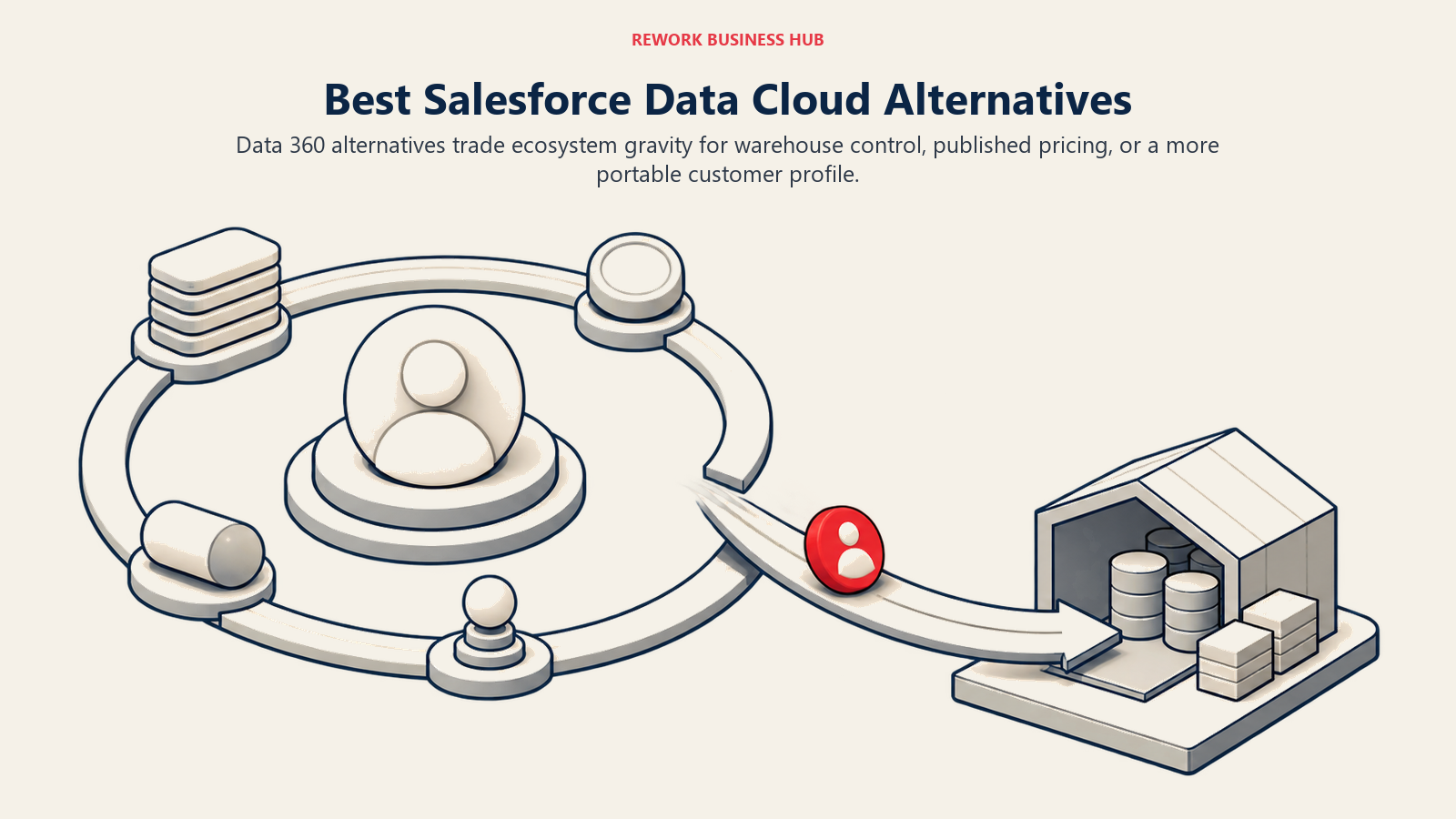
If you're still searching "Salesforce Data Cloud," here's the update first: Salesforce renamed it to Salesforce Data 360 at Dreamforce on October 14, 2025, as part of the Agentforce 360 launch. Same license, integrations and data model, just a new name. That rename is also why a chunk of the third-party pricing pages in this category are stale: they describe "Data Cloud" tiers that predate the switch. This guide uses Salesforce Data 360 (formerly Data Cloud) on first mention and Data 360 after that. For the full category view, start with the Best Customer Data Platforms 2026 hub; this guide goes deep on the 12 tools worth shortlisting against it.
Data 360's strengths are real. Zero-copy access to Salesforce CRM data means Sales, Service and Marketing Cloud records feed one profile without a separate ETL job. Agentforce and Einstein ground directly on that profile, so an AI agent answering a ticket works from the same data a rep sees. The harmonized model spans the whole Salesforce family, and enterprise buyers get the trust posture a large procurement team expects. The reasons teams look elsewhere are just as real: consumption-credit pricing that's hard to forecast, the gravity of an all-Salesforce stack, real implementation cost and partner dependency, and a pull toward warehouse-native architectures that never copy data anywhere.
Key Facts
- The global CDP market is projected to grow from $3.28 billion in 2025 to $4.07 billion in 2026, reaching $17.03 billion by 2034 at a 19.6% CAGR, per Fortune Business Insights' Customer Data Platform Market Report.
- Salesforce is the sole returning Leader in Gartner's 2026 Magic Quadrant for CDPs, with Data 360 posting 141% year-over-year customer growth, while Hightouch, Oracle and Uniphore entered the Leaders and Visionaries quadrants for the first time, per CX Today's rundown of the report.
- 98% of marketing teams using AI reported at least one data-related barrier to personalization, and the average team juggles seven separate data sources, per Salesforce's 10th-edition State of Marketing report (4,450 marketers, 26 countries), as reported by Diginomica.
- B2B companies using AI for personalization see a 15% to 20% increase in revenue per customer, and 65% are already using or piloting AI for commerce operations, per McKinsey's Global B2B Pulse research.
- IDC named Amperity a Leader in its 2026 MarketScape for Worldwide AI-Enabled Customer Data Platforms for B2C Users, per IDC's June 2026 announcement.
Quick Comparison Table
| Tool | Best For | Starting Price / Pricing Model | Key Strength | Key Limitation |
|---|---|---|---|---|
| Adobe Real-Time CDP | Enterprise teams on Adobe Experience Cloud | No published price; priced on profile volume | Real-time streaming, native privacy and consent | Publishes no rate at all, unlike Data 360 |
| Twilio Segment | A published, self-serve pipeline layer | Free: 1,000 visitors/mo; Team: from $120/mo | Published pricing; 700+ integrations | Full identity resolution (Unify) is quote-only |
| Tealium | Deep, battle-tested integration breadth | No published price | 1,200+ prebuilt integrations | Dropped from Leader to Challenger in Gartner's 2026 MQ |
| Treasure AI (formerly Treasure Data) | Profile-and-behavior pricing, not per query | No published price; tiered on profiles and behaviors | "No compute" pricing logic | Rebranded mid-2026; Gartner moved it to Challenger |
| Amperity | Teams standardized on Databricks or Snowflake | No published price; consumption-based ("Amps") | Lakehouse-native, no reverse ETL required | No self-serve trial or rate card |
| mParticle (Rokt) | Existing mobile-first mParticle deployments | No published price | Mobile-first identity collection | Dropped out of Gartner's 2026 CDP MQ entirely |
| BlueConic | Mid-market teams without platform-scale needs | No published price; demo or quote only | Deep marketing-specific activation | Gartner notes only modest growth |
| Hightouch | Activating directly from a data warehouse | No published price; usage-based | Warehouse-native, no replication | New to the Leaders quadrant; no rate card |
| RudderStack | Self-hostable pipeline with published pricing | Free: 250K events/mo; Growth: $265/mo for 1M | Published pricing; source-available | Not OSI open source; free tier caps at 250K events |
| Microsoft Dynamics 365 Customer Insights | Teams already on the Microsoft stack | $1,700/tenant/mo (paid yearly); $1,000 Attach | Only fully published per-tenant rate card here | Priced per tenant plus capacity add-ons |
| SAP Emarsys (SAP Engagement Cloud) | Unification bundled with campaign execution | No published price (reported: $1,500-$5,000+/mo) | Unification bundled into omnichannel campaigns | No rate card; rebranded in late 2025 |
| Uniphore (ActionIQ) | Enterprises on Uniphore's AI platform | No published price; contact sales | Composable CDP feeding a conversational AI stack | Pricing tied to the wider AI platform sale |
Pricing Models: Profile-Based, Consumption-Credit, MTU and Quote-Only
Data 360's consumption-credit model isn't unique here. Knowing which shape an alternative uses tells you how the bill behaves when usage grows.
| Model | How it's billed | Examples in this guide | What happens when usage doubles |
|---|---|---|---|
| Consumption credit | Metered usage from a pre-purchased pool, multiplied per operation type | Data 360 ($500 per 100k Flex Credits, published), Amperity, Hightouch, Treasure AI | Hardest to forecast; a renewal true-up can arrive as a surprise |
| Monthly tracked users or events | Price scales with unique visitors or events per month | Twilio Segment (visitors), RudderStack (events) | Predictable mid-tier, but overage rates add up fast at scale |
| Per-tenant with capacity add-ons | Flat per-tenant base, then tiered add-on packs | Microsoft Dynamics 365 Customer Insights | Cost climbs in defined, published steps, easy to model |
| Profile or audience volume | Price scales with unified or contactable profiles, tiered into packages | Adobe Real-Time CDP, SAP Emarsys (reported) | Cost grows with audience size, independent of query volume |
| Quote-only, no published meter | Nothing published; every price is negotiated | Tealium, mParticle (Rokt), BlueConic, Uniphore | Impossible to model without a sales call or vendor benchmark |
Why Teams Leave Salesforce Data 360
| Reason | What it looks like in practice | Who feels it most |
|---|---|---|
| Consumption credits are hard to forecast | Unification, activation, segmentation and AI inference draw from one pool at different multipliers | Finance and procurement modeling next year's renewal |
| No published rate card | The base credit rate is absent from salesforce.com; only multipliers show up in third-party breakdowns | Teams that need a number before a budget request starts |
| All-Salesforce stack gravity | Zero-copy access and Agentforce grounding work best with Sales, Service and Marketing Cloud all in place | Teams running a heterogeneous CRM or warehouse stack |
| Implementation cost and partner dependency | Standing up the harmonized data model is a real systems-integrator project for most rollouts | Teams without in-house Salesforce admins or architects |
| Warehouse-native architecture is now common | Newer entrants activate straight from Snowflake or Databricks with zero data duplication | Teams already centralized in a cloud warehouse |
| Renewal true-up risk | Usage that outgrows the committed pool mid-contract surfaces as a true-up at renewal | Teams that scaled usage during the contract term |
The Eight Paths Out of a Data 360 Evaluation
Almost nobody evaluating alternatives here is starting cold. Unified, AI-ready data already matters, or Data 360 wouldn't have made the shortlist. The evaluation usually resolves into one of these questions.
| Path | What you've decided | Tools covered here |
|---|---|---|
| Stay on an enterprise, platform-scale CDP | Unified profiles are right, but the pricing or Salesforce dependency isn't | Adobe Real-Time CDP |
| Go warehouse-native or composable | Data shouldn't be duplicated into a separate CDP store | Hightouch, RudderStack, Amperity |
| Default to your non-Salesforce ecosystem | Microsoft already owns your data and CRM stack | Microsoft Dynamics 365 Customer Insights |
| Keep unification bundled with campaigns | You want unification and marketing execution in one contract | SAP Emarsys |
| Start on published pricing, unify later | A self-serve entry point now, full identity resolution later | Twilio Segment, RudderStack |
| Move the AI bet to an AI-platform vendor | Your AI roadmap centers on agentic AI more than CRM | Uniphore (ActionIQ) |
| Stay with proven integration breadth | Coverage matters more than the newest architecture | Tealium |
| Right-size to mid-market marketing depth | A full enterprise CDP is more than your team needs | BlueConic |
1. Adobe Real-Time CDP: The Enterprise Peer With the Same Pricing Opacity
Adobe Real-Time CDP is the closest peer to Data 360's enterprise ambition: a real-time, streaming CDP built inside Adobe Experience Platform. The architecture diverges though. Data 360 leans on zero-copy access to Salesforce CRM objects; Adobe leans on real-time event streaming and native privacy-and-consent handling.
Methodology and fit. Adobe is the sole Visionary in Gartner's 2026 Magic Quadrant for CDPs, credited with strong real-time data management and privacy handling but not yet the platformization breadth the Leaders quadrant rewards. Forrester's Q3 2025 Wave for B2B CDPs named Adobe a Leader outright.
| Pros | Cons |
|---|---|
| Real-time streaming and privacy/consent handling native to the platform | No published pricing anywhere, the same opacity problem as Data 360 |
| Forrester Leader in the B2B CDP Wave, Q3 2025 | Full value shows up mainly alongside the rest of Adobe Experience Cloud |
| Deep integration across Adobe's own activation tools | Sole Visionary status signals it hasn't matched the Leaders' breadth yet |
Pricing. No published figures. Editions are B2C, B2B and B2P, each sold in Prime and Ultimate packages, priced on profile volume through a sales conversation.
Best for: Enterprise teams already invested in Adobe Experience Cloud who prioritize real-time streaming and consent management as much as raw unification. If Salesforce itself is the incumbent, the Best Salesforce Alternatives guide covers the CRM layer underneath.
2. Twilio Segment: A Published Entry Price for the Data-Pipeline Layer
Twilio Segment is really two products wearing one name. Connections is the event pipeline most teams start with, with genuinely published, self-serve pricing. Segment CDP, the Unify and Engage layer doing full identity resolution, is quote-only. Worth noting: segment.com/pricing now redirects to twilio.com.
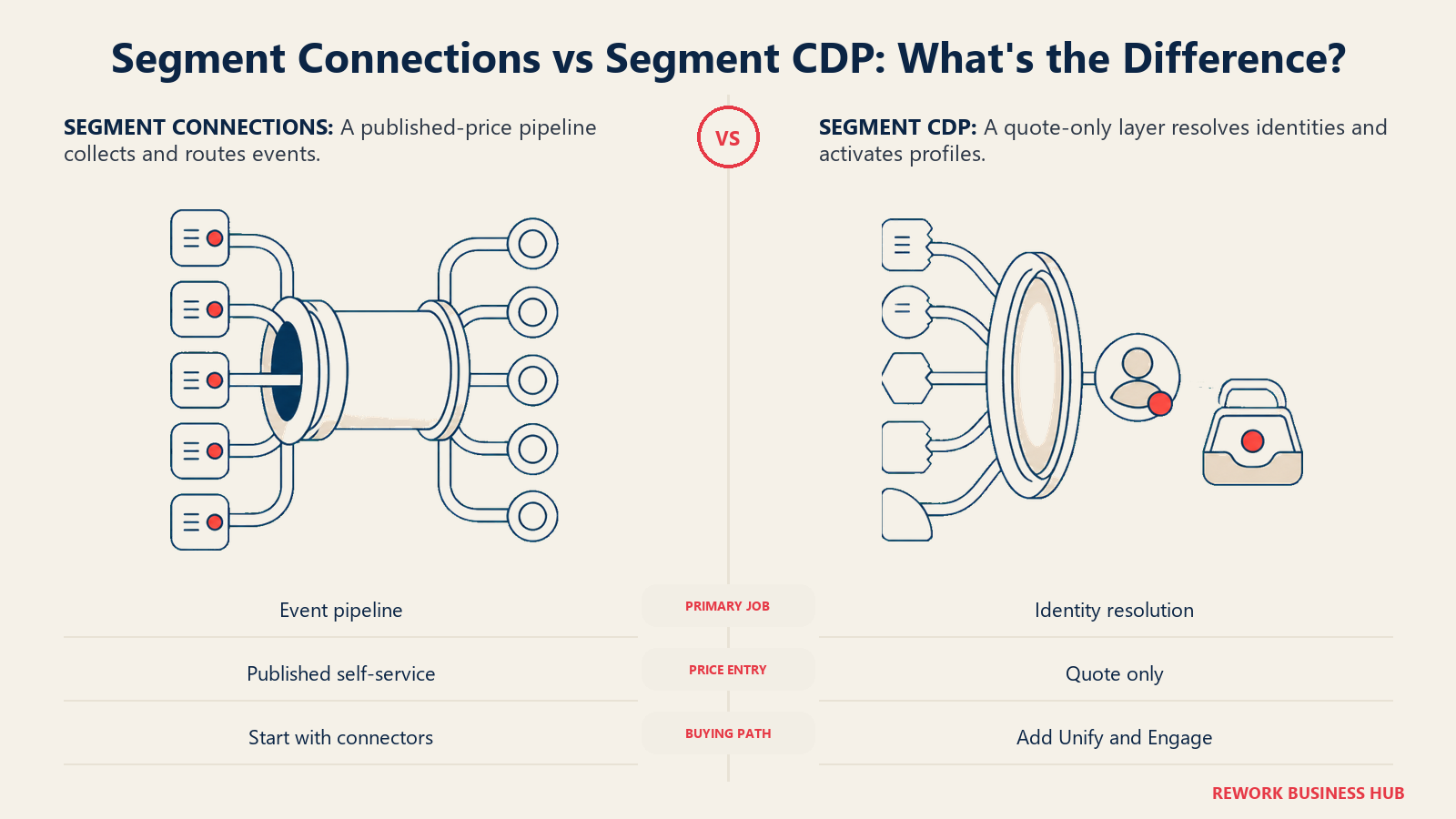
Methodology and fit. Gartner's 2026 Magic Quadrant places Twilio as a Niche Player, noting privacy and governance strengths without the Leaders' platformization ambition. Segment is a strong pipeline layer, but the deep unification Data 360 does natively is a separate, pricier purchase here.
| Pros | Cons |
|---|---|
| Published, self-serve pricing for the connector layer | Full identity resolution (Unify/Engage) is quote-only |
| 700+ integrations and a generous free tier | Niche Player in Gartner's 2026 MQ, not platform-scale |
| A genuine on-ramp: start cheap, add resolution later | MTU overage adds real cost once visitor volume climbs |
Pricing. Free: $0/month, 1,000 visitors, 2 sources, 500,000 Reverse ETL records, 700+ integrations. Team: from $120/month, 10,000 visitors, unlimited sources, 1,000,000 Reverse ETL records, public API, up to 20% off annually. Business: custom. Team-tier MTU overage: $12/1,000 (10K-25K), $11/1,000 (25K-100K), $10/1,000 (100K+). Full Segment CDP (Unify/Engage) is contact-sales only.
Best for: Teams that want a published, self-serve entry point now, with the option to add identity resolution later. If Segment itself becomes the incumbent, the Best Segment Alternatives guide covers that direction.
3. Tealium: Deep Integration Breadth, Slower Growth
Tealium's roots are in real-time tag management, and that history still shows: Gartner's 2026 Magic Quadrant credits it with 1,200 or more prebuilt integrations, broader coverage than most newer CDPs have matched yet.
Methodology and fit. The same Gartner report dropped Tealium from Leader to Challenger in 2026, citing a slowdown in market velocity and diminished customer acquisition. Integration depth is still a real strength, but the analyst trajectory has shifted, worth factoring into a multi-year platform bet.
| Pros | Cons |
|---|---|
| 1,200+ prebuilt integrations, among the deepest here | Dropped from Leader to Challenger in Gartner's 2026 MQ |
| Real-time tag management heritage, strong client-side collection | Publishes no pricing; tealium.com/pricing redirects to a stray image |
| Established, battle-tested enterprise deployments | No rate card to budget against before a sales call |
Pricing. No published prices anywhere on tealium.com. Any figure elsewhere is third-party and reported, never vendor-confirmed.
Best for: Teams that need proven, wide-ranging integration coverage and are comfortable with a quote-only process. The Best Tealium Alternatives guide covers this if Tealium itself is the incumbent.
4. Treasure AI (formerly Treasure Data): Pricing by Profile, Not by Query
Treasure Data rebranded to Treasure AI in April 2026, repositioning from a straight CDP to what it calls an "agentic experience platform." The underlying product still functions as a full enterprise CDP, with pricing logic genuinely different from Data 360's.
Methodology and fit. Forrester named it (still as Treasure Data) a Strong Performer in its Q3 2025 Wave for B2B CDPs. Gartner's 2026 Magic Quadrant moved it the other way, from Leader to Challenger, flagging pricing concerns. The product markets a "no compute" model: pay for profiles and behaviors tracked, not query volume or processing power, a different shape than Data 360's per-operation credit multipliers.
| Pros | Cons |
|---|---|
| "No compute" pricing scales with audience size, not query volume | Rebranded mid-2026, adding naming confusion to an active evaluation |
| Forrester Strong Performer (as Treasure Data), B2B CDP Wave Q3 2025 | Gartner moved it from Leader to Challenger in 2026 |
| Three distinct product lines let you buy just what you need | No published dollar figures for any of the three lines |
Pricing. No published figures. Three lines: Intelligent Customer Data Platform (annual subscription tiered on profiles and behaviors), Treasure AI Suites (fixed license plus consumption credits), Treasure AI Studio (usage credits).
Best for: Teams that want predictable, audience-size-based pricing over per-operation metering, and can tolerate a mid-rebrand evaluation.
5. Amperity: Lakehouse-Native Unification, No Reverse ETL
Amperity takes a different architectural stance than most tools here: its Lakehouse CDP and Amperity Bridge share unified profiles directly into Databricks and Snowflake via Delta Sharing and Iceberg tables, skipping the reverse-ETL hop most CDPs still require.
Methodology and fit. IDC named Amperity a Leader in its 2026 MarketScape for AI-Enabled CDPs for B2C Users. Gartner's 2026 Magic Quadrant places it as a Niche Player, crediting strong AI-driven profile unification while flagging business-viability questions worth raising in due diligence.
| Pros | Cons |
|---|---|
| Native profile sharing into Databricks and Snowflake | No published prices, no freemium tier, no self-serve trial |
| IDC 2026 MarketScape Leader for AI-Enabled B2C CDPs | Gartner flags business-viability questions in its writeup |
| Consumption-based "Amps" pricing tracks actual usage | Every evaluation starts with a sales conversation |
Pricing. No published prices. Consumption-based, metered in "Amps," with no freemium tier or self-serve trial.
Best for: Teams already standardized on Databricks or Snowflake who want profile unification living natively in that lakehouse, not duplicated into a separate managed store.
6. mParticle (Rokt): Mobile-First Identity Under New Ownership
mParticle is now part of Rokt, the e-commerce ad-tech company, and Gartner's 2026 Magic Quadrant dropped it from the CDP quadrant entirely, along with pre-acquisition ActionIQ, Redpoint Global and Zeta Global, citing updated inclusion criteria.
Methodology and fit. The product didn't disappear; it continues under Rokt, and mParticle's mobile-first SDK-based collection remains a real strength for app-heavy consumer businesses. But the analyst signal that used to support a CDP-category shortlist is gone, worth weighing against technical fit.
| Pros | Cons |
|---|---|
| Strong mobile-first SDK-based identity and event collection | Dropped out of Gartner's 2026 CDP Magic Quadrant entirely |
| Continuity for teams with existing deployments | No published prices on mparticle.com/pricing |
| Backed by Rokt's e-commerce and ad-tech infrastructure | Product direction now tied to Rokt's ad-tech roadmap, not a standalone CDP strategy |
Pricing. No published prices on mparticle.com/pricing.
Best for: Teams with existing mobile-first data collection built on mParticle's SDKs who want continuity under Rokt, with a clear-eyed view that its independent CDP standing narrowed in 2026.
7. BlueConic: Marketing-Depth CDP, Right-Sized for Mid-Market
BlueConic stayed a Niche Player in Gartner's 2026 Magic Quadrant, credited with deep marketing-specific functionality even as the report notes only modest growth.
Methodology and fit. Where Data 360, Adobe and Oracle chase platform-scale ambitions, BlueConic stays focused on marketing teams building and activating audiences, without the broader CRM and commerce model Data 360 spans. For a mid-market team that found an enterprise CDP oversized, that focus is the point.
| Pros | Cons |
|---|---|
| Deep, marketing-specific audience building and activation | No published pricing signal anywhere; demo or quote only |
| Right-sized scope avoids paying for breadth you won't use | Gartner notes only modest growth in its 2026 placement |
| Simpler implementation than a full enterprise platform | Less suited to teams needing service and sales data unified too |
Pricing. No published prices. Demo or quote only.
Best for: Mid-market marketing teams that want CDP-grade audience building without the platform-scale ambitions of Data 360, Adobe or Oracle.
8. Hightouch: Warehouse-Native, No Data Replication
Hightouch is one of two brand-new entrants in Gartner's 2026 Magic Quadrant for CDPs, alongside Uniphore, promoted for a composable, warehouse-native architecture that Gartner says eliminates replication costs: your warehouse stays the source of truth, and Hightouch activates data directly from it.
Methodology and fit. Forrester named Hightouch a Strong Performer in its Q3 2025 Wave for B2B CDPs. The product line splits into an Agentic Marketing Platform and a Composable CDP, both usage-based, plus a free Basic Reverse ETL tier for teams just getting started.
| Pros | Cons |
|---|---|
| Warehouse-native architecture eliminates data replication | No published paid prices; both product lines are usage-based |
| New Leaders-quadrant entrant in Gartner's 2026 CDP MQ | Newer to full CDP positioning than established players here |
| Free Basic Reverse ETL tier for evaluation | Composable CDP unlimited seats still ship without a published rate |
Pricing. No published paid prices. Agentic Marketing Platform and Composable CDP are both usage-based (Composable CDP includes unlimited seats). Basic Reverse ETL is free: up to 2 active syncs, unlimited destinations and seats.
Best for: Teams already invested in a modern warehouse (Snowflake, BigQuery, Databricks) that want the CDP layer to activate data directly rather than duplicate it. Read the Best Hightouch Alternatives guide if Hightouch is the incumbent.
9. RudderStack: Source-Available, Not Open Source, With Published Pricing
RudderStack is the closest thing here to a self-hosted alternative with a real published price. The label matters though: the self-hosted code ships under the Elastic License 2.0, source-available, not OSI open source, and the free tier caps at 250,000 events per month.
Methodology and fit. For engineering-led teams, the appeal is a published, self-serve rate card plus the option to self-host under that license rather than paying for a fully managed product from day one.
| Pros | Cons |
|---|---|
| Published, self-serve pricing across Free, Growth, Enterprise | Source-available under Elastic License 2.0, not OSI open source |
| Free tier includes 250K events/month, 16 SDK sources, 200+ destinations | Free tier caps at 250K events, a real ceiling at scale |
| 30-day free trial, unlimited team members on Growth | Identity resolution depth thinner than a dedicated enterprise CDP |
Pricing. Free: $0 forever, 250K events/month, 16 SDK sources, 200+ destinations, 5 transformations. Growth: $265/month for 1M events (tiers to 25M+), 15% off annually, 30-day trial, unlimited members, 25 reverse ETL connections. Enterprise: custom, 5-minute warehouse sync, unlimited transformations.
Best for: Engineering-led teams that want published, self-serve pricing and the option to self-host under a source-available license. Read the Best RudderStack Alternatives guide if RudderStack is your incumbent, or the Segment vs. RudderStack comparison for the direct head-to-head.
10. Microsoft Dynamics 365 Customer Insights: The One With a Real Rate Card
Customer Insights is the one enterprise CDP-class alternative here with fully published, vendor-confirmed per-tenant pricing, a real difference from Data 360's credit model and most of the field above.
Methodology and fit. Customer Insights - Data handles unification, and Customer Insights - Journeys handles orchestration, both licensed per tenant with unlimited users included. For teams already running Dynamics 365 or the broader Microsoft stack, that per-tenant model plugs into existing budgeting processes.
| Pros | Cons |
|---|---|
| Fully published, vendor-confirmed per-tenant pricing | Priced per tenant with tiered capacity add-ons, not simple per-user |
| Unlimited users included in the base subscription | Multiple tenants each require their own separate license |
| Deep native ties to the Microsoft data and productivity stack | Less purpose-built for CDP unification outside Dynamics 365 |
Pricing. Base: $1,700/tenant/month, paid yearly, with unlimited users, 100,000 Unified People and 10,000 Interacted People. Attach: a discounted $1,000/tenant/month for existing Dynamics 365 customers. Unified People add-ons: $2,000/mo per 100K (100K-500K), $1,500/mo (500K-2M), $1,000/mo (2M+). Interacted People add-ons: $250/mo per 5K (10K-50K), $300/mo per 10K (50K-250K), $500/mo per 50K (250K+).
Best for: Teams already running Dynamics 365 or the wider Microsoft stack who want a real, published rate card instead of a quote-only conversation. If the BI layer is next, the Best Business Intelligence Tools 2026 and Best Power BI Alternatives guides cover that choice.
11. SAP Emarsys (SAP Engagement Cloud): Unification Bundled Into Campaigns
Emarsys, SAP's marketing platform, was rebranded SAP Engagement Cloud in late 2025, though most of the market still calls it Emarsys. It bundles CDP-style unification into its omnichannel campaign engine rather than selling unification standalone the way Data 360 or Adobe do.
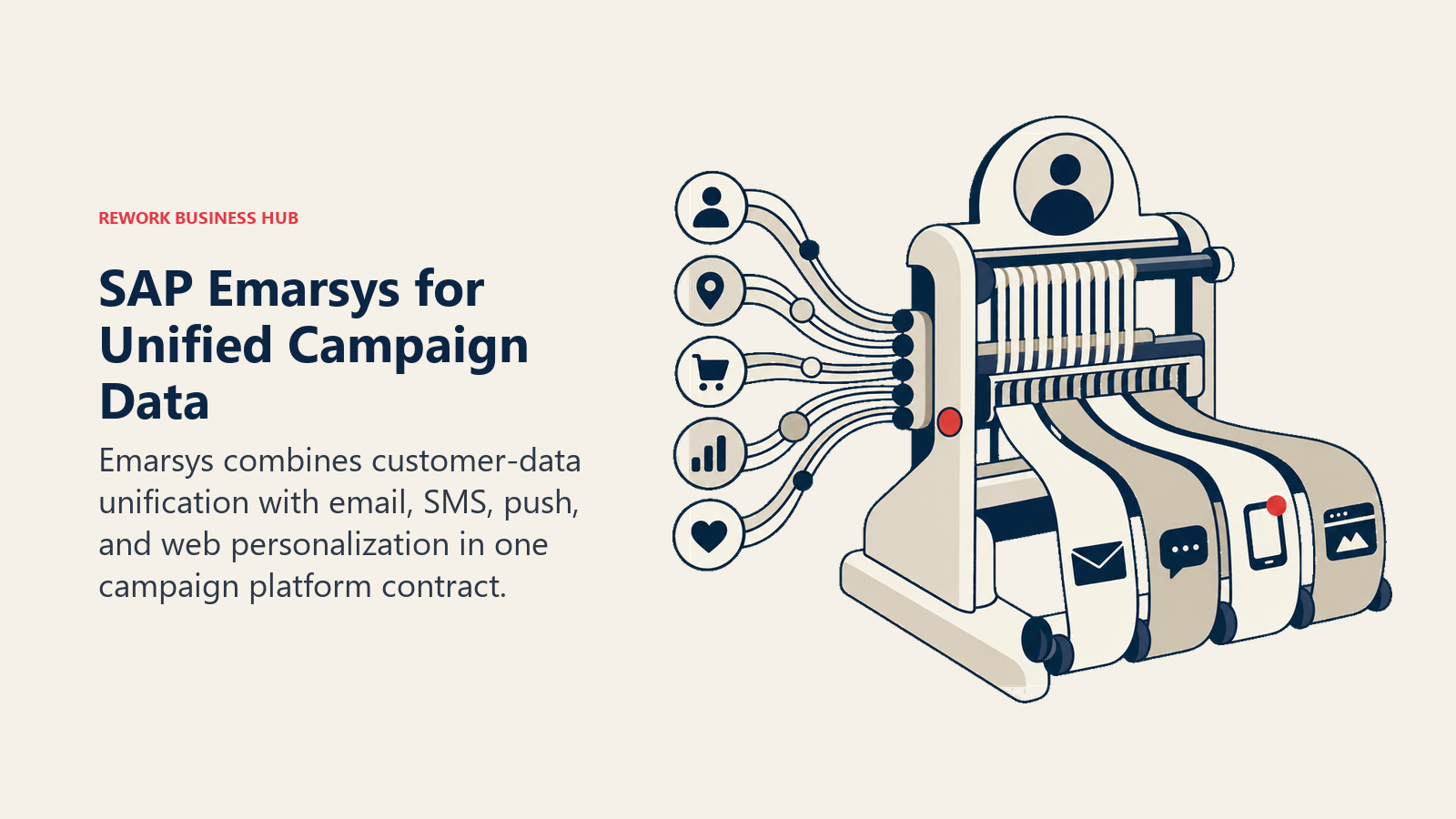
Methodology and fit. The bundled model is the whole pitch: one contract covers data unification, email, SMS, mobile push and web personalization, instead of pairing a standalone CDP with a separate ESP or marketing-automation tool.
| Pros | Cons |
|---|---|
| CDP-style unification bundled into omnichannel campaign execution | No published price; contact sales for both editions |
| Two editions let teams scale within one product | Reported enterprise spend runs into six figures annually |
| Deep ties into the broader SAP customer experience ecosystem | Recently rebranded, adding naming confusion mid-evaluation |
Pricing. No published price; contact sales, with Emarsys Edition and Enterprise Edition as the two named tiers. Third-party reporting puts Emarsys Edition contracts at $1,500 to $5,000+ per month depending on database size and channel usage (reported, per Coldiq's 2026 review), and median annual spend around $340,000 across 45+ verified contracts (reported, per VendorBenchmark's pricing analysis). Neither figure is SAP-confirmed.
Best for: Marketing teams that want unification and cross-channel execution in one contract rather than pairing a CDP with a separate ESP. If a marketing-automation-first tool fits closer, the Best Marketo Alternatives and Best Klaviyo Alternatives guides cover that shortlist.
12. Uniphore (ActionIQ): A Composable CDP Inside an AI Platform
ActionIQ, once an independent composable CDP, was acquired by Uniphore and now ships as the CDP component of its Marketing AI line. That's a different pitch from every other tool here: Uniphore's core business is enterprise conversational AI, and the CDP feeds that stack with unified context, similar to what Data 360 does for Agentforce.
Methodology and fit. The analyst standing is strong on both fronts. Gartner named Uniphore a new-entrant Leader in the 2026 Magic Quadrant for CDPs, describing it as an intelligent data fabric with warehouse-native architecture. IDC separately named ActionIQ a Leader in its MarketScape for Worldwide CDPs Focused on B2C Users, in the 2024 to 2025 edition, crediting its hybrid-composable architecture and its use of AI.
| Pros | Cons |
|---|---|
| New Leader placement in Gartner's 2026 CDP Magic Quadrant | No published prices; every deal starts as a sales conversation |
| IDC MarketScape Leader for B2C CDPs, 2024 to 2025 edition | Pricing tied to the wider Uniphore AI platform sale, not standalone |
| Composable, warehouse-native architecture built to feed agentic AI | Younger combined track record than established independent CDP vendors |
Pricing. No published prices; contact sales through Uniphore.
Best for: Enterprises already using or evaluating Uniphore's conversational AI products who want the CDP layer to plug into that same stack. The Best AI CRM Tools 2026 guide covers the same AI-native logic applied to CRM.
Stage Fit Matrix
| Tool | Startup 0-50 | Growth 50-250 | Mid-Market 250-1,000 | Enterprise 1,000+ |
|---|---|---|---|---|
| Adobe Real-Time CDP | Weak | Weak | Moderate | Strong |
| Twilio Segment | Strong | Strong | Strong | Moderate |
| Tealium | Weak | Moderate | Strong | Strong |
| Treasure AI | Weak | Weak | Moderate | Strong |
| Amperity | Weak | Weak | Moderate | Strong |
| mParticle (Rokt) | Weak | Moderate | Strong | Moderate |
| BlueConic | Weak | Moderate | Strong | Moderate |
| Hightouch | Weak | Moderate | Strong | Strong |
| RudderStack | Strong | Strong | Strong | Moderate |
| Microsoft Dynamics 365 CI | Weak | Weak | Strong | Strong |
| SAP Emarsys | Weak | Moderate | Strong | Strong |
| Uniphore (ActionIQ) | Weak | Weak | Moderate | Strong |
Sizing and Persona Table
| Tool | Headcount sweet spot | Primary buyer | Secondary buyer |
|---|---|---|---|
| Adobe Real-Time CDP | 500-20,000+ | VP of Marketing Technology | CDO |
| Twilio Segment | 20-2,000 | Director of Data / Engineering | VP of Product |
| Tealium | 200-10,000+ | Director of MarTech | CDO |
| Treasure AI | 300-10,000+ | VP of Data / Analytics | CMO |
| Amperity | 200-10,000+ | VP of Data Engineering | CMO |
| mParticle (Rokt) | 50-2,000 (mobile-first) | Director of Growth / Mobile | VP of Product |
| BlueConic | 50-1,000 | Director of Marketing Ops | VP of Marketing |
| Hightouch | 50-2,000 | Data Engineering lead | Director of Marketing Ops |
| RudderStack | 20-1,000 | Engineering / Data Platform lead | Director of Analytics |
| Microsoft Dynamics 365 CI | 200-10,000+ | Director of MarTech / IT | CDO |
| SAP Emarsys | 100-5,000 | VP of Marketing | Director of Ecommerce |
| Uniphore (ActionIQ) | 500-20,000+ | Chief AI Officer / CDO | VP of Customer Experience |
How to Choose: Decision Framework
Choose the data architecture and billing model first, then shortlist the platform that fits your existing stack.
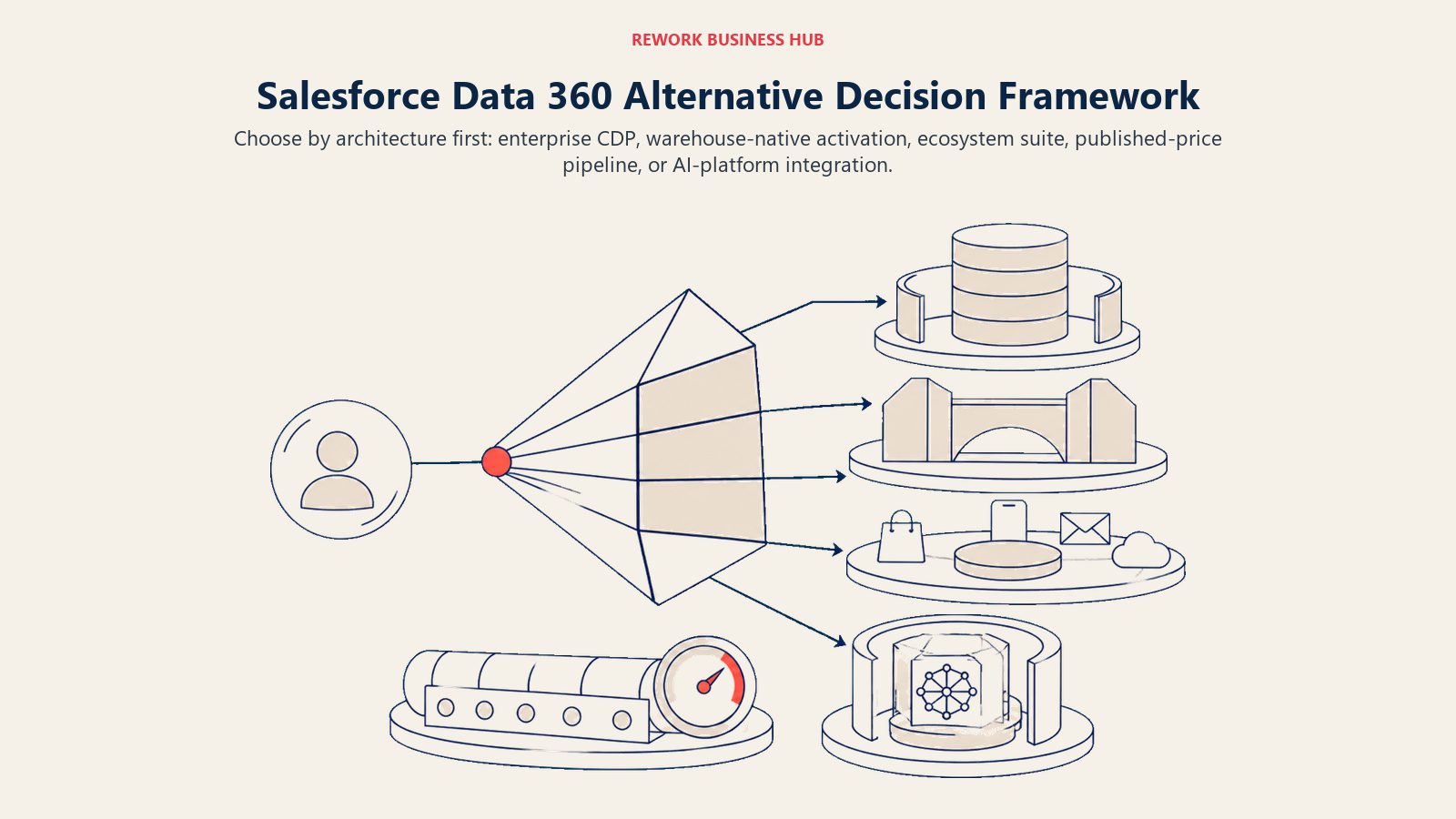
| If you need... | Choose |
|---|---|
| The closest enterprise-scale peer, real-time streaming and native privacy handling | Adobe Real-Time CDP |
| A published, self-serve entry price for the data-pipeline layer | Twilio Segment |
| Proven, deep integration breadth across a large existing tool stack | Tealium |
| Pricing based on profiles and behaviors, not per-query compute | Treasure AI |
| Native unification inside Databricks or Snowflake, no reverse ETL | Amperity |
| Continuity for existing mobile-first identity collection | mParticle (Rokt) |
| Marketing-depth CDP functionality without enterprise-platform scope | BlueConic |
| Warehouse-native activation that eliminates data replication | Hightouch |
| A source-available, self-hostable pipeline with published pricing | RudderStack |
| A fully published, vendor-confirmed per-tenant rate card | Microsoft Dynamics 365 Customer Insights |
| Unification bundled directly into omnichannel campaign execution | SAP Emarsys (SAP Engagement Cloud) |
| A CDP built to feed a broader conversational or agentic AI platform | Uniphore (ActionIQ) |
Frequently Asked Questions about Salesforce Data Cloud Alternatives
Is Salesforce Data Cloud the same as Data 360?
Yes. Salesforce renamed Data Cloud to Salesforce Data 360 at Dreamforce on October 14, 2025, as part of the Agentforce 360 launch. The license, integrations and data model are unchanged, it's the same product under a new name. If a pricing page or case study is still labeled "Data Cloud," treat it as pre-rename and verify any figure against Salesforce's current Data 360 pages.
How much does Salesforce Data 360 actually cost?
It does. Salesforce publishes $500 per 100,000 Flex Credits on the consumption model, and on the newer profile-based model $240 per 1,000 profiles per year, or $420 per 1,000 Enterprise Profiles per year. Credits are still spent across operations like unification, activation and AI inference at different multipliers, so a published rate is not the same as a predictable bill, and Salesforce marks the page subject to change.
Which alternative has the most transparent pricing?
Microsoft Dynamics 365 Customer Insights is the clearest: a published $1,700-per-tenant-per-month base price (or $1,000 for existing Dynamics 365 customers), with tiered add-on pricing. Twilio Segment and RudderStack also publish full self-serve tiers for their pipeline layers, though identity-resolution products are quote-only.
What happened to ActionIQ, mParticle and Treasure Data?
All three changed hands or names recently. ActionIQ was acquired by Uniphore and now ships as its composable CDP inside the Marketing AI line. mParticle is now part of Rokt, the e-commerce ad-tech company. Treasure Data rebranded to Treasure AI in April 2026, repositioning toward an agentic experience platform while still functioning as a CDP.
Is RudderStack really open source?
Not in the OSI sense. Its self-hosted code ships under the Elastic License 2.0, source-available, meaning you can read and modify it, but not an OSI-approved open-source license. The free tier caps at 250,000 events per month, not unlimited.
What to Do Next
Pick your path before booking a demo. If the unified-profile idea behind Data 360 is right and only pricing or the Salesforce dependency needs to change, shortlist Adobe Real-Time CDP and price a proof of concept against your real profile volume. If your data already lives in a modern warehouse, pilot Hightouch or RudderStack against your actual Snowflake or Databricks tables before paying for a managed store you don't need. If Microsoft already owns your data stack, start with Dynamics 365 Customer Insights and its published rate card. Whichever path you take, get three numbers in writing before you commit: the real unit cost at your current usage, what happens if usage doubles inside the contract term, and the year-two renewal figure, since a consumption model can look reasonable in year one and very different at true-up.
Camellia covers customer data platforms, marketing technology and CRM tooling for B2B teams.

Principal Product Marketing Strategist
On this page
- Key Facts
- Quick Comparison Table
- Pricing Models: Profile-Based, Consumption-Credit, MTU and Quote-Only
- Why Teams Leave Salesforce Data 360
- The Eight Paths Out of a Data 360 Evaluation
- 1. Adobe Real-Time CDP: The Enterprise Peer With the Same Pricing Opacity
- 2. Twilio Segment: A Published Entry Price for the Data-Pipeline Layer
- 3. Tealium: Deep Integration Breadth, Slower Growth
- 4. Treasure AI (formerly Treasure Data): Pricing by Profile, Not by Query
- 5. Amperity: Lakehouse-Native Unification, No Reverse ETL
- 6. mParticle (Rokt): Mobile-First Identity Under New Ownership
- 7. BlueConic: Marketing-Depth CDP, Right-Sized for Mid-Market
- 8. Hightouch: Warehouse-Native, No Data Replication
- 9. RudderStack: Source-Available, Not Open Source, With Published Pricing
- 10. Microsoft Dynamics 365 Customer Insights: The One With a Real Rate Card
- 11. SAP Emarsys (SAP Engagement Cloud): Unification Bundled Into Campaigns
- 12. Uniphore (ActionIQ): A Composable CDP Inside an AI Platform
- Stage Fit Matrix
- Sizing and Persona Table
- How to Choose: Decision Framework
- What to Do Next