Best RudderStack Alternatives in 2026: 12 CDPs for Warehouse-Native Teams
Turn this article into takeaways for your work.


Each assistant summarizes the article only for you and suggests best practices for your work.
If your team is shopping RudderStack alternatives, it's usually for one of three reasons: the engineering lift to run and maintain it is bigger than budgeted, the event-volume pricing stopped scaling gracefully, or marketing and lifecycle teams need packaged identity resolution and activation tools that a developer-first pipeline was never built to hand them. None of that makes RudderStack wrong. It built a real reputation on warehouse-native architecture (data lands in your Snowflake, BigQuery, or Redshift instance instead of a vendor's black box), a self-hostable deployment option, 16 SDK sources, and more than 200 cloud destinations, all genuinely useful for a team that wants control over its own event data. This guide is for the data engineering leads, CDOs, and marketing ops directors deciding whether that control is worth the setup and operating cost at their current scale.
Below are 12 alternatives ordered by relevance, not the alphabet, evaluated on architecture, pricing transparency, and licensing, three things this category gets wrong in public write-ups more often than any other. Every price below comes from the vendor's own pricing page rather than a third-party listicle, and where a vendor publishes nothing, this guide says so plainly instead of dressing up a guess as a "starting price." Start with the best customer data platforms roundup if you haven't narrowed the category yet, or Segment vs RudderStack if those two are your actual shortlist.
Key Facts
- CDP Institute's January 2026 industry update found composable, warehouse-native CDP vendors grew organic employment 7.8% in the second half of 2025, nearly six times the 1.3% industry average, and more than a quarter of all CDPs now support a warehouse-centric architecture (CDP Institute, via CDP.com industry statistics).
- CDP Institute's July 2025 update counted 208 CDP vendors employing 18,361 people, up 4% year over year, with total industry funding up 10% to $9.396 billion, and large vendors now hold 67% of that employment and 73% of that funding (CDP Institute, via CDP.com).
- In the 2026 Gartner Magic Quadrant for Customer Data Platforms, Hightouch entered the Leader quadrant on its first appearance, a composable vendor that started as a reverse ETL tool, while ActionIQ, Redpoint Global, mParticle, and Zeta Global dropped off the quadrant entirely (CX Today, "Gartner Magic Quadrant for Customer Data Platforms (CDPs) 2026: The Rundown").
- 75% of companies report increased customer spend from personalization, averaging a 32% lift per purchase, and 88% of consumers say they're more likely to buy when engagement is personalized in real time, but only 44% of brands say they can actually execute at that level, per Twilio's 2025 State of Customer Engagement Report, surveying 7,640 consumers and 637 business leaders across 18 countries (Twilio, 2025 State of Customer Engagement Report).
- 98% of marketing teams using AI report at least one data-related barrier to personalization, and only 31% say they're fully satisfied with their data-unification ability, according to Salesforce's State of Marketing 2026 report, which surveyed 4,450 marketers (Salesforce State of Marketing, via Diginomica).
Quick Comparison Table
| Tool | Best For | Starting Price | Key Strength | Key Limitation |
|---|---|---|---|---|
| Twilio Segment | The polished, paid version of what RudderStack does | Free: 1K visitors/mo; Team from $120/mo, annual | 700+ integrations, largest install base in the category | Segment's own CDP (Unify) is quote-only, separate product |
| Snowplow | Behavioral data pipelines at real scale | No published price, 14-day free trial | Deep event-schema control, warehouse-native by design | SLULA 1.1 license, not Apache 2.0, and zero price transparency |
| Jitsu | Genuinely open-source RudderStack peer | Free: 200K active events/mo; Business $99/mo | MIT license, real OSI open source (unlike RudderStack) | Smaller ecosystem, fewer prebuilt destinations |
| Hightouch | Composable CDP built for reverse ETL first | Free: 2 active syncs; paid usage-based | 2026 Gartner Leader on its first appearance | No published paid pricing at any tier |
| Fivetran Activations | Teams already on Fivetran for ingestion | Free: 500K Connections MAR/mo | One platform for ingest and activation, MAR-priced | Formerly Census; per-MAR rate unpublished |
| mParticle | Mobile-first, enterprise identity resolution | No published price | Deep mobile SDK heritage, now part of Rokt | Zero pricing transparency, Rokt ownership still settling |
| Tealium | Enterprise tag management plus CDP in one | No published price | Tag management pedigree, real-time enrichment | Dropped from Leader to Challenger in 2026 Gartner MQ |
| Treasure AI | Profile-and-behavior priced enterprise CDP | No published price, "no compute" pricing model | Pay for profiles/behaviors, not query volume | Rebranded from Treasure Data, repositioning still in flux |
| Lytics (now Contentstack) | Existing customers planning a migration | No longer published; pricing page 404s | Lives on as Lytics CDP inside Contentstack AXP | Standalone site retires 30 September 2026 |
| BlueConic | Marketer-owned profiles, no-code activation | No published price, demo only | Built for marketers to self-serve without engineering | Zero pricing transparency |
| Amperity | Enterprise identity resolution at lakehouse scale | No published price, consumption-based ("Amps") | Lakehouse-native profile sharing via Delta Sharing/Iceberg | No freemium or self-serve trial at all |
| Klaviyo Data Platform | DTC and ecommerce teams already on Klaviyo | Free: 250 profiles; paid from ~$45/mo | Native fit inside a B2C CRM/ESP teams already run | CDP layer is bundled, not a standalone pipeline product |
Why Teams Look Beyond RudderStack
RudderStack's core pitch holds up: data stays in your own warehouse instead of a vendor's, the platform is self-hostable, and the source-and-destination catalog (200+ cloud destinations, 16 SDK sources) covers most of what a mid-size data team needs on day one. The Free plan is real, not a crippled trial, at 250,000 events per month with 5 transformations included. Where the friction shows up is what happens after that first deployment matures.
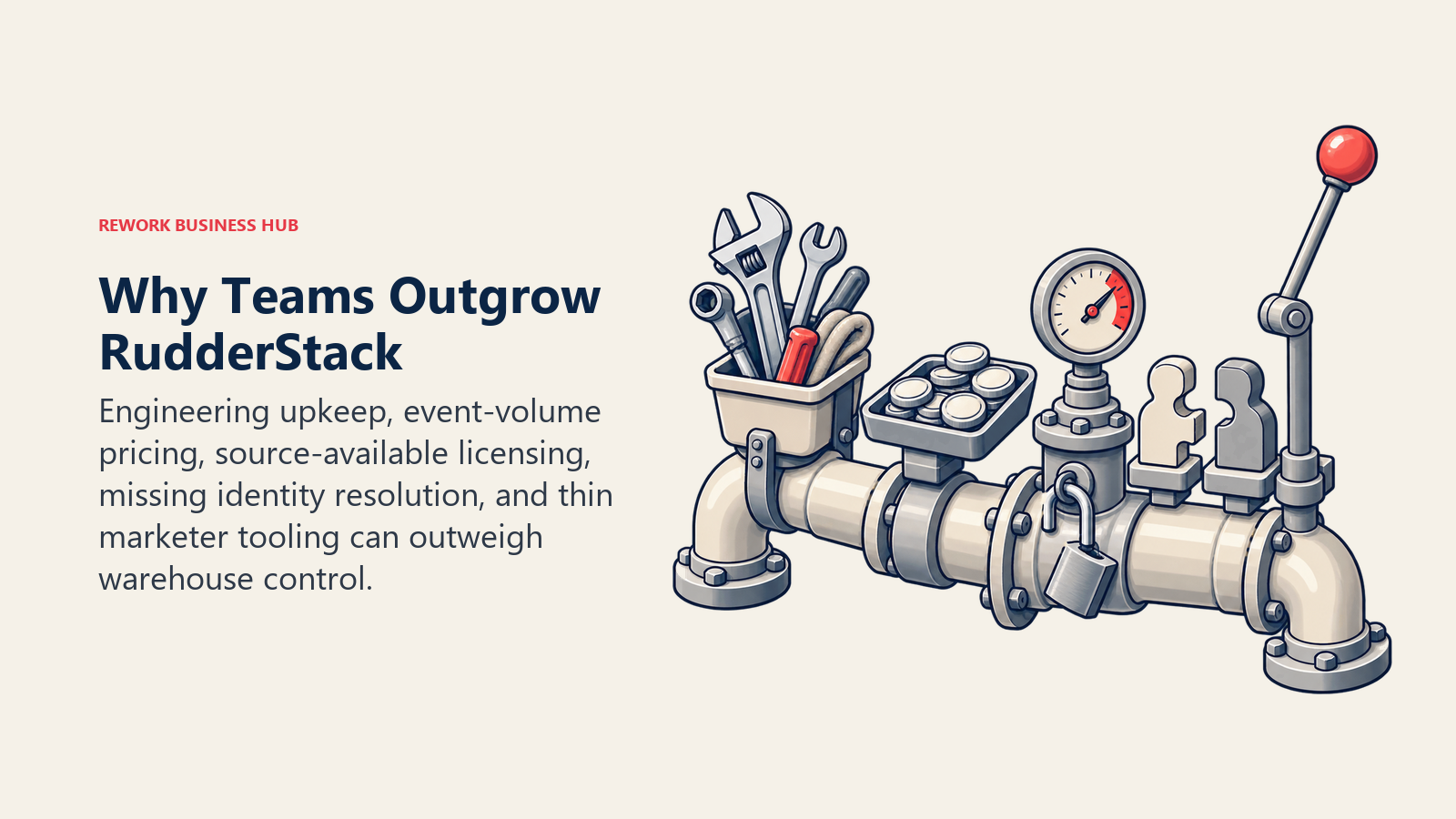
Setup and ongoing operation are engineering-heavy by design. RudderStack was built for teams with a data engineer already on staff, not marketing ops configuring a UI. Running the self-hosted option well (schema changes, transformation logic, warehouse sync scheduling) is real, recurring engineering work, and Growth-tier pricing starts at $265 per month for 1 million events, a bill that climbs with tiers up to 25 million-plus rather than staying flat. The licensing question trips people up too: the self-hosted code sits on GitHub under the Elastic License 2.0, source-available and free to read and modify, but not an OSI-approved open-source license, a real distinction from a tool like Jitsu that ships under MIT. And RudderStack's own toolset stays thin on the marketer-facing side. There's no packaged identity resolution product, no built-in journey builder, no no-code segmentation UI a lifecycle marketer can run without engineering support, which is exactly the gap products like Tealium, Lytics, and BlueConic are built to close.
| Reason teams start shopping | What actually happens | What buyers look for instead |
|---|---|---|
| Engineering-heavy setup and upkeep | Transformations, schema changes, and warehouse sync scheduling are ongoing engineering work, not one-time setup | A managed platform, or a lighter self-serve activation layer |
| Event-volume pricing climbs with growth | Growth tier starts at $265/mo for 1M events and tiers upward through 25M-plus, with no flat ceiling | Credit or MAR-based pricing that better matches actual usage patterns |
| Elastic License 2.0, not OSI open source | Source-available and self-hostable, but not free to fork and resell the way genuinely open-source MIT code is | A tool like Jitsu that ships under a real OSI license, or a fully managed SaaS with no licensing question at all |
| No packaged identity resolution | RudderStack routes and transforms events; stitching identities into a single customer profile is largely left to the team | A CDP with built-in identity resolution, like Amperity, mParticle, or Tealium |
| Thin marketer-facing tooling | No native journey builder or no-code segmentation UI for a lifecycle marketer to run solo | A platform marketing ops can operate without opening a ticket to data engineering |
| Reverse ETL capped by plan | Growth tier includes 25 reverse ETL connections; activating audiences broadly can mean an upgrade conversation | A composable CDP built primarily for activation, like Hightouch |
Three Ways Teams Replace RudderStack
RudderStack sits in the middle of this category, and teams tend to leave in one of three directions once they've outgrown the fit.
Toward a packaged CDP. Tealium, mParticle, Treasure AI, Lytics, BlueConic, Amperity, and Klaviyo Data Platform all ship identity resolution, segmentation, and activation as built-in product, not something your own engineers assemble on top of a pipeline. The trade is less infrastructure control and, in most cases, no published price.
Toward a composable CDP. Hightouch and Fivetran Activations keep data in the warehouse, RudderStack's own philosophy, but focus specifically on the activation layer (reverse ETL, audience sync) rather than trying to be a full event-collection pipeline too. This is the closest philosophical cousin to RudderStack, just narrower in scope.
Toward a pure event pipeline. Twilio Segment, Snowplow, and Jitsu are the most direct like-for-like swaps: tools built primarily to collect, route, and transform event data, with CDP-style identity and activation features either bolted on separately (Segment's Unify) or left out entirely (Snowplow, Jitsu). If engineering-first control over event data is what your team actually wants to keep, one of these three is the least disruptive move.
1. Twilio Segment - The Polished, Paid Version of the Same Job
Twilio Segment is the comparison every RudderStack evaluation eventually runs, since RudderStack was built as a warehouse-native, self-hostable answer to Segment's original SaaS-only model. Segment Connections, the event pipeline product, is free for 1,000 monthly tracked visitors, 2 sources, and 500,000 Reverse ETL records with access to 700+ integrations, the largest destination catalog in this comparison. Team tier starts at $120 per month for 10,000 monthly visitors, unlimited sources, and 1 million Reverse ETL records, with up to 20% off on annual billing; overage runs $12 per 1,000 MTUs in the 10K-25K band, stepping down to $10 per 1,000 above 100K. Business tier is custom. Segment's actual CDP layer (Unify and Engage, the identity resolution and activation products) is a separate, quote-only purchase; note that segment.com/pricing now redirects to twilio.com, and the product's full name is Twilio Segment. In the 2026 Gartner Magic Quadrant, Twilio holds a Niche Player position.
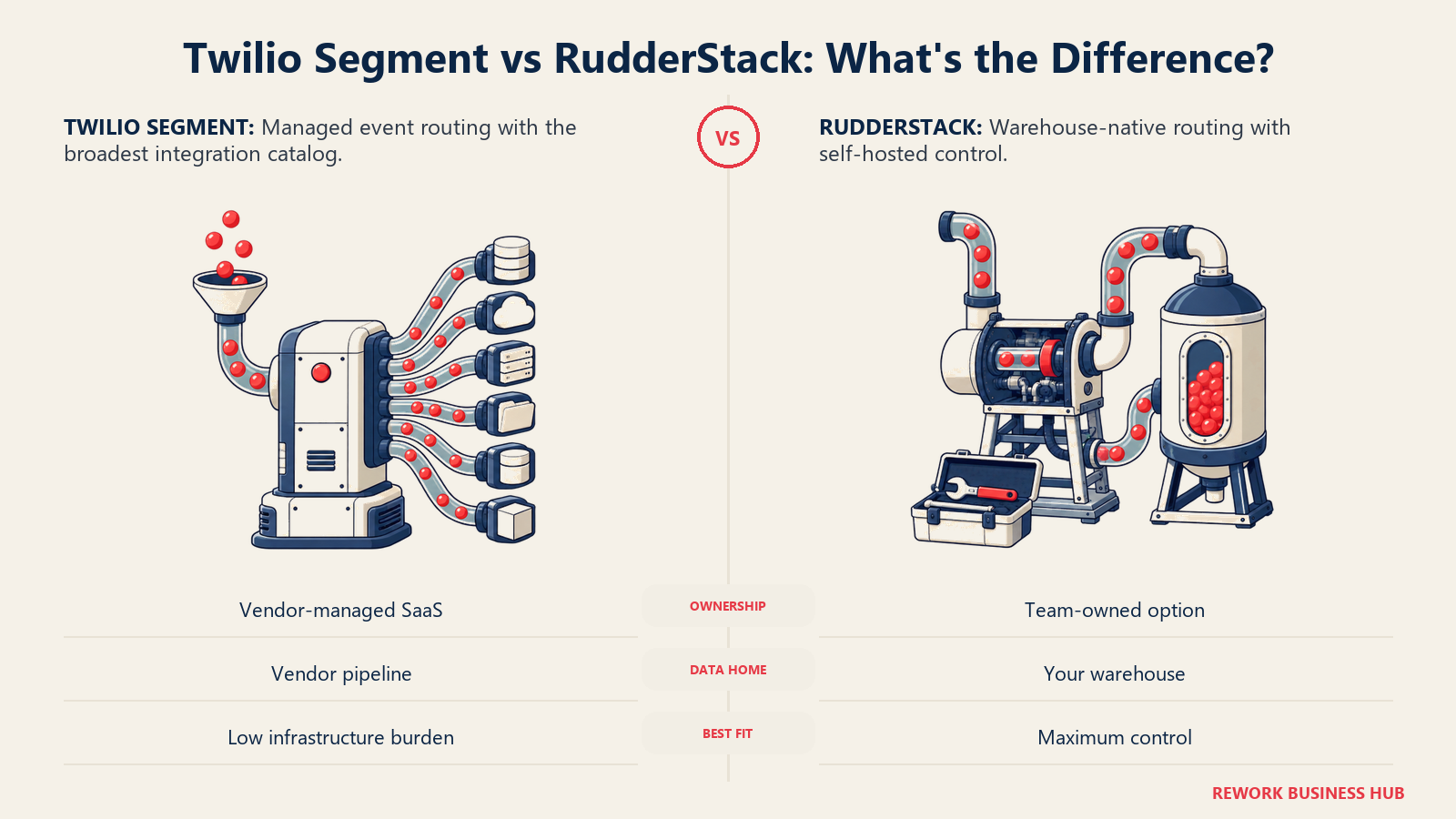
Target audience and sizing. Teams from an early-stage startup on the free tier through enterprise deployments on Business, especially those wanting the largest available destination catalog without self-hosting.
Stage fit. Best for teams that want RudderStack's job done as a managed SaaS product instead of infrastructure they operate themselves.
| Pros | Cons |
|---|---|
| 700+ integrations is the deepest destination catalog in this comparison | The CDP layer (Unify/Engage) is a separate, unpublished-price product |
| Published, transparent pricing at Free and Team tiers | MTU-based overage pricing gets harder to forecast at real scale |
| Fully managed, no self-hosting or infrastructure ownership required | Loses RudderStack's warehouse-native, self-hostable control entirely |
Pricing: Free: 1,000 monthly visitors, 2 sources, 500,000 Reverse ETL records/mo, 700+ integrations. Team: from $120/mo billed with up to 20% off annually, 10,000 visitors/mo, unlimited sources, 1M Reverse ETL records, public API. Business: custom. Segment CDP (Unify/Engage): quote-only, unpublished.
Best for: Teams that want RudderStack's pipeline job without operating the infrastructure themselves, and don't need the data to live exclusively in their own warehouse. If Segment itself is what you're replacing, see the best Segment alternatives guide.
2. Snowplow - Behavioral Data Pipelines Built for Real Event-Schema Control
Snowplow's pitch is depth over convenience: instead of a generic event API, it gives teams strict, versioned event schemas and a pipeline built to run entirely inside their own cloud account, a warehouse-native architecture that predates RudderStack's own version of the same idea. That schema rigor matters most to teams that have been burned by inconsistent event tracking and want validation enforced at the pipeline level, not cleaned up after the fact in the warehouse. Pricing is entirely unpublished: a 14-day free trial requires no card, and both the Self-Hosted Pipeline and the managed Snowplow Platform are quote-only. The licensing point matters here specifically because Snowplow gets misremembered as fully open source: the self-hosted core ships under SLULA 1.1 (Snowplow Limited Use License Agreement), which carries a non-commercial use restriction, not Apache 2.0. The paid, self-hosted option exists specifically to remove that restriction for commercial use.
Target audience and sizing. Data engineering teams running high-volume behavioral tracking (product analytics, ad tech, large-scale ecommerce) that need schema enforcement more than a quick setup.
Stage fit. Best for teams past the point of tolerating inconsistent event data, ready to invest engineering time in schema governance.
| Pros | Cons |
|---|---|
| Strict, versioned event schemas catch bad data before it hits the warehouse | Zero published pricing at any tier, every deal is a sales conversation |
| Warehouse-native architecture with real self-hosting control | SLULA 1.1 license, not Apache 2.0, carries commercial-use restrictions on the free path |
| Built for genuinely high-volume behavioral tracking use cases | Steeper setup curve than a plug-and-play SaaS pipeline |
Pricing: No public price. 14-day free trial at $0, no card required. Self-Hosted Pipeline and Snowplow Platform (managed) are both quote-only. Self-hosted code licensed under SLULA 1.1, not Apache 2.0.
Best for: Data engineering teams that need enforced event-schema quality at scale more than they need a fast, low-touch setup.
3. Jitsu - The Genuinely Open-Source RudderStack Peer
Jitsu is the closest true architectural sibling to RudderStack on this list, and the one place where the "open source" label actually applies without an asterisk: the self-hosted core ships under MIT, a real OSI-approved license, versus RudderStack's source-available Elastic License 2.0. The free tier is generous for a team just getting started: unlimited captured events up to 200,000 active events per month, with unlimited connectors on a once-daily sync. Business tier runs $99 per month for 2 million active events, with additional volume at $40 per extra million and additional sync frequency (5 monthly active syncs included, $20 each beyond that) stepping up to hourly; Enterprise adds 1-minute sync frequency on a custom quote. For a team that specifically wants RudderStack's model (warehouse-native, self-hostable, developer-first) but with unambiguous open-source licensing, Jitsu is the direct swap to evaluate first.
Target audience and sizing. Small to mid-size engineering teams that want RudderStack's architecture with real MIT licensing and don't need its full 200+ destination catalog.
Stage fit. Best for teams early enough that a smaller destination catalog is an acceptable trade for licensing clarity and a genuinely free tier.
| Pros | Cons |
|---|---|
| MIT license, real OSI open source, unlike RudderStack's Elastic License 2.0 | Smaller prebuilt connector and destination catalog than RudderStack |
| Free tier covers 200K active events/mo with unlimited connectors | Sync frequency is gated by tier (daily on Free, hourly on Business) |
| Published, simple pricing at both paid tiers | Younger project, shorter enterprise deployment track record |
Pricing: Free: unlimited captured events, 200,000 active events/mo, unlimited connectors, 1 daily active sync. Business: $99/mo, 2M active events/mo (+$40 per additional 1M), 5 monthly active syncs (+$20 each), 1-hour sync frequency. Enterprise: custom, 1-minute syncs. Self-hosted under MIT license.
Best for: Teams that want RudderStack's warehouse-native, self-hosted model but need unambiguous open-source licensing to satisfy legal or procurement.
4. Hightouch - The Composable CDP That Made Gartner's Leader Quadrant
Hightouch started as a reverse ETL tool and has grown into the composable CDP most credibly challenging the packaged incumbents, landing in the Leader quadrant of the 2026 Gartner Magic Quadrant for Customer Data Platforms on its first appearance. The core idea is the same one RudderStack is built on (keep data in the warehouse, don't copy it into a vendor silo) narrowed specifically to activation: syncing audiences and traits out to ad platforms, CRMs, and messaging tools directly from Snowflake, BigQuery, or Databricks. Hightouch publishes no paid pricing: the Agentic Marketing Platform and Composable CDP lines are both usage-based and quote-only, though the free Basic Reverse ETL tier is real, covering up to 2 active syncs with unlimited destinations and unlimited user seats. Worth flagging plainly since it circulates often: the older $350/month starter tier some articles still cite is gone from the current vendor pricing page.
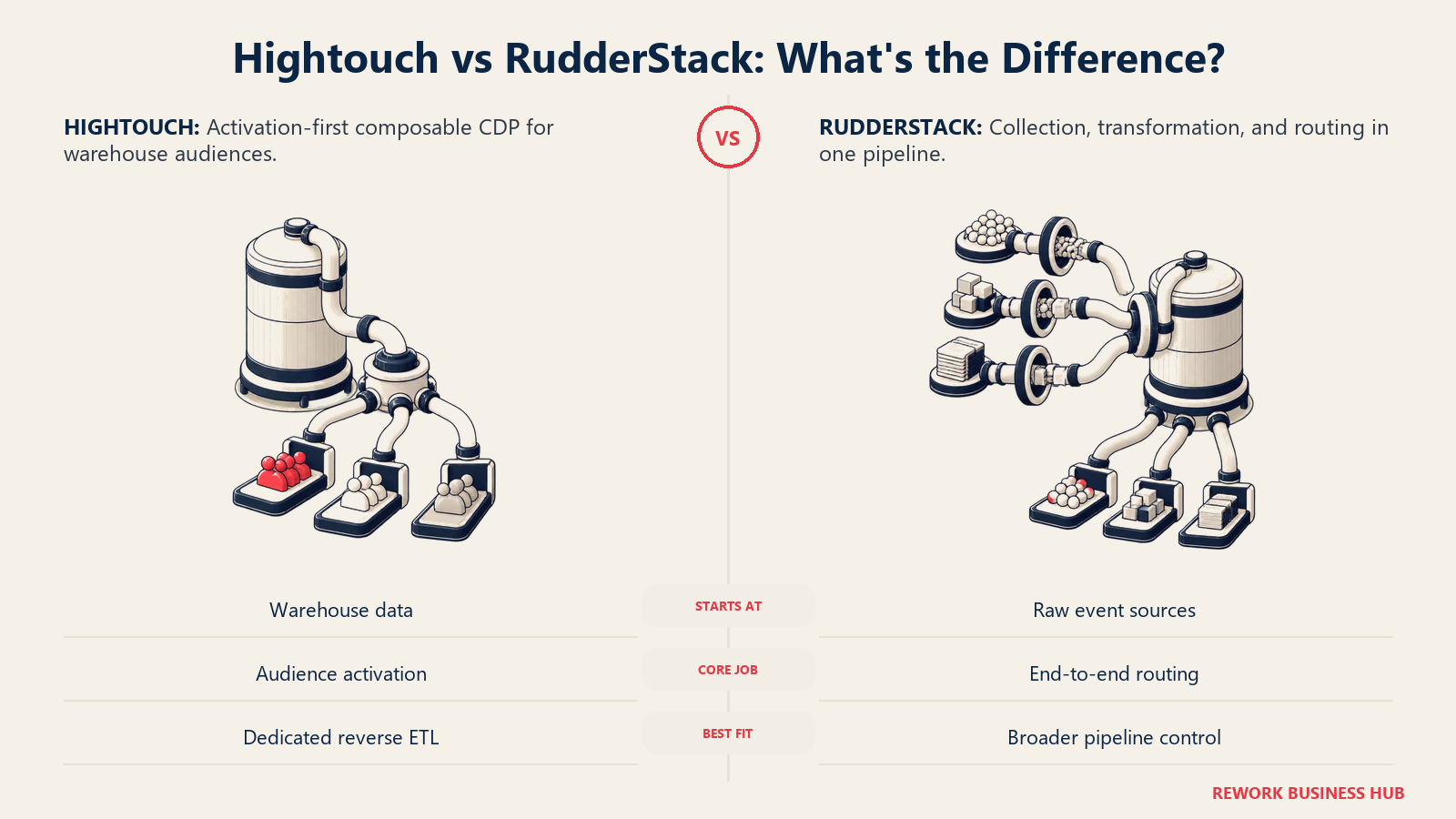
Target audience and sizing. Mid-market to enterprise teams already committed to a cloud warehouse, wanting activation and audience sync without owning a full event-collection pipeline too.
Stage fit. Best once a team has warehouse data worth activating and wants that job handled by a dedicated tool rather than built in-house.
| Pros | Cons |
|---|---|
| 2026 Gartner Leader on its first appearance in the Magic Quadrant | No published paid pricing at any tier, usage-based and quote-only |
| Unlimited user seats and destinations even on the free Basic tier | Narrower scope than RudderStack: activation-focused, not full event collection |
| Shares RudderStack's warehouse-native philosophy in a more focused product | Still requires a separate event-collection layer for raw tracking |
Pricing: No published paid price. Agentic Marketing Platform: usage-based. Composable CDP: usage-based, unlimited user seats. Basic Reverse ETL: free, up to 2 active syncs, unlimited destinations and seats.
Best for: Teams that want RudderStack's warehouse-native philosophy applied specifically to activation, backed by a 2026 Gartner Leader placement. If Hightouch itself is what you're replacing, see the best Hightouch alternatives guide.
5. Fivetran Activations (formerly Census) - Activation From the Ingestion Vendor You May Already Run
Census, once a standalone composable CDP competitor to Hightouch, was acquired by Fivetran in an agreement announced May 1, 2025, and now ships as Fivetran Activations, folded into the same platform many data teams already use for warehouse ingestion. For a team already paying for Fivetran to move data into the warehouse, adding activation from the same vendor removes a second contract and a second tool to learn. Fivetran's Free plan includes 500,000 Connections MAR (monthly active rows) per month, 3,500 Activations MAR per month, and 5,000 monthly model runs; paid Standard, Enterprise, and Business Critical plans price per MAR with no flat published rate, though the pricing page shows a $5 base charge for connections in the 1-1M MAR band, with annual contract discounts starting at 5% and reaching up to 22%.
Target audience and sizing. Teams already running Fivetran for data ingestion, from small teams on the Free tier to enterprise deployments needing Business Critical support.
Stage fit. Best once ingestion and activation vendor consolidation is worth more than staying with a best-of-breed, standalone activation tool.
| Pros | Cons |
|---|---|
| One platform and one contract for both ingestion and activation | Per-MAR rate isn't published, budgeting requires a sales conversation |
| Free tier includes real usage: 500K Connections MAR and 3,500 Activations MAR/mo | The Census brand and its old flat pricing no longer exist, can confuse procurement |
| Up to 22% off on annual contracts | Best value depends on already being (or becoming) a Fivetran ingestion customer |
Pricing: Free: 500,000 Connections MAR/mo, 3,500 Activations MAR/mo, 5,000 monthly model runs. Standard/Enterprise/Business Critical: usage-based per MAR, unpublished rate ($5 base charge shown for connections in the 1-1M MAR band); annual contract discounts from 5% up to 22%.
Best for: Teams already on or evaluating Fivetran for ingestion who want activation from the same vendor rather than a separate composable CDP contract.
6. mParticle (Rokt) - Mobile-First Identity Resolution, Now Under New Ownership
mParticle built its reputation on mobile SDK depth and identity resolution before "CDP" was a common category name, and that strength (stitching a single customer identity across web, iOS, Android, and server-side events) remains real. The company is now part of Rokt, and as of the 2026 Gartner Magic Quadrant cycle, mParticle dropped off the quadrant entirely, alongside ActionIQ, Redpoint Global, and Zeta Global, reportedly for not meeting updated inclusion criteria on CDP-specific customers and contract value. Pricing is entirely unpublished; there is no self-serve tier or published rate card, so evaluating mParticle means starting a sales conversation before seeing a number.
Target audience and sizing. Mobile-first consumer brands and app-heavy enterprises needing strong cross-device identity stitching.
Stage fit. Best for teams with real mobile app volume where cross-device identity resolution is the primary technical requirement.
| Pros | Cons |
|---|---|
| Genuine mobile SDK depth and cross-device identity resolution heritage | Dropped off the 2026 Gartner Magic Quadrant entirely |
| Established enterprise deployment track record predating the CDP category label | Zero pricing transparency, no published rate at any tier |
| Now backed by Rokt's broader commerce data business | Ownership transition still settling, roadmap direction less certain than a stable independent vendor |
Pricing: No published price. Part of Rokt; all deployments are quoted through sales.
Best for: Mobile-heavy consumer brands that need deep cross-device identity resolution and are comfortable evaluating without published pricing.
7. Tealium - Enterprise Tag Management With a Full CDP Layered On
Tealium's advantage is sequencing: it started as a tag management system, so real-time data collection and enrichment sit closer to the source than in tools that bolt a CDP onto an existing analytics stack. That heritage still shows up as a genuine strength for enterprise teams juggling dozens of marketing and analytics tags. In the 2026 Gartner Magic Quadrant, Tealium dropped from Leader to Challenger, a real shift worth factoring into a long-term platform bet. Pricing publishes nothing at all: tealium.com/pricing/ redirects to a stray image asset rather than a rate card, so any number attached to Tealium anywhere online should be treated as unverified.
Target audience and sizing. Large enterprises running many marketing and analytics tags that want tag management and CDP capability from a single vendor.
Stage fit. Best for organizations with tag-sprawl problems a dedicated tag-management heritage genuinely solves, not just a CDP need in isolation.
| Pros | Cons |
|---|---|
| Real-time enrichment happens at the point of collection, a tag-management strength | Dropped from Leader to Challenger in the 2026 Gartner Magic Quadrant |
| Deep tag management pedigree layered under the CDP functionality | Publishes literally no pricing, not even a starting figure |
| Long enterprise deployment history across large, complex tag environments | Heavier platform, likely overbuilt for a team without real tag-sprawl problems |
Pricing: No published price. tealium.com/pricing/ redirects to a stray asset with no rate card; all pricing is quote-only.
Best for: Large enterprises with real tag-management complexity who want that solved alongside CDP identity and activation. If Tealium itself is what you're replacing, see the best Tealium alternatives guide.
8. Treasure AI (formerly Treasure Data) - Profile-and-Behavior Pricing, Repositioned as an Agentic Platform
Treasure Data rebranded to Treasure AI in April 2026, repositioning from a straightforward customer data platform toward what the company now calls an agentic experience platform, a real shift in ambition, not just a name change. The pricing philosophy stays distinctive either way: Treasure markets a "no compute" model, meaning cost is tied to the volume of customer profiles and behaviors stored, not query volume or processing power, a genuinely different mental model than RudderStack's event-count pricing. Three lines now exist: the Intelligent Customer Data Platform (annual subscription tiered on profiles and behaviors), Treasure AI Suites (a fixed annual license per suite plus consumption credits), and Treasure AI Studio (usage credits). None of the three publishes a number; the 2026 Gartner Magic Quadrant also moved Treasure Data from Leader to Challenger during this repositioning.
Target audience and sizing. Mid-market to enterprise teams that want cost predictability tied to data volume rather than query activity, and are comfortable with a platform mid-repositioning.
Stage fit. Best for teams evaluating a longer-term platform bet who are willing to track where Treasure AI's agentic pivot lands before committing.
| Pros | Cons |
|---|---|
| "No compute" pricing model ties cost to profiles/behaviors, not query volume | No published price at any of the three product lines |
| Established enterprise CDP track record under the Treasure Data name | Dropped from Leader to Challenger in the 2026 Gartner Magic Quadrant during the rebrand |
| Repositioning toward agentic AI could add real capability over time | The repositioning itself adds uncertainty about product direction and pricing |
Pricing: No published price. Intelligent Customer Data Platform: annual subscription tiered on profiles and behaviors. Treasure AI Suites: fixed annual license plus consumption credits. Treasure AI Studio: usage credits.
Best for: Enterprise teams that want profile-and-behavior-based pricing predictability and are comfortable evaluating a platform mid-rebrand.
9. Lytics (now Contentstack) - Being Retired as a Standalone CDP
Lytics used to earn a spot on this list for something rare in this category: it actually published real numbers, which made it one of the few tools here you could model against a projected event volume before signing anything. That is no longer true. Contentstack acquired Lytics, and lytics.com now carries one notice: "Lytics has moved to Contentstack. This site will be retired on September 30th, 2026." Lytics already has no public pricing page. The technology ships on as Lytics CDP inside Contentstack AXP, but the published, self-serve credit pricing it was known for is gone, and Contentstack publishes no rate for it. Include it now only if you are an existing customer planning a migration, or a Contentstack CMS customer who wants personalization data in the same platform. Anyone who shortlisted Lytics for its published price should look at Jitsu, which is the remaining option on this list that publishes pricing granular enough to model against event counts directly.
Target audience and sizing. Mid-market marketing teams that want predictable, published credit pricing and real predictive scoring without enterprise-tier complexity.
Stage fit. Best for teams that have outgrown a free event pipeline but aren't yet enterprise-scale enough to need Amperity- or Tealium-level infrastructure.
| Pros | Cons |
|---|---|
| Genuinely published, easy-to-model credit pricing at every tier | Growth-tier credit overages ($500 per additional 10M) add up at real scale |
| Free-forever Developer tier is a real starting point, not a crippled trial | Less enterprise-scale identity resolution depth than Amperity or Tealium |
| Built-in predictive scoring alongside standard segmentation | Smaller ecosystem and partner network than the larger, older vendors here |
Pricing: Developer: free forever, 2M monthly credits, up to 10 domains. Growth: from $500/mo, 5M monthly credits, unlimited domains, +$500 per additional 10M credits. Enterprise: custom, 10M-plus credits.
Best for: Mid-market teams that want to actually model CDP cost against projected volume before committing, something most of this category won't let you do.
10. BlueConic - Built for Marketers to Run Without an Engineering Ticket
BlueConic's whole pitch runs opposite to RudderStack's developer-first model: profiles and segments are meant to be owned and operated by marketers directly, through a no-code interface, without opening a ticket to a data engineering team for every new audience. That's a genuine answer to the exact complaint that sends teams away from RudderStack in the first place, a platform where the people running campaigns can self-serve. In the 2026 Gartner Magic Quadrant, BlueConic sits as a Niche Player, having moved down from Challenger. Pricing is entirely unpublished, demo or quote only, with no self-serve tier or free plan to test the product hands-on before a sales conversation starts.
Target audience and sizing. Marketing teams that want direct, no-code ownership of customer profiles and segmentation, without depending on engineering for day-to-day changes.
Stage fit. Best once marketing has felt the RudderStack gap directly, needing new segments or audiences faster than an engineering queue can turn them around.
| Pros | Cons |
|---|---|
| No-code profile and segment management built specifically for marketers | Niche Player in the 2026 Gartner Magic Quadrant, down from Challenger |
| Directly solves the "waiting on engineering" complaint RudderStack teams raise | No published pricing at all, and no self-serve trial to test before a sales call |
| Marketer-owned model reduces day-to-day dependency on a data team | Less architectural control for engineering teams that want to own the pipeline layer |
Pricing: No published price. Demo or quote only, no self-serve tier.
Best for: Marketing teams whose real complaint about RudderStack is dependency on engineering for every new segment or audience.
11. Amperity - Enterprise Identity Resolution at Lakehouse Scale
Amperity's differentiator is identity resolution depth at genuine enterprise scale, stitching together loyalty, purchase, and behavioral data into a single customer record for large, often retail-scale, organizations. Its Lakehouse CDP and Amperity Bridge products share those unified profiles directly into Databricks and Snowflake using Delta Sharing, Snowflake Secure Data Sharing, and Iceberg tables, a genuinely different activation mechanism than the reverse ETL model most of this category (including RudderStack) relies on. Pricing is entirely consumption-based, measured in Amperity's own unit ("Amps"), with no published rate, no freemium tier, and no self-serve trial of any kind; every relationship starts as a sales conversation. In the 2026 Gartner Magic Quadrant, Amperity retained its Niche Player position.
Target audience and sizing. Large enterprise and retail organizations with complex, high-volume identity resolution needs across loyalty, purchase, and behavioral data.
Stage fit. Best for organizations that have already hit the limits of simpler identity stitching and need lakehouse-native profile sharing at real scale.
| Pros | Cons |
|---|---|
| Genuine enterprise-grade identity resolution depth, built for retail-scale complexity | No freemium tier or self-serve trial of any kind, every evaluation starts with sales |
| Lakehouse-native profile sharing (Delta Sharing, Iceberg) skips reverse ETL entirely | Zero published pricing, "Amps" consumption model is opaque until a deal is quoted |
| Niche Player status held steady in the 2026 Gartner Magic Quadrant | Overbuilt for a team without real enterprise-scale identity complexity |
Pricing: No published price. Consumption-based, billed in Amperity's own "Amps" unit. No freemium tier, no self-serve trial.
Best for: Large, identity-complex enterprises (retail especially) ready to activate unified profiles directly into a Databricks or Snowflake lakehouse.
12. Klaviyo Data Platform - The CDP Layer Bundled Inside a B2C CRM Teams Already Run
Klaviyo Data Platform is the option worth naming for one specific reader: a DTC or ecommerce team that's already running Klaviyo for email and SMS and doesn't want a separate pipeline vendor at all. Rather than a standalone product, it's a CDP layer sold as "Klaviyo Data Platform" and "Advanced Klaviyo Data Platform" inside Klaviyo's broader B2C CRM. Klaviyo's Free plan covers up to 250 active profiles, 500 email sends per month, and $5 of mobile messages per month; paid pricing scales by active profile count and is configured per module (Marketing, Data + Analytics, Service, Composer, Customer Agent), with a representative starter configuration on Klaviyo's own pricing page totaling $45 per month. For a team whose real need is unified customer data feeding lifecycle campaigns, not a general-purpose event pipeline, this is a legitimately different answer than any pipeline-first tool on this list.
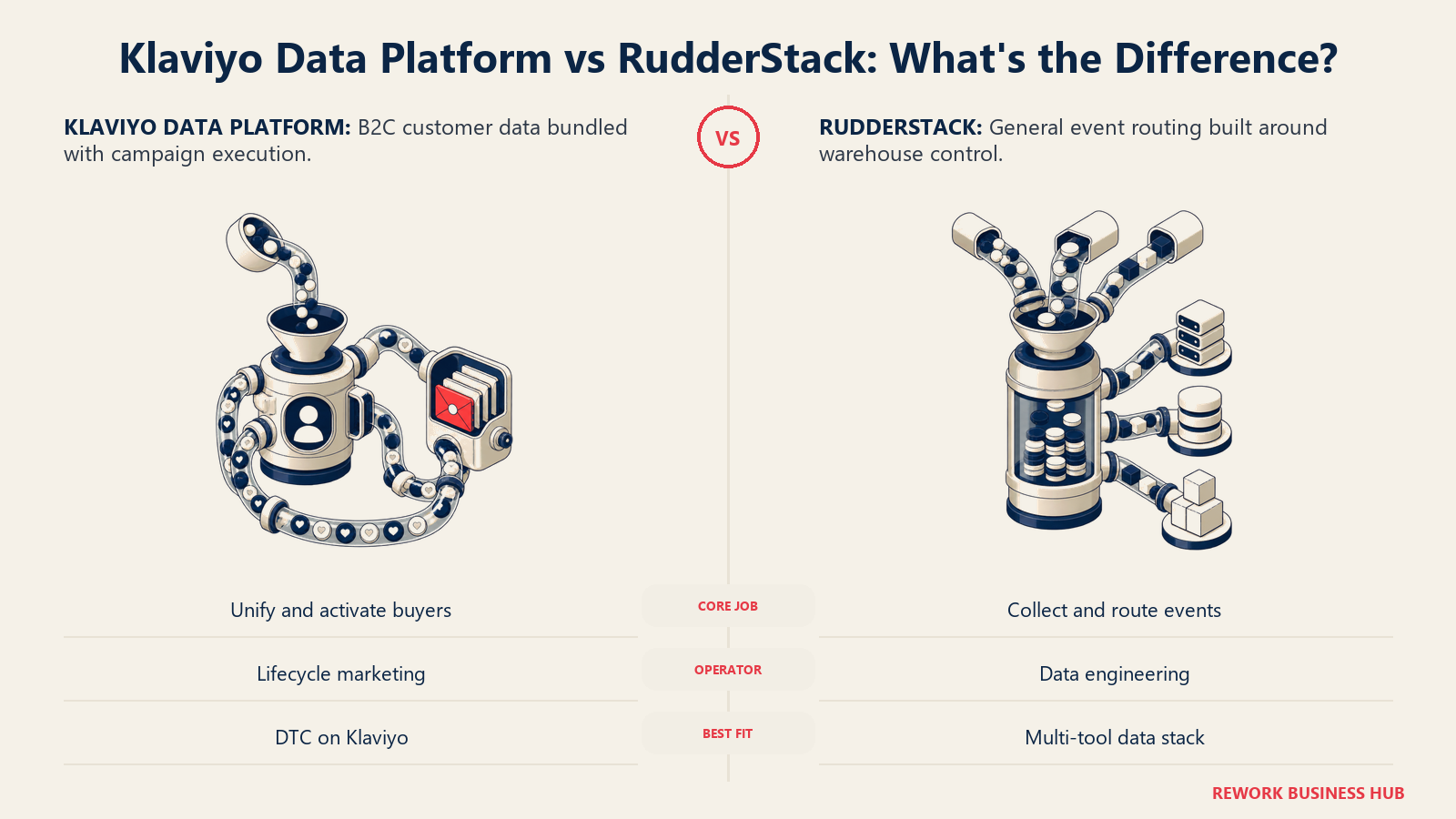
Target audience and sizing. DTC and ecommerce brands already running or evaluating Klaviyo for email and SMS, wanting unified customer data without a separate CDP vendor.
Stage fit. Best for smaller ecommerce teams where consolidating onto one platform matters more than owning a standalone, best-of-breed pipeline.
| Pros | Cons |
|---|---|
| Native fit inside a CRM/ESP many DTC teams already run and pay for | The CDP layer is bundled, not a standalone pipeline product like RudderStack |
| Free tier and low published starter pricing (~$45/mo) lower the barrier to test | Profile-based, module pricing gets harder to forecast as usage scales |
| Consolidates data unification and lifecycle marketing execution in one bill | Not built for general-purpose event collection outside the Klaviyo ecosystem |
Pricing: Free: up to 250 active profiles, 500 email sends/mo, $5 of mobile messages/mo. Paid: scales by active profiles, priced per module (Marketing, Data + Analytics, Service, Composer, Customer Agent); a representative starter configuration totals $45/mo. If Klaviyo itself is what you're replacing for lifecycle marketing, see the best Klaviyo alternatives guide.
Best for: Ecommerce and DTC teams that want unified customer data feeding campaigns from inside a CRM they already run, not a standalone pipeline.
What Moving Off RudderStack Actually Costs at Volume
Most of this category won't publish a number, which is itself worth noting since it makes RudderStack's own transparent tiering (rare in this list) a real point in its favor even for teams that leave. The table below shows the few tools here that do publish usable, volume-based pricing, run against RudderStack's own tiers for a rough apples-to-apples read. Figures are vendor list price as of August 2026; none include negotiated enterprise discounts.
| Tool (tier) | What the meter is | Roughly RudderStack's 1M events/mo | Roughly RudderStack's 25M+ events/mo |
|---|---|---|---|
| RudderStack Growth | Events | $265/mo | Custom (Enterprise tier) |
| Twilio Segment Team | Monthly Tracked Users (MTU), not events | From $120/mo at 10K MTUs, +$10-12/1K MTU overage | Not published at this volume, likely Business tier |
| Jitsu Business | Active events | $99/mo covers 2M active events, +$40 per extra 1M | Roughly $1,059/mo at 25M active events (list math) |
| Lytics (now Contentstack) | Formerly credits; withdrawn from public pricing | No published rate | Standalone site retires 30 September 2026 |
| Fivetran Activations | Monthly Active Rows (MAR), not raw events | Free tier covers 500K Connections MAR | Standard/Enterprise: per-MAR, unpublished rate |
The honest takeaway: only Jitsu still publishes pricing granular enough to model against RudderStack's own event-count tiers directly, now that Lytics has withdrawn its public rates. Segment and Fivetran Activations meter differently (users and rows, not raw events), so a real comparison needs your actual traffic and row-volume numbers, not just an events-per-month figure, before any of these swaps pencil out.
Sizing and Persona Fit
| Headcount / data maturity | Best fit | Watch out for |
|---|---|---|
| Small team, first real pipeline | Jitsu, Segment Free, RudderStack Free | Free tiers cap fast on events or credits once real traffic hits |
| Mid-market, one data engineer | Twilio Segment Team, Hightouch, Fivetran Activations | Usage-based tiers need real traffic modeling before committing |
| Mid-market, marketing-led | Klaviyo Data Platform, BlueConic | No-code tools trade engineering control for marketer speed |
| Enterprise, tag-heavy stack | Tealium, mParticle, Treasure AI | Nearly all enterprise tiers are quote-only, budget procurement time |
| Enterprise, identity-complex (retail) | Amperity, Snowplow, Treasure AI | Highest setup and integration lift of any tier on this list |
| Persona | Optimizes for | Strongest picks |
|---|---|---|
| Data engineer replacing a self-hosted pipeline | Architectural control, warehouse-native design | Jitsu, Snowplow, Hightouch |
| CDO consolidating vendor contracts | One platform for ingestion and activation | Fivetran Activations |
| Marketing ops lead tired of engineering tickets | No-code segmentation and activation | BlueConic, Klaviyo Data Platform |
| Lifecycle marketer at a DTC brand | Unified data inside the CRM they already run | Klaviyo Data Platform |
| Enterprise identity resolution owner | Deep, accurate cross-source customer stitching | Amperity, mParticle, Tealium |
Stage Fit
The right fit changes as data teams move from basic collection to activation and enterprise identity work.
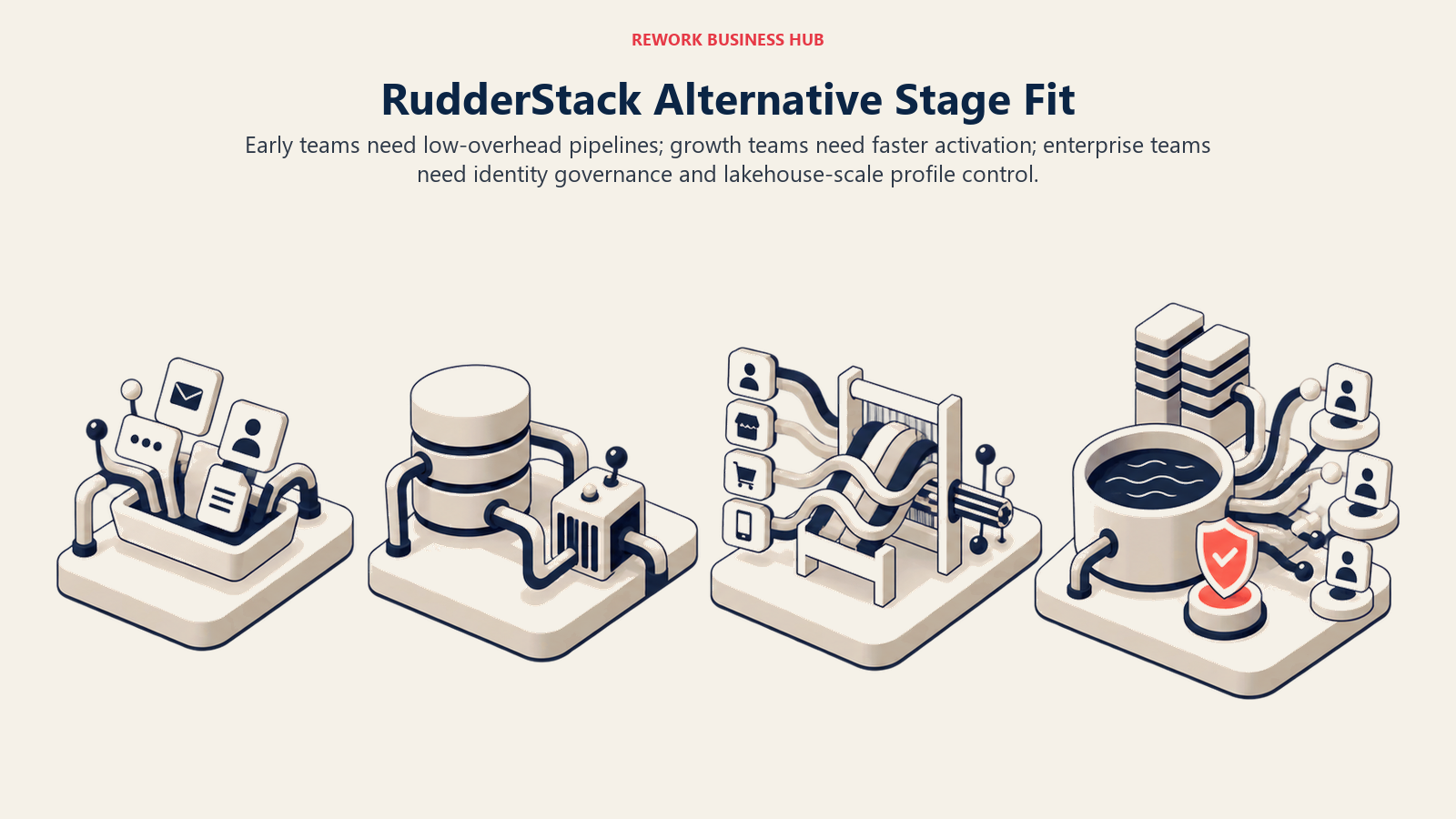
| Company stage | What usually breaks | Best fit |
|---|---|---|
| Seed to Series A | No dedicated data engineer to run a self-hosted pipeline | Jitsu Free, Twilio Segment Free |
| Series B, first data hire | Event volume outgrows a free tier faster than budget was set | Twilio Segment Team, Klaviyo Data Platform |
| Series C to growth stage | Marketing needs activation speed engineering can't keep pace with | Hightouch, BlueConic, Fivetran Activations |
| Late stage, multi-brand | Tag sprawl and fragmented identity across products or brands | Tealium, mParticle |
| Enterprise, retail or high-volume | Identity resolution accuracy and lakehouse-scale profile sharing | Amperity, Treasure AI, Snowplow |
A well-scoped data governance strategy matters more to whether any of these 12 tools actually earns its keep than the platform choice alone. Nearly every persona above shares the same underlying problem Salesforce's own research surfaced: 98% of marketing teams using AI report a data-related barrier to personalization, and most of that traces back to unresolved identity and fragmented pipelines, not a missing feature in whichever CDP sits on top.
Migrating Off RudderStack: What Actually Transfers
Nothing here moves automatically, and the amount of real work depends heavily on which of the three directions above you're heading. Event schemas and tracking plans built in RudderStack don't import natively into Segment, Snowplow, Jitsu, or any packaged CDP; each platform has its own source SDK and event-naming conventions, so instrumentation code across web, mobile, and server-side sources needs updating even for a like-for-like pipeline swap. Transformations written in RudderStack (JavaScript or Python) need rewriting in the new platform's own transformation layer, whether that's dbt models feeding a composable CDP or a vendor's proprietary rules engine.
Destination connections have to be reconfigured one by one; RudderStack's 200+ destination catalog doesn't transfer its specific configuration to a new vendor even where both support the same downstream tool. And if the move is toward a packaged CDP (Tealium, Amperity, Lytics, and similar), budget real time for identity resolution logic: RudderStack largely leaves identity stitching to your own warehouse SQL or a downstream tool, while a packaged CDP owns that logic internally, which means reconciling however your team currently defines "the same customer" against the new platform's resolution rules, not just moving data.
The practical test that actually predicts migration cost: pick one real, moderately complex event (a purchase or signup with several downstream destinations) and rebuild its full path, source instrumentation, transformation, and destination delivery, in your top two finalists before committing budget. Time how long an engineer who didn't build the original RudderStack setup takes to match it exactly. That tells you more than any feature comparison, including this one.
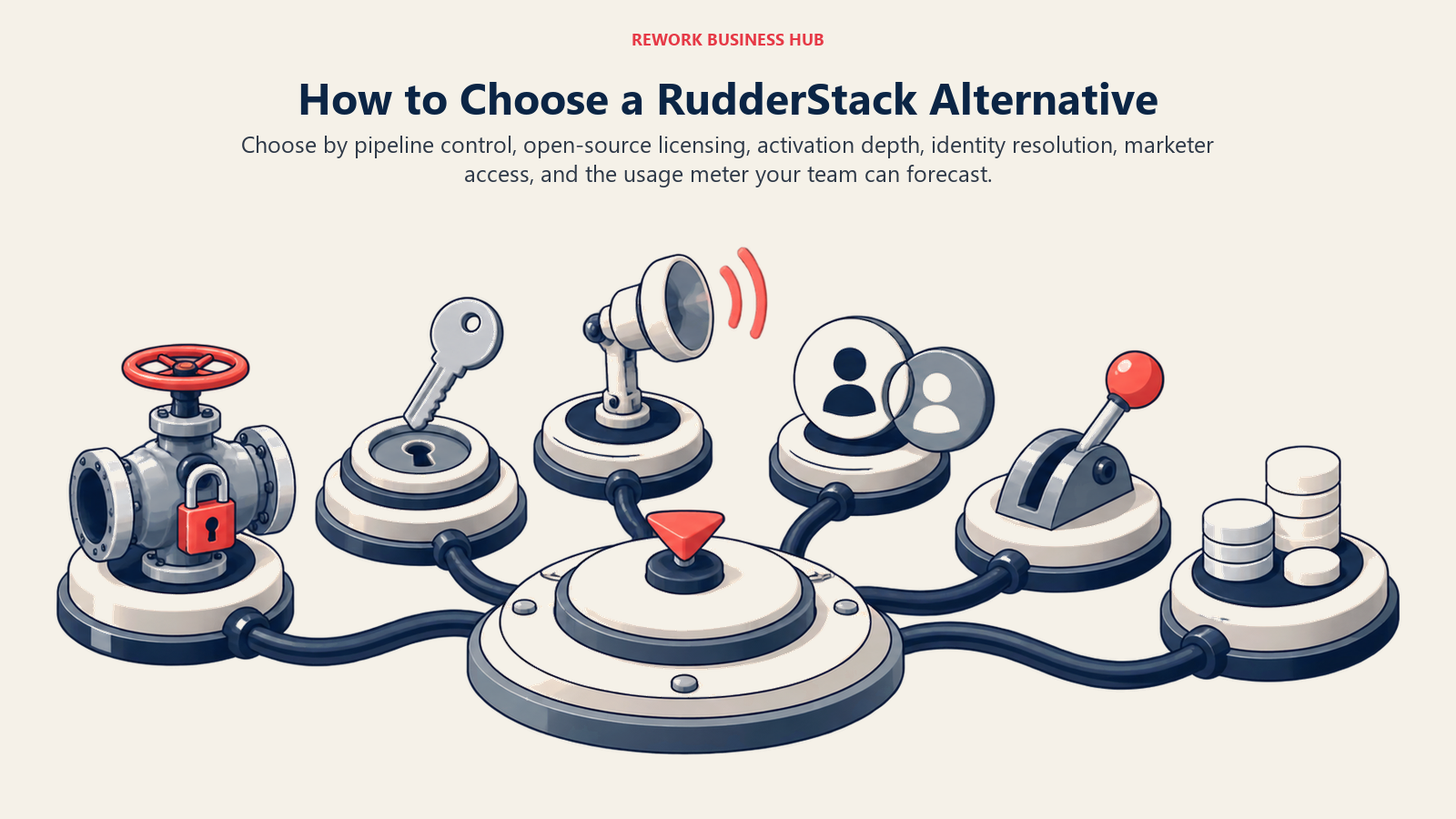
How to Choose: Decision Framework
One fork first: if the real problem isn't the pipeline at all, if data is fine but the tools sitting on top of it (dashboards, BI) are the actual gap, the best business intelligence tools roundup or the best Looker alternatives guide is the more relevant read. If the gap is workflow automation rather than customer data specifically, see best Zapier alternatives or best Workato alternatives.
| If you need... | Choose |
|---|---|
| The closest like-for-like pipeline swap, fully managed | Twilio Segment |
| Genuine OSI open-source licensing, not source-available | Jitsu |
| Strict, versioned event-schema enforcement at scale | Snowplow |
| Warehouse-native activation without owning the full pipeline | Hightouch |
| Activation bundled with your existing ingestion vendor | Fivetran Activations |
| No-code segmentation marketing can run without engineering | BlueConic |
| Transparent, modelable pricing | Jitsu |
| Enterprise tag management plus CDP in one platform | Tealium |
| Lakehouse-native identity resolution at retail scale | Amperity |
| A CDP layer bundled inside a CRM you already run for ecommerce | Klaviyo Data Platform |
Whichever direction you pick, the best CRM software roundup and best AI tools for data analysis are worth a look before finalizing, since a CDP or pipeline swap rarely happens in isolation from the CRM and analytics tools reading its output.
Frequently Asked Questions about RudderStack Alternatives
Is RudderStack actually open source?
Not in the OSI sense. RudderStack's self-hosted code is source-available under the Elastic License 2.0, meaning you can read and modify it, but it isn't a fully open license like MIT or Apache 2.0. Jitsu, by comparison, ships under MIT, a genuine OSI-approved open-source license.
What does RudderStack cost at real scale?
Free covers 250,000 events per month. Growth starts at $265 per month for 1 million events and tiers up through 25 million-plus, with 15% off on annual billing. Enterprise pricing is custom and unpublished.
What's the cheapest way to replace RudderStack?
Jitsu's free tier (200,000 active events per month, unlimited connectors) or Twilio Segment's free tier (1,000 monthly visitors, 700+ integrations) are the two genuinely free starting points. RudderStack's own free tier (250,000 events per month) is the third, and the most direct like-for-like starting point.
What's the difference between a packaged CDP and a composable CDP?
A packaged CDP (Tealium, Amperity, BlueConic, Lytics) ships identity resolution, segmentation, and activation as one built-in product. A composable CDP (Hightouch, Fivetran Activations) keeps data in your own warehouse and focuses specifically on the activation layer, syncing audiences out, closer to RudderStack's own warehouse-native philosophy but narrower in scope.
Does RudderStack include identity resolution?
No, not as a packaged feature. RudderStack collects, routes, and transforms events; stitching multiple events into one customer identity is largely left to your own warehouse logic or a downstream tool. Amperity, mParticle, and Tealium all include identity resolution as core product.
Is Twilio Segment the same company as RudderStack?
No, they're separate, competing vendors. Segment (now Twilio Segment) pioneered the SaaS event-pipeline category; RudderStack launched later as a warehouse-native, self-hostable alternative to Segment's original model. Note that segment.com/pricing now redirects to twilio.com, since the product's full name is Twilio Segment.
How long does migrating off RudderStack typically take?
It depends more on transformation and identity-resolution complexity than on the destination vendor. A straightforward pipeline swap to Segment or Jitsu can move in a few weeks. A move to a packaged CDP that owns identity resolution internally, like Amperity or Tealium, often takes months to reconcile against however your team currently defines a unique customer.
What to Do Next
Pick your two strongest candidates from the decision framework and rebuild one real, moderately complex event path (ideally one with several downstream destinations and at least one identity-resolution edge case) end to end in each. Time how long it takes an engineer who didn't build your original RudderStack setup to match the same result and get sign-off from whoever currently trusts that data.
Then price the real deployment against your actual event, MTU, or row volume, not the marketing-page number, since most of this category is usage-based and quote-only. The gap between "looks cheaper" and "the actual invoice" only shows up once a vendor sees your real traffic, exactly the discipline this guide applied to RudderStack itself.
Camellia writes about customer data platforms and data infrastructure for B2B teams.

Principal Product Marketing Strategist
On this page
- Key Facts
- Quick Comparison Table
- Why Teams Look Beyond RudderStack
- Three Ways Teams Replace RudderStack
- 1. Twilio Segment - The Polished, Paid Version of the Same Job
- 2. Snowplow - Behavioral Data Pipelines Built for Real Event-Schema Control
- 3. Jitsu - The Genuinely Open-Source RudderStack Peer
- 4. Hightouch - The Composable CDP That Made Gartner's Leader Quadrant
- 5. Fivetran Activations (formerly Census) - Activation From the Ingestion Vendor You May Already Run
- 6. mParticle (Rokt) - Mobile-First Identity Resolution, Now Under New Ownership
- 7. Tealium - Enterprise Tag Management With a Full CDP Layered On
- 8. Treasure AI (formerly Treasure Data) - Profile-and-Behavior Pricing, Repositioned as an Agentic Platform
- 9. Lytics (now Contentstack) - Being Retired as a Standalone CDP
- 10. BlueConic - Built for Marketers to Run Without an Engineering Ticket
- 11. Amperity - Enterprise Identity Resolution at Lakehouse Scale
- 12. Klaviyo Data Platform - The CDP Layer Bundled Inside a B2C CRM Teams Already Run
- What Moving Off RudderStack Actually Costs at Volume
- Sizing and Persona Fit
- Stage Fit
- Migrating Off RudderStack: What Actually Transfers
- How to Choose: Decision Framework
- What to Do Next