Best Zoho Bigin Alternatives in 2026: 12 CRMs for Teams Ready to Grow Past a Micro-CRM
Turn this article into takeaways for your work.


Each assistant summarizes the article only for you and suggests best practices for your work.
Bigin is Zoho's answer to a real problem: most small teams don't need a full CRM, they need a place to track deals that doesn't take a week to set up. It's cheap, it's fast to configure, and for a genuinely small team it still does the job in 2026. If you're searching for alternatives, you're usually in one of three situations: you've outgrown Bigin's automation and reporting ceiling, you want out of the Zoho ecosystem entirely, or you're just looking for something cheaper or simpler, which turns out to be a shorter list than you'd expect once you see what Bigin's own Express tier costs.
This guide covers 12 alternatives across all three situations, plus a section on when the right move is to stay exactly where you are.
Key Facts
- The SME segment of the CRM market is projected to grow at a 15.5% compound annual rate, the fastest-growing segment even though large enterprises still hold most of the revenue. (Grand View Research)
- Sales reps spend under a third of their week on actual selling; the rest goes to admin, data entry, and coordination work that a single-pipeline tool can't automate away. (Salesforce, State of Sales research)
- Companies that respond to a new lead within an hour are nearly seven times more likely to qualify it than those that wait 60 minutes, yet the average B2B company still takes 42 hours to respond. (Harvard Business Review)
- CRM software now returns $3.10 for every dollar spent, down from the widely repeated $8.71 figure as adoption has matured into table stakes rather than a differentiator. (Nucleus Research)
Quick Comparison Table
Use this table as your first filter. Zoho CRM and Rework are the two "grow past Bigin" options; the rest split between teams leaving the Zoho ecosystem entirely and teams that just want something cheaper or simpler.
| Tool | Best For | Starting Price | Key Strength | Key Limitation |
|---|---|---|---|---|
| Zoho CRM | Bigin users who like Zoho, just need more depth | Free (3 users); Standard from about $14/user/mo (reported) | Same ecosystem as Bigin, real automation and reporting | Zoho's deep menu tree, the complexity Bigin exists to avoid |
| Rework | Teams of 5+ that outgrew a single pipeline | From $69/mo billed yearly for 5 seats (Sales Engine); $159/mo with chat inbox and lead routing (Revenue Engine) (rework.com/pricing) | Unified chat inbox, pipeline, and native lead routing | Not built for teams under about 5 people |
| Pipedrive | Deal-focused reps who want the cleanest pipeline UI | From about $14/seat/mo billed annually (Lite, reported) | Best visual pipeline on the market | Thin native marketing tools |
| HubSpot Sales Hub | Teams that want a free start with room to add marketing | Free (up to 2 users); Starter $7/seat/mo annual | Huge ecosystem, genuinely useful free tier | Professional and Enterprise carry required onboarding fees |
| Freshsales | Growing teams wanting AI lead scoring and built-in phone | From $9/user/mo billed annually (Growth) | Built-in phone, AI deal insights | UI gets dense as you add features |
| Capsule CRM | Teams that want Bigin's simplicity, minus Zoho | Free (2 users, 250 contacts); paid from about $21/user/mo (reported) | Clean, contact-first simplicity | Doesn't publish tier prices; light automation |
| Less Annoying CRM | Tiny teams who want one price and zero tiers | $15/user/month flat, one tier | Radical simplicity, one price forever | No free plan, minimal automation |
| Copper | Teams that live entirely inside Google Workspace | From $23/seat/mo billed annually (Basic) | Deep Gmail and Drive integration | Only worth it if your team is Google-native |
| Nutshell | Teams wanting a CRM plus built-in email marketing | From $13/user/mo billed annually (Foundation) | Unlimited contacts, built-in campaigns | Automation depth still limited on lower tiers |
| Close | Inside sales teams doing high-volume calling and email | From $9/user/mo billed annually (Solo, 1-user cap) | Built-in power dialer and sequences | Solo caps at 1 user; Essentials jumps to $35 |
| monday CRM | Teams already running projects in monday.com | From $12/seat/mo billed annually (3-seat minimum) | Familiar visual boards, fast setup | CRM depth is secondary to project management |
| Attio | RevOps-led teams that want a fully custom data model | Free (3 seats); Plus from $35/user/mo annual | Spreadsheet-flexible objects, strong API | Needs setup time before it's usable day one |
When Bigin Is Still the Right Answer
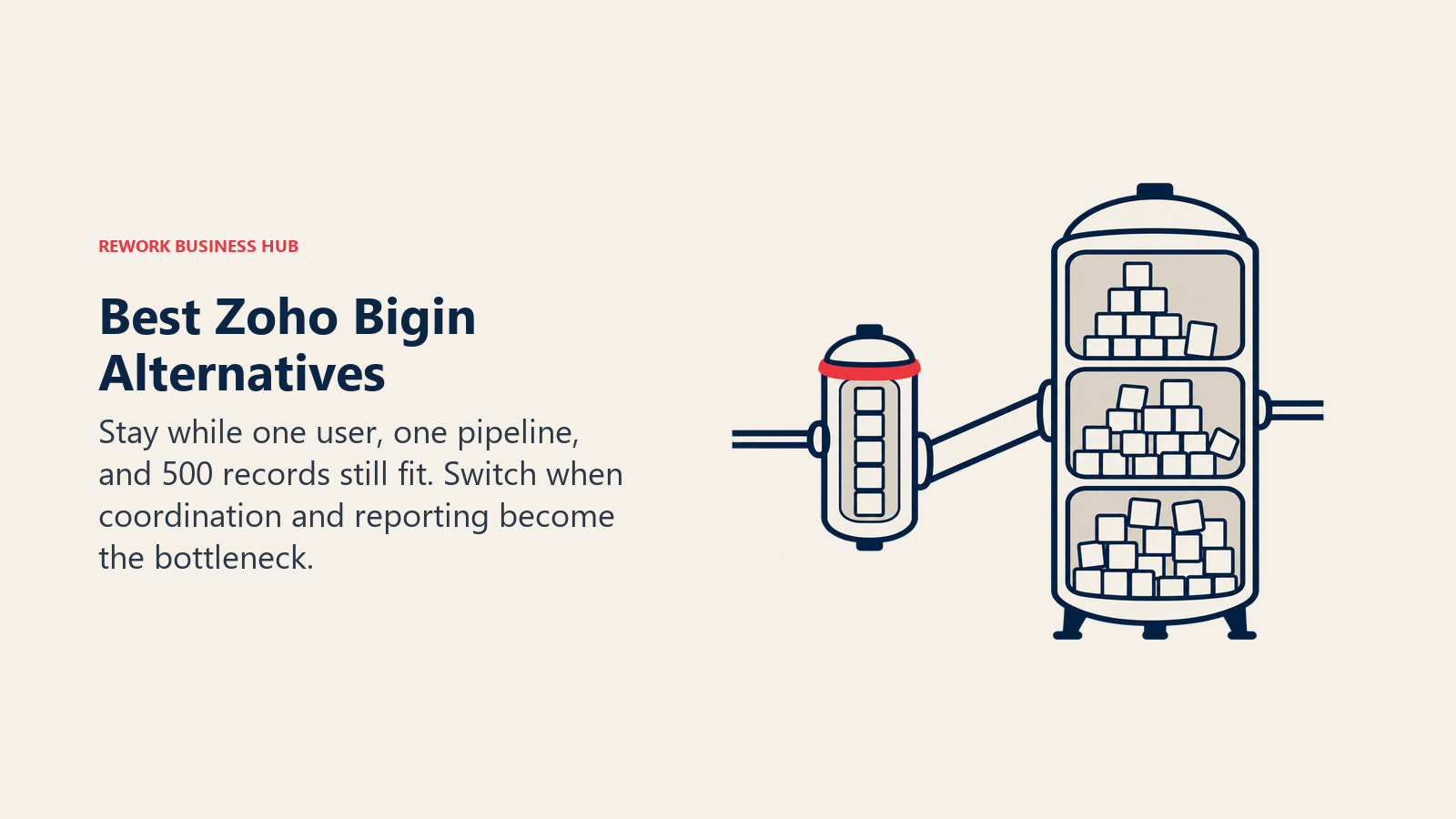
Before you read 12 reasons to switch, here's the honest case for not switching. Bigin's free plan really is free forever (1 user, 500 records, 1 pipeline), and Express is $7/user/month billed annually, $9 month to month. That's not a teaser price designed to expire; it's a real, sustainable tier for a genuinely small team.
Stay on Bigin if most of the following are true: your team is under 5 people, you're running one sales motion rather than multiple pipelines for different product lines or regions, your reporting needs stop at "how many deals are in each stage," and nobody is asking for automation beyond a basic follow-up reminder. Under those conditions, every alternative on this list either costs more for the same job or adds configuration overhead you don't need yet.
The signal to actually start shopping isn't a feature you're missing, it's a workaround you've already built. If you're tracking a second pipeline in a spreadsheet because Bigin's free plan only allows one, assigning leads over Slack because there's no routing logic, or exporting data to a separate tool because Bigin's reporting stops at basic pipeline views, that's the point where an alternative starts paying for itself.
Team Size and Stage Fit
Team size is the fastest filter here. Most Bigin alternatives, Rework included, assume a team bigger than the 1-4 person range Bigin itself is built for.
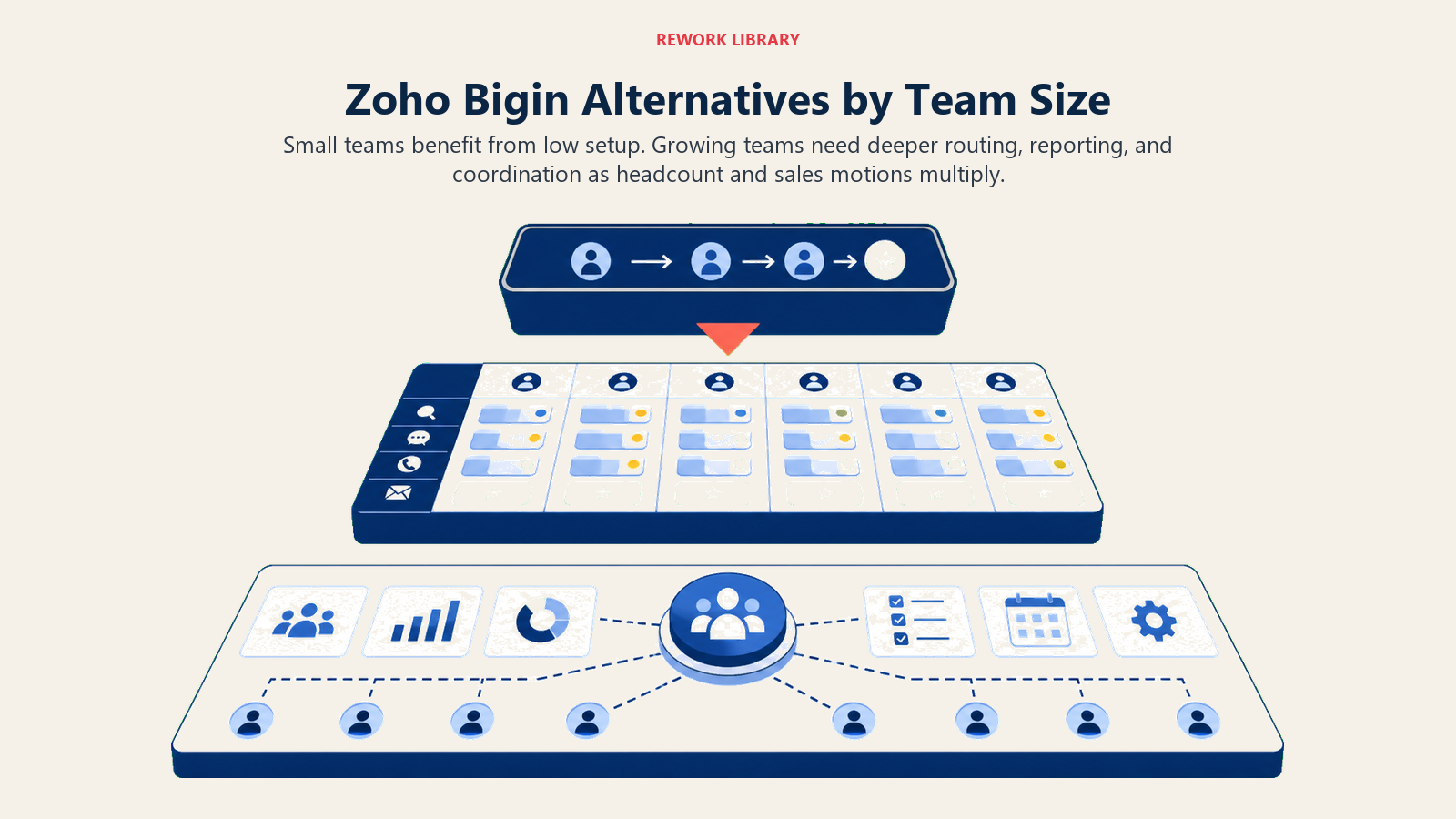
| Tool | Team Size Sweet Spot | Where It Fits Best |
|---|---|---|
| Zoho CRM | 3-50 | Existing Zoho or Bigin users who need more depth |
| Rework | 5-100 | Growing B2B sales teams past the single-pipeline stage |
| Pipedrive | 3-200 | Deal-focused B2B sales, field sales |
| HubSpot Sales Hub | 1-500+ | Teams planning to add marketing tools later |
| Freshsales | 5-200 | Mid-market teams with a sales ops function |
| Capsule CRM | 1-50 | Contact-first teams that want to stay simple |
| Less Annoying CRM | 1-10 | Solo operators and very small teams, no tiers to navigate |
| Copper | 2-100 | Google Workspace-native professional services teams |
| Nutshell | 3-100 | SMBs that want CRM plus email marketing bundled |
| Close | 1-150 | Inside sales, high-volume phone and email outreach |
| monday CRM | 10-250 | Teams already standardized on monday.com |
| Attio | 3-150 | Technical, RevOps-led B2B SaaS teams |
1. Zoho CRM: The in-family upgrade path Zoho itself points you to
If your only real complaint with Bigin is that you've outgrown it, not that you dislike Zoho as a company, the obvious first stop is Zoho CRM itself. Bigin was designed as Zoho's training-wheels product; Zoho CRM is where Bigin graduates go, and reviewers consistently name it the natural next step once reporting or automation needs grow past what Bigin offers.
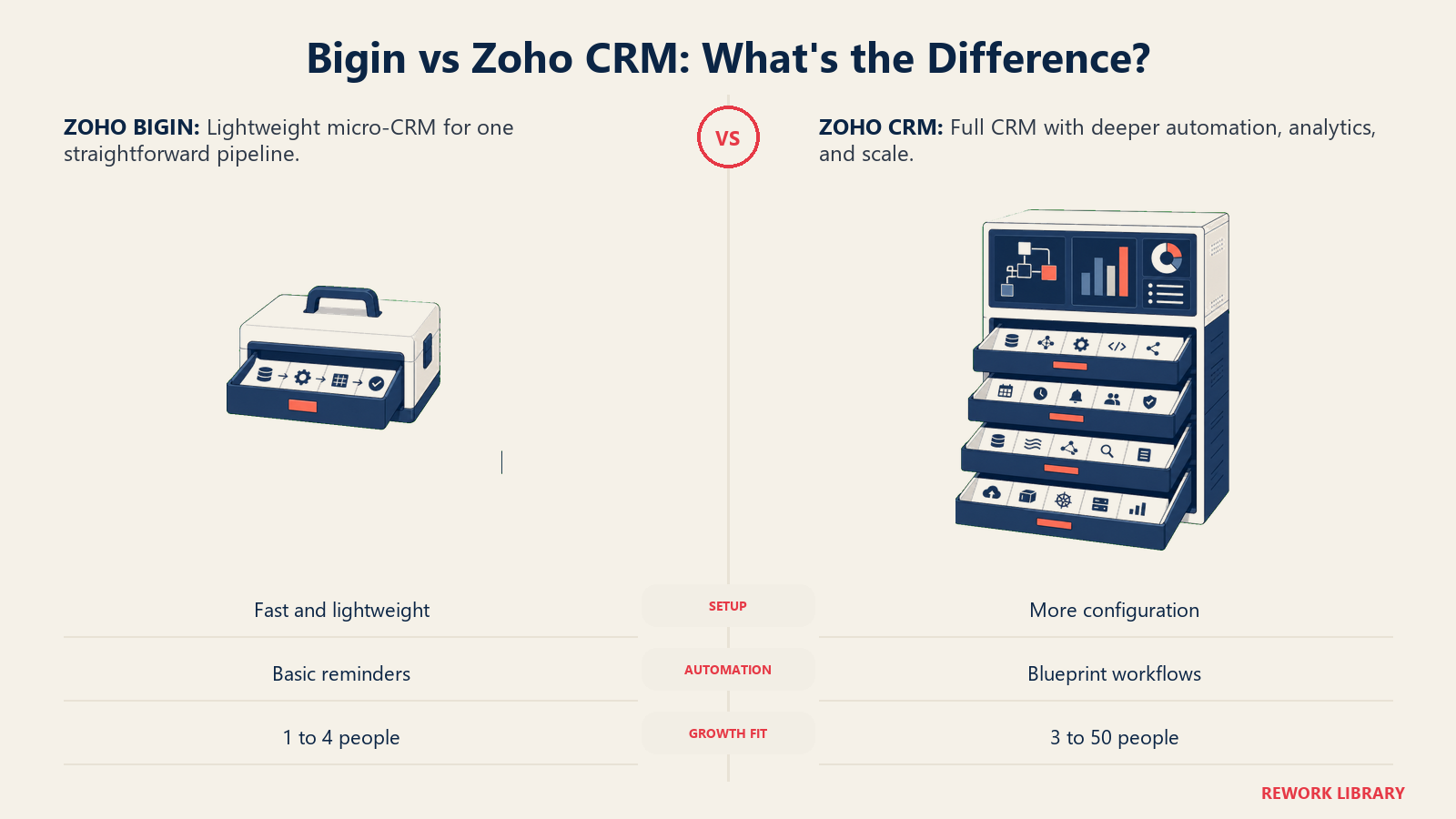
You keep the same login and account team, and Zoho provides direct migration tooling from Bigin to CRM. What you gain: Blueprint-style process automation, deeper analytics, and Zia AI features that don't exist at any Bigin tier. What you get back: Zoho CRM's famously deep menu tree, the same complexity that pushes a lot of buyers toward Bigin in the first place. It's less a simplicity upgrade and more a trade of ease for power.
Zoho's paid CRM pricing page serves local currency by default rather than a fixed USD list. The reported USD figures are Standard around $14/user/month, Professional $23, Enterprise $40, and Ultimate $52, all billed annually; the India-priced list runs 800, 1,400, 2,400, and 2,600 rupees per user per month for the same tiers. The free edition covers 3 users, forever. If Zoho CRM still feels like too much Zoho, the best Zoho alternatives roundup and Rework vs Zoho CRM both cover the field beyond the Zoho ecosystem.
| What you get | What you don't |
|---|---|
| Zoho's same account, same login as Bigin | Bigin's fast, low-friction setup |
| Deeper automation (Blueprint) and reporting | A flat, predictable price (currency and tier math vary) |
| Zia AI assistant and 55-plus connected Zoho apps | Simplicity, if that's why you liked Bigin |
| Direct Bigin-to-CRM data migration | Freedom from Zoho's interface, if that's the real complaint |
Pricing: Free edition (3 users, forever); Standard from about $14/user/month billed annually (reported; Zoho's own page serves local currency).
Best for: Teams that are happy with Zoho and just need Bigin's ceiling raised. Not ideal for: Anyone whose real complaint is Zoho itself rather than Bigin specifically.
2. Rework: The upgrade for teams that outgrew a single-pipeline CRM
Zoho's own product logic points Bigin users toward Zoho CRM when they outgrow the free plan. But if the real complaint isn't "I need more Zoho," it's "I need my team to stop losing track of who's working which lead," Rework solves a different problem.
Rework pairs a visual pipeline with a unified chat inbox (WhatsApp, Messenger, Instagram, live chat, and more) tied to the same lead record, so a growing sales team stops relying on forwarded messages and Slack pings to know who owns a conversation. Email runs through Rework's separate Mail app rather than the inbox. Lead routing, SLA rules, and workflow automation run natively, the categories where Bigin's Express and Premier tiers stay shallow by design.
Be honest with yourself here. If you're a 2-4 person team still on Bigin's free plan or Express tier, Rework is not your next move; you're still small enough that Bigin covers the job, and Rework's 5-seat minimum (seats come in blocks of 5) would have you paying for seats you don't need yet. The fit shows up once a team crosses into roughly 5-10+ people, when coordination, not data entry, becomes the bottleneck. For a wider view of where Rework sits among pipeline-first CRMs, see the best sales pipeline software for 2026.
| What you get | What you don't |
|---|---|
| Unified chat inbox (WhatsApp, Messenger, live chat) with lead activity on the same record | Zoho's 55-plus connected apps |
| Native lead routing and SLA automation | A built-in dialer |
| Cross-team workflow automation | The right fit for teams under about 5 people |
| Clean onboarding without a consultant | A large third-party app marketplace |
Pricing: The Sales Engine (CRM) is $69/mo billed yearly for 5 sales seats; the Revenue Engine, which adds the chat inbox, lead capture, and routing, is $159/mo billed yearly. 14-day free trial, no free plan (rework.com/pricing)
Best for: Sales teams of 5-100 that have outgrown a single-pipeline CRM and need real coordination, not just contact storage. Not ideal for: Solo operators or teams under about 5 people. If that's you, revisit the "When Bigin Is Still the Right Answer" section above before you shop further.
3. Pipedrive: The sales-first CRM for teams that live in their pipeline
Pipedrive was built by salespeople frustrated with CRMs that felt designed by engineers instead of reps. The pipeline view is the product here, not a tab you visit occasionally, which makes it one of the more natural next steps for a Bigin user who liked Bigin's pipeline-first simplicity but wants more room to grow.
Every workflow flows outward from the deal: add a contact, link it to a deal, move the card, log the activity. Where Pipedrive pulls ahead of Bigin is pipeline customization and activity-based selling reminders that nudge reps toward their next action. Where it falls short is anything beyond the pipeline; native email marketing is thin, and multi-channel outreach means stitching together Zapier integrations rather than working in one inbox.
Pipedrive renamed its tiers in 2026: Lite, Growth, Premium, and Ultimate replaced the old Essential/Advanced/Professional/Power/Enterprise names. Lite runs about $14/seat/month billed annually, and Ultimate about $79/seat/month (both reported, so treat these as directionally accurate rather than confirmed to the dollar). For the full field of Pipedrive alternatives, see the best Pipedrive alternatives.
| What you get | What you don't |
|---|---|
| The clearest visual pipeline UI in this list | Strong native email marketing |
| Activity-based selling prompts | A multi-channel inbox |
| A clean, fast mobile app for field sales | Deep reporting without paid add-ons |
| Familiar, deal-first workflow if you liked Bigin's pipeline | Company-wide workflow automation |
Pricing: From about $14/seat/month billed annually (Lite, reported), scaling through Growth and Premium to Ultimate at about $79/seat/month (reported).
Best for: Deal-focused B2B sales teams of 3-200 that want the cleanest pipeline UX and don't need marketing tools bundled in. Not ideal for: Teams running inbound and outbound together, or anyone who needs a multi-channel inbox out of the box.
4. HubSpot Sales Hub: The free-to-start option with a marketing suite behind it
HubSpot's free CRM has been the default recommendation for teams leaving a starter tool for years, and Sales Hub is the reason: it's a "free forever" tier that's actually useful, not a crippled trial. For Bigin users leaving the Zoho ecosystem entirely, HubSpot is usually the first stop.
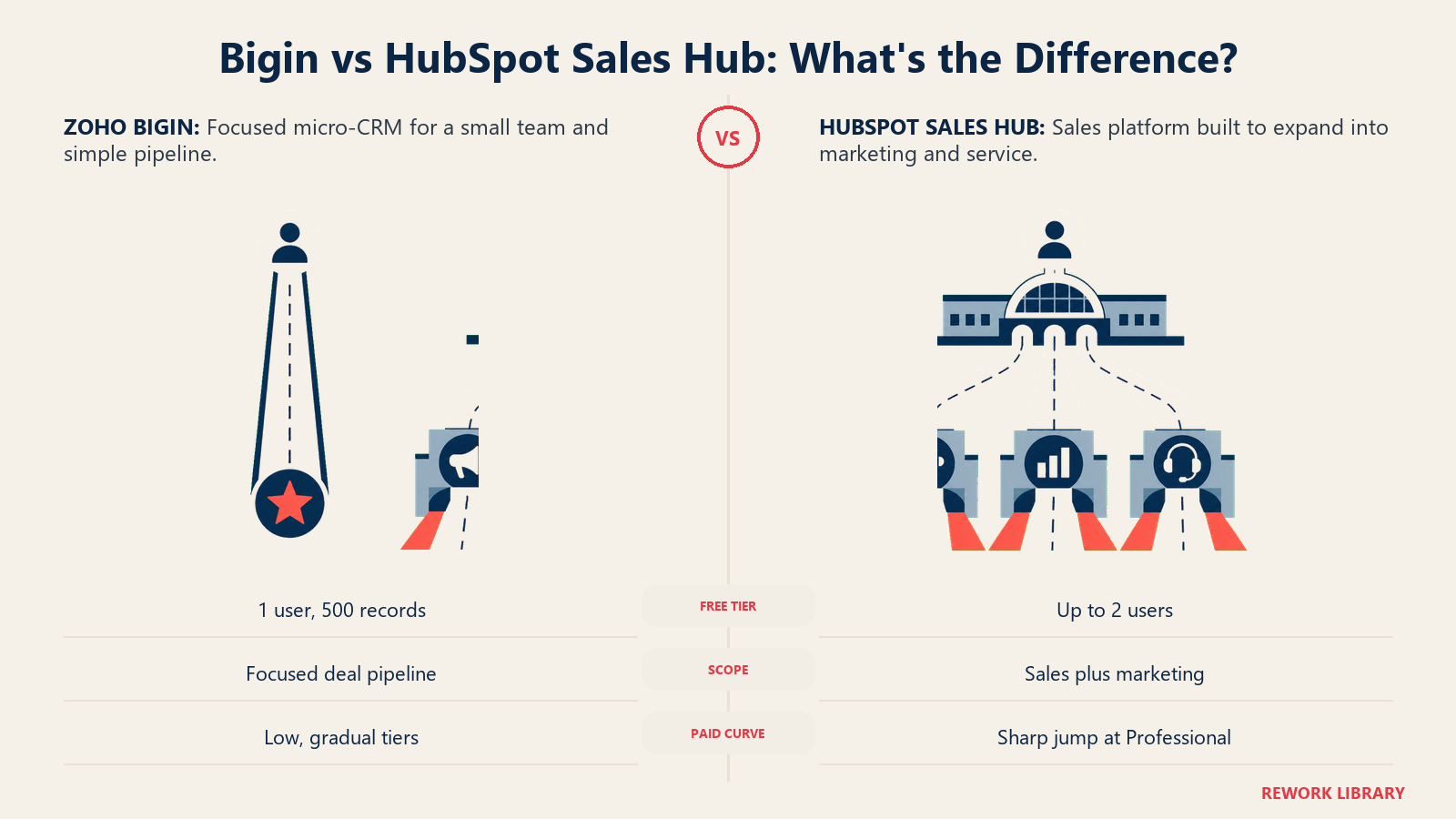
The philosophy is different from Bigin's in kind, not just size. Bigin wants to be a fast, focused pipeline tool; HubSpot wants to be the system of record for marketing, sales, and service under one roof. That's a real strength if you'll eventually want email marketing or a help desk in the same login. It's a cost problem if you only need the CRM core and the features you actually want live behind a Professional-tier paywall.
HubSpot's Free Tools cover up to 2 users at $0. Sales Hub Starter is $7/seat/month billed annually ($20 monthly). Professional jumps to $90/seat/month annual ($100 monthly) and requires a one-time $1,500 onboarding fee. Enterprise is $150/seat/month annual plus a required $3,500 onboarding fee. For Bigin users, the CRM core at Starter will feel familiar; just be honest about whether you're buying HubSpot for the CRM or for the platform around it. The best HubSpot alternatives covers the field if the pricing curve gives you pause.
| What you get | What you don't |
|---|---|
| A genuinely useful free tier, not a crippled trial | Simple pricing once you cross into Professional |
| Huge integration marketplace (1,000-plus apps) | A lightweight CRM without platform sprawl |
| Best-in-class email marketing, if you need it | Freedom from onboarding fees on Professional and up |
| World-class onboarding content |
Pricing: Free Tools $0 (up to 2 users); Starter $7/seat/month billed annually ($20 monthly); Professional $90/seat/month annual plus a required $1,500 onboarding fee.
Best for: Teams that want CRM plus marketing tools under one login and are willing to grow into HubSpot's broader platform. Not ideal for: Teams that want a focused sales CRM without eventually paying for marketing features they didn't ask for.
5. Freshsales: AI-assisted selling with built-in phone
Freshsales (part of Freshworks) positions itself as the mid-market option that punches above its price point: AI lead scoring, a built-in phone system, and email sequences in one product, for less than what HubSpot charges for Sales Hub Professional alone. For a Bigin user who's outgrown basic reporting but doesn't want Zoho CRM's complexity, it's a real middle option.
The product vision is "sell smarter with AI." Freddy AI, Freshworks' AI layer, surfaces deal health signals and suggests next actions, a genuine step up from Bigin's rule-based automation. Where Freshsales gets complicated is UI density; the product has grown fast, and new users often report feeling like there's a lot to configure before they can just start selling. The sweet spot is a team with someone in an ops or RevOps-adjacent role who can handle the initial setup.
Freshsales' Growth tier starts at $9/user/month billed annually, Pro at $39, and Enterprise at $59. There's a 21-day free trial, but Freshworks' own pricing page doesn't confirm a permanent free tier, so don't expect a Bigin-style forever-free plan here. The best Freshsales alternatives rounds up the closest competitors if this one doesn't land.
| What you get | What you don't |
|---|---|
| Built-in phone and SMS | A perpetual free tier |
| AI lead scoring and deal health signals | Easy DIY onboarding for non-ops teams |
| Multi-pipeline support | Bigin's low UI density |
| A meaningful step up from Bigin's automation | Deep marketing automation |
Pricing: Growth $9/user/month billed annually; Pro $39; Enterprise $59. 21-day free trial, no confirmed permanent free tier.
Best for: Sales teams of 10-200 who want AI-assisted selling and built-in calling without HubSpot- or Salesforce-level pricing. Not ideal for: Small teams without a sales ops person to configure the platform.
6. Capsule CRM: The other simple CRM, for teams that want to stay simple
If you liked Bigin's core promise (fast setup, no consultant needed, a clean list of contacts and deals) but want out of Zoho specifically, Capsule is the closest thing to a like-for-like swap. It's built around the same idea: get organized fast, don't make the user think about the data model.
Capsule's free plan caps at 2 users and 250 contacts, tighter than Bigin's free plan on the contact side but similarly aimed at genuinely small teams. Paid tiers run Starter, Growth, Advanced, and Ultimate. Capsule doesn't publish per-tier prices in a form that's easy to verify automatically; expect to pay roughly $21/user/month billed annually at the entry paid tier (reported, not confirmed to the dollar), climbing from there.
Where Capsule differs from Bigin: slightly better relationship and contact management, a cleaner UI for pure contact tracking, and, once you're on a paid tier, more automation headroom. Where it's similar: neither tool is built for heavy multi-team process or deep reporting. If contact-first simplicity is genuinely the goal, the best Capsule CRM alternatives is worth a look too, in case Capsule itself turns out to have the same ceiling as Bigin.
| What you get | What you don't |
|---|---|
| Bigin-style simplicity from a non-Zoho vendor | Automation depth beyond the entry tiers |
| Clean, contact-first interface | Published per-tier pricing you can verify in seconds |
| A genuine, if tight, free plan | Multi-channel inbox or built-in phone |
| Reasonable step up in relationship tracking | Company-wide workflow automation |
Pricing: Free (2 users, 250 contacts); paid tiers from about $21/user/month billed annually (reported; Capsule doesn't publish exact tier prices).
Best for: Teams that want Bigin's simplicity without the Zoho ecosystem attached. Not ideal for: Teams that need real automation depth or multi-channel messaging; Capsule has the same kind of ceiling Bigin does.
7. Less Annoying CRM: One tier, one price, built for tiny teams that hate CRM software
The name is the pitch, and it's held up: Less Annoying CRM (LACRM) has run one tier at $15/user/month since long before "simple CRM" became a crowded category. No free plan, no Starter/Growth/Pro ladder, no upsell path. You pay $15 per user, every month, for every feature the product has.
For a Bigin user whose main complaint is Zoho's sprawl rather than Bigin's feature set, LACRM is close to a direct swap. It covers contacts, a pipeline, task reminders, and basic reporting, roughly the same job Bigin does, from a company that has deliberately stayed small rather than bolting on 50 adjacent products. The tradeoff is the same one Bigin makes: minimal automation, no AI features, and a UI that looks its age next to newer tools on this list.
If your team is 1-10 people and the whole reason you're shopping is wanting a CRM without a pricing page that requires a spreadsheet to parse, LACRM is the most literal answer to that request on this list. The best Less Annoying CRM alternatives covers what to look at if you outgrow it later.
| What you get | What you don't |
|---|---|
| One price, one tier, no upsell ladder | A free plan |
| Radical simplicity, easy to explain to a team | Automation, AI features, or multi-channel inbox |
| Predictable cost as you add users | Enterprise-grade reporting |
| A genuinely small, founder-run company behind it | Fast growth headroom past small-team size |
Pricing: $15/user/month, one tier, no other plans.
Best for: Tiny teams (1-10 people) that want Bigin-level simplicity without a Zoho login. Not ideal for: Teams that expect to need automation, AI, or multi-channel messaging within the next year or two.
8. Copper: Zero-data-entry CRM for teams that live in Google Workspace
Copper's entire product is built around one insight: sales teams that live in Gmail and Google Calendar shouldn't have to leave to update their CRM. It sits inside Gmail as a sidebar, auto-captures emails, and syncs with Calendar and Drive. For a Bigin user whose team runs on Google Workspace, Copper removes a category of manual logging that Bigin doesn't touch.
The philosophy is zero data entry, as long as Google is genuinely your team's operating system. If even half your team is on Outlook, or you're Slack-first with limited Google dependency, Copper's core value disappears fast, and you're paying a premium for an integration you're not using.
Copper's Basic tier runs $23/seat/month billed annually ($29 monthly), noticeably more than Bigin's Express tier for a narrower feature set outside of the Google integration itself. Professional is $59 annual ($69 monthly), Business $99 annual ($134 monthly). The best Copper alternatives covers options that aren't tied to a single productivity suite.
| What you get | What you don't |
|---|---|
| Deep Gmail sidebar CRM experience | Value outside Google Workspace |
| Auto-capture of emails and meetings | A multi-channel inbox (chat, calls) |
| Google Drive file attachment to deals | Bigin's lower entry price |
| Clean, minimal pipeline UI | Strong reporting or forecasting |
Pricing: Basic $23/seat/month billed annually ($29 monthly); Professional $59 annual ($69 monthly); Business $99 annual ($134 monthly).
Best for: Small professional services teams of 2-50 that are fully in Google Workspace. Not ideal for: Teams on Outlook, hybrid setups, or anyone who needs built-in phone or marketing automation.
9. Nutshell: A straightforward step up with built-in email marketing
Nutshell occupies similar territory to Bigin: a straightforward CRM built for small teams that don't want a consultant to get started. The difference is what's bundled in. Nutshell adds built-in email marketing campaigns on top of the pipeline, something Bigin doesn't offer at any tier without a separate Zoho Campaigns subscription.
For a Bigin user who wants to stay in "simple CRM" territory but add email marketing without adding a second vendor, Nutshell is a reasonable lateral move. It's not a big leap in automation sophistication, more a different bundle of the same basic idea: pipeline plus a bit more.
Nutshell's Sales Suite runs Foundation at $13/user/month, Growth at $25, Pro at $42, Business at $59, and Enterprise at $79, all billed annually. Foundation includes unlimited contacts, a real advantage over Bigin's 500-record cap on the free plan, though API access doesn't show up until Enterprise. The best Nutshell alternatives covers the field if Nutshell's own ceiling becomes the next problem.
| What you get | What you don't |
|---|---|
| Unlimited contacts, even on the entry tier | Bigin's lower starting price |
| Built-in email marketing campaigns | API access below the Enterprise tier |
| Clean pipeline views, easy onboarding | A deep multi-channel inbox |
| A step up from Bigin's reporting | Company-wide workflow automation |
Pricing: Foundation $13/user/month billed annually; Growth $25; Pro $42; Business $59; Enterprise $79.
Best for: SMBs that want a CRM and basic email marketing in one subscription without adding a second Zoho product. Not ideal for: Teams that need deep automation or an API without paying for the top tier.
10. Close: Built for inside sales teams doing high-volume outreach
Close was designed for one thing: inside sales teams that live on the phone and in their inbox. Calling, SMS, and email sequences are built directly into the CRM, so a rep runs their entire outbound motion without leaving the tool. This is a different animal from Bigin, which has no native dialer at any tier.
For a Bigin user doing real outbound volume (50-plus calls or emails a day per rep), Close closes a gap Bigin was never built to fill. If your motion is more relationship-based or inbound-heavy, the built-in calling stack is dead weight you're paying for.
Close's Solo tier is $9/user/month billed annually ($19 monthly), but it caps at exactly 1 user and a 10,000-lead limit, so it's really a solo-founder tier rather than a team plan. Essentials starts real team pricing at $35/user/month annual ($49 monthly) with no user cap, Growth at $99 annual ($109 monthly), Scale at $139 annual ($149 monthly). The best Close alternatives covers the next tier of options if Close is too specialized for your motion.
| What you get | What you don't |
|---|---|
| Built-in power dialer and VoIP | A CRM for non-inside-sales motions |
| Native SMS and email sequences | Bigin's low entry price for a team |
| Fast, keyboard-driven rep experience | Marketing automation |
| Strong reporting on outbound activity | A meaningful free tier |
Pricing: Solo $9/user/month billed annually (1-user cap); Essentials $35/user/month annual (unlimited users); Growth $99 annual; Scale $139 annual.
Best for: Inside sales teams of 5-150 doing high-volume phone and email outreach. Not ideal for: Relationship-based or inbound-first teams, or anyone who doesn't need built-in calling.
11. monday CRM: Pipeline tracking for teams already living in monday.com
monday CRM is a layer built on top of monday.com's work management platform. If your company already runs projects, delivery, or ops in monday, adding the CRM keeps pipeline tracking in the same tool instead of introducing a new login for sales alone.
The philosophy is that sales is just another workflow, and the same visual board model that works for project management works for deal tracking too. For teams where sales, delivery, and ops already share context on monday boards, that's genuinely true. For a Bigin user with no existing monday relationship, there's little reason to adopt the CRM without the platform around it.
Every monday CRM plan has a 3-seat minimum, which matters for a very small Bigin team: you can't buy a single seat here the way you can on Bigin's free plan. Basic runs $12/seat/month billed annually ($18 monthly), Standard $17 ($25), Pro $28 ($41), and Ultimate is quote-only. If the 3-seat minimum doesn't fit your team, most other tools on this list sell single seats.
| What you get | What you don't |
|---|---|
| Familiar monday UI, if your team already uses it | A single-seat plan (3-seat minimum) |
| Visual deal boards with color coding | CRM-native depth (dialing, sequencing) |
| Integration with monday's existing projects and ops | Bigin's low starting price for one person |
| Fast setup if you're already on monday | A purpose-built sales rep experience |
Pricing: Basic $12/seat/month billed annually ($18 monthly); Standard $17 ($25); Pro $28 ($41); Ultimate by quote. 3-seat minimum on every plan.
Best for: Teams of 10-250 already standardized on monday.com who want to avoid adding a separate CRM. Not ideal for: Teams buying monday purely for CRM, or anyone under the 3-seat minimum.
12. Attio: The flexible, data-model-first CRM for technical teams
Attio is what CRM looks like when product designers take "flexible as a spreadsheet" seriously. Every object, contacts, companies, deals, even custom objects, is configurable. You define the fields, the relationships, and what your pipeline stages actually mean, instead of working inside a fixed contact-account-deal hierarchy.
That's close to the opposite of Bigin, which is opinionated and pre-configured by design. For a Bigin user leaving because the tool felt too rigid, Attio is the other extreme: a blank canvas that rewards a team with a RevOps or technical operator to configure it, and underwhelms a team without one.
Attio's free tier covers up to 3 seats at $0, which lines up closely with a small Bigin team's headcount. Plus is $35/user/month billed annually ($44 monthly), Pro $79 annual ($99 monthly), and Enterprise is custom, annual only. If Attio's setup time is the deciding factor against it, Zoho CRM or Rework both ship with more structure out of the box.
| What you get | What you don't |
|---|---|
| Fully customizable data model and objects | A pre-configured CRM you can use day one |
| Native enrichment and a strong API | Bigin's fast, no-setup onboarding |
| Free tier that fits a small team's headcount | Built-in phone, SMS, or email sequences |
| Room to build the exact model your motion needs | A large ecosystem of native integrations |
Pricing: Free (up to 3 seats); Plus $35/user/month billed annually ($44 monthly); Pro $79 annual ($99 monthly); Enterprise custom, annual only.
Best for: Small B2B SaaS teams with a RevOps-minded operator who want to build a CRM around their exact motion. Not ideal for: Teams that want to start selling immediately without configuration time.
Why Teams Leave Zoho Bigin (And What to Look For Instead)
The cleanest way to pick a replacement is to name the specific workaround Bigin forced, then match it to the tool built for that gap, not just whichever CRM name you've heard most often.
| Bigin pain point | What to prioritize in a replacement |
|---|---|
| Automation stays shallow past a few basic rules | Rework, Zoho CRM, Freshsales, Close |
| Reporting doesn't go beyond basic pipeline views | Zoho CRM, HubSpot, Freshsales, Attio |
| Free plan caps at 1 pipeline and 500 records | Rework, Capsule CRM, Nutshell, Less Annoying CRM |
| No multi-channel inbox beyond email and light chat | Rework, Freshsales |
| Want out of the Zoho ecosystem entirely | Pipedrive, HubSpot, Nutshell, Copper, Less Annoying CRM |
| Team crossed 10-plus people and needs role-based coordination | Rework, HubSpot, Freshsales |
| Bigin already feels cheap; you just want fewer Zoho quirks | Capsule CRM, Less Annoying CRM |
Pricing at Real Seat Counts
Bigin buyers are usually price-sensitive by nature, so here's the real math at two realistic team sizes: a 3-person team (roughly Bigin's own sweet spot) and an 8-person team (past the point most people start shopping).
| Tool | At 3 Users (Annual) | At 8 Users (Annual) |
|---|---|---|
| Zoho Bigin (staying put) | $252 (Express) | $672 (Express) |
| Zoho CRM | $0 (Free edition covers exactly 3) | $1,344 (Standard, reported) |
| Rework | Not sold below 5 seats; the Sales Engine covers 5 for $828 (billed yearly) | $1,080 (Sales Engine plus one 5-seat block, billed yearly) |
| Pipedrive | $504 (Lite, reported) | $1,344 (Lite, reported) |
| HubSpot Sales Hub | $252 (Starter; first 2 seats free) | $672 (Starter) |
| Freshsales | $324 (Growth) | $864 (Growth) |
| Capsule CRM | $756 (reported; free plan caps at 2) | $2,016 (reported) |
| Less Annoying CRM | $540 | $1,440 |
| Copper | $828 (Basic) | $2,208 (Basic) |
| Nutshell | $468 (Foundation) | $1,248 (Foundation) |
| Close | $1,260 (Essentials; Solo caps at 1 user) | $3,360 (Essentials) |
| monday CRM | $432 (Basic, 3-seat minimum) | $1,152 (Basic) |
| Attio | $0 (Free covers exactly 3) | $3,360 (Plus) |
Two things jump out. Zoho CRM and Attio both cover a 3-person team for $0 on their free tiers, while Rework doesn't sell an engine below 5 seats at all, by design. And at 8 users, staying on Bigin Express ($672/yr) is still the cheapest line on this table by a wide margin, which is exactly why the "When Bigin Is Still the Right Answer" section above exists: if price is your only complaint, the math still favors staying put.
How to Choose: Decision Framework
Match the tool to the specific reason you're shopping, not to whichever name is most familiar.
| If you need... | Pick this |
|---|---|
| To stay inside Zoho's product family, just with more depth | Zoho CRM |
| Unified inbox and native lead routing for a team past 5 people | Rework |
| The cleanest visual pipeline, with no Zoho attached | Pipedrive |
| A genuinely free CRM with room to add marketing tools later | HubSpot Sales Hub |
| AI lead scoring and built-in phone at mid-market pricing | Freshsales |
| Bigin's simplicity, from a non-Zoho vendor | Capsule CRM or Less Annoying CRM |
| Zero manual data entry because your team lives in Gmail | Copper |
| CRM plus built-in email marketing in one subscription | Nutshell |
| High-volume calling and email sequences for inside sales | Close |
| Pipeline tracking inside a tool your team already uses daily | monday CRM |
| A fully custom data model for a technical, RevOps-led team | Attio |
| Fewer than 5 people and a genuinely simple sales motion | Stay on Bigin |
Frequently Asked Questions about Zoho Bigin Alternatives
What is the best Zoho Bigin alternative for a growing sales team?
Zoho CRM is the natural first step for most Bigin teams, since it shares Bigin's login and account and adds the automation and reporting depth Bigin lacks. Rework is the stronger option once a team crosses roughly 5 to 10 people and the bottleneck is coordination, combining a visual pipeline with a unified chat inbox and native lead routing, with the Revenue Engine at $159/month billed yearly (the CRM-only Sales Engine starts at $69/month billed yearly for 5 seats).
Should I stay on Zoho Bigin or switch to something else?
Stay on Bigin if your team is under 5 people, you're running a single pipeline, and your reporting needs stop at basic deal-stage counts. The signal to switch isn't a missing feature, it's a workaround you've already built, like tracking a second pipeline in a spreadsheet because Bigin's free plan only allows one.
How much does Zoho Bigin cost in 2026?
Bigin's free plan covers 1 user, 500 records, and 1 pipeline, forever. Paid tiers are Express at $7/user/month billed annually ($9 monthly), Premier at $12/user/month annual ($15 monthly), and Bigin 360 at $18/user/month annual ($21 monthly), per Zoho's own pricing page.
What's the cheapest Zoho Bigin alternative?
Less Annoying CRM, at a flat $15/user/month with no tiers, is the simplest priced alternative, though it costs more per seat than Bigin's own Express tier. Zoho CRM and Attio both offer free plans that cover a 3-person team at $0, closer to Bigin's own free-plan economics.
Should I upgrade to Zoho CRM or leave the Zoho ecosystem entirely?
If your complaint is Bigin specifically (thin reporting, shallow automation) and you're otherwise fine with Zoho as a vendor, Zoho CRM is the faster, lower-friction move. If your complaint is Zoho itself (interface complexity, the sprawl of 55-plus connected apps, support response times), leaving the ecosystem for Rework, Pipedrive, or HubSpot solves the actual problem instead of just raising Bigin's ceiling.
Is Zoho Bigin good for a growing sales team?
Bigin works well for 1 to 4 person teams running one straightforward sales motion. Past that, most teams hit the same three walls: automation that stays shallow, reporting that stops at basic pipeline views, and a free plan capped at a single pipeline, which is exactly when this list becomes relevant.
How do I evaluate a CRM switch without wasting time on demos?
Run a two-week pilot with live deals and real reps instead of judging tools from a demo. Track three things: how many reps updated the CRM without a reminder, how many activities got logged per deal, and whether pipeline visibility actually improved for whoever manages the team. A tool that passes those three tests in two weeks is the right fit, regardless of the feature list.
What to Do Next
Start with the "When Bigin Is Still the Right Answer" section above and rule yourself out honestly before you shop. If none of those conditions apply, pick your top two picks based on the specific workaround pushing you to switch (automation, reporting, ecosystem fatigue, or price), and run a two-week pilot with real deals before committing.
For a wider view of the CRM category beyond this specific Bigin comparison, the best CRM software for 2026 covers the full field across use cases. The right CRM is the one your team actually updates without being reminded, not the one with the longest feature list.

Head of Enterprise Solutions
On this page
- Key Facts
- Quick Comparison Table
- When Bigin Is Still the Right Answer
- Team Size and Stage Fit
- 1. Zoho CRM: The in-family upgrade path Zoho itself points you to
- 2. Rework: The upgrade for teams that outgrew a single-pipeline CRM
- 3. Pipedrive: The sales-first CRM for teams that live in their pipeline
- 4. HubSpot Sales Hub: The free-to-start option with a marketing suite behind it
- 5. Freshsales: AI-assisted selling with built-in phone
- 6. Capsule CRM: The other simple CRM, for teams that want to stay simple
- 7. Less Annoying CRM: One tier, one price, built for tiny teams that hate CRM software
- 8. Copper: Zero-data-entry CRM for teams that live in Google Workspace
- 9. Nutshell: A straightforward step up with built-in email marketing
- 10. Close: Built for inside sales teams doing high-volume outreach
- 11. monday CRM: Pipeline tracking for teams already living in monday.com
- 12. Attio: The flexible, data-model-first CRM for technical teams
- Why Teams Leave Zoho Bigin (And What to Look For Instead)
- Pricing at Real Seat Counts
- How to Choose: Decision Framework
- What to Do Next