OpenPhone vs Google Voice in 2026: Which Is Cheaper Once You Add the Required Workspace Licence?
Turn this article into takeaways for your work.


Each assistant summarizes the article only for you and suggests best practices for your work.
Updated August 2026
If you run a small or growing team and you're picking a business phone system this year, OpenPhone and Google Voice are almost certainly the two cheapest credible names on your list. One is the scrappy app-first phone system that small teams recommend to each other. The other is a $10 line item bolted onto the Google account you already pay for. On the surface it looks like a simple question: pay a bit more for the nicer app, or pay less and keep everything inside Google.
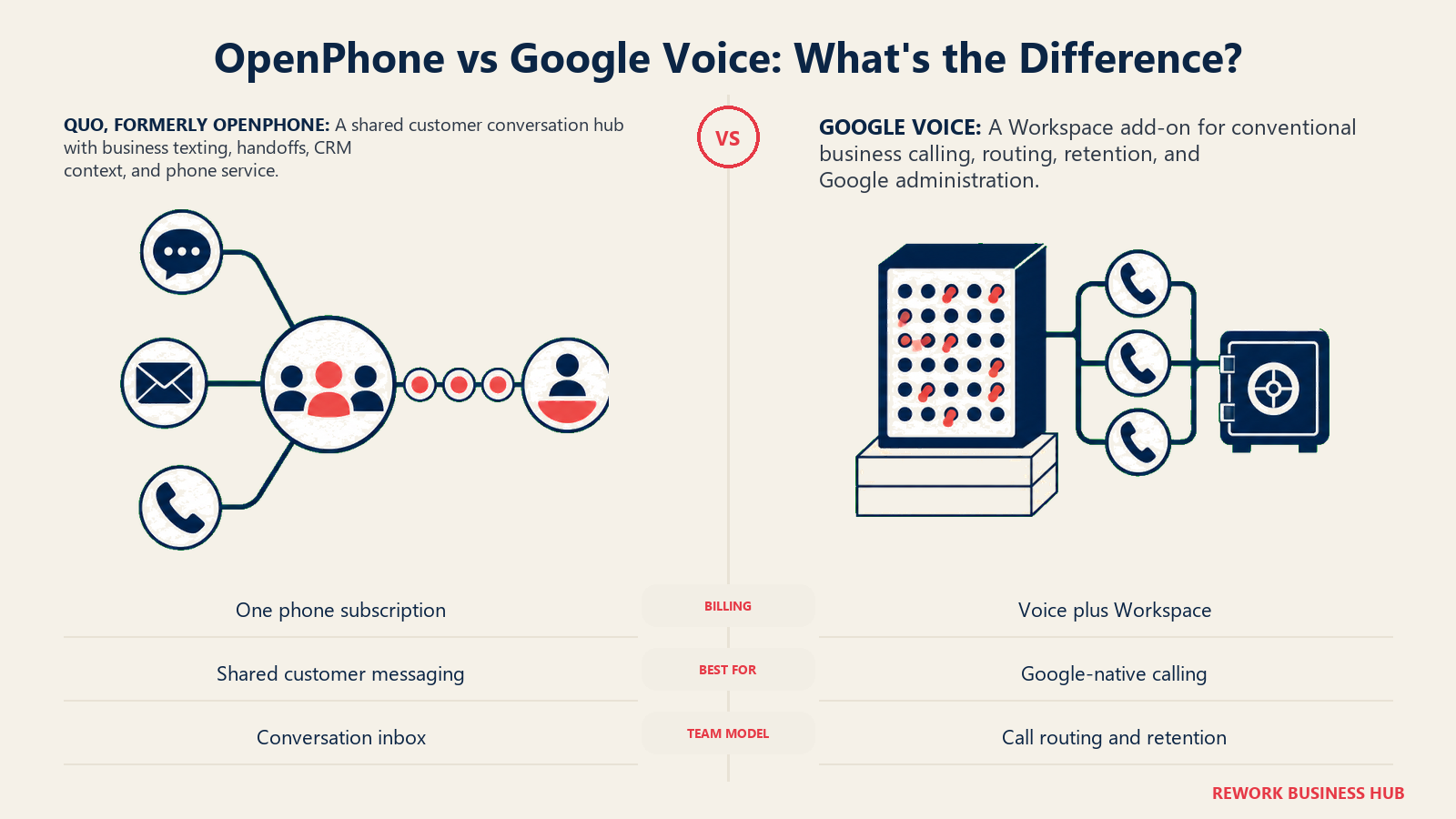
Two facts break that framing before you get to features. First, OpenPhone doesn't exist under that name any more. On 23 September 2025 the company announced it had renamed itself to Quo, alongside $105 million in growth financing (PRNewswire release). Same product, same team, new name. Type openphone.com/pricing into a browser today and you land on quo.com/pricing, where the header reads "Quo (formerly OpenPhone)". Second, Google Voice's famous $10 is not the bill. For a team, a Voice licence is an add-on, and Google's own admin documentation states plainly that "Your organization needs Google Workspace before you can buy a Voice add-on subscription" (Google Workspace Help). That's two line items per seat, not one.
Once you count both line items, the cheapest real Google Voice seat for a team is $17 per user per month, and Quo's entry tier is $15. The price advantage most buyers assume they're getting from Google turns out to run the other way. That doesn't settle the decision, because these two products are genuinely different shapes and each one wins clearly in places the other doesn't reach. But it does mean the comparison has to start with real arithmetic rather than headline numbers. If you want the wider field before narrowing to these two, start with our best business phone system roundup for 2026.
TL;DR
| Quo (formerly OpenPhone) | Google Voice | |
|---|---|---|
| Current name | Quo, renamed from OpenPhone on 23 September 2025 | Google Voice, unchanged |
| Entry price as advertised | $15/user/mo billed annually ($180/yr), $19/user/mo monthly | $10/user/mo (Starter) |
| What the entry price actually buys | A complete phone system, one line item | A Voice licence only. A paid Google Workspace subscription is required on top |
| Cheapest realistic team seat, all in | $15/user/mo annual | $17/user/mo (Voice Starter $10 + Workspace Business Starter $7.00) |
| Entry-tier user cap | No published minimum or maximum on the plan sheet | Voice Starter is capped at 10 users |
| Calling claim | "Unlimited* Calling (US & Canada)", asterisk reads "Subject to our Fair Usage Policy" | "Unlimited domestic calling" |
| Texting claim | "Unlimited* Messaging (US & Canada)", same fair-use asterisk | "Unlimited US texting", but Google's help says messaging "is intended only for 1:1, personal conversations" |
| Group texting | Group calling and shared numbers are core to the product | Up to 7 names or numbers per group text, 8 participants including the sender |
| AI on the entry tier | Yes. Sona AI agent and 1,000 automation credits from Starter | No. AI note-taking requires Voice Standard or Premier |
| CRM integrations | HubSpot and Salesforce native from Business ($23/user/mo annual) | Not listed on the Voice plan pages |
| Standout strength | Shared numbers, team inbox, AI agent, and a documented A2P 10DLC path for business texting | Google Vault, eDiscovery, BigQuery reporting, and 24/7 support from the entry tier |
| Best for | Teams where the phone number is a shared customer channel worth staffing | Google-native orgs that need compliant call handling, not a texting or CRM workflow |
Key Facts
- Google's own Workspace admin documentation states the prerequisite in one sentence: "Your organization needs Google Workspace before you can buy a Voice add-on subscription", per Google Workspace Help. The Voice licence is never the whole bill for a team.
- Google Voice's messaging help page sets the intended use explicitly: "Google Voice messaging is intended only for 1:1, personal conversations. It is not intended for bulk messaging, which can result in messages being flagged as spam and blocked", and caps a group text at 7 added names or numbers, per Google Voice Help.
- Americans exchanged nearly 2.2 trillion texts in 2024, an increase of 42 billion SMS and MMS messages year over year, according to the CTIA 2025 Annual Survey published 8 September 2025. Texting is not a side channel for most small businesses any more.
- Eight in ten Americans say they don't generally answer a cellphone call from an unknown number, and only 19% of U.S. adults say they do, from a Pew Research Center survey of 10,211 adults fielded 13 to 19 July 2020. It's the clearest published reason a business number needs a texting fallback, not just a dial tone.
- FCC rules require carriers to complete a simple wireline-to-wireline or simple intermodal port request within one business day unless the customer or the new provider asks for longer, under 47 CFR 52.35. Any vendor quoting you weeks for a straightforward port is describing its own queue, not a regulatory floor.
The Two Asterisks You Have to Clear Before Anything Else
Both products are known for something that's only about two thirds true, and both half-truths sit exactly where the money is.
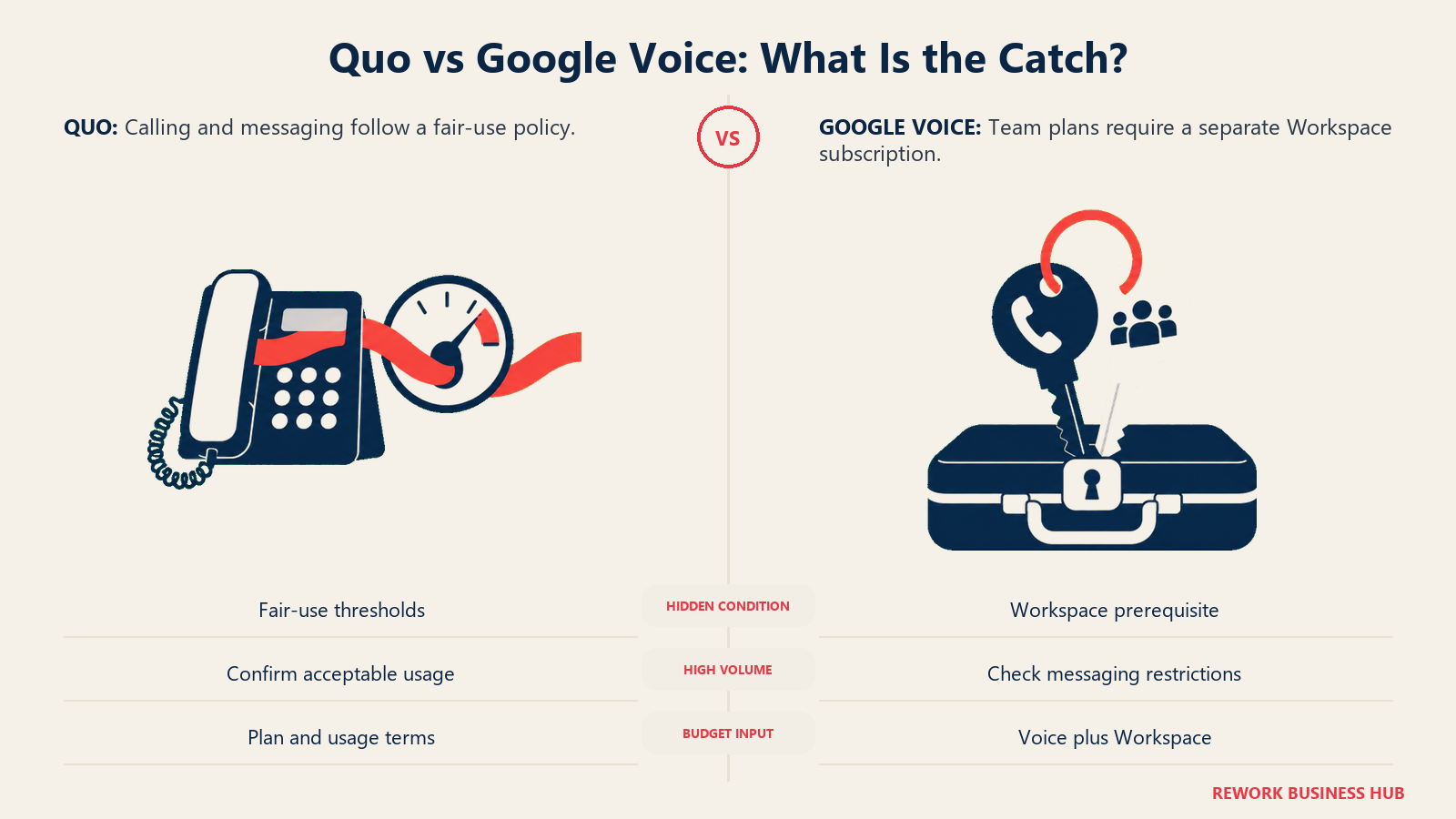
Quo's marketing runs on the word unlimited. Every tier on quo.com/pricing advertises "Unlimited* Calling (US & Canada)" and "Unlimited* Messaging (US & Canada)", and the asterisk resolves to "Subject to our Fair Usage Policy". That's not a scandal, it's how nearly every flat-rate telecom product is built, and for a normal team making normal calls it will never bite. But don't design a high-volume outbound calling or blast-texting operation on the assumption that a $15 seat has no ceiling. If your use case is closer to a dialler than a phone system, get the fair-use thresholds in writing, and look at the best SMS marketing software for 2026 instead.
Google Voice's asterisk is bigger, and Google doesn't print it with a star. The $10 Starter tier is real, but for a business it's an add-on to a Workspace subscription you must already hold. There is a genuinely standalone $10 Voice Starter and a standalone $20 Voice Standard that skip Workspace, but they are US-only and support exactly one user each, per Google Voice Help. A one-person consultancy can use that. A four-person team cannot. The moment you're buying for a team, you're buying two things per seat.
| The label you've probably got in your head | What the vendor page actually says |
|---|---|
| "OpenPhone" | Quo. Renamed 23 September 2025 alongside $105M in growth financing. openphone.com/pricing redirects to quo.com/pricing |
| "OpenPhone has unlimited calling and texting" | "Unlimited* Calling (US & Canada)" and "Unlimited* Messaging (US & Canada)", asterisk: "Subject to our Fair Usage Policy" |
| "Google Voice is $10 a seat" | $10 is the Voice licence. "Your organization needs Google Workspace before you can buy a Voice add-on subscription" |
| "You can get Google Voice without Workspace" | True, but the standalone Starter and Standard plans are US-only and cap at one user each |
| "Google Voice Starter scales with the team" | Voice Starter is capped at 10 users. Past that you're on Standard at $20 plus Workspace |
| "Google Voice does unlimited US texting" | The plan sheet says so, and the help centre says messaging "is intended only for 1:1, personal conversations. It is not intended for bulk messaging" |
Quo's Plan Ladder
Quo (formerly OpenPhone) publishes three tiers with both an annual and a month-to-month rate, and no published minimum user count. The annual rate is what the pricing page shows by default, so read carefully when a rep quotes you a number.
| Plan | Annual rate | Billed annually at | Month-to-month rate | What it adds |
|---|---|---|---|---|
| Starter | $15/user/mo | $180/yr per user | $19/user/mo | One number (local or toll-free) per user, calling and messaging to US and Canadian numbers subject to fair use, voicemail transcripts, the Quo API, Sona AI agent, ChatGPT and Claude MCP, 1,000 automation credits, email ticket support |
| Business | $23/user/mo | $276/yr per user | $33/user/mo | Everything in Starter plus AI call summaries and transcripts, group calling, custom ring orders, call transfers, HubSpot and Salesforce integrations, phone menus, analytics and reporting, auto call recording, live chat support |
| Scale | $35/user/mo | $420/yr per user | $47/user/mo | Everything in Business plus AI call tags, dedicated onboarding, priority live chat and email support, inbound phone support |
Two structural details matter more than the tier names. Extra phone numbers beyond the one included per user run $5 per month each, so a team that wants a departmental main line, a support number and a sales number is adding line items on top of seats. And shared-number capacity is gated: Starter supports up to 10 paid users on a shared number, while Business and Scale support unlimited paid users. If the whole reason you're buying is that four people need to work one inbound number together, Starter covers you until the eleventh person joins.
The jump from Starter to Business at $23/user/mo annual is where Quo stops being a nicer personal line and starts being a team system: phone menus, call transfers, analytics, auto call recording, and the native HubSpot and Salesforce connectors all live there. For most teams comparing against Google Voice Standard, Business is the honest comparison point, not Starter.
Google Voice's Plan Ladder
Google Voice has three add-on tiers. The prices below are the Voice licence only. Every one of them assumes a paid Workspace subscription underneath, and the next section prices that.
| Plan | Voice licence | User cap | What it adds |
|---|---|---|---|
| Starter | $10/user/mo | Up to 10 users | One number per user, unlimited domestic calling, unlimited US texting, voicemail transcription, three-way calling, call transfers, desk phone and ATA support, 24/7 Google Voice support |
| Standard | $20/user/mo | Unlimited users | Everything in Starter plus auto attendants, ring groups, call queuing, call delegation, custom hold audio, on-demand call recording, AI note-taking, eDiscovery for calls, voicemails and texts, SIP Link, unlimited regional billing locations |
| Premier | $30/user/mo | Unlimited users | Everything in Standard plus automatic call recording, Google Vault, advanced reporting via BigQuery export, unlimited international billing locations |
One wording discrepancy worth knowing before a sales call. Google's consumer-facing Voice product page lists "easy call recording" among the Starter bullets, while Google's own admin comparison for the paid add-ons names on-demand call recording at Standard and automatic call recording at Premier. If recording is a requirement, get it confirmed against the tier you're actually buying rather than the marketing bullet.
The Starter cap is the detail that catches most growing teams. Ten users is a real ceiling, not a soft one, and crossing it means moving to Standard at $20 per user per month. That's a doubling of the Voice line item, on top of the Workspace line item you're already paying, triggered by hiring one person.
What a Google Workspace Licence Actually Costs
This is the table nobody publishes next to a Google Voice comparison, and it's the one that decides the whole question. These are the standard per-user rates displayed on Google's own Workspace pricing page.
| Google Workspace plan | Standard rate shown | Promotional rate currently on the page |
|---|---|---|
| Business Starter | $7.00 USD per user / month | $3.50 (50% off), first 12 months |
| Business Standard | $14.00 USD per user / month | $8.40 (40% off), first 12 months |
| Business Plus | $22 / user per month | No discount shown |
| Enterprise | "Let's talk", contact sales | Not published |
Read the promotional column carefully and then set it aside for budgeting. Google's own disclaimer on that page states: "Offer available to new Google Workspace customers only. This introductory price is only available for the first 20 users added, for 12 months. Standard pricing will apply to all users after 12 months." A first-year quote built on $3.50 seats is a first-year quote. Year two is $7.00, and if you're above 20 users the discount never applied to the extra seats in the first place. Budget against the standard column.
If your company already pays for Workspace for email and Docs, that cost is sunk and Voice really is a $10 to $30 incremental line. That's the scenario where Google Voice's economics look great, and it's a common scenario. If you don't already run Workspace, or if you were planning to count Voice as your total communications spend, the sunk-cost logic disappears and both line items are new money.
All-In Cost Per Seat
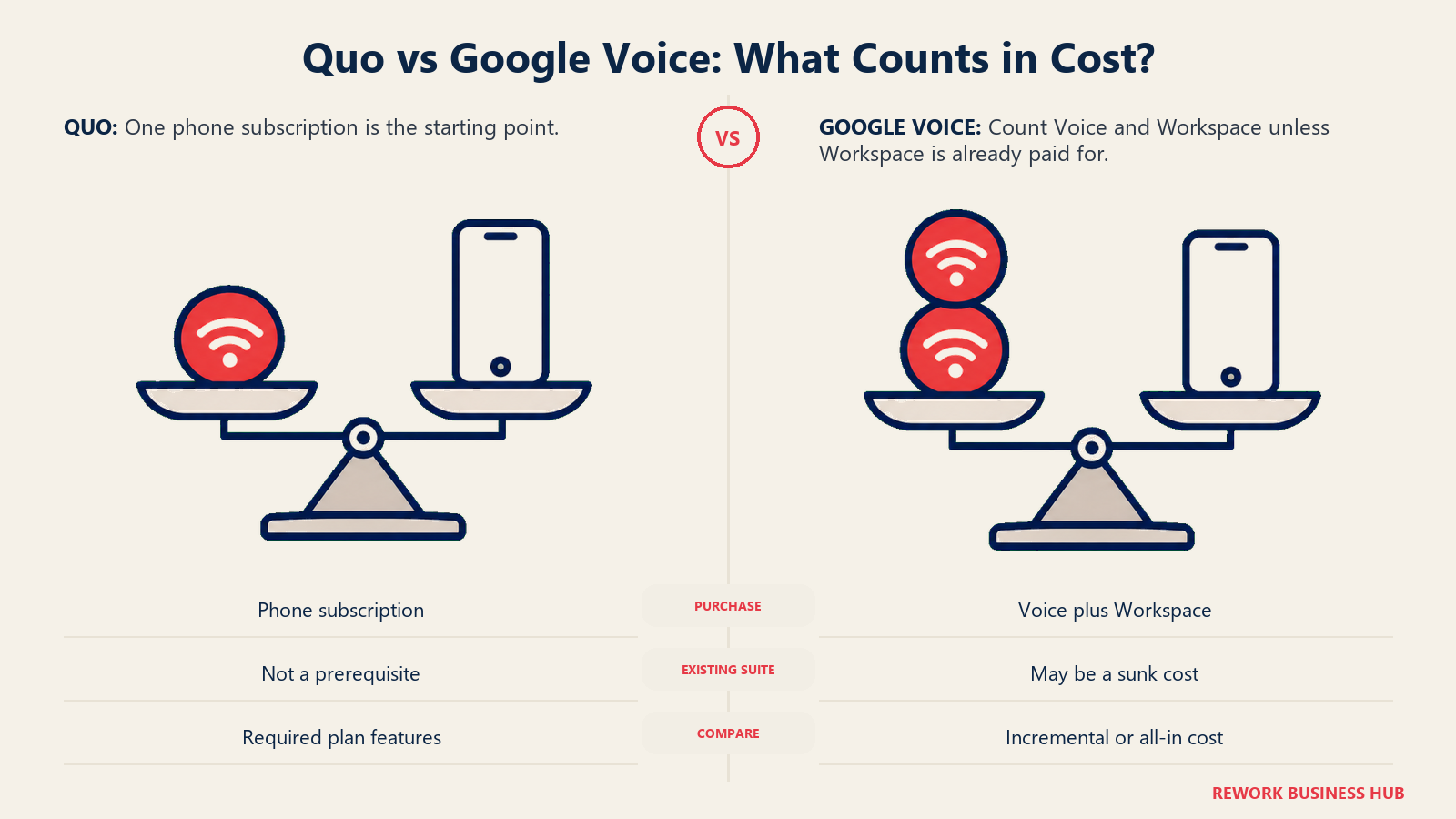
Here is the arithmetic that the two pricing pages never do for you. Every Google Voice row below adds the Voice licence to the required Workspace licence.
| Configuration | Voice or Quo licence | Workspace licence | All-in per user per month |
|---|---|---|---|
| Quo Starter, annual | $15 | Not applicable | $15 |
| Google Voice Starter + Workspace Business Starter | $10 | $7.00 | $17 |
| Quo Business, annual | $23 | Not applicable | $23 |
| Google Voice Starter + Workspace Business Standard | $10 | $14.00 | $24 |
| Google Voice Standard + Workspace Business Starter | $20 | $7.00 | $27 |
| Google Voice Standard + Workspace Business Standard | $20 | $14.00 | $34 |
| Quo Scale, annual | $35 | Not applicable | $35 |
| Google Voice Premier + Workspace Business Standard | $30 | $14.00 | $44 |
| Google Voice Premier + Workspace Business Plus | $30 | $22 | $52 |
The headline result is the one nobody expects: the cheapest genuinely usable Google Voice team seat costs more than Quo's entry tier. $17 against $15. And the gap widens fast, because Voice Starter caps at 10 users while Quo's Starter carries no published user cap on the plan sheet, so an eleventh hire moves Google to a $27 all-in seat while Quo stays at $15.
There is one important exception. If you already pay for Workspace and would keep paying for it whether or not you bought a phone system, the honest incremental comparison is $10 against $15, and Google wins on price at the entry tier. Which number is right for you depends entirely on whether Workspace is a decision you're making now or one you made years ago.
Annual Cost at 5, 10 and 25 Seats
Same math, annualised, at the three team sizes where this comparison is actually fought. All Quo figures use the annual rate; all Google figures use standard Workspace pricing, not the introductory discount.
| Configuration | 5 seats | 10 seats | 25 seats |
|---|---|---|---|
| Quo Starter, annual ($15/user/mo) | $900/yr | $1,800/yr | $4,500/yr |
| Google Voice Starter + Workspace Business Starter ($17/user/mo) | $1,020/yr | $2,040/yr | Not available, Voice Starter caps at 10 users |
| Quo Business, annual ($23/user/mo) | $1,380/yr | $2,760/yr | $6,900/yr |
| Google Voice Standard + Workspace Business Starter ($27/user/mo) | $1,620/yr | $3,240/yr | $8,100/yr |
| Google Voice Standard + Workspace Business Standard ($34/user/mo) | $2,040/yr | $4,080/yr | $10,200/yr |
| Quo Scale, annual ($35/user/mo) | $2,100/yr | $4,200/yr | $10,500/yr |
| Google Voice Premier + Workspace Business Standard ($44/user/mo) | $2,640/yr | $5,280/yr | $13,200/yr |
At 25 seats the comparison that most teams should actually run is Quo Business at $6,900 a year against Google Voice Standard plus Workspace Business Starter at $8,100 a year. Those two configurations are roughly feature-comparable on call handling, and Quo comes in about $1,200 a year cheaper while also including AI call summaries and native CRM connectors that Google Voice doesn't list at any tier.
Flip it and Google's case appears at the top end. If you need Google Vault retention, eDiscovery across calls, voicemails and texts, and BigQuery reporting, Quo has no equivalent SKU at any price, so the $13,200 Premier configuration isn't expensive, it's the only one of the two that does the job at all.
If your seat count is heading well past 25 and you want a broader field, our best OpenPhone alternatives guide covers what teams move to when Quo stops fitting, and RingCentral vs Nextiva covers the tier above that.
Core Telephony Feature Parity
Set price aside and compare the plumbing. The comparison below reads each vendor's own published plan sheets.
| Capability | Quo Starter | Quo Business | Google Voice Starter | Google Voice Standard | Google Voice Premier |
|---|---|---|---|---|---|
| All-in per user per month | $15 annual | $23 annual | $17 with Workspace Business Starter | $27 with Workspace Business Starter | $44 with Workspace Business Standard |
| Domestic calling | Unlimited, subject to Fair Usage Policy | Unlimited, subject to Fair Usage Policy | Unlimited domestic | Unlimited domestic | Unlimited domestic |
| Numbers included | One local or toll-free number per user | One per user, extras at $5/mo | One per user | One per user | One per user |
| Voicemail transcription | Yes | Yes | Yes | Yes | Yes |
| Call transfers | Not at this tier | Yes | Yes | Yes | Yes |
| Auto attendant or phone menu | Not at this tier | Yes, phone menus | Not at this tier | Yes, auto attendants | Yes |
| Ring groups and call queuing | Group calling at Business | Yes, group calling and custom ring orders | Not at this tier | Yes, ring groups and call queuing | Yes |
| Call recording | Not at this tier | Auto call recording | Marketing page lists "easy call recording", admin comparison does not | On-demand | Automatic |
| Desk phone and ATA support | Not published on the plan sheet | Not published on the plan sheet | Yes | Yes | Yes |
| Analytics and reporting | Not at this tier | Yes | Not at this tier | Not at this tier | Advanced reporting via BigQuery |
| International calling | Rates apply beyond US and Canada | Rates apply beyond US and Canada | Yes | Yes, unlimited regional billing locations | Yes, unlimited international billing locations |
Two honest readings. Google Voice's Starter tier does more basic telephony out of the box than Quo's Starter does: call transfers and desk phone support are there on day one, while Quo makes you climb to Business for transfers. But Google puts the entire team-routing layer, auto attendants, ring groups and queuing, behind Standard, where the all-in price jumps to $27. Quo puts the equivalent layer at $23. The sequence in which each vendor unlocks capability is almost inverted, so which one feels cheaper depends on which feature you hit first.
Texting and MMS: The Section That Decides It for Most Teams
Both products advertise unlimited texting. They mean very different things by it, and this is where the comparison usually stops being close.
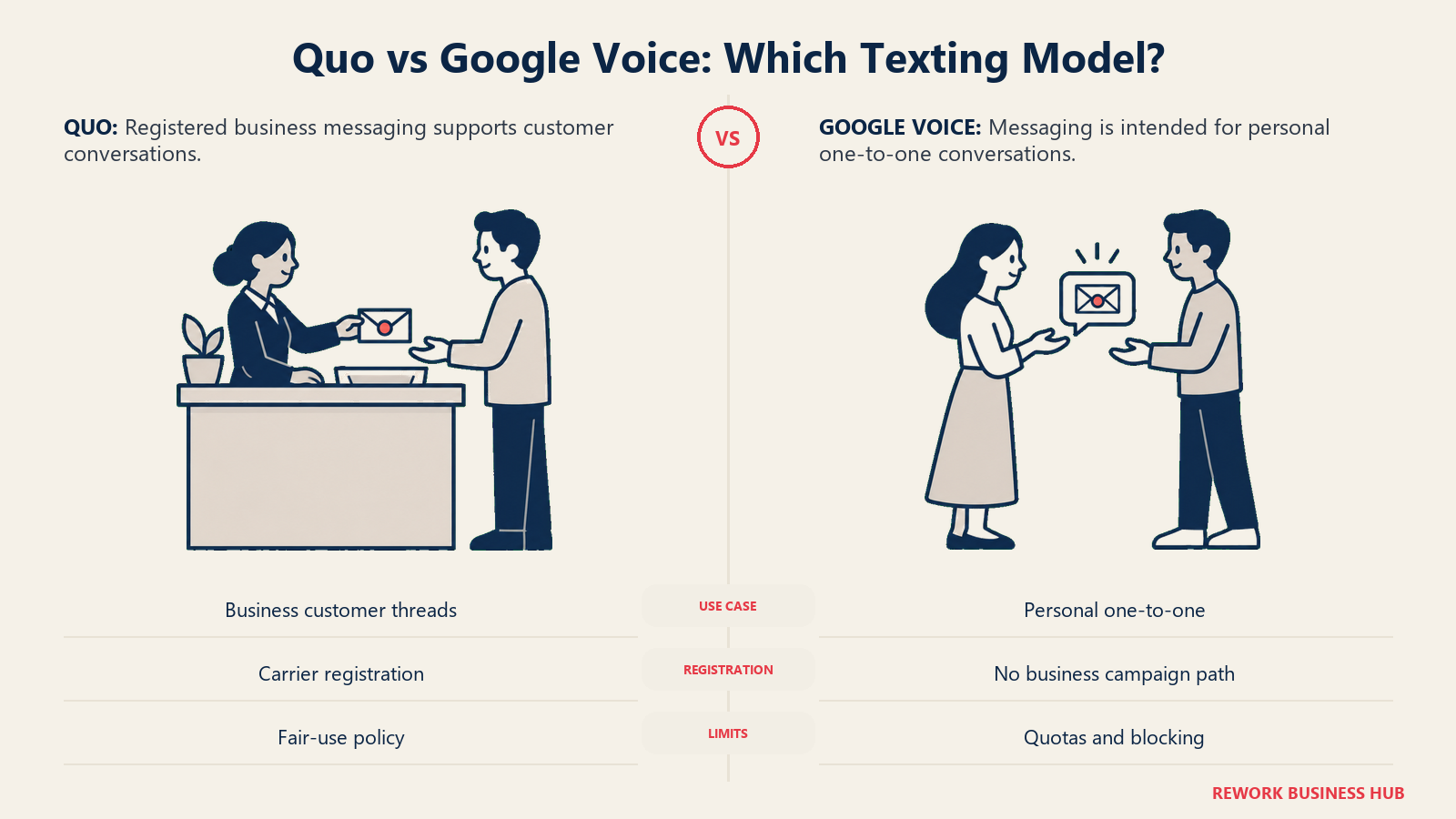
Quo (formerly OpenPhone) advertises "Unlimited* Messaging (US & Canada)" on all three tiers, with the asterisk resolving to "Subject to our Fair Usage Policy". Critically, Quo also runs a documented A2P 10DLC carrier registration process, which is the mechanism US carriers require before they'll reliably deliver business texts. Quo's support centre states that "As of August 31, 2023, unregistered numbers cannot text US phone numbers. Registration is mandatory for all virtual phone number users", that every Quo customer texting US numbers needs to register, and that most approvals land in 24 to 48 hours though some have pended for up to 20 days. Registration carries real fees: a one-time $19.50 to the registry, then $1.50 per month for most organisations or $2.00 for sole proprietors, with a $15 resubmission fee if you're rejected.
Google Voice takes the opposite position, and states it in its own help centre rather than in fine print. The messaging documentation reads: "Google Voice messaging is intended only for 1:1, personal conversations. It is not intended for bulk messaging, which can result in messages being flagged as spam and blocked." Group texts are capped at 7 added names or phone numbers, for 8 participants including the sender. And there's a documented throttle: "If you exceed your quota, your messages are blocked. You'll get an error message: 'Message not delivered. You've sent too many messages.'"
| Texting capability | Quo (formerly OpenPhone) | Google Voice |
|---|---|---|
| Headline claim | "Unlimited* Messaging (US & Canada)" | "Unlimited US texting" |
| The asterisk | "Subject to our Fair Usage Policy". Never read this as uncapped | No asterisk, but the help centre restricts intended use to 1:1 personal conversations |
| Stated intended use | Business messaging, including shared team texting | "not intended for bulk messaging, which can result in messages being flagged as spam and blocked" |
| Group message size | Group calling and shared inboxes are core product features | Up to 7 added names or numbers, 8 participants including the sender |
| A2P 10DLC registration | Documented and mandatory. $19.50 one-time, then $1.50/mo (or $2.00 sole proprietor), 24 to 48 hours typical, up to 20 days observed | Not documented as a registration flow on Google's Voice pages |
| Behaviour while registration pends | Outbound texts to US numbers cannot be sent until approved | Not applicable |
| Volume throttle | Fair-use policy, thresholds not published on the pricing page | "You've sent too many messages" error once quota is exceeded |
| Canada texting | Included in the US and Canada allowance | Not part of the published US texting claim |
The practical translation: if texting customers is part of how your business runs, appointment reminders, quotes, dispatch updates, delivery notices, two-way support, Quo is built for it and Google Voice's own documentation tells you it isn't. That's not a knock on Google. It's Google being unusually clear about scope. Treat it as scope guidance and you'll avoid a very expensive discovery three months into a rollout.
If texting is more than a side channel and you're really shopping for outbound campaign capability rather than a phone system, neither of these is your product. Look at SMS marketing software instead.
Shared Numbers and Team Inboxes
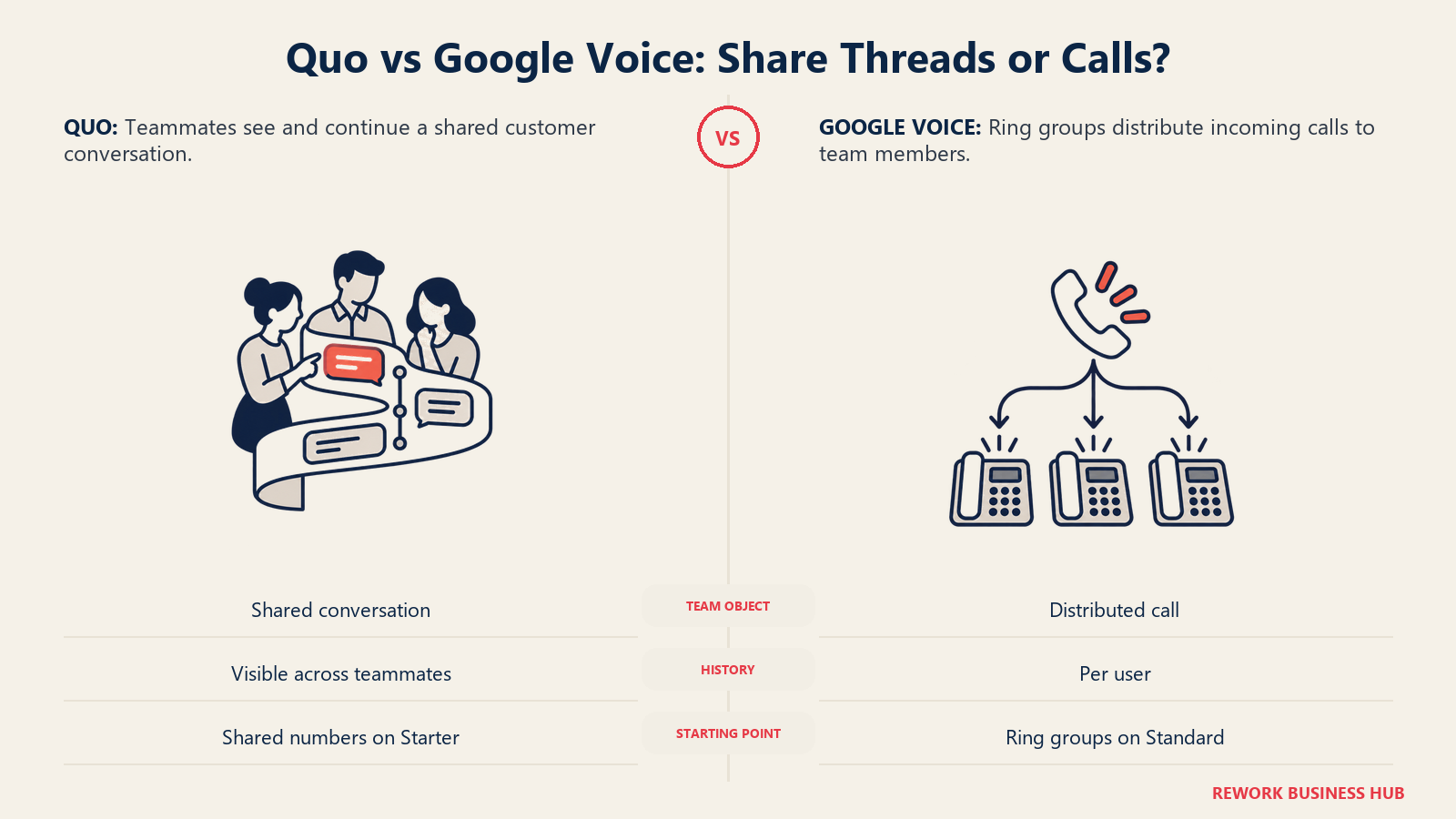
This is Quo's actual product thesis, and it's the reason people who use it evangelise it. A phone number is treated as a shared object that multiple teammates work together, with visible conversation history, rather than a private line that rings on one person's phone.
| Behaviour | Quo (formerly OpenPhone) | Google Voice |
|---|---|---|
| Shared number model | Core concept. Multiple teammates work one number | Ring groups distribute an inbound call to a set of users, from Standard |
| Shared-number user limit | Starter: up to 10 paid users. Business and Scale: unlimited paid users | Ring group membership, tier-gated to Standard and above |
| Shared texting inbox | Yes, part of the shared-number model | Not listed on Google's Voice feature comparison |
| Call delegation | Group calling, custom ring orders and call transfers from Business | Call delegation from Standard |
| Call queuing | Not named on the plan sheet | Yes, from Standard |
| Custom hold audio | Not named on the plan sheet | Yes, from Standard |
| Conversation history visibility | Shared across the team on a shared number | Per user |
| Where the entry tier lands you | Starter already supports a shared number for up to 10 people | Starter has no ring groups, queuing or delegation at all |
The split is clean. Google Voice's team features are call-distribution features: get the ringing phone to the right person. Quo's are conversation features: let several people see and continue the same thread with a customer. If your problem is "calls ring the wrong desk," Google Voice Standard solves it. If your problem is "three people all text this customer and nobody knows what the others said," Google Voice doesn't address it at any tier. Teams whose real problem is inbound conversation volume beyond voice should also look at help desk software, which handles shared queues, assignment and SLAs at a depth neither phone product attempts.
Integrations and CRM Depth
| Integration | Quo (formerly OpenPhone) | Google Voice |
|---|---|---|
| HubSpot | Native, from Business ($23/user/mo annual) | Not listed on the Voice plan pages |
| Salesforce | Native, from Business | Not listed on the Voice plan pages |
| Zoho CRM | Listed on Business and Scale | Not listed |
| Zapier and Make | Listed on Business and Scale | Not listed |
| Public API | Quo API, from Starter | Not listed on the Voice plan pages |
| MCP for AI assistants | ChatGPT and Claude MCP, from Starter | Not listed |
| Google Calendar and Meet | Not the product's centre of gravity | Native, part of Workspace |
| SIP Link for existing carrier numbers | Not published | Yes, from Standard |
| Data warehouse export | Not published | BigQuery export, Premier only |
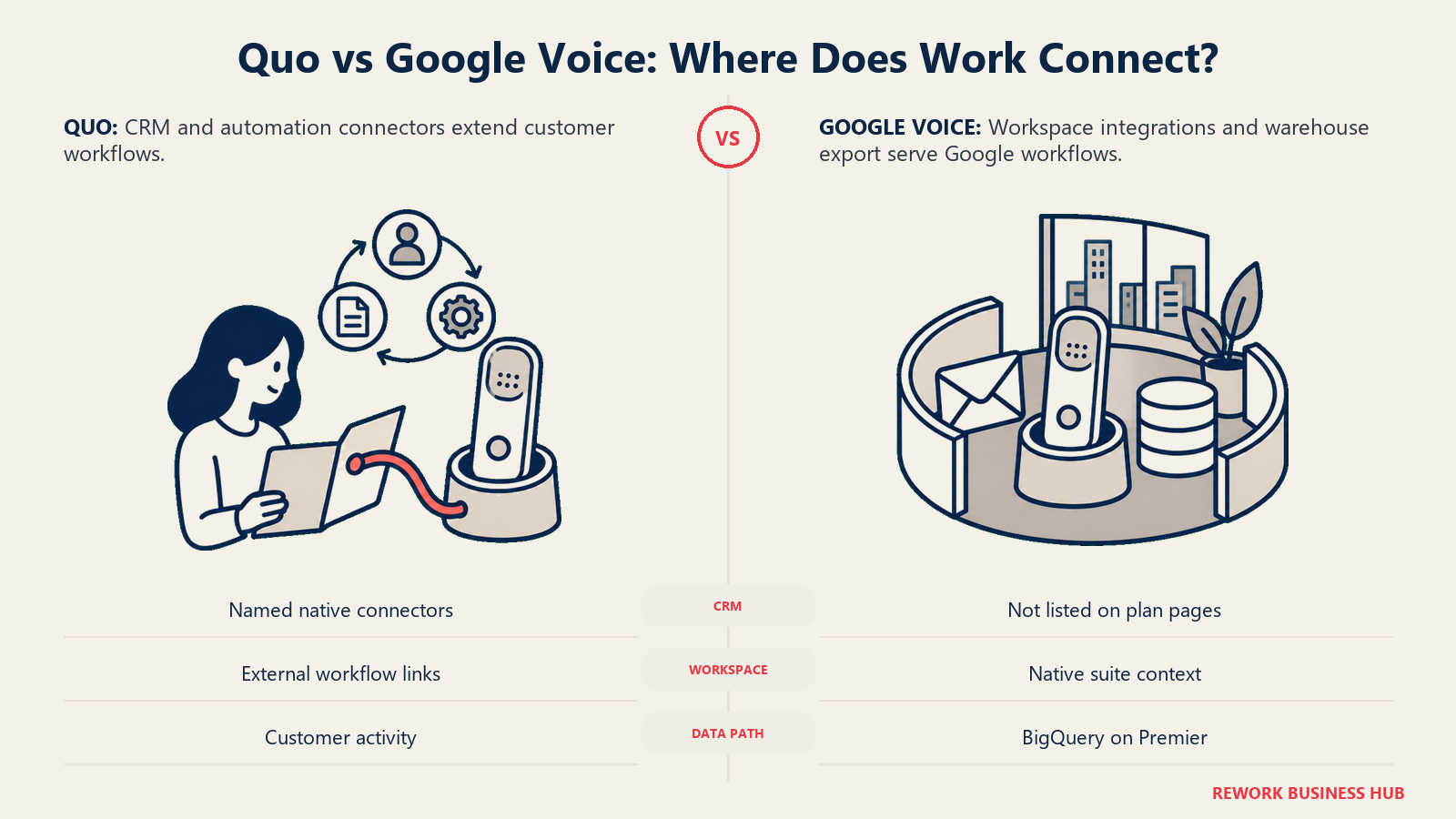
Quo's integration story points outward: it wants to sit next to your CRM and your automation layer. Google Voice's points inward: it wants to sit inside Workspace and, at the top tier, hand its call data to BigQuery. A sales team that needs call activity logged against deal records will find Quo's Business tier does that natively with no published Google equivalent. A data team that wants every call record queryable in a warehouse will find the reverse.
If CRM logging is the deciding factor, the CRM you pick matters as much as the phone system. Our best CRM software roundup for 2026 covers which platforms have the deepest native telephony hooks.
AI Features
Both vendors now ship AI. They ship it at very different points in the price ladder, and that difference is worth more than the feature lists suggest.
| AI capability | Quo (formerly OpenPhone) | Google Voice |
|---|---|---|
| Cheapest tier with any AI | Starter, $15/user/mo annual | Voice Standard, $27/user/mo all-in with Workspace Business Starter |
| AI voice agent | Sona AI agent, included from Starter | Not offered |
| Automation credits | 1,000 free credits on every plan. The pricing page states 1 call = 100 credits | Not applicable |
| Call transcripts | AI call summaries and transcripts, from Business | Included with AI note-taking, Standard and Premier |
| Call summaries | From Business | Gemini-generated summary with key points and action items, delivered via Gmail |
| Automatic tagging | AI call tags, Scale only | Not offered |
| Where notes are delivered | In-app | Emailed via Gmail and stored in the Voice app |
| Language support | Not restricted on the plan sheet | English only at launch |
| Availability date | Sona included at launch of the Quo rebrand | AI note-taking began rolling out 16 June 2026 |
Google's AI note-taking is genuinely good and genuinely new. It was announced on 16 June 2026 for "all Google Workspace customers with Voice Standard and Voice Premier add-ons, as well as customers with Voice Standard standalone plans", and Google notes "This feature is only available in English at this time." Tap Notes during a call and Gemini records, transcribes, summarises key points and organises action items, then emails you the result.
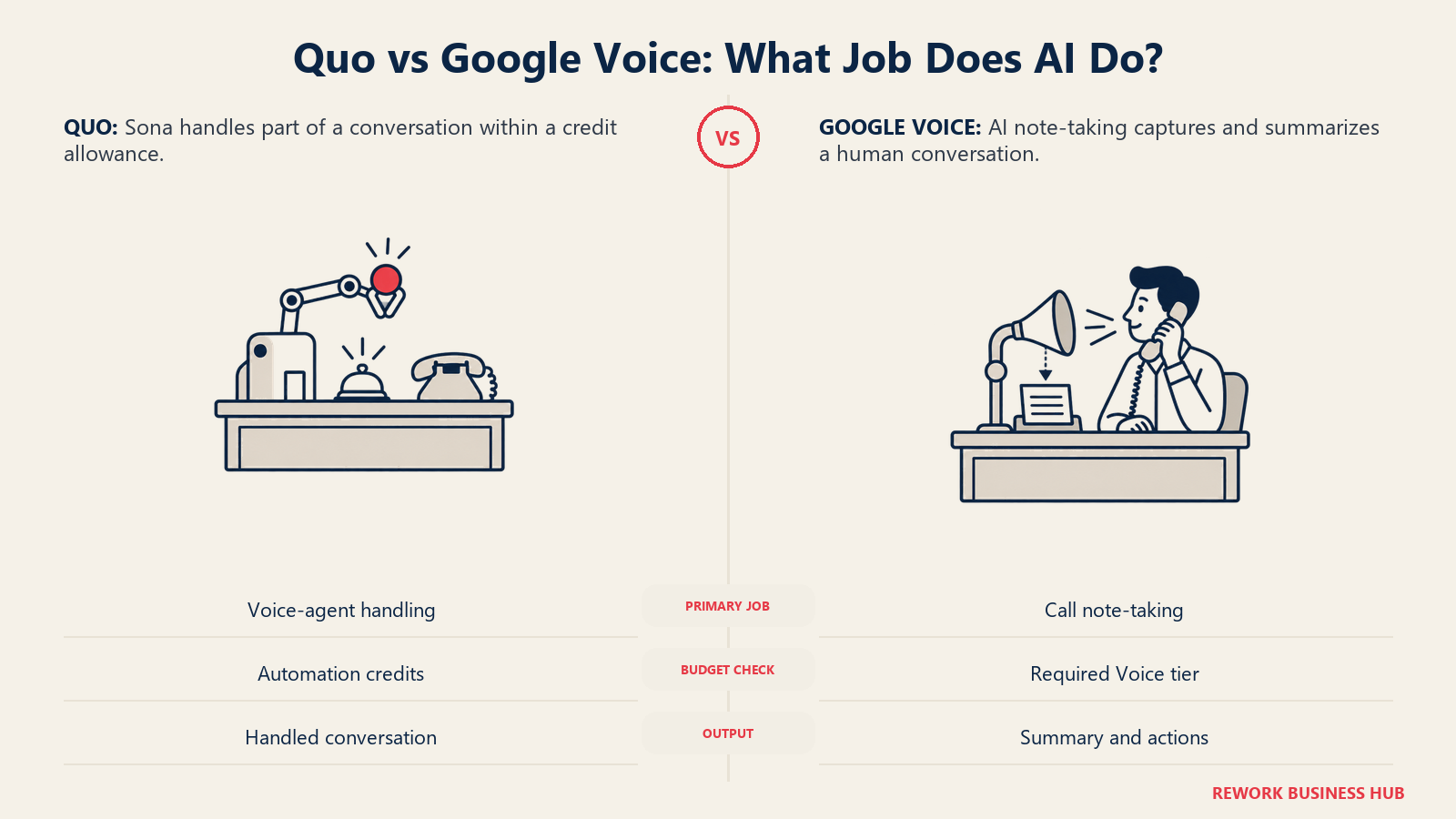
The catch is the tier. Reaching it needs Voice Standard, which means $20 for Voice plus at least $7.00 for Workspace, so $27 per user per month all in. Quo includes its Sona AI agent from the $15 Starter tier. That's a $12-per-seat-per-month difference to reach the first rung of AI, and the two products aren't doing the same job anyway: Google's is a note-taker that runs after a conversation, Quo's is an agent meant to handle part of one.
Read the credit arithmetic before you build anything on Sona. Quo's pricing page states 1,000 free automation credits are included on every plan and that 1 call = 100 credits, roughly ten agent-handled calls before the pool is spent. Ask what credits cost past that, in writing, before you route real inbound volume through it. If an autonomous voice agent is the actual purchase rather than a bonus, evaluate it as its own category using our best AI voice agents roundup for 2026.
Porting and Number Management
| Porting or number task | Quo (formerly OpenPhone) | Google Voice |
|---|---|---|
| Porting cost | Free porting, stated on the pricing page | Not published as a separate fee |
| Numbers per user included | One local or toll-free number | One number |
| Additional numbers | $5 per month each | Additional numbers are not a published plan option |
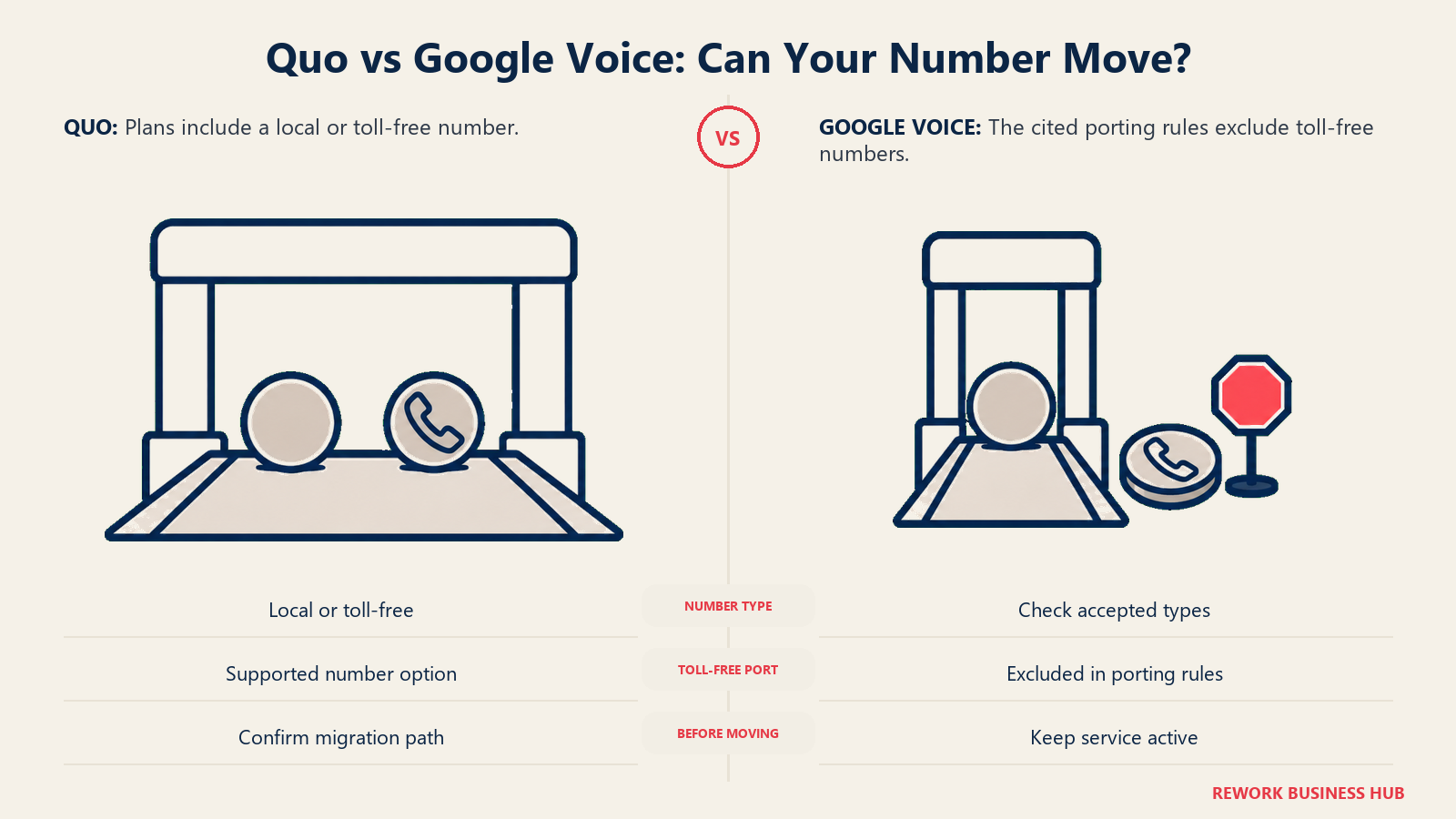
| Toll-free numbers | Starter includes one local or toll-free number per user | Google's own porting doc lists toll-free numbers among those that cannot be ported |
| Bulk port limit | Not published | Up to 1,000 numbers at a time (50 in Canada) |
| Same-carrier requirement | Not published | All numbers in a single request must come from the same service provider |
| Number range handling | Not published | Numbers belonging to a range must be ported together in one request |
| Risk during port | Standard industry guidance applies | Google warns service must remain active during the port or you can lose the number |
| Regulatory floor | Simple ports: one business day under 47 CFR 52.35 | Simple ports: one business day under 47 CFR 52.35 |
The toll-free row is the one to check against your own situation, because it's a hard blocker rather than a preference. Google's admin documentation on number porting requirements for Google Voice explicitly lists toll-free numbers among number types that cannot be ported in. If your business has advertised an 800 number on vans, packaging or signage for a decade, that number cannot follow you into Google Voice. It can follow you into Quo, where Starter includes one local or toll-free number per user.
The other row worth acting on is the FCC floor. Simple ports are a one-business-day obligation, not a favour. If a vendor's onboarding team quotes you three weeks for a single-line port, that's their process, and it's a fair thing to push back on.
Admin, Compliance and Support
| Area | Quo (formerly OpenPhone) | Google Voice |
|---|---|---|
| Entry-tier support channel | Email ticket support on Starter | 24/7 access to Google Voice Support, named from Starter |
| Mid-tier support | Live chat support from Business | Same 24/7 support, no tiering published |
| Top-tier support | Priority live chat and email, inbound phone support, dedicated onboarding on Scale | Same 24/7 support |
| Legal hold and retention | Not published | Google Vault, Premier only |
| eDiscovery | Not published | eDiscovery for calls, voicemails and texts, from Standard |
| Audit and activity reporting | Analytics and reporting from Business | Advanced reporting via BigQuery export, Premier only |
| Identity and access management | Not published on the plan sheet | Inherits Google Workspace admin, SSO and device policy |
| Regional and international billing locations | Not published as a tiered feature | Unlimited regional at Standard, unlimited international at Premier |
| Where it wins | Faster human support as you climb tiers, plus onboarding help | Compliance and governance depth, plus 24/7 support from the cheapest tier |
Google's advantage here is real and under-discussed. Round-the-clock support named on a $10 Voice licence is unusual at this price point, and the compliance stack (eDiscovery at Standard, Vault and BigQuery at Premier) has no counterpart in Quo's published plans. If your legal team has ever asked you to preserve communications for a matter, that should probably decide the whole comparison on its own. Quo's counter is that its support gets more human as you pay more: email tickets at Starter, live chat at Business, priority chat plus inbound phone support and dedicated onboarding at Scale. For a small team without an IT function, being able to phone your phone vendor has genuine value.
When Quo (Formerly OpenPhone) Is the Right Call
- Texting customers is part of the job, not an afterthought. Quo runs a documented A2P 10DLC registration path with published fees and timelines, which is what US carriers require for business messaging. Google Voice's own help centre says its messaging "is intended only for 1:1, personal conversations." That single sentence disqualifies Voice for a large slice of small-business use cases, and it's Google saying it, not a competitor.
- Several people need to work one number together. Shared numbers with a visible team inbox are Quo's core design, available for up to 10 paid users on Starter and unlimited on Business and Scale. Google Voice distributes calls with ring groups from Standard but doesn't publish a shared texting inbox at any tier.
- You don't already pay for Google Workspace. Then the real comparison is $15 against $17 all in at the entry tier, and Quo is both cheaper and less complicated to buy. The gap grows the moment you pass Voice Starter's 10-user cap.
- You need call activity in HubSpot or Salesforce. Quo lists both as native integrations from the $23 Business tier, plus Zapier, Make, Zoho CRM, a public API from Starter, and MCP connectors for ChatGPT and Claude. Google Voice's plan pages don't list CRM connectors.
- You have a toll-free number you can't abandon. Quo's Starter includes one local or toll-free number per user. Google's own porting documentation lists toll-free among number types that cannot be ported into Voice.
When Google Voice Is the Right Call
- You already run Google Workspace and would keep paying for it regardless. Then Voice is a genuine $10 to $30 incremental add, provisioned through an admin console your IT lead already knows, with no new vendor, no new billing relationship and no new SSO integration to argue about.
- Compliance and retention are real requirements. eDiscovery across calls, voicemails and texts arrives at Standard, and Google Vault plus BigQuery export at Premier. Quo publishes no equivalent. If legal hold is on your requirements list, this is close to a one-horse race.
- Your team calls more than it texts. Voice's telephony is solid, unlimited domestic calling is on every tier, desk phone and ATA support is there from Starter, and 24/7 Google support is named on the cheapest licence. For a team whose phone is genuinely a phone, that's a well-priced package.
- You want AI note-taking without adding another vendor. Gemini-powered note-taking, live since 16 June 2026 on Voice Standard and Premier, records, transcribes, summarises and emails action items through Gmail. If your team already lives in Gmail, the delivery mechanism matters as much as the feature.
- You need international billing locations. Premier's unlimited international billing locations serve multi-country operations in a way Quo's US-and-Canada-centred plan sheet does not attempt.
Decision Framework
Pick the row that describes your actual situation, not the one that describes the product you'd rather buy.
| If this is your situation | Pick |
|---|---|
| You text customers regularly: reminders, quotes, dispatch, two-way support | Quo, because Google's own help centre restricts Voice messaging to 1:1 personal conversations |
| Your legal or compliance team needs retention, legal hold or eDiscovery | Google Voice, Vault and eDiscovery have no Quo equivalent |
| You do not already pay for Google Workspace | Quo, $15 all in against Google's $17 minimum all in |
| You already pay for Workspace and would regardless | Google Voice, the honest incremental comparison is $10 against $15 |
| Your team will pass 10 users within a year | Quo, Voice Starter's 10-user cap forces a jump to $27 all in per seat |
| Several people need to work the same number and see the same threads | Quo, shared numbers and a team inbox are the core product |
| Calls need to route by department with queues and hold music | Google Voice Standard, or Quo Business for phone menus and custom ring orders |
| Call activity must log to HubSpot or Salesforce | Quo Business, native connectors at $23/user/mo annual |
| You have an advertised toll-free number you must keep | Quo, Google's porting doc excludes toll-free numbers |
| You want call data queryable in a warehouse | Google Voice Premier, BigQuery export |
| You want an AI agent to handle part of the call, not just summarise it | Quo, Sona is included from Starter, though check the credit arithmetic first |
| Neither shape fits and you want the wider field | Best business phone system in 2026 |
Frequently Asked Questions about OpenPhone vs Google Voice
Is OpenPhone still called OpenPhone?
No. OpenPhone announced on 23 September 2025 that it had renamed itself to Quo, alongside $105 million in growth financing. It's the same product and the same team under a new name, and openphone.com/pricing now redirects to quo.com/pricing, where the page header reads "Quo (formerly OpenPhone)". If a review or a comparison you're reading still says OpenPhone, it's talking about Quo.
Do I need a Google Workspace subscription to use Google Voice?
For a team, yes. Google's own admin documentation states that "Your organization needs Google Workspace before you can buy a Voice add-on subscription", so a Voice seat is two line items: the Voice licence at $10, $20 or $30 per user per month, plus a Workspace licence starting at $7.00 per user per month at standard pricing. There are standalone Voice Starter and Standard plans that don't need Workspace, but they are US-only and support exactly one user each, so they don't work for a team.
Is Google Voice actually cheaper than Quo?
Only if you already pay for Google Workspace. Counting both required line items, the cheapest usable Google Voice team seat is $17 per user per month (Voice Starter at $10 plus Workspace Business Starter at $7.00), against Quo Starter at $15 per user per month billed annually. If Workspace is already a sunk cost you'd pay regardless, the incremental comparison becomes $10 against $15 and Google is cheaper at the entry tier.
Is Quo's unlimited calling and texting really unlimited?
Not without a qualifier. Every Quo tier advertises "Unlimited* Calling (US & Canada)" and "Unlimited* Messaging (US & Canada)", and the asterisk resolves to "Subject to our Fair Usage Policy". For normal team use that policy will not affect you, but it does mean you shouldn't plan high-volume outbound dialling or blast texting on the assumption that a $15 seat has no ceiling. Ask for the thresholds in writing if your volume is unusual.
How many users can Google Voice Starter support?
Up to 10. That's a hard cap on the Starter add-on, and crossing it means moving to Voice Standard at $20 per user per month, which roughly doubles the Voice line item on top of the Workspace licence you're already paying. The standalone (no Workspace) versions of Starter and Standard are stricter still at one user each and US-only.
Can I use Google Voice for business text message campaigns?
Google says no, in its own help centre: "Google Voice messaging is intended only for 1:1, personal conversations. It is not intended for bulk messaging, which can result in messages being flagged as spam and blocked." Group texts cap at 7 added names or numbers, and exceeding the quota returns "Message not delivered. You've sent too many messages." Quo runs a documented A2P 10DLC carrier registration process instead, which is the mechanism US carriers require for business texting.
Can I port my toll-free number to Google Voice?
No. Google's own number porting requirements documentation lists toll-free numbers among the types that cannot be ported into Voice. If you have an 800 number printed on vehicles, packaging or signage, that alone may decide the comparison, because Quo's Starter tier includes one local or toll-free number per user.
Does Google Voice have AI features now?
Yes, as of 16 June 2026. AI note-taking powered by Gemini records and transcribes a call, then summarises key points and action items and emails them through Gmail. It's available to Workspace customers with Voice Standard and Voice Premier add-ons plus Voice Standard standalone, and Google notes it "is only available in English at this time." It is not on Voice Starter, so reaching it costs at least $27 per user per month all in.
What does A2P 10DLC registration cost on Quo?
Quo's support centre lists a one-time $19.50 fee to the registry, then $1.50 per month for most organisations or $2.00 per month for sole proprietors, with a $15 fee if a submission is rejected and resubmitted. Most approvals land within 24 to 48 hours, though Quo notes some have stayed pending for up to 20 days, and outbound texts to US numbers cannot be sent while registration is pending. Budget that delay into your go-live date.
What to Do Next
- Answer the Workspace question first, because it decides the price comparison. If you already pay for Workspace and would keep paying regardless, price Google Voice as a $10 to $30 incremental add and it competes well. If you don't, price it as $17 to $52 all in per seat and compare that against Quo's $15 to $35.
- Count how many business texts your team sends in a month. If the answer is anything above occasional 1:1 replies, Google's own documentation has already told you Voice isn't the tool. If it's genuinely just replying to individual customers, Voice is fine and you can weigh the other factors.
- Check your headcount trajectory against Voice Starter's 10-user cap. Growing from 9 to 11 people moves a Google Voice seat from $17 all in to $27 all in. If that's plausible inside your contract term, budget for Standard now rather than being surprised by it.
- Ask your legal or compliance lead whether retention and eDiscovery are requirements. If they are, Google Voice Standard or Premier is close to the only one of these two that qualifies, and the price comparison becomes secondary.
- Confirm your toll-free number can move before you sign anything. Google's porting documentation excludes toll-free numbers. If you have one that customers actually dial, verify the migration path in writing first.
- Run a two-week pilot with the three people who use the phone most. Buy monthly, not annually, for the pilot. Quo's month-to-month rates ($19, $33 and $47) exist precisely so you can do this without a year-long commitment, and Google Voice can be provisioned and removed from the Workspace admin console.
Related Resources:

Principal Product Marketing Strategist
On this page
- TL;DR
- Key Facts
- The Two Asterisks You Have to Clear Before Anything Else
- Quo's Plan Ladder
- Google Voice's Plan Ladder
- What a Google Workspace Licence Actually Costs
- All-In Cost Per Seat
- Annual Cost at 5, 10 and 25 Seats
- Core Telephony Feature Parity
- Texting and MMS: The Section That Decides It for Most Teams
- Shared Numbers and Team Inboxes
- Integrations and CRM Depth
- AI Features
- Porting and Number Management
- Admin, Compliance and Support
- When Quo (Formerly OpenPhone) Is the Right Call
- When Google Voice Is the Right Call
- Decision Framework
- What to Do Next